1993 CHEVROLET CAMARO lights
[x] Cancel search: lightsPage 89 of 358

Main Light Control
The main light control is a knob that
works these lights:
0 Headlights
0 Taillights
Parking lights
0 License lights
0 Sidemarker lights
Instrument panel lights
Turn the knob
to SF- to turn on your
headlights and other operating lights.
Turn
the knob to pf to turn on your
parking lights without your headlights,
Turn the knob to
OFF to turn off the
lights.
. .....
Brightness Control
This switch controls the brightness of
your instrument panel lights. Turn the switch to brighten or dim the lights.
If you
turn the switch all the way up to
dv ,
your courtesy lights will come on.
Lights On Reminder
If you turn the ignition Off and leave the
lights on, you
will hear a tone when you
open the driver’s door.
Daytime Running Lights (Canada)
The Canadian Federal Government has
decided that “Daytime Running Lights”
(DRL) are a useful feature,
in that DRL
can make your vehicle more visible to
pedestrians and other drivers during
daylight hours.
DRL are required on new
vehicles sold
in Canada.
Your DRL work
with a light sensor on top
of the instrument panel. Don’t cover
it up.
The front
turn signal lights will come on
in daylight when:
0 The ignition is on
The headlight switch is off, and
The parking brake is released.
ProCarManuals.com
Page 90 of 358
Features & Controls
At dusk, the exterior lights will come on
automatically and the front turn signal
lights will go out.
At dawn, the exterior
lights will
go out and the front turn signal
lights will come on (if the headlight
switch is
off).
Of course, you may still turn on the
headlights any time you need to.
To idle your vehicle with the
DRL off, set
the parking brake while the ignition is
in
the Off or LOCK position. Then start the
vehicle. The
DRL will stay off until you
release the parking brake.
I
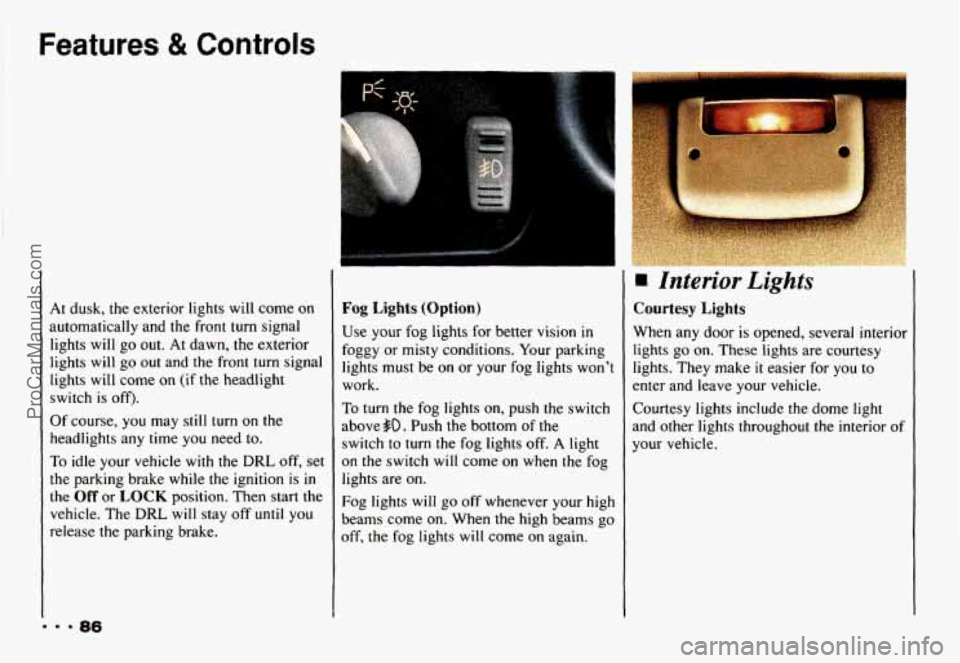
Fog Lights (Option)
Use your fog lights for better vision in
foggy or misty conditions. Your parking
lights must be on or your fog lights won't
work.
To turn the fog lights on, push the switch
abovego. Push the bottom of the
switch to
turn the fog lights off. A light
on the switch will come on when the fog
lights are on.
Fog lights will go off whenever your high
beams come on. When the high beams
go
off, the fog lights will come on again.
Interior Lights
Courtesy Lights
When any door is opened, several interior
lights
go on. These lights are courtesy
lights. They make
it easier for you to
mter and leave your vehicle.
Courtesy lights include the dome light
md other lights throughout the interior of
your vehicle.
ProCarManuals.com
Page 91 of 358
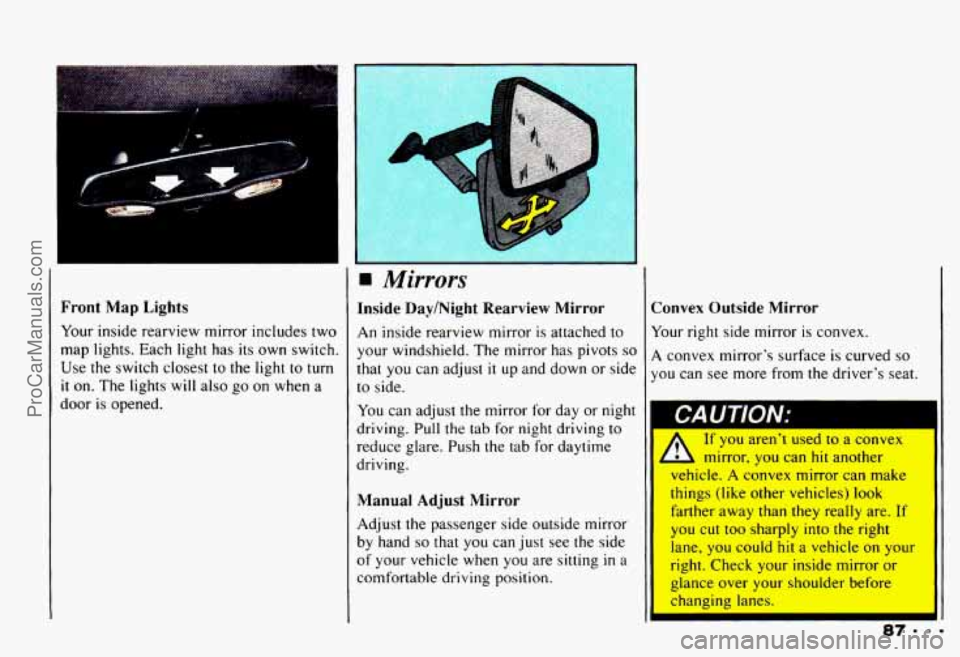
Front Map Lights
Your inside rearview mirror includes two
map lights. Each light has its own switch.
Use the switch closest to the light to
turn
it on. The lights will also go on when a
door is opened.
I
1
I'
. . . .. . .. . , . . .
Mirrors
Inside Day/Night Rearview Mirror
An inside rearview mirror is attached to
your windshield, The mirror has pivots
so
that you can adjust it up and down or side
to side.
You can adjust the mirror for day or night
driving. Pull the tab for
night driving to
reduce glare. Push the tab for daytime
driving.
Convex Outside Mirror
Your right side mirror is convex.
A convex mirror's surface is curvec so
you can see more from the driver's seat,
If you aren't used to a convex
L mirror, you can hit another
vehicle.
A convex mirror can make
things (like other vehicles) look
Manual Adjust Mirror
Adjust the passenger side outside mirror you cut too sharply into the right
by hand
so that you can just see the side lane, you could hit a vehicle on your
of your vehicle when you are sitting
in a right. Check your inside mirror or
comfortable driving position. glance over your shoulder before
farther
away than they really are.
If
changing lanes.
I
87.9-
ProCarManuals.com
Page 103 of 358

Trip Odometer
The trip odometer can tell you how far
your vehicle has been driven since you
last set the trip odometer to zero.
To set the trip odometer to zero, press the
knob.
Tachometer
The tachometer displays the engine speed
in thousands of revolutions per minute
(rpm).
NOTICE:
Do not operate the engine with th-
tachometer in the red :are:* nr en~~
damage may occur.
Warning Lights, Gages
and Zndicators
This section describes the warning lights
and gages that are
on your vehicle. The
pictures will help you locate them.
Warning lights and gages can signal that
something is wrong before
it becomes
serious enough
to cause an expensive
repair
or replacement. Paying attention to
your warning lights and gages could also
save you or others from injury.
Warning lights
go on when there may be
or is a problem with one
of your vehicle’s
functions.
As you will see in the details
on the next few pages, some warning
lights come on briefly when
you turn the
ignition key just to let you know they‘re working.
If you
are familiar with this
section,
you should not be alarmed when
this happens.
Gages can indicate when there may be or
is a problem with one of your vehicle’s
functions. Often gages and warning lights
work together to let
you know when
there’s a problem with your vehicle.
When one
of the warning lights comes on
and stays on when you are driving. or
when one
of the gages shows there may
be a problem, check the section that tells
you what
to do about it. Please follow the
manual’s advice. Waiting
to do repairs
can
be costly - and even dangerous. So
please get to know your warning lights
and gages. They‘re
a big help.
ProCarManuals.com
Page 138 of 358
Your Driving and the Road
KEEP LEFT OR RIGHT TURN
RIGHT THROUGH ONLY
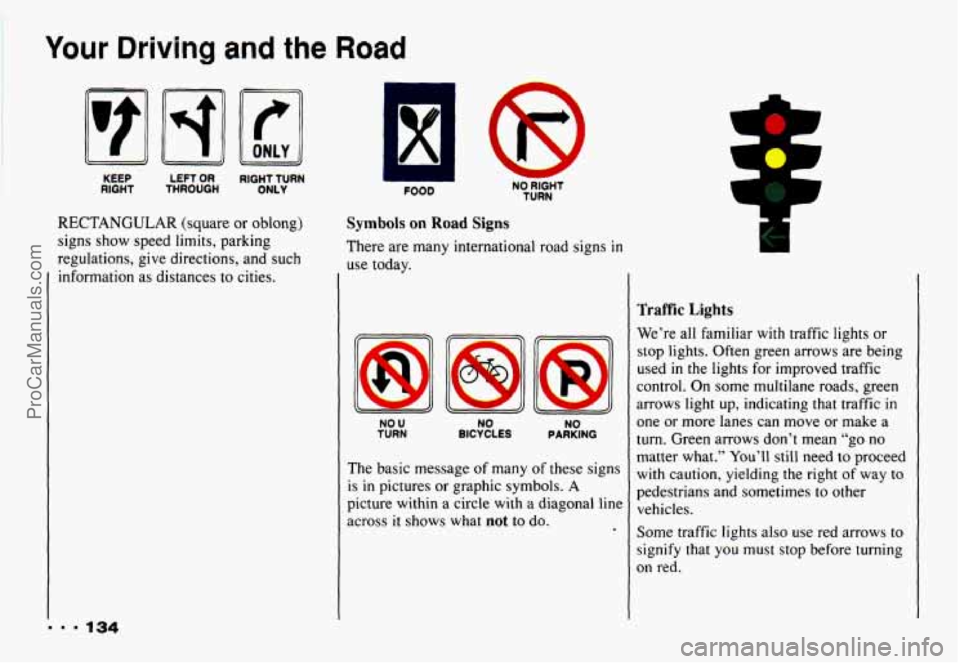
RECTANGULAR (square or oblong)
signs show speed limits, parking
regulations, give directions, and such
information as distances
to cities.
Symbols on Road Signs
There are many international road signs in
use today.
NO U TURN BICYCLES NO PARKING NO
The basic message
of many of these signs
is in pictures or graphic symbols.
A
picture within a circle with a diagonal line
across
it shows what not to do.
Traffic Lights
We’re all familiar with traffic lights or
stop lights. Often green arrows are being
used
in the lights for improved traffic
control. On some multilane roads, green
arrows light up, indicating that traffic
in
one or more lanes can move or make a
turn. Green arrows don’t mean “go no
matter what.’’
You’ll still need to proceed
with caution, yielding the right of way to
pedestrians and sometimes to other
vehicles.
Some traffic lights also use red arrows
to
signify that you must stop before turning
on red.
ProCarManuals.com
Page 140 of 358
Your Driving and the Road
136
Slowing down: If time allows, tap the
brake pedal once or twice
in advance of
slowing or stopping. This warns the driver
behind you.
Disabled: Your four-way flashers signal
that your vehicle
is disabled or is a
hazard. See “Hazard Warning Flashers”
in
the Index.
Traffic Officer
The traffic police officer is also a source
of important information. The officer’s
signals govern, no matter what the traffic
lights or other signs say.
The next section discusses some of the
road conditions you may encounter.
Defensive Driving
The best advice anyone can give about
driving
is: Drive defensively.
Please start
with a very important safety
device
in your Chevrolet: Buckle up. (See
“Safety Belts”
in the Index.)
Defensive driving really means “be ready for anything.“ On city streets,
rural roads,
or freeways, it means “always expect the
unexpected.”
Assume that pedestrians or other drivers
are going
to be careless and make
mistakes. Anticipate what they
might do.
Be ready for their mistakes.
Expect children
to dash out from behind
parked cars, often followed
by other
children. Expect occupants
in parked cars
to open doors into traffic. Watch for movement
in parked cars - someone
may be about
to open a door.
Expect other drivers
to run stop signs
when you are
on a through street. Be
ready
to brake if necessary as you go
:hrough intersections.
You may not have
:o use the brake, but if you do, you will be
-eady.
If you’re driving through a shopping
center parking
lot where there are
well-marked lanes, directional arrows,
and designated parking areas, expect
some drivers to ignore all these markings
and dash straight toward one part of the
lot.
ProCarManuals.com
Page 151 of 358
the tires against the road surface makes it
possible for the vehicle to change its path
when
you turn the front wheels. If there’s
no traction, inertia will keep the vehicle
going
in the same direction. If you’ve
ever tried to steer a vehicle on wet ice,
~ you’ll understand this.
The traction you can get
in a curve
depends on the condition of your tires and
the road surface, the angle at which the
curve is banked, and your speed. While
you’re
in a curve, speed is the one factor
you can control. Suppose you’re
steering through a sharp
curve. Then you suddenly accelerate.
Those two control systems
- steering
and acceleration
- can overwhelm those
places where the tires meet the road and
make you lose control.
What should you do
if this ever happens?
Let up on the accelerator pedal, steer the
vehicle the way you want
it to go, and
slow down.
Speed limit signs near curves warn
that
you should adjust your speed. Of course,
the posted speeds are based on good
weather and road conditions. Under less
favorable conditions you’ll want to
go
slower.
If you need to reduce your speed as you
approach
a curve, do it before you enter
the curve, while your front wheels are
straight ahead.
Try to adjust your speed so you can
“drive” through the curve. Maintain a
reasonable, steady speed. Wait to
accelerate
until you are out of the curve,
and then accelerate gently into the
straightaway.
When you drive into a curve at night, it’s
harder
to see the road ahead of you
because
it bends away from the straight
beams
of your lights. This is one good
reason to drive slower.
ProCarManuals.com
Page 155 of 358
If other cars are lined up to pass a
slow vehicle, wait your turn.
But take
care that someone isn’t
trying to pass
you as you pull out
to pass the slow
vehicle. Remember to glance over
your shoulder and check the blind
spot.
Check your mirrors, glance over your
shoulder, and start your left lane
change signal before moving out of
the right lane to pass. When you are
far enough ahead of the passed vehicle
to see its front in your inside mirror,
activate your right lane change signal
and move back into the right lane. (Remember
that your right outside
mirror is convex. The vehicle you
just
passed may seem to be farther away
from you than
it really is.)
Try not to pass more than one vehicle
at a time on two-lane roads.
Reconsider before passing the next
vehicle.
Don’t overtake a slowly moving
vehicle too rapidly. Even though the
brake lights are not flashing,
it may be
slowing down or starting to turn.
If you’re being passed, make
it easy
for the following driver
to get ahead
of you. Perhaps you can ease a little
to
the right.
Loss of Control
Let’s review what driving experts say
about what happens when the three
control systems (brakes, steering and
acceleration) don’t have enough friction
where the tires meet the road
to do what
the driver has asked.
In any emergency, don’t give up. Keep
trying to steer and constantly seek an
escape route or area of less danger.
Skidding
In a skid, a driver can lose control of the
vehicle. Defensive drivers avoid most
skids by taking reasonable care suited
to
existing conditions, and by not
“overdriving” those conditions.
But skids
are always possible.
ProCarManuals.com