Page 177 of 358
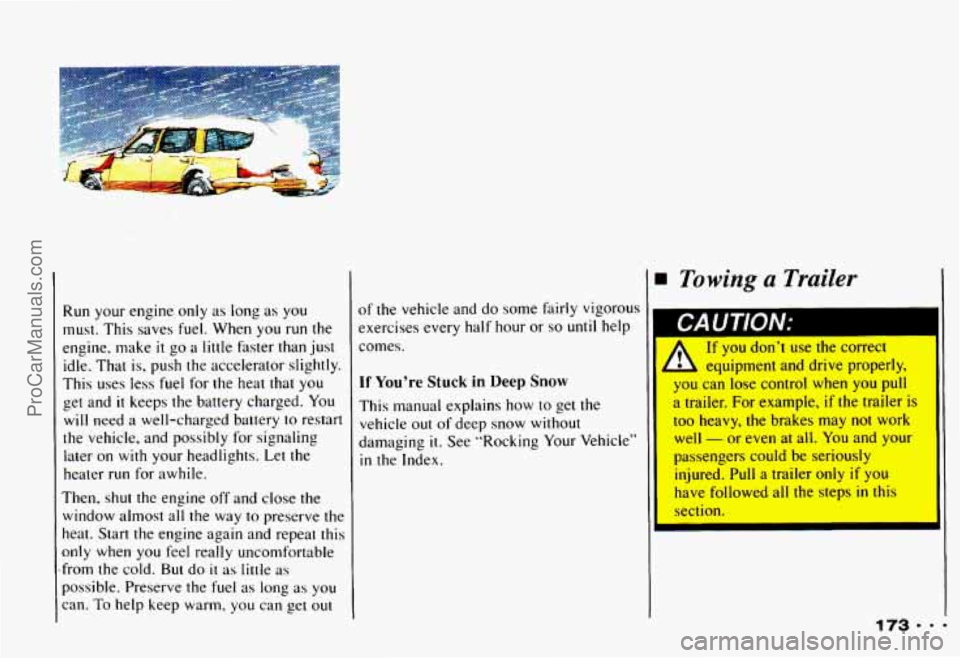
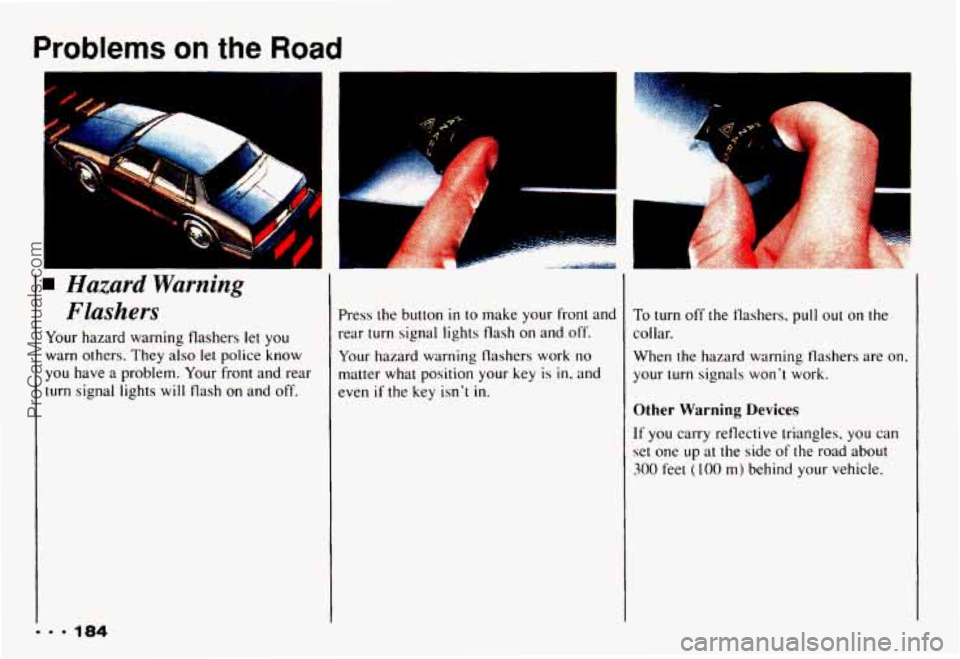
Run your engine only as long as you
must. This saves fuel. When you
run the
engine, make
it go a little faster than just
idle. That is, push the accelerator slightly.
This uses less fuel for the heat that you
get and
it keeps the battery charged. You
will need a well-charged battery to restart
the vehicle, and possibly for signaling
later on
with your headlights. Let the
heater
run for awhile.
Then. shut the engine off and close the
window almost all the way to preserve the
heat. Start the engine again and repeat this
only when you feel really uncomfortable
from the cold.
But do it as little as
possible. Preserve the fuel as long as you
can.
To help keep warm. you can get out
3f the vehicle and do some fairly vigorous
zxercises every half hour or
so until help
Zomes.
If You're Stuck in Deep Snow
This manual explains how to get the
vehicle
out of deep snow without
damaging it. See "Rocking Your Vehicle"
in the Index.
Towing a Trailer
you can lose control when you pull
a trailer. For example, if the trailer is
too heavy, the brakes may not work
well - or even at all. You and your
passengers could be seriously
injured. Pull a trailer only if you
have followed all the steps in this
section.
ProCarManuals.com
Page 182 of 358
Your Driving and the Road
178
weight of the trailer. And always keep in
mind that the vehicle you are driving is
now a good deal longer and not nearly so
responsive as your vehicle is by itself,
Before you start, check the trailer hitch
and platform, safety chains, electrical
connector, lights, tires and mirror
adjustment. If the trailer has electric
brakes, start your vehicle and trailer
moving and then apply the trailer brake
controller by hand
to be sure the brakes
are working. This lets you check your
electrical connection
at the same time.
During your trip, check occasionally to be
sure that the load is secure, and that the
lights and any trailer brakes are still
working.
Following Distance
Stay at least twice as far behind the
vehicle ahead as you would when driving
your vehicle without a trailer. This can
help you avoid situations that require
heavy braking and sudden turns.
Passing
You’ll need more passing distance up
ahead when you’re towing a trailer. And,
because you’re a good deal longer, you’ll
need to go much farther beyond the
passed vehicle before you can return
to
your lane.
Backing Up
Hold the bottom of the steering wheel
with one hand. Then, to move the trailer
to the left, just move that hand
to the left.
To move the trailer to the right, move
your hand
to the right. Always back up
slowly and,
if possible, have someone
guide you.
Making Turns
When you’re turning with a trailer, make
wider turns than normal.
Do this so your
trailer won’t strike
soft shoulders, curbs,
road signs, trees, or other objects. Avoid
jerky or sudden maneuvers. Signal well
in
advance.
ProCarManuals.com
Page 183 of 358

Turn Signals When Towing a Trailer
When you tow a trailer, your vehicle has to
have a different turn signal flasher and
extra wiring. The green arrows on your
instrument panel will flash whenever you
signal a turn or lane change. Properly
hooked up, the trailer lights will also flash,
telling other drivers you’re about to
turn,
change lanes or stop.
When towing a trailer, the green arrows on
your instrument panel will flash for turns
even if the bulbs on the trailer are burned
out. Thus,
you may think drivers behind
you are seeing your signal when they are
not. It’s important to check occasionally to
be sure the trailer bulbs are still working.
Driving on Grades
Reduce speed and shift to a lower gear
before you start down a long or steep
downgrade. If
you don’t shift down, you
might have to use your brakes
so much
that they would get hot and no longer work well.
On a long uphill grade, shift down and
reduce your speed to around
45 mph
(70 km/h) to reduce the possibility of
engine and transmission overheating. If you
are towing a trailer and you
have an automatic transmission with
Overdrive, you may prefer to drive
in D
instead of Overdrive (or, as you need to,
a lower gear). Or, if you have a manual
transmission
with fifth (or sixth) gear
and you are towing a trailer, it’s better
not to use
fifth (or sixth) gear. Just drive
in fourth gear (fifth gear
if you have
a six-speed manual transmission)
(or, as you need to, a lower gear.
ProCarManuals.com
Page 188 of 358
Problems on the Road
1
A
... 184
Hazard Warning
Flashers
Your hazard warning flashers let you
warn others. They also let police know
you have a problem. Your front and rear
turn signal lights
will flash on and off.
Press the button in to make your fronl and
rear
turn signal lights flash on and off.
Your hazard warning flashers work no
matter what position your key
is in, and
even
if the key isn‘t in.
To turn off the flashers. pull out on the
collar.
When the hazard warning tlashers are on,
your turn signals won’t work.
Other Warning Devices
If you carry retlective triangles, you can
set one
up at the side of the road about
300 feet (100 m> behind your vehicle.
ProCarManuals.com
Page 190 of 358
Problems an the Road
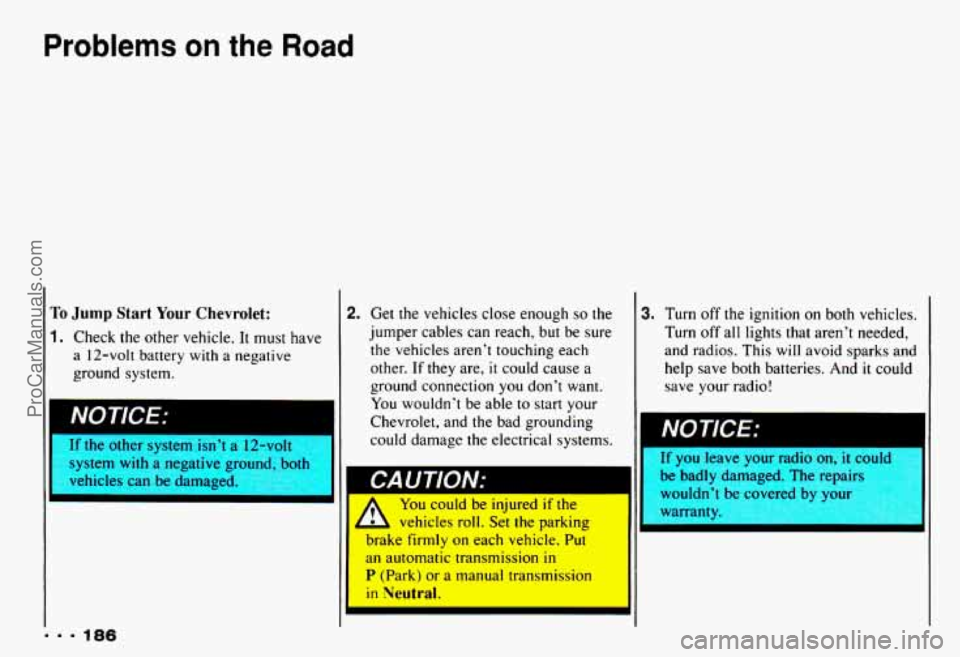
To Jump Start Your Chevrolet:
1. Check the other vehicle. It must have
a 12-volt battery
with a negative
ground system.
11 NOTICE:
... 186
2.
lr tne otner system Isn’t a lz-vo~t
--/stem
with a negative ground, botn
Yzhicles can be damaged.
r
Get the vehicles close enough so the
jumper cables can reach,
but be sure
the vehicles aren’t touching each
other.
If they are, it could cause a
ground connection you don’t want.
You wouldn’t be able to start your
Chevrolet, and the bad grounding
could damage the electrical systems.
I
’WTION: II ~____
rou cows De rnJurea if the
4 vehicles roll. Set the parking
,,ake firmly on each vehicle. Put
an automatic transmission
in
P (Park) or a manual transmission
in Neutral.
‘I
3. Turn off the ignition on both vehicles,
Turn
off all lights that aren’t needed,
and radios. This
will avoid sparks and
help save both batteries.
And it could
save your radio!
be badly damaged. The repairs
wouldn’t be covered
1 your
NOTICE:
warrar
I
ProCarManuals.com
Page 242 of 358
Service & Appearance Care
What to Use:
Standard and Limited-Slip Differential
Use Axle Lubricant (GM Part No.
1052271) or SAE 8OW-90 GL-5 gear
lubricant.
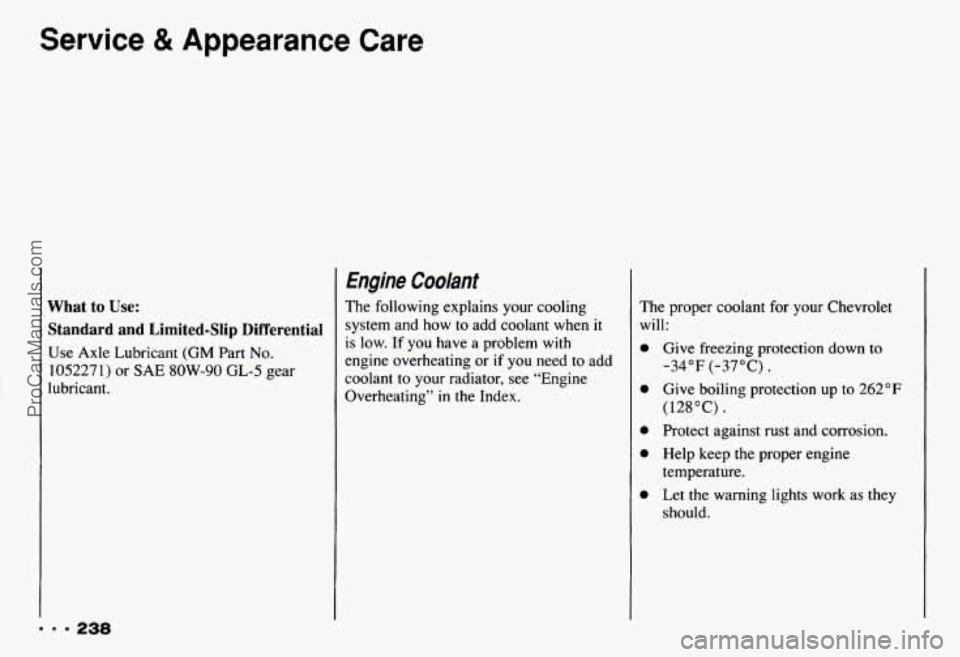
Engine Coolant
The following explains your cooling
system and how
to add coolant when it
is low. If
you have a problem with
engine overheating or if you need to add
coolant to your radiator, see “Engine
Overheating”
in the Index.
I
The proper coolant for your Chevrolet
will:
0
0
0
0
0
Give freezing protection down to
-34°F (-37°C).
Give boiling protection up to 262°F
(128°C).
Protect against rust and corrosion.
Help keep the proper engine
temperature.
Let
the warning lights work as they
should.
ProCarManuals.com
Page 252 of 358
Service & Appearance Care
Headlights
Headlight Aiming
Your vehicle has a mini-quad headlight
system. These headlights have vertical
and horizontal indicators. When the
headlights are properly installed and
adjusted, and the vehicle is on level
ground, both indicators will read in the
center of the gage. If they do not, you can
adjust the aim.
A
To adjust the aim of your headlights:
1. Move your vehicle to a level surface.
Use a spirit level to be sure. Be sure
to remove any items that are not part
of your original equipment from the
trunk and passenger areas.
No one
should be seated in the vehicle and
your fuel tank should be about half
full. Check to be sure your tires are
at the correct pressure. There
are four headlights. Each one
has its own vertical and horizontal
aim position indicator. Each indicator
has its own aiming screw.
A. Vertical Indicator
B. Horizontal Indicator
C. Vertical Aiming Screw
D. Horizontal Aiming Screw
ProCarManuals.com
Page 255 of 358
I
r 1
3.
4.
5.
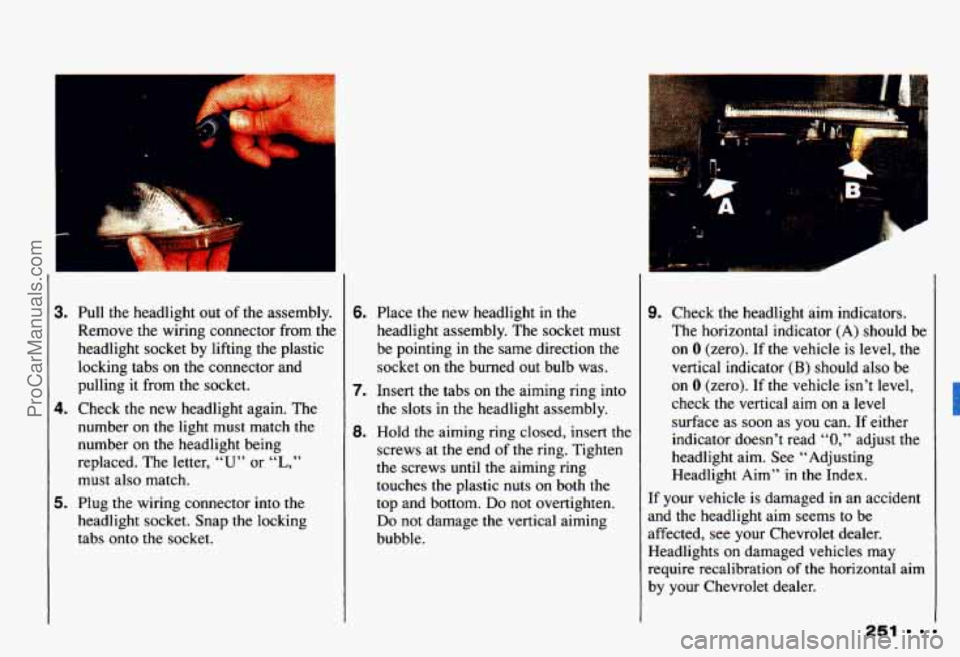
Pull the headlight out of the assembly.
Remove
the wiring connector from the
headlight socket by lifting the plastic
locking tabs on the connector and
pulling it from the socket.
Check
the new headlight again. The
number on
the light must match the
number on
the headlight being
replaced. The letter,
“U” or “L,”
must also match.
Plug the wiring connector into the
headlight socket. Snap the locking
tabs onto the socket.
6.
7.
8.
Place the new headlight in the
headlight assembly. The socket must
be pointing
in the same direction the
socket on the burned out bulb was.
Insert the tabs on the aiming ring into
the slots in the headlight assembly.
Hold the aiming ring closed, insert the
screws at the end of the ring. Tighten
the screws
until the aiming ring
touches the plastic nuts on both the
top and bottom.
Do not overtighten.
Do not damage the vertical aiming
bubble.
. ..
9. Check the headlight aim indicators.
The horizontal indicator (A) should be
on
0 (zero). If the vehicle is level, the
vertical indicator
(B) should also be
on 0 (zero). If the vehicle isn’t level,
check the vertical aim on a level
surface as soon as you can. If either
indicator doesn’t read
“0,” adjust the
headlight aim. See “Adjusting
Headlight Aim”
in the Index.
If your vehicle
is damaged in an accident
and the headlight aim seems to be
affected, see your Chevrolet dealer.
Headlights on damaged vehicles may
require recalibration
of the horizontal aim
by your Chevrolet dealer.
251
ProCarManuals.com