1993 CHEVROLET CAMARO check engine
[x] Cancel search: check enginePage 167 of 358

Driving a Long
Distance
Although most long trips today are made
on freeways, there are
still many made on
regular highways.
Long-distance driving on freeways and
regular highways
is the same in some
ways. The
trip has to be planned and the
vehicle prepared, you drive at
higher-than-city speeds, and there are
longer turns behind the wheel. You’ll
enjoy your trip more
if you and your
vehicle are
in good shape. Here are some
:ips for a successful long trip.
Before Leaving on a Long Trip
Make sure you’re ready. Try to be well
rested. If you must start when you’re not
fresh
- such as after a day’s work -
don’t plan to make too many miles that
first part of the journey. Wear comfortable
clothing and shoes you can easily drive
in.
Is your vehicle ready for a long trip? If
you keep
it serviced and maintained, it’s
ready to go. If
it needs service, have it
done before starting out. Of course, you’ll
find experienced and able service experts
in Chevrolet dealerships all across North
America. They’ll be ready and willing to
help
if you need it. Here
are some things you can check
before a trip:
0
0
0
0
0
Windshield Washer Fluid: Is the
reservoir
full? Are all windows clean
inside and outside?
Wiper Blades: Are they in good
shape?
Fuel, Engine Oil, Other Fluids:
Have you checked all levels?
Lights: Are they all working? Are the
lenses clean?
Tires: They are vitally important to a
safe, trouble-free trip.
Is the tread
good enough for long-distance
driving? Are the tires all inflated to
the recommended pressure?
163 -
ProCarManuals.com
Page 176 of 358
Your Driving and the Road
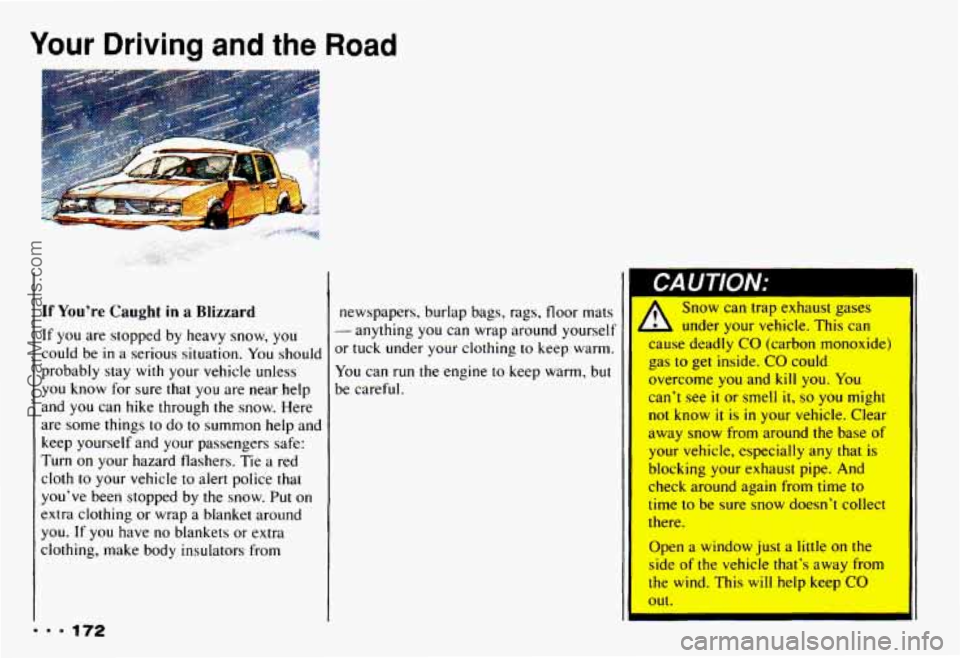
If You’re Caught in a Blizzard
If you are stopped by heavy snow, you
could be
in a serious situation. You should
probably stay
with your vehicle unless
you know for sure that you are near
help
and you can hike through the snow. Here
are some things to
do to summon help and
keep yourself and your passengers safe:
Turn on your hazard flashers. Tie a red
cloth to your vehicle
to alert police that
you’ve been stopped
by the snow. Put on
extra clothing or wrap a blanket around
you.
If you have no blankets or extra
clothing, make body insulators from newspapers, burlap bags, rags, floor mats
- anything
you can wrap around yourself
or tuck under your clothing to keep warm.
You can run the engine to keep warm, but
be careful. Snow can trap exhaust gases
L under your vehicle.
This can
cause deadly
CO (carbon monoxide)
gas to get inside. CO could
overcome you and
kill you. You
can’t see it or smell it, so you might
not know
it is in your vehicle. Clear
away snow from around the base of
your vehicle, especially any that is
blocking your exhaust pipe.
And
check around again from time to
time
to be sure snow doesn’t collect
there.
Open a window just a little on the
side
of the vehicle that’s away from
the wind. This
will help keep CO
out. I
m.. 172
ProCarManuals.com
Page 183 of 358

Turn Signals When Towing a Trailer
When you tow a trailer, your vehicle has to
have a different turn signal flasher and
extra wiring. The green arrows on your
instrument panel will flash whenever you
signal a turn or lane change. Properly
hooked up, the trailer lights will also flash,
telling other drivers you’re about to
turn,
change lanes or stop.
When towing a trailer, the green arrows on
your instrument panel will flash for turns
even if the bulbs on the trailer are burned
out. Thus,
you may think drivers behind
you are seeing your signal when they are
not. It’s important to check occasionally to
be sure the trailer bulbs are still working.
Driving on Grades
Reduce speed and shift to a lower gear
before you start down a long or steep
downgrade. If
you don’t shift down, you
might have to use your brakes
so much
that they would get hot and no longer work well.
On a long uphill grade, shift down and
reduce your speed to around
45 mph
(70 km/h) to reduce the possibility of
engine and transmission overheating. If you
are towing a trailer and you
have an automatic transmission with
Overdrive, you may prefer to drive
in D
instead of Overdrive (or, as you need to,
a lower gear). Or, if you have a manual
transmission
with fifth (or sixth) gear
and you are towing a trailer, it’s better
not to use
fifth (or sixth) gear. Just drive
in fourth gear (fifth gear
if you have
a six-speed manual transmission)
(or, as you need to, a lower gear.
ProCarManuals.com
Page 185 of 358

Maintenance When Trailer Towing
Your vehicle will need service more often
when you're pulling a trailer. See the
Maintenance Schedule for more on this.
Things that are especially important
in
trailer operation are automatic
transmission
fluid (don't overfill), engine
oil, axle lubricant. belts. cooling system,
and brake adjustment. Each of these is
covered
in this manual, and the Index will
help you find them quickly. If you're
trailering, it's
a good idea to review these
sections before
you start your trip.
Check periodically to see that all hitch
nuts
and bolts are tight.
ProCarManuals.com
Page 191 of 358

, Open the hoods and locate the
batteries.
CAUTION:
A
An electric fan can start up
even when the engine
is not
running and can injure you. Keep
hands, clothing and tools away from
any underhood electric fan.
Find the positive
(+) and negative (-)
terminals on each battery.
A
Using a match near a battery
can cause battery gas to
explode. People have been hurt
doing
this, and some have been
blinded.
Use a flashlight if you need
more light.
Be sure the battery has enough
water,
You don’t need to add water
to the Delco Freedom@ battery
installed
in every new GM vehicle.
But if a battery has filler caps, be
sure the right amount of fluid is
there. If it is low, add water to take
care
of that first. If you don’t,
explosive
gas could be present.
Battery fluid contains acid that can
burn you. Don’t get it on you. If
you accidentally get it in your eyes
or
on your skin, flush the place
with water and get medical help
immediately. Check that the
jumper cables don’t
have
loose or missing insulation. If
they do, you could get a shock. The
vehicles could
be damaged, too.
Before you connect the cables, here
are some basic things you should
know. Positive
(+) will go to positive
(+) and negative (-) will go to
negative
(-) or a metal engine part.
Don’t connect
(+) to (-) or you’ll get a
short that would damage the battery
and maybe other parts, too.
18799.
ProCarManuals.com
Page 201 of 358
eng~ witho
r
u -.. .
tolar .-
[f there seems to be no leak, check to see
f the electric engine fan is running. If the
:ngine is overheating, the fan should be
-unning.
If it isn’t, your vehicle needs
iervice.
I I
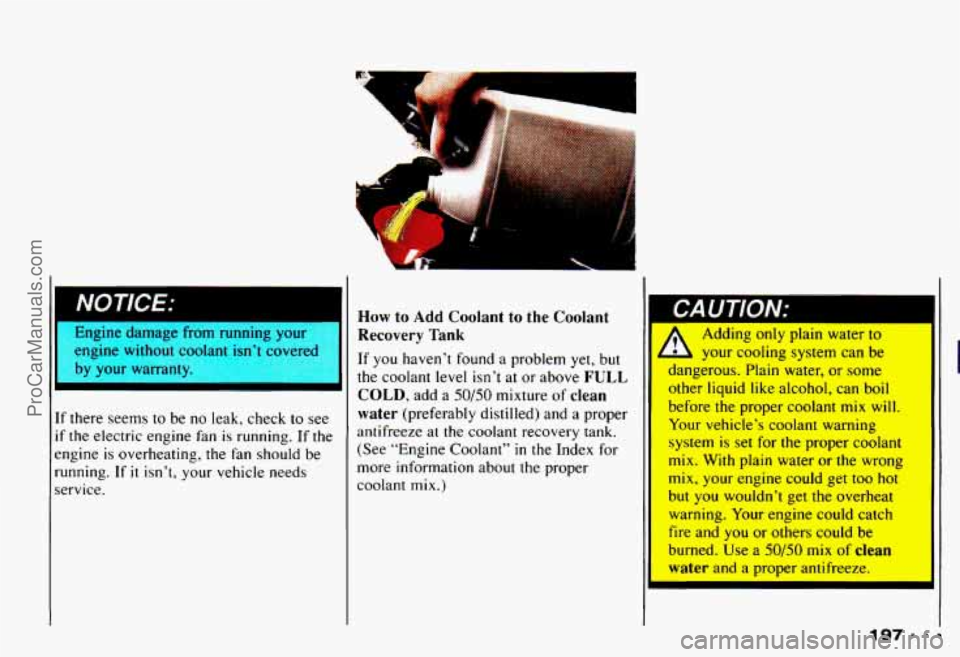
How to Add Coolant to the Coolant
Recovery Tank
If you haven’t found a problem yet, but
the coolant level isn’t
at or above FULL
COLD,
add a 50/50 mixture of clean
water
(preferably distilled) and a proper
antifreeze at the coolant recovery tank.
(See “Engine Coolant”
in the Index for
more information about the proper
coolant
mix.)
A Adding only plain water to
L your cooling system can be
dangerous. Plain water, or some
I
other liquid like alcohol, can boil
before the proper coolant
mix will.
Your vehicle’s coolant warning
system
is set for the proper coolant
mix. With plain water or the wrong
mix, your engine could get too hot
but you wouldn’t get the overheat
warning. Your engine could catch
fire and you or others could
be
burned. Use a 50/50 mix of clean
water
and a proper antifreeze.
197-
ProCarManuals.com
Page 221 of 358

Part b
Here you will find information
about the care
of your Chevrolet .
This part begins with service and
fuel information. and then it shows
how
to check important fluid and
lubricant levels
. There is also
technical information about your
vehicle. and a section devoted to
its appearance care
.
Service & Appearance Care
Service .......................................................... 218
Fuel
............................................................ 219
Checking Things under the Hood
..................................... 223
HoodRelease
................................................... 223
Engineoil
...................................................... 226
Aircleaner
..................................................... 230
Automatic Transmission Fluid
...................................... 233
Manual Transmission Fluid
........................................ 235
Hydraulicclutch
................................................ 237
RearAxle
...................................................... 237
Enginecoolant
.................................................. 238
Power Steering Fluid
............................................. 242
Windshield Washer Fluid
.......................................... 243
Brake Master Cylinder
............................................ 244
Battery
........................................................ 246
Bulb Replacement
................................................. 247
Loading Your Vehicle
.............................................. 255
Appearance Care and Maintenance Materials
............................ 274
Vehicle Identification Number (VIN)
.................................. 275
Service Parts Identification Label
..................................... 275
Add-on Electrical Equipment
........................................ 275
Fuses and Circuit Breakers
.......................................... 276
Replacement Bulbs
................................................ 279
Capacities and Specifications
......................................... 280
Tires
............................................................ 256
Appearancecare
.................................................. 265
217
ProCarManuals.com
Page 226 of 358
Service & Appearance Care
Fuels in Foreign Countries
If you plan on driving in another country
outside the
U.S. or Canada, unleaded fuel
may be hard to find.
Do not use leaded
gasoline.
If you use even one tankful,
your emission controls won’t work well or at all. With continuous use, spark plugs
can get fouled, the exhaust system can
corrode, and your engine oil can
deteriorate quickly.
Your vehicle’s oxygen
sensor will be damaged.
All of that means
costly repairs that wouldn’t be covered by
your warranty.
c L. 222
To check on fuel availability, ask an auto
club,
or contact a major oil company that
does business in the country where you’ll
be driving.
You can also write us at the following
address for advice. Just tell us where
you’re going and give your Vehicle
Identification Number (VIN).
General Motors of Canada Ltd.
International Export Sales
P.O. Box 828
Oshawa, Ontario L1H 7N1
Canada
I
Filling Your Tank
Gasoline vapor is highly
flammable. It burns violently,
and that can cause very bad injuries. Don’t smoke if you’re near gasoline
or refueling your vehicle. Keep
, sparks, flames, and smoking
C
materials away from gasoline.
‘I
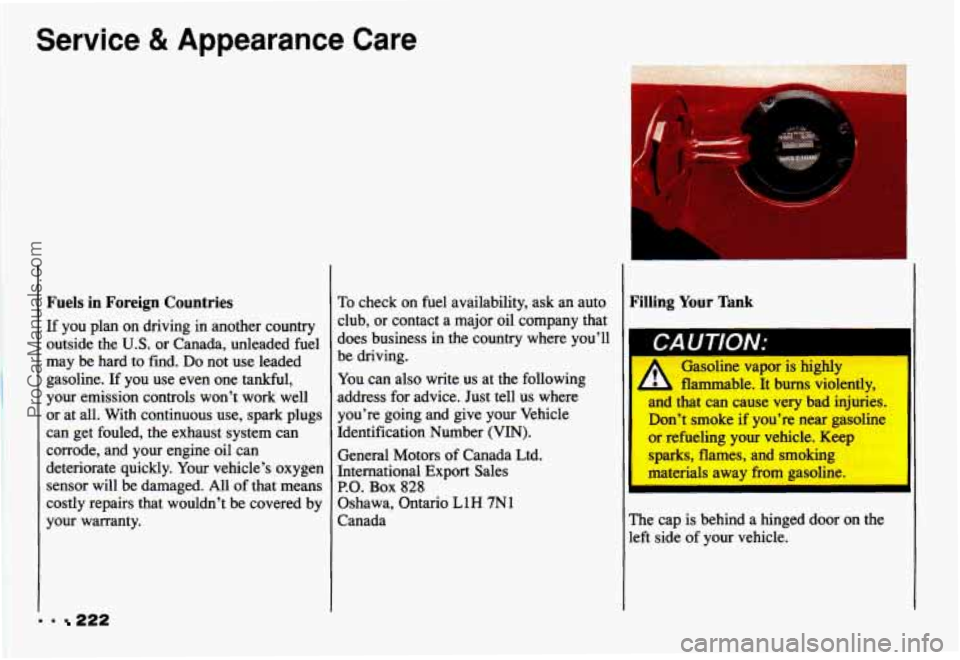
The cap is behind a hinged door on the
left side of your vehicle.
ProCarManuals.com