1993 CADILLAC SEVILLE traction control
[x] Cancel search: traction controlPage 10 of 407
Downloaded from www.Manualslib.com manuals search engine This rich tradition continues
into the '90s as Cadillac became the
first automobile manufacturer
to be
awarded the prestigious Malcolm
Baldrige National
Quality Award.
The 1992 Seville STS is the first
car ever to win all three major auto-
motive awards: Car
of the Year,
Motor Trend; Ten Best List, Car
&
Driver; Car of the Year, Automobile
Magazine.
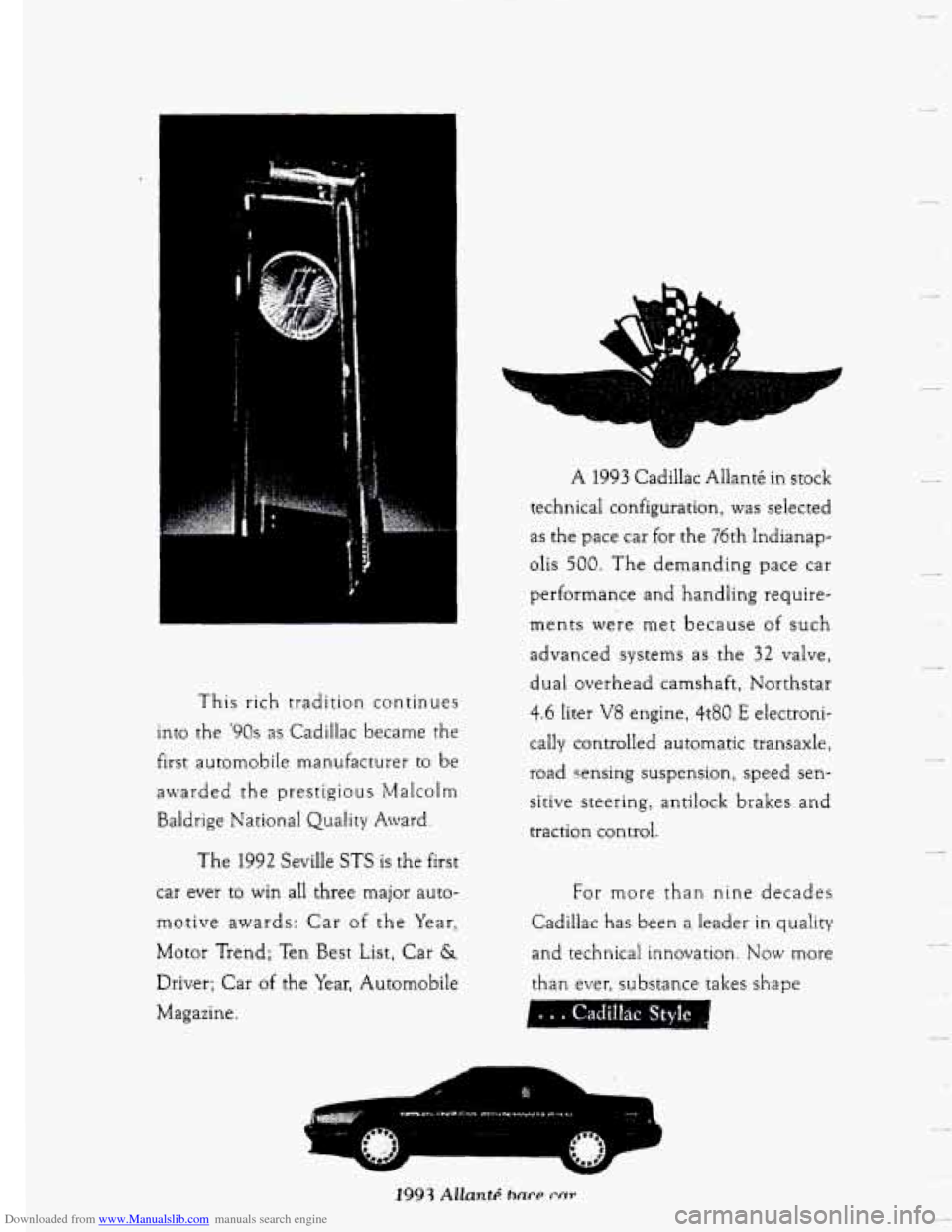
A 1993 Cadillac Allant6 in stock
technical configuration, was selected
as the pace car for the 76th Indianap-
olis
500. The demanding pace car
performance and handling require-
ments were met because
of such
advanced systems as the
32 valve,
dual overhead camshaft, Northstar
4.6 liter V8 engine, 4t80 E electroni-
cally controlled automatic transaxle,
road sensing suspension, speed sen-
sitive steering, antilock brakes and
traction control.
For more
than nine decades
Cadillac has been a leader in quality
and technical innovation.
Now more
than ever, substance takes shape
Page 119 of 407
Downloaded from www.Manualslib.com manuals search engine c
-
A CAUTION
Cruise Control can be dangerous where you can't drive safely
at a steady speed. So, donV use your Cruise Controt on
winding roads or in heavy traRic.
Cruise Control an be dangerous on slippery roads, On such
roads, fast changes in tire traction can muse needless wheel
spinning, and you could lose control. Don't use Cruise
Control on slippery roads.
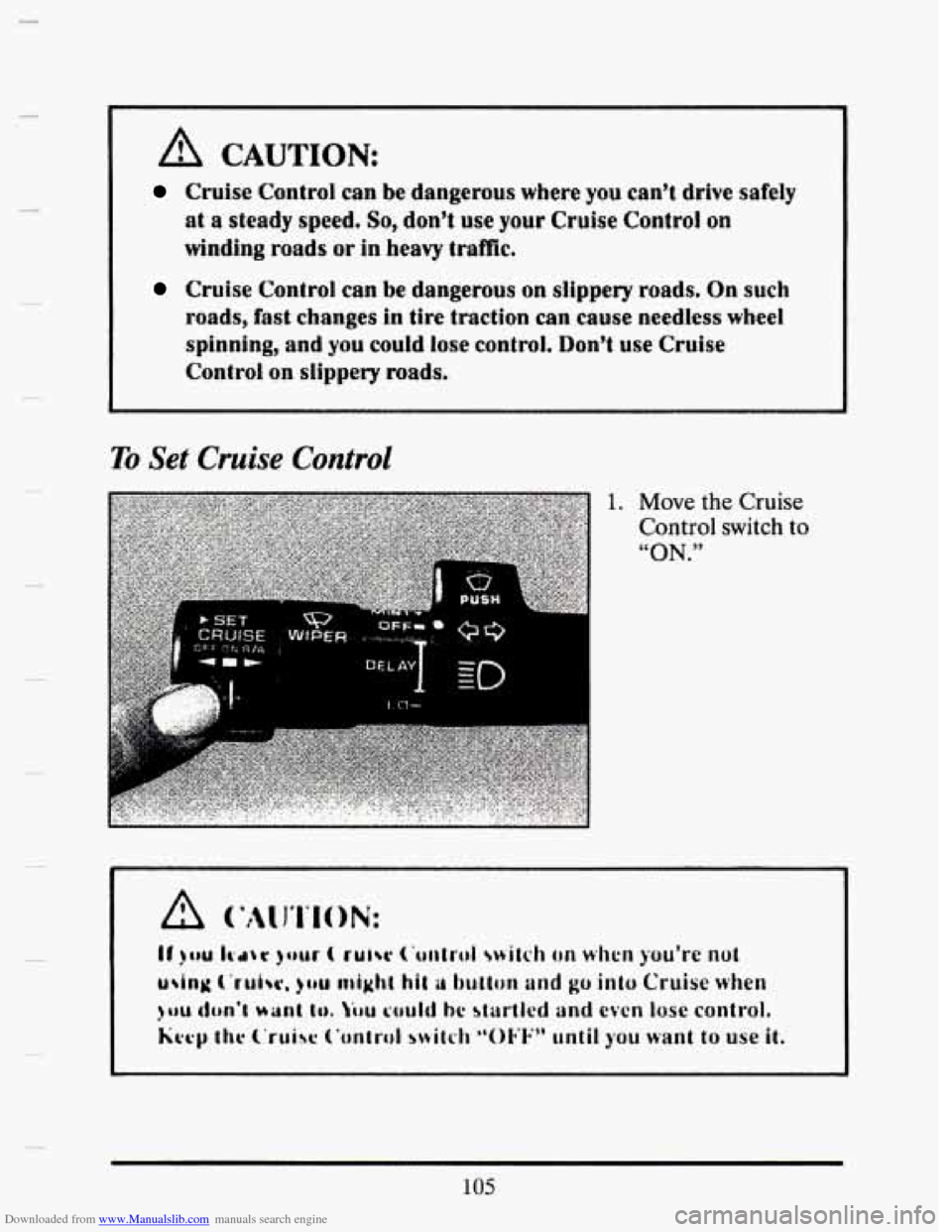
To Set Cruise Control
1. Move the Cruise
Control switch to
" ON. "
105
Page 137 of 407
Downloaded from www.Manualslib.com manuals search engine GARAGE DOOR OPENER (OPTION)
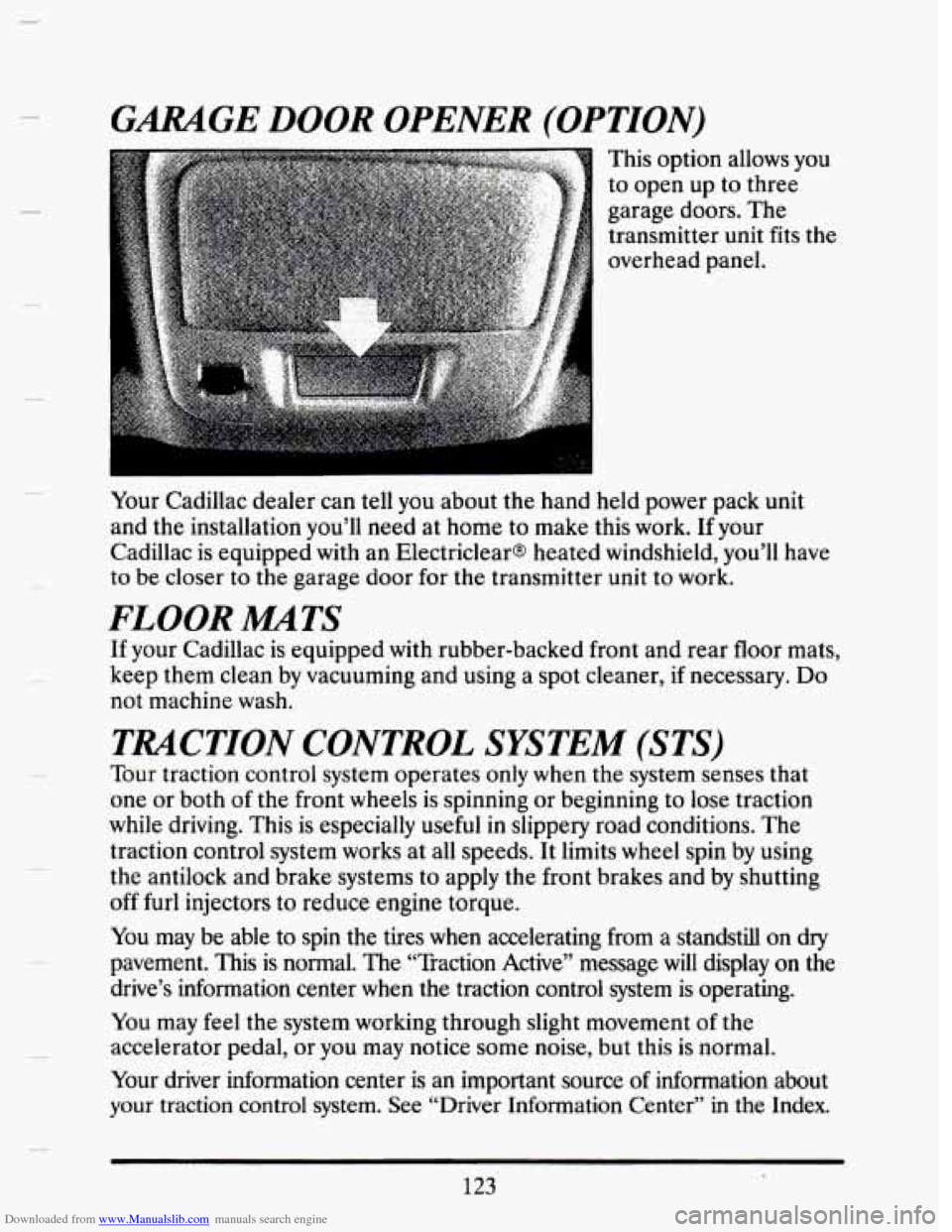
This option allows you
to open up to three
garage doors. The
transmitter unit fits the
overhead panel.
Your Cadillac dealer can tell you about the hand held power pack unit
and the installation you’ll need at home to make this work. If your
Cadillac is equipped with an Electriclears heated windshield,
you’ll have
to be closer to the garage door for the transmitter unit to work.
FLOOR MATS
If your Cadillac is equipped with rubber-backed front and rear floor mats,
keep them clean by vacuuming and using a spot cleaner,
if necessary. Do
not machine wash.
TRACTION CONTROL SYSTEM (STS)
Tour traction control system operates only when the system senses that
one or both
of the front wheels is spinning or beginning to lose traction
while driving. This is especially useful
in slippery road conditions. The
traction control system works at all speeds. It limits wheel spin
by using
the antilock and brake systems
to apply the front brakes and by shutting
off furl injectors to reduce engine torque.
You may be able to spin the tires when accelerating from a standstill on
dry
pavement. This is normal. The “Traction Active” message will display on the
drive’s information center when the traction control system is operating.
You may feel the system working through slight movement
of the
accelerator pedal, or you may notice some noise, but this is normal.
Your driver information center is an important source
of information about
your traction control system. See “Driver Information Center” in the Index.
123
Page 155 of 407
Downloaded from www.Manualslib.com manuals search engine SERVICE RIDE CONTROL
This message is displayed to indicate that the Suspension System is not
operating properly.
To correct this problem have your vehicle serviced at
your Cadillac dealership at your earliest convenience.
STOP ENGINE ENGINE OVERHEATING
This message will appear when your engine has overheated. Stop and
turn your engine
off immediately to avoid severe engine damage. See
“Engine Overheating”
in the Index.
SERVICE VEHICLE SOON
This message will appear if there is a problem with your Emission
Control System.
If the “SERVICE ENGINE SOON” light on the
instrument panel and this message appear and then turns off, it is an
indication that a temporary problem has cleared itself. Have your vehicle
checked at your earliest convenience.
STOP ENGINE LOW OIL PRESSURE
If this message appears while the engine is running, stop the engine and
do not operate it until the cause
of low oil pressure is corrected. Severe
damage to the engine can result.
SERVICE SUPPLEMENTAL INFLATABLE RESTRAINT
If this message appears, there is a problem with your Supplemental
Inflatable Restraint (Air Bag) system. Let only a qualified technician
work on your vehicle.
See your Cadillac dealer for service at once.
THEFT SYSTEM PROBLEWCAR MAY NOT RESTART
This message means there is atroblem in the Personalized Automotive
Security System (PASS
Key I1 ). PASS Key I1 TM will prevent the vehicle
from restarting
if it is turned off, so you should take the vehicle to a
proper service center before turning the engine off. Never leave
an
unattended vehicle with the engine running. Once you are where you can
get service, turn
the engine off and then try to restart it. If the vehicle
does not restart, the PASS
Key I1 TM system will need servicing.
TRACTION ACTIVE
If your vehicle is equipped with Traction Control, this message will be
displayed
if Traction Control is being used to reduce wheel slippage.
141
Page 156 of 407
Downloaded from www.Manualslib.com manuals search engine TRACTION DISABLED
If your vehicle is equipped with Traction Control, this message will be
displayed if a problem is noted in the Traction Control System. Have your
vehicle serviced as soon as possible.
TRANS FLUID RESET (Northstar Only)
With the engine not running and the ignition ON, press and hold the
OFF and REAR DEFOG buttons until the TRANS FLUID RESET
message appears in the Information Center (between S and 20 seconds).
This message is a reminder, after driving about a mile that you have your
turn signal on.
TRUNK OPEN
This message indicates that your trunk is open when the Ignition is ON.
VERY LOW REFRIGERANT
This message means that the Air Conditioning system detects a
refrigerant level that is low enough to cause damage to the
NC
compressor. To avoid damage, the A/C compressor automatically turns
off and the Electronic Climate Control will automatically switch from
“AUTO” to
“ECON” and remain there. Have vour A/C system serviced if
this message appears.
Speed Sensitive Steering (SSS)
This system varies the amount of steering effort proportionate to your
vehicle speed. Steering is easier at a lower speed for increased
maneuverability and parking ease.
As your vehicle speed increases, the
steering effort is also increased proportionately. At highway speeds the
amount of steering effort is greatly increased to provide
a manual like
steering feel for maximum control and enhanced vehicle stability\
.
142
Li
Page 199 of 407
Downloaded from www.Manualslib.com manuals search engine A lot of the “driver lost control” accidents mentioned on the news
happen on curves. Here’s
why:
Experienced driver or beginner, each of us is subject to the same laws of
physics when driving on curves. The traction of the tires against the road
surface makes it possible for the vehicle to change its path
when you turn
the front wheels.
If there’s no traction, inertia will keep the vehicle going
in the same direction. If you’ve ever tried to steer a vehicle on wet ice,
you’ll understand this.
The traction
you can get in a curve depends on the condition of your tires
and the road surface, the angle at which the curve is banked, and your
speed. While you’re in a curve, speed is the one factor you can control.
Suppose you’re steering through a sharp curve. Then you suddenly
accelerate.
Those
two control systems -- steering and acceleration -- can overwhelm
those places where the tires meet the road and make you lose control.
What should you do
if this ever happens? Let up on the accelerator
pedal, steer the vehicle the
way you want it to go, and slow down.
Speed
limit signs near curves warn that you should adjust your speed. Of
course, the posted speeds are based on good weather and road
conditions. Under less favorable conditions you’ll want to
go slower.
If you need to reduce your speed as you approach a curve, do it before
you enter the curve, while your front wheels are straight ahead.
Try to adjust your speed so you can “drive” through the curve. Maintain a
reasonable, steady speed. Wait to accelerate
until you are out of the
curve, and then accelerate gently into the straightaway.
When you drive into a curve at night, it’s harder to see the road ahead of
you because
it bends away from the straight beams of your lights. This is
one good reason to drive slower.
Steering in Emergencies
There are times when steering can be more effective than braking. For
example, you come over a
hill and find a truck stopped in your lane, or a
car suddenly pulls out from nowhere,
or a child darts out from between
parked cars and stops right
in front of you. You can avoid these problems
185
Page 204 of 407
Downloaded from www.Manualslib.com manuals search engine
Of course, traction is reduced when water, snow, ice, gravel, or other
material
is on the road. For safety, you’ll want to slow down and adjust
your driving to these conditions. It is important to slow down on slippery
surfaces because stopping distance
will be longer and vehicle control
more limited.
While driving on
a surface with reduced traction, try your best to avoid
sudden steering, acceleration, or braking (including engine braking by
shifting to a lower gear).
Any sudden changes could cause the tires to
slide. You
may not realize the surface is slippery until your vehicle is
skidding. Learn to recognize warning clues
-- such as enough water, ice 01
packed snow on the road to make a “mirrored surface” -- and slow down
when
you have any doubt.
Remember: Any anti-lock braking system
(ABS) helps avoid only the
braking skid. Steer the way
you want to go.
DRM.NG AT NIGHT
Night driving is more dangerous than day driving. One reason is that
some drivers are
likely to be impaired -- by alcohol or drugs, with night
vision problems, or
by fatigue.
Here
are some tips on night driving.
Drive defensively. Remember, this is the most dangerous time.
190
I
Page 325 of 407
Downloaded from www.Manualslib.com manuals search engine -
Buying New Tires
To find out what kind and size of tires you need, look at the Tire-Loading
Information label.
The tires installed
on your vehicle when it was new had a Tire
Performance Criteria Specification
(TPC Spec) number on each tire’s
sidewall. When you get new tires, get ones with that same
TPC Spec
number. That way, your vehicle will continue to have tires that are
designed to give proper endurance, handling, speed rating, traction, ride
and other things during normal service
on your vehicle. If your tires have
an all-season tread design, the
TPC number will be followed by a “MS”
(for mud and snow).
If you ever replace your tires with
those not having a TPC Spec number,
make sure they are the same size, load range, speed rating and
construction type
(bias, bias-belted or radial) as your original tires.
A CAUTION:
Mixing tires could cause you to lose control while driving. If you
mix tires of different sizes or types (radial and bias-belted
tires), the vehicle
may not handle properly, and you could have a
crash. Be sure to use the same size and type tires on all four
wheels.
It’s
all right to drive with your compact spare, though. It was
developed for use
on your vehicle.
Uniform Tire Quality Grading
The following information relates to the system developed by the United
States National Highway Traffic Safety Administration which grades tires
by treadwear, traction and temperature performance. (This applies only
to vehicles sold
in the United States.)
311