1993 CADILLAC SEVILLE oil light
[x] Cancel search: oil lightPage 19 of 407
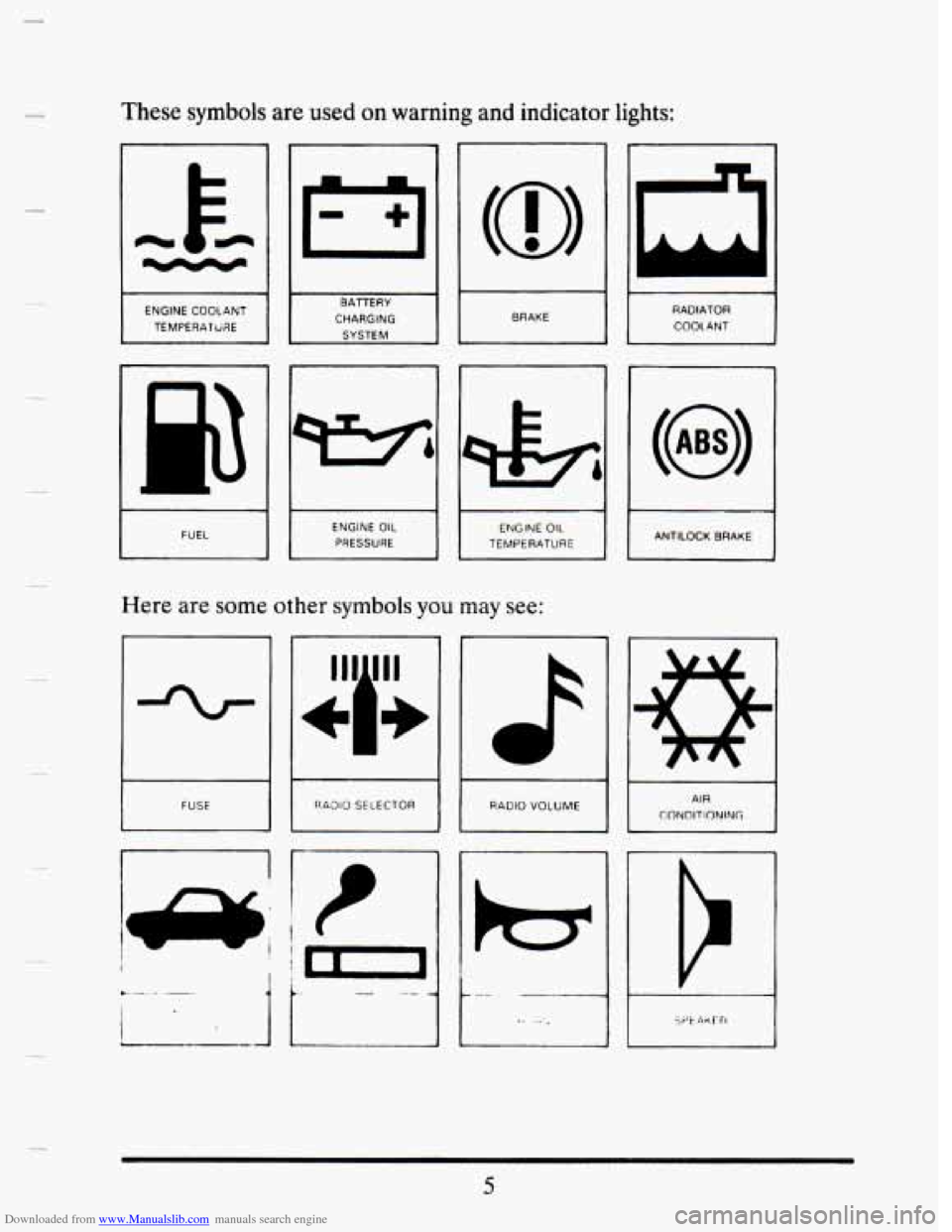
Downloaded from www.Manualslib.com manuals search engine These symbols are used on warning and indicator lights:
I
I
BRAKE
I
ENGINE COOLANT
TEMPERATURE RADIATOR COOL ANT
CHAAGlNG
I FUEL ENGINE OIL PRESSURE I
~~
ANTILOCK BRAKE ENGINE OIL TEMPERATURE I
Here
are some other symbols you may see:
L
RAOIO SELECTOR AIR CONDITIONING I RADIO VOLUME
i !t-l
.- -- 1
5
Page 146 of 407
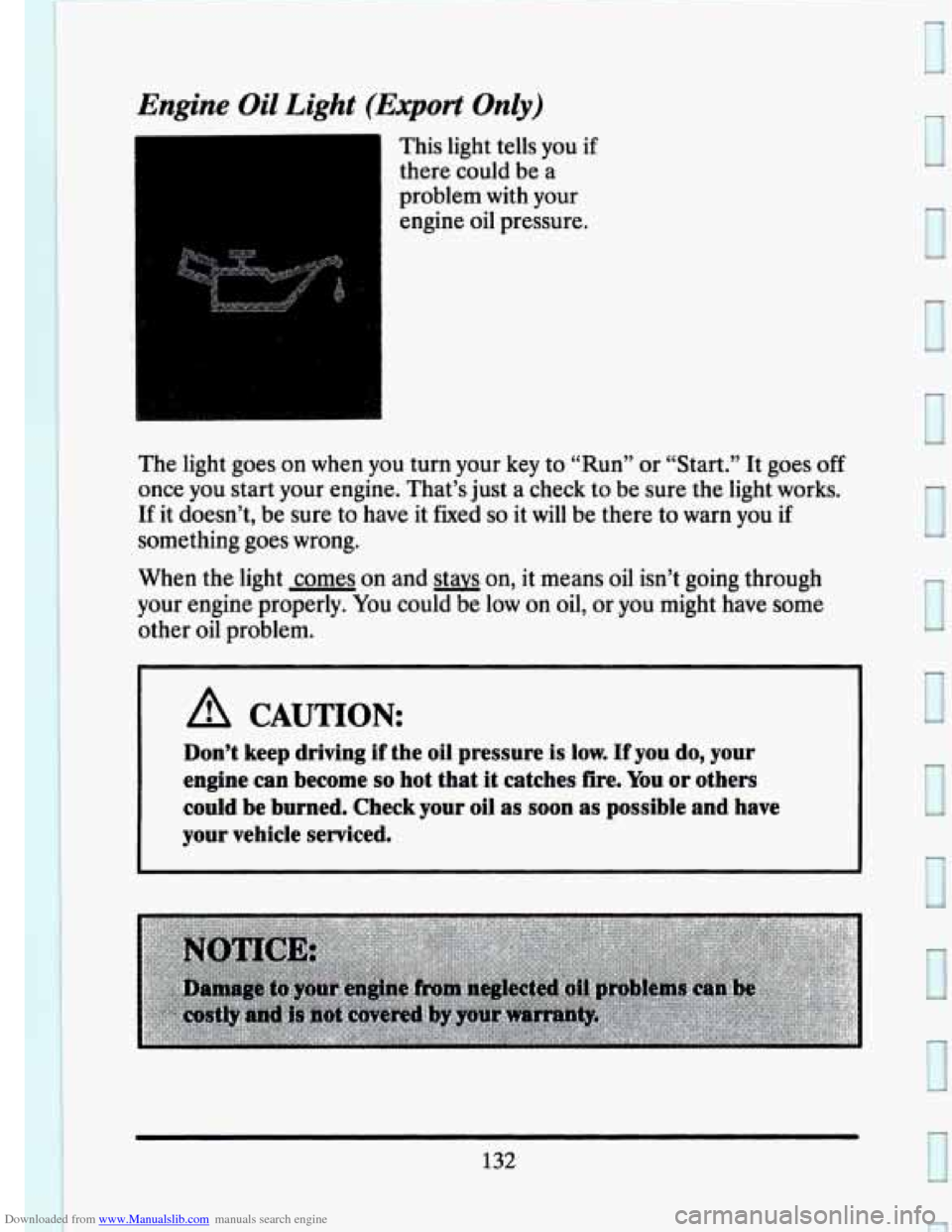
Downloaded from www.Manualslib.com manuals search engine Engine Oil Light (Export Only)
This light tells you if
there could be
a
j ’ problem with your
engine oil pressure.
The light goes on when
you turn your key to “Run” or “Start.” It goes off
once you start your engine. That’s just a check to be sure the light works.
If it doesn’t, be sure to have it fixed so it will be there to warn you if
something goes wrong.
When the light
comes on and stavs on, it means oil isn’t going through
your engine properly. You could be low on oil, or you might have some
other oil problem.
A CAUTION:
Don’t keep driving if the oil pressure is low. If you do, your
engine
can become so hot that it catches fire. You or others
could be burned. Check your oil as
soon as possible and have
your vehicle serviced.
132
I
I
I
Page 155 of 407
Downloaded from www.Manualslib.com manuals search engine SERVICE RIDE CONTROL
This message is displayed to indicate that the Suspension System is not
operating properly.
To correct this problem have your vehicle serviced at
your Cadillac dealership at your earliest convenience.
STOP ENGINE ENGINE OVERHEATING
This message will appear when your engine has overheated. Stop and
turn your engine
off immediately to avoid severe engine damage. See
“Engine Overheating”
in the Index.
SERVICE VEHICLE SOON
This message will appear if there is a problem with your Emission
Control System.
If the “SERVICE ENGINE SOON” light on the
instrument panel and this message appear and then turns off, it is an
indication that a temporary problem has cleared itself. Have your vehicle
checked at your earliest convenience.
STOP ENGINE LOW OIL PRESSURE
If this message appears while the engine is running, stop the engine and
do not operate it until the cause
of low oil pressure is corrected. Severe
damage to the engine can result.
SERVICE SUPPLEMENTAL INFLATABLE RESTRAINT
If this message appears, there is a problem with your Supplemental
Inflatable Restraint (Air Bag) system. Let only a qualified technician
work on your vehicle.
See your Cadillac dealer for service at once.
THEFT SYSTEM PROBLEWCAR MAY NOT RESTART
This message means there is atroblem in the Personalized Automotive
Security System (PASS
Key I1 ). PASS Key I1 TM will prevent the vehicle
from restarting
if it is turned off, so you should take the vehicle to a
proper service center before turning the engine off. Never leave
an
unattended vehicle with the engine running. Once you are where you can
get service, turn
the engine off and then try to restart it. If the vehicle
does not restart, the PASS
Key I1 TM system will need servicing.
TRACTION ACTIVE
If your vehicle is equipped with Traction Control, this message will be
displayed
if Traction Control is being used to reduce wheel slippage.
141
Page 177 of 407

Downloaded from www.Manualslib.com manuals search engine 3
Care of Your Cassette Tape Player
A tape player that is not cleaned regularly can cause reduced sound
quality, ruined cassettes, or a damaged mechanism. Cassette tapes should
be stored
in their cases away from contaminants, direct sunlight, and
extreme heat.
If they aren't, they may not operate properly or cause
failure of the tape player.
Your tape player should be cleaned regularly each month or after every
15 hours of use. If you notice a reduction in sound quality, try a known
good cassette to see
if the tape or the tape player is at fault. If this other
cassette has no improvement
in sound quality, clean the tape player.
Clean your tape player
with a wiping-action, non-abrasive cleaning
cassette, and follow the directions provided
with it.
Cassettes are subject to wear and the sound quality may degrade over
time. Always make sure that the cassette tape is
in good condition before
you have your tape player serviced.
Care of Your Compact Discs
Handle discs carefully. Store them in their original cases or other
protective cases and away from direct sunlight
and dust. If the surface of
a disc is soiled, dampen a clean, soft cloth
in a mild, neutral detergent
solution and clean it, wiping from the center to the edge.
A
Be sure never to
touch the signal
surface when
handling discs. Pick
up discs
by grasping
the outer edges or
the edge
of the hole
and the outer edge.
163
Page 215 of 407
Downloaded from www.Manualslib.com manuals search engine time and flash your brake lights (in addition to your turn signal) as extra
warning that you are about to slow down and exit.
The exit ramp can be curved, sometimes quite sharply.
The exit speed is usually posted. Reduce your speed according
to your
speedometer, not to your sense
of motion. After driving for any distance
at higher speeds, you may tend to think you are going slower than you
actually are. For example,
40 mph (65 km/h) might seem like only 20 mph
(30 km/h). Obviously, this could lead to serious trouble on a ramp
designed for
20 mph (30 km/h)!
DMNG A LONG DISTANCE
Although most long trips today are made on freeways, there are still
many made
on regular highways.
Long-distance driving on freeways and regular highways is the same
in
some ways. The trip has to be planned and the vehicle prepared, you
drive at higher-than-city speeds, and there are longer turns behind
the
wheel. You’ll enjoy your trip more if you and your vehicle are in good
shape. Here are some tips for a successful long trip.
BEFORE LEAWNG ONA LONG THP
Make sure you’re ready. Try to be well rested. If you must start when
you’re not fresh
-- such as after a day’s work -- don’t plan to make too
many miles that first part of
the journey. Wear comfortable clothing and
shoes
you can easily drive in.
Is your vehicle ready for a long trip? If you keep it serviced and
maintained, it’s ready to
go. If it needs service, have it done before
starting out. Of course, you’ll find experienced and able service experts
in
Cadillac dealerships all across North America. They’ll be ready and
willing to help
if you need it.
Here are some things
you can check before a trip:
Windshield Washer Fluid: Is the reservoir full? Are all windows clean
inside and outside?
Wiper Blades: Are they in good shape?
0 Fuel. Enpine Oil. Other Fluids: Have you checked all levels?
201
Page 296 of 407
Downloaded from www.Manualslib.com manuals search engine When the correct fluid level is obtained, push the dipstick back in all
the way.
How To Reset Transaxle Fluid Change Indicator: 4.6L (Northstar)
Your vehicle is equipped with a transaxle fluid change indicator.
A
“CHANGE TRANS FLUID” message will display on the Information
Center
when the power train computer determines that the transaxle
fluid needs to be changed or at each 100,000 miles
(160,000 km) interval,
whichever occurs first. When this message appears, change the t\
ransaxle
fluid and reset the transaxle fluid life indicator
as follows:
Turn the key “ON” with the engine stopped.
Press and hold the “OFF” and “REAR DEFOG” buttons on the
climate control simultaneously
until the “TRANS FLUID RESET”
message appears
in the Information Center (between 5 and 20
seconds).
ENGINE COOLANT
The following explains your cooling system and how to add coolant when
it is low. If you have
a problem with engine overheating, see “Engine
Overheating” in the Index.
The proper coo’ It for
your Cadillac will:
Give freezing protection down to -34°F (-37’C) .
Give boiling protection up to 262 ” F (128 ” C) .
Protect against rust and corrosion.
Help keep the proper engine temperature.
Let the warning lights work as they should.
What to Use:
Use a mixture of one-half clean water (preferably distilled) and one\
-half
antifreeze that meets
“GM Specification 1825-M,” which won’t damage
aluminum parts. You can also use a recycled coolant conforming to
GM
Specification 1825-M with a complete coolant flush and refill. Use GM
Engine Coolant Supplement (sealer) with any complete coolant c\
hange.
If you use these, you don’t need to add anything else.
Y
c.
282
Page 332 of 407

Downloaded from www.Manualslib.com manuals search engine stain, “feathering” toward the center. Keep changing to a clean
section of the cloth.
0 When you clean a stain from fabric, immediately dry the area with an
air hose, hair dryer, or heat lamp to help prevent a cleaning ring. (See
the previous
NOTICE.)
-
SPECIAL CLEANING PROBLEMS
Greasy or Oily Stains: Like grease, oil, butter, margarine, shoe polish,
coffee
with cream, chewing gum, cosmetic creams, vegetable oils, wax
crayon, tar and asphalt.
Carefully scrape off excess stain.
Then follow the solvent-type instructions above.
0 Shoe polish, wax crayon, tar and asphalt will stain if left on a vehicle
seat fabric. They should be removed
as soon as possible. Be careful,
because the cleaner will dissolve them and may cause them to bleed.
Non-Greasy Stains: Like catsup, coffee (black), egg, fruit, fruit juice,
milk, soft drinks, wine, vomit, urine and blood.
0 Carefully scrape off excess stain, then sponge the soiled area with cool
water.
If a stain remains, follow the foam-type instructions above.
If an odor lingers after cleaning vomit or urine, treat the area with a
waterbaking soda solution:
1 teaspoon (5 ml) of baking soda to 1 cup
(250 ml) of lukewarm water.
Finally, if needed, clean lightly with solvent-type cleaner.
Combination Stains: Like candy, ice cream, mayonnaise, chili sauce and
unknown stains.
Carefully scrape off excess stain, then clean with cool water and allow
If a stain remains, clean it with solvent-type cleaner.
to
dry.
318
Y
3
Page 343 of 407

Downloaded from www.Manualslib.com manuals search engine c
P
___.__ HDIP Lo HDLP HI R H'C HI IGN 3 COOL FAN TRANSECS
i I
I FUSE CENTER IDENTIFICATION J
ENGINE COMPARTMENT FUSE BLOCK
COIL 20A - 4.9L DISTRIBUTOR - 4.6L IGNtTION CONTROL MODULE SIR 2OA
- DIAGNOSTIC ENERGY RESERVE - - - - - - -
LF4 DERM) SIR (AIR BAG) - MlNG SENSOR
PCM (IO 1.OA - POWE Y TRAIN CONTROL MODUL
INJ IOA - PASSKeyS DECODER MODULE MODULE
.E (PCM)
--FUEL INJECTORS 1,4,6,7 INJ 1OA - FUEL INJECTORS 2,3,5,8 ION 1OA - A/C COMPRESSOR - ELECTROCHROMIC MIRROR - INSTRUMENT PANEL CLUSTER - DIAGNOSTIC ENERGY RESERVE MODULE
- KEYLE &Pi S E TRY MO b ULE - CORNERING LIGHTS - CHIME MODULE - TWILIGHT SENTINEUDRL MODULE - BACKUP LIGHTS - BRAKE TRANSMISSION SHIFT INTERLOCK
- FUEL PUMP
(DERM SIR AIR BAG
FUEL
20A
PCU(&A IOA
AC IOI
MID W 8 101
$TOP LP ;Ku
fURNiHA2 20A
FQWERTWN CONTROL MOWlE
MI&€ a 7RAIFI CONTRO( uOMKE (PCM)
AC CCEUYellS3uA
HfArtO &NISH&AO
STOP LIGHTS
- HAZARD LIGHTS - TURN SIGNAL LIGHTS
DRL 1OA (CANADA)
DRL
10A (CANADA)
SUSPENSION 1OA
- DAYTIME RUNNING LIGHTS
- DAYTIME RUNNING LIGHTS
- ROAD SENSING SUSPENSION
- LNORTHSTW PEED SENSITIVE SUSPENSION (4.9L)
- R 6 AD SENSING SUSPENSION
- LEFT HEADIAMP LOW BEAM
- RT HEADLAMP LOW BEAM
- LEFT HEADIAMP HIGH BEAM
- RIGHT HEADIAMP HIGH BEAM
- HEATED WINDSHIELD - HEATER AND A/C PROGRAMMER
- ELECT. LEVEL CONTROL (ELC) - DEFOGGER RELAY "D"
- CRUISE CONTROL
- POWERTRAIN CONTROL MODULE
- COOLING FANS
- POWERTRAIN CONTROL MODULE 4.6L)
- FRONT AND REAR HEATED OXYGE L
RTD BAT) 20A
L HDLP LO 1OA (EXPORT)
R HDLP LO 1OA (EXPORT)
L HDLP HI 1OA (EXPORT)
R HDLP HI (EXPORT)
ION 3 1OA
COOLING FAN 1OA
SENSOR (4.6L) TRANSIECS 1 OA
SOLENOID -- EXHAUST GAS RECIRCULATION (EGR)
- POWERTRAIN CONTROL MODULE (PCM) - AUTOMATIC TRANSAXLE - EVAPORATIVE EMISSION CONTROL
- OVERSPEED ALERT MODULE (EXPOR
- POWER STEERING PRESSURE SWITC 3
SOLENOID
329
I
F