1993 BUICK RIVIERA lights
[x] Cancel search: lightsPage 183 of 324
bags, rags, floor mats -- anything you can wrap around
yourself or tuck under your clothing to keep warm.
You can run the engine to keep warm, but be careful.
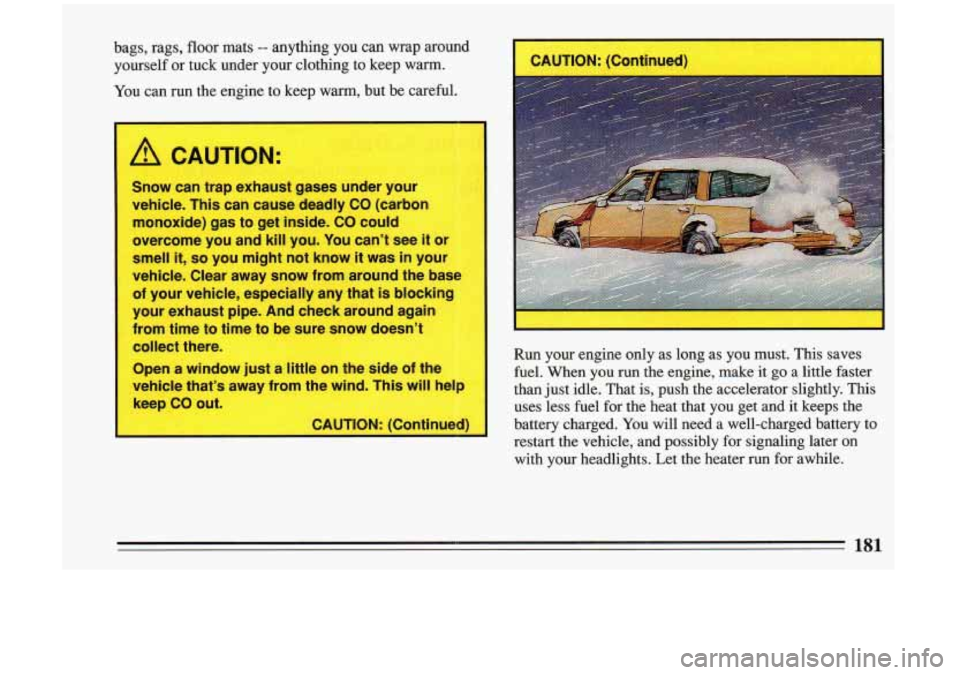
Snow can trap exhaust gases under your
vehicle. This can cause deadly CO (carbon
monoxide) gas to get inside. CO could
overcome you and kill you. You can’t see
it or
smell it,
so you might not know it was in your
vehicle. Clear away snow from around the ba
!
of your vehicle, especially any that is blocking
your exhaust pipe- And check ar
from time to time to be sure snow
collect there.
Open a window just a little on the side of the
vehicle that’s away from the wind. This
will heir
keep CO out.
I CAUTION: (Continued)
Run your engine only
as long as you must. This saves
fuel. When you run the engine, make
it go a little faster
than just idle. That is, push the accelerator slightly.
This
uses less fuel for the heat that you get and it keeps the
battery charged. You will need a well-charged battery to
restart the vehicle, and possibly for signaling later on
with your headlights. Let the heater run for awhile.
181
Page 186 of 324
Hazard Warning Flashers
c
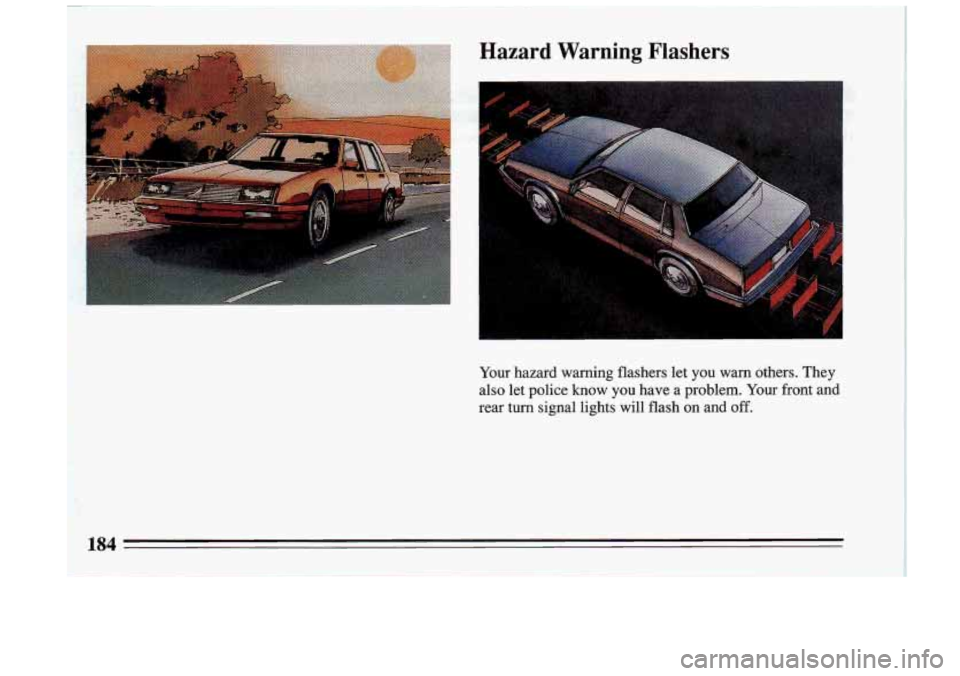
Your hazard warning flashers let you warn others. They
also let police know you have a problem. Your front and
rear turn signal lights will flash on and
off.
Page 187 of 324
I
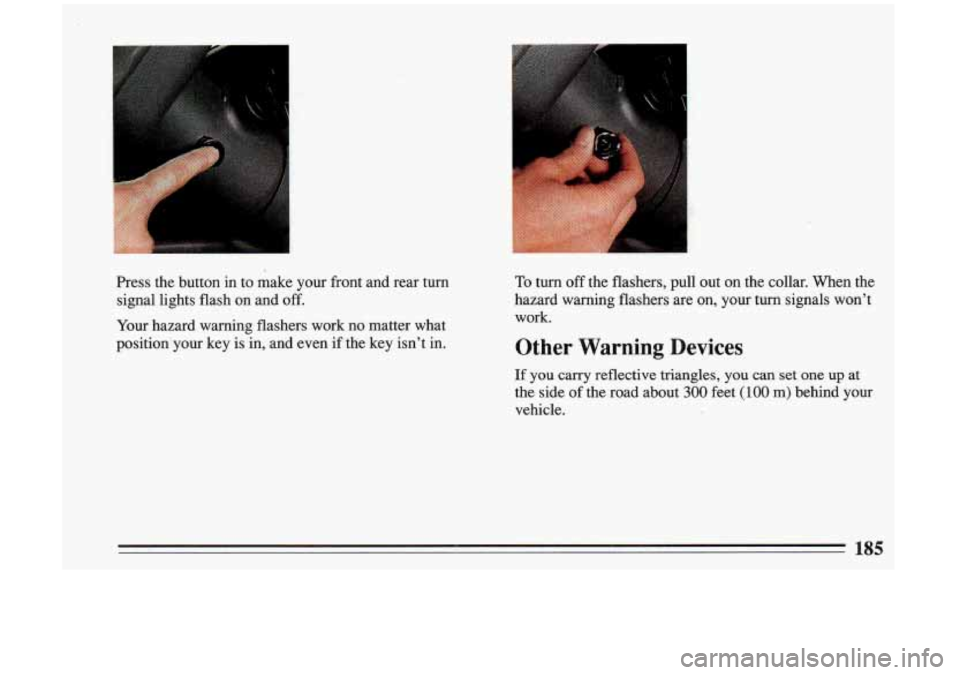
Press the button in to make your front and rear turn
signal lights flash on and
off.
Your hazard warning flashers work no matter what
position your key is in, and even
if the key isn't in.
To turn off the flashers, pull out on the collar. When the
hazard warning flashers are on, your
turn signals won't
work.
Other Warning Devices
If you carry reflective triangles, you can set one up at
the side
of the road about 300 feet (100 m) behind your
vehicle.
185
Page 189 of 324
I A CAUTION:
u could be injured if the vehicles roll. Set the
arking brake firmly on each vehicle. Put an
utomatic transaxle
in “P” (Park) or a manual
axle
in “N” (Neutral).
P
3. Turn off the ignition on both vehicles. Turn off all
lights that aren’t needed, and radios. This
will avoid
sparks and help save both batteries. And it could
save your radio!
4. Open the hoods and locate the batteries.
I A CAUTION:
An electric fan can start up even when the
engine is not running and can injure you. Keep
hands; clothing and tools away from any
underhood electric fan.
~~
Find the positive .(+) and negetive (-), terminals on
each battery.
Page 233 of 324
are made especially for your automatic transaxle.
Damage caused by fluid other than
DEXRONs-IIE is
not covered by your new vehicle warranty.
After adding fluid, recheck the fluid level as
described under
“How to Check.”
When the correct fluid level is obtained, push the
dipstick back in all the way.
Engine Coolant
The following explains your cooling system and how to
add coolant when it is low. If you have a problem with
engine overheating, see “Engine Overheating” in the
Index.
The proper coolant for your Buick
will:
Give freezing protection down to -34’F (-37 ’ C) .
0 Give boiling protection up to 262 ’ F ( 128 ’ C) .
Protect against rust and corrosion.
Help keep the proper engine temperature.
0 Let the warning lights work as they should.
What to Use:
Use a mixture of one-half clean water (preferably
distilled) and one-half antifreeze that meets “GM Specification 1825-M,” which won’t damage aluminum
parts. Use GM Engine Coolant Supplement (sealer) with
any complete coolant change. You can also use a
recycled coolant conforming to “GM Specifications
1825-M” with a complete coolant flush and-refill.
If you
use these, you don’t need to add anything else.
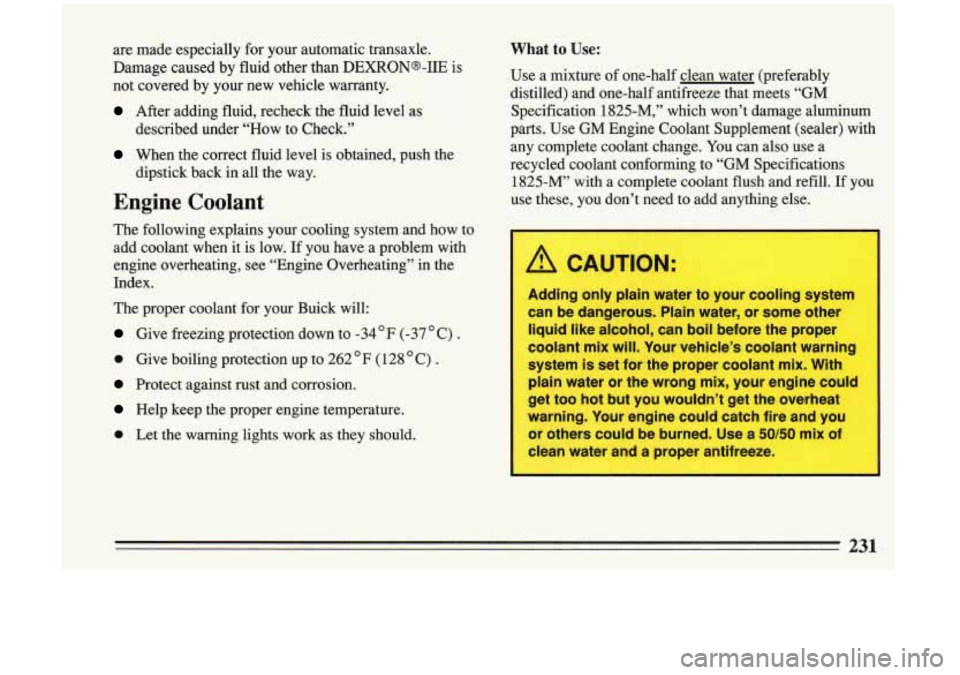
Adding only plain water to your cooling system
can be dangerous. Plain water, or some other
liquid like alcohol, can boil before the proper
coolant mix will. Your vehicle’s coolant warnin!
system
is set for the proper coolant mix. With
plain water or the wrong mix, your engine coul
get
too hot but you wouldn’t get the overheat
warning. Your engine could catch fire and you
or others could be burned. Use a
50150 mix of
clean water and
a proper antifreeze.
231
Page 266 of 324
i
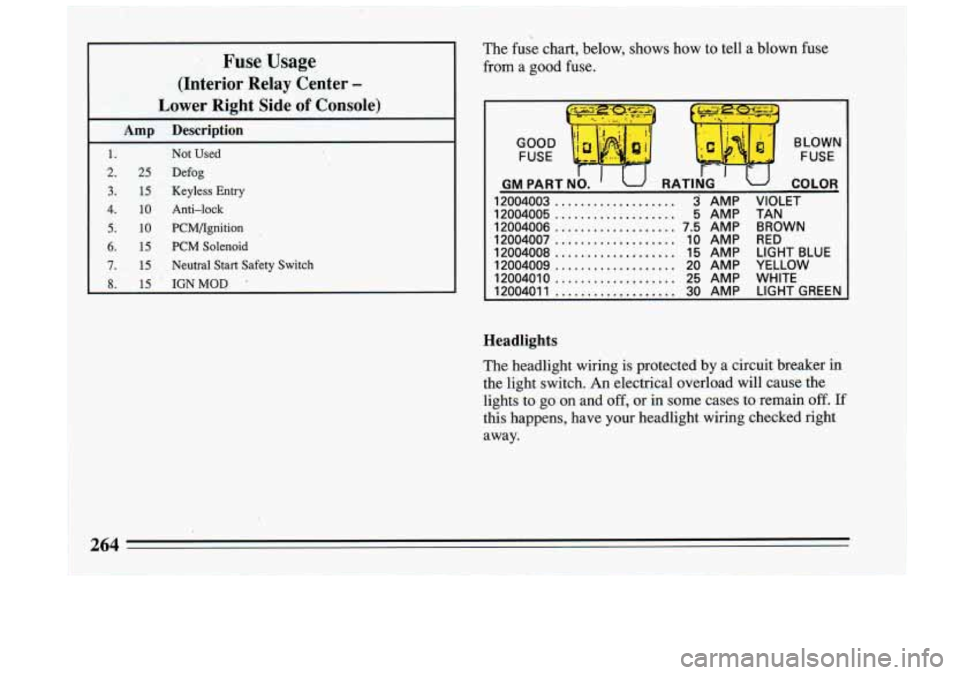
Fuse Usage
(Interior Relay Center -
Lower Right Side of Console)
Amp Description
1. Not Used
2. 25 Defog
3. 15 Keyless Entry
4. 10 Anti-lock
5. 10 PCMflgnition
6. 15 PCM Solenoid
7. 15 Neutral Start Safety Switch
8. 15 ' IGN MOD -
The fuse chart, below, shows how to tell a blown fuse
from a good fuse.
GOOD
FUSE '
rll
-1
I
BLOWN
FUSE
GM PARTNO. ' U RATING ' U COLO~
12004003
................... 3 AMP VIOLET
'12004005
................... 5 AMP TAN
12004006
................... 7.5 AMP BROWN
12004007
................... 10 AMP RED
12004008
.................... 15 AMP LIGHT BLUE
12004009
................... 20 AMP
YELLOW
12004010
................... 25 AMP WHITE
120040.1 1
................... 30 AMP LIGHT GREEN
Headlights
The headlight wiring is protected by a circuit breaker in
the light switch.
An electrical overload will cause the
lights to go on and
off, or in some cases to remain off. If
this happens, have your headlight wiring checked right away.
Page 304 of 324
High Speed. Shifting When Your Engine is Running ..... 76 Jack. Tire ..................................... 205
Highway Hypnosis
............................... 172 Jacking Up the Car ............................... 205
Hill and Mountain Roads
.......................... 173 Jump Starting ................................... 186
Hills. Parking on
................................. 175
Holding a Baby in Your Car
......................... 43
Hood. Opening the
............................... 221
Horn ........................................... 84 Keys 59
Hot Coolant Warning Light
........................ 113 Keyless Entry System. Remote 64
Hydroplaning
................................... 166
..........................................
......................
Hot Engine. Safety Warnings About 196 Kilomefa- J&$q$cx .. +... .? . ... _. % ......... . ... .’_ rs.z7 t- ........ . 105 .................
Ice. Driving on ................................. 179
Identification Label. Service Parts
................... 261
Identification Number. Vehicle
..................... 261
Idling Your Engine
................................ 82
If You’re Stuck: In Sand. Mud. Ice or Snow
........... 214
Indicator. Turn Signal
............................. 85
Indicators. Disc Brake Wear ....................... 156
Indicators. Warning Lights and Gages
................ 107
Infant Restraint
................................... 45
Inflation. Tire
................................... 245
Inside Mirror
.................................... 99
Inspection. Tire
................................. 245
Instrument Panel
................................ 105
Interior Cleaning
................................ 253
Interlock. Brake-Transaxle Shift
.................. 75. 81
Introduction
. How To Use This Manual ............... 10
Ignition Key Positions
............................. 71
Label.
Service Parts Identification
.................. 261
Lane Change Indicator
............................. 85
Lap-Shoulder Belt Usage by Children
................. 55
Leaving Your Vehicle .............................. 80
Level Control. Electronic
.......................... 104
License Plate Holder. Rear
......................... 104
Light. Safety Belt
................................. -25
Light.
Turn Signal Indicator ......................... 85
Lighter. Cigarette
................................ 111
Lights Daytime Running
.............................. 98
Panel and Interior
.............................. 96
Traffic
...................................... 145
“On” Warning
................................. 96
Operation
.................................... 86
Loading Your Vehicle ............................ 242
Lap Belt
........................................ -42
Lights
& Gages. Warning Indicators ................. 107
302
Page 307 of 324
Run (Ignition Key Position) ......................... 72
Running Lights. Daytime
........................... 98
Running Your Engine While You’re Parked
............ 82
Safety Belt Care
................................ 256
Safety Belt Extender
.............................. 56
Safety Belt Reminder Light
......................... 25
Safety Belt Replacement
........................... 57
Safety Belt. Center Adult Passenger
.................. 42
Safety Belt. Lap
.................................. 42
Safety Belt. Lap-Shoulder
.......................... 27
Safety Belts
..................................... 13
Safety Belts. Buckled Wrong
........................ 29
Safety Belts. Questions About
....................... 24
Safety Belts. Rear Seat Passengers
................... 38
Safety Belt.
Too Loose ............................. 28
Safety Belt.
Torn ................................. 57
Safety Belts. Twisted
.............................. 31
Safety Belts. Right Front. Adult Passenger
............. 38
Safety Belts. Usage by Adults
....................... 26
Safety Belts. Usage by Children
..................... 43
Safety Belts. Usage During Pregnancy
................. 37
Safety Belts. Why They Work
....................... 20
Safety Belts. Worn Under
Arm ...................... 30
Safety Defects. Reporting .......................... 291
Scheduled Maintenance Services
.................... 273
Safety Warnings
.................................. 10 Seats and Safety Belts
............................. 13
Seat Controls
.................................... 14
Second Gear. When to Use
......................... 77
Securing A Child Restraint
......................... 45
Security Light
................................. 67. 69
Service Tips
.................................... 216
Service A/C Light
............................... 115
Service and Appearance . Care ...................... 215
“Service Engine Soon” Warning Light
............... 113
Service Parts Identification Label
................... 261
Service Publications
.............................. 292
Setting the Clock
......................... 127.130. 132
Setting the Trip Odometer
......................... 107
ShapeofRoadSigns
............................. 143
Sheet Metal Damage
............................. 258
Shift. Brake-Transaxle Interlock
.................. 75. 81
Shift Lever Positions
.............................. 75
Shifting Into Park
................................. 79
Shifting Out of Park
............................... 81
Signaling Turns
................................... 85
Signs. Road .................................... 140
Skidding ....................................... 161
Slippery Surfaces. Driving on
...................... 179
Snow or Ice. Driving on
........................... 179
Solvent-Type Cleaner on Fabric
.................... 254
Sound Equipment. Adding
......................... 125
Sound Systems
.................................. 124
Snowstorm. If You’re Caught in a Bad
............... 180
SpareTire
...................................... 212
305’ I