Page 14 of 324
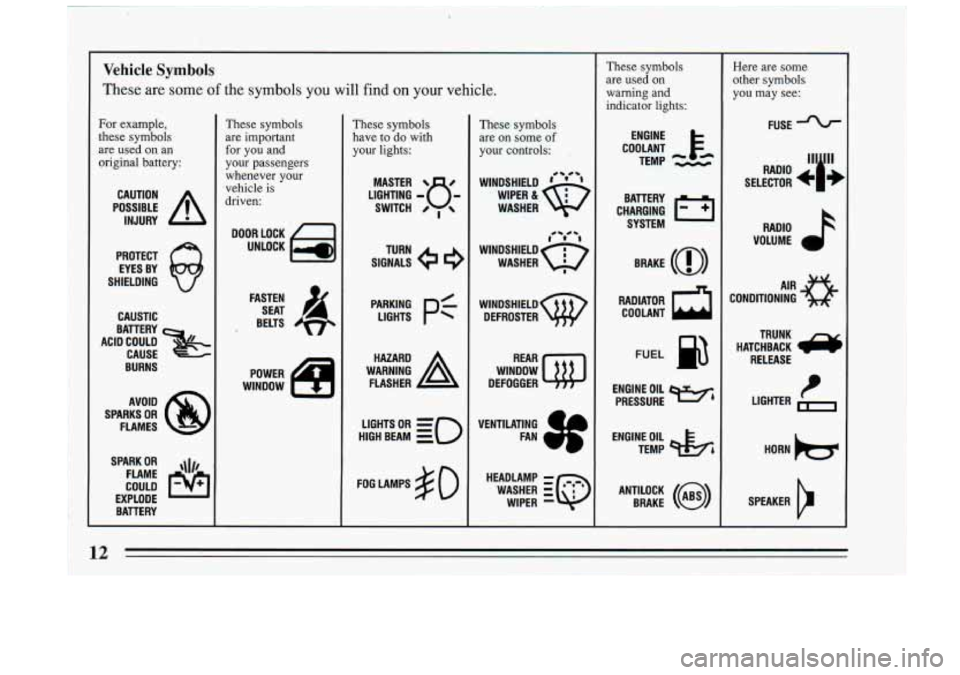
Vehicle Symbols
These are some of the symbols you will find on your vehicle.
For example,
these symbols
are used on an
original battery:
POSSIBLE A
CAUTION
INJURY
PROTECT EYES BY
SHIELDING
CAUSTIC
BURNS AVOID
SPARKS
OR
FLAMES
SPARK
OR ,111,
COULD pq
FLAME
EXPLODE BATTERY
These symbols
are important
for you and
your passengers whenever your
vehicle
is
driven:
FASTEN SEAT 4
BELTS
These symbols
have to do with
your lights:
SIGNALS TURN
HIGH BEAM
OR = =o
FOG LAMPS $0
These symbols
are on some
of
your controls:
WINDSHIELD ’ ’ ’ 4- #-
WASHER
f0 -**
WINDSHIELD Q
WASHER I
WINDSHIELD
DEFROSTER
WINDOW
DEFOGGER
VENTILATING
FAN
L.
HEADLAMP - ,~*-,
WASHER iQ
WIPER -
L
These symbols
are used on
warning and
indicator lights:
COOLANT F-
TEMP --
ENGINE
CHARGING
I-1
BATTERY SYSTEM
RADIATOR
a
COOLANT
FUEL
ENGINE OIL
PRESSURE
Wb
TEMP OIL &
ANTILOCK (@)
BRAKE
Here are some
other symbols
you may see:
FUSE
RADIO
‘‘ill
SELECTOR
RADIO
k
VOLUME
CONDITIONING
AIR 33
HATCHBACK /y
TRUNK
RELEASE
t LIGHTER 1-
HORN
SPEAKER
cr
~ 12 , .
Page 71 of 324
PASS-Key I1 TM
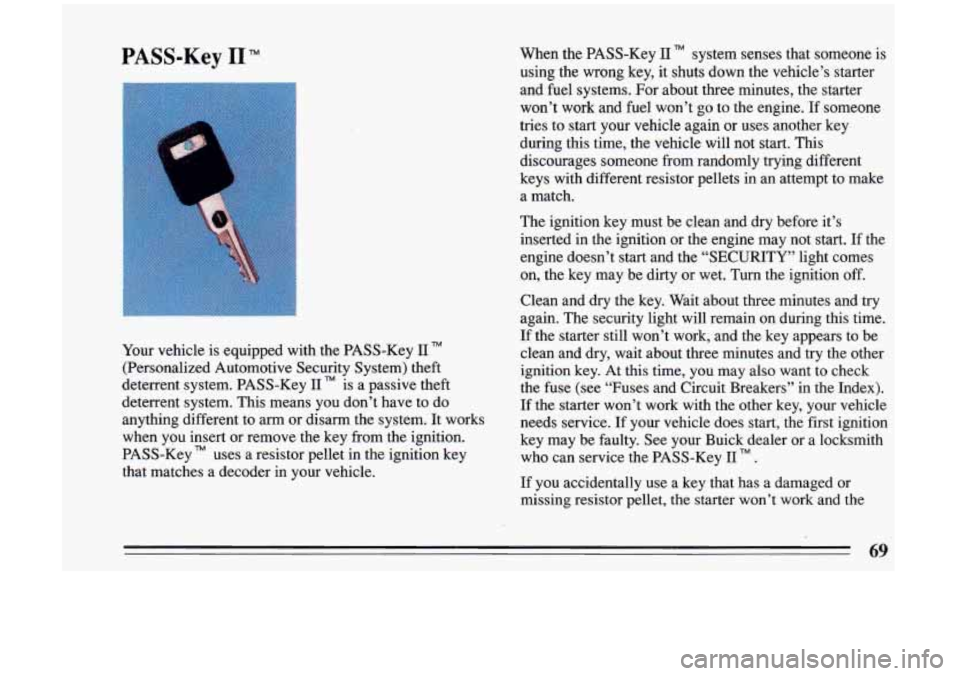
Your vehicle is equipped with the PASS-Key I1
(Personalized Automotive Security System) theft
deterrent system. PASS-Key
11 TM is a passive theft
deterrent system. This means you don’t have to do
anything different to arm or disarm the system. It works when you insert or remove the key from the ignition.
PASS-Key
TM uses a resistor pellet in the ignition key
that matches a decoder in your vehicle. When
the PASS-Key
I1 TM system senses that someone is
using the wrong key, it shuts down the vehicle’s starter
and fuel systems. For about three minutes, the starter
won’t work and fuel won’t
go to the engine. If someone
tries to start your vehicle again or uses another key during this time, the vehicle will not start. This
discourages someone Erom randomly trying different
keys with different resistor pellets in an attempt to make
a match.
The ignition key must be clean and dry before it’s
inserted in the ignition or the engine may not start. If the
engine doesn’t start and the “SECURITY” light comes
on, the key may be dirty or wet. Turn the ignition
off.
Clean and dry the key. Wait about three minutes and try
again. The security light will remain on during this time. If the starter still won’t work, and the key appears to be
clean and dry, wait about three minutes and try the other
ignition key. At this time, you may also want
to check
the fuse (see “Fuses and Circuit Breakers” in the Index).
If the starter won’t work with the other key, your vehicle
needs service. If your vehicle does start, the first ignition
key may be faulty. See your Buick dealer or
a locksmith
who can service the PASS-Key I1
.
If you accidentally use a key that has a damaged or
missing resistor pellet, the starter won’t work and the
69
Page 76 of 324
Engine Block Heater (Option)
In very cold weather, 0 F (- 18 C) or colder, the engine
block heater can help. You’ll get easier starting and
better fuel economy during engine warm-up.
j To use the block heater: I
I. Turn off the engine.
L. Open the hood and unwrap the electrical cord.
1 3. Plug it into a normal, grounded 110-volt outlet.
A CAUTION:
Plugging the cord into an ungrounded outlet
could cause an electrical shock.
Also, the
wrong kind of extension cord could overheat
and cause
a fire. You could be seriously injured.
Plug the cord into
a properly grounded
three-prong 110-volt outlet.
If the cord won’t
reach, use
a heavy-duty three-prong extension
cord rated for at least
15 amps.
How long should you keep the block heater-plugged in?
The answer depends on the weather, the kind
of oil you
have, and some other things. Instead
of trying to list
everything here, we ask that you contact
a Buick dealer
in the area where you’ll be parking your vehicle. The
dealer
can give you the best advice for that particular
area.
74
Page 79 of 324
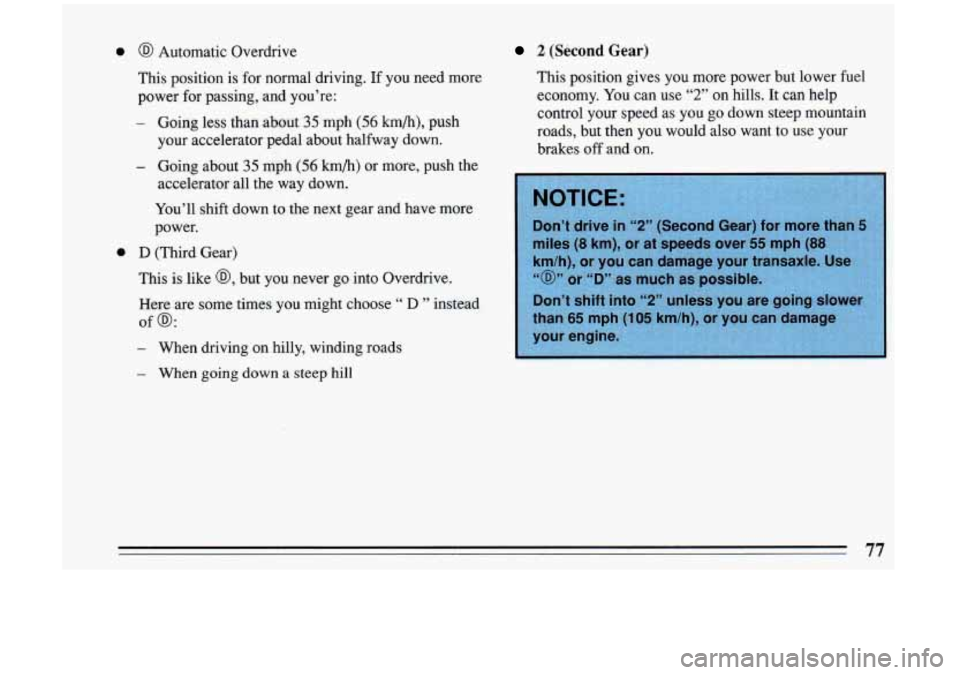
0 @ Automatic Overdrive
This position is for normal driving.
If you need more
power
for passing, and you’re:
- Going less than about 35 mph (56 km/h), push
your accelerator pedal about halfway down.
- Going about 35 mph (56 km/h) or more, push the
accelerator all the way down.
0
You’ll shift down to the next gear and have more
power.
D (Third Gear)
This is like
@, but you never go into Overdrive.
Here are some times you might choose
“ D ” instead
of
@:
- When driving on hilly, winding roads
- When going down a steep hill
2 (Second Gear)
This position gives you more power but lower fuel
economy. You can
use “2” on hills. It can help
control your speed as you
go down steep mountain
roads, but then you would also want to use your brakes
off and on.
77
Page 80 of 324
1 (First Gear) Parking Brake
This position gives you even more power (but lower
fuel economy) than
“2.” You can use it on very steep
hills, or in deep snow or mud. If the selector lever is
put in
“1,” the transaxle won’t shift into first gear
until the vehicle is going slowly enough.
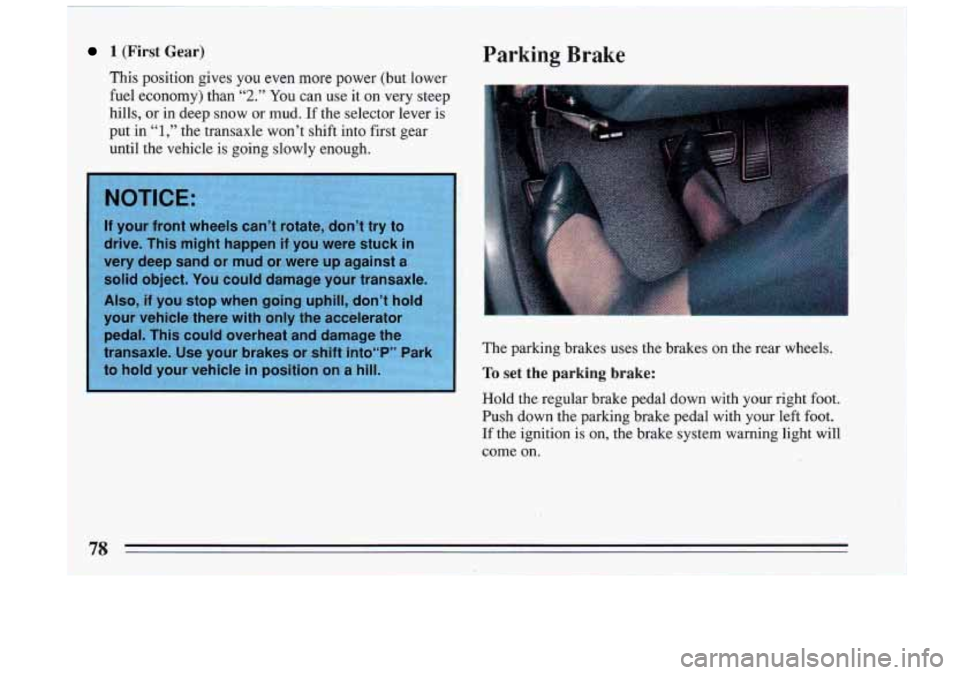
The parking brakes uses the brakes on the rear wheels.
To set the parking brake:
Hold the regular brake pedal down with your right foot.
Push down the parking brake pedal with your left foot.
If the ignition is on, the brake system warning light will
come on.
Page 107 of 324
The Instrument Panel: Your Speedometer and Odometer
Information System Your speedometer lets you see your speed in both miles I I“ , _’ .... __ . I, . -’ ~ ” per hour (mph) and kilometers per hour (lun/h). Your
odometer shows how far
your vehicle has been driven,
in either miles (used in the
U.S.) or kilometers (used in
Canada).
I-
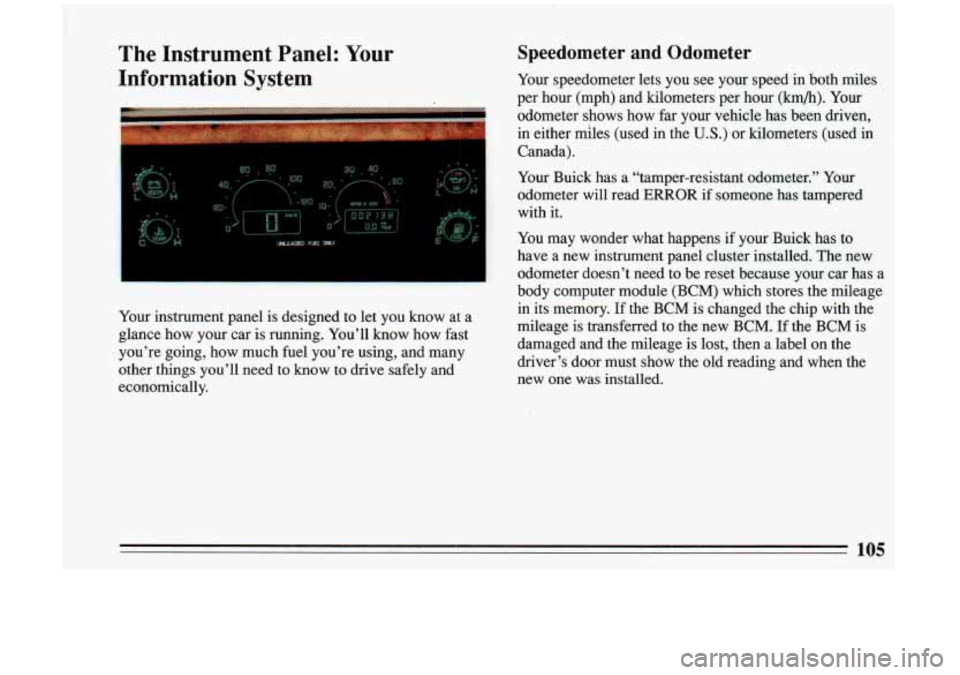
Your instrument panel is designed to let’you know at a
glance how your car
is running. You’ll know how fast
you’re going, how much fuel you’re using, and many
other
things you’ll need to know to drive safely and
economically. Your Buick has
a “tamper-resistant odometer.” Your
odometer will read
ERROR if someone has tampered
with it.
You may wonder what happens if your Buick has to
have a new instrument panel cluster installed. The new
odometer doesn’t need to be reset because your car has a
body computer module (BCM) which stores the mileage
in its memory.
If the BCM is changed the chip with the
mileage
is transferred to the new BCM. If the BCM is
damaged and the mileage is lost, then a label on the
driver’s door must show the old reading and when the
new one was installed.
105
Page 110 of 324
Fuel Gage
I
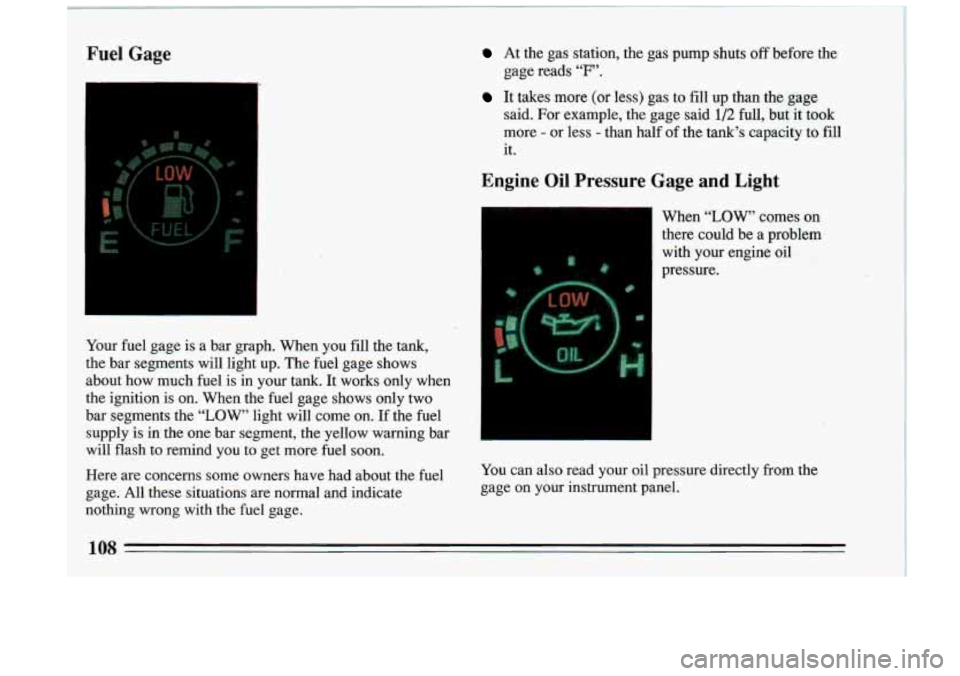
Your fuel gage is a bar graph. When you fill the tank,
the bar segments will light up. The fuel gage shows
about how much fuel is in your
tank. It works only when
the ignition is on. When the fuel gage shows only two
bar segments the
“LOW’ light will come on. If the fuel
~ supply is in the one bar segment, the yellow warning bar
’ will flash to remind you to get more fuel soon.
At the gas station, the gas pump shuts off before the
gage reads
“F’.
It takes more (or less) gas to fill up than the gage
said. For example, the gage said
1/2 full, but it took
more
- or less - than half of the tank’s, capacity to fill
it.
Engine Oil Pressure Gage and Light
When “LOW, comes on
there could be a problem
with your engine oil
pressure.
~ Here are concerns some owners have had about the fuel You
can also read your oil pressure directly from the
~ gage. All these situations are normal and indicate gage on you\
r instrument panel.
I
nothing wrong with the fuel gage.
j 108 I ~ 1 1
Page 115 of 324
Engine Coolant Temperature Warning
Light and Gage Malfunction Indicator Lamp (Service
Engine Soon Light)
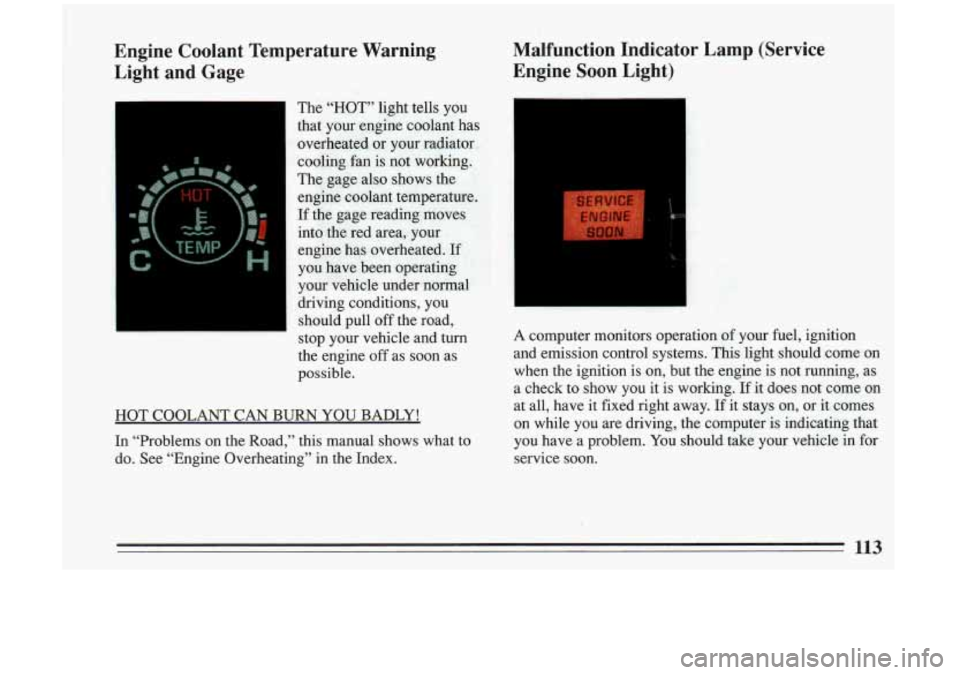
the engine off as soon as
possible.
HOT COOLANT CAN
BURN YOU BADLY!
In “Problems on the Road,” this manual shows what to
do. See “Engine Overheating” in the Index. A computer monitors operation
of your fuel, ignition
and emission control systems. This light should come on when the ignition
is on, but the engine is not running, as
a check to show you it
is working. If it does not come on
at all, have it fixed right away. If it stays
on, or it comes
on while you are driving, the computer is indicating that
you have a problem. You should take your vehicle in for
service soon.
113