1993 BUICK RIVIERA fuel
[x] Cancel search: fuelPage 245 of 324
7
Isl
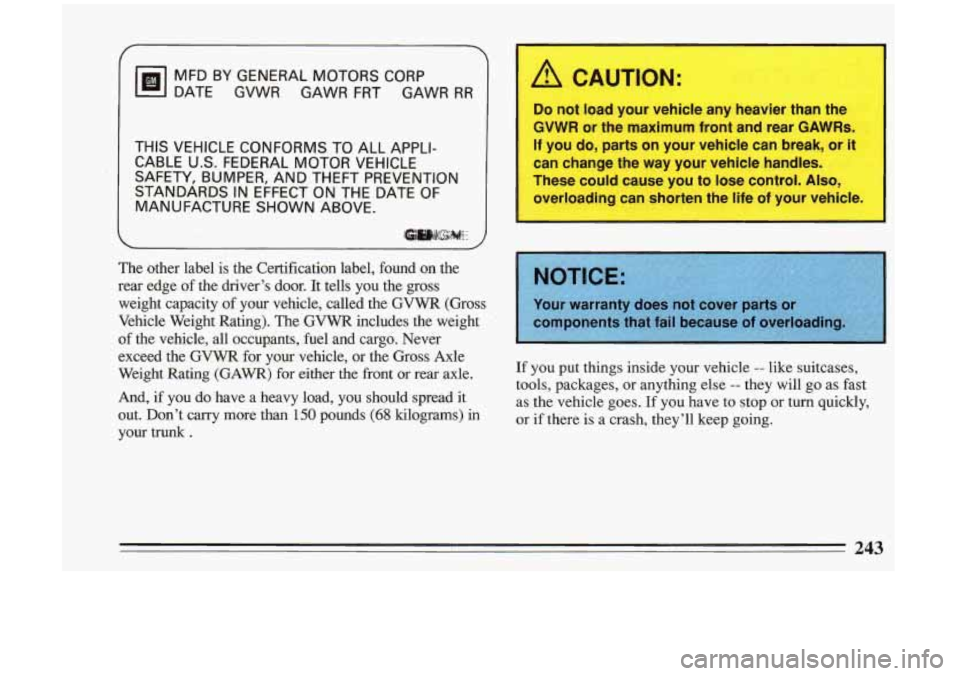
MFD BY GENERAL MOTORS CORP
DATE GVWR GAWR FRT GAWR
RR
THIS VEHICLE CONFORMS TO ALL APPLI-
CABLE US. FEDERAL MOTOR VEHICLE
SAFETY, BUMPER, AND THEFT PREVENTION
STANDARDS IN EFFECT
ON THE DATE OF
MANUFACTURE SHOWN ABOVE.
@iwlIk$#d!!i
The other label is the Certification label, found on the
rear edge of the driver’s door. It tells you the
gross
weight capacity of your vehicle, called the GVWR (Gross
Vehicle Weight Rating). The
GVWR includes the weight
of the vehicle, all occupants, fuel and cargo. Never
exceed the GVWR for your vehicle, or the Gross Axle
Weight Rating
(GAWR) for either the front or rear axle.
And, if you do have a heavy load, YOU should spread it
out. Don’t carry more than
150 pounds (68 kilograms) in
your trunk
.
ur vehicle any heavier than the
:imum front
and rear GAWRs.
1 your vehicle can break, or it
lay your vehicle handles.
;e you
to lose control. Ako,
;horten the life of your vehicle. I
If you put things inside your vehicle -- like suitcases,
tools, packages, or anything else
-- they will go as fast
as the vehicle goes.
If you have to stop or turn quickly,
or if there
is a crash, they’ll keep going.
243
Page 260 of 324
Weatherstrips
-These are places where glass or metal meets rubber.
Silicone grease there will make them last longer, seal
better, and not squeak. Apply silicone grease with a
clean cloth at least every six months.
Sheet Metal Damage
.If your vehicle is damaged and requires sheet metal
.repair or replacement, make sure the body repair shop
: applies anti-corrosion material to the parts repaired or
replaced to restore corrosion protection.
-Foreign Material
Calcium chloride and other salts, ice melting agents,
road oil and tar, tree sap, bird droppings, chemicals from industrial chimneys, and other foreign matter can
damage your vehicle’s finish if they remain on painted
surfaces. Use cleaners that are marked safe for painted
surfaces for these stains.
Finish Damage
Any stone chips, fractures or deep scratches in the finish
should be repaired right away. Bare metal will corrode
quickly and may develop into a major repair expense. Minor chips and scratches can be repaired with touch-up
materials available fi-om your dealer
or other service
outlets. Larger areas of finish damage can be corrected
in your dealer’s body and paint shop.
Underbody Maintenance
Chemicals used for ice and snow removal and dust
control can collect
on the underbody. If these are not
removed, accelerated corrosion (rust) can occur on the Underbody parts such as fuel lines, frame, floor pan, and
exhaust system even though
they have corrosion
protection.
At least every spring, flush these materials from the
underbody with plain water. Clean any areas where mud
and other debris can collect. Dirt packed in closed areas
of the frame should be loosened before being flushed.
Your dealer or an underbody vehicle washing system
can do this for you.
Page 265 of 324
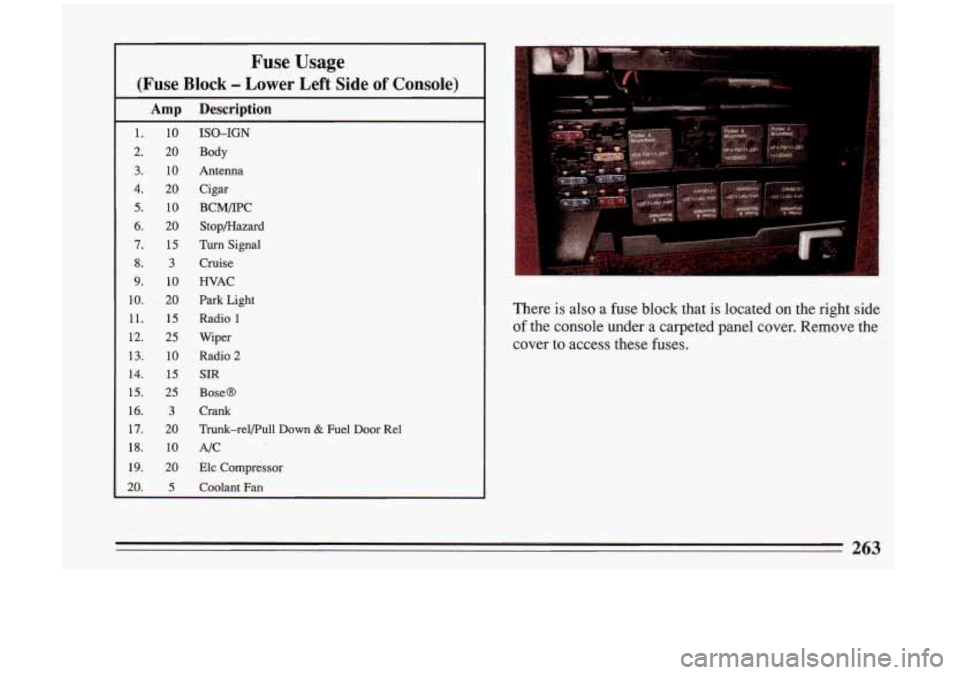
Fuse Usage
(Fuse Block - Lower Left Side of Console)
Amp Description
1.
2.
3.
4.
5.
6.
7.
8.
9.
10.
11.
12.
13.
14.
15.
16.
17.
18.
19.
20.
10
20
10
20
10
20
15
3
10
20
15
25
10
15
25
3
20
10
20
5
ISO-IGN
Body
Antenna
Cigar
BCM/IPC Stopmazard
Turn Signal
Cruise
WAC
Park Light
Radio
1
Wiper
Radio
2
SIR
BoseO
Crank
Trunk-rel/Pull
Down & Fuel Door Re1
AIC
Elc Compressor
Coolant Fan
There is also a fuse block that is located on the right side
of the console under a carpeted panel cover. Remove the
cover to access these fuses.
263
Page 274 of 324
If YOU are skilled enough to do some work on your
vehicle, you will probably want to get the service
information GM publishes. You will find a list of
publications and how to get them in this manual. See
“Service Publications” in the Index.
“Section B: Owner Checks and Services” tells you what
should be checked whenever you stop for fuel. It also
explains what you can easily do to help keep your vehicle in good condition.
“Section C: Periodic Maintenance Inspections” explains
important inspections that your Buick dealer’s service
department or another qualified service center should
perform. ‘‘Section D: Recommended Fluids and Lubricants” lists
some products GM recommends to help keep your
vehicle properly ,maintained. These products, or their
equivalents, should be used whether you do the work
yourself or have it done.
“Section
E: Maintenance Record” provides a place for
you to record the maintenance performed on your
vehicle. Whenever any maintenance is performed, be sure
to write it down in this section. This will help you
determine when your next maintenance should be done.
In addition, it is a good idea to keep your maintenance
receipts. They may be needed to qualify your vehicle for
warranty repairs.
272
Page 275 of 324
Section A: Scheduled Maintenance
Services
Using Your Maintenance Schedules
This section tells you the maintenance services you
should have done and when you should schedule them.
Your Buick dealer knows your vehicle best and wants
you to be happy with it. If you go to your dealer for your
service needs, you’ll know that GM-trained and
supported service people will perform the work using
genuine GM parts.
These schedules are for vehicles that:
0
0
0
carry passengers and cargo within recommended
limits. You will find these limits on your vehicle’s
Tire-Loading Information label. See “Loading Your
Vehicle” in the Index.
are driven on reasonable road surfaces within legal
driving limits.
use the recommended unleaded fuel. See “Fuel” in
the Index.
Selecting the Right Schedule
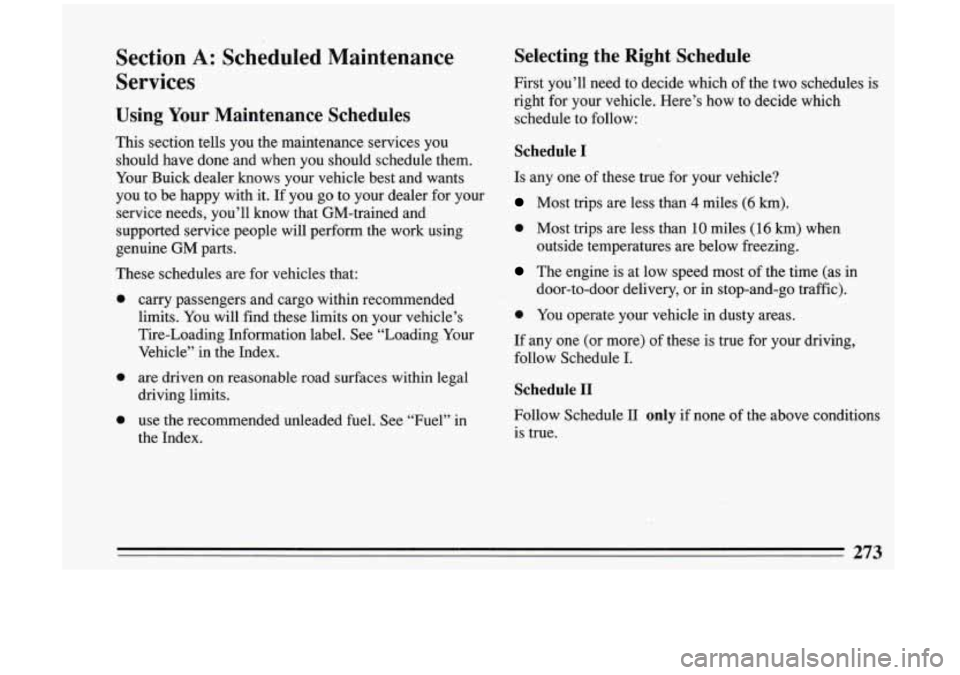
First you’ll need to decide which of the two schedules is
right for your vehicle. Here’s how’ to decide which schedule to follow:
Schedule I
Is any one of these true for your vehicle?
Most trips are less than 4 miles (6 km).
0. Most trips are less than 10 miles ( 16 km) when
outside temperatures
are below freezing.
The engine. is at low speed most of the time (as in
door-to-door delivery, or in stop-and-go traffic).
0 You operate your vehicle in dusty areas.
If any one (or more) of these is true for your driving,
follow Schedule I.
Schedule I1
Follow Schedule I1 only if none of the above conditions
is true.
273
Page 279 of 324
TO BE SERVICED
(See Explanation of
Scheduled Maintenance
Services Following Schedules
I and 11)
Item No.
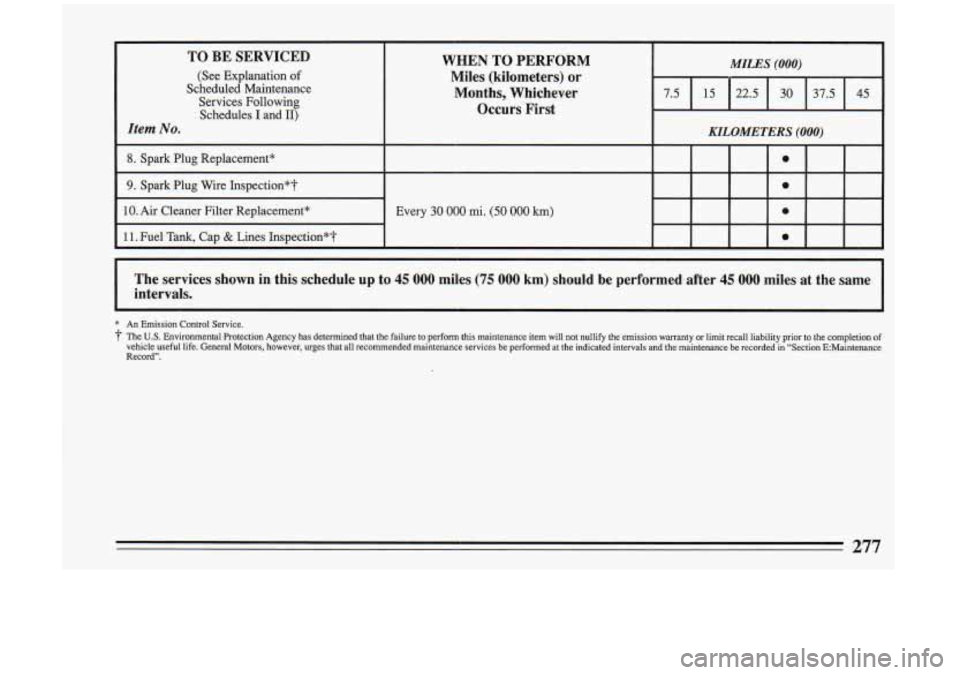
8. Spark Plug Replacement*
9. Spark Plug Wire Inspection*T
10. Air Cleaner Filter Replacement*
11. Fuel Tank, Cap
& Lines Inspection*?
WHEN TO PERFORM I MILES (000)
Miles (kilometers) or Months, Whichever
Occurs First I ,,
7.5 45 37.5 30 22.5 15
KILOMETERS (000)
0
0
Every 30 000 mi. (50 000 km) 0
0
I
The services shown in this schedule up to 45 000 miles (75 000 km) should be performed after 45 000 miles at the same
intervals.
I
* An Emission Control Service.
T The U.S. Environmental Protection Agency has determined that the failure to perform this maintenance item will not nullify the emission \
warranty or limit recall liability prior to the completion of
vehicle useful life. General Motors, however, urges that all recommended maintenance services be performed at the indicated intervals and the maintenance be recorded in “Section E:Maintenance
Record“.
277
Page 281 of 324

conditioning condenser. Wash the pressure cap and
neck.
To help ensure proper operation, we recommend a
pressure test of both the, cooling system and the
pressure cap.
7. Transaxle Service -- Change both the fluid and filter
every
15,000 miles (25 000 km) if the vehicle is
mainly driven under one or more of these conditions:
In heavy city traffic where the outside
temperature regularly reaches
90 F (32 C) or
higher.
In hilly or mountainous terrain.
Uses such as found in taxi, police car or delivery
If you do not use your vehicle under any of these
conditions, change both the fluid and filter every
100,000 miles (160 000 km).
8. Spark Plug Replacement* -- Replace spark plugs
with the proper type. See “Specifications Chart” in
the Index.
service.
9. Spark
Plug Wire Inspection*? -- Inspect for burns,
cracks or other damage. Check the boot fit at the
distributor and at the spark plugs. Replace wires as
needed.
10. Air Cleaner Filter Replacement* -- Replace every
30,000 miles
(50 000 km) or more often under dusty
conditions.
Ask your dealer for the proper
replacement intervals for your driving conditions.
11. Fuel Tank, Caa, and Lines Insa,ection*T -- Inspect
fuel tank, cap and lines (including fuel rails and
injection assembly, if equipped) for damage or leaks.
Inspect fuel cap gasket for an even filler neck
imprint or any damage. Replace parts as needed.
Periodic replacement of the fuel filter is not required.
i
* An Emission Control Service.
3‘ The U.S. Environmental Protection Agency has determined that the failure \
to perform this maintenance item will not nullify the emission warranty or limitrecall liability prior to the completion of vehicle
useful life. General Motors, however, urges that all recommended maintenance services be performed at the indicated intervals and the maintenance be recorded in “Section EMaintenance Record“.
1 279
1:
Page 282 of 324
.Section B: Owner Checks and
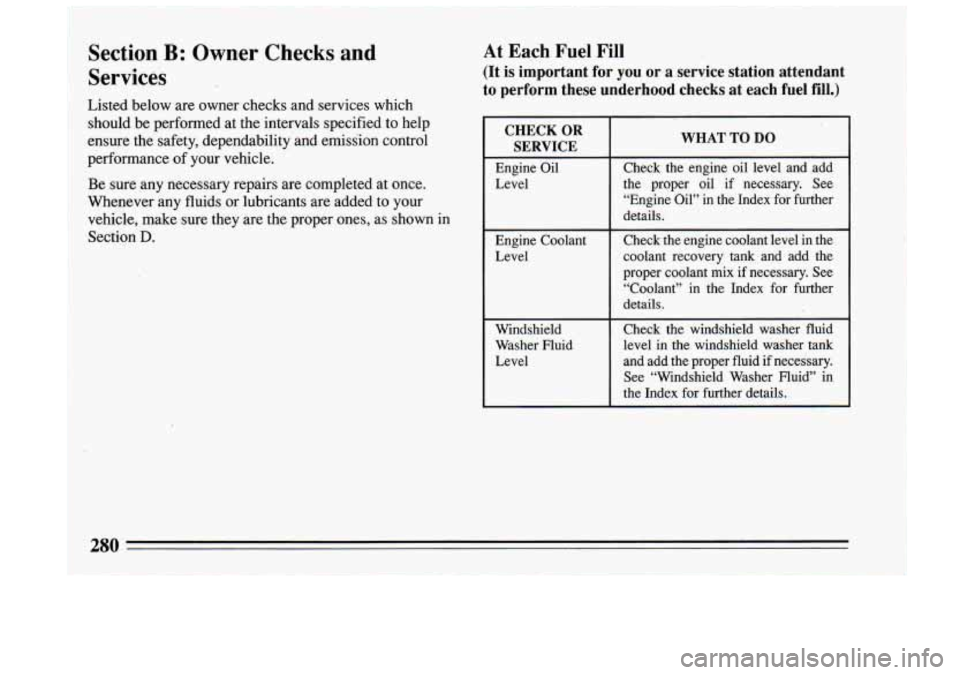
Services At Each Fuel Fill
(It is important for you or a service station attendant
to perform these underhood checks at each fuel
fill.)
Listed below are owner checks and services which
should be performed at the intervals specified to help
ensure the safety, dependability and emission control
performance of your vehicle.
Be sure any necessary repairs are completed at once.
Whenever any fluids or lubricants are added to your
vehicle, make sure they are the proper ones, as shown in
Section
D.
CHECK OR
SERVICE
Engine Oil
Level
Engine Coolant
Level
Windshield
Washer Fluid
Level
WHAT TO DO
Check the engine oil level and add
the proper oil if necessary. See “Engine Oil” in the Index for further
details.
Check the engine coolant level in the
coolant recovery tank and add the
proper coolant mix if necessary. See “Coolant” in the Index for further
details.
Check the windshield washer fluid
level in the windshield washer tank
and add the proper fluid if necessary.
See “Windshield Washer Nuid”
in
the Index for further details. ~-~ ~- ~
280 .~