Page 97 of 324
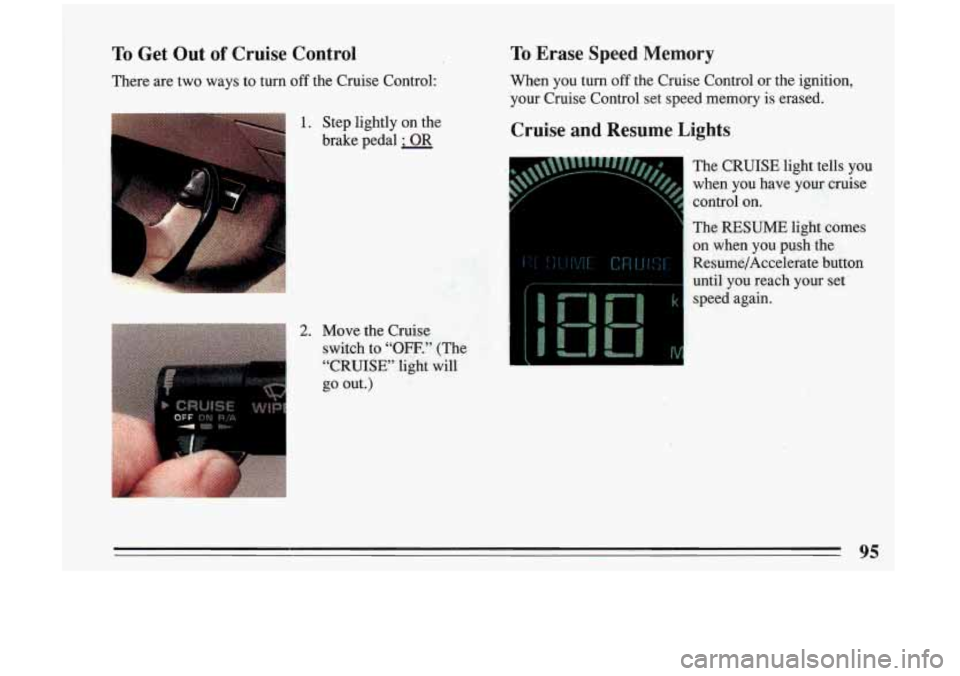
To Get Out of Cruise Control
There are two ways to turn off the Cruise Control:
To Erase Speed Memory
When you turn off the Cruise Control or the ignition,
your Cruise Control set speed memory is erased.
. ..
Move the Cruise
switch
to "'OFF.'' (The
"CRUISE' ligfit will
go aut.)
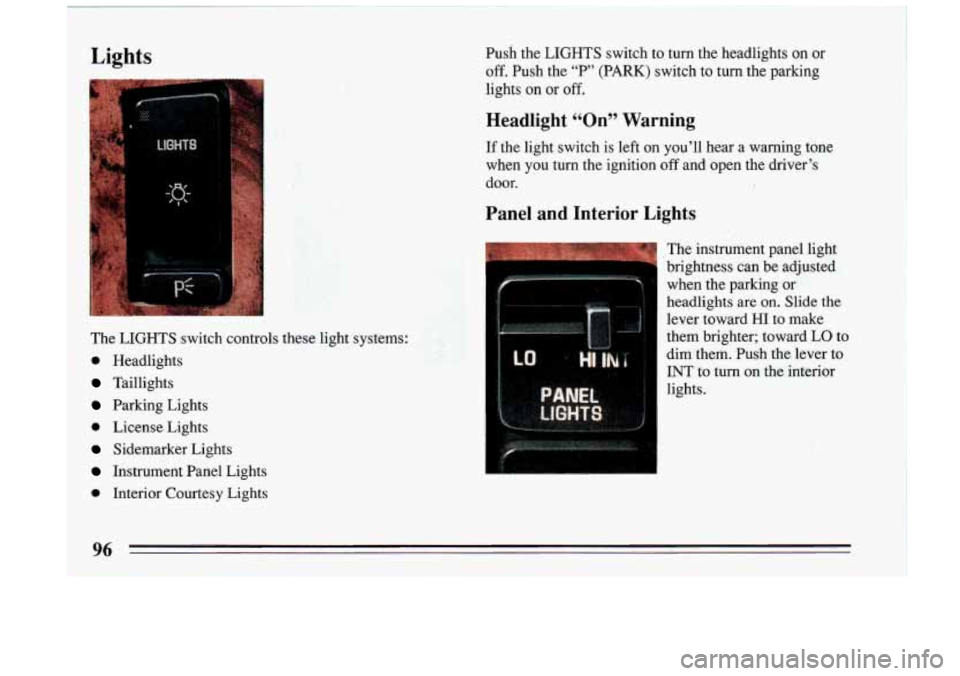
Cruise and Resume Lights
The CRUISE light tells you
when you have your cruise
control on.
The RESUME light comes
on when you push the
Resume/Accelerate button until you reach
yov set
speed again.
Page 98 of 324
Lights
'
1 0 Headlights
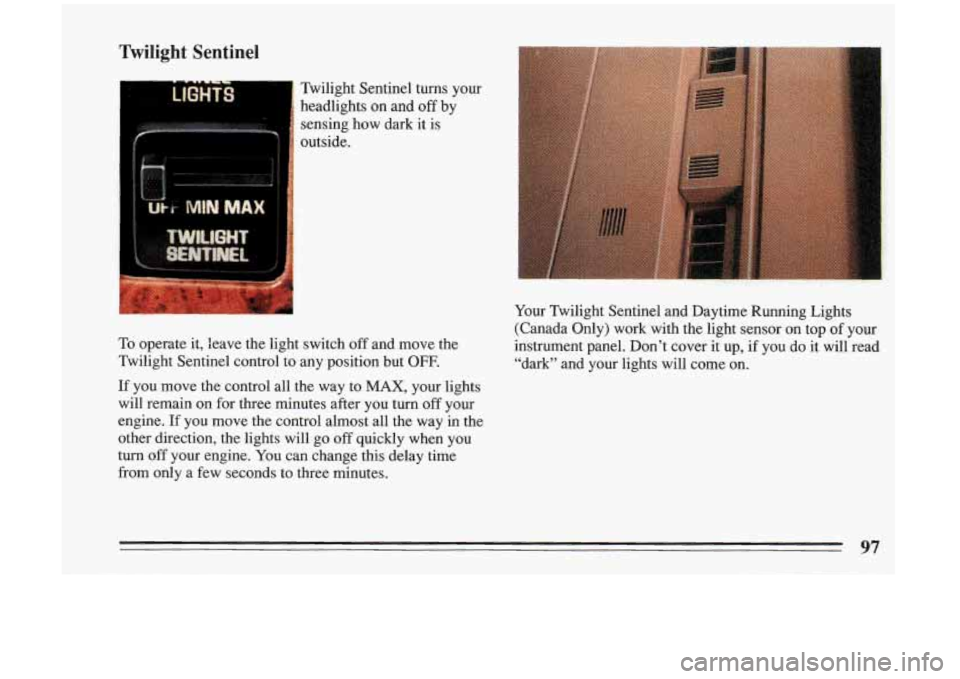
The LIGHTS switch controls these light systems:
Taillights
Parking Lights
0 License Lights
Sidemarker Lights
Instrument Panel Lights
0 Interior Courtesy Lights
Push the LIGHTS switch to turn the
headlights on or
off. Push the "P" (PARK) switch to turn the parking
lights
on or off.
Headlight ''On" Warning
If the light switch is left on you'll hear a warning tone
when you turn the ignition off and open the driver's
door.
\,
Panel and Interior Lights
The instrument panel light
brightness can be adjusted when the parking or
headlights are
on. Slide the
lever toward HI to make
them brighter; toward
LO to
dim them. Push the lever to
INT to
turn on the interior
lights.
96
Page 99 of 324
Twilight Sentinel
Twilight Sentinel turns your headlights
on and off by
sensing how dark it
is
outside.
To operate
it, leave the light switch off and move the
Twilight Sentinel control to any position but
OFF.
If you move the control. all the way to MAX, your lights
will remain on for three minutes after you turn
off your
engine.
If you move the control almost all the way in the
other direction, the lights will
go off quickly when you
turn off your engine. You can change this delay time
from only a few seconds to three minutes. Your
Twilight Sentinel and Daytime Running Lights
(Canada Only) work with the light sensor
on top of your
instrument panel. Don’t cover it up, if you
do it will read
“dark” and your lights will come on.
97
Page 100 of 324
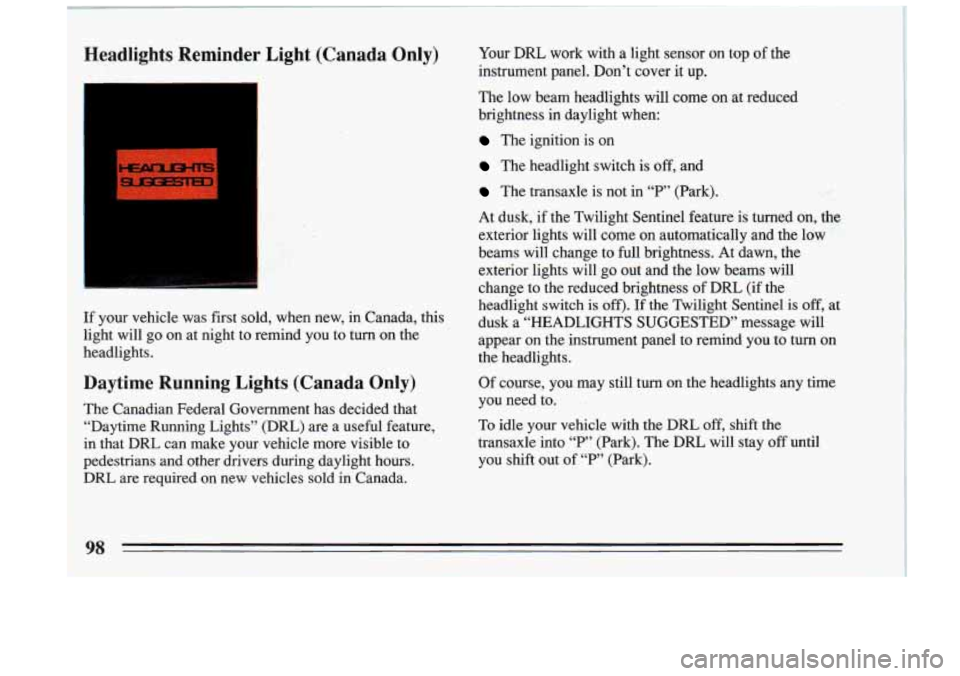
-Headlights Reminder Light (Canada Only)
If your vehicle was first sold, when new, in Canada, this
light will go on at night to remind you to turn on the
headlights.
Daytime Running Lights (Canada Only)
The Canadian Federal Government has decided that
“Daytime Running Lights” (DRL) are a useful feature,
in that DRL can make your vehicle more visible to
pedestrians and other drivers during daylight hours.
DRL are required on new vehicles sold in Canada. Your
DRL work with a light sensor on
top of the
instrument panel. Don’t cover it up.
The low beam headlights will come
on at reduced
brightness in daylight when:
The ignition is on.
The headlight switch is off, and
The transaxle is not in “P” (Park).
At dusk, if the Twilight Sentinel feature is turned
on, the
exterior lights will come on automatically and the low
beams will change to
full brightness. At dawn, the
exterior lights will
go out and the low beams will
change to the reduced brightness of DRL (if the
headlight switch is
off). If the Twilight Sentinel is off, at
dusk a “HEADLIGHTS SUGGESTED” message will
appear on the instrument panel to remind you to turn. on
the headlights.
Of course, you may still turn on the headlights any time
you need to.
.
To idle your vehicle with the DRL off, shift the
transaxle into
T“ (Park). The DRL will stay off until
you shift out of “P”.(Park).
98
Page 102 of 324
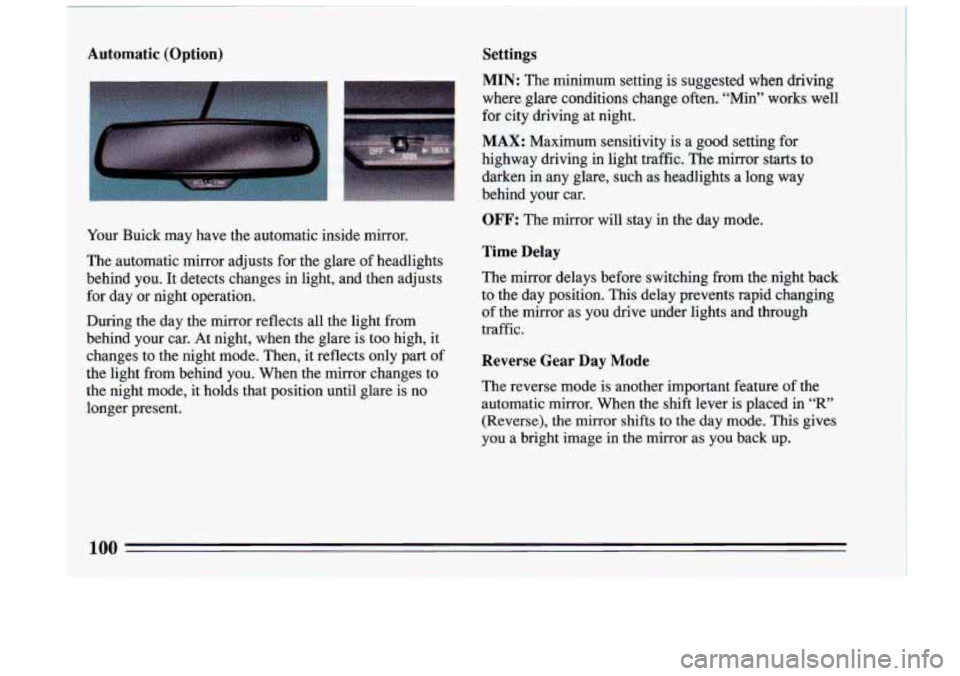
Automatic (Option) Settings
Your Buick may have the automatic inside mirror.
The automatic mirror adjusts for the glare of headlights
behind you.
It detects changes in light, and then adjusts
for day or night operatiol-~
During the day the mirror reflects all the light from
behind your car. At night, when the glare is too high, it
changes to the night mode. Then,
it reflects only part of
the light from behind you. When the mirror changes to
the night mode, it holds that position until glare is no
longer present.
MIN: The minimum setting is suggested when driving
where glare conditions change
often. '"in" works well
for city driving at night.
MAX: Maximum sensitivity is a good setting for
highway driving in light traffic. The mirror
starts to
darken in any glare, such as headlights a long way
behind your car.
OFF: The mirror will stay in the day mode.
Time Delay
The mirror delays before switching from the night back
to the day position.
This delay prevents rapid changing
of the mirror as you drive under lights and through
traffic.
Reverse Gear Day Mode
The reverse mode is another important feature of the
automatic mirror. When the shift lever is placed in
"R"
(Reverse), the mirror shifts to the day mode. This gives
you a bright image in the mirror as you back up.
I
100
Page 109 of 324

Trip Odometer
I
Warning Lights, Gages and Indicators
A trip odometer can tell you
how many miles you have Warning lights and gages can signal t\
hat something is
driven since you last set it wrong before it becomes serious enough to cause an
back to zero.
TO reset, push expensive repair or replacement. Paying attention to
the button. your warning lights and gages could also save you or
others from injury.
Warning lights go on when there may be or
is a problem
with one
of your vehicle's functions. As you will see in
the details on the next few pages, some warning lights come on briefly when you turn the ignition key just to
let you know they're working.
If you are familiar with
this section, you should not be alarmed when this
happens.
This section describes the warning lights and gages that
are on your vehicle. The pictures will help
you locate
them. Gages can indicate when there may be or is a problem
with one
of your vehicle's functions. Often gages and
warning lights work together to let you know when
there's a problem with your vehicle.
When one of the warning lights comes on and stays on
when you are driving, or when one of the gages shows
there may be a problem, check the section that tells
you
what to do about it. Please follow the manual's advice.
Waiting to do repairs can be costly
-- and even
dangerous.
So please get to know your warning lights
and gages. They're a big help.
107
Page 147 of 324
Symbols on Road Signs
There are many international road signs in use today.
The basic message
of many of these signs is in pictures
or graphic symbols.
A picture within a circle with a
diagonal line across it shows what
not to do.
Traffic Lights
1
L
'1
145
Page 148 of 324

We’re all familiar with traffic lights or stop lights. Often
green arrows are being used in the lights for improved
traffic control. On some multilane roads, green arrows light up, indicating that traffic
in one or more lanes can
move or make
a turn. Green arrows don’t mean “go no
matter what.” You’ll still need to proceed with caution,
yielding the right of way to pedestrians and sometimes
to other vehicles.
Some traffic lights also use red arrows to signify that
you must stop before turning on red.
REVERSIBLE LANE
0.N
LANE
ROADWAY MULTI-
time. A green arrow means you may drive in that lane.
Look for
the signs posted to warn drivers what hours
and days these systems are in effect.
Pavement Markings
NO
PASSING ZONE
I
I
Pavement markings add to traffic signs and signals.
They give information to drivers without taking
attention from the roadway.
A solid yellow line on your
side of the road or lane means “don’t cross.”
I
I
I
Many city roads and expressways, and even bridges, use
reversible-lane traffic control during rush hours.
A red X
light above a lane means no driving in that lane at that