1991 MITSUBISHI ECLIPSE ABS
[x] Cancel search: ABSPage 1077 of 1216
BODY - Service Adiistment Procedures23-33
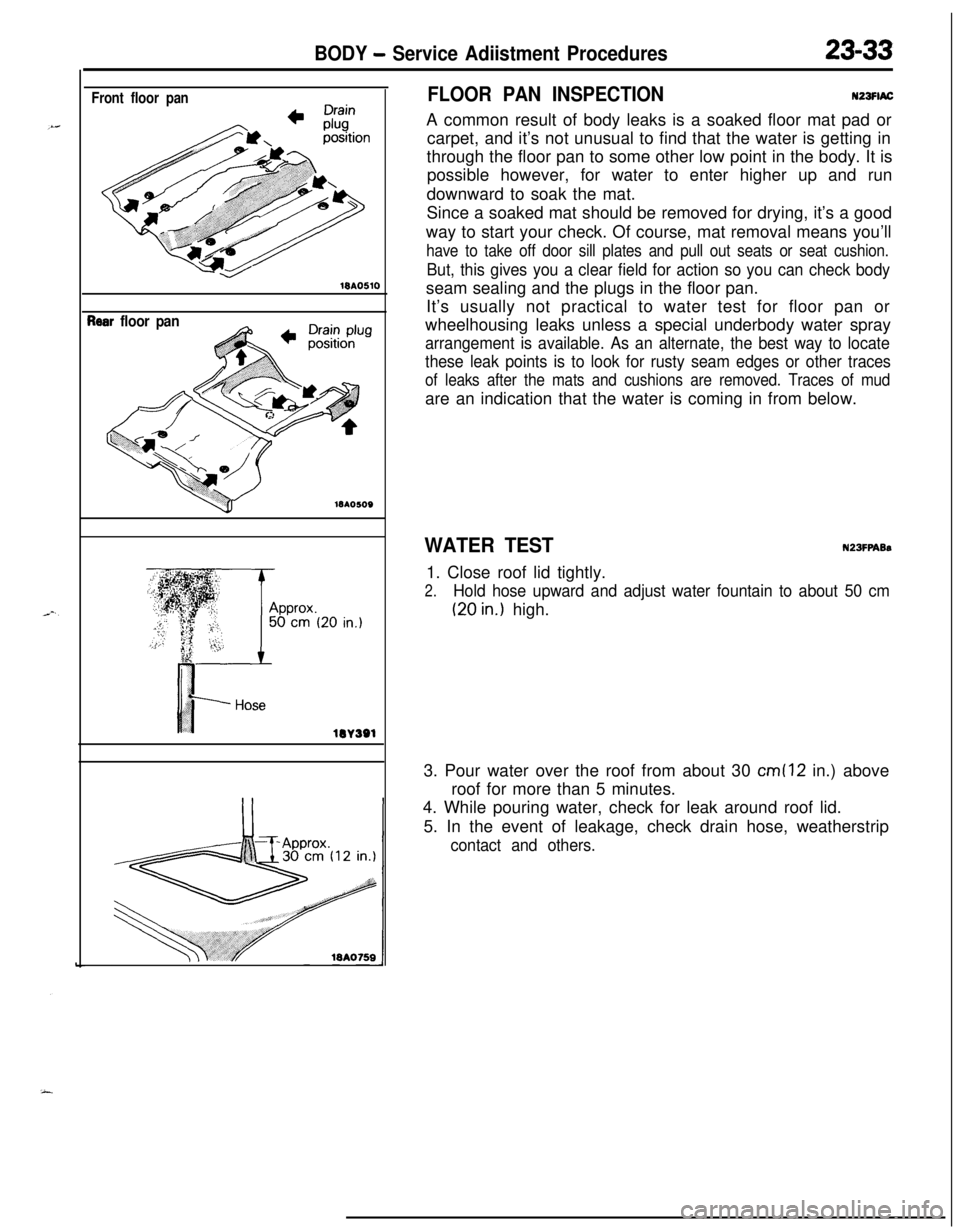
Front floor pan18AO510
?ear floor pan
lOA
lW391
FLOOR PAN INSPECTIONN23FlACA common result of body leaks is a soaked floor mat pad or
carpet, and it’s not unusual to find that the water is getting in
through the floor pan to some other low point in the body. It is
possible however, for water to enter higher up and run
downward to soak the mat.
Since a soaked mat should be removed for drying, it’s a good
way to start your check. Of course, mat removal means you’ll
have to take off door sill plates and pull out seats or seat cushion.
But, this gives you a clear field for action so you can check bodyseam sealing and the plugs in the floor pan.
It’s usually not practical to water test for floor pan or
wheelhousing leaks unless a special underbody water spray
arrangement is available. As an alternate, the best way to locate
these leak points is to look for rusty seam edges or other traces
of leaks after the mats and cushions are removed. Traces of mudare an indication that the water is coming in from below.
WATER TESTN23FPABs1. Close roof lid tightly.
2.Hold hose upward and adjust water fountain to about 50 cm
(20 in.) high.
3. Pour water over the roof from about 30
cm (12 in.) above
roof for more than 5 minutes.
4. While pouring water, check for leak around roof lid.
5. In the event of leakage, check drain hose, weatherstrip
contact and others.
Page 1085 of 1216
BODY - Front Bumper23-41
DISASSEMBLY ANDREASSEMBLY
< Normal type >
-
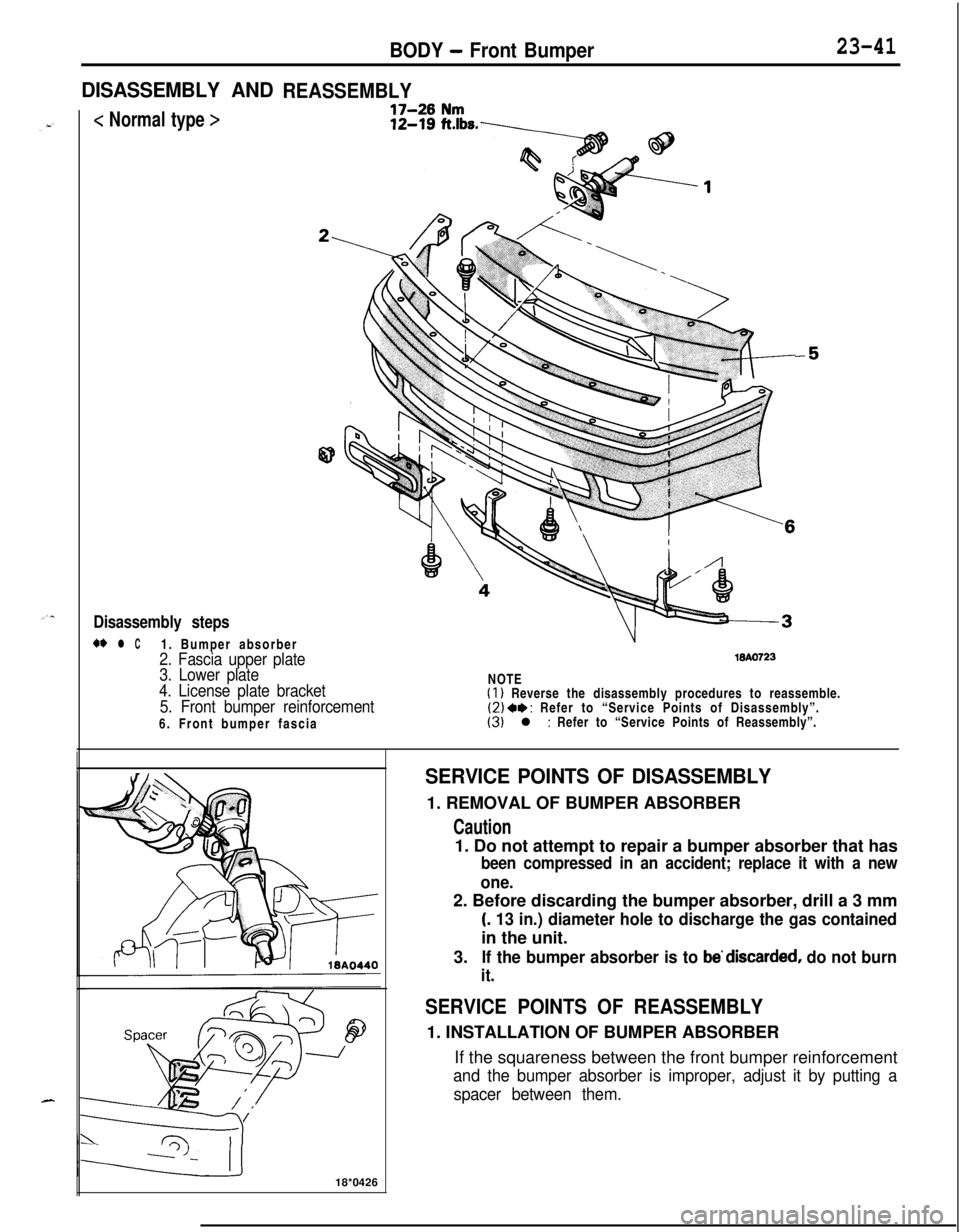
Disassembly steps
w l C1. Bumper absorber
2. Fascia upper plate
3. Lower plate18AO723
4. License plate bracket
5. Front bumper reinforcement6. Front bumper fasciaNOTE(1) Reverse the disassembly procedures to reassemble.(2) 4, : Refer to “Service Points of Disassembly”.(3) l : Refer to “Service Points of Reassembly”.
18*0426
SERVICE POINTS OF DISASSEMBLY1. REMOVAL OF BUMPER ABSORBER
Caution1. Do not attempt to repair a bumper absorber that has
been compressed in an accident; replace it with a new
one.2. Before discarding the bumper absorber, drill a 3 mm
(. 13 in.) diameter hole to discharge the gas containedin the unit.
3.
If the bumper absorber is to be’discarded, do not burn
it.
SERVICE POINTS OF REASSEMBLY1. INSTALLATION OF BUMPER ABSORBER
If the squareness between the front bumper reinforcement
and the bumper absorber is improper, adjust it by putting a
spacer between them.
Page 1086 of 1216
23-42BODY - Front Bumper
< Large type >
17-26 Nm
12-19
ftlbs.
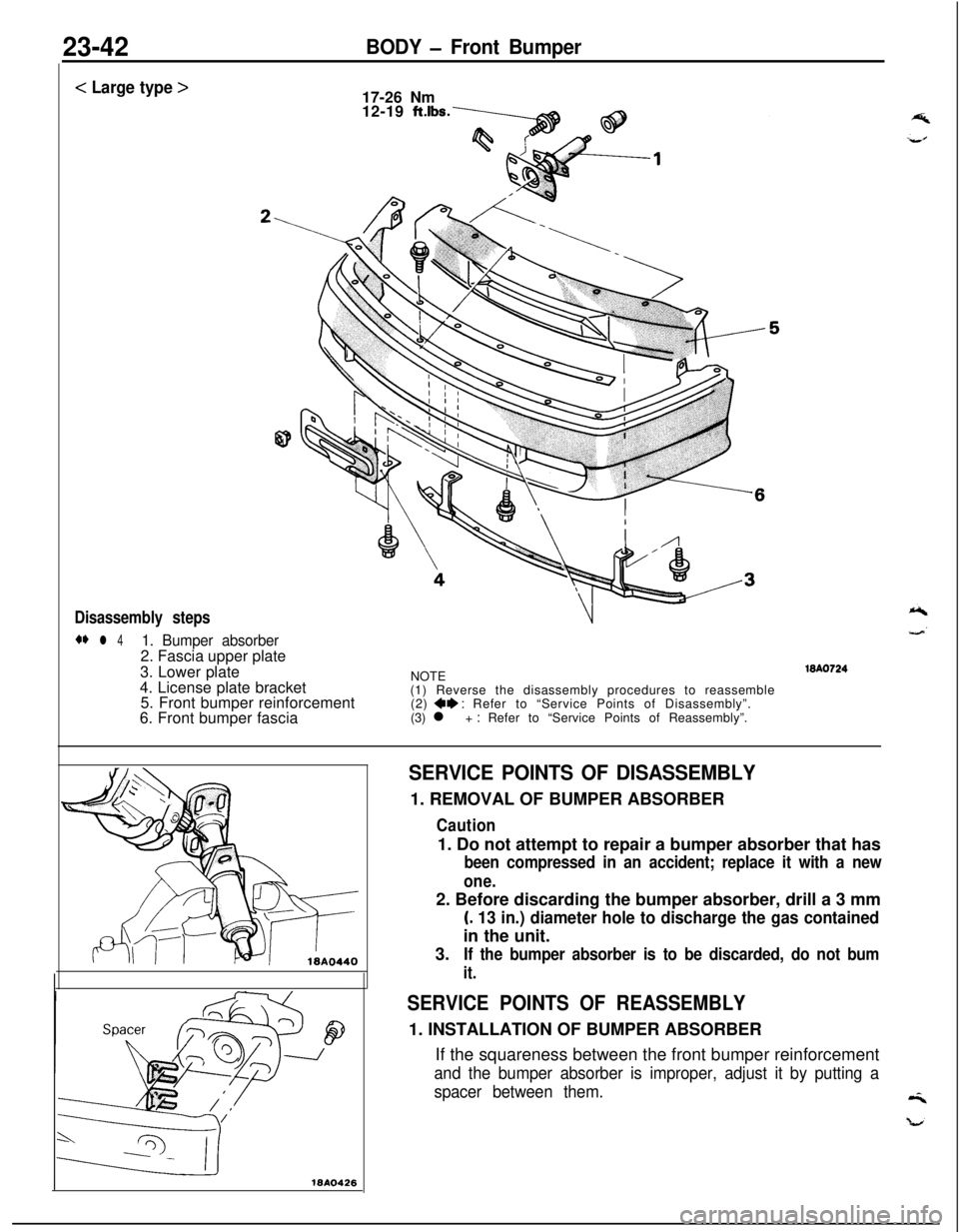
Disassembly steps
** l 41. Bumper absorber2. Fascia upper plate
3. Lower plate
4. License plate bracket
5. Front bumper reinforcement
6. Front bumper fasciaNOTE
(1) Reverse the disassembly procedures to reassemble
(2)
+e : Refer to “Service Points of Disassembly”.
(3) l + : Refer to “Service Points of Reassembly”.WA0724
18410426
SERVICE POINTS OF DISASSEMBLY1. REMOVAL OF BUMPER ABSORBER
Caution1. Do not attempt to repair a bumper absorber that has
been compressed in an accident; replace it with a new
one.2. Before discarding the bumper absorber, drill a 3 mm
(. 13 in.) diameter hole to discharge the gas containedin the unit.
3.
If the bumper absorber is to be discarded, do not bum
it.
SERVICE POINTS OF REASSEMBLY1. INSTALLATION OF BUMPER ABSORBER
If the squareness between the front bumper reinforcement
and the bumper absorber is improper, adjust it by putting a
spacer between them.
Page 1089 of 1216
BODY - Rear Bummer23-45
DISASSEMBLY AND REASSEMBLY<
Normal type >
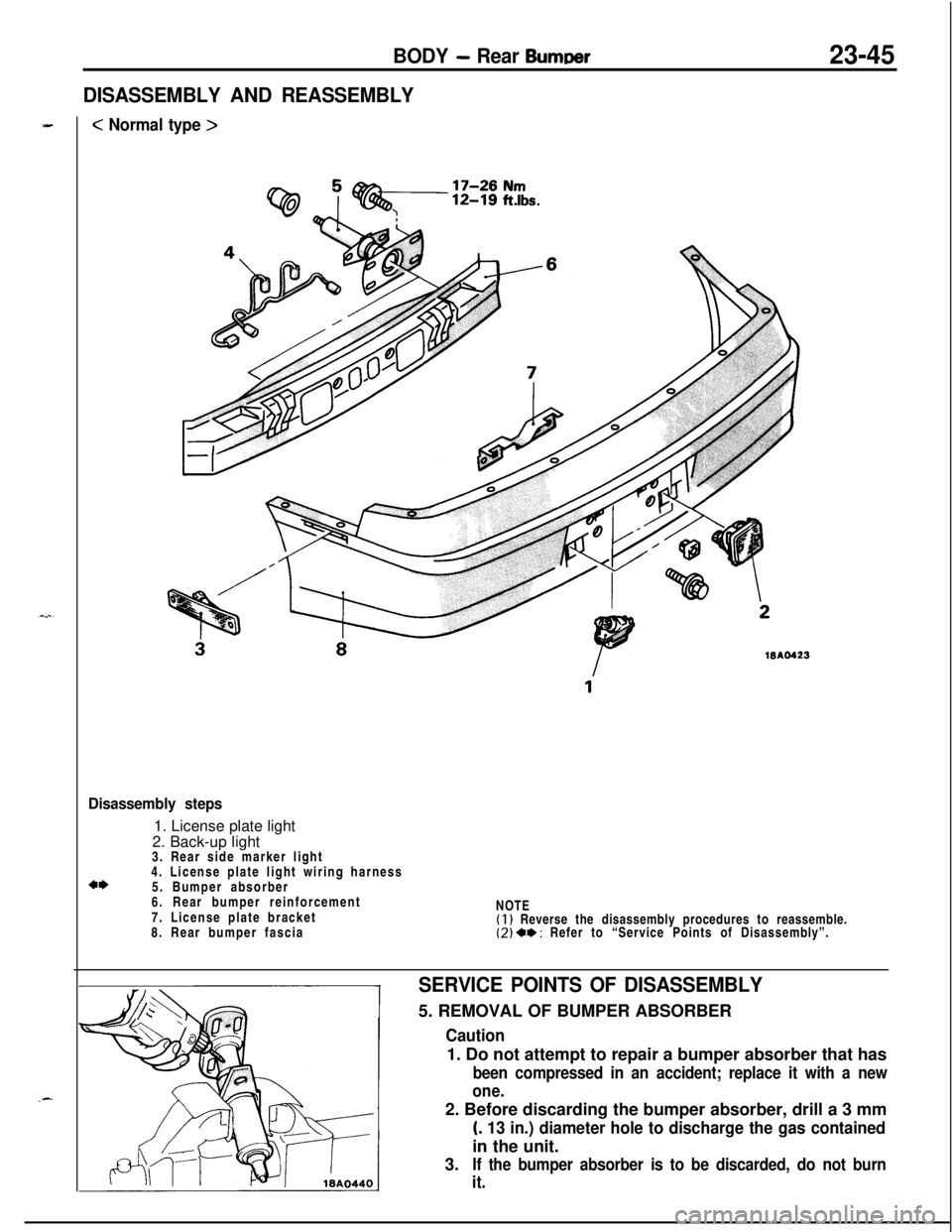
Disassembly steps1. License plate light
2. Back-up light
3. Rear side marker light
4. License plate light wiring harness
5. Bumper absorber
6. Rear bumper reinforcement
7. License plate bracket
8. Rear bumper fasciaNOTE
(1) Reverse the disassembly procedures to reassemble.(2) +* : Refer to “Service Points of Disassembly”.
SERVICE POINTS OF DISASSEMBLY5. REMOVAL OF BUMPER ABSORBER
Caution1. Do not attempt to repair a bumper absorber that has
been compressed in an accident; replace it with a new
one.2. Before discarding the bumper absorber, drill a 3 mm
(. 13 in.) diameter hole to discharge the gas containedin the unit.
3.
If the bumper absorber is to be discarded, do not burn
it.
Page 1090 of 1216
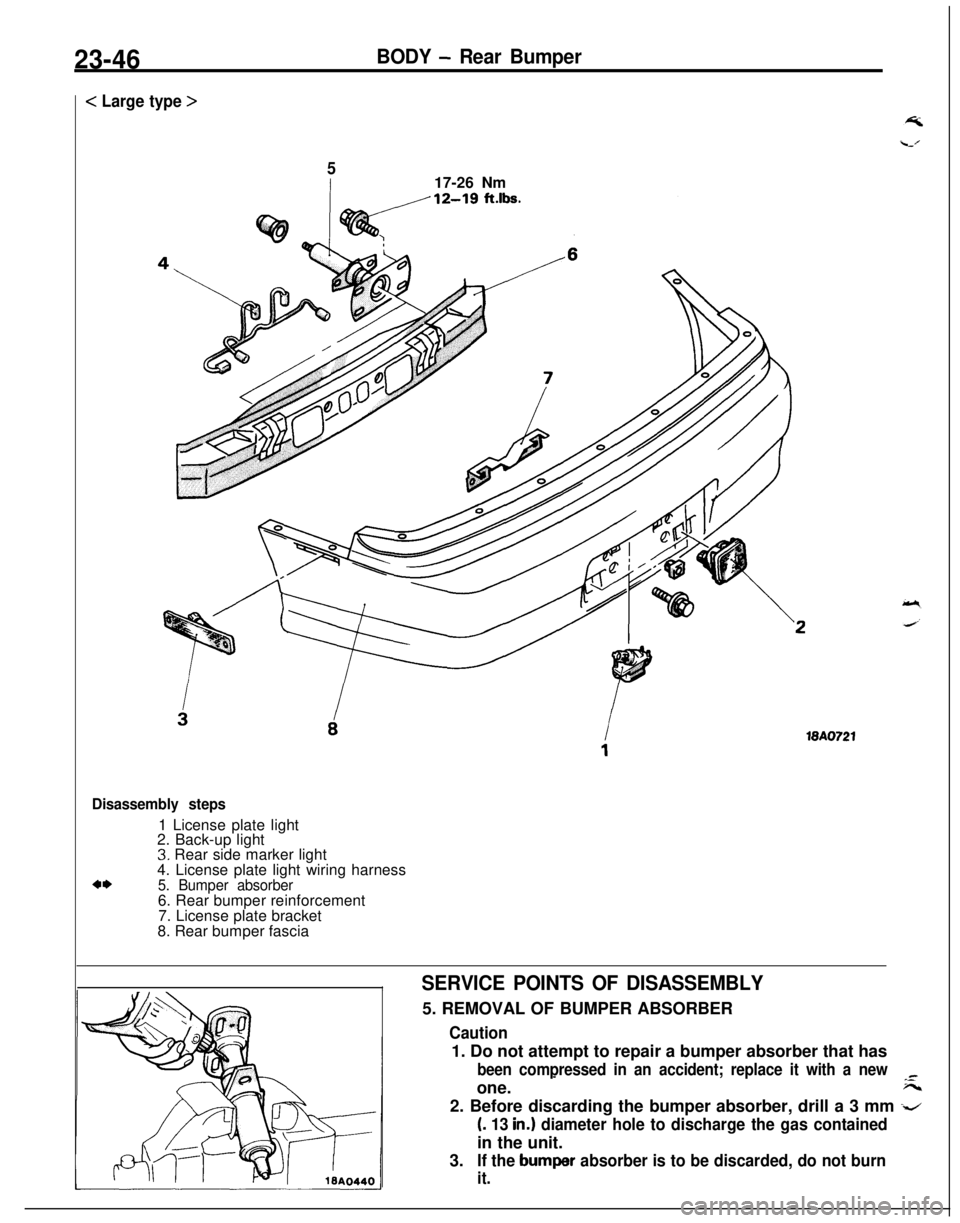
23-46BODY - Rear Bumper
< Large type >
517-26 Nm
18A0721
Disassembly steps1 License plate light
2. Back-up light
3. Rear side marker light
4. License plate light wiring harness
4*5. Bumper absorber6. Rear bumper reinforcement
7. License plate bracket
8. Rear bumper fascia
SERVICE POINTS OF DISASSEMBLY5. REMOVAL OF BUMPER ABSORBER
Caution1. Do not attempt to repair a bumper absorber that has
been compressed in an accident; replace it with a new-one.
-F--2. Before discarding the bumper absorber, drill a 3 mm
-z
(. 13 in.1 diameter hole to discharge the gas containedin the unit.
3.
If the bumper absorber is to be discarded, do not burn
it.
Page 1135 of 1216
\&Front seat’s rearz-2 bracketarea mounting
1Lanchor\
coverForward tabB-B cross-se")
-
BODY - Front Seat23-91
Bolts
19AO308
FrontFront seat forward
installation bracket
A-A cross-section
Forward tab
.)\&Front seat’s rearz-2 bracketarea mounting
1Lanchor\
coverForward tabB-B cross-section19A0124
Slid; railSlide kail’sreararea mounting
bracketWA0302
SERVICE POINTS OF INSTALLATION
5. INSTALLATION OF SEAT MOUNTING NUTW4. SEAT
MOUNTING BOLTS
After checking that the seat adjuster is locked at both sides,
provisionally tighten (in the
A,B,C and D sequence) the seat
mounting nuts and the seat mounting bolts; then fully tighten
at the specified torque.
2. INSTALLATION OF SEAT ANCHOR COVERS
(1) Securely install the front side seat.anchor forward tab tothe front seat forward installation bracket.
(21 Turn the seat anchor cover in the direction indicated by
the arrow, and install the tab at the side part to the holein the bracket side part.
(3) Securely install the rear side seat anchor cover rearwardtab to the front seat rearward installation bracket.
(4) Turn the seat anchor cover in the direction indicated by
the arrow and insert the side tabs into the holes in the
front seat rearward installation bracket side part.1. INSTALLATION OF SLIDER RAIL ANCHOR COVERS
Securely the rear
pawl of the slider rail anchor cover to the
mounting bracket on the rear of the slider rail, and mount theslider rail anchor cover, turning its front area.
Page 1154 of 1216
24-10HEATERS AND AIR CONDITIONING - Safety Precautions
SAFETY PRECAUTIONSN24PAAD
The refrigerant used in all air conditioner is R-l 2. It istransparent and colorless in both the liquid and
vapor state. Since it has a boiling point of
-29.8”C(-85.6”F).
at atmospheric pressure, it will be a vapor
at all normal temperatures and pressures. The vaporis heavier than air, non-flammable, and nonexplo-
sive. It is nonpoisonous except when it is in direct
contact with open flame. It
ia noncorrosive except
when combined with water. The following precau-
tions must be observed when handling
R-12.Caution
Wear safety goggles when servicing the refriger-ation system.
R-12 evaporates so rapidly at normal atmospheric
pressures and temperatures that it tends to freeze
anything it contacts. For this reason, extreme care
must be taken to prevent any liquid refrigerant from
contacting the skin and especially the eyes. Always
wear safety goggles when servicing the refrigera-
tion part of the air conditioning system. Keep a
bottle of sterile mineral oil handy when working on
the refrigeration system. Should any liquid re-
frigerant get into the eyes, use a few drops of
mineral oil to wash them out.
R-12 is rapidly
absorbed by the oil. Next splash the eyes with
plenty of cold water. Call your doctor immediately
even though irritation has ceased after treatment.
Caution
Do not heat
R-12 above 40°C (104°F).In most instances, moderate heat is required to
bring the pressure of the refrigerant in its container
above the pressure of the system when charging or
adding refrigerant. A bucket or large pan of hot
water not over
40°C (104°F) is all the heat required
for this purpose. Do not heat the refrigerant contain-
er with a blow torch or any other means that would
raise temperature and pressure above this tempera-ture. Do not weld or steam clean on or near the
system components or refrigerant lines.
Caution
Keep
R-12 containers upright when charging the
system.When metering
R-12 into the refrigeration system,
keep the supply tank or cans in an upright position. Ifthe refrigerant container is on its side or upside
down, liquid refrigerant will enter the system and
damage the compressor.Caution
Always work in a well-ventilated room.
‘irrGood ventilation is vital in the working area. Always
discharge the refrigerant into the service bay ex-
haust system or outside the building. Large quanti-
ties of refrigerant vapor in a small, poorly ventilated
room can displace the air and cause suffocation.
Although
R-12 vapor is normally nonpoisonous,
contact with an open flame can cause the vapor to
become very poisonous. Do not discharge large
quantities of refrigerant in an area having an open
flame. A poisonous gas is produced when using theflame-type leak detector. Avoid inhaling the fumes
from the leak detector.
Caution
Do not allow liquid refrigerant to touch bright
metal.
Refrigerant will tarnish bright metal and chrome
surfaces, and in combination with moisture can
severely corrode all metal surfaces.
R-12 Refrigerant Bundling
Refrigerant Recycling
R-12 refrigerant is a chloro-floro-carbon (CFC) that
can contribute to the depletion of the ozone layer in
the upper atmosphere.A
Ozone filters out harmful radiation from the sun.
- -/.To assist in protecting the ozone layer, Mitsubishi
Motors Corporation
recomends that a R-12 re-
frigerant recycling device that meets SAE standard
J1991 be used.
Contact an automotive service equipment supplier
for refrigerant recycling equipment that is available
in your area.
Refer to the operating instructions provided with therecycling equipment for proper operation.
Page 1164 of 1216
24-20 HEATERS AND AIR CONDITIONING - Service Adjustment Procedures
20A0465
20A0466
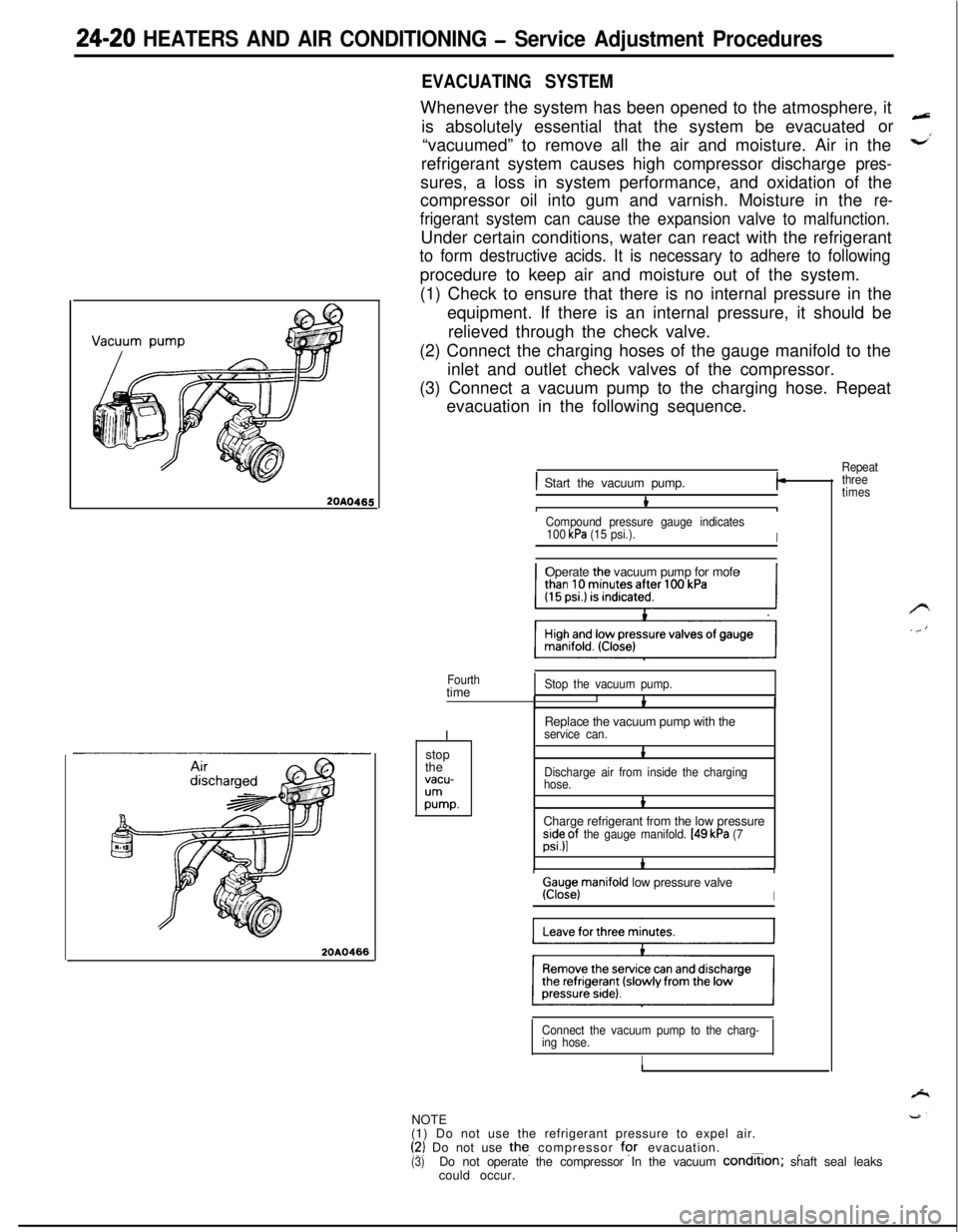
EVACUATING SYSTEMWhenever the system has been opened to the atmosphere, it
is absolutely essential that the system be evacuatedor
“vacuumed” to remove all the air and moisture. Air in the
refrigerant system causes high compressor discharge
pres-sures, a loss in system performance, and oxidation of the
compressor oil into gum and varnish. Moisture in the
re-
frigerant system can cause the expansion valve to malfunction.Under certain conditions, water can react with the refrigerant
to form destructive acids. It is necessary to adhere to followingprocedure to keep air and moisture out of the system.
(1) Check to ensure that there is no internal pressure in the
equipment. If there is an internal pressure, it should be
relieved through the check valve.
(2) Connect the charging hoses of the gauge manifold to the
inlet and outlet check valves of the compressor.
(3) Connect a vacuum pump to the charging hose. Repeat
evacuation in the following sequence.
Repeat
) Start the vacuum pump.I-
bIICompound pressure gauge indicates
100 kPa (15 psi.).IOperate the vacuum pump for mofe
Fourthtime
IStop the vacuum pump.IbReplace the vacuum pump with the
service can.stop
the
vacu-
;Ummp.
1
Discharge air from inside the charging
hose.
bCharge refrigerant from the low pressure
;s”;pf the gauge manifold. [49 kPa (7
Ga;iejmanifold low pressure valveI
Connect the vacuum pump to the charg-
ing hose.
INOTE
(1) Do not use the refrigerant pressure to expel air.
(‘2) Do not use the. compressor for evacuation.___(3)Do not operate the compressor In the vacuum condrtlon; shaft seal leaks
could occur.
three
times