Page 2169 of 4087
26. FINAL INSPECTION
(a) Check the operation of the body parts:wHood:
Auxiliary catch operates properly Hood locks securely
when closed
w Doors:
Door locks operate properly Doors close properly
w Luggage compartment door:
Door lock operates properly
w Seats:
Seat adjusts easily and locks securely in any position
Front seat back locks securely in any position Folding±
down rear seat backs lock securely
(b) Be sure to deliver a clean car. Especially check: wSteering wheel
w Shift lever knob
w All switch knobs
w Seats
MA±18
±
MAINTENANCE (1UZ ± FE)
WhereEverybodyKnowsYourName
Page 2170 of 4087

GENERAL MAINTENANCE
MA00M±03
There are the maintenance and inspection
items which are considered to be the owner's
responsibility. They can be performed by the
owner or be can have them done at a service
shop. These items include those which should
be checked on a daily basis, those which, in
most cases, do not require (special) tools and
those which are considered to be reasonable
for the owner to perform. Items and procedures
for general maintanance are as follows:
MA00P±04
OUTSIDE VEHICLE
1. TIRES
(a) Check the pressure with a gauge. Adjust ifnecessary.
(b) Check for cuts, damage or excessive wear.
2. WHEEL NUTS Wheel checking the tires, check the nuts for
looseness or for missing nuts. If necessary,
tighten them.
3. TIRE ROTATION It is recommended that tires be rotated every
12,000 km (7,500 miles).
4. WINDSHIELD WIPER BLADES Check for wear or cracks whenever they do not
wipe clean. Replace if necessary.
5. FLUID LEAKS
(a) Check underneath for leaking fuel, oil, water or
other fluid.
(b) If you smell gasoline fumes or notice any leak, have the cause found and corrected.
6. DOORS AND ENGINE HOOD
(a) Check that all doors including the trunk lid operate smoothly, and that all latches lock
securely.
(b) Check that the engine hood secondary latch secures the hood from opening when the
primary latch is released.
MA00R±05
INSIDE VEHICLE
7. LIGHTS
(a) C h e c k t h a t t h e h eadlights, stop lights,
tail±lights, turn signal lights, and other lights
are all working. (b) Check the headlight aiming.
8. WARNING LIGHT AND BUZZERS
Check that all warning lights and buzzers func-
tion properly.
9. HORN Check that it is working.
10. WINDSHIELD GLASS
Check for scratches, pits or abrasions.
11. WINDSHIELD WIPER AND WASHER
(a) Check operation of the wipers and washer.
(b) Check that the wipers do not streak.
12. WINDSHIELD DEFROSTER Check that the air comes out from the defroster
outlet when operating the heater air condition-
er at defroster mode.
13. REAR VIEW MIRROR
Check that it is mounted securely.
14. SUN VISORS Check that they move freely and are mounted
securely.
15. STEERING WHEEL Check that it has the specified freeplay. Be
alert for changes in steering condition, such as
hard steering, excessive freeplay or strange
noise.
16. SEATS
(a) Check that all front seat controls such as seat adjusters, seatback recliner, etc. operate
smoothly.
(b) Check that all latches lock securely in any position.
(c) Check that the locks hold securely in any latched position.
(d) Check that the head restraints move up and
down smoothly and that the locks hold securely
in ay latches position.
(e) For folding±down rear seat backs, check that the latches lock securely.
17. SEAT BELTS
(a) Ch e ck th a t th e se a t be lt syste m su ch as buckles, retractors and anchors operate
properly and smoothly.
(b) Check that the belt webbing is not cut, frayed,
worn or damaged.
18. ACCELERATOR PEDAL Check the pedal for smooth operation and un-
even pedal effort or catching.
±
MAINTENANCE (1UZ ± FE)MA±19
WhereEverybodyKnowsYourName
Page 2185 of 4087
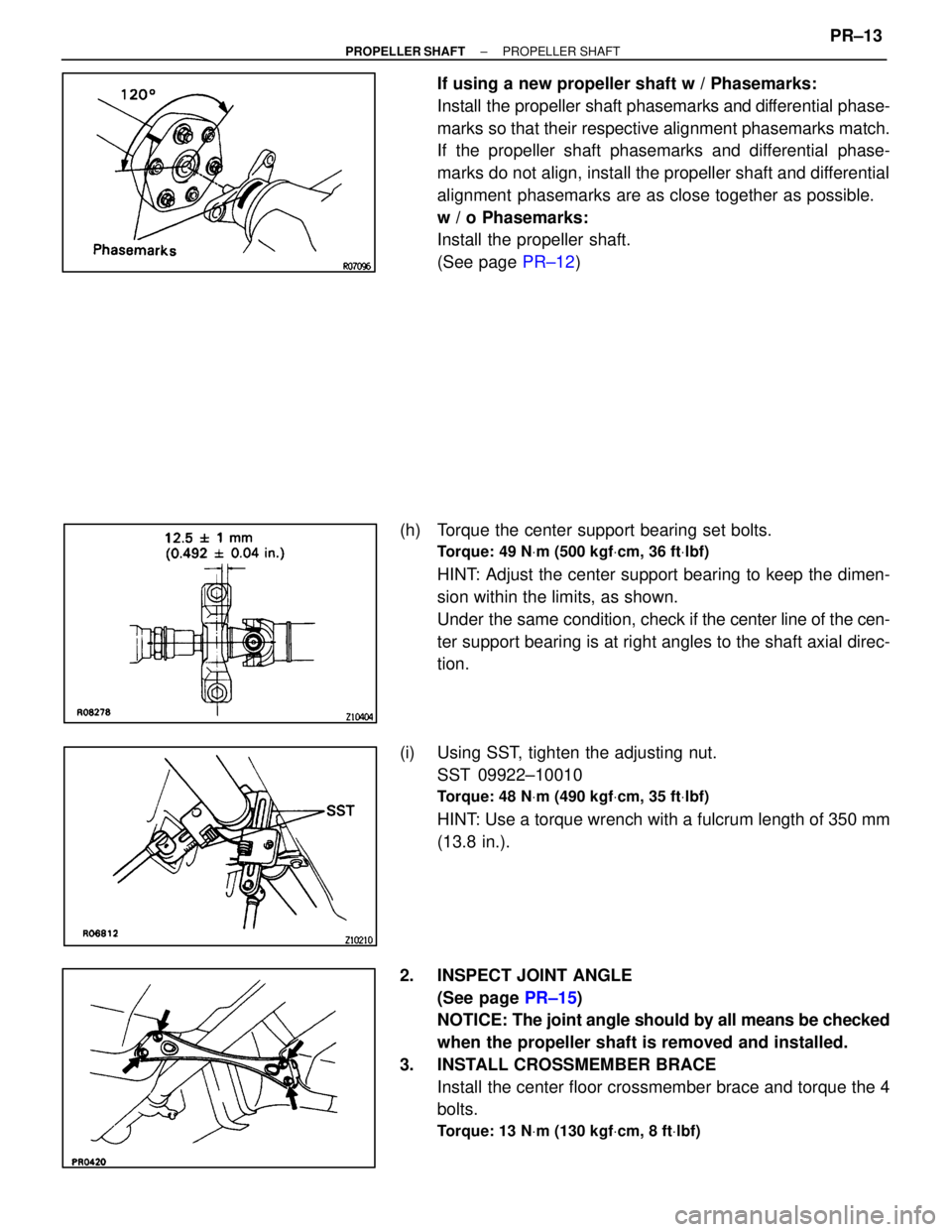
If using a new propeller shaft w / Phasemarks:
Install the propeller shaft phasemarks and differential phase-
marks so that their respective alignment phasemarks match.
If the propeller shaft phasemarks and differential phase-
marks do not align, install the propeller shaft and differential
alignment phasemarks are as close together as possible.
w / o Phasemarks:
Install the propeller shaft.
(See page PR±12)
(h) Torque the center support bearing set bolts.
Torque: 49 N Vm (500 kgf Vcm, 36 ft Vlbf)
HINT: Adjust the center support bearing to keep the dimen-
sion within the limits, as shown.
Under the same condition, check if the center line of the cen-
ter support bearing is at right angles to the shaft axial direc-
tion.
(i) Using SST, tighten the adjusting nut. SST 09922±10010
Torque: 48 N Vm (490 kgf Vcm, 35 ft Vlbf)
HINT: Use a torque wrench with a fulcrum length of 350 mm
(13.8 in.).
2. INSPECT JOINT ANGLE (See page PR±15)
NOTICE: The joint angle should by all means be checked
when the propeller shaft is removed and installed.
3. INSTALL CROSSMEMBER BRACE Install the center floor crossmember brace and torque the 4
bolts.
Torque: 13 N Vm (130 kgf Vcm, 8 ft Vlbf)
±
PROPELLER SHAFT PROPELLER SHAFTPR±13
WhereEverybodyKnowsYourName
Page 2201 of 4087
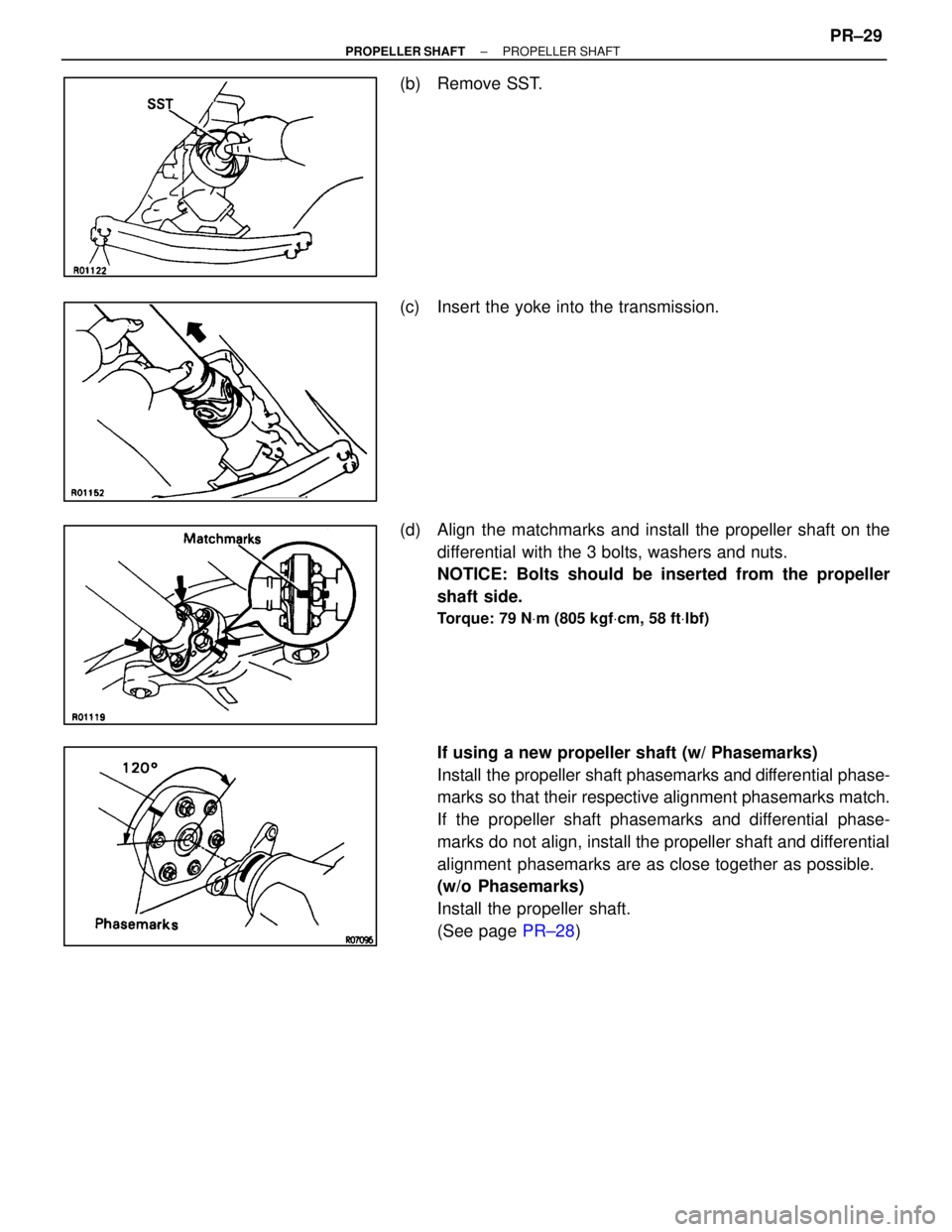
(b) Remove SST.
(c) Insert the yoke into the transmission.
(d) Align the matchmarks and install the propeller shaft on thedifferential with the 3 bolts, washers and nuts.
NOTICE: Bolts should be inserted from the propeller
shaft side.
Torque: 79 N Vm (805 kgf Vcm, 58 ft Vlbf)
If using a new propeller shaft (w/ Phasemarks)
Install the propeller shaft phasemarks and differential phase-
marks so that their respective alignment phasemarks match.
If the propeller shaft phasemarks and differential phase-
marks do not align, install the propeller shaft and differential
alignment phasemarks are as close together as possible.
(w/o Phasemarks)
Install the propeller shaft.
(See page PR±28)
±
PROPELLER SHAFT PROPELLER SHAFTPR±29
WhereEverybodyKnowsYourName
Page 2284 of 4087
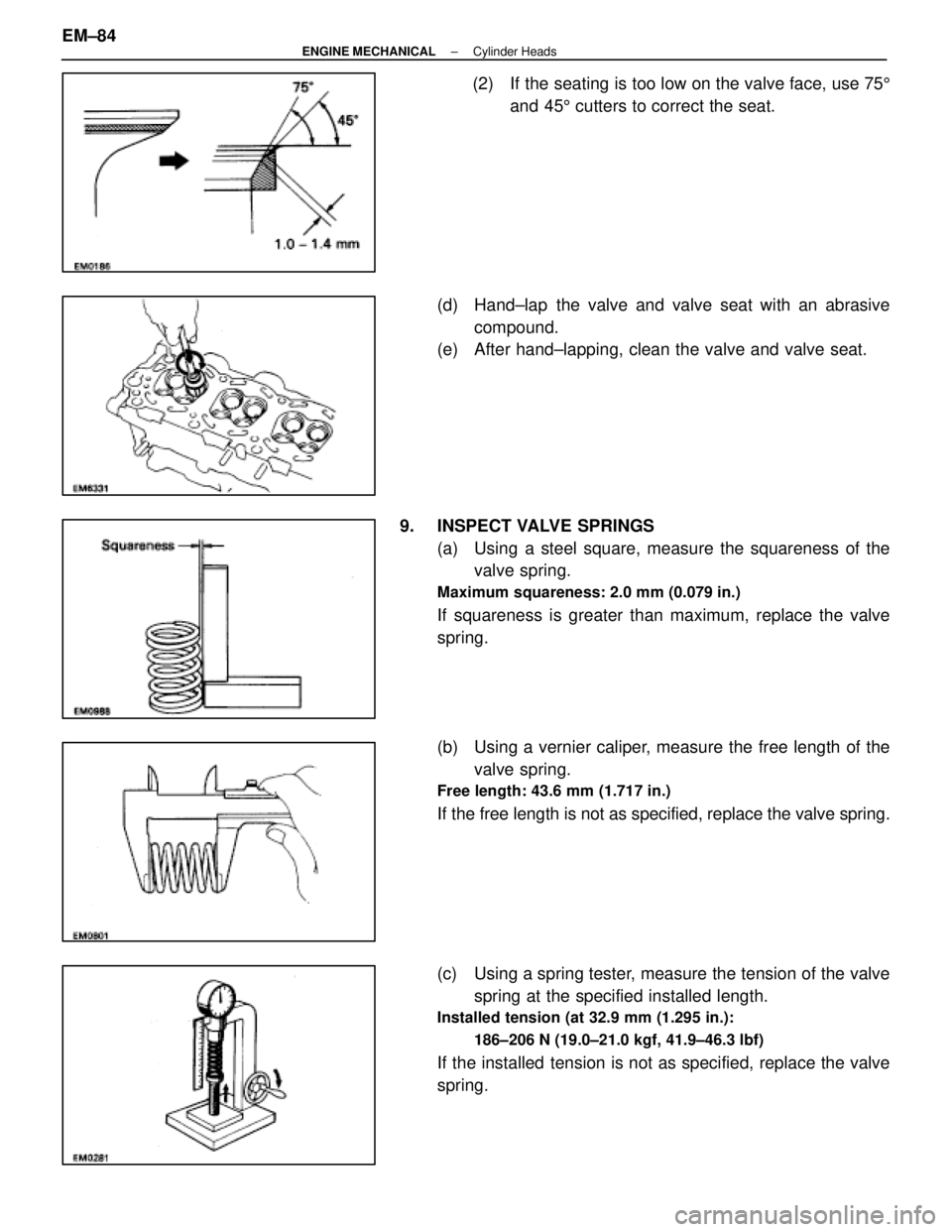
(2) If the seating is too low on the valve face, use 755
and 45 5 cutters to correct the seat.
(d) Hand±lap the valve and valve seat with an abrasive compound.
(e) After hand±lapping, clean the valve and valve seat.
9. INSPECT VALVE SPRINGS (a) Using a steel square, measure the squareness of thevalve spring.
Maximum squareness: 2.0 mm (0.079 in.)
If squareness is greater than maximum, replace the valve
spring.
(b) Using a vernier caliper, measure the free length of the
valve spring.
Free length: 43.6 mm (1.717 in.)
If the free length is not as specified, replace the valve spring.
(c) Using a spring tester, measure the tension of the valvespring at the specified installed length.
Installed tension (at 32.9 mm (1.295 in.):
186±206 N (19.0±21.0 kgf, 41.9±46.3 lbf)
If the installed tension is not as specified, replace the valve
spring.
EM±84
±
ENGINE MECHANICAL Cylinder Heads
WhereEverybodyKnowsYourName
Page 2354 of 4087
ASSEMBLY OF PISTON AND
CONNECTING ROD ASSEMBLIES
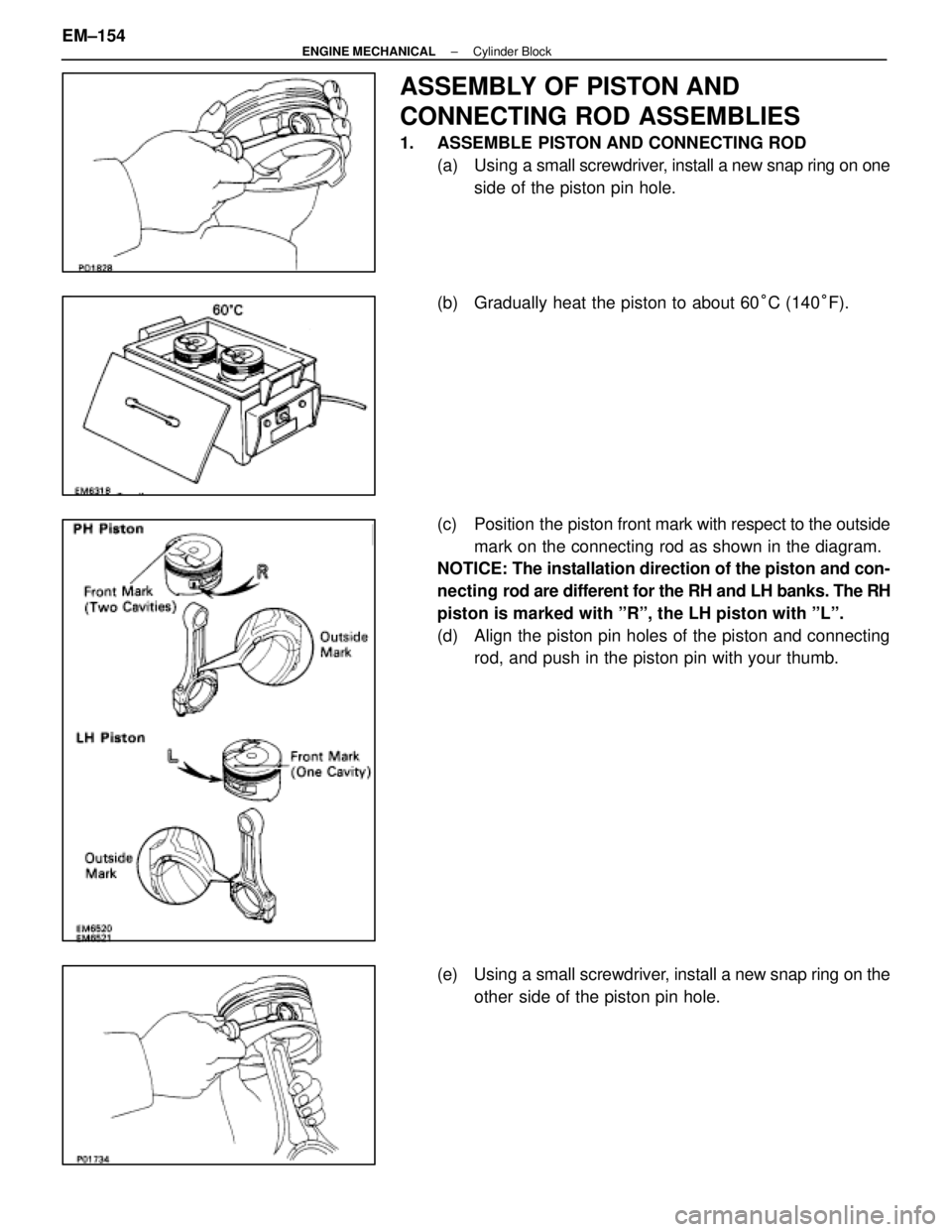
1. ASSEMBLE PISTON AND CONNECTING ROD(a) Using a small screwdriver, install a new snap ring on one
side of the piston pin hole.
(b) Gradually heat the piston to about 60 °C (140 °F).
(c) Position the piston front mark with respect to the outside
mark on the connecting rod as shown in the diagram.
NOTICE: The installation direction of the piston and con-
necting rod are different for the RH and LH banks. The RH
piston is marked with ºRº, the LH piston with ºLº.
(d) Align the piston pin holes of the piston and connecting rod, and push in the piston pin with your thumb.
(e) Using a small screwdriver, install a new snap ring on the
other side of the piston pin hole.
EM±154
±
ENGINE MECHANICAL Cylinder Block
WhereEverybodyKnowsYourName
Page 2396 of 4087
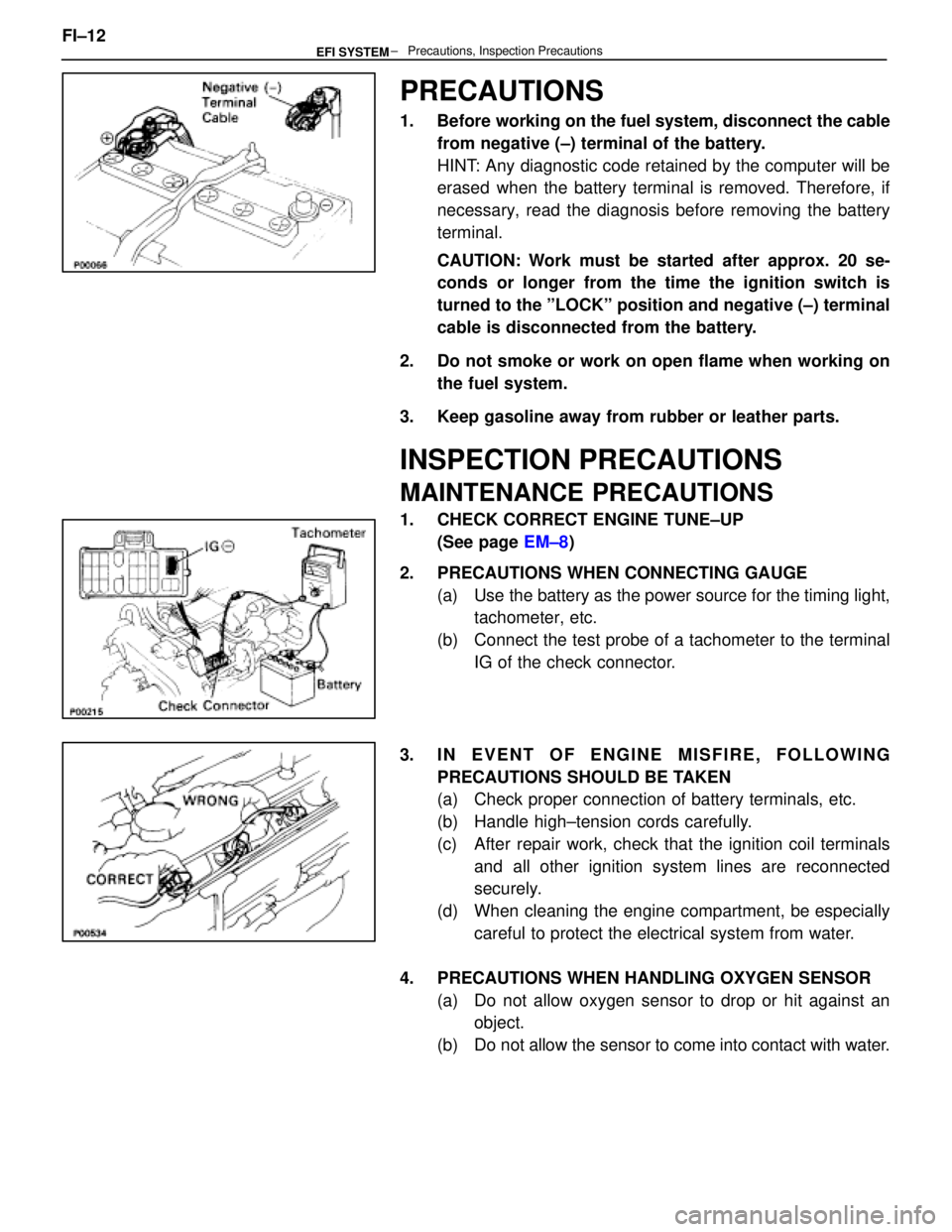
PRECAUTIONS
1. Before working on the fuel system, disconnect the cablefrom negative (±) terminal of the battery.
HINT: Any diagnostic code retained by the computer will be
erased when the battery terminal is removed. Therefore, if
necessary, read the diagnosis before removing the battery
terminal.
CAUTION: Work must be started after approx. 20 se-
conds or longer from the time the ignition switch is
turned to the ºLOCKº position and negative (±) terminal
cable is disconnected from the battery.
2. Do not smoke or work on open flame when working on the fuel system.
3. Keep gasoline away from rubber or leather parts.
INSPECTION PRECAUTIONS
MAINTENANCE PRECAUTIONS
1. CHECK CORRECT ENGINE TUNE±UP (See page EM±8)
2. PRECAUTIONS WHEN CONNECTING GAUGE (a) Use the battery as the power source for the timing light,tachometer, etc.
(b) Connect the test probe of a tachometer to the terminal IG of the check connector.
3. IN EVENT OF ENGINE MISFIRE, FOLLOWING PRECAUTIONS SHOULD BE TAKEN
(a) Check proper connection of battery terminals, etc.
(b) Handle high±tension cords carefully.
(c) After repair work, check that the ignition coil terminalsand all other ignition system lines are reconnected
securely.
(d) When cleaning the engine compartment, be especially careful to protect the electrical system from water.
4. PRECAUTIONS WHEN HANDLING OXYGEN SENSOR (a) Do not allow oxygen sensor to drop or hit against anobject.
(b) Do not allow the sensor to come into contact with water.
FI±12
± Precautions, Inspection PrecautionsEFI SYSTEM
WhereEverybodyKnowsYourName
Page 2703 of 4087
 Circuit
CIRCUIT DESCRIPTION
The HAC sensor is built into the ECU. This is a semiconductor pressure sens\
or with properties which cause i")
Diag. Code 35High Altitude Compensator Sensor
(HAC Sensor) Circuit
CIRCUIT DESCRIPTION
The HAC sensor is built into the ECU. This is a semiconductor pressure sens\
or with properties which cause its
electrical resistance to change when stress is applied to the sensor's crystal (silicon) (piezoelectric effect). This
sensor is used to detect the atmospheric (absolute) pressure and outputs cor\
responding electrical signals. Fluc-
tuations in the air pressure cause changes in the intake air density, which can cause deviations in the air±fuel
ratio. The signals from HAC sensor are used to make corrections for these fluct\
uations. If the ECU records diag-
nostic code º35º, the fail safe function operates and the atmospheric pressure is set at a\
constant 760 mmHg.
Code No.Diagnostic Code Detecting ConditionTrouble Area
35Open or short detected in HAC sensor circuit for 0.5
sec. or more.� ECU
DIAGNOSTIC CHARTDIAGNOSTIC CHART
Are there any other codes (besides Code 16)
being output?
Replace engine & ECT ECU. Go to relevant diag. code chart.
TR±92±
ENGINE TROUBLESHOOTING Circuit Inspection
WhereEverybodyKnowsYourName