1991 FORD FESTIVA wheel alignment
[x] Cancel search: wheel alignmentPage 42 of 454
Installation (All)
1. To install axle shaft, reverse removal procedure. Always install a NEW retaining circlip. Check seals at both ends of axle shaft. If
necessary, replace seals prior to installation. Lubricate transaxle seal lip with transaxle oil. See Fig. 1
.
2. After installing axle shaft into transaxle, pull axle shaft outward by hand to ensure proper engagement of retaining circlip and snap ring.
Install axle shaft into wheel hub. Align suspension alignment marks and tighten nuts.
INTERMEDIATE SHAFT
Removal
Intermediate shaft and axle shaft are removed as an assembly. See FWD AXLE SHAFTS under REMOVAL, DISASSEMBLY,
REASSEMBLY & INSTALLATION.
Disassembly
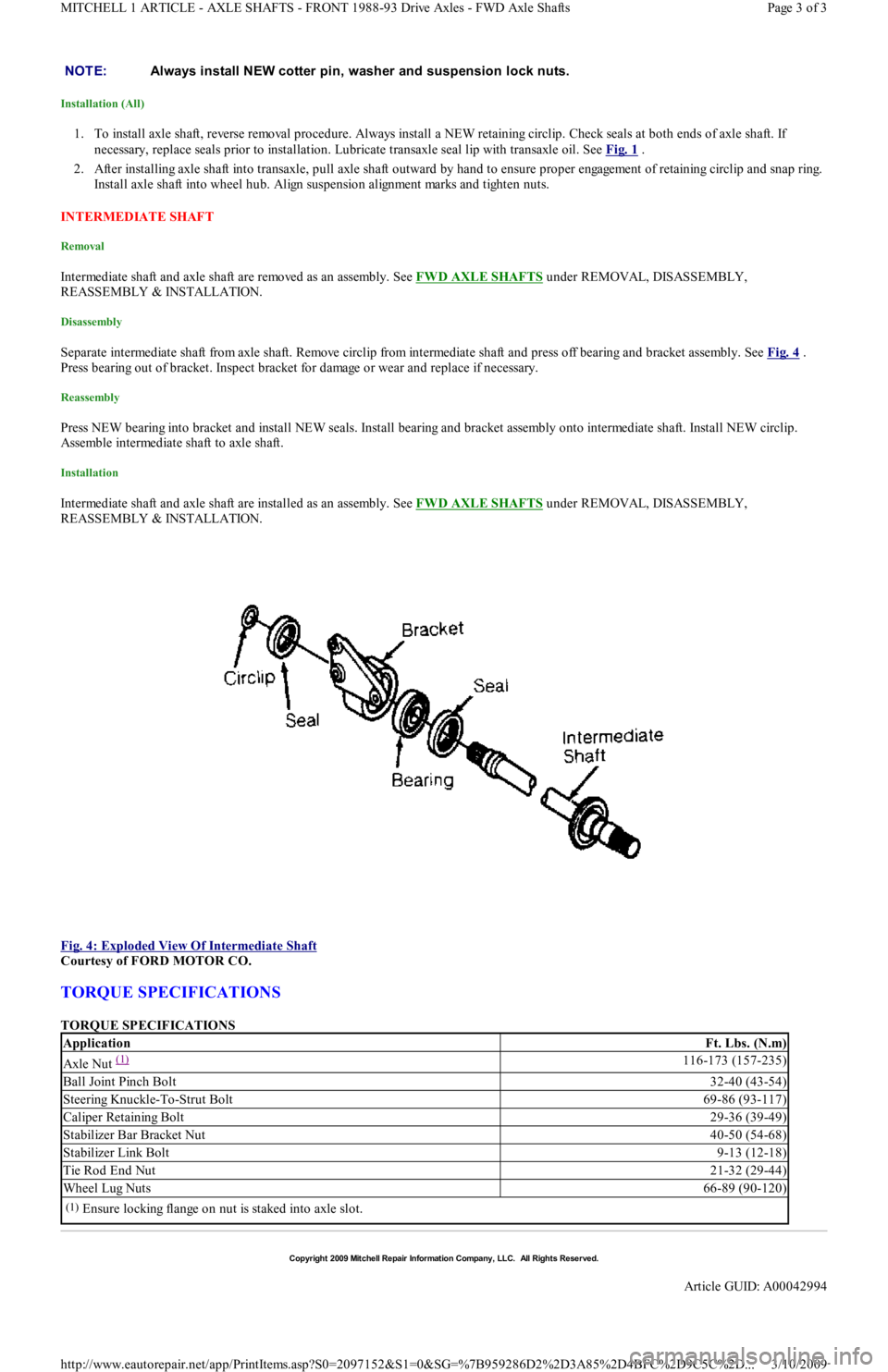
Separate intermediate shaft from axle shaft. Remove circlip from intermediate shaft and press off bearing and bracket assembly. See Fig. 4 .
Press bearing out of bracket. Inspect bracket for damage or wear and replace if necessary.
Reassembly
Press NEW bearing into bracket and install NEW seals. Install bearing and bracket assembly onto intermediate shaft. Install NEW circlip.
Assemble intermediate shaft to axle shaft.
Installation
Intermediate shaft and axle shaft are installed as an assembly. See FWD AXLE SHAFTS under REMOVAL, DISASSEMBLY,
REASSEMBLY & INSTALLATION.
Fig. 4: Exploded View Of Intermediate Shaft
Courtesy of FORD MOTOR CO.
TORQUE SPECIFICATIONS
TORQUE SPECIFICATIONS NOTE:Always install NEW cotter pin, washer and suspension lock nuts.
ApplicationFt. Lbs. (N.m)
Axle Nut (1) 116-173 (157-235)
Ball Joint Pinch Bolt32-40 (43-54)
Steering Knuckle-To-Strut Bolt69-86 (93-117)
Caliper Retaining Bolt29-36 (39-49)
Stabilizer Bar Bracket Nut40-50 (54-68)
Stabilizer Link Bolt9-13 (12-18)
Tie Rod End Nut21-32 (29-44)
Wheel Lug Nuts66-89 (90-120)
(1)Ensure locking flange on nut is staked into axle slot.
Copyr ight 2009 Mitchell Repair Information Company, LLC. All Rights Reserved.
Article GUID: A00042994
Page 3 of 3 MITCHELL 1 ARTICLE - AXLE SHAFTS - FRONT 1988-93 Drive Axles - FWD Axle Shafts
3/10/2009 http://www.eautorepair.net/app/PrintItems.asp?S0=2097152&S1=0&SG=%7B959286D2%2D3A85%2D4BFC%2D9C5C%2D
...
Page 107 of 454
Remove timing belt covers, See TIMING BELT COVER procedure to remove timing belt from this engine.
Installation (1.6L)
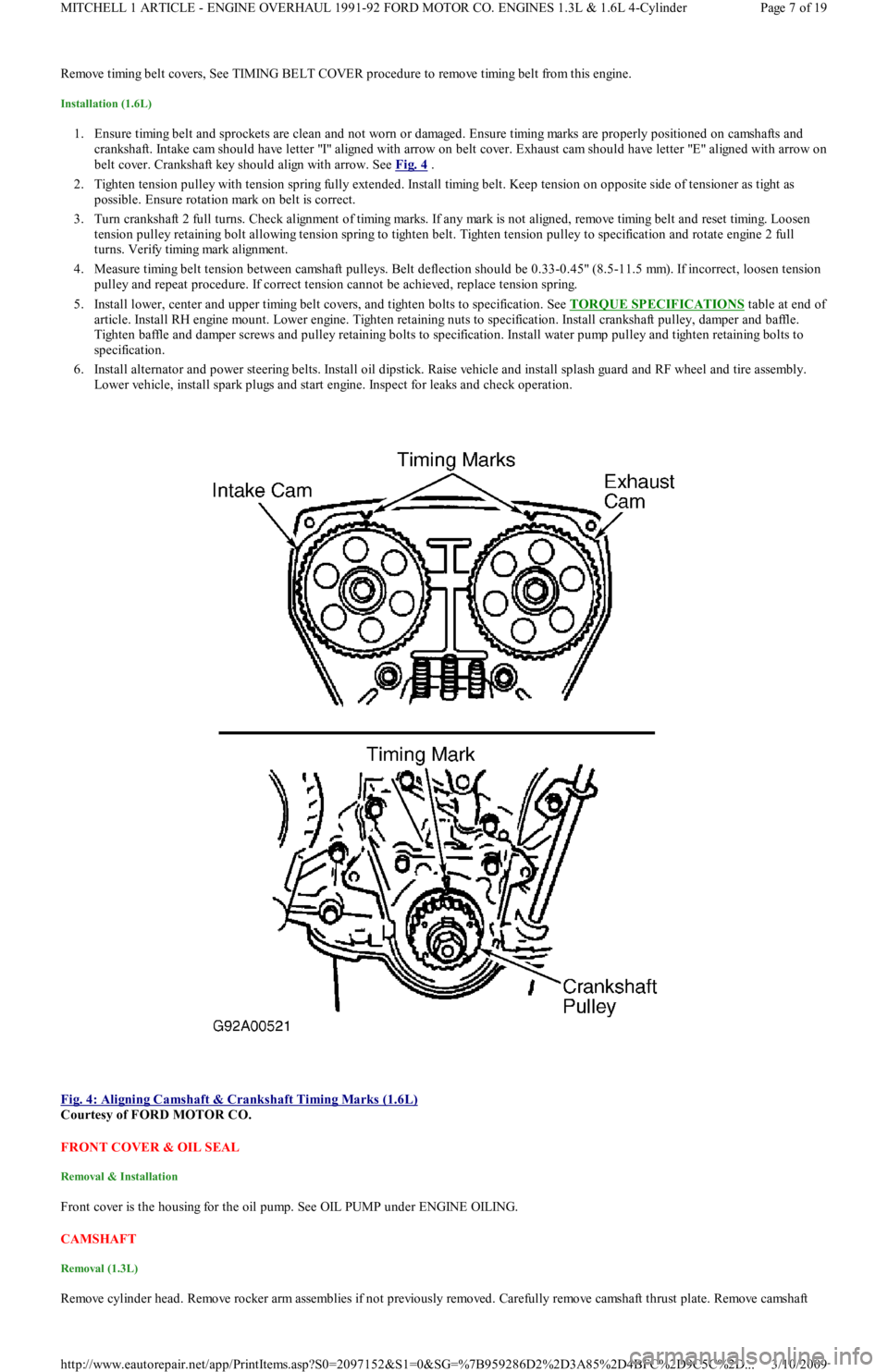
1. Ensure timing belt and sprockets are clean and not worn or damaged. Ensure timing marks are properly positioned on camshafts and
crankshaft. Intake cam should have letter "I" aligned with arrow on belt cover. Exhaust cam should have letter "E" aligned with arrow on
belt cover. Crankshaft key should align with arrow. See Fig. 4
.
2. Tighten tension pulley with tension spring fully extended. Install timing belt. Keep tension on opposite side of tensioner as tight as
possible. Ensure rotation mark on belt is correct.
3. Turn crankshaft 2 full turns. Check alignment of timing marks. If any mark is not aligned, remove timing belt and reset timing. Lo o se n
tension pulley retaining bolt allowing tension spring to tighten belt. Tighten tension pulley to specification and rotate engine 2 full
turns. Verify timing mark alignment.
4. Measure timing belt tension between camshaft pulleys. Belt deflection should be 0.33-0.45" (8.5-11.5 mm). If incorrect, loosen tension
pulley and repeat procedure. If correct tension cannot be achieved, replace tension spring.
5. Install lower, center and upper timing belt covers, and tighten bolts to specification. See TORQUE SPECIFICATIONS
table at end of
article. Install RH engine mount. Lower engine. Tighten retaining nuts to specification. Install crankshaft pulley, damper and baffle.
Tighten baffle and damper screws and pulley retaining bolts to specification. Install water pump pulley and tighten retaining bolts to
specification.
6. Install alternator and power steering belts. Install oil dipstick. Raise vehicle and install splash guard and RF wheel and tire assembly.
Lower vehicle, install spark plugs and start engine. Inspect for leaks and check operation.
Fig. 4: Aligning Camshaft & Crankshaft Timing Marks (1.6L)
Courtesy of FORD MOTOR CO.
FRONT COVER & OIL SEAL
Removal & Installation
Front cover is the housing for the oil pump. See OIL PUMP under ENGINE OILING.
CAMSHAFT
Removal (1.3L)
Remove cylinder head. Remove rocker arm assemblies if not previously removed. Carefully remove camshaft thrust plate. Remove camsh aft
Page 7 of 19 MITCHELL 1 ARTICLE - ENGINE OVERHAUL 1991-92 FORD MOTOR CO. ENGINES 1.3L & 1.6L 4-Cylinder
3/10/2009 http://www.eautorepair.net/app/PrintItems.asp?S0=2097152&S1=0&SG=%7B959286D2%2D3A85%2D4BFC%2D9C5C%2D
...
Page 220 of 454
BRAKES
BRAKE SYSTEM TROUBLE SHOOTING
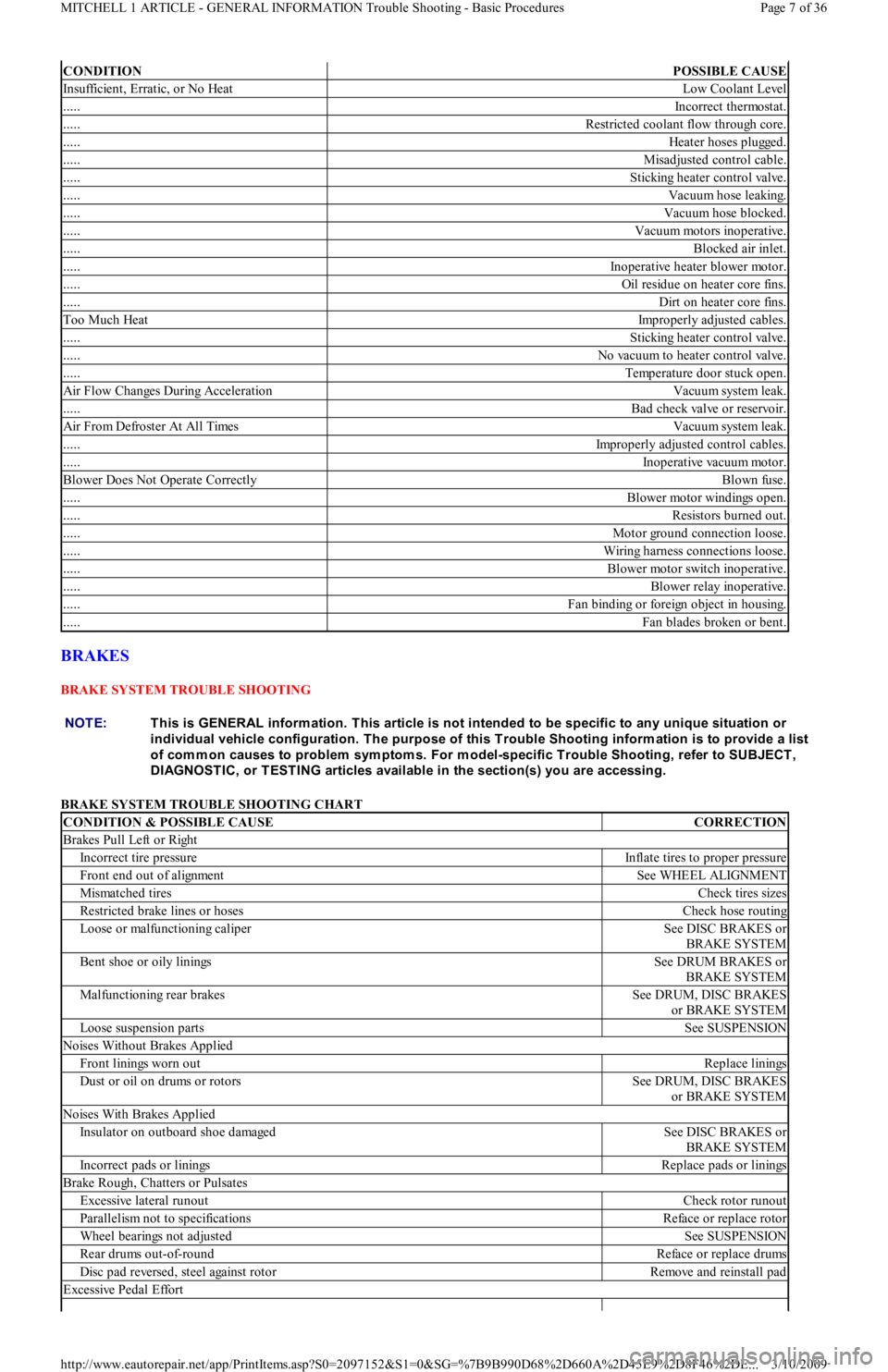
BRAKE SYSTEM TROUBLE SHOOTING CHART
CONDITIONPOSSIBLE CAUSE
Insufficient, Erratic, or No HeatLow Coolant Level
.....Incorrect thermostat.
.....Restricted coolant flow through core.
.....Heater hoses plugged.
.....Misadjusted control cable.
.....Sticking heater control valve.
.....Vacuum hose leaking.
.....Vacuum hose blocked.
.....Vacuum motors inoperative.
.....Blocked air inlet.
.....Inoperative heater blower motor.
.....Oil residue on heater core fins.
.....Dirt on heater core fins.
Too Much HeatImproperly adjusted cables.
.....Sticking heater control valve.
.....No vacuum to heater control valve.
.....Temperature door stuck open.
Air Flow Changes During AccelerationVacuum system leak.
.....Bad check valve or reservoir.
Air From Defroster At All TimesVacuum system leak.
.....Improperly adjusted control cables.
.....Inoperative vacuum motor.
Blower Does Not Operate CorrectlyBlown fuse.
.....Blower motor windings open.
.....Resistors burned out.
.....Motor ground connection loose.
.....Wiring harness connections loose.
.....Blower motor switch inoperative.
.....Blower relay inoperative.
.....Fan binding or foreign object in housing.
.....Fan blades broken or bent.
NOTE:This is GENERAL inform ation. This article is not intended to be specific to any unique situation or
individual vehicle configuration. T he purpose of this T rouble Shooting inform ation is to provide a list
of com m on causes to problem sym ptom s. For m odel-specific T rouble Shooting, refer to SUBJECT ,
DIAGNOST IC, or T EST ING articles available in the section(s) you are accessing.
CONDITION & POSSIBLE CAUSECORRECTION
Brakes Pull Left or Right
Incorrect tire pressureInflate tires to proper pressure
Front end out of alignmentSee WHEEL ALIGNMENT
Mismatched tiresCheck tires sizes
Restricted brake lines or hosesCheck hose routing
Loose or malfunctioning caliperSee DISC BRAKES or
BRAKE SYSTEM
Bent shoe or oily liningsSee DRUM BRAKES or
BRAKE SYSTEM
Malfunctioning rear brakesSee DRUM, DISC BRAKES
or BRAKE SYSTEM
Loose suspension partsSee SUSPENSION
Noises Without Brakes Applied
Front linings worn outReplace linings
Dust or oil on drums or rotorsSee DRUM, DISC BRAKES
or BRAKE SYSTEM
Noises With Brakes Applied
Insulator on outboard shoe damagedSee DISC BRAKES or
BRAKE SYSTEM
Incorrect pads or liningsReplace pads or linings
Brake Rough, Chatters or Pulsates
Excessive lateral runoutCheck rotor runout
Parallelism not to specificationsReface or replace rotor
Wheel bearings not adjustedSee SUSPENSION
Rear drums out-of-roundReface or replace drums
Disc pad reversed, steel against rotorRemove and reinstall pad
Excessive Pedal Effort
Page 7 of 36 MITCHELL 1 ARTICLE - GENERAL INFORMATION Trouble Shooting - Basic Procedures
3/10/2009 http://www.eautorepair.net/app/PrintItems.asp?S0=2097152&S1=0&SG=%7B9B990D68%2D660A%2D45E9%2D8F46%2DE
...
Page 239 of 454
POWERTRAIN
CLUTCH TROUBLE SHOOTING
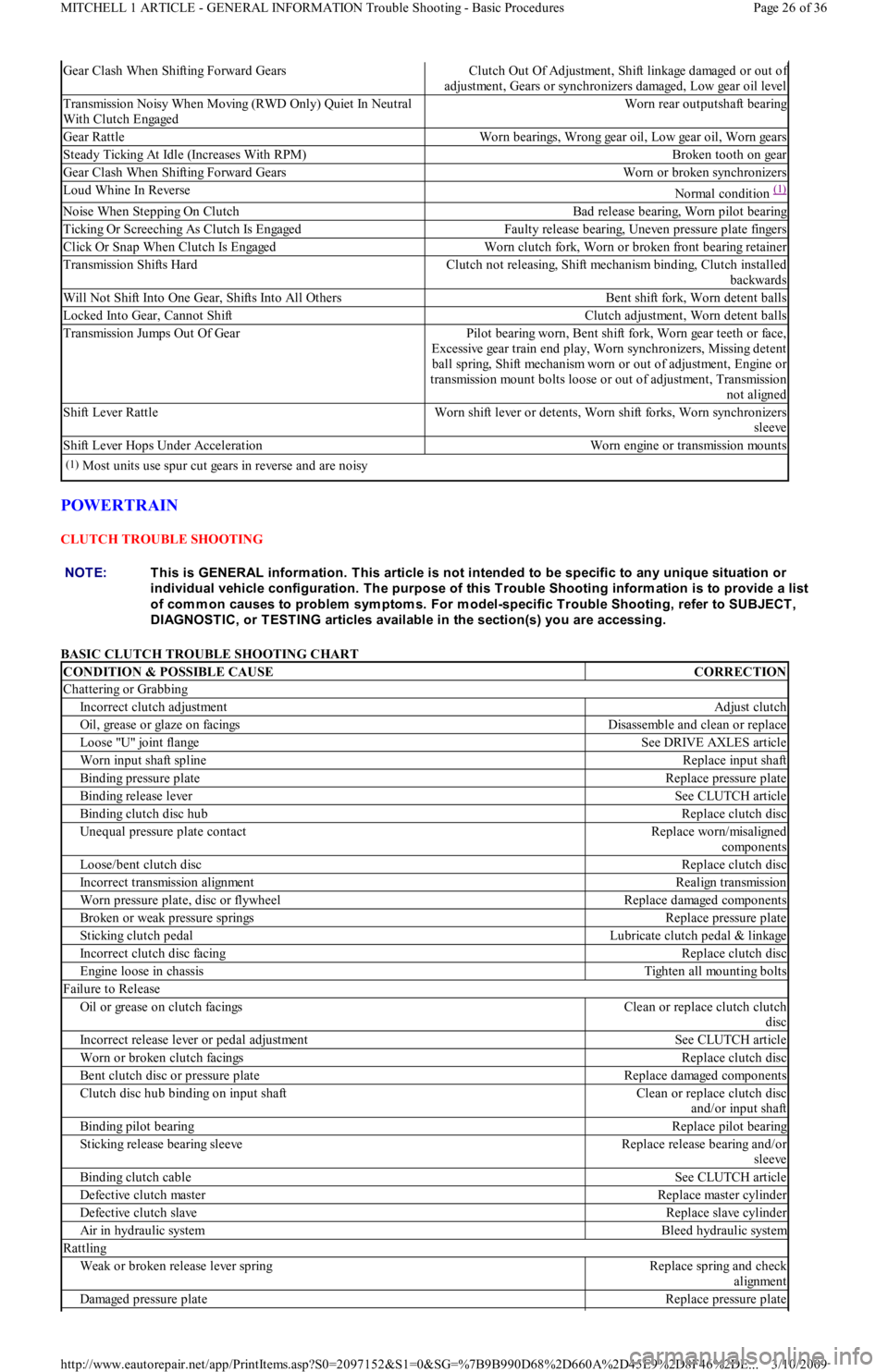
BASIC CLUTCH TROUBLE SHOOTING CHART
Gear Clash When Shifting Forward GearsClutch Out Of Adjustment, Shift linkage damaged or out of
adjustment, Gears or synchronizers damaged, Low gear oil level
Transmission Noisy When Moving (RWD Only) Quiet In Neutral
With Clutch EngagedWorn rear outputshaft bearing
Gear RattleWorn bearings, Wrong gear oil, Low gear oil, Worn gears
Steady Ticking At Idle (Increases With RPM)Broken tooth on gear
Gear Clash When Shifting Forward GearsWorn or broken synchronizers
Loud Whine In ReverseNormal condition (1)
Noise When Stepping On ClutchBad release bearing, Worn pilot bearing
Ticking Or Screeching As Clutch Is EngagedFaulty release bearing, Uneven pressure plate fingers
Click Or Snap When Clutch Is EngagedWorn clutch fork, Worn or broken front bearing retainer
Transmission Shifts HardClutch not releasing, Shift mechanism binding, Clutch installed
backwards
Will Not Shift Into One Gear, Shifts Into All OthersBent shift fork, Worn detent balls
Locked Into Gear, Cannot ShiftClutch adjustment, Worn detent balls
Transmission Jumps Out Of GearPilot bearing worn, Bent shift fork, Worn gear teeth or face,
Excessive gear train end play, Worn synchronizers, Missing detent
ball spring, Shift mechanism worn or out of adjustment, Engine or
transmission mount bolts loose or out of adjustment, Transmission
not aligned
Shift Lever RattleWorn shift lever or detents, Worn shift forks, Worn synchronizers
sleeve
Shift Lever Hops Under AccelerationWorn engine or transmission mounts
(1)Most units use spur cut gears in reverse and are noisy
NOTE:This is GENERAL inform ation. This article is not intended to be specific to any unique situation or
individual vehicle configuration. T he purpose of this T rouble Shooting inform ation is to provide a list
of com m on causes to problem sym ptom s. For m odel-specific T rouble Shooting, refer to SUBJECT ,
DIAGNOST IC, or T EST ING articles available in the section(s) you are accessing.
CONDITION & POSSIBLE CAUSECORRECTION
Chattering or Grabbing
Incorrect clutch adjustmentAdjust clutch
Oil, grease or glaze on facingsDisassemble and clean or replace
Lo o se "U" jo in t fl an geSee DRIVE AXLES article
Worn input shaft splineReplace input shaft
Binding pressure plateReplace pressure plate
Binding release leverSee CLUTCH article
Binding clutch disc hubReplace clutch disc
Unequal pressure plate contactReplace worn/misaligned
components
Loose/bent clutch discReplace clutch disc
Incorrect transmission alignmentRealign transmission
Worn pressure plate, disc or flywheelReplace damaged components
Broken or weak pressure springsReplace pressure plate
Sticking clutch pedalLubricate clutch pedal & linkage
Incorrect clutch disc facingReplace clutch disc
Engine loose in chassisTighten all mounting bolts
Failure to Release
Oil or grease on clutch facingsClean or replace clutch clutch
disc
Incorrect release lever or pedal adjustmentSee CLUTCH article
Worn or broken clutch facingsReplace clutch disc
Bent clutch disc or pressure plateReplace damaged components
Clutch disc hub binding on input shaftClean or replace clutch disc
and/or input shaft
Binding pilot bearingReplace pilot bearing
Sticking release bearing sleeveReplace release bearing and/or
sleeve
Binding clutch cableSee CLUTCH article
Defective clutch masterReplace master cylinder
Defective clutch slaveReplace slave cylinder
Air in hydraulic systemBleed hydraulic system
Rattling
Weak or broken release lever springReplace spring and check
alignment
Damaged pressure plateReplace pressure plate
Page 26 of 36 MITCHELL 1 ARTICLE - GENERAL INFORMATION Trouble Shooting - Basic Procedures
3/10/2009 http://www.eautorepair.net/app/PrintItems.asp?S0=2097152&S1=0&SG=%7B9B990D68%2D660A%2D45E9%2D8F46%2DE
...
Page 240 of 454
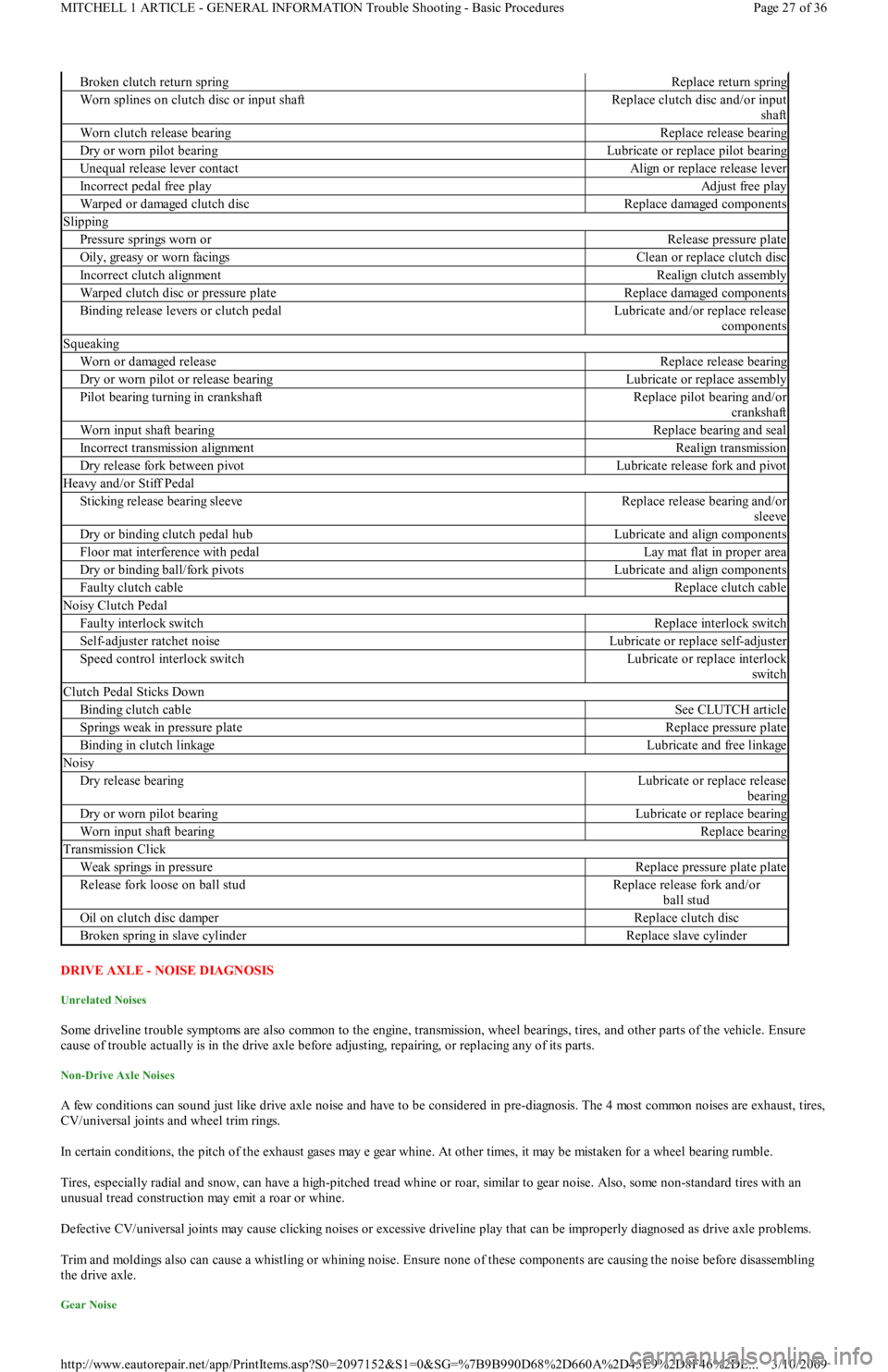
DRIVE AXLE - NOISE DIAGNOSIS
Unrelated Noises
Some driveline trouble symptoms are also common to the engine, transmission, wheel bearings, tires, and other parts of the vehicle. Ensure
cause of trouble actually is in the drive axle before adjusting, repairing, or replacing any of its parts.
Non-Drive Axle Noises
A few conditions can sound just like drive axle noise and have to be considered in pre-diagnosis. The 4 most common noises are exhaust, tires,
CV/universal joints and wheel trim rings.
In certain conditions, the pitch of the exhaust gases may e gear whine. At other times, it may be mistaken for a wheel bearing rumble.
Tires, especially radial and snow, can have a high-pitched tread whine or roar, similar to gear noise. Also, some non-standard tires with an
unusual tread construction may emit a roar or whine.
Defective CV/universal joints may cause clicking noises or excessive driveline play that can be improperly diagnosed as drive axle problems.
Trim and moldings also can cause a whistling or whining noise. Ensure none of these components are causing the noise before disassembling
the drive axle.
Gear Noise
Broken clutch return springReplace return spring
Worn splines on clutch disc or input shaftReplace clutch disc and/or input
shaft
Worn clutch release bearingReplace release bearing
Dry or worn pilot bearingLubricate or replace pilot bearing
Unequal release lever contactAlign or replace release lever
Incorrect pedal free playAdjust free play
Warped or damaged clutch discReplace damaged components
Slipping
Pressure springs worn orRelease pressure plate
Oily, greasy or worn facingsClean or replace clutch disc
Incorrect clutch alignmentRealign clutch assembly
Warped clutch disc or pressure plateReplace damaged components
Binding release levers or clutch pedalLubricate and/or replace release
components
Squeaking
Worn or damaged releaseReplace release bearing
Dry or worn pilot or release bearingLubricate or replace assembly
Pilot bearing turning in crankshaftReplace pilot bearing and/or
crankshaft
Worn input shaft bearingReplace bearing and seal
Incorrect transmission alignmentRealign transmission
Dry release fork between pivotLubricate release fork and pivot
Heavy and/or Stiff Pedal
Sticking release bearing sleeveReplace release bearing and/or
sleeve
Dry or binding clutch pedal hubLubricate and align components
Floor mat interference with pedalLay mat flat in proper area
Dry or binding ball/fork pivotsLubricate and align components
Faulty clutch cableReplace clutch cable
Noisy Clutch Pedal
Faulty interlock switchReplace interlock switch
Self-adjuster ratchet noiseLubricate or replace self-adjuster
Speed control interlock switchLubricate or replace interlock
switch
Clutch Pedal Sticks Down
Binding clutch cableSee CLUTCH article
Springs weak in pressure plateReplace pressure plate
Binding in clutch linkageLubricate and free linkage
Noisy
Dry release bearingLubricate or replace release
bearing
Dry or worn pilot bearingLubricate or replace bearing
Worn input shaft bearingReplace bearing
Transmission Click
Weak springs in pressureReplace pressure plate plate
Release fork loose on ball studReplace release fork and/or
ball stud
Oil on clutch disc damperReplace clutch disc
Broken spring in slave cylinderReplace slave cylinder
Page 27 of 36 MITCHELL 1 ARTICLE - GENERAL INFORMATION Trouble Shooting - Basic Procedures
3/10/2009 http://www.eautorepair.net/app/PrintItems.asp?S0=2097152&S1=0&SG=%7B9B990D68%2D660A%2D45E9%2D8F46%2DE
...
Page 242 of 454
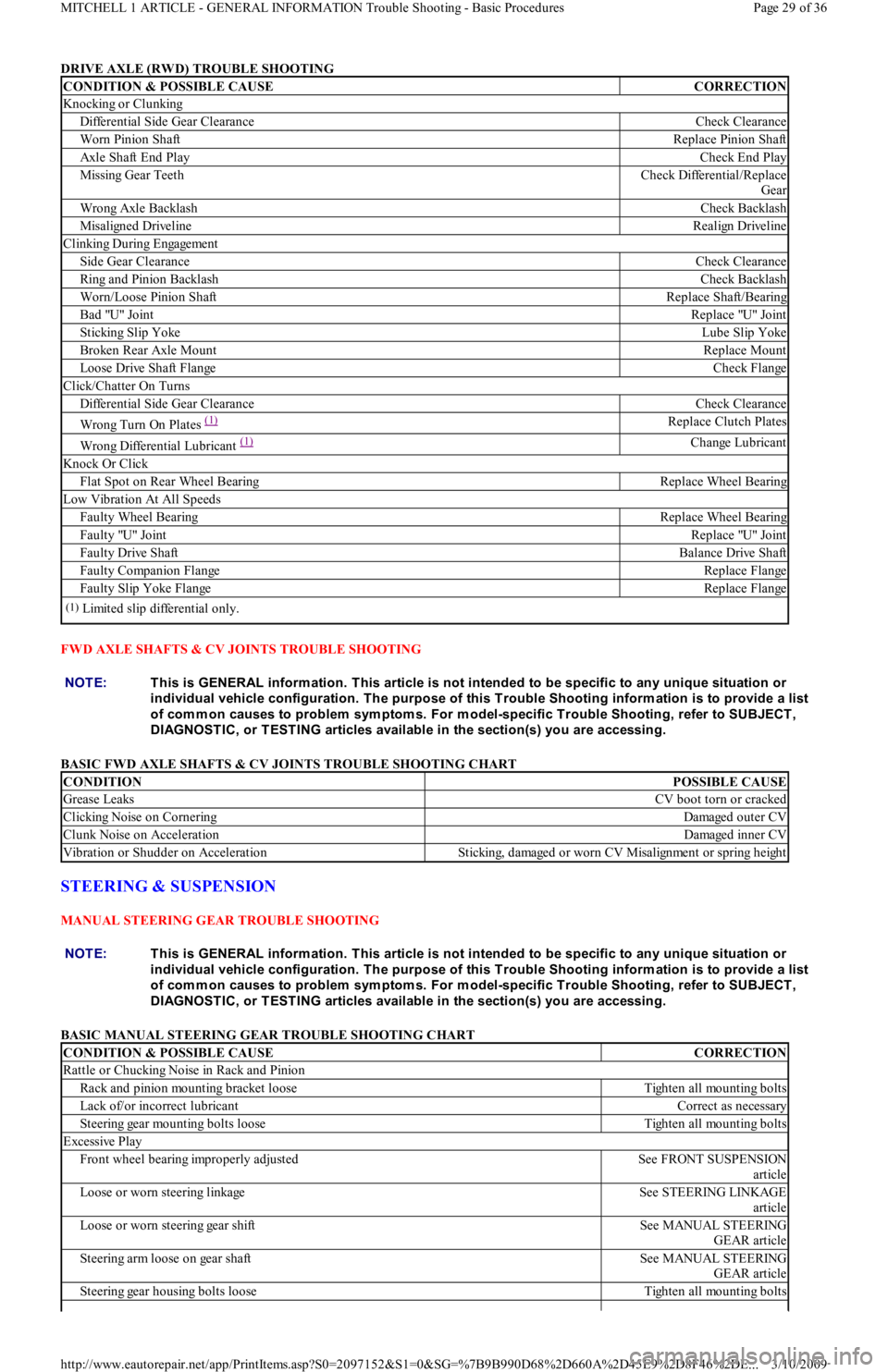
DRIVE AXLE (RWD) TROUBLE SHOOTING
FWD AXLE SHAFTS & CV JOINTS TROUBLE SHOOTING
BASIC FWD AXLE SHAFTS & CV JOINTS TROUBLE SHOOTING CHART
STEERING & SUSPENSION
MANUAL STEERING GEAR TROUBLE SHOOTING
BASIC MANUAL STEERING GEAR TROUBLE SHOOTING CHART
CONDITION & POSSIBLE CAUSECORRECTION
Knocking or Clunking
Differential Side Gear ClearanceCheck Clearance
Worn Pinion ShaftReplace Pinion Shaft
Axle Shaft End PlayCheck End Play
Missing Gear TeethCheck Differential/Replace
Gear
Wrong Axle BacklashCheck Backlash
Misaligned DrivelineRealign Driveline
Clinking During Engagement
Side Gear ClearanceCheck Clearance
Ring and Pinion BacklashCheck Backlash
Worn/Loose Pinion ShaftReplace Shaft/Bearing
Bad "U" JointReplace "U" Joint
Sticking Slip YokeLube Slip Yoke
Broken Rear Axle MountReplace Mount
Loose Drive Shaft FlangeCheck Flange
Click/Chatter On Turns
Differential Side Gear ClearanceCheck Clearance
Wrong Turn On Plates (1)Replace Clutch Plates
Wrong Differential Lubricant (1)Change Lubricant
Knock Or Click
Flat Spot on Rear Wheel BearingReplace Wheel Bearing
Low Vibration At All Speeds
Faulty Wheel BearingReplace Wheel Bearing
Faulty "U" JointReplace "U" Joint
Faulty Drive ShaftBalance Drive Shaft
Faulty Companion FlangeReplace Flange
Faulty Slip Yoke FlangeReplace Flange
(1)Limited slip differential only.
NOTE:This is GENERAL inform ation. This article is not intended to be specific to any unique situation or
individual vehicle configuration. T he purpose of this T rouble Shooting inform ation is to provide a list
of com m on causes to problem sym ptom s. For m odel-specific T rouble Shooting, refer to SUBJECT ,
DIAGNOST IC, or T EST ING articles available in the section(s) you are accessing.
CONDITIONPOSSIBLE CAUSE
Grease LeaksCV boot torn or cracked
Clicking Noise on CorneringDamaged outer CV
Clunk Noise on AccelerationDamaged inner CV
Vibration or Shudder on AccelerationSticking, damaged or worn CV Misalignment or spring height
NOTE:This is GENERAL inform ation. This article is not intended to be specific to any unique situation or
individual vehicle configuration. T he purpose of this T rouble Shooting inform ation is to provide a list
of com m on causes to problem sym ptom s. For m odel-specific T rouble Shooting, refer to SUBJECT ,
DIAGNOST IC, or T EST ING articles available in the section(s) you are accessing.
CONDITION & POSSIBLE CAUSECORRECTION
Rattle or Chucking Noise in Rack and Pinion
Rack and pinion mounting bracket looseTighten all mounting bolts
Lack of/or incorrect lubricantCorrect as necessary
Steering gear mounting bolts looseTighten all mounting bolts
Excessive Play
Front wheel bearing improperly adjustedSee FRONT SUSPENSION
article
Loose or worn steering linkageSee STEERING LINKAGE
article
Loose or worn steering gear shiftSee MANUAL STEERING
GEAR article
Steering arm loose on gear shaftSee MANUAL STEERING
GEAR article
Steering gear housing bolts looseTighten all mounting bolts
Page 29 of 36 MITCHELL 1 ARTICLE - GENERAL INFORMATION Trouble Shooting - Basic Procedures
3/10/2009 http://www.eautorepair.net/app/PrintItems.asp?S0=2097152&S1=0&SG=%7B9B990D68%2D660A%2D45E9%2D8F46%2DE
...
Page 243 of 454
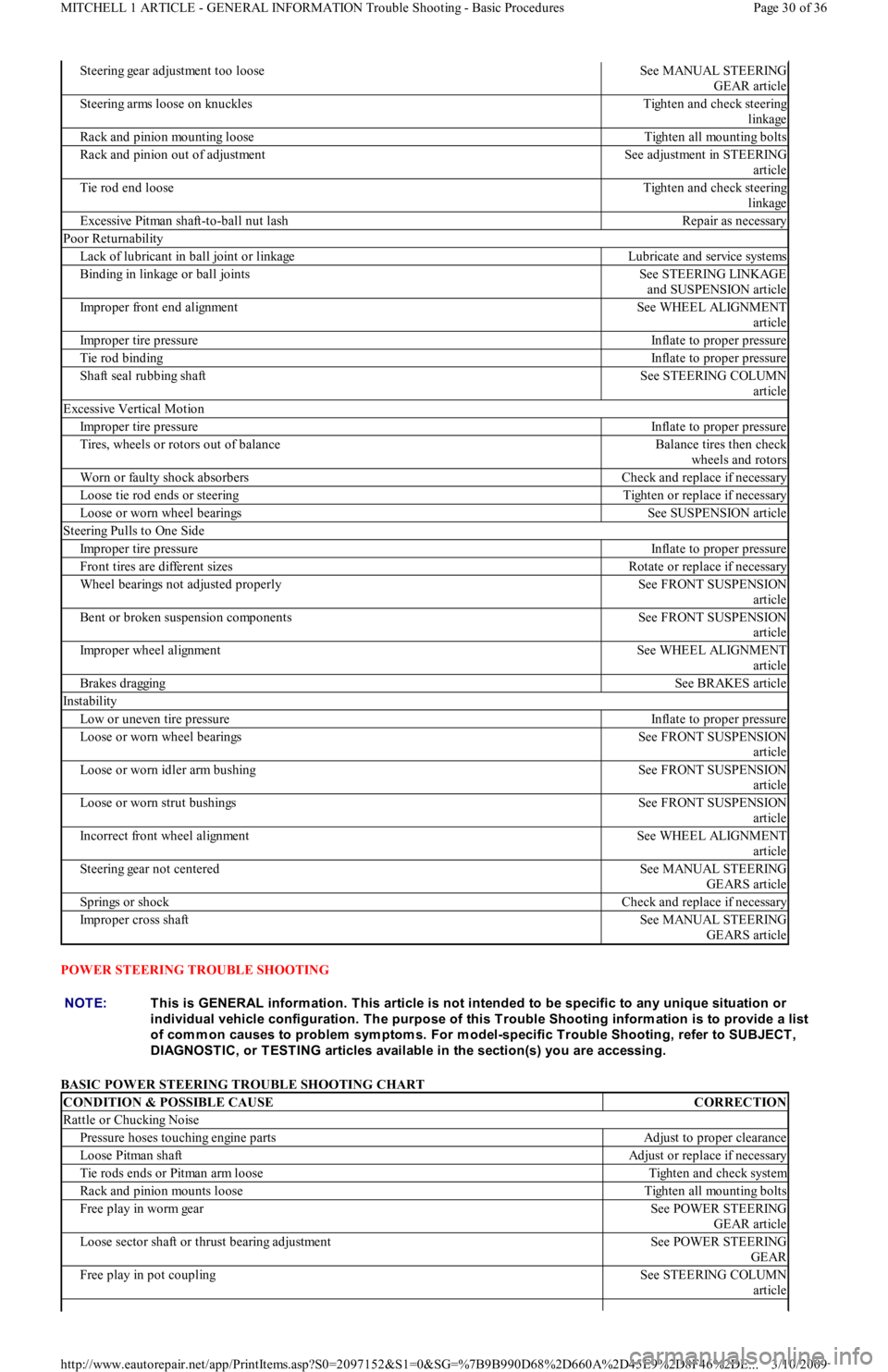
POWER STEERING TROUBLE SHOOTING
BASIC POWER STEERING TROUBLE SHOOTING CHART
Steering gear adjustment too looseSee MANUAL STEERING
GEAR article
Steering arms loose on knucklesTighten and check steering
linkage
Rack and pinion mounting looseTighten all mounting bolts
Rack and pinion out of adjustmentSee adjustment in STEERING
article
Tie rod end looseTighten and check steering
linkage
Excessive Pitman shaft-to-ball nut lashRepair as necessary
Poor Returnability
Lack of lubricant in ball joint or linkageLubricate and service systems
Binding in linkage or ball jointsSee STEERING LINKAGE
and SUSPENSION article
Improper front end alignmentSee WHEEL ALIGNMENT
article
Improper tire pressureInflate to proper pressure
Tie rod bindingInflate to proper pressure
Shaft seal rubbing shaftSee STEERING COLUMN
article
Excessive Vertical Motion
Improper tire pressureInflate to proper pressure
Tires, wheels or rotors out of balanceBalance tires then check
wheels and rotors
Worn or faulty shock absorbersCheck and replace if necessary
Loose tie rod ends or steeringTighten or replace if necessary
Loose or worn wheel bearingsSee SUSPENSION article
Steering Pulls to One Side
Improper tire pressureInflate to proper pressure
Front tires are different sizesRotate or replace if necessary
Wheel bearings not adjusted properlySee FRONT SUSPENSION
article
Bent or broken suspension componentsSee FRONT SUSPENSION
article
Improper wheel alignmentSee WHEEL ALIGNMENT
article
Brakes draggingSee BRAKES article
Instability
Low or uneven tire pressureInflate to proper pressure
Loose or worn wheel bearingsSee FRONT SUSPENSION
article
Loose or worn idler arm bushingSee FRONT SUSPENSION
article
Loose or worn strut bushingsSee FRONT SUSPENSION
article
Incorrect front wheel alignmentSee WHEEL ALIGNMENT
article
Steering gear not centeredSee MANUAL STEERING
GEARS article
Springs or shockCheck and replace if necessary
Improper cross shaftSee MANUAL STEERING
GEARS article
NOTE:This is GENERAL inform ation. This article is not intended to be specific to any unique situation or
individual vehicle configuration. T he purpose of this T rouble Shooting inform ation is to provide a list
of com m on causes to problem sym ptom s. For m odel-specific T rouble Shooting, refer to SUBJECT ,
DIAGNOST IC, or T EST ING articles available in the section(s) you are accessing.
CONDITION & POSSIBLE CAUSECORRECTION
Rattle or Chucking Noise
Pressure hoses touching engine partsAdjust to proper clearance
Loose Pitman shaftAdjust or replace if necessary
Tie rods ends or Pitman arm looseTighten and check system
Rack and pinion mounts looseTighten all mounting bolts
Free play in worm gearSee POWER STEERING
GEAR article
Loose sector shaft or thrust bearing adjustmentSee POWER STEERING
GEAR
Free play in pot couplingSee STEERING COLUMN
article
Page 30 of 36 MITCHELL 1 ARTICLE - GENERAL INFORMATION Trouble Shooting - Basic Procedures
3/10/2009 http://www.eautorepair.net/app/PrintItems.asp?S0=2097152&S1=0&SG=%7B9B990D68%2D660A%2D45E9%2D8F46%2DE
...
Page 244 of 454
Worn shaft serrationsSee STEERING COLUMN
article
Growl in Steering Pump
Excessive pressure in hosesRestricted hoses, see POWER
STEERING GEAR article
Scored pressure platesSee POWER STEERING
GEAR article
Scored thrust plates or rotorSee POWER STEERING
GEAR article
Extreme wear of cam ringSee POWER STEERING
GEAR article
Rattle in Steering Pump
Vanes not installedSee POWER STEERING
PUMP article
Vanes sticking in rotorSee POWER STEERING
PUMP article
Swish noise in Pump
Defective flow control valveSee POWER STEERING
PUMP article
Groan in Steering Pump
Air in fluidSee POWER STEERING
PUMP article
Poor pressure hose connectionTighten and check, replace if
necessary
Squawk When Turning
Damper "O" ring on valve spool cutSee POWER STEERING
PUMP article
Moan or Whine in Pump
Pump shaft bearing scoredReplace bearing and fluid
Air in fluid or fluid level lowSee POWER STEERING
PUMP article
Hose or column groundedCheck and replace if necessary
Cover "O" ring missing or damagedSee POWER STEERING
PUMP article
Valve cover baffle missing or damagedSee POWER STEERING
PUMP article
Interference of components in pumpSee POWER STEERING
PUMP article
Loose or poor bracket alignmentCorrect or replace if necessary
Hissing When Parking
Internal leakage in steering gearCheck valved assembly first
Chirp in Steering Pump
Loose or worn power steering beltAdjust or replace if necessary
Buzzing When Not Steering
Noisy pumpSee POWER STEERING
PUMP article
Free play in steering shaft bearingSee STEERING COLUMN
article
Bearing loose on shaft serrationsSee STEERING COLUMN
article
Clicking Noise in Pump
Pump slippers too longSee POWER STEERING
PUMP article
Broken slipper springsSee POWER STEERING
PUMP article
Excessive wear or nicked rotorsSee POWER STEERING
PUMP article
Damaged cam contourSee POWER STEERING
PUMP article
Poor Return of Wheel
Wheel rubbing against turn signalSee STEERING COLUMN
SWITCHES article
Flange rubbing steering gear adjusterSee STEERING COLUMN
article
Tight or frozen steering shaft bearingSee STEERING COLUMN
article
Steering gear out of adjustmentSee POWER STEERING
GEAR article
Sticking or plugged spool valveSee POWER STEERING
PUMP article
Improper front end alignmentSee WHEEL ALIGNMENT
article
Wheel bearings worn or looseSee FRONT SUSPENSION
article
Page 31 of 36 MITCHELL 1 ARTICLE - GENERAL INFORMATION Trouble Shooting - Basic Procedures
3/10/2009 http://www.eautorepair.net/app/PrintItems.asp?S0=2097152&S1=0&SG=%7B9B990D68%2D660A%2D45E9%2D8F46%2DE
...