1991 FORD FESTIVA check engine
[x] Cancel search: check enginePage 114 of 454
2. Remove main bearing cap bolts. Remove cap and lower bearing insert. Use bearing remover or fabricated cotter key to remove upper
bearing insert. Insert bearing remover in journal lubrication hole. Rotate crankshaft in normal direction of operation only. Repeat
procedure for remaining main bearings.
3. Check bearings for abnormal wear. Check crankshaft for grooves, scratches and pitting. Using Plastigage method, check clearance of
main bearing-to-crankshaft. Always keep at least 2 bearings and caps tight during clearance check. See, at end of article,
CRANKSHAFT MAIN & CONNECTING ROD BEARINGS
table under ENGINE SPECIFICATIONS.
4. Lubricate and install new bearings in cap and block. Match bearing tangs with notch in cap and block. Position cap in its proper
location and position. Install cap bolts and tighten to specification. See TORQUE SPECIFICATIONS
table at end of article. Repeat
procedure for remaining main bearings.
CRANKSHAFT END PLAY
Check crankshaft end play with dial indicator. End play should be .0031-.0111" (.08-.282 mm). Service limit is .012" (.30 mm). If end play is
not within specification, replace thrust bearings as necessary.
CYLINDER BLOCK
1. Using straightedge and feeler gauge, check entire cylinder head surface of cylinder block. Ensure warpage does not exceed .006" (.15
mm). If warpage exceeds specification, cylinder block surface can be machined a maximum of .008" (.20 mm).
2. Replace cylinder block if it needs to be machined more than .008" (.20 mm). Check cylinder bore for wear, out-of-round, taper and
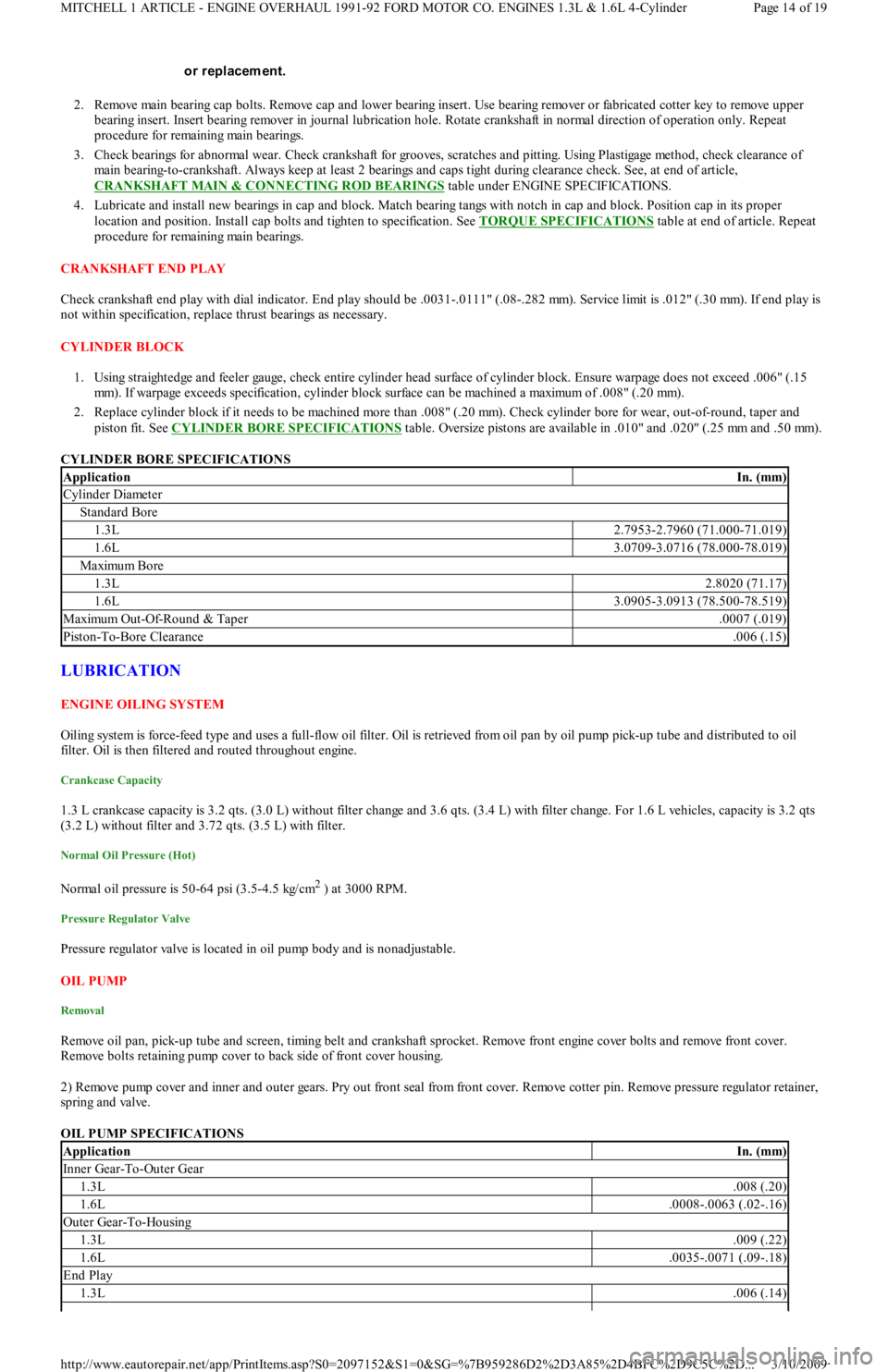
piston fit. See CYLINDER BORE SPECIFICATIONS
table. Oversize pistons are available in .010" and .020" (.25 mm and .50 mm).
CYLINDER BORE SPECIFICATIONS
LUBRICATION
ENGINE OILING SYSTEM
Oiling system is force-feed type and uses a full-flow oil filter. Oil is retrieved from oil pan by oil pump pick-up tube and distributed to oil
filter. Oil is then filtered and routed throughout engine.
Crankcase Capacity
1.3 L crankcase capacity is 3.2 qts. (3.0 L) without filter change and 3.6 qts. (3.4 L) with filter change. For 1.6 L vehicles, capacity is 3.2 qts
(3.2 L) without filter and 3.72 qts. (3.5 L) with filter.
Normal Oil Pressure (Hot)
Normal oil pressure is 50-64 psi (3.5-4.5 kg/cm2 ) at 3000 RPM.
Pressure Regulator Valve
Pressure regulator valve is located in oil pump body and is nonadjustable.
OIL PUMP
Removal
Remove oil pan, pick-up tube and screen, timing belt and crankshaft sprocket. Remove front engine cover bolts and remove front cover.
R e mo ve b o l t s r e t a in in g p u mp c o ve r t o b a c k sid e o f fr o n t c o ve r h o u sin g.
2) Remove pump cover and inner and outer gears. Pry out front seal from front cover. Remove cotter pin. Remove pressure regulator retainer,
spring and valve.
OIL PUMP SPECIFICATIONS or replacem ent.
ApplicationIn. (mm)
Cylinder Diameter
Standard Bore
1.3L2.7953-2.7960 (71.000-71.019)
1.6L3.0709-3.0716 (78.000-78.019)
Maximu m Bo re
1.3L2.8020 (71.17)
1.6L3.0905-3.0913 (78.500-78.519)
Maximu m Ou t -Of-Ro u n d & Tap er.0007 (.019)
Piston-To-Bore Clearance.006 (.15)
ApplicationIn. (mm)
Inner Gear-To-Outer Gear
1.3L.008 (.20)
1.6L.0008-.0063 (.02-.16)
Outer Gear-To-Housing
1.3L.009 (.22)
1.6L.0035-.0071 (.09-.18)
End Play
1.3L.006 (.14)
Page 14 of 19 MITCHELL 1 ARTICLE - ENGINE OVERHAUL 1991-92 FORD MOTOR CO. ENGINES 1.3L & 1.6L 4-Cylinder
3/10/2009 http://www.eautorepair.net/app/PrintItems.asp?S0=2097152&S1=0&SG=%7B959286D2%2D3A85%2D4BFC%2D9C5C%2D
...
Page 121 of 454
3. If voltage is not present or is less than 8 volts at starter solenoid terminal "S", malfunction in circuit to terminal "S" is indicated. Proceed
to the following tests.
IGNITION SWITCH TEST
1. Locate ignition switch connector under dash. Using a 12-volt test light or voltmeter, ensure voltage is present on Black/Yellow wire
when ignition switch is turned to RUN or ON position. This will verify proper operation of ignition switch.
2. If there is no voltage on Black/Yellow wire, the problem is either ignition switch or circuit between battery and ignition switch.
CLUTCH ENGAGE SWITCH (M/T) TEST
Unplug clutch engage switch from main wiring harness. Using an ohmmeter, check for continuity across switch terminals. Continuity should
exist when switch plunger is pushed in and should not exist when switch plunger is released. If clutch engage switch does not operate as
specified, replace switch.
NEUTRAL SAFETY SWITCH (A/T) TEST
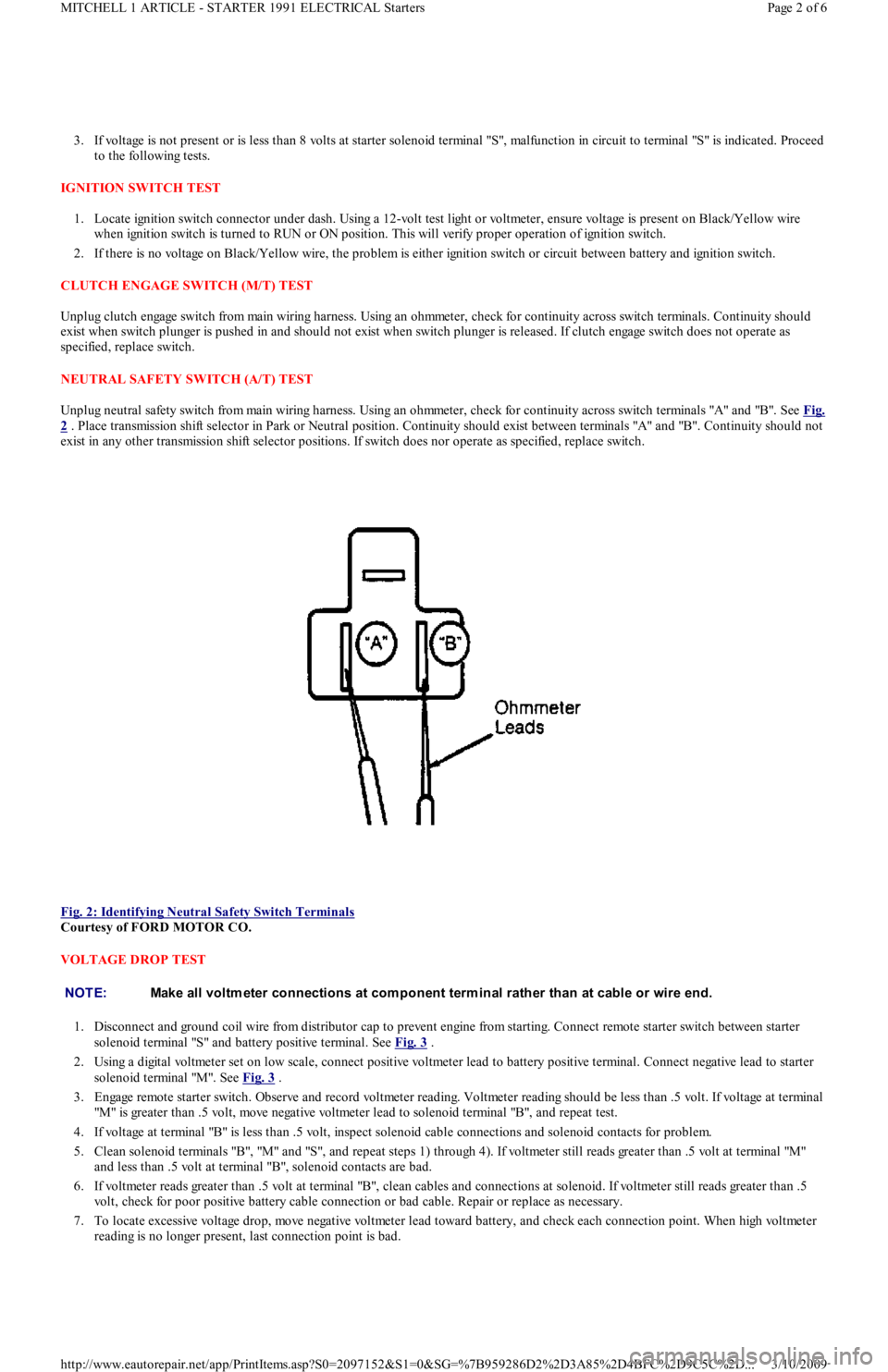
Unplug neutral safety switch from main wiring harness. Using an ohmmeter, check for continuity across switch terminals "A" and "B". See Fig.
2 . Place transmission shift selector in Park or Neutral position. Continuity should exist between terminals "A" and "B". Continuity should not
exist in any other transmission shift selector positions. If switch does nor operate as specified, replace switch.
Fig. 2: Identifying Neutral Safety Switch Terminals
Courtesy of FORD MOTOR CO.
VOLTAGE DROP TEST
1. Disconnect and ground coil wire from distributor cap to prevent engine from starting. Connect remote starter switch between starter
solenoid terminal "S" and battery positive terminal. See Fig. 3
.
2. Using a digital voltmeter set on low scale, connect positive voltmeter lead to battery positive terminal. Connect negative lead to starter
solenoid terminal "M". See Fig. 3
.
3. Engage remote starter switch. Observe and record voltmeter reading. Voltmeter reading should be less than .5 volt. If voltage at terminal
"M" is greater than .5 volt, move negative voltmeter lead to solenoid terminal "B", and repeat test.
4. If voltage at terminal "B" is less than .5 volt, inspect solenoid cable connections and solenoid contacts for problem.
5 . Cl ean so l en o id t ermin al s "B", "M" an d "S", an d rep eat st ep s 1 ) through 4). If voltmeter still reads greater than .5 volt at termin al "M"
and less than .5 volt at terminal "B", solenoid contacts are bad.
6. If voltmeter reads greater than .5 volt at terminal "B", clean cables and connections at solenoid. If voltmeter still reads greater than .5
volt, check for poor positive battery cable connection or bad cable. Repair or replace as necessary.
7. To locate excessive voltage drop, move negative voltmeter lead toward battery, and check each connection point. When high voltmeter
reading is no longer present, last connection point is bad.
NOTE:Make all voltm eter connections at com ponent term inal rather than at cable or wire end.
Page 2 of 6 MITCHELL 1 ARTICLE - STARTER 1991 ELECTRICAL Starters
3/10/2009 http://www.eautorepair.net/app/PrintItems.asp?S0=2097152&S1=0&SG=%7B959286D2%2D3A85%2D4BFC%2D9C5C%2D
...
Page 129 of 454
Back To Article
D - ADJUSTMENTS
1991 ENGINE PERFORMANCE Ford/Mercury - On-Vehicle Adjustm ents
ADJUSTMENTS
ENGINE MECHANICAL
Before beginning any on-vehicle adjustments to fuel or ignition systems, ensure engine mechanical condition is okay.
VALVE CLEARANCE
IGNITION TIMING
CAPRI
1. Place automatic transmission in Park or manual transmission in Neutral. Disconnect and plug hoses attached to vacuum diaphragm
assembly on distributor. Connect tachometer and timing light. Turn off all electrical loads.
2. Start engine, and warm it to operating temperature. Ensure idle speed is set to specification, adjusting if necessary. See IDLE SPEED &
MIXTURE . Determine initial timing. See IGNITION TIMING table. If base timing is not correct, loosen distributor mounting bolts
and rotate distributor until marks align. Tighten bolts to 14-18 ft. lbs. (19-25 N.m).
3. Increase engine RPM while observing timing light. Verify ignition timing advances. For Turbo models, go to step 5). For non-Turbo
models, continue with step 4).
4. On non-Turbo models, apply 16 in. Hg vacuum to chamber "A". Verify timing advances by 26-30 degrees. Remove vacuum source from
chamber "A". Apply 8 in. Hg vacuum to chamber "B" while observing timing. Verify timing advances by 3-7 degrees. Stop engine, and
remove test equipment.
5. On Turbo models, apply 20 in. Hg vacuum to advance diaphragm. Verify timing advances by 13-17 degrees. Disconnect vacuum source.
Apply 8 psi (.6 kg/cm
2 ) pressure to advance diaphragm. Verify timing retards by 3-7 degrees. Stop engine, and remove test equipment.
FESTIVA
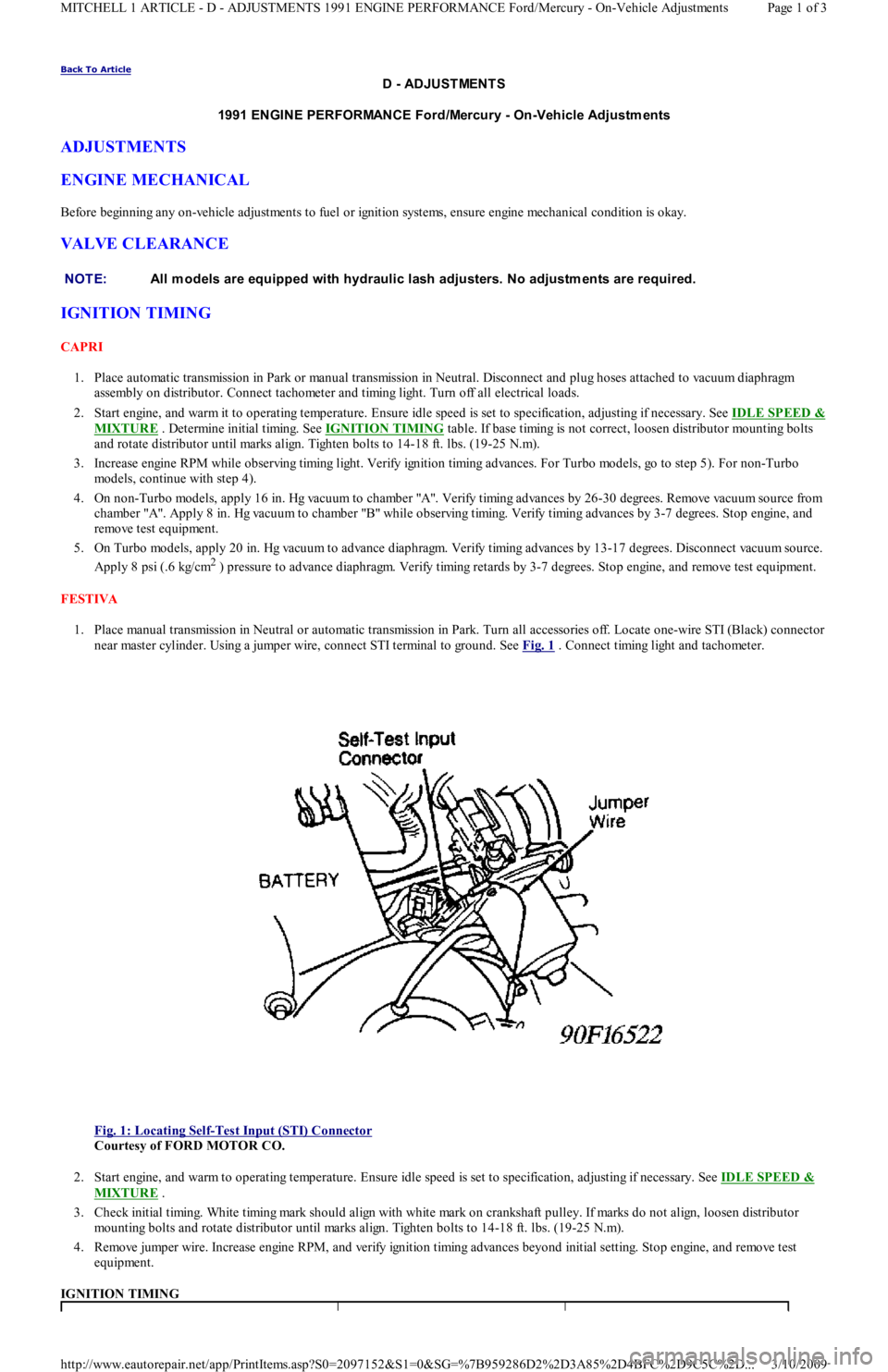
1. Place manual transmission in Neutral or automatic transmission in Park. Turn all accessories off. Locate one-wire STI (Black) connector
near master cylinder. Using a jumper wire, connect STI terminal to ground. See Fig. 1
. Connect timing light and tachometer.
Fig. 1: Locating Self
-Test Input (STI) Connector
Courtesy of FORD MOTOR CO.
2. Start engine, and warm to operating temperature. Ensure idle speed is set to specification, adjusting if necessary. See IDLE SPEED &
MIXTURE .
3. Check initial timing. White timing mark should align with white mark on crankshaft pulley. If marks do not align, loosen distributor
mounting bolts and rotate distributor until marks align. Tighten bolts to 14-18 ft. lbs. (19-25 N.m).
4. Remove jumper wire. Increase engine RPM, and verify ignition timing advances beyond initial setting. Stop engine, and remove test
equipment.
IGNITION TIMING NOTE:All m odels are equipped with hydraulic lash adjusters. No adjustm ents are required.
Page 1 of 3 MITCHELL 1 ARTICLE - D - ADJUSTMENTS 1991 ENGINE PERFORMANCE Ford/Mercury - On-Vehicle Adjustments
3/10/2009 http://www.eautorepair.net/app/PrintItems.asp?S0=2097152&S1=0&SG=%7B959286D2%2D3A85%2D4BFC%2D9C5C%2D
...
Page 130 of 454

IDLE SPEED & MIXTURE
IDLE MIXTURE
IDLE SPEED
1. Turn off all accessories. Place automatic transmission in Park or manual transmission in Neutral. Set parking brake. Connect tachometer
to engine. Warm engine to normal operating temperature. Connect a jumper wire between single-wire STI test connector (Green on
Capri; Black on Festiva) and ground. See Fig. 1
.
2. Locate idle speed control by-pass air (ISC-BPA) valve on intake manifold. Remove cap, and adjust idle speed to specification by turning
idle air adjust screw on ISC-BPA valve. See Fig. 2
. Remove jumper wire.
IDLE RPM
Fig. 2: Locating Idle Air Adjust Screw
Courtesy of FORD MOTOR CO.
THROTTLE POSITION SWITCH (TP)
CAPRI
Throttle position sensor is preset at factory. No adjustment is required.
FESTIVA
1. Ensure idle speed and ignition timing are adjusted to specification. Stop engine. Disconnect negative battery cable.
2. Unplug TP connector at throttle body. Insert appropriate feeler gauge between throttle stop screw and stop lever. Check for continuity
between specified terminals on TP connector. See TP ADJUSTMENT table.
3. To adjust, loosen TP attaching screws. Connect ohmmeter between terminals IDL and TL. See Fig. 3
. Insert a .020" (.5 mm) feeler
gauge between throttle stop screw and stop lever.
4. Rotate TP until ohmmeter indicates continuity. Insert a .028" (.7 mm) thickness gauge between stop screw and stop lever. Ohmmeter
should indicate no continuity. If ohmmeter indicates continuity, repeat adjustment procedure.
ApplicationAuto. Trans.Man. Trans.
1.3L9-11 @ 8509-11 @ 700
1.6L Non-Turbo1-3 @ 8500-4 @ 850
1.6L Turbo10-14 @ 8500-4 @ 850
NOTE:Idle m ixture is controlled by ECA and is not adjustable.
ApplicationAuto. Trans.Man. Trans.
1.3L830-870680-720
1.6L800-900800-900
CAUT ION: DO NOT tam per with throttle stop screw at throttle lever. Doing so m ay result in dam age to throttle
body.
Page 2 of 3 MITCHELL 1 ARTICLE - D - ADJUSTMENTS 1991 ENGINE PERFORMANCE Ford/Mercury - On-Vehicle Adjustments
3/10/2009 http://www.eautorepair.net/app/PrintItems.asp?S0=2097152&S1=0&SG=%7B959286D2%2D3A85%2D4BFC%2D9C5C%2D
...
Page 132 of 454
Back To Article
A - ENGINE/VIN ID
1991 ENGINE PERFORMANCE Ford/Mercury - Introduction
APPLICATION
MODEL COVERAGE
VIN DEFINITION
Numbers preceding the explanations in the legend below refer to the sequence of characters as listed on VIN identification label.
SAMPLE VIN
Digit #: 1 2 3 4 5 6 7 8 9 10 11 12 13 14 15 16 17.
(VIN) K N J P T O 6 H 9 L 6 1 0 0 0 0 0.
VIN Definition
1-3 - Indicates Nation of Origin.
4 - Indicates Restraint System.
5 - Indicates Carline Code.
6-7 - Indicates Body Type.
8 - Indicates Engine Type.
9 - Indicates Check Digit.
10 - Indicates Model Year.
11 - Indicates Assembly Plant.
12-17 - Vehicle Serial Number.
ENGINE CODE LOCATION
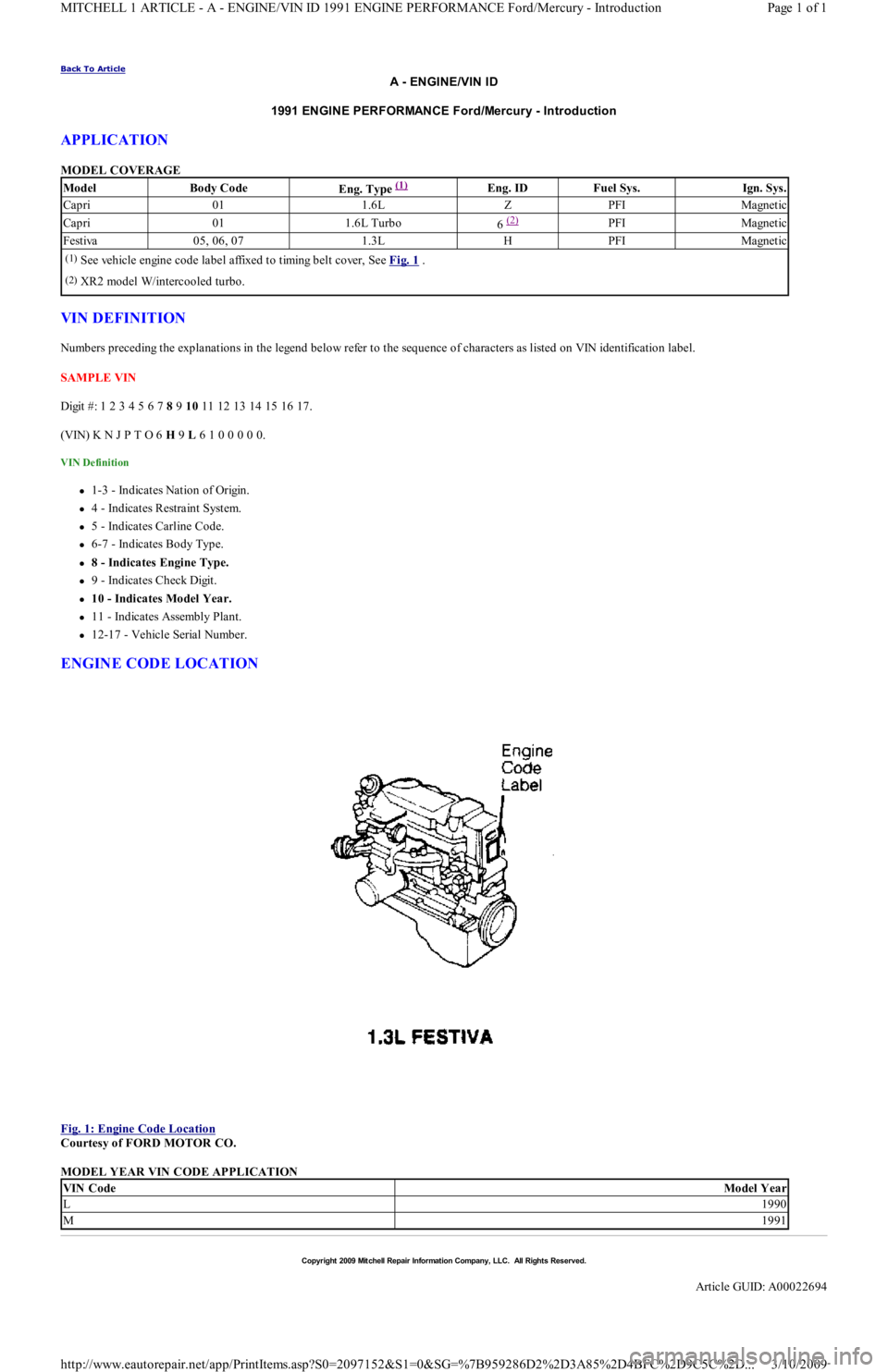
Fig. 1: Engine Code Location
Courtesy of FORD MOTOR CO.
MODEL YEAR VIN CODE APPLICATION
ModelBody CodeEng. Type (1) Eng. IDFuel Sys.Ign. Sys.
Capri011.6LZPFIMagnetic
Capri011.6L Turbo6 (2) PFIMagnetic
Festiva05, 06, 071.3LHPFIMagnetic
(1)See vehicle engine code label affixed to timing belt cover, See Fig. 1 .
(2)XR2 model W/intercooled turbo.
VIN CodeModel Year
L1990
M1991
Copyr ight 2009 Mit chell Repair Information Company, LLC. All Rights Reserved.
Article GUID: A00022694
Page 1 of 1 MITCHELL 1 ARTICLE - A - ENGINE/VIN ID 1991 ENGINE PERFORMANCE Ford/Mercury - Introduction
3/10/2009 http://www.eautorepair.net/app/PrintItems.asp?S0=2097152&S1=0&SG=%7B959286D2%2D3A85%2D4BFC%2D9C5C%2D
...
Page 136 of 454
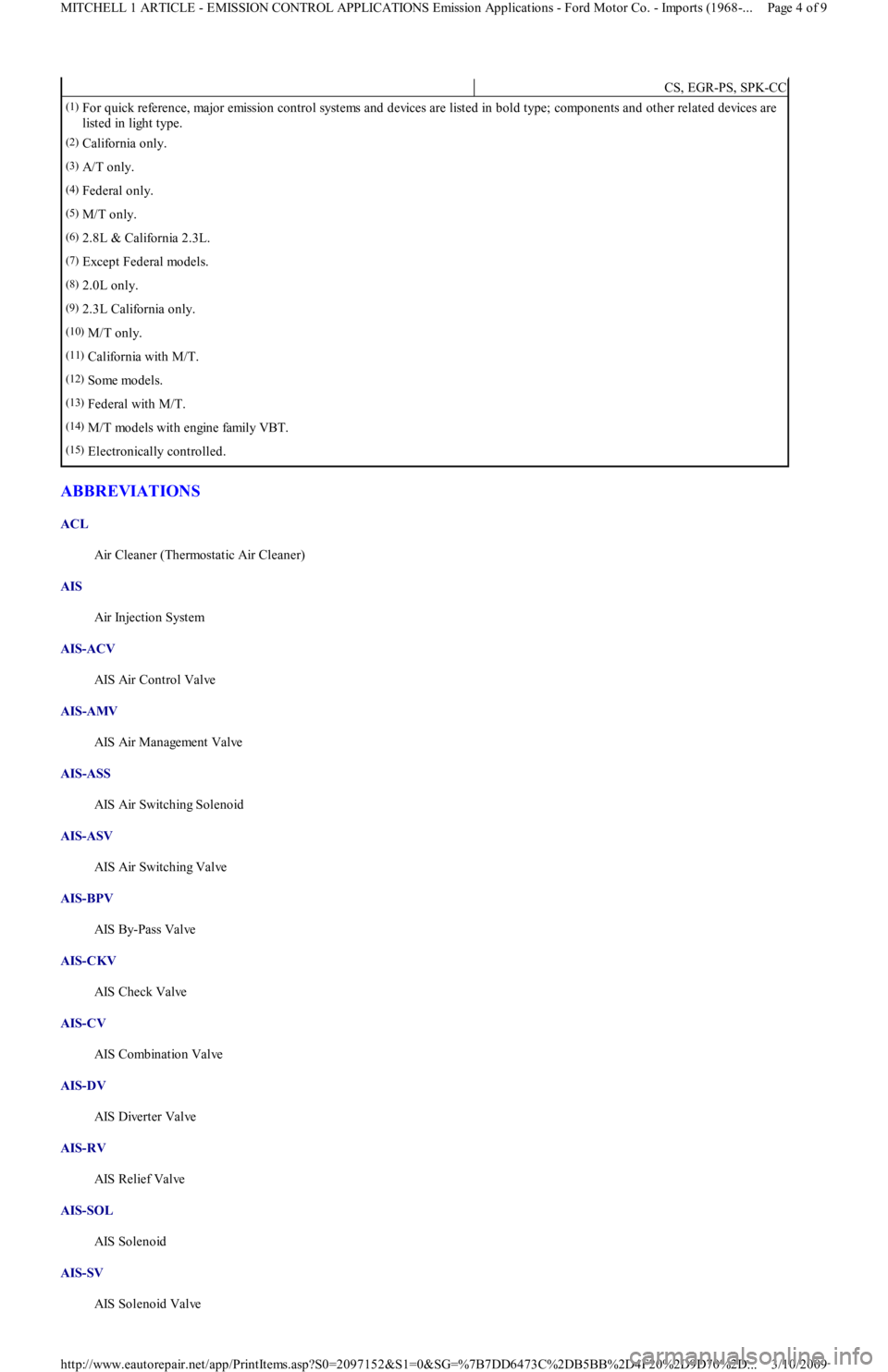
ABBREVIATIONS
ACL
Air Cleaner (Thermostatic Air Cleaner)
AIS
Air Injection System
AIS-ACV
AIS Air Control Valve
AIS-AMV
AIS Air Management Valve
AIS-ASS
AIS Air Switching Solenoid
AIS-ASV
AIS Air Switching Valve
AIS-BPV
AIS By-Pass Valve
AIS-CKV
AIS Check Valve
AIS-CV
AIS Combination Valve
AIS-DV
AIS Diverter Valve
AIS-RV
AIS Relief Valve
AIS-SOL
AIS Solenoid
AIS-SV
AIS Solenoid Valve
CS, EGR-PS, SPK-CC
(1)For quick reference, major emission control systems and devices are listed in bold type; components and other related devices are
listed in light type.
(2)California only.
(3)A/T only.
(4)Federal only.
(5)M/T only.
(6)2.8L & California 2.3L.
(7)Except Federal models.
(8)2.0L only.
(9)2.3L California only.
(10)M/T only.
(11)California with M/T.
(12)Some models.
(13)Federal with M/T.
(14)M/T models with engine family VBT.
(15)Electronically controlled.
Page 4 of 9 MITCHELL 1 ARTICLE - EMISSION CONTROL APPLICATIONS Emission Applications - Ford Motor Co. - Imports (1968-
...
3/10/2009 http://www.eautorepair.net/app/PrintItems.asp?S0=2097152&S1=0&SG=%7B7DD6473C%2DB5BB%2D4F20%2D9D70%2D
...
Page 138 of 454
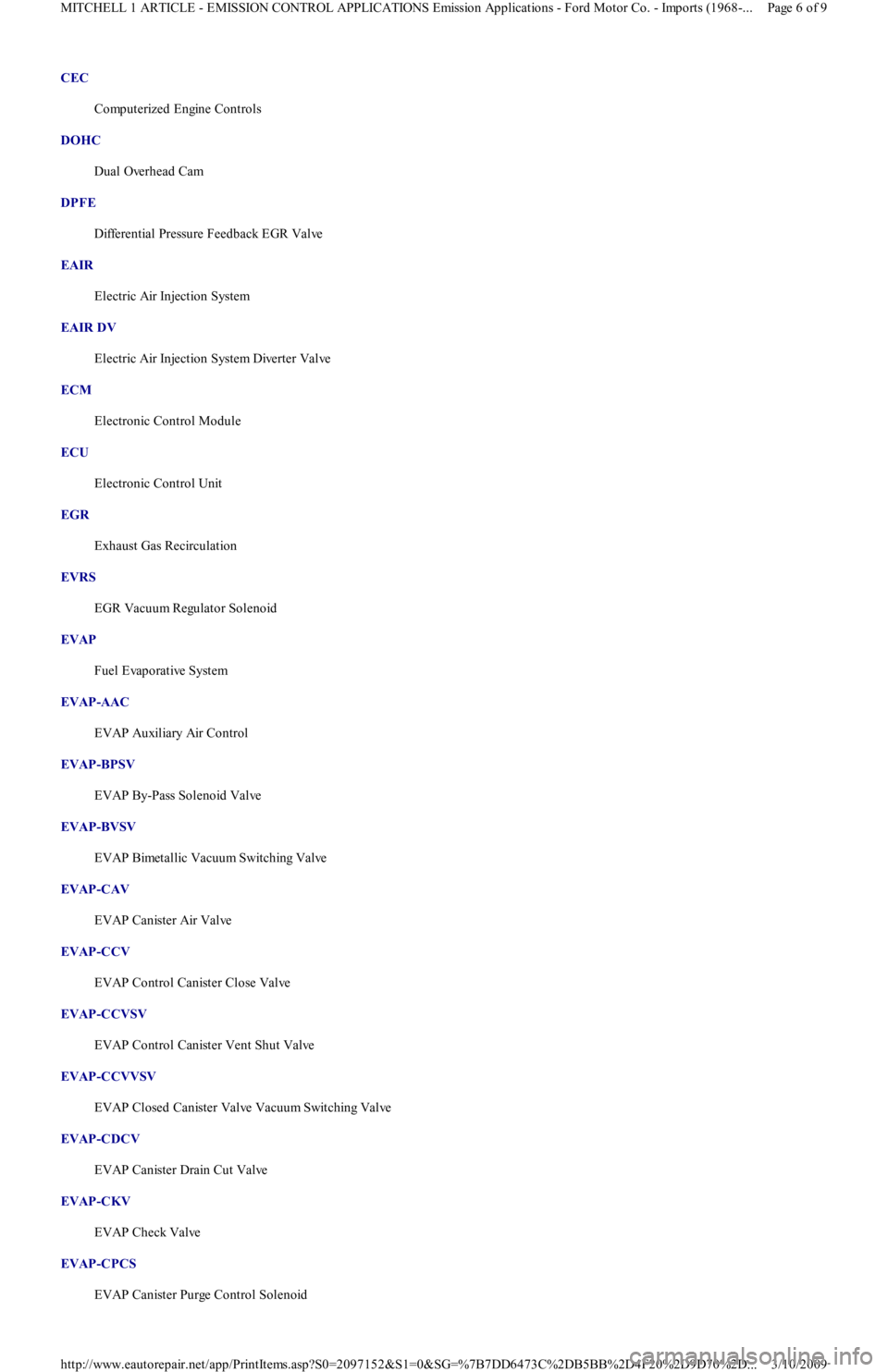
CEC
Computerized Engine Controls
DOHC
Dual Overhead Cam
DPFE
Differential Pressure Feedback EGR Valve
EAIR
Electric Air Injection System
EAIR DV
Electric Air Injection System Diverter Valve
ECM
Electronic Control Module
ECU
Electronic Control Unit
EGR
Exhaust Gas Recirculation
EVRS
EGR Vacuum Regulator Solenoid
EVAP
Fuel Evaporative System
EVAP-AAC
EVAP Auxiliary Air Control
EVAP-BPSV
EVAP By-Pass Solenoid Valve
EVAP-BVSV
EVAP Bimetallic Vacuum Switching Valve
EVAP-CAV
EVAP Canister Air Valve
EVAP-CCV
EVAP Control Canister Close Valve
EVAP-CCVSV
EVAP Control Canister Vent Shut Valve
EVAP-CCVVSV
EVAP Closed Canister Valve Vacuum Switching Valve
EVAP-CDCV
EVAP Canister Drain Cut Valve
EVAP-CKV
EVAP Check Valve
EVAP-CPCS
EVAP Canister Purge Control Solenoid
Page 6 of 9 MITCHELL 1 ARTICLE - EMISSION CONTROL APPLICATIONS Emission Applications - Ford Motor Co. - Imports (1968-
...
3/10/2009 http://www.eautorepair.net/app/PrintItems.asp?S0=2097152&S1=0&SG=%7B7DD6473C%2DB5BB%2D4F20%2D9D70%2D
...
Page 142 of 454
Back To Article
J - PIN VOLT AGE CHART S
1991 ENGINE PERFORMANCE Ford/Mercury Pin Voltage Charts
INTRODUCTION
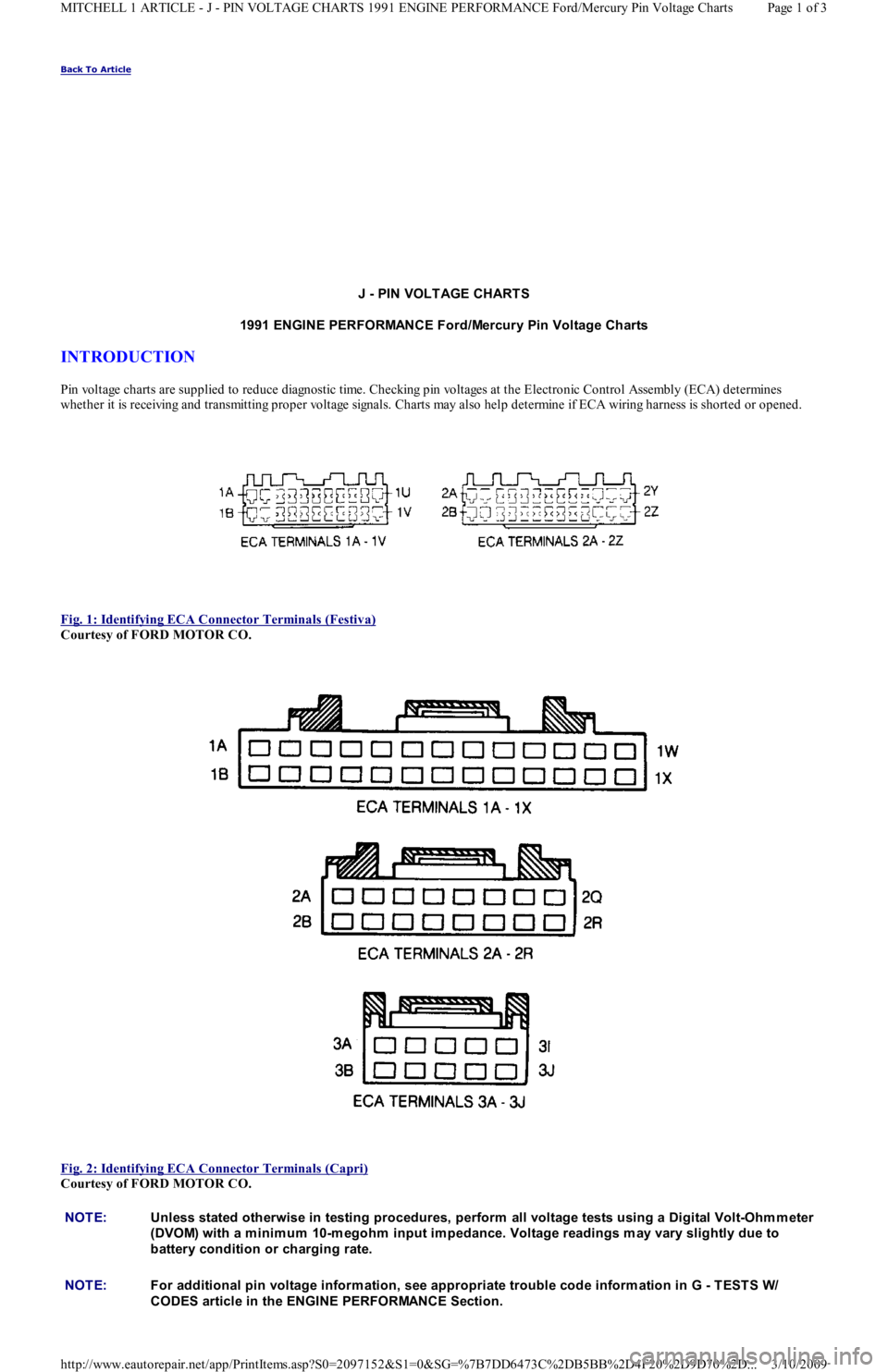
Pin voltage charts are supplied to reduce diagnostic time. Checking pin voltages at the Electronic Control Assembly (ECA) determin es
whether it is receiving and transmitting proper voltage signals. Charts may also help determine if ECA wiring harness is shorted or opened.
Fig. 1: Identifying ECA Connector Terminals (Festiva)
Courtesy of FORD MOTOR CO.
Fig. 2: Identifying ECA Connector Terminals (Capri)
Courtesy of FORD MOTOR CO.
NOTE:Unless stated otherwise in testing procedures, perform all voltage tests using a Digital Volt-Ohm m eter
(DVOM) with a m inim um 10-m egohm input im pedance. Voltage readings m ay vary slightly due to
battery condition or charging rate.
NOTE:For additional pin voltage inform ation, see appropriate trouble code inform ation in G - T EST S W/
CODES article in the ENGINE PERFORMANCE Section.
Page 1 of 3 MITCHELL 1 ARTICLE - J - PIN VOLTAGE CHARTS 1991 ENGINE PERFORMANCE Ford/Mercury Pin Voltage Charts
3/10/2009 http://www.eautorepair.net/app/PrintItems.asp?S0=2097152&S1=0&SG=%7B7DD6473C%2DB5BB%2D4F20%2D9D70%2D
...