1991 FORD FESTIVA check engine
[x] Cancel search: check enginePage 189 of 454

Check vane airflow meter.
Check idle speed control solenoid.
Check pressure regulator control solenoid.
Check heated exhaust gas oxygen sensor.
Check engine coolant temperature sensor.
Check A/C load control solenoid.
STUMBLE/HESITATION DURING ACCELERATION
Check throttle position switch.
Check vane airflow meter.
Check canister purge solenoid.
Check heated exhaust gas oxygen sensor.
Check wide open throttle A/C (WAC) relay.
Check A/C thermostatic switch.
MISSES/SURGES
Check exhaust gas oxygen sensor.
Check throttle position switch.
Check vane airflow meter.
Check wide open throttle vacuum switch.
Check A/C load control solenoid.
Check engine coolant temperature sensor.
IDLE IS FAST/SLOW RETURN TO IDLE
Check idle speed control solenoid.
Check by-pass air control valve.
Check engine coolant temperature sensor.
Check A/C load control solenoid.
IDLE IS ROUGH
Check idle speed control solenoid.
Check A/C load control solenoid.
Check by-pass air control valve.
Check throttle position switch.
Check vane airflow meter.
Check vane air temperature sensor.
Check canister purge solenoid.
Check engine cooling fan.
Check headlight switch.
Check blower control switch.
Check A/C thermostatic switch.
Check neutral safety switch.
Check neutral gear switch or clutch engage switch.
Check heated exhaust gas oxygen sensor.
ENGINE SPEEDS UP
Check idle speed control solenoid.
Check heated exhaust gas oxygen sensor.
Check by-pass air control valve.
CRANKS NORMALLY/NO START
Verify secondary ignition spark is present.
Verify fuel pressure is within specification.
Check vane airflow meter.
Check engine coolant temperature sensor.
CRANKS NORMALLY/SLOW TO START
Check ignition module.
Check engine coolant temperature sensor.
Check vane airflow meter.
Check evaporative emission control components.
Page 2 of 3 MITCHELL 1 ARTICLE - H - TESTS W/O CODES 1991-92 ENGINE PERFORMANCE Ford Motor Co. Trouble Shooting -
...
3/10/2009 http://www.eautorepair.net/app/PrintItems.asp?S0=2097152&S1=0&SG=%7B7DD6473C%2DB5BB%2D4F20%2D9D70%2D
...
Page 190 of 454

POOR FUEL ECONOMY
Verify intake air is not restricted.
Verify fuel pressure is within specification.
Check ignition module.
Check canister purge solenoid.
Check vane air temperature sensor.
Check vane airflow meter.
Check heated exhaust gas oxygen sensor.
EXHAUST SMOKE/ODOR
Check vane air temperature sensor.
Check vane airflow meter.
Check exhaust gas oxygen sensor.
FUEL ODOR/LEAKS
Check evaporative emission control components.
Check rollover vent valve.
Check by-pass air control valve.
FAILS EMISSION TEST
Check canister purge solenoid.
Check pressure regulator control solenoid.
Check heated exhaust gas oxygen sensor.
Check by-pass air control valve.
INTERMITTENTS
INTERMITTENT PROBLEM DIAGNOSIS
Intermittent fault testing requires duplicating circuit or component failure to identify problem. These procedures may lead to computer setting
a fault code (on some systems) which may help in diagnosis.
If problem vehicle does not produce fault codes, monitor voltage or resistance values using a DVOM while attempting to reproduce conditions
causing intermittent fault. A status change on DVOM indicates a fault has been located.
Use a DVOM to pinpoint faults. When monitoring voltage, ensure ignition switch is in ON position or engine is running. Ensure ign it io n
switch is in OFF position or negative battery cable is disconnected when monitoring circuit resistance. Status changes on DVOM during test
procedures indicate area of fault.
TEST PROCEDURES
INTERMITTENT SIMULATION
To reproduce conditions creating an intermittent fault, use following methods:
Lightly vibrate component.
Heat component.
Wiggle or bend wiring harness.
Spray component with water.
Remove/apply vacuum source.
Monitor circuit/component voltage or resistance while simulating intermittent. If engine is running, monitor for self-diagnostic codes. Use test
results to identify a faulty component or circuit.
Copyr ight 2009 Mitchell Repair Information Company, LLC. All Rights Reserved.
Article GUID: A00022699
Page 3 of 3 MITCHELL 1 ARTICLE - H - TESTS W/O CODES 1991-92 ENGINE PERFORMANCE Ford Motor Co. Trouble Shooting -
...
3/10/2009 http://www.eautorepair.net/app/PrintItems.asp?S0=2097152&S1=0&SG=%7B7DD6473C%2DB5BB%2D4F20%2D9D70%2D
...
Page 192 of 454

CLUTCH ENGAGE SWITCH (CES)
This switch is located on the manual transaxle and informs the ECA of transmission operating conditions. The ECA uses this data fo r id l e
speed control and canister purge valve operation.
CRANKSHAFT POSITION SENSOR (CPS) (FESTIVA)
This sensor is located in the distributor and sends engine RPM and crankshaft position data to the ECA. The ECA uses this data in calculating
fuel metering, ignition timing, idle speed control and canister purge valve operation.
CYLINDER IDENTIFICATION SENSOR (CID) (CAPRI)
This sensor is located in the distributor and provides crankshaft position data to the ECA. The ECA uses this data in calculating fuel metering
and ignition timing.
ELECTRICAL LOAD SWITCHES
Blower control, cooling fan, rear window defroster, air conditioning and headlight switches all send signals to the ECA. The ECA uses these
signals for idle speed control.
ENGINE COOLANT TEMPERATURE (ECT) SENSOR
This sensor is located in the intake manifold and sends coolant temperature data to the ECA. The ECA uses this data in calculating fuel
metering, idle speed control and canister purge valve operation.
EXHAUST GAS OXYGEN (EGO) SENSOR
This sensor is located in the exhaust manifold and senses oxygen concentration in the exhaust gas. The ECA uses this data in calculating fuel
metering, idle speed control and canister purge valve operation.
NEUTRAL SAFETY SWITCH (A/T)
This switch is located on the automatic transaxle and sends a signal to the ECA whenever the transaxle is in Neutral or Park ranges. The ECA
uses this signal in calculating fuel metering, idle speed control and canister purge valve operation.
POWER STEERING PRESSURE SWITCH (PSPS)
This switch is located on the power steering pump and sends data about power steering operation to the ECA. The ECA uses this data for idle
speed control.
THROTTLE POSITION SENSOR (TP)
This device is located on the throttle body and contains 2 switches. The Wide Open Throttle (WOT) Switch sends a signal to the ECA when
throttle valve opening is more than 70 degrees. The ECA uses this signal in calculating fuel metering.
The Idle Switch (IDL) sends a signal to the ECA when throttle valve opening is less than 1.5 degrees. The ECA uses this signal for idle speed
control and canister purge valve operation.
VANE AIRFLOW (VAF) METER
This sensor is located in the air cleaner housing and sends intake airflow data to the ECA. The ECA uses this data in calculating fuel metering.
VANE AIR TEMPERATURE (VAT) SENSOR
This sensor is located inside the vane airflow sensor and senses intake air temperature. The ECA uses this data in calculating fu el met erin g,
idle speed control and canister purge valve operation.
CEC OUTPUT SIGNALS
CANISTER PURGE (CANP) SOLENOID
See EMISSION SYSTEMS.
CHECK ENGINE LIGHT
See SELF-DIAGNOSTIC SYSTEM.
FUEL INJECTORS
See FUEL CONTROL.
IDLE SPEED CONTROL BY-PASS AIR (ISC-BPA) VALVE
See IDLE SPEED. NOTE:Vehicles are equipped with different com binations of com puter-controlled com ponents. Not all
com ponents listed below are used on every vehicle. For theory and operation of each output
com ponent, refer to indicated system .
Page 2 of 6 MITCHELL 1 ARTICLE - E - THEORY/OPERATION 1991 ENGINE PERFORMANCE Ford/Mercury Theory & Operation
3/10/2009 http://www.eautorepair.net/app/PrintItems.asp?S0=2097152&S1=0&SG=%7B7DD6473C%2DB5BB%2D4F20%2D9D70%2D
...
Page 193 of 454
FUEL DELIVERY SYSTEM
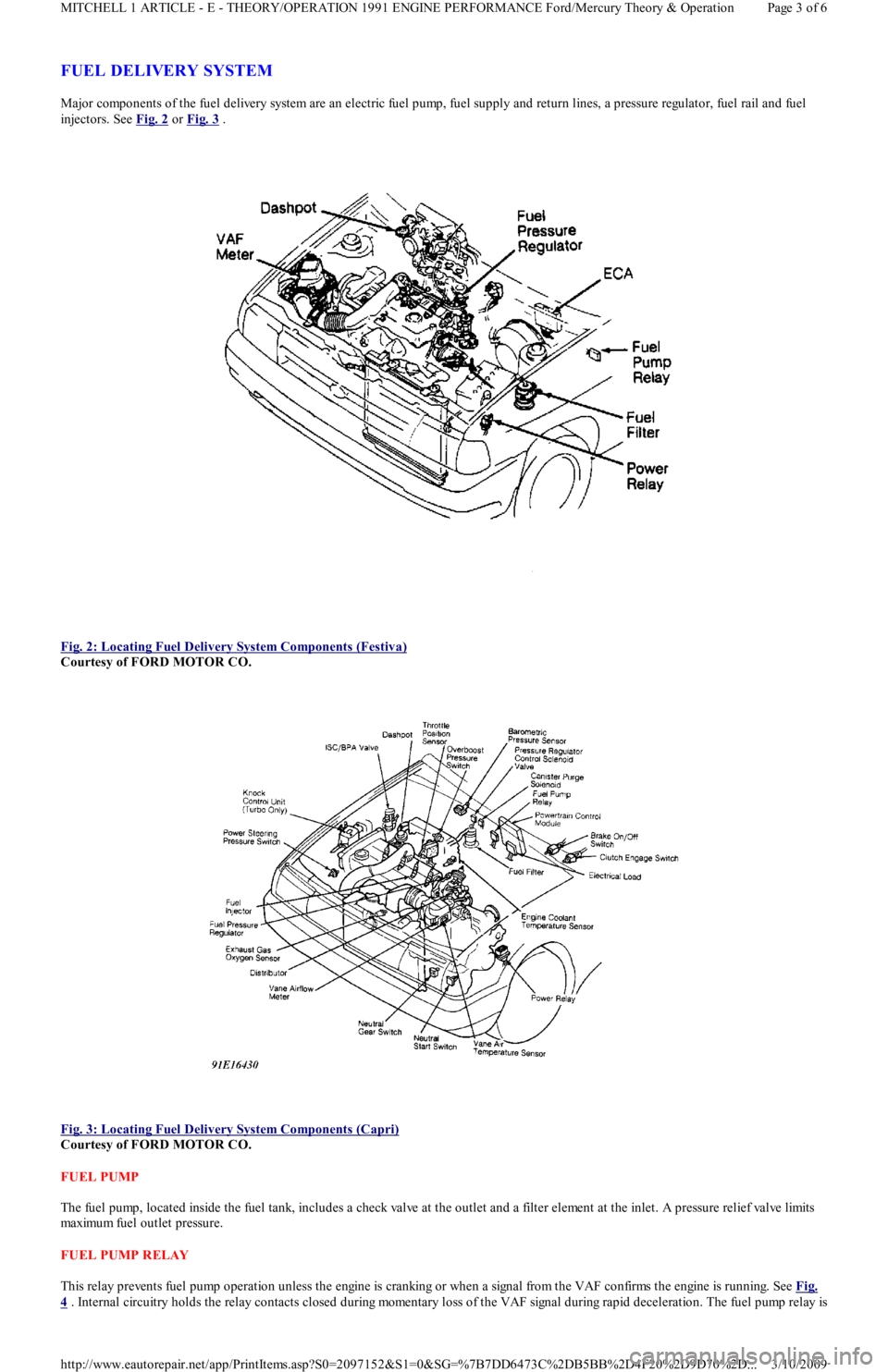
Major components of the fuel delivery system are an electric fuel pump, fuel supply and return lines, a pressure regulator, fuel rail and fuel
injectors. See Fig. 2
or Fig. 3 .
Fig. 2: Locating Fuel Delivery System Components (Festiva)
Courtesy of FORD MOTOR CO.
Fig. 3: Locating Fuel Delivery System Components (Capri)
Courtesy of FORD MOTOR CO.
FUEL PUMP
The fuel pump, located inside the fuel tank, includes a check valve at the outlet and a filter element at the inlet. A pressure relief valve limits
maximu m fu el o u t l et p ressu re.
FUEL PUMP RELAY
This relay prevents fuel pump operation unless the engine is cranking or when a signal from the VAF confirms the engine is running. See Fig.
4 . Internal circuitry holds the relay contacts closed during momentary loss of the VAF signal during rapid deceleration. The fuel pump relay is
Page 3 of 6 MITCHELL 1 ARTICLE - E - THEORY/OPERATION 1991 ENGINE PERFORMANCE Ford/Mercury Theory & Operation
3/10/2009 http://www.eautorepair.net/app/PrintItems.asp?S0=2097152&S1=0&SG=%7B7DD6473C%2DB5BB%2D4F20%2D9D70%2D
...
Page 196 of 454

gases into harmless substances.
PCV VALVE
The Positive Crankcase Ventilation (PCV) valve, located in the valve cover, controls the flow of blow-by gas from the crankcase to the intake
man ifo l d .
SELF-DIAGNOSTIC SYSTEM
The ECA monitors its inputs and outputs. When it detects a malfunction, it sets a code in the ECA and sends a signal to the CHECK ENGINE
warning light. The light remains on until the malfunction is repaired. Trouble codes may be accessed at the Self-Test Output (STO) and Self-
Test Input (STI) connectors, near the battery.
If a sensor fails, the ECA will use a substitute value in its calculations to permit continued engine operation. In this condition, the vehicle will
run, but driveability may be poor. Intermittent failures may result in the CHECK ENGINE warning light flickering or going out after the fault
goes away. The corresponding trouble code, however, will be stored in the ECA. If fault does not recur, the related code will be erased from
ECA memory.
CHECK ENGINE LIGHT
Hard failures cause the CHECK ENGINE warning light to come on and remain on until the malfunction is repaired. If the warning light comes
on and stays on during vehicle operation, determine and correct the cause of the malfunction. NOTE:For additional inform ation and operating procedures for the self-diagnostic system , refer to T EST S
W/CODES article in the ENGINE PERFORMANCE Section.
Copyr ight 2009 Mitchell Repair Information Company, LLC. All Rights Reserved.
Article GUID: A00022697
Page 6 of 6 MITCHELL 1 ARTICLE - E - THEORY/OPERATION 1991 ENGINE PERFORMANCE Ford/Mercury Theory & Operation
3/10/2009 http://www.eautorepair.net/app/PrintItems.asp?S0=2097152&S1=0&SG=%7B7DD6473C%2DB5BB%2D4F20%2D9D70%2D
...
Page 202 of 454
CDI
Capacitor Discharge Ignition
CEC
Computerized Engine Control
CID
Cubic Inch Displacement
cm
Centimeter
CMP
Camshaft Position Sensor
CO
Carbon Monoxide
CO
2
Carbon Dioxide
Cont.
Continued
CONV
Convertible
CP
Canister Purge
CKP
Crankshaft Position Sensor
CTS
Coolant Temperature Sensor
Cu. In.
Cubic Inch
CVC
Constant Vacuum Control
CV
Check Valve or Constant Velocity
CW
Clockwise
CYL or Cyl.
Cylinder
C
3 I
Computer Controlled Coil Ignition
C
4
Computer Controlled Catalytic Converter
"D"
"D"
Page 4 of 15 MITCHELL 1 ARTICLE - GENERAL INFORMATION Commonly Used Abbreviations
3/10/2009 http://www.eautorepair.net/app/PrintItems.asp?S0=2097152&S1=0&SG=%7B9B990D68%2D660A%2D45E9%2D8F46%2DE
...
Page 214 of 454
Back To Article
GENERAL INFORMATION
T rouble Shooting - Basic Procedures
* PLEASE READ THIS FIRST *
ACCESSORIES & ELECTRICAL
CHARGING SYSTEM TROUBLE SHOOTING
BASIC CHARGING SYSTEM TROUBLE SHOOTING CHART NOTE:This is GENERAL inform ation. This article is not intended to be specific to any unique situation or
individual vehicle configuration. T he purpose of this T rouble Shooting inform ation is to provide a list
of com m on causes to problem sym ptom s. For m odel-specific T rouble Shooting, refer to SUBJECT ,
DIAGNOST IC, or T EST ING articles available in the section(s) you are accessing.
NOTE:This is GENERAL inform ation. This article is not intended to be specific to any unique situation or
individual vehicle configuration. T he purpose of this T rouble Shooting inform ation is to provide a list
of com m on causes to problem sym ptom s. For m odel-specific T rouble Shooting, refer to SUBJECT ,
DIAGNOST IC, or T EST ING articles available in the section(s) you are accessing.
NOTE:This is GENERAL inform ation. This article is not intended to be specific to any unique situation or
individual vehicle configuration. T he purpose of this T rouble Shooting inform ation is to provide a list
of com m on causes to problem sym ptom s. For m odel-specific T rouble Shooting, refer to SUBJECT ,
DIAGNOST IC, or T EST ING articles available in the section(s) you are accessing.
CONDITION & POSSIBLE CAUSECORRECTION
Vehicle Will Not Start
Dead batteryCheck battery cells, alternator
belt tension and alternator
output
Loose or corroded battery connectionsCheck all charging system
connections
Ignition circuit or switch malfunctionCheck and replace as necessary
Alternator Light Stays On With Engine Running
Loose or worn alternator drive beltCheck alternator drive tension
and condition, See Belt
Adjustment in TUNE-UP article
in the TUNE-UP section
Loose alternator wiring connectionsCheck all charging system
connections
Short in alternator light wiringSee Indicator Warning Lights in
STANDARD INSTRUMENTS
in the ACCESSORIES &
EQUIPMENT section
Defective alternator stator or diodesSee Bench Tests in
ALTERNATOR article
Defective regulatorSee Regulator Check in
ALTERNATOR article
Alternator Light Stays Off With Ignition Switch ON
Blown fuseSee WIRING DIAGRAMS
Defective alternatorSee Testing in ALTERNATOR
article
Defective indicator light bulb or socketSee Indicator Warning Lights in
STANDARD INSTRUMENTS
in the ACCESSORIES &
EQUIPMENT section
Alternator Light Stays OFF With Ignition Switch ON
Short in alternator wiringSee On-Vehicle Tests in
ALTERNATOR article
Defective rectifier bridgeSee Bench Tests in
ALTERNATOR article
Lights or Fuses Burn Out Frequently
Defective alternator wiringSee On-Vehicle Tests in
ALTERNATOR article
Defective regulatorSee Regulator Check in
ALTERNATOR article
Defective batteryCheck and replace as necessary
Ammeter Gauge Shows Discharge
Loose or worn drive beltCheck alternator drive belt
tension and condition. See Belt
Adjustment in TUNE-UP article
in the TUNE-UP section
Defective wiringCheck all wires and wire
Page 1 of 36 MITCHELL 1 ARTICLE - GENERAL INFORMATION Trouble Shooting - Basic Procedures
3/10/2009 http://www.eautorepair.net/app/PrintItems.asp?S0=2097152&S1=0&SG=%7B9B990D68%2D660A%2D45E9%2D8F46%2DE
...
Page 217 of 454
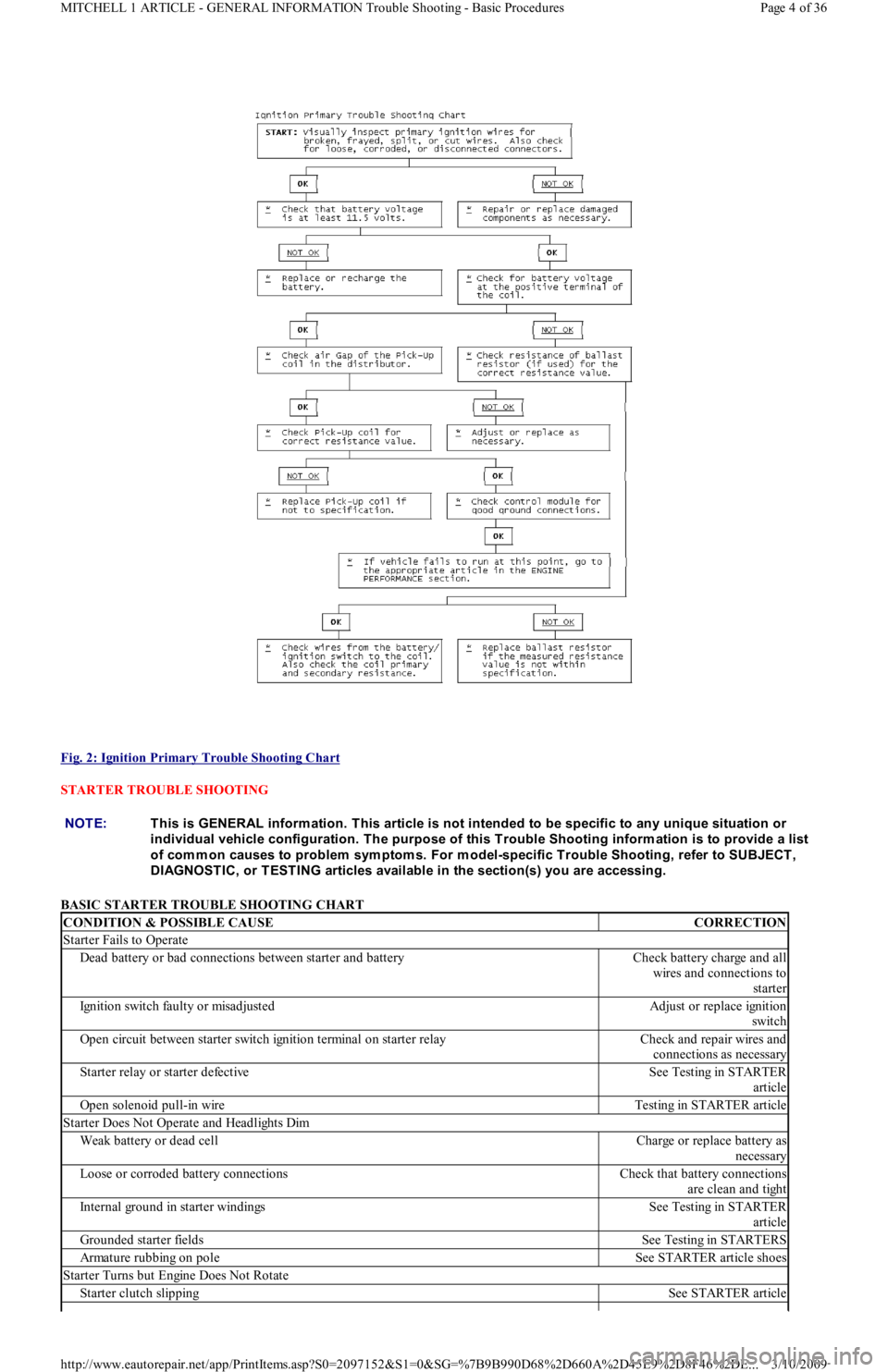
Fig. 2: Ignition Primary Trouble Shooting Chart
STARTER TROUBLE SHOOTING
BASIC STARTER TROUBLE SHOOTING CHART
NOTE:This is GENERAL inform ation. This article is not intended to be specific to any unique situation or
individual vehicle configuration. T he purpose of this T rouble Shooting inform ation is to provide a list
of com m on causes to problem sym ptom s. For m odel-specific T rouble Shooting, refer to SUBJECT ,
DIAGNOST IC, or T EST ING articles available in the section(s) you are accessing.
CONDITION & POSSIBLE CAUSECORRECTION
Starter Fails to Operate
Dead battery or bad connections between starter and batteryCheck battery charge and all
wires and connections to
starter
Ignition switch faulty or misadjustedAdjust or replace ignition
switch
Open circuit between starter switch ignition terminal on starter relayCheck and repair wires and
connections as necessary
Starter relay or starter defectiveSee Testing in STARTER
article
Open solenoid pull-in wireTesting in STARTER article
Starter Does Not Operate and Headlights Dim
Weak battery or dead cellCharge or replace battery as
necessary
Loose or corroded battery connectionsCheck that battery connections
are clean and tight
Internal ground in starter windingsSee Testing in STARTER
article
Grounded starter fieldsSee Testing in STARTERS
Armature rubbing on poleSee STARTER article shoes
Starter Turns but Engine Does Not Rotate
Starter clutch slippingSee STARTER article
Page 4 of 36 MITCHELL 1 ARTICLE - GENERAL INFORMATION Trouble Shooting - Basic Procedures
3/10/2009 http://www.eautorepair.net/app/PrintItems.asp?S0=2097152&S1=0&SG=%7B9B990D68%2D660A%2D45E9%2D8F46%2DE
...