1991 FORD FESTIVA width
[x] Cancel search: widthPage 4 of 454
Turbo Boost Gauge Always Reads High
If turbo boost gauge always reads high, check these items:
Check for damaged White/Black signal wire.
Check for defective boost sensing unit.
Check for defective boost gauge.
Turbo Boost Gauge Inaccurate
If turbo boost gauge is inaccurate, check these items:
Check for loose or corroded connections.
Check for defective boost sensing unit.
Check for defective boost gauge.
TESTING
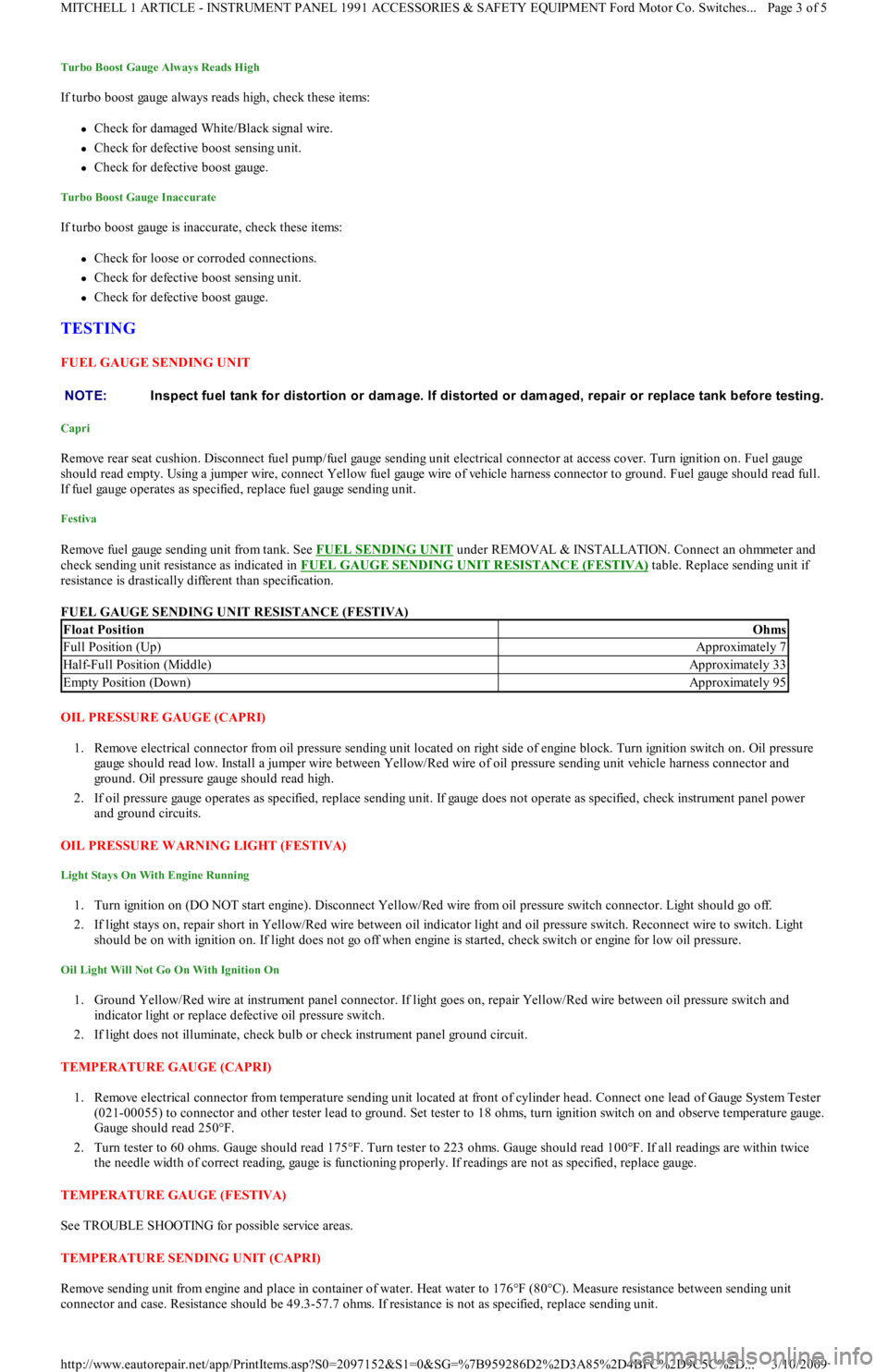
FUEL GAUGE SENDING UNIT
Capri
Remove rear seat cushion. Disconnect fuel pump/fuel gauge sending unit electrical connector at access cover. Turn ignition on. Fuel gauge
should read empty. Using a jumper wire, connect Yellow fuel gauge wire of vehicle harness connector to ground. Fuel gauge should read full.
If fuel gauge operates as specified, replace fuel gauge sending unit.
Festiva
Remove fuel gauge sending unit from tank. See FUEL SENDING UNIT under REMOVAL & INSTALLATION. Connect an ohmmeter and
check sending unit resistance as indicated in FUEL GAUGE SENDING UNIT RESISTANCE (FESTIVA)
table. Replace sending unit if
resistance is drastically different than specification.
FUEL GAUGE SENDING UNIT RESISTANCE (FESTIVA)
OIL PRESSURE GAUGE (CAPRI)
1. Remove electrical connector from oil pressure sending unit located on right side of engine block. Turn ignition switch on. Oil pressure
gauge should read low. Install a jumper wire between Yellow/Red wire of oil pressure sending unit vehicle harness connector and
ground. Oil pressure gauge should read high.
2. If oil pressure gauge operates as specified, replace sending unit. If gauge does not operate as specified, check instrument panel power
and ground circuits.
OIL PRESSURE WARNING LIGHT (FESTIVA)
Light Stays On With Engine Running
1. Turn ignition on (DO NOT start engine). Disconnect Yellow/Red wire from oil pressure switch connector. Light should go off.
2. If light stays on, repair short in Yellow/Red wire between oil indicator light and oil pressure switch. Reconnect wire to switch. Light
should be on with ignition on. If light does not go off when engine is started, check switch or engine for low oil pressure.
Oil Light Will Not Go On With Ignition On
1. Ground Yellow/Red wire at instrument panel connector. If light goes on, repair Yellow/Red wire between oil pressure switch and
indicator light or replace defective oil pressure switch.
2. If light does not illuminate, check bulb or check instrument panel ground circuit.
TEMPERATURE GAUGE (CAPRI)
1. Remove electrical connector from temperature sending unit located at front of cylinder head. Connect one lead of Gauge System Tester
(021-00055) to connector and other tester lead to ground. Set tester to 18 ohms, turn ignition switch on and observe temperature gauge.
Gauge should read 250°F.
2. Turn tester to 60 ohms. Gauge should read 175°F. Turn tester to 223 ohms. Gauge should read 100°F. If all readings are within twice
the needle width of correct reading, gauge is functioning properly. If readings are not as specified, replace gauge.
TEMPERATURE GAUGE (FESTIVA)
See TROUBLE SHOOTING for possible service areas.
TEMPERATURE SENDING UNIT (CAPRI)
Remove sending unit from engine and place in container of water. Heat water to 176°F (80°C). Measure resistance between sending unit
connector and case. Resistance should be 49.3-57.7 ohms. If resistance is not as specified, replace sending unit. NOTE:Inspect fuel tank for distortion or dam age. If distorted or dam aged, repair or replace tank before testing.
Float PositionOhms
Full Position (Up)Approximately 7
Half-Full Position (Middle)Approximately 33
Empty Position (Down)Approximately 95
Page 3 of 5 MITCHELL 1 ARTICLE - INSTRUMENT PANEL 1991 ACCESSORIES & SAFETY EQUIPMENT Ford Motor Co. Switches
...
3/10/2009 http://www.eautorepair.net/app/PrintItems.asp?S0=2097152&S1=0&SG=%7B959286D2%2D3A85%2D4BFC%2D9C5C%2D
...
Page 118 of 454
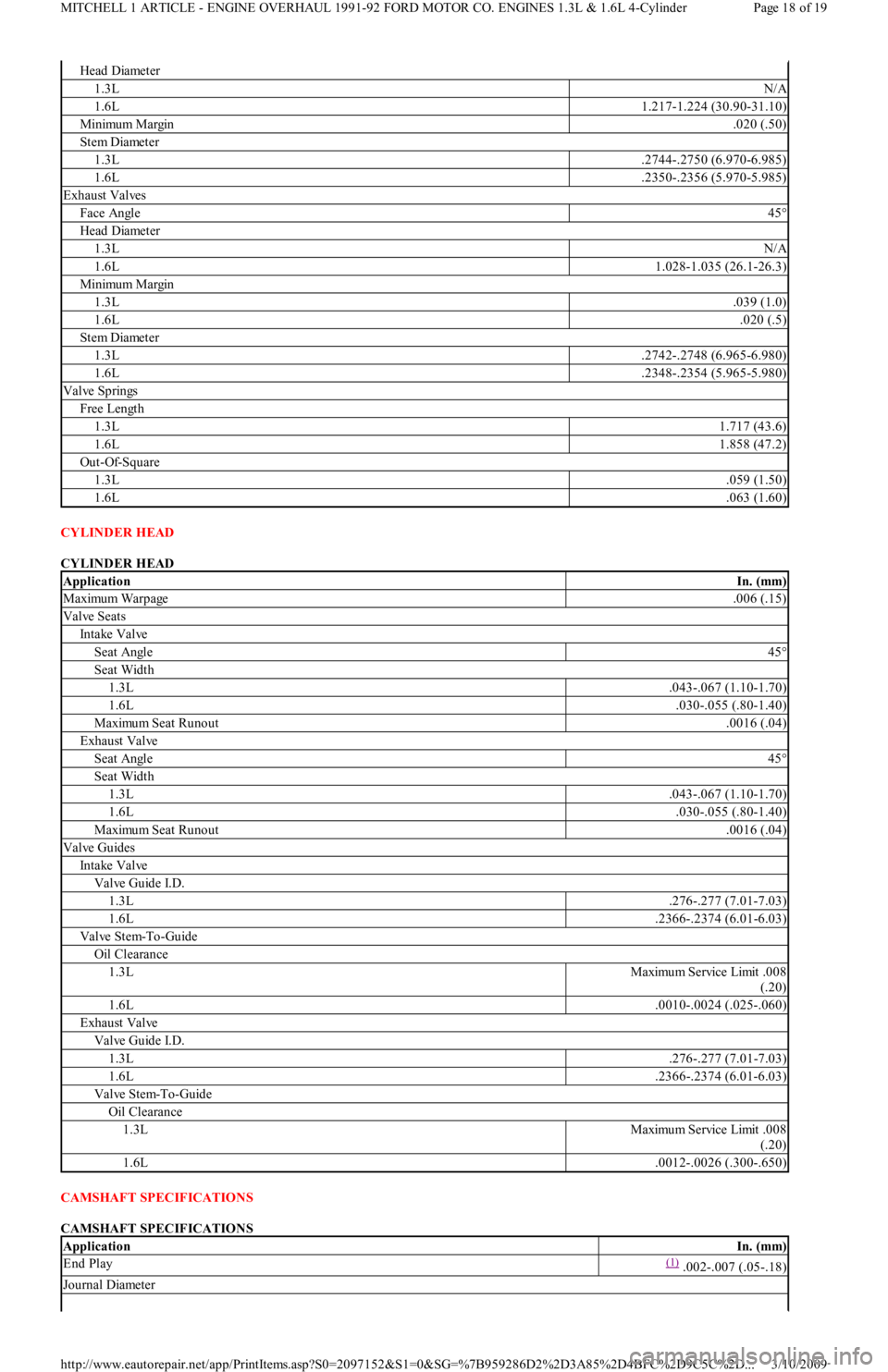
CYLINDER HEAD
CYLINDER HEAD
CAMSHAFT SPECIFICATIONS
CAMSHAFT SPECIFICATIONS
Head Diameter
1.3LN/A
1.6L1.217-1.224 (30.90-31.10)
Min imu m Margin.020 (.50)
Stem Diameter
1.3L.2744-.2750 (6.970-6.985)
1.6L.2350-.2356 (5.970-5.985)
Exhaust Valves
Face Angle45°
Head Diameter
1.3LN/A
1.6L1.028-1.035 (26.1-26.3)
Min imu m Margin
1.3L.039 (1.0)
1.6L.020 (.5)
Stem Diameter
1.3L.2742-.2748 (6.965-6.980)
1.6L.2348-.2354 (5.965-5.980)
Valve Springs
Free Length
1.3L1.717 (43.6)
1.6L1.858 (47.2)
Out-Of-Square
1.3L.059 (1.50)
1.6L.063 (1.60)
ApplicationIn. (mm)
Maximu m Warp age.006 (.15)
Valve Seats
Intake Valve
Seat Angle45°
Seat Width
1.3L.043-.067 (1.10-1.70)
1.6L.030-.055 (.80-1.40)
Maximu m Seat Ru n o u t.0016 (.04)
Exhaust Valve
Seat Angle45°
Seat Width
1.3L.043-.067 (1.10-1.70)
1.6L.030-.055 (.80-1.40)
Maximu m Seat Ru n o u t.0016 (.04)
Valve Guides
Intake Valve
Valve Guide I.D.
1.3L.276-.277 (7.01-7.03)
1.6L.2366-.2374 (6.01-6.03)
Valve Stem-To-Guide
Oil Clearance
1.3LMaximu m Service Limit .0 0 8
(.20)
1.6L.0010-.0024 (.025-.060)
Exhaust Valve
Valve Guide I.D.
1.3L.276-.277 (7.01-7.03)
1.6L.2366-.2374 (6.01-6.03)
Valve Stem-To-Guide
Oil Clearance
1.3LMaximu m Service Limit .0 0 8
(.20)
1.6L.0012-.0026 (.300-.650)
ApplicationIn. (mm)
End Play(1) .002-.007 (.05-.18)
Journal Diameter
Page 18 of 19 MITCHELL 1 ARTICLE - ENGINE OVERHAUL 1991-92 FORD MOTOR CO. ENGINES 1.3L & 1.6L 4-Cylinder
3/10/2009 http://www.eautorepair.net/app/PrintItems.asp?S0=2097152&S1=0&SG=%7B959286D2%2D3A85%2D4BFC%2D9C5C%2D
...
Page 225 of 454
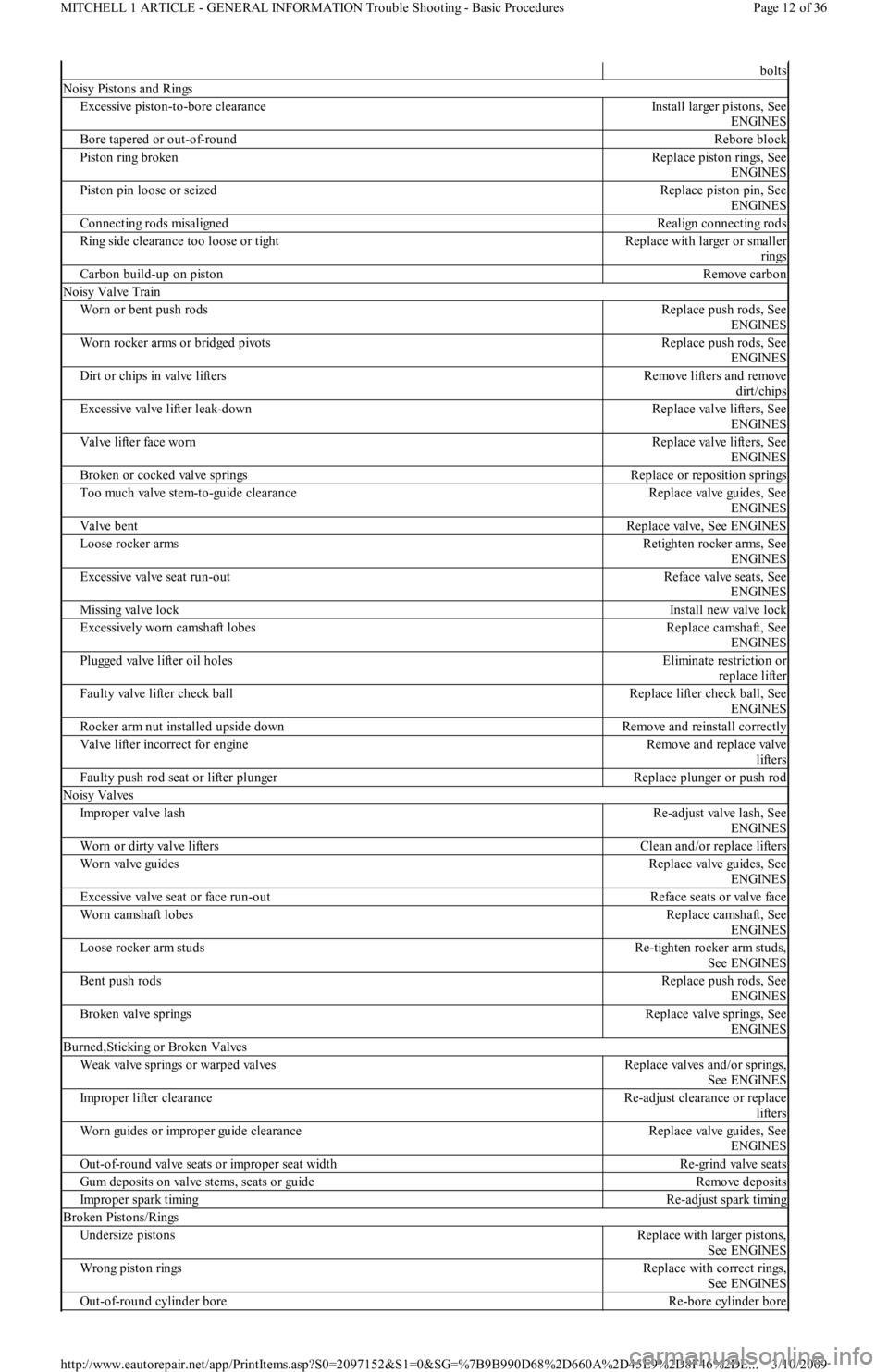
bolts
Noisy Pistons and Rings
Excessive piston-to-bore clearanceInstall larger pistons, See
ENGINES
Bore tapered or out-of-roundRebore block
Piston ring brokenReplace piston rings, See
ENGINES
Piston pin loose or seizedReplace piston pin, See
ENGINES
Connecting rods misalignedRealign connecting rods
Ring side clearance too loose or tightReplace with larger or smaller
rings
Carbon build-up on pistonRemove carbon
Noisy Valve Train
Worn or bent push rodsReplace push rods, See
ENGINES
Worn rocker arms or bridged pivotsReplace push rods, See
ENGINES
Dirt or chips in valve liftersRemove lifters and remove
dirt/chips
Excessive valve lifter leak-downReplace valve lifters, See
ENGINES
Valve lifter face wornReplace valve lifters, See
ENGINES
Broken or cocked valve springsReplace or reposition springs
Too much valve stem-to-guide clearanceReplace valve guides, See
ENGINES
Valve bentReplace valve, See ENGINES
Loose rocker armsRetighten rocker arms, See
ENGINES
Excessive valve seat run-outReface valve seats, See
ENGINES
Missing valve lockInstall new valve lock
Excessively worn camshaft lobesReplace camshaft, See
ENGINES
Plugged valve lifter oil holesEliminate restriction or
replace lifter
Faulty valve lifter check ballReplace lifter check ball, See
ENGINES
Rocker arm nut installed upside downRemove and reinstall correctly
Valve lifter incorrect for engineRemove and replace valve
lifters
Faulty push rod seat or lifter plungerReplace plunger or push rod
Noisy Valves
Improper valve lashRe-adjust valve lash, See
ENGINES
Worn or dirty valve liftersClean and/or replace lifters
Wo r n va l ve gu id e sReplace valve guides, See
ENGINES
Excessive valve seat or face run-outReface seats or valve face
Worn camshaft lobesReplace camshaft, See
ENGINES
Loose rocker arm studsRe-tighten rocker arm studs,
See ENGINES
Bent push rodsReplace push rods, See
ENGINES
Broken valve springsReplace valve springs, See
ENGINES
Burned,Sticking or Broken Valves
Weak valve springs or warped valvesReplace valves and/or springs,
See ENGINES
Improper lifter clearanceRe-adjust clearance or replace
lifters
Worn guides or improper guide clearanceReplace valve guides, See
ENGINES
Out-of-round valve seats or improper seat widthRe-grind valve seats
Gum deposits on valve stems, seats or guideRemove deposits
Improper spark timingRe-adjust spark timing
Broken Pistons/Rings
Undersize pistonsReplace with larger pistons,
See ENGINES
Wrong piston ringsReplace with correct rings,
See ENGINES
Out-of-round cylinder boreRe-bore cylinder bore
Page 12 of 36 MITCHELL 1 ARTICLE - GENERAL INFORMATION Trouble Shooting - Basic Procedures
3/10/2009 http://www.eautorepair.net/app/PrintItems.asp?S0=2097152&S1=0&SG=%7B9B990D68%2D660A%2D45E9%2D8F46%2DE
...
Page 269 of 454

Fig. 15: Typical Digital EGR Valve
Courtesy of GENERAL MOTORS CORP.
Integrated Electronic EGR Valve
This type functions similar to a ported EGR valve with a remote vacuum regulator. The internal solenoid is normally open, which causes the
vacuum signal to be vented off to the atmosphere when EGR is not controlled by the Electronic Control Module (ECM). The solenoid valve
opens and closes the vacuum signal, controlling the amount of vacuum applied to the diaphragm. See Fig. 16
.
The electronic EGR valve contains a voltage regulator, which converts ECM signal and regulates current to the solenoid. The ECM controls
EGR flow with a pulse width modulated signal based on airflow, TPS and RPM. This system also contains a pintle position sensor, which
works similarly to a TPS sensor. As EGR flow is increased, the sensor output increases.
Verify EGR valve is present and not modified or purposely damaged. Ensure thermal vacuum switches, pressure transducers, speed switches,
etc., (if applicable) are not by-passed or modified. Ensure electrical connector to EGR valve is not disconnected.
Page 9 of 12 MITCHELL 1 ARTICLE - EMISSION CONTROL VISUAL INSPECTION PROCEDURES 1983-93 GENERAL INFORMATI
...
3/10/2009 http://www.eautorepair.net/app/PrintItems.asp?S0=2097152&S1=0&SG=%7B9B990D68%2D660A%2D45E9%2D8F46%2DE
...
Page 283 of 454

Circuits with external injector resistors. Used predominately on some Asian & European systems, they are used to reduce the available
voltage to an injector in order to limit the current flow. This lower voltage can cause a dim flash on a noid light designed for full voltage.
Circuits with current controlled injector drivers (e.g. "Peak and Hold"). Basically, this type of driver allows a quick burst of
voltage/current to flow and then throttles it back significantly for the remainder of the pulse width duration. If a noid light was designed
for the other type of driver (voltage controlled, e.g. "Saturated"), it will appear dim because it is expecting full voltage/current to flow
for the entire duration of the pulse width.
Let's move to the other situation where a noid light flashes normally when it should be dim. This could occur if a more sensitive n o id l igh t is
used on a higher voltage/amperage circuit that was weakened enough to cause problems (but not outright broken). A circuit with an actual
problem would thus appear normal.
Let's look at why. A noid light does not come close to consuming as much amperage as an injector solenoid. If there is a partial driver failure
or a minor voltage drop in the injector circuit, there can be adequate amperage to fully operate the noid light BUT NOT ENOUGH TO
OPERATE THE INJECTOR.
If this is not clear, picture a battery with a lot of corrosion on the terminals. Say there is enough corrosion that the starter motor will not
operate; it only clicks. Now imagine turning on the headlights (with the ignition in the RUN position). You find they light normally and are
fully bright. This is the same idea as noid light: There is a problem, but enough amp flow exists to operate the headlights ("noid light"), but not
the starter motor ("injector").
How do you identify and avoid all these situations? By using the correct type of noid light. This requires that you understanding the types of
injector circuits that your noid lights are designed for. There are three. They are:
Systems with a voltage controlled injector driver. Another way to say it: The noid light is designed for a circuit with a "high" resistance
injector (generally 12 ohms or above).
Systems with a current controlled injector driver. Another way to say it: The noid light is designed for a circuit with a low resistance
injector (generally less than 12 ohms) without an external injector resistor.
Systems with a voltage controlled injector driver and an external injector resistor. Another way of saying it: The noid light is designed
for a circuit with a low resistance injector (generally less than 12 ohms) and an external injector resistor.
If you are not sure which type of circuit your noid light is designed for, plug it into a known good car and check out the results. If it flashes
normally during cranking, determine the circuit type by finding out injector resistance and if an external injector resistor is used. You now
know enough to identify the type of injector circuit. Label the noid light appropriately.
Next time you need to use a noid light for diagnosis, determine what type of injector circuit you are dealing with and select the appropriate
noid light.
Of course, if you suspect a no-pulse condition you could plug in any one whose connector fit without fear of misdiagnosis. This is because it is
unimportant if the flashing light is dim or bright. It is only important that it flashes.
In any cases of doubt regarding the use of a noid light, a lab scope will overcome all inherent weaknesses.
OVERVIEW OF DVOM
A DVOM is typically used to check injector resistance and available voltage at the injector. Some techs also use it check injector on-time
either with a built-in feature or by using the dwell/duty function.
There are situations where the DVOM performs these checks dependably, and other situations where it can deceive you. It is important to be
aware of these strengths and weaknesses. We will cover the topics above in the following text.
Checking Injector Resistance
If a short in an injector coil winding is constant, an ohmmeter will accurately identify the lower resistance. The same is true with an open
winding. Unfortunately, an intermittent short is an exception. A faulty injector with an intermittent short will show "good" if the ohmmeter
cannot force the short to occur during testing.
Alcohol in fuel typically causes an intermittent short, happening only when the injector coil is hot and loaded by a current high e n o u gh t o
jump the air gap between two bare windings or to break down any oxides that may have formed between them.
When you measure resistance with an ohmmeter, you are only applying a small current of a few milliamps. This is nowhere near enough to
load the coil sufficiently to detect most problems. As a result, most resistance checks identify intermittently shorted injectors as being normal.
There are two methods to get around this limitation. The first is to purchase an tool that checks injector coil windings under full load. The
Kent-Moore J-39021 is such a tool, though there are others. The Kent-Moore costs around $240 at the time of this writing and works on many
different manufacturer's systems.
The second method is to use a lab scope. Remember, a lab scope allows you to see the regular operation of a circuit in real time. If an injector
is having an short or intermittent short, the lab scope will show it.
Checking Available Voltage At the Injector
Verifying a fuel injector has the proper voltage to operate correctly is good diagnostic technique. Finding an open circuit on the feed circuit
like a broken wire or connector is an accurate check with a DVOM. Unfortunately, finding an intermittent or excessive resistance problem with
a DVOM is unreliable.
Let's explore this drawback. Remember that a voltage drop due to excessive resistance will only occur when a circuit is operating? Since the
injector circuit is only operating for a few milliseconds at a time, a DVOM will only see a potential fault for a few milliseconds. The remaining
90+% of the time the unloaded injector circuit will show normal battery voltage. NOTE:Som e noid lights can m eet both the second and third categories sim ultaneously.
Page 2 of 19 MITCHELL 1 ARTICLE - GENERAL INFORMATION Waveforms - Injector Pattern Tutorial
3/10/2009 http://www.eautorepair.net/app/PrintItems.asp?S0=2097152&S1=0&SG=%7B9B990D68%2D660A%2D45E9%2D8F46%2DE
...
Page 284 of 454

Since DVOMs update their display roughly two to five times a second, all measurements in between are averaged. Because a potential voltage
drop is visible for such a small amount of time, it ge t s "a ve r a ge d o u t ", c a u sin g yo u t o miss it .
Only a DVOM that has a "min-max" function that checks EVERY MILLISECOND will catch this fault consistently (if used in that mode). The
Fluke 87 among others has this capability.
A "min-max" DVOM with a lower frequency of checking (100 millisecond) can miss the fault because it will probably check when the injector
is not on. This is especially true with current controlled driver circuits. The Fluke 88, among others fall into this category.
Outside of using a Fluke 87 (or equivalent) in the 1 mS "min-max" mode, the only way to catch a voltage drop fault is with a lab scope. You
will be able to see a voltage drop as it happens.
One final note. It is important to be aware that an injector circuit with a solenoid resistor will always show a voltage drop when the circuit is
energized. This is somewhat obvious and normal; it is a designed-in voltage drop. What can be unexpected is what we already covered--a
voltage drop disappears when the circuit is unloaded. The unloaded injector circuit will show normal battery voltage at the injector.
Remember this and do not get confused.
Checking Injector On-Time With Built-In Function
Several DVOMs have a feature that allows them to measure injector on-time (mS pulse width). While they are accurate and fast to hookup,
they have three limitations you should be aware of:
They only work on voltage controlled injector drivers (e.g "Saturated Switch"), NOT on current controlled injector drivers (e.g. "Peak &
Hold").
A few unusual conditions can cause inaccurate readings.
Varying engine speeds can result in inaccurate readings.
Regarding the first limitation, DVOMs need a well-defined injector pulse in order to determine when the injector turns ON and OFF. Voltage
controlled drivers provide this because of their simple switch-like operation. They completely close the circuit for the entire duration of the
pulse. This is easy for the DVOM to interpret.
The other type of driver, the current controlled type, start off well by completely closing the circuit (until the injector pintle opens), but then
they throttle back the voltage/current for the duration of the pulse. The DVOM understands the beginning of the pulse but it cannot figure out
the throttling action. In other words, it cannot distinguish the throttling from an open circuit (de-energized) condition.
Yet current controlled injectors will still yield a millisecond on-time reading on these DVOMs. You will find it is also always the same,
regardless of the operating conditions. This is because it is only measuring the initial completely-closed circuit on-time, which always takes the
same amount of time (to lift the injector pintle off its seat). So even though you get a reading, it is useless.
The second limitation is that a few erratic conditions can cause inaccurate readings. This is because of a DVOM's slow display rate; roughly
two to five times a second. As we covered earlier, measurements in between display updates get averaged. So conditions like skipped injector
pulses or intermittent long/short injector pulses tend to get "averaged out", which will cause you to miss important details.
The last limitation is that varying engine speeds can result in inaccurate readings. This is caused by the quickly shifting injector on-time as the
engine load varies, or the RPM moves from a state of acceleration to stabilization, or similar situations. It too is caused by the averaging of all
measurements in between DVOM display periods. You can avoid this by checking on-time when there are no RPM or load changes.
A lab scope allows you to overcome each one of these limitations.
Checking Injector On-Time With Dwell Or Duty
If no tool is available to directly measure injector millisecond on-time measurement, some techs use a simple DVOM dwell or duty cycle
functions as a replacement.
While this is an approach of last resort, it does provide benefits. We will discuss the strengths and weaknesses in a moment, but first we will
look at how a duty cycle meter and dwell meter work.
How A Duty Cycle Meter and Dwell Meter Work
All readings are obtained by comparing how long something has been OFF to how long it has been ON in a fixed time period. A dwell meter
and duty cycle meter actually come up with the same answers using different scales. You can convert freely between them. See
RELATIONSHIP BETWEEN DWELL & DUTY CYCLE READINGS TABLE
.
The DVOM display updates roughly one time a second, although some DVOMs can be a little faster or slower. All measurements during this
update period are tallied inside the DVOM as ON time or OFF time, and then the total ratio is displayed as either a percentage (duty cycle) or
degrees (dwell meter).
For example, let's say a DVOM had an update rate of exactly 1 second (1000 milliseconds). Let's also say that it has been measuring/tallying
an injector circuit that had been ON a total of 250 mS out of the 1000 mS. That is a ratio of one-quarter, which would be displayed as 25%
duty cycle or 15° dwell (six-cylinder scale). Note that most duty cycle meters can reverse the readings by selecting the positive o r n e ga t ive
slope to trigger on. If this reading were reversed, a duty cycle meter would display 75%.
Strengths of Dwell/Duty Meter
The obvious strength of a dwell/duty meter is that you can compare injector on-time against a known-good reading. This is the only practical
way to use a dwell/duty meter, but requires you to have known-good values to compare against.
Another strength is that you can roughly convert injector mS on-time into dwell reading with some computations.
A final strength is that because the meter averages everything together it does not miss anything (though this is also a severe weakness that we
will look at later). If an injector has a fault where it occasionally skips a pulse, the meter registers it and the reading changes accordingly.
Page 3 of 19 MITCHELL 1 ARTICLE - GENERAL INFORMATION Waveforms - Injector Pattern Tutorial
3/10/2009 http://www.eautorepair.net/app/PrintItems.asp?S0=2097152&S1=0&SG=%7B9B990D68%2D660A%2D45E9%2D8F46%2DE
...
Page 285 of 454

Let's go back to figuring out dwell/duty readings by using injector on-time specification. This is not generally practical, but we will cover it for
completeness. You NEED to know three things:
Injector mS on-time specification.
Engine RPM when specification is valid.
How many times the injectors fire per crankshaft revolution.
The first two are self-explanatory. The last one may require some research into whether it is a bank-fire type that injects every 360° of
crankshaft rotation, a bank-fire that injects every 720°, or an SFI that injects every 720°. Many manufacturers do not release this data so you
may have to figure it out yourself with a frequency meter.
Here are the four complete steps to convert millisecond on-time:
1. Determine the injector pulse width and RPM it was obtained at. Let's say the specification is for one millisecond of on-time at a hot idle
of 600 RPM.
2. Determine injector firing method for the complete 4 stroke cycle. Let's say this is a 360° bank-fired, meaning an injector fires each and
every crankshaft revolution.
3. Determine how many times the injector will fire at the specified engine speed (600 RPM) in a fixed time period. We will use 100
milliseconds because it is easy to use. Six hundred crankshaft Revolutions Per Minute (RPM) divided by 60 seconds equals 10
revolutions per second. Multiplying 10 times .100 yields one; the crankshaft turns one time in 100 milliseconds. With exactly one
crankshaft rotation in 100 milliseconds, we know that the injector fires exactly one time.
4. Determine the ratio of injector on-time vs. off-time in the fixed time period, then figure duty cycle and/or dwell. The injector fires one
time for a total of one millisecond in any given 100 millisecond period. One hundred minus one equals 99. We have a 99% duty cycle.
If we wanted to know the dwell (on 6 cylinder scale), multiple 99% times .6; this equals 59.4° dwell.
Weaknesses of Dwell/Duty Meter
The weaknesses are significant. First, there is no one-to-one correspondence to actual mS on-time. No manufacturer releases dwell/duty data,
and it is time-consuming to convert the mS on-time readings. Besides, there can be a large degree of error because the conversion forces you to
assume that the injector(s) are always firing at the same rate for the same period of time. This can be a dangerous assumption.
Second, all level of detail is lost in the averaging process. This is the primary weakness. You cannot see the details you need to make a
confident diagnosis.
Here is one example. Imagine a vehicle that has a faulty injector driver that occasionally skips an injector pulse. Every skipped pulse means
that that cylinder does not fire, thus unburned O2 gets pushed into the exhaust and passes the O2 sensor. The O2 sensor indicates lean, so the
computer fattens up the mixture to compensate for the supposed "lean" condition.
A connected dwell/duty meter would see the fattened pulse width but would also see the skipped pulses. It would tally both and likely come
back with a reading that indicated the "pulse width" was within specification because the rich mixture and missing pulses offset each other.
This situation is not a far-fetched scenario. Some early GM 3800 engines were suffering from exactly this. The point is that a lack of detail
could cause misdiagnosis.
As yo u migh t h a ve gu e sse d , a lab scope would not miss this.
RELATIONSHIP BETWEEN DWELL & DUTY CYCLE READINGS
THE TWO TYPES OF INJECTOR DRIVERS
OVERVIEW
There are two types of transistor driver circuits used to operate electric fuel injectors: voltage controlled and current controlled. The voltage
controlled type is sometimes called a "saturated switch" driver, while the current controlled type is sometimes known as a "peak and hold"
driver.
The basic difference between the two is the total resistance of the injector circuit. Roughly speaking, if a particular leg in an injector circuit has
total resistance of 12 or more ohms, a voltage control driver is used. If less than 12 ohms, a current control driver is used.
It is a question of what is going to do the job of limiting the current flow in the injector circuit; the inherent "high" resistance in the injector
circuit, or the transistor driver. Without some form of control, the current flow through the injector would cause the solenoid coil to overheat
and result in a damaged injector.
VOLTAGE CONTROLLED CIRCUIT ("SATURATED SWITCH")
Dwell Meter (2)Duty Cycle Meter
1°1%
15°25%
30°50%
45°75%
60°100%
(1)These are just some examples for your understanding. It is okay to fill in the gaps.
(2)Dwell meter on the six-cylinder scale.
NOTE:This is GENERAL inform ation. This article is not intended to be specific to any unique situation or
individual vehicle configuration. For m odel-specific inform ation see appropriate articles where
available.
Page 4 of 19 MITCHELL 1 ARTICLE - GENERAL INFORMATION Waveforms - Injector Pattern Tutorial
3/10/2009 http://www.eautorepair.net/app/PrintItems.asp?S0=2097152&S1=0&SG=%7B9B990D68%2D660A%2D45E9%2D8F46%2DE
...
Page 286 of 454
The voltage controlled driver inside the computer operates much like a simple switch because it does not need to worry about limiting current
flow. Recall, this driver typically requires injector circuits with a total leg resistance of 12 or more ohms.
The driver is either ON, closing/completing the circuit (eliminating the voltage-drop), or OFF, opening the circuit (causing a total voltage
drop).
Some manufacturers call it a "saturated switch" driver. This is because when switched ON, the driver allows the magnetic field in the injector
to build to saturation. This is the same "saturation" property that you are familiar with for an ignition coil.
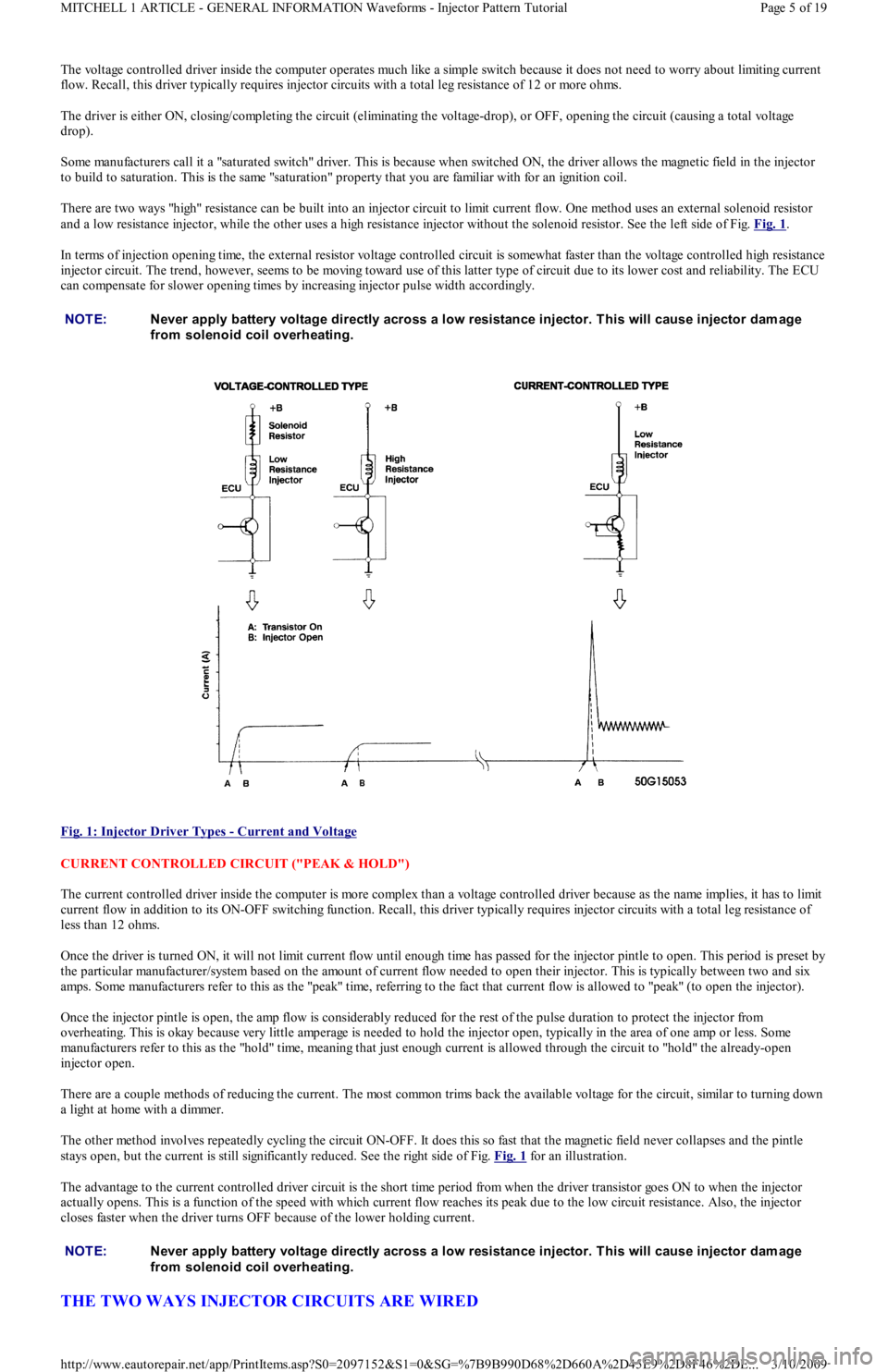
There are two ways "high" resistance can be built into an injector circuit to limit current flow. One method uses an external solenoid resistor
and a low resistance injector, while the other uses a high resistance injector without the solenoid resistor. See the left side of Fig. Fig. 1
.
In terms of injection opening time, the external resistor voltage controlled circuit is somewhat faster than the voltage controlled high resistance
injector circuit. The trend, however, seems to be moving toward use of this latter type of circuit due to its lower cost and reliability. The ECU
can compensate for slower opening times by increasing injector pulse width accordingly.
Fig. 1: Injector Driver Types
- Current and Voltage
CURRENT CONTROLLED CIRCUIT ("PEAK & HOLD")
The current controlled driver inside the computer is more complex than a voltage controlled driver because as the name implies, it has to limit
current flow in addition to its ON-OFF switching function. Recall, this driver typically requires injector circuits with a total leg resistance of
less than 12 ohms.
Once the driver is turned ON, it will not limit current flow until enough time has passed for the injector pintle to open. This period is preset by
the particular manufacturer/system based on the amount of current flow needed to open their injector. This is typically between two and six
amps. Some manufacturers refer to this as the "peak" time, referring to the fact that current flow is allowed to "peak" (to open the injector).
Once the injector pintle is open, the amp flow is considerably reduced for the rest of the pulse duration to protect the injector from
overheating. This is okay because very little amperage is needed to hold the injector open, typically in the area of one amp or less. Some
manufacturers refer to this as the "hold" time, meaning that just enough current is allowed through the circuit to "hold" the already-open
injector open.
There are a couple methods of reducing the current. The most common trims back the available voltage for the circuit, similar to turning down
a light at home with a dimmer.
The other method involves repeatedly cycling the circuit ON-OFF. It does this so fast that the magnetic field never collapses and the pintle
stays open, but the current is still significantly reduced. See the right side of Fig. Fig. 1
for an illustration.
The advantage to the current controlled driver circuit is the short time period from when the driver transistor goes ON to when the injector
actually opens. This is a function of the speed with which current flow reaches its peak due to the low circuit resistance. Also, the injector
closes faster when the driver turns OFF because of the lower holding current.
THE TWO WAYS INJECTOR CIRCUITS ARE WIRED
NOTE:Never apply battery voltage directly across a low resistance injector. T his will cause injector dam age
from solenoid coil overheating.
NOTE:Never apply battery voltage directly across a low resistance injector. T his will cause injector dam age
from solenoid coil overheating.
Page 5 of 19 MITCHELL 1 ARTICLE - GENERAL INFORMATION Waveforms - Injector Pattern Tutorial
3/10/2009 http://www.eautorepair.net/app/PrintItems.asp?S0=2097152&S1=0&SG=%7B9B990D68%2D660A%2D45E9%2D8F46%2DE
...