1991 FORD FESTIVA ESP
[x] Cancel search: ESPPage 284 of 454

Since DVOMs update their display roughly two to five times a second, all measurements in between are averaged. Because a potential voltage
drop is visible for such a small amount of time, it ge t s "a ve r a ge d o u t ", c a u sin g yo u t o miss it .
Only a DVOM that has a "min-max" function that checks EVERY MILLISECOND will catch this fault consistently (if used in that mode). The
Fluke 87 among others has this capability.
A "min-max" DVOM with a lower frequency of checking (100 millisecond) can miss the fault because it will probably check when the injector
is not on. This is especially true with current controlled driver circuits. The Fluke 88, among others fall into this category.
Outside of using a Fluke 87 (or equivalent) in the 1 mS "min-max" mode, the only way to catch a voltage drop fault is with a lab scope. You
will be able to see a voltage drop as it happens.
One final note. It is important to be aware that an injector circuit with a solenoid resistor will always show a voltage drop when the circuit is
energized. This is somewhat obvious and normal; it is a designed-in voltage drop. What can be unexpected is what we already covered--a
voltage drop disappears when the circuit is unloaded. The unloaded injector circuit will show normal battery voltage at the injector.
Remember this and do not get confused.
Checking Injector On-Time With Built-In Function
Several DVOMs have a feature that allows them to measure injector on-time (mS pulse width). While they are accurate and fast to hookup,
they have three limitations you should be aware of:
They only work on voltage controlled injector drivers (e.g "Saturated Switch"), NOT on current controlled injector drivers (e.g. "Peak &
Hold").
A few unusual conditions can cause inaccurate readings.
Varying engine speeds can result in inaccurate readings.
Regarding the first limitation, DVOMs need a well-defined injector pulse in order to determine when the injector turns ON and OFF. Voltage
controlled drivers provide this because of their simple switch-like operation. They completely close the circuit for the entire duration of the
pulse. This is easy for the DVOM to interpret.
The other type of driver, the current controlled type, start off well by completely closing the circuit (until the injector pintle opens), but then
they throttle back the voltage/current for the duration of the pulse. The DVOM understands the beginning of the pulse but it cannot figure out
the throttling action. In other words, it cannot distinguish the throttling from an open circuit (de-energized) condition.
Yet current controlled injectors will still yield a millisecond on-time reading on these DVOMs. You will find it is also always the same,
regardless of the operating conditions. This is because it is only measuring the initial completely-closed circuit on-time, which always takes the
same amount of time (to lift the injector pintle off its seat). So even though you get a reading, it is useless.
The second limitation is that a few erratic conditions can cause inaccurate readings. This is because of a DVOM's slow display rate; roughly
two to five times a second. As we covered earlier, measurements in between display updates get averaged. So conditions like skipped injector
pulses or intermittent long/short injector pulses tend to get "averaged out", which will cause you to miss important details.
The last limitation is that varying engine speeds can result in inaccurate readings. This is caused by the quickly shifting injector on-time as the
engine load varies, or the RPM moves from a state of acceleration to stabilization, or similar situations. It too is caused by the averaging of all
measurements in between DVOM display periods. You can avoid this by checking on-time when there are no RPM or load changes.
A lab scope allows you to overcome each one of these limitations.
Checking Injector On-Time With Dwell Or Duty
If no tool is available to directly measure injector millisecond on-time measurement, some techs use a simple DVOM dwell or duty cycle
functions as a replacement.
While this is an approach of last resort, it does provide benefits. We will discuss the strengths and weaknesses in a moment, but first we will
look at how a duty cycle meter and dwell meter work.
How A Duty Cycle Meter and Dwell Meter Work
All readings are obtained by comparing how long something has been OFF to how long it has been ON in a fixed time period. A dwell meter
and duty cycle meter actually come up with the same answers using different scales. You can convert freely between them. See
RELATIONSHIP BETWEEN DWELL & DUTY CYCLE READINGS TABLE
.
The DVOM display updates roughly one time a second, although some DVOMs can be a little faster or slower. All measurements during this
update period are tallied inside the DVOM as ON time or OFF time, and then the total ratio is displayed as either a percentage (duty cycle) or
degrees (dwell meter).
For example, let's say a DVOM had an update rate of exactly 1 second (1000 milliseconds). Let's also say that it has been measuring/tallying
an injector circuit that had been ON a total of 250 mS out of the 1000 mS. That is a ratio of one-quarter, which would be displayed as 25%
duty cycle or 15° dwell (six-cylinder scale). Note that most duty cycle meters can reverse the readings by selecting the positive o r n e ga t ive
slope to trigger on. If this reading were reversed, a duty cycle meter would display 75%.
Strengths of Dwell/Duty Meter
The obvious strength of a dwell/duty meter is that you can compare injector on-time against a known-good reading. This is the only practical
way to use a dwell/duty meter, but requires you to have known-good values to compare against.
Another strength is that you can roughly convert injector mS on-time into dwell reading with some computations.
A final strength is that because the meter averages everything together it does not miss anything (though this is also a severe weakness that we
will look at later). If an injector has a fault where it occasionally skips a pulse, the meter registers it and the reading changes accordingly.
Page 3 of 19 MITCHELL 1 ARTICLE - GENERAL INFORMATION Waveforms - Injector Pattern Tutorial
3/10/2009 http://www.eautorepair.net/app/PrintItems.asp?S0=2097152&S1=0&SG=%7B9B990D68%2D660A%2D45E9%2D8F46%2DE
...
Page 285 of 454

Let's go back to figuring out dwell/duty readings by using injector on-time specification. This is not generally practical, but we will cover it for
completeness. You NEED to know three things:
Injector mS on-time specification.
Engine RPM when specification is valid.
How many times the injectors fire per crankshaft revolution.
The first two are self-explanatory. The last one may require some research into whether it is a bank-fire type that injects every 360° of
crankshaft rotation, a bank-fire that injects every 720°, or an SFI that injects every 720°. Many manufacturers do not release this data so you
may have to figure it out yourself with a frequency meter.
Here are the four complete steps to convert millisecond on-time:
1. Determine the injector pulse width and RPM it was obtained at. Let's say the specification is for one millisecond of on-time at a hot idle
of 600 RPM.
2. Determine injector firing method for the complete 4 stroke cycle. Let's say this is a 360° bank-fired, meaning an injector fires each and
every crankshaft revolution.
3. Determine how many times the injector will fire at the specified engine speed (600 RPM) in a fixed time period. We will use 100
milliseconds because it is easy to use. Six hundred crankshaft Revolutions Per Minute (RPM) divided by 60 seconds equals 10
revolutions per second. Multiplying 10 times .100 yields one; the crankshaft turns one time in 100 milliseconds. With exactly one
crankshaft rotation in 100 milliseconds, we know that the injector fires exactly one time.
4. Determine the ratio of injector on-time vs. off-time in the fixed time period, then figure duty cycle and/or dwell. The injector fires one
time for a total of one millisecond in any given 100 millisecond period. One hundred minus one equals 99. We have a 99% duty cycle.
If we wanted to know the dwell (on 6 cylinder scale), multiple 99% times .6; this equals 59.4° dwell.
Weaknesses of Dwell/Duty Meter
The weaknesses are significant. First, there is no one-to-one correspondence to actual mS on-time. No manufacturer releases dwell/duty data,
and it is time-consuming to convert the mS on-time readings. Besides, there can be a large degree of error because the conversion forces you to
assume that the injector(s) are always firing at the same rate for the same period of time. This can be a dangerous assumption.
Second, all level of detail is lost in the averaging process. This is the primary weakness. You cannot see the details you need to make a
confident diagnosis.
Here is one example. Imagine a vehicle that has a faulty injector driver that occasionally skips an injector pulse. Every skipped pulse means
that that cylinder does not fire, thus unburned O2 gets pushed into the exhaust and passes the O2 sensor. The O2 sensor indicates lean, so the
computer fattens up the mixture to compensate for the supposed "lean" condition.
A connected dwell/duty meter would see the fattened pulse width but would also see the skipped pulses. It would tally both and likely come
back with a reading that indicated the "pulse width" was within specification because the rich mixture and missing pulses offset each other.
This situation is not a far-fetched scenario. Some early GM 3800 engines were suffering from exactly this. The point is that a lack of detail
could cause misdiagnosis.
As yo u migh t h a ve gu e sse d , a lab scope would not miss this.
RELATIONSHIP BETWEEN DWELL & DUTY CYCLE READINGS
THE TWO TYPES OF INJECTOR DRIVERS
OVERVIEW
There are two types of transistor driver circuits used to operate electric fuel injectors: voltage controlled and current controlled. The voltage
controlled type is sometimes called a "saturated switch" driver, while the current controlled type is sometimes known as a "peak and hold"
driver.
The basic difference between the two is the total resistance of the injector circuit. Roughly speaking, if a particular leg in an injector circuit has
total resistance of 12 or more ohms, a voltage control driver is used. If less than 12 ohms, a current control driver is used.
It is a question of what is going to do the job of limiting the current flow in the injector circuit; the inherent "high" resistance in the injector
circuit, or the transistor driver. Without some form of control, the current flow through the injector would cause the solenoid coil to overheat
and result in a damaged injector.
VOLTAGE CONTROLLED CIRCUIT ("SATURATED SWITCH")
Dwell Meter (2)Duty Cycle Meter
1°1%
15°25%
30°50%
45°75%
60°100%
(1)These are just some examples for your understanding. It is okay to fill in the gaps.
(2)Dwell meter on the six-cylinder scale.
NOTE:This is GENERAL inform ation. This article is not intended to be specific to any unique situation or
individual vehicle configuration. For m odel-specific inform ation see appropriate articles where
available.
Page 4 of 19 MITCHELL 1 ARTICLE - GENERAL INFORMATION Waveforms - Injector Pattern Tutorial
3/10/2009 http://www.eautorepair.net/app/PrintItems.asp?S0=2097152&S1=0&SG=%7B9B990D68%2D660A%2D45E9%2D8F46%2DE
...
Page 416 of 454
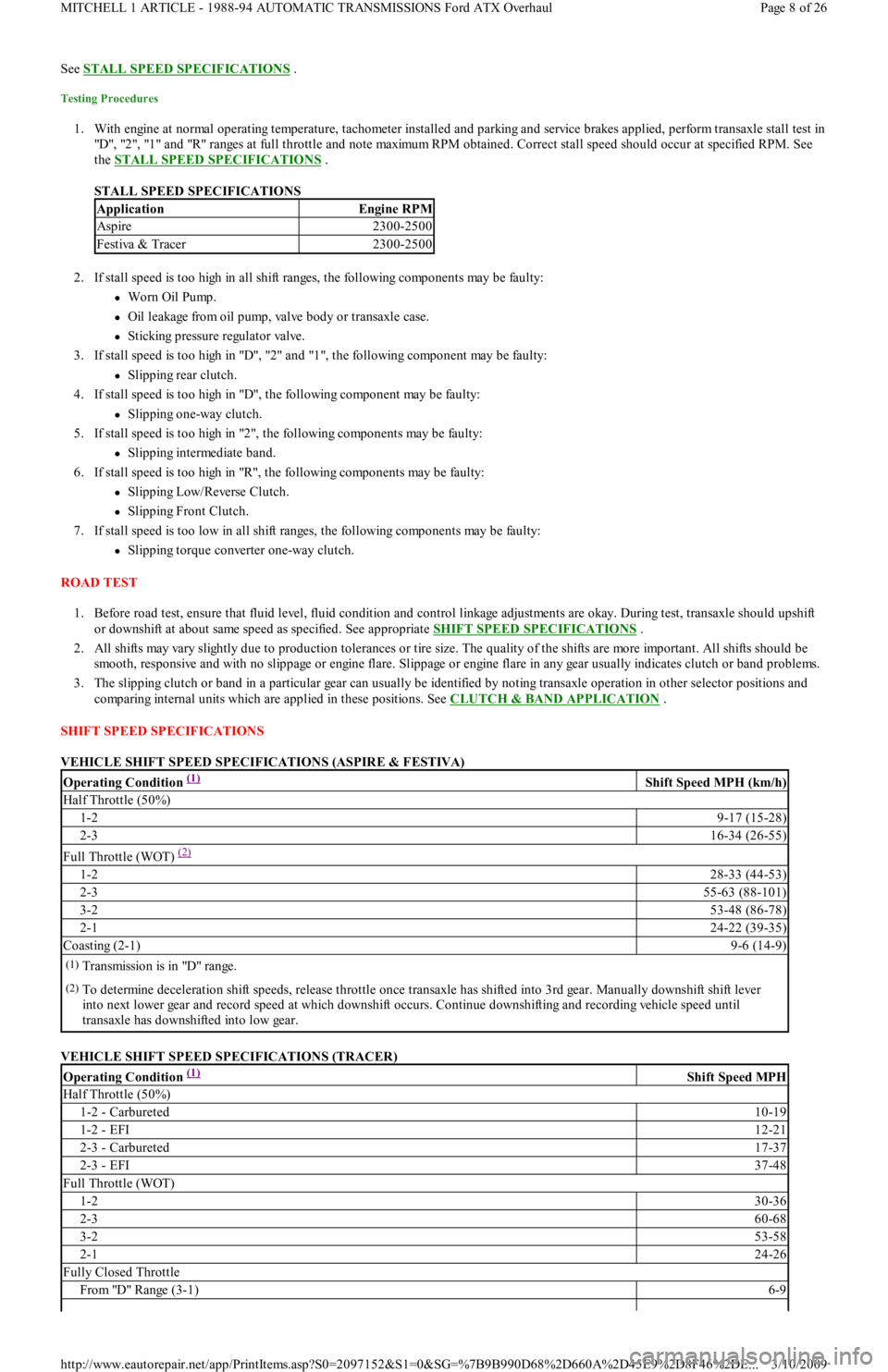
See STALL SPEED SPECIFICATIONS .
Testing Procedures
1. With engine at normal operating temperature, tachometer installed and parking and service brakes applied, perform transaxle stall test in
"D", "2", "1" and "R" ranges at full throttle and note maximum RPM obtained. Correct stall speed should occur at specified RPM. See
the STALL SPEED SPECIFICATIONS
.
STALL SPEED SPECIFICATIONS
2. If stall speed is too high in all shift ranges, the following components may be faulty:
Worn Oil Pump.
Oil leakage from oil pump, valve body or transaxle case.
Sticking pressure regulator valve.
3. If stall speed is too high in "D", "2" and "1", the following component may be faulty:
Slipping rear clutch.
4. If stall speed is too high in "D", the following component may be faulty:
Slipping one-way clutch.
5. If stall speed is too high in "2", the following components may be faulty:
Slipping intermediate band.
6. If stall speed is too high in "R", the following components may be faulty:
Slipping Low/Reverse Clutch.
Slipping Front Clutch.
7. If stall speed is too low in all shift ranges, the following components may be faulty:
Slipping torque converter one-way clutch.
ROAD TEST
1. Before road test, ensure that fluid level, fluid condition and control linkage adjustments are okay. During test, transaxle should upshift
or downshift at about same speed as specified. See appropriate SHIFT SPEED SPECIFICATIONS
.
2. All shifts may vary slightly due to production tolerances or tire size. The quality of the shifts are more important. All shifts should be
smooth, responsive and with no slippage or engine flare. Slippage or engine flare in any gear usually indicates clutch or band problems.
3. The slipping clutch or band in a particular gear can usually be identified by noting transaxle operation in other selector positions and
comparing internal units which are applied in these positions. See CLUTCH & BAND APPLICATION
.
SHIFT SPEED SPECIFICATIONS
VEHICLE SHIFT SPEED SPECIFICATIONS (ASPIRE & FESTIVA)
VEHICLE SHIFT SPEED SPECIFICATIONS (TRACER)
ApplicationEngine RPM
Aspire2300-2500
Festiva & Tracer2300-2500
Operating Condition (1) Shift Speed MPH (km/h)
Half Throttle (50%)
1-29-17 (15-28)
2-316-34 (26-55)
Full Throttle (WOT) (2)
1-228-33 (44-53)
2-355-63 (88-101)
3-253-48 (86-78)
2-124-22 (39-35)
Coasting (2-1)9-6 (14-9)
(1)Transmission is in "D" range.
(2)To determine deceleration shift speeds, release throttle once transaxle has shifted into 3rd gear. Manually downshift shift lever
into next lower gear and record speed at which downshift occurs. Continue downshifting and recording vehicle speed until
transaxle has downshifted into low gear.
Operating Condition (1) Shift Speed MPH
Half Throttle (50%)
1-2 - Carbureted10-19
1-2 - EFI12-21
2-3 - Carbureted17-37
2-3 - EFI37-48
Full Throttle (WOT)
1-230-36
2-360-68
3-253-58
2-124-26
Fully Closed Throttle
Fro m "D" Ran ge (3 -1 )6-9
Page 8 of 26 MITCHELL 1 ARTICLE - 1988-94 AUTOMATIC TRANSMISSIONS Ford ATX Overhaul
3/10/2009 http://www.eautorepair.net/app/PrintItems.asp?S0=2097152&S1=0&SG=%7B9B990D68%2D660A%2D45E9%2D8F46%2DE
...