1991 FORD FESTIVA display
[x] Cancel search: displayPage 177 of 454
connector while moving vane in VAF meter. Voltage should be as specified in VAF METER VOLTAGE table. If voltage is okay,
repair VAF wire to ECA. If voltage is not okay, go to next step.
VAF METER VOLTAGE
4. Unplug connector from VAF. Using jumper wires, connect VPWR and SIGRTN terminals on VAF connector to corresponding terminals
on VAF meter. Leave VAF and VMREF wires disconnected. Measure voltage between VAF terminal at VAF meter, and SIGRTN pin at
harness connector while moving vane in VAF meter. Voltage should be as specified in VAF METER VOLTAGE
table. If voltage is
okay, repair VMREF wire to ECA. If voltage is not okay, go to next step.
5. Unplug connector from VAF meter. Turn ignition on. Measure voltage between SIGRTN and VPWR wire. If voltage is more than 10
volts, replace VAF meter. If voltage is not more than 10 volts, go to next step.
6. Unplug VAF meter connector. Turn ignition on. Measure voltage between VAF meter VPWR wire and ground. If voltage is more than
10 volts, repair VAF wire to ECA. If voltage is not more than 10 volts, go to PINPOINT TEST VPWR.
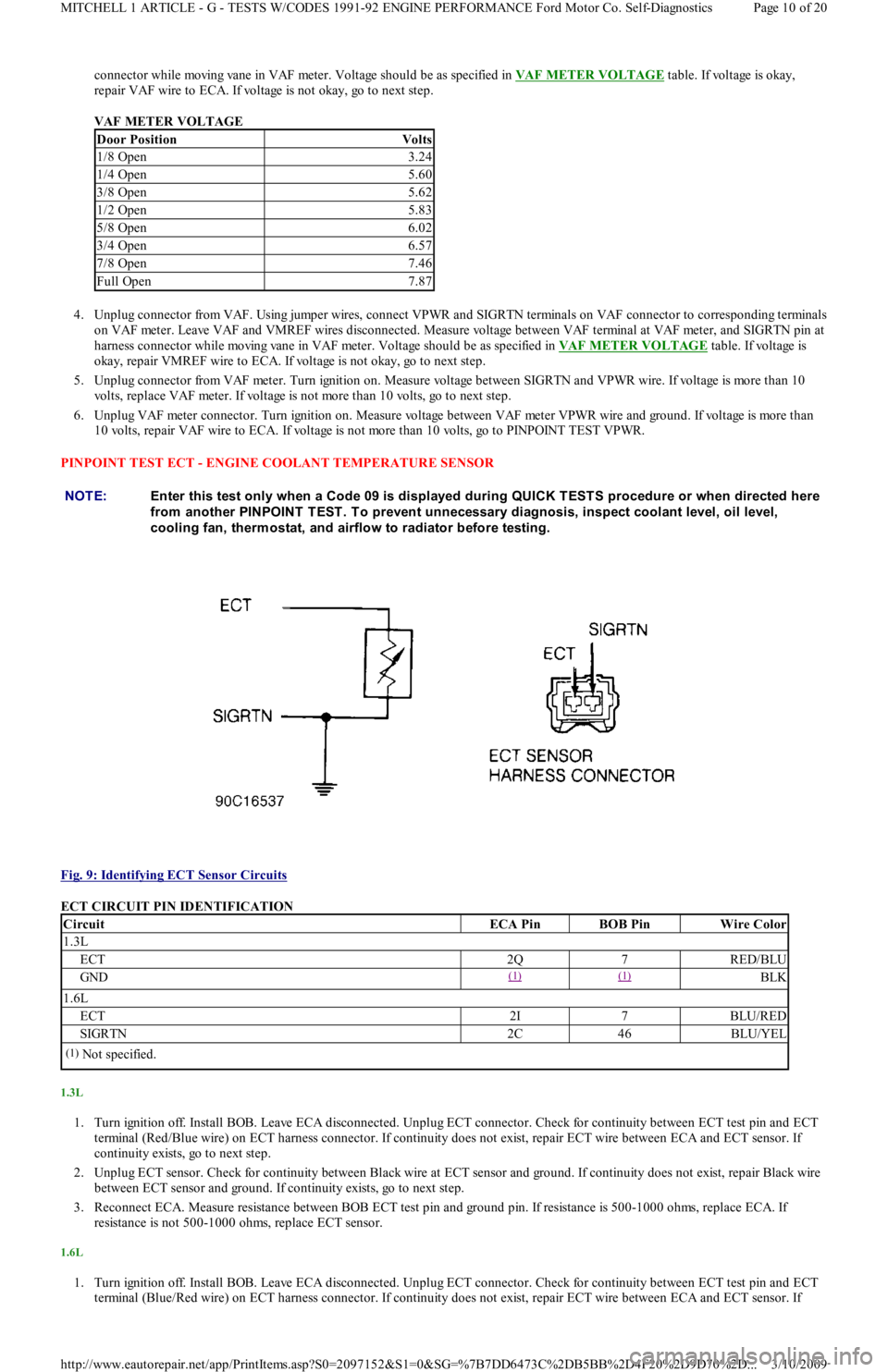
PINPOINT TEST ECT - ENGINE COOLANT TEMPERATURE SENSOR
Fig. 9: Identifying ECT Sensor Circuits
ECT CIRCUIT PIN IDENTIFICATION
1.3L
1. Turn ignition off. Install BOB. Leave ECA disconnected. Unplug ECT connector. Check for continuity between ECT test pin and ECT
terminal (Red/Blue wire) on ECT harness connector. If continuity does not exist, repair ECT wire between ECA and ECT sensor. If
continuity exists, go to next step.
2. Unplug ECT sensor. Check for continuity between Black wire at ECT sensor and ground. If continuity does not exist, repair Black wire
between ECT sensor and ground. If continuity exists, go to next step.
3. Reconnect ECA. Measure resistance between BOB ECT test pin and ground pin. If resistance is 500-1000 ohms, replace ECA. If
resistance is not 500-1000 ohms, replace ECT sensor.
1.6L
1. Turn ignition off. Install BOB. Leave ECA disconnected. Unplug ECT connector. Check for continuity between ECT test pin and ECT
terminal (Blue/Red wire) on ECT harness connector. If continuity does not exist, repair ECT wire between ECA and ECT sensor. If
Door PositionVolts
1/8 Open3.24
1/4 Open5.60
3/8 Open5.62
1/2 Open5.83
5/8 Open6.02
3/4 Open6.57
7/8 Open7.46
Full Open7.87
NOTE:Enter this test only when a Code 09 is displayed during QUICK T EST S procedure or when directed here
from another PINPOINT T EST . T o prevent unnecessary diagnosis, inspect coolant level, oil level,
cooling fan, therm ostat, and airflow to radiator before testing.
CircuitECA PinBOB PinWire Color
1.3L
ECT2Q7RED/BLU
GND(1) (1) BLK
1.6L
ECT2I7BLU/RED
SIGRTN2C46BLU/YEL
(1)Not specified.
Page 10 of 20 MITCHELL 1 ARTICLE - G - TESTS W/CODES 1991-92 ENGINE PERFORMANCE Ford Motor Co. Self-Diagnostics
3/10/2009 http://www.eautorepair.net/app/PrintItems.asp?S0=2097152&S1=0&SG=%7B7DD6473C%2DB5BB%2D4F20%2D9D70%2D
...
Page 178 of 454
continuity exists, go to next step.
2. Install BOB. Connect ECT. Warm engine to normal operating temperature. Measure resistance between ECT test pin and SIGRTN pins.
If resistance is 500-1000 ohms, replace ECA. If resistance is not 500-1000 ohms, replace ECT sensor.
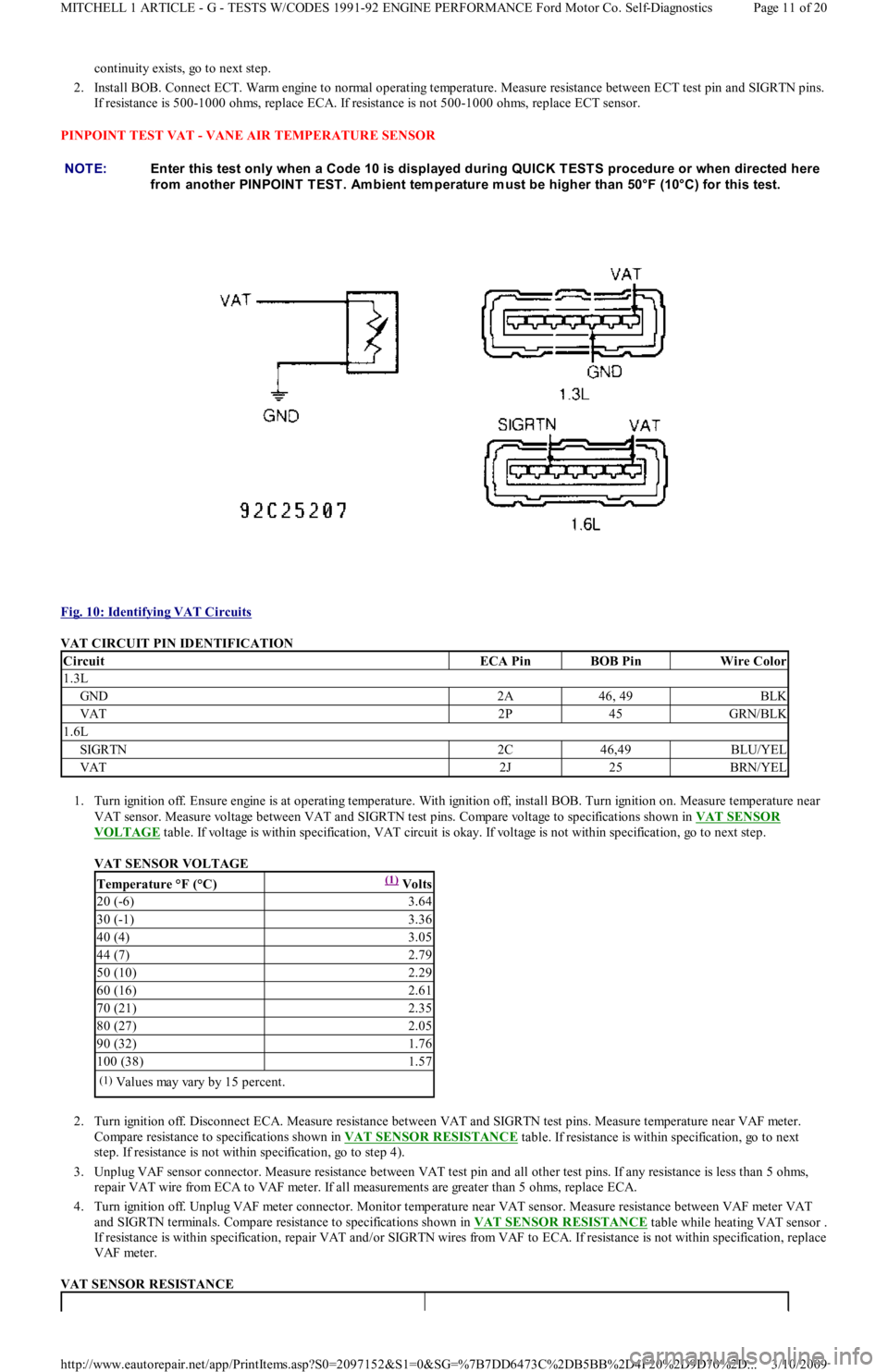
PINPOINT TEST VAT - VANE AIR TEMPERATURE SENSOR
Fig. 10: Identifying VAT Circuits
VAT CIRCUIT PIN IDENTIFICATION
1. Turn ignition off. Ensure engine is at operating temperature. With ignition off, install BOB. Turn ignition on. Measure temperature near
VAT sensor. Measure voltage between VAT and SIGRTN test pins. Compare voltage to specifications shown in VAT SENSOR
VOLTAGE table. If voltage is within specification, VAT circuit is okay. If voltage is not within specification, go to next step.
VAT SENSOR VOLTAGE
2. Turn ignition off. Disconnect ECA. Measure resistance between VAT and SIGRTN test pins. Measure temperature near VAF meter.
Compare resistance to specifications shown in VAT SENSOR RESISTANCE
table. If resistance is within specification, go to next
step. If resistance is not within specification, go to step 4).
3. Unplug VAF sensor connector. Measure resistance between VAT test pin and all other test pins. If any resistance is less than 5 ohms,
repair VAT wire from ECA to VAF meter. If all measurements are greater than 5 ohms, replace ECA.
4. Turn ignition off. Unplug VAF meter connector. Monitor temperature near VAT sensor. Measure resistance between VAF meter VAT
and SIGRTN terminals. Compare resistance to specifications shown in VAT SENSOR RESISTANCE
table while heating VAT sensor .
If resistance is within specification, repair VAT and/or SIGRTN wires from VAF to ECA. If resistance is not within specification, replace
VAF meter.
VAT SENSOR RESISTANCE NOTE:Enter this test only when a Code 10 is displayed during QUICK T EST S procedure or when directed here
from another PINPOINT T EST . Am bient tem perature m ust be higher than 50°F (10°C) for this test.
CircuitECA PinBOB PinWire Color
1.3L
GND2A46, 49BLK
VAT2P45GRN/BLK
1.6L
SIGRTN2C46,49BLU/YEL
VAT2J25BRN/YEL
Temperature °F (°C)(1) Volts
20 (-6)3.64
30 (-1)3.36
40 (4)3.05
44 (7)2.79
50 (10)2.29
60 (16)2.61
70 (21)2.35
80 (27)2.05
90 (32)1.76
100 (38)1.57
(1)Values may vary by 15 percent.
Page 11 of 20 MITCHELL 1 ARTICLE - G - TESTS W/CODES 1991-92 ENGINE PERFORMANCE Ford Motor Co. Self-Diagnostics
3/10/2009 http://www.eautorepair.net/app/PrintItems.asp?S0=2097152&S1=0&SG=%7B7DD6473C%2DB5BB%2D4F20%2D9D70%2D
...
Page 179 of 454

PINPOINT TEST TP - THROTTLE POSITION SENSOR
Fig. 11: Identifying TP Circuits
TP CIRCUIT PIN IDENTIFICATION
1.6L
1. Turn ignition off. Install BOB. Turn ignition on. Measure voltage between BOB test pins TP and SIGRTN while opening throttle.
Compare voltage to specification in TP SENSOR OUTPUT VOLTAGE
table. Go to next step if output voltage is not within
specification.
TP SENSOR OUTPUT VOLTAGE
2. Turn ignition off. Unplug TP sensor connector at throttle body. Using jumper wires, connect VREF and SIGRTN wires on harness
Temperature °F (°C)Ohms
-4 (-23)15,000
32 (0)5210
68 (20)2500
104 (40)1100
140 (60)600
176 (80)300
NOTE:Enter this test only when a Code 12 is displayed during QUICK T EST S procedure or when directed here
from another PINPOINT TEST.
CircuitECA PinBOB PinWire Color
1.6L
IDL1E28GRN/ORG
SIGRTN2C46, 49BLK/YEL
TP2G47ORG
VREF2A26WHT/BLK
Throttle Opening(1) Voltage
1/81.00
1/41.60
3/82.37
1/22.74
5/83.15
3/43.43
7/83.60
(1)Voltage may vary by 15 percent.
Page 12 of 20 MITCHELL 1 ARTICLE - G - TESTS W/CODES 1991-92 ENGINE PERFORMANCE Ford Motor Co. Self-Diagnostics
3/10/2009 http://www.eautorepair.net/app/PrintItems.asp?S0=2097152&S1=0&SG=%7B7DD6473C%2DB5BB%2D4F20%2D9D70%2D
...
Page 180 of 454

connector to corresponding terminals on TP sensor connector. Turn ignition on. Measure voltage between TP and SIGRTN terminals on
TP sensor while opening throttle. Compare voltage to specification in TP SENSOR OUTPUT VOLTAGE
table. If voltage is within
specification, repair TP wire to ECA. Go to next step if voltage is not within specification.
3. Turn ignition off. Unplug TP harness connector. Turn ignition on. Measure voltage between VREF and SIGRTN wires on TP harness
connect-or. If voltage is 4-5 volts, replace TP sensor. If voltage is not 4.5-5.5 volts, go to next step.
4. Measure voltage between VREF wire on TP harness connector and ground. If voltage is 4-5 volts, adjust or replace throttle position
sensor. If voltage is not 4-5 volts, go to PINPOINT TEST VREF
.
PINPOINT TEST BP - BAROMETRIC PRESSURE SENSOR
Fig. 12: Identifying BP Sensor Circuits
1.3L
BP sensor is incorporated into ECA; it cannot be checked or serviced separately. If Code 14 is set and cannot be cleared, replace ECA.
1.6L
Turn ignition off. Connect BOB. Remove dust cover from BP sensor, located on passenger side cowl. Turn ignition on. Connect vacuum pump
to BP sensor. Measure voltage between pins BP and SIGRTN on BOB while applying vacuum to BP sensor. See BAROMETRIC
PRESSURE SENSOR OUTPUT VOLTAGE table. Replace BP sensor if voltage is not as specified.
BAROMETRIC PRESSURE SENSOR OUTPUT VOLTAGE
PINPOINT TEST EGO - EXHAUST GAS OXYGEN SENSOR
EGO CIRCUIT PIN IDENTIFICATION
1. Warm engine to operating temperature, and let idle. Unplug EGO sensor. Measure voltage between EGO sensor connector (sensor side) NOTE:Enter this procedure only when a Code 14 is displayed during QUICK T EST S procedure or when
directed here from another PINPOINT T EST . T o prevent unnecessary replacem ent of com ponents, note
following non-EEC item s m ay be at fault: unusually high or low atm ospheric pressure, blocked vacuum
lines, or basic m echanical engine com ponents.
Vacuum (In. Hg.)(1) Voltage
03.84
53.36
102.66
151.93
201.26
25.58
(1)Voltage may vary by 15 percent.
NOTE:Enter this test only when a Code 15 (lean) or Code 17 (rich) is displayed during QUICK TESTS
procedure.
CircuitECA PinBOB PinWire Color
EGO
1.3L2N29BLU
1.6L2D29BLK
Page 13 of 20 MITCHELL 1 ARTICLE - G - TESTS W/CODES 1991-92 ENGINE PERFORMANCE Ford Motor Co. Self-Diagnostics
3/10/2009 http://www.eautorepair.net/app/PrintItems.asp?S0=2097152&S1=0&SG=%7B7DD6473C%2DB5BB%2D4F20%2D9D70%2D
...
Page 181 of 454

and ground. With engine at idle, voltage should fluctuate between 0.2-0.8 volt.
2. Increase and decrease engine speed while reading voltmeter. When engine speed is decreasing, voltage should decrease. When engin e
speed is increasing, voltage should increase. If voltage is within specification, go to next step. If voltage is not within specification,
replace EGO sensor.
3. With ignition off, install BOB. Leave ECA disconnected. Unplug EGO sensor connector. Measure continuity between EGO test pin and
EGO sensor connector wire. If continuity exists, EGO circuit is okay; return to QUICK TESTS if sent here from there. If not sent here
from QUICK TESTS, replace ECA. If voltage is not as specified, repair VMREF wire to VAF. If continuity does not exist, service EGO
sensor wire to ECA.
PINPOINT TEST PRC - FUEL PRESSURE REGULATOR CONTROL SOLENOID
Fig. 13: Identifying PRC Circuit & Connector
PRC CIRCUIT PIN IDENTIFICATION
1. Locate Fuel Pressure Control (PRC) solenoid on cowl panel, next to canister purge solenoid. Unplug PRC solenoid connector. Remo ve
both vacuum lines. Plug vacuum port from engine vacuum source. Apply vacuum to remaining port. Replace PRC solenoid if it does not
hold vacuum.
2. Turn ignition off. Connect BOB. Leave ECA disconnected. Reconnect wiring to PRC solenoid. Turn ignition on. Apply vacuum to PRC
solenoid. Connect jumper wire between PRC test pin on BOB and ground. If vacuum drops to zero, PRC solenoid function is okay.
Return to QUICK TESTS if sent here from there. If vacuum does not drop to zero, go to next step.
3. Turn ignition off. Unplug PRC solenoid connector. Turn ignition on. Measure voltage between VPWR wire on harness connector and
gr o u n d . If vo l t a ge is n o t h igh e r t h a n 1 0 vo l t s, r e p a ir VP WR wir e t o ma in r e l a y. If vo l t a ge is h igh e r t h a n 1 0 vo l t s, go t o n e xt step.
4. Turn ignition off. Unplug PRC solenoid connector. Turn ignition on. Measure voltage between solenoid connector VPWR wire and
solenoid connector SIG wire. Connect jumper wire between PRC test pin on BOB and ground. If voltage is higher than 10 volts only
when solenoid is activated, replace solenoid. If voltage is not higher than 10 volts only when solenoid is activated, go to next step.
5. Turn ignition off. Connect BOB. Leave ECA disconnected. Unplug solenoid connector. Measure resistance between SIG test pin and
solenoid connector SIG wire. If resistance is not less than 5 ohms, repair SIG wire to ECA. If resistance is less than 5 ohms, go t o n e xt
step.
6. Turn ignition off. Connect BOB. Leave ECA disconnected. Unplug solenoid connector. Measure resistance between SIG test pin and all
other test pins. If resistance between SIG PRC test pin and any other pin is less than 5 ohms, repair PRC wire to ECA. If resistance
between PRC test pin and any other pin is greater than 10,000 ohms, replace ECA.
PINPOINT TEST CANP - CANISTER PURGE CONTROL SOLENOID
NOTE:Enter this test only when a Code 25 is displayed during QUICK T EST S procedure or when directed here
from another PINPOINT TEST.
CircuitECA PinBOB PinWire Color
PRC (1.6L)2K31BRN
NOTE:Enter this test only when a Code 26 is displayed during QUICK T EST S procedure or when directed here
from another PINPOINT TEST.
Page 14 of 20 MITCHELL 1 ARTICLE - G - TESTS W/CODES 1991-92 ENGINE PERFORMANCE Ford Motor Co. Self-Diagnostics
3/10/2009 http://www.eautorepair.net/app/PrintItems.asp?S0=2097152&S1=0&SG=%7B7DD6473C%2DB5BB%2D4F20%2D9D70%2D
...
Page 182 of 454
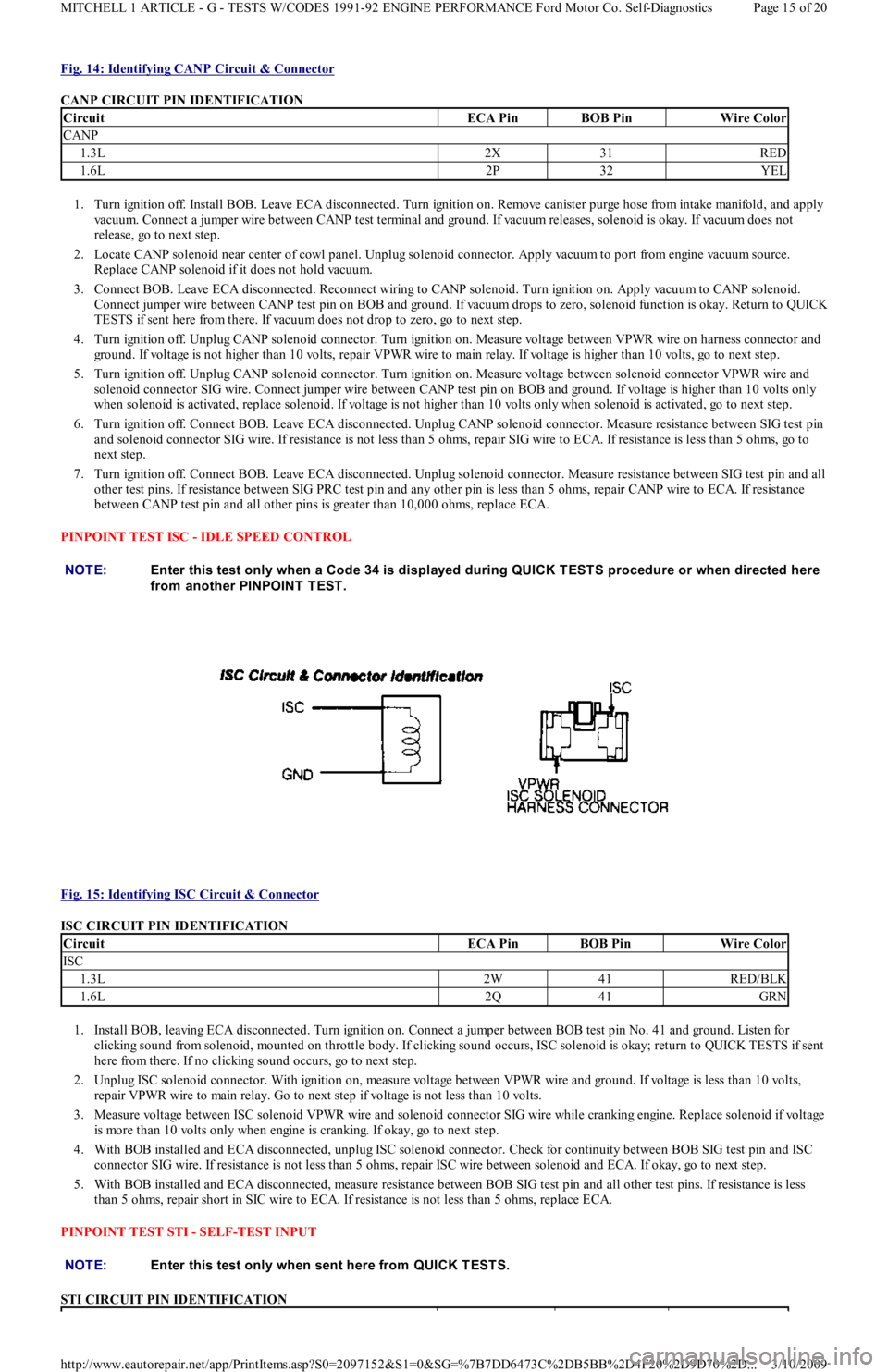
Fig. 14: Identifying CANP Circuit & Connector
CANP CIRCUIT PIN IDENTIFICATION
1. Turn ignition off. Install BOB. Leave ECA disconnected. Turn ignition on. Remove canister purge hose from intake manifold, and apply
vacuum. Connect a jumper wire between CANP test terminal and ground. If vacuum releases, solenoid is okay. If vacuum does not
release, go to next step.
2. Locate CANP solenoid near center of cowl panel. Unplug solenoid connector. Apply vacuum to port from engine vacuum source.
Replace CANP solenoid if it does not hold vacuum.
3. Connect BOB. Leave ECA disconnected. Reconnect wiring to CANP solenoid. Turn ignition on. Apply vacuum to CANP solenoid.
Connect jumper wire between CANP test pin on BOB and ground. If vacuum drops to zero, solenoid function is okay. Return to QUIC
K
TESTS if sent here from there. If vacuum does not drop to zero, go to next step.
4. Turn ignition off. Unplug CANP solenoid connector. Turn ignition on. Measure voltage between VPWR wire on harness connector and
gr o u n d . If vo l t a ge is n o t h igh e r t h a n 1 0 vo l t s, r e p a ir VP WR wir e t o ma in r e l a y. If vo l t a ge is h igh e r t h a n 1 0 vo l t s, go t o n e xt step.
5. Turn ignition off. Unplug CANP solenoid connector. Turn ignition on. Measure voltage between solenoid connector VPWR wire and
solenoid connector SIG wire. Connect jumper wire between CANP test pin on BOB and ground. If voltage is higher than 10 volts only
when solenoid is activated, replace solenoid. If voltage is not higher than 10 volts only when solenoid is activated, go to next step.
6. Turn ignition off. Connect BOB. Leave ECA disconnected. Unplug CANP solenoid connector. Measure resistance between SIG test pin
and solenoid connector SIG wire. If resistance is not less than 5 ohms, repair SIG wire to ECA. If resistance is less than 5 ohms, go to
next step.
7. Turn ignition off. Connect BOB. Leave ECA disconnected. Unplug solenoid connector. Measure resistance between SIG test pin and all
other test pins. If resistance between SIG PRC test pin and any other pin is less than 5 ohms, repair CANP wire to ECA. If resistance
between CANP test pin and all other pins is greater than 10,000 ohms, replace ECA.
PINPOINT TEST ISC - IDLE SPEED CONTROL
Fig. 15: Identifying ISC Circuit & Connector
ISC CIRCUIT PIN IDENTIFICATION
1. Install BOB, leaving ECA disconnected. Turn ignition on. Connect a jumper between BOB test pin No. 41 and ground. Listen for
clicking sound from solenoid, mounted on throttle body. If clicking sound occurs, ISC solenoid is okay; return to QUICK TESTS if sen t
here from there. If no clicking sound occurs, go to next step.
2. Unplug ISC solenoid connector. With ignition on, measure voltage between VPWR wire and ground. If voltage is less than 10 volts,
repair VPWR wire to main relay. Go to next step if voltage is not less than 10 volts.
3. Measure voltage between ISC solenoid VPWR wire and solenoid connector SIG wire while cranking engine. Replace solenoid if voltage
is more than 10 volts only when engine is cranking. If okay, go to next step.
4. With BOB installed and ECA disconnected, unplug ISC solenoid connector. Check for continuity between BOB SIG test pin and ISC
connector SIG wire. If resistance is not less than 5 ohms, repair ISC wire between solenoid and ECA. If okay, go to next step.
5. With BOB installed and ECA disconnected, measure resistance between BOB SIG test pin and all other test pins. If resistance is less
than 5 ohms, repair short in SIC wire to ECA. If resistance is not less than 5 ohms, replace ECA.
PINPOINT TEST STI - SELF-TEST INPUT
STI CIRCUIT PIN IDENTIFICATION
CircuitECA PinBOB PinWire Color
CANP
1.3L2X31RED
1.6L2P32YEL
NOTE:Enter this test only when a Code 34 is displayed during QUICK T EST S procedure or when directed here
from another PINPOINT TEST.
CircuitECA PinBOB PinWire Color
ISC
1.3L2W41RED/BLK
1.6L2Q41GRN
NOTE:Enter this test only when sent here from QUICK TESTS.
Page 15 of 20 MITCHELL 1 ARTICLE - G - TESTS W/CODES 1991-92 ENGINE PERFORMANCE Ford Motor Co. Self-Diagnostics
3/10/2009 http://www.eautorepair.net/app/PrintItems.asp?S0=2097152&S1=0&SG=%7B7DD6473C%2DB5BB%2D4F20%2D9D70%2D
...
Page 207 of 454

"J"
J/B
Junction Block
"K"
KAPWR
Keep Alive Power
k/ohms
kilo-ohms (1000 ohms)
kg
Kilograms (weight)
kg/cm
2
Kilograms Per Square Centimeter
KM/H
Kilometers Per Hour
KOEO
Key On, Engine Off
KOER
Ke y On , E n gin e R u n n in g
KS
Knock Sensor
kW
Kilowatt
kV
Kilovolt
"L"
L
Liter
lbs. (Lbs. when used in table)
Pounds
LCD
Liquid Crystal Display
L/D
Light Duty
LDP
Leak Detection Pump (Part of EVAP system.)
LED
Light Emitting Diode
LH
Left Hand
"M"
Page 9 of 15 MITCHELL 1 ARTICLE - GENERAL INFORMATION Commonly Used Abbreviations
3/10/2009 http://www.eautorepair.net/app/PrintItems.asp?S0=2097152&S1=0&SG=%7B9B990D68%2D660A%2D45E9%2D8F46%2DE
...
Page 241 of 454
A "howling" or "whining" noise from the ring and pinion gear can be caused by an improper gear pattern, gear damage, or improper bearing
preload. It can occur at various speeds and driving conditions, or it can be continuous.
Before disassembling axle to diagnose and correct gear ke sure that tires, exhaust, and vehicle trim have been checked as possible causes.
Chuckle
This is a particular rattling noise that sounds like a stick against the spokes of a spinning bicycle wheel. It occurs while decelerating from 40
MPH and usually can be heard until vehicle comes to a complete stop. The frequency varies with the speed of the vehicle.
A chuckle that occurs on the driving phase is usually caused ive clearance due to differential gear wear, or by a damaged tooth on the coast
side of the pinion or ring gear. Even a very small tooth nick or a ridge on the edge of a gear tooth is enough the cause the noise.
This condition can be corrected simply by cleaning the gear tooth nick or ridge with a small grinding wheel. If either gear is damaged or scored
badly, the gear set must be replaced. If metal has broken loose, the carrier and housing must be cleaned to remove particles that could cause
damage.
Knock
This is very similar to a chuckle, though it may be louder, and occur on acceleration or deceleration. Knock can be caused by a gear tooth that
is damaged on the drive side of the ring and pinion gears. Ring gear bolts that are hitting the carrier casting can cause knock. Knock can also be
due to excessive end play in the axle shafts.
Clunk
Clunk is a metallic noise heard when an automatic transmission is engaged in Reverse or Drive, or when throttle is applied or released. It is
caused by backlash somewhere in the driveline, but not necessarily in the axle. To determine whether driveline clunk is caused by the axle,
check the total axle backlash as follows:
1. Raise vehicle on a frame or twinpost hoist so that drive wheels are free. Clamp a bar between axle companion flange and a part of the
frame or body so that flange cannot move.
2. On conventional drive axles, lock the left wheel to keep it from turning. On all models, turn the right wheel slowly until it is felt to be in
Drive condition. Hold a chalk marker on side of tire about 12" from center of wheel. Turn wheel in the opposite direction until it is
again felt to be in Drive condition.
3. Measure the length of the chalk mark, which is the total axle backlash. If backlash is one inch or less, drive axle is not the source of
clunk noise.
Bearing Whine
Bearing whine is a high-pitched sound similar to a whistle. It is usually caused by malfunctioning pinion bearings. Pinion bearings operate at
drive shaft speed. Roller wheel bearings may whine in a similar manner if they run completely dry of lubricant. Bearing noise will occur at all
driving speeds. This distinguishes it from gear whine, which usually comes and goes as speed changes.
Bearing Rumble
Bearing rumble sounds like marbles being tumbled. It is usually caused by a malfunctioning wheel bearing. The lower pitch is because the
wheel bearing turns at only about 1/3 of drive shaft speed.
Chatter On Turns
This is a condition where the entire front or rear of vehicle vibrates when vehicle is moving. The vibration is plainly felt as well as heard. Extra
differential thrust washers installed during axle repair can cause a condition of partial lock-up that creates this chatter.
Axle Shaft Noise
Axle shaft noise is similar to gear noise and pinion bearing whine. Axle shaft bearing noise will normally distinguish itself from gear noise by
occurring in all driving modes (Drive, cruise, coast and float), and will persist with transmission in Neutral while vehicle is moving at problem
speed.
If vehicle displays this noise condition, remove suspect parts, replace wheel seals and install a new set of bearings. Re-evaluate vehicle for
noise before removing any internal components.
Vibration
Vibration is a high-frequency trembling, shaking or grinding condition (felt or heard) that may be constant or variable in level and can occur
during the total operating speed range of the vehicle.
The types of vibrations that can be felt in the vehicle can d into 3 main groups:
Vibrations of various unbalanced rotating parts of the vehicle.
Resonance vibrations of the body and frame structures caused by rotating of unbalanced parts.
Tip-in moans of resonance vibrations from stressed engine or exhaust system mounts or driveline flexing modes.
DRIVE AXLE - RWD TROUBLE SHOOTING
NOTE:This is GENERAL inform ation. This article is not intended to be specific to any unique situation or
individual vehicle configuration. T he purpose of this T rouble Shooting inform ation is to provide a list
of com m on causes to problem sym ptom s. For m odel-specific T rouble Shooting, refer to SUBJECT ,
DIAGNOST IC, or T EST ING articles available in the section(s) you are accessing. For definitions of listed
noises or sounds, see DRIVE AXLE
- NOISE DIAGNOSIS under POWERTRAIN.
Page 28 of 36 MITCHELL 1 ARTICLE - GENERAL INFORMATION Trouble Shooting - Basic Procedures
3/10/2009 http://www.eautorepair.net/app/PrintItems.asp?S0=2097152&S1=0&SG=%7B9B990D68%2D660A%2D45E9%2D8F46%2DE
...