1991 FORD FESTIVA engine
[x] Cancel search: enginePage 183 of 454
1. Turn ignition off. Install BOB. Leave ECA disconnected. Connect test light between STI test pin on BOB and 12-volt source. If test
light comes on, go to PINPOINT TEST STO
. If light does not come on, go to next step.
2. Leave test light connected. Ground STI connector. If test light does not come on, repair open circuit between STI connector and ECA.
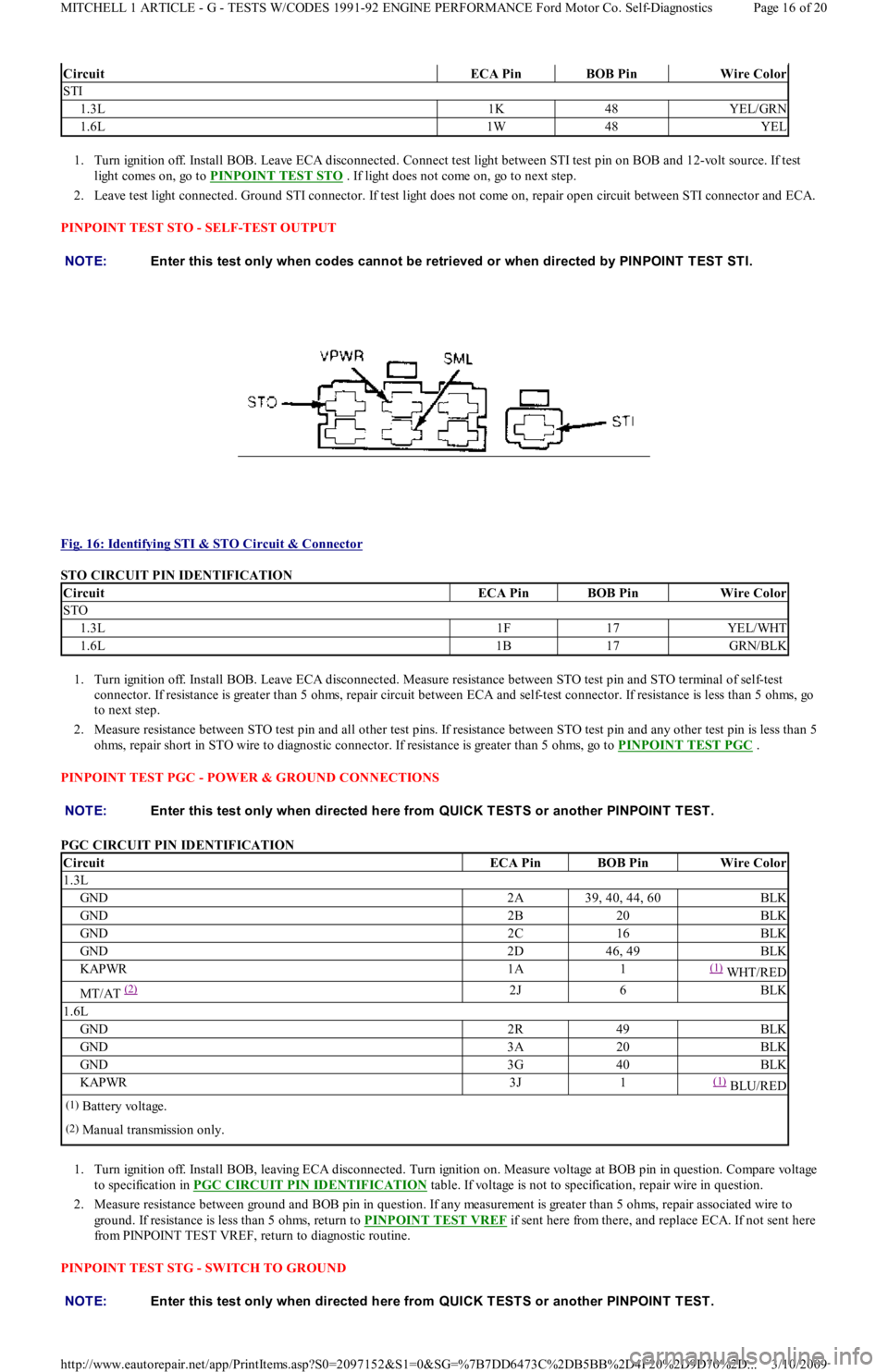
PINPOINT TEST STO - SELF-TEST OUTPUT
Fig. 16: Identifying STI & STO Circuit & Connector
STO CIRCUIT PIN IDENTIFICATION
1. Turn ignition off. Install BOB. Leave ECA disconnected. Measure resistance between STO test pin and STO terminal of self-test
connector. If resistance is greater than 5 ohms, repair circuit between ECA and self-test connector. If resistance is less than 5 ohms, go
to next step.
2. Measure resistance between STO test pin and all other test pins. If resistance between STO test pin and any other test pin is less than 5
ohms, repair short in STO wire to diagnostic connector. If resistance is greater than 5 ohms, go to PINPOINT TEST PGC
.
PINPOINT TEST PGC - POWER & GROUND CONNECTIONS
PGC CIRCUIT PIN IDENTIFICATION
1. Turn ignition off. Install BOB, leaving ECA disconnected. Turn ignition on. Measure voltage at BOB pin in question. Compare voltage
to specification in PGC CIRCUIT PIN IDENTIFICATION
table. If voltage is not to specification, repair wire in question.
2. Measure resistance between ground and BOB pin in question. If any measurement is greater than 5 ohms, repair associated wire to
ground. If resistance is less than 5 ohms, return to PINPOINT TEST VREF
if sent here from there, and replace ECA. If not sent here
from PINPOINT TEST VREF, return to diagnostic routine.
PINPOINT TEST STG - SWITCH TO GROUND
CircuitECA PinBOB PinWire Color
STI
1.3L1K48YEL/GRN
1.6L1W48YEL
NOTE:Enter this test only when codes cannot be retrieved or when directed by PINPOINT T EST ST I.
CircuitECA PinBOB PinWire Color
STO
1.3L1F17YEL/WHT
1.6L1B17GRN/BLK
NOTE:Enter this test only when directed here from QUICK T EST S or another PINPOINT T EST .
CircuitECA PinBOB PinWire Color
1.3L
GND2A39, 40, 44, 60BLK
GND2B20BLK
GND2C16BLK
GND2D46, 49BLK
KAPWR1A1(1) WHT/RED
MT/AT (2) 2J6BLK
1.6L
GND2R49BLK
GND3A20BLK
GND3G40BLK
KAPWR3J1(1) BLU/RED
(1)Battery voltage.
(2)Manual transmission only.
NOTE:Enter this test only when directed here from QUICK T EST S or another PINPOINT T EST .
Page 16 of 20 MITCHELL 1 ARTICLE - G - TESTS W/CODES 1991-92 ENGINE PERFORMANCE Ford Motor Co. Self-Diagnostics
3/10/2009 http://www.eautorepair.net/app/PrintItems.asp?S0=2097152&S1=0&SG=%7B7DD6473C%2DB5BB%2D4F20%2D9D70%2D
...
Page 184 of 454
STG CIRCUIT PIN IDENTIFICATION
1. Turn ignition off. Install BOB, leaving ECA disconnected. Measure resistance between switch BOB test pin and ground. Cycle switch. I
f
resistance is greater than 10,000 ohms with switch open and less than 5 ohms when switch is closed, switch is okay; go to step 4). If
resistance is not greater than 10,000 ohms with switch open, or greater than 5 ohms when switch is closed, go to next step.
2. Turn ignition off. Disconnect switch. Connect ohmmeter between switch terminals on 2-pin switches, or between ground and switch
ECA terminal on multi-pin or one-pin switches. Cycle switch. If resistance is not greater than 10,000 ohms with switch open, or is
greater than 5 ohms when switch is closed, replace switch. If resistance is greater than 10,000 ohms with switch open and less than 5
ohms when switch is closed, switch is okay; go to next step.
3. Turn ignition off. Install BOB, leaving ECA disconnected. Measure resistance between BOB pin for suspected switch and BOB pins 26,
37, 57, and 60. If any measurement is less than 10,000, repair shorted wire in question. If all measurements are greater than 10,000
ohms, go to next step.
4. Turn ignition off. Install BOB, leaving ECA disconnected. Measure resistance between BOB pin for suspected switch and switch
connector. If resistance is greater than 5 ohms, repair wire in question. If sent here from SWITCH MONITOR TEST in QUICK TESTS,
replace ECA; otherwise, return to QUICK TESTS.
PINPOINT TEST STP - SWITCH TO POWER
STP CIRCUIT PIN IDENTIFICATION
1. Turn ignition off. Install BOB, leaving ECA disconnected. Turn ignition on. Cycle switch in question. Measure voltage between switch
BOB test pin and ground. If voltage changes from less than 4 volts to more than 10 volts, switch is okay. If sent here from SWITCH
MONITOR TEST in QUICK TESTS, replace ECA. If sent here from elsewhere in QUICK TESTS, return to QUICK TESTS. If voltage is
not as specified, go to next step.
2. Turn ignition on. Measure voltage at switch in question on wire to ECA. Cycle switch. If voltage changes from less than 4 volts to more
than 10 volts, repair wire from switch to ECA. If voltage does not change from less than 4 volts to more than 10 volts, go to next step.
3. Turn ignition on. Install BOB, leaving ECA disconnected. Measure resistance between BOB test pin for switch in question and ground
and between BOB test pin and BOB pins 37, 57, and 26. If resistance is greater than 10,000 ohms for all measurements, go to next step.
If resistance is not greater than 10,000 ohms for all measurements, repair wire to switch.
4. Disconnect switch. Measure resistance between switch terminals. Cycle switch. If resistance is less than 5 ohms with switch closed and
greater than 10,000 ohms with switch open, switch is okay. If sent here from SWITCH MONITOR TEST in QUICK TESTS, return to
QUICK TESTS. If sent here from elsewhere in QUICK TESTS, replace ECA. If resistance is not as specified, replace switch.
PINPOINT TEST VPWR - VEHICLE POWER
SwitchECA PinBOB PinWire Color
1.3L
ACS1Q10BLU/RED
BLMT1S23GRN
IDL1N18YEL/BLK
NGS/CES (1) 1V43BLU/WHT
PSPS1P19PNK
WOT2L27YEL
1.6L
BPS (2) 2L12LT GRN/BLK
IDL1E18GRN/ORG
NGS/CES (1) 1G8RED/BLU
PSPS1K19GRN/RED
(1)Manual transmission only.
(2)Turbo only.
NOTE:For 1.3L, blower m otor resistor m ust be disconnected, HEAT ER fuse m ust be rem oved, and blower
m otor switch m ust be in position "1" when testing ACS signal.
NOTE:Enter this test only when directed here from QUICK T EST S.
SwitchECA PinBOB PinWire Color
1.3L
ACS1Q10GRN
BOO1O2GRN/RED
DEF1T30BLK/BLU
Fan1R22YEL/RED
HLDT1U28WHT
VST1C5BLK/RED
1.6L
BOO1J3WHT/GRN
VST3B5BLK/RED
NOTE:Enter this test only when directed here from another PINPOINT T EST . T o prevent replacem ent of good
com ponents, note following non-EEC com ponents m ay be faulty: ignition switch, alternator, battery
cables, ground straps, or voltage regulator. T his test is intended to diagnose only ECA, wiring harness
circuits, and battery voltage.
Page 17 of 20 MITCHELL 1 ARTICLE - G - TESTS W/CODES 1991-92 ENGINE PERFORMANCE Ford Motor Co. Self-Diagnostics
3/10/2009 http://www.eautorepair.net/app/PrintItems.asp?S0=2097152&S1=0&SG=%7B7DD6473C%2DB5BB%2D4F20%2D9D70%2D
...
Page 185 of 454
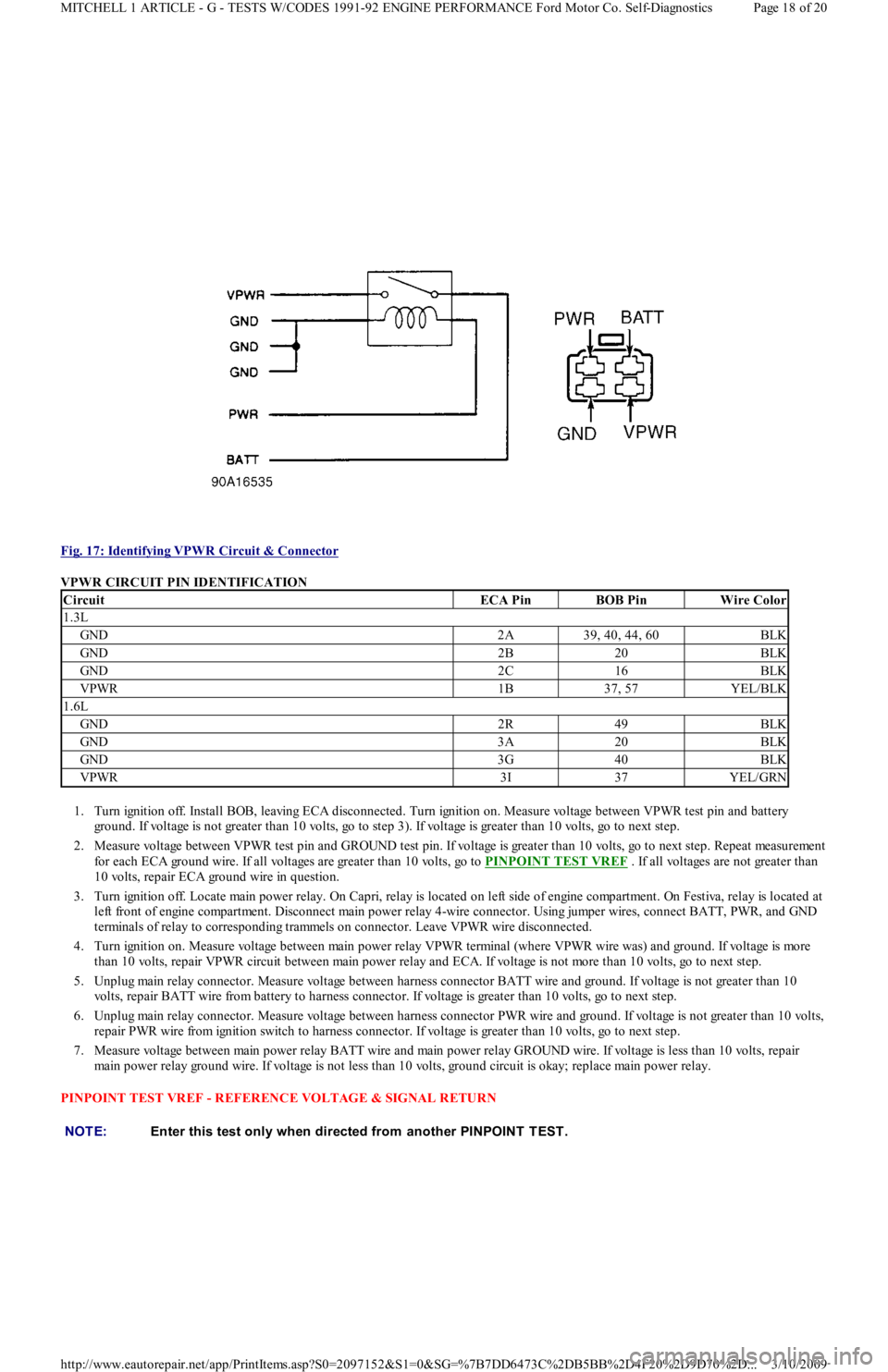
Fig. 17: Identifying VPWR Circuit & Connector
VPWR CIRCUIT PIN IDENTIFICATION
1. Turn ignition off. Install BOB, leaving ECA disconnected. Turn ignition on. Measure voltage between VPWR test pin and battery
gr o u n d . If vo l t a ge is n o t gr e a t e r t h a n 1 0 vo l t s, go t o st e p 3). If voltage is greater than 10 volts, go to next step.
2. Measure voltage between VPWR test pin and GROUND test pin. If voltage is greater than 10 volts, go to next step. Repeat measurement
for each ECA ground wire. If all voltages are greater than 10 volts, go to PINPOINT TEST VREF
. If all voltages are not greater than
10 volts, repair ECA ground wire in question.
3. Turn ignition off. Locate main power relay. On Capri, relay is located on left side of engine compartment. On Festiva, relay is located at
left front of engine compartment. Disconnect main power relay 4-wire connector. Using jumper wires, connect BATT, PWR, and GND
terminals of relay to corresponding trammels on connector. Leave VPWR wire disconnected.
4. Turn ignition on. Measure voltage between main power relay VPWR terminal (where VPWR wire was) and ground. If voltage is more
than 10 volts, repair VPWR circuit between main power relay and ECA. If voltage is not more than 10 volts, go to next step.
5. Unplug main relay connector. Measure voltage between harness connector BATT wire and ground. If voltage is not greater than 10
volts, repair BATT wire from battery to harness connector. If voltage is greater than 10 volts, go to next step.
6. Unplug main relay connector. Measure voltage between harness connector PWR wire and ground. If voltage is not greater than 10 volts,
repair PWR wire from ignition switch to harness connector. If voltage is greater than 10 volts, go to next step.
7. Measure voltage between main power relay BATT wire and main power relay GROUND wire. If voltage is less than 10 volts, repair
main power relay ground wire. If voltage is not less than 10 volts, ground circuit is okay; replace main power relay.
PINPOINT TEST VREF - REFERENCE VOLTAGE & SIGNAL RETURN
CircuitECA PinBOB PinWire Color
1.3L
GND2A39, 40, 44, 60BLK
GND2B20BLK
GND2C16BLK
VPWR1B37, 57YEL/BLK
1.6L
GND2R49BLK
GND3A20BLK
GND3G40BLK
VPWR3I37YEL/GRN
NOTE:Enter this test only when directed from another PINPOINT T EST .
Page 18 of 20 MITCHELL 1 ARTICLE - G - TESTS W/CODES 1991-92 ENGINE PERFORMANCE Ford Motor Co. Self-Diagnostics
3/10/2009 http://www.eautorepair.net/app/PrintItems.asp?S0=2097152&S1=0&SG=%7B7DD6473C%2DB5BB%2D4F20%2D9D70%2D
...
Page 186 of 454

Fig. 18: Identifying VREF Circuit & Connector
VREF CIRCUIT PIN IDENTIFICATION
1. On 1.3L, go to next step. On 1.6L, turn ignition on. Measure voltage between throttle position switch VREF and SIGRTN wires. See
VREF CIRCUIT PIN IDENTIFICATION
table. If voltage is 10-12 volts, repair short to voltage. If voltage is zero volts, go to next
step.
2. Turn ignition on. On 1.3L, measure voltage between Black and White-Black wires at VAF sensor. On 1.6L, measure voltage between
White-Black and Blue/Yellow wires at BP sensor. If voltage is 4-5 volts, VREF circuit is okay. If voltage is zero volts, go to next step. If
vo l t a ge is 1 0 - 1 2 vo l t s, r e p a ir sh o r t t o vo l t a ge .
3. Turn ignition off. Install BOB. Install 4EAT tester (if vehicle is equipped with 4EAT transaxle). Unplug connector from VAF, TP, and
BP sensors as applicable to vehicle. Measure resistance between VREF terminals on ECA and 4EAT module. Also measure resistance
between ECA VREF terminal and TP, BP, and VAF VREF harness connector terminals. If any measurement is greater than 5 ohms,
repair wire in question. If resistance is less than 5 ohms for all measurements, go to next step.
4. Turn ignition off. Disconnect 4EAT module (if equipped). Unplug connector from VAF, TP, and BP sensors as applicable to vehicle.
Measure resistance between ECA VREF pin on BOB and ground. If resistance is not greater than 10,000 ohms, repair short in VREF
circuit. If resistance is greater than 10,000 ohms, go to next step.
5. Turn ignition off. Disconnect ECA. Unplug connector from VAF, TP, and BP sensors as applicable to vehicle. Measure resistance
between ECA SIGRTN, 4EAT, and all SIGRTN pins on BOB. If any measurement is greater than 5 ohms, repair wire in question. If
resistance is less than 5 ohms for all measurements, go to next step.
6. Turn ignition off. Install BOB. Connect ECA. Connect 4EAT module (if equipped). Turn ignition on. Measure voltage at ECA SIGRTN
test pin on BOB. If voltage is 0-1 volt, go to PINPOINT TEST PGC
. If voltage is not 0-1 volt, repair short to voltage on SIGRTN
circuit.
SUMMARY
CircuitECA PinBOB PinWire Color
1.3L
SIGRTN2D46, 49BLK
VREF2K26WHT/BLK
1.6L
SIGRTN2C46BLU/YEL
VREF2A26WHT/BLK
Page 19 of 20 MITCHELL 1 ARTICLE - G - TESTS W/CODES 1991-92 ENGINE PERFORMANCE Ford Motor Co. Self-Diagnostics
3/10/2009 http://www.eautorepair.net/app/PrintItems.asp?S0=2097152&S1=0&SG=%7B7DD6473C%2DB5BB%2D4F20%2D9D70%2D
...
Page 187 of 454
If no hard codes, or only pass codes, are present, and driveability symptoms or intermittent codes still exist, proceed to TESTS W/O CODES
article in the ENGINE PERFORMANCE Section for diagnosis by symptom (i.e., ROUGH IDLE, NO START, etc.) or intermittent diagnostic
procedures.
Copyr ight 2009 Mitchell Repair Information Company, LLC. All Rights Reserved.
Article GUID: A00022768
Page 20 of 20 MITCHELL 1 ARTICLE - G - TESTS W/CODES 1991-92 ENGINE PERFORMANCE Ford Motor Co. Self-Diagnostics
3/10/2009 http://www.eautorepair.net/app/PrintItems.asp?S0=2097152&S1=0&SG=%7B7DD6473C%2DB5BB%2D4F20%2D9D70%2D
...
Page 188 of 454

Back To Article
H - T EST S W/O CODES
1991-92 ENGINE PERFORMANCE Ford Motor Co. T rouble Shooting - No Codes
INTRODUCTION
Before diagnosing symptoms or intermittent faults, perform steps in BASIC TESTING and TESTS W/CODES articles in the ENGINE
PERFORMANCE Section. Use this article to diagnose driveability problems existing when a hard fault code is not present or vehicle is not
equipped with a self-diagnostic system.
Symptom checks can direct the technician to malfunctioning component(s) for further diagnosis. A symptom should lead to a specific
component, system test or adjustment.
Use intermittent test procedures to locate driveability problems which DO NOT occur when the vehicle is being tested. These test procedures
should also be used if a soft (intermittent) trouble code was present but no problem was found during self-diagnostic testing.
SYMPTOMS
SYMPTOM DIAGNOSIS
Symptom checks cannot be used properly unless problem occurs while vehicle is being tested. To reduce diagnostic time, ensure steps in
BASIC TESTING and TESTS W/CODES articles in the ENGINE PERFORMANCE Section were performed before diagnosing a symptom.
These symptoms are available for diagnosis.
Backfire through induction or exhaust.
Dieseling (run-on).
Lack of power.
Spark knock (pinging).
Stalls/quits.
Stumble/hesitation during acceleration.
Misses/surges.
Idle is fast/slow return to idle.
Id l e is ro u gh .
Engine speeds up.
Cranks normally/no start.
Cranks normally/slow to start.
Poor fuel economy.
Exhaust smoke/odor.
Fuel odor/leaks.
Fails emission test.
BACKFIRE THROUGH INDUCTION OR EXHAUST
Check vane airflow meter.
Check idle speed control solenoid.
DIESELING (RUN-ON)
Check idle speed control solenoid.
LACK OF POWER
Check vane airflow meter.
Check throttle position switch.
Check heated exhaust gas oxygen sensor.
Check A/C switch.
Check wide open throttle A/C (WAC) relay.
SPARK KNOCK (PINGING)
Verify ignition timing is correct.
Check vane airflow meter.
STALLS/QUITS NOTE:Som e driveability problem s m ay have been corrected by m anufacturer with a revised com puter
calibration chip or com puter control unit. Check with m anufacturer for latest chip or com puter
application.
NOTE:For specific testing procedures, see SYST EM/COMPONENT T EST S article in the ENGINE
PERFORMANCE Section. For specifications, see ADJUST MENT S or SPECIFICAT IONS article in the
ENGINE PERFORMANCE Section.
Page 1 of 3 MITCHELL 1 ARTICLE - H - TESTS W/O CODES 1991-92 ENGINE PERFORMANCE Ford Motor Co. Trouble Shooting -
...
3/10/2009 http://www.eautorepair.net/app/PrintItems.asp?S0=2097152&S1=0&SG=%7B7DD6473C%2DB5BB%2D4F20%2D9D70%2D
...
Page 189 of 454

Check vane airflow meter.
Check idle speed control solenoid.
Check pressure regulator control solenoid.
Check heated exhaust gas oxygen sensor.
Check engine coolant temperature sensor.
Check A/C load control solenoid.
STUMBLE/HESITATION DURING ACCELERATION
Check throttle position switch.
Check vane airflow meter.
Check canister purge solenoid.
Check heated exhaust gas oxygen sensor.
Check wide open throttle A/C (WAC) relay.
Check A/C thermostatic switch.
MISSES/SURGES
Check exhaust gas oxygen sensor.
Check throttle position switch.
Check vane airflow meter.
Check wide open throttle vacuum switch.
Check A/C load control solenoid.
Check engine coolant temperature sensor.
IDLE IS FAST/SLOW RETURN TO IDLE
Check idle speed control solenoid.
Check by-pass air control valve.
Check engine coolant temperature sensor.
Check A/C load control solenoid.
IDLE IS ROUGH
Check idle speed control solenoid.
Check A/C load control solenoid.
Check by-pass air control valve.
Check throttle position switch.
Check vane airflow meter.
Check vane air temperature sensor.
Check canister purge solenoid.
Check engine cooling fan.
Check headlight switch.
Check blower control switch.
Check A/C thermostatic switch.
Check neutral safety switch.
Check neutral gear switch or clutch engage switch.
Check heated exhaust gas oxygen sensor.
ENGINE SPEEDS UP
Check idle speed control solenoid.
Check heated exhaust gas oxygen sensor.
Check by-pass air control valve.
CRANKS NORMALLY/NO START
Verify secondary ignition spark is present.
Verify fuel pressure is within specification.
Check vane airflow meter.
Check engine coolant temperature sensor.
CRANKS NORMALLY/SLOW TO START
Check ignition module.
Check engine coolant temperature sensor.
Check vane airflow meter.
Check evaporative emission control components.
Page 2 of 3 MITCHELL 1 ARTICLE - H - TESTS W/O CODES 1991-92 ENGINE PERFORMANCE Ford Motor Co. Trouble Shooting -
...
3/10/2009 http://www.eautorepair.net/app/PrintItems.asp?S0=2097152&S1=0&SG=%7B7DD6473C%2DB5BB%2D4F20%2D9D70%2D
...
Page 190 of 454

POOR FUEL ECONOMY
Verify intake air is not restricted.
Verify fuel pressure is within specification.
Check ignition module.
Check canister purge solenoid.
Check vane air temperature sensor.
Check vane airflow meter.
Check heated exhaust gas oxygen sensor.
EXHAUST SMOKE/ODOR
Check vane air temperature sensor.
Check vane airflow meter.
Check exhaust gas oxygen sensor.
FUEL ODOR/LEAKS
Check evaporative emission control components.
Check rollover vent valve.
Check by-pass air control valve.
FAILS EMISSION TEST
Check canister purge solenoid.
Check pressure regulator control solenoid.
Check heated exhaust gas oxygen sensor.
Check by-pass air control valve.
INTERMITTENTS
INTERMITTENT PROBLEM DIAGNOSIS
Intermittent fault testing requires duplicating circuit or component failure to identify problem. These procedures may lead to computer setting
a fault code (on some systems) which may help in diagnosis.
If problem vehicle does not produce fault codes, monitor voltage or resistance values using a DVOM while attempting to reproduce conditions
causing intermittent fault. A status change on DVOM indicates a fault has been located.
Use a DVOM to pinpoint faults. When monitoring voltage, ensure ignition switch is in ON position or engine is running. Ensure ign it io n
switch is in OFF position or negative battery cable is disconnected when monitoring circuit resistance. Status changes on DVOM during test
procedures indicate area of fault.
TEST PROCEDURES
INTERMITTENT SIMULATION
To reproduce conditions creating an intermittent fault, use following methods:
Lightly vibrate component.
Heat component.
Wiggle or bend wiring harness.
Spray component with water.
Remove/apply vacuum source.
Monitor circuit/component voltage or resistance while simulating intermittent. If engine is running, monitor for self-diagnostic codes. Use test
results to identify a faulty component or circuit.
Copyr ight 2009 Mitchell Repair Information Company, LLC. All Rights Reserved.
Article GUID: A00022699
Page 3 of 3 MITCHELL 1 ARTICLE - H - TESTS W/O CODES 1991-92 ENGINE PERFORMANCE Ford Motor Co. Trouble Shooting -
...
3/10/2009 http://www.eautorepair.net/app/PrintItems.asp?S0=2097152&S1=0&SG=%7B7DD6473C%2DB5BB%2D4F20%2D9D70%2D
...