1991 FORD FESTIVA engine
[x] Cancel search: enginePage 175 of 454
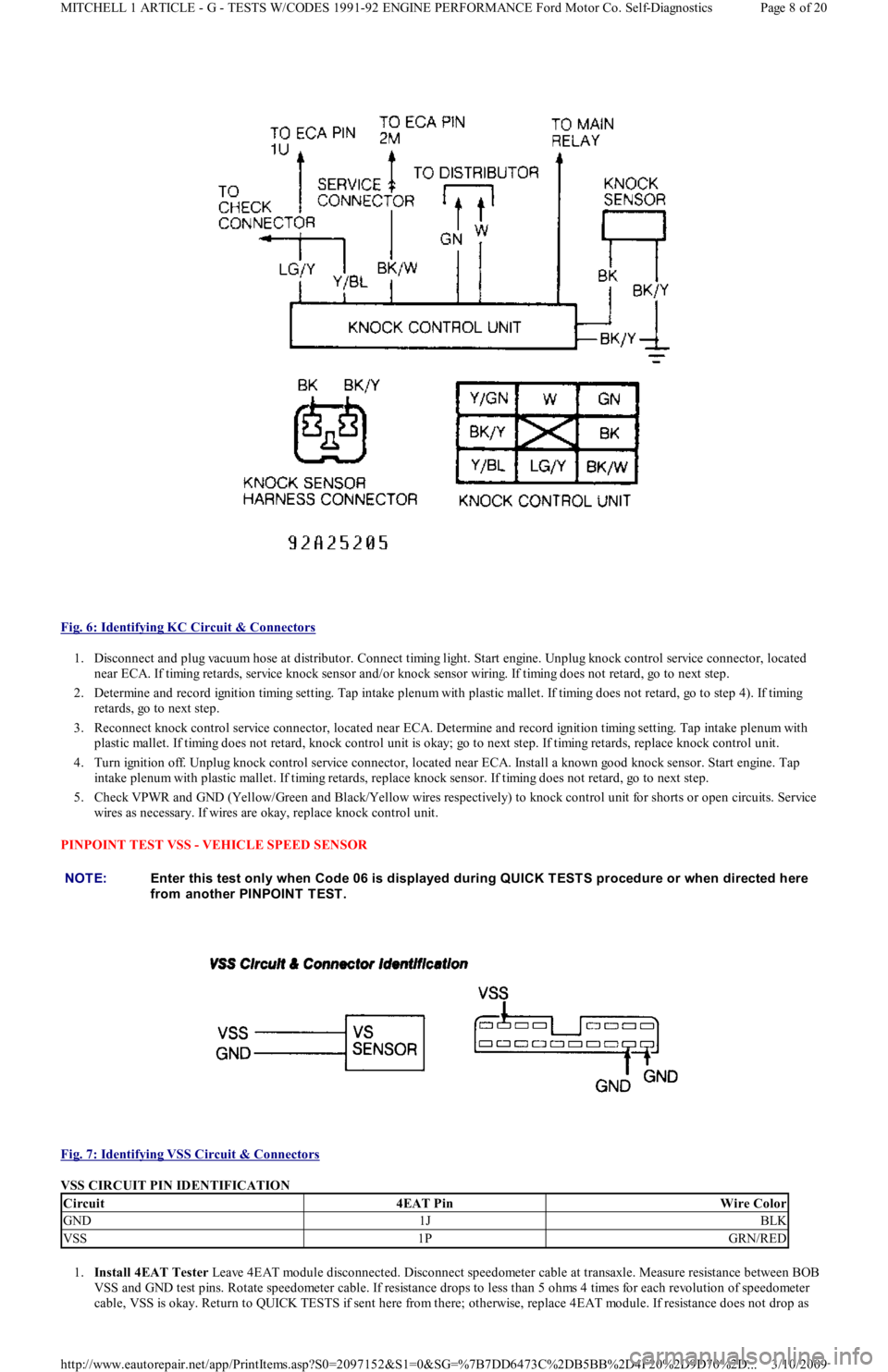
Fig. 6: Identifying KC Circuit & Connectors
1. Disconnect and plug vacuum hose at distributor. Connect timing light. Start engine. Unplug knock control service connector, located
near ECA. If timing retards, service knock sensor and/or knock sensor wiring. If timing does not retard, go to next step.
2. Determine and record ignition timing setting. Tap intake plenum with plastic mallet. If timing does not retard, go to step 4). If t imin g
retards, go to next step.
3. Reconnect knock control service connector, located near ECA. Determine and record ignition timing setting. Tap intake plenum with
plastic mallet. If timing does not retard, knock control unit is okay; go to next step. If timing retards, replace knock control unit.
4. Turn ignition off. Unplug knock control service connector, located near ECA. Install a known good knock sensor. Start engine. Tap
intake plenum with plastic mallet. If timing retards, replace knock sensor. If timing does not retard, go to next step.
5. Check VPWR and GND (Yellow/Green and Black/Yellow wires respectively) to knock control unit for shorts or open circuits. Service
wires as necessary. If wires are okay, replace knock control unit.
PINPOINT TEST VSS - VEHICLE SPEED SENSOR
Fig. 7: Identifying VSS Circuit & Connectors
VSS CIRCUIT PIN IDENTIFICATION
1.Install 4EAT Tester Leave 4EAT module disconnected. Disconnect speedometer cable at transaxle. Measure resistance between BOB
VSS and GND test pins. Rotate speedometer cable. If resistance drops to less than 5 ohms 4 times for each revolution of speedometer
cable, VSS is okay. Return to QUICK TESTS if sent here from there; otherwise, replace 4EAT module. If resistance does not drop as
NOTE:Enter this test only when Code 06 is displayed during QUICK T EST S procedure or when directed here
from another PINPOINT TEST.
Circuit4EAT PinWire Color
GND1JBLK
VSS1PGRN/RED
Page 8 of 20 MITCHELL 1 ARTICLE - G - TESTS W/CODES 1991-92 ENGINE PERFORMANCE Ford Motor Co. Self-Diagnostics
3/10/2009 http://www.eautorepair.net/app/PrintItems.asp?S0=2097152&S1=0&SG=%7B7DD6473C%2DB5BB%2D4F20%2D9D70%2D
...
Page 176 of 454
specified, go to next step.
2. Unplug VSS connector at instrument cluster. Measure resistance between VSS and GND terminals on instrument cluster. Rotate
speedometer cable. If resistance drops to less than 5 ohms 4 times for each revolution of speedometer cable, repair VSS signal wire to
4EAT. If resistance does not drop as specified, replace speedometer assembly.
PINPOINT TEST VAF - VANE AIRFLOW METER
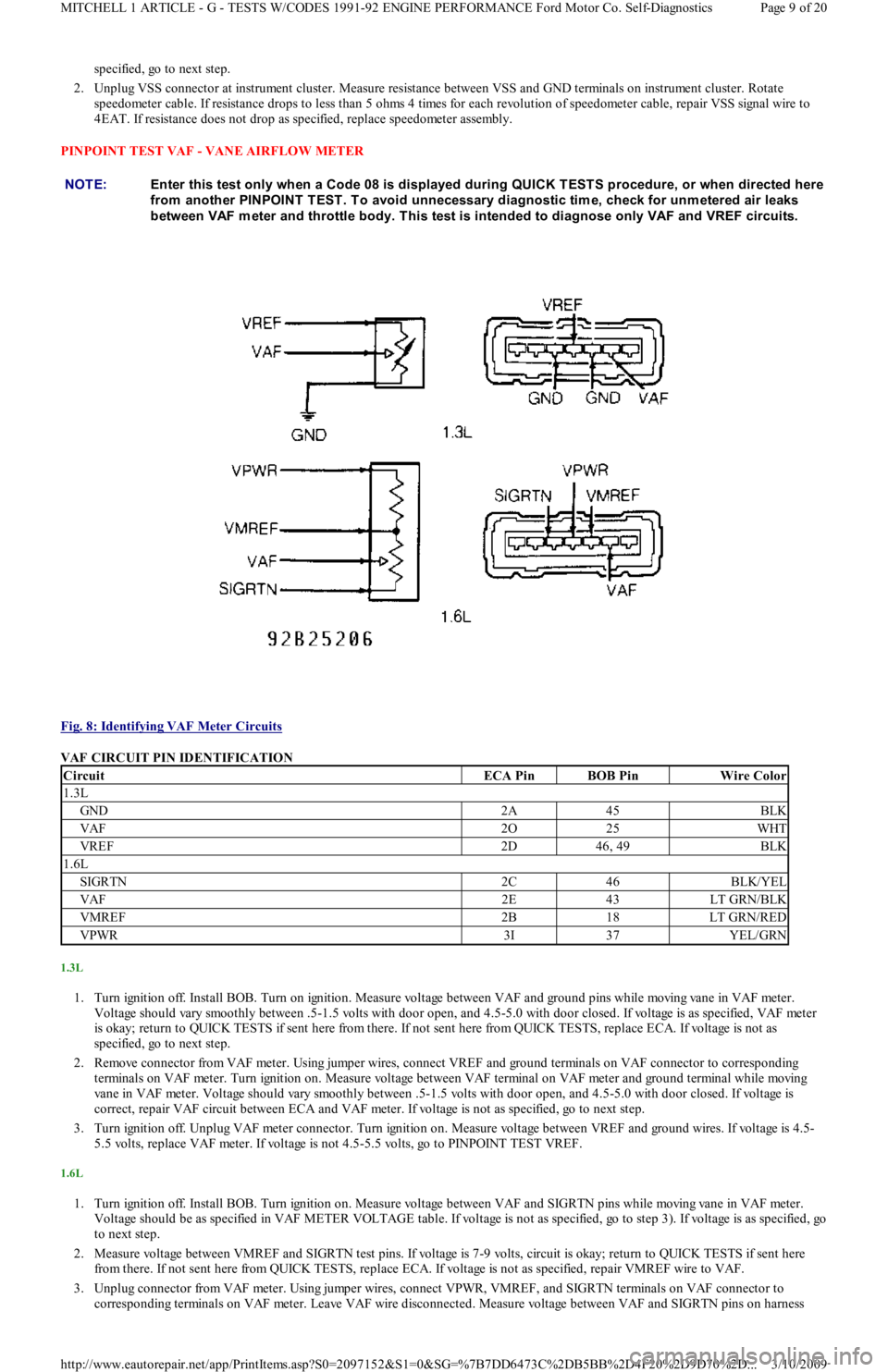
Fig. 8: Identifying VAF Meter Circuits
VAF CIRCUIT PIN IDENTIFICATION
1.3L
1. Turn ignition off. Install BOB. Turn on ignition. Measure voltage between VAF and ground pins while moving vane in VAF meter.
Voltage should vary smoothly between .5-1.5 volts with door open, and 4.5-5.0 with door closed. If voltage is as specified, VAF met er
is okay; return to QUICK TESTS if sent here from there. If not sent here from QUICK TESTS, replace ECA. If voltage is not as
specified, go to next step.
2. Remove connector from VAF meter. Using jumper wires, connect VREF and ground terminals on VAF connector to corresponding
terminals on VAF meter. Turn ignition on. Measure voltage between VAF terminal on VAF meter and ground terminal while moving
vane in VAF meter. Voltage should vary smoothly between .5-1.5 volts with door open, and 4.5-5.0 with door closed. If voltage is
correct, repair VAF circuit between ECA and VAF meter. If voltage is not as specified, go to next step.
3. Turn ignition off. Unplug VAF meter connector. Turn ignition on. Measure voltage between VREF and ground wires. If voltage is 4.5-
5.5 volts, replace VAF meter. If voltage is not 4.5-5.5 volts, go to PINPOINT TEST VREF.
1.6L
1. Turn ignition off. Install BOB. Turn ignition on. Measure voltage between VAF and SIGRTN pins while moving vane in VAF meter.
Voltage should be as specified in VAF METER VOLTAGE table. If voltage is not as specified, go to step 3). If voltage is as specified, go
to next step.
2. Measure voltage between VMREF and SIGRTN test pins. If voltage is 7-9 volts, circuit is okay; return to QUICK TESTS if sent here
from there. If not sent here from QUICK TESTS, replace ECA. If voltage is not as specified, repair VMREF wire to VAF.
3. Unplug connector from VAF meter. Using jumper wires, connect VPWR, VMREF, and SIGRTN terminals on VAF connector to
corresponding terminals on VAF meter. Leave VAF wire disconnected. Measure voltage between VAF and SIGRTN pins on harness NOTE:Enter this test only when a Code 08 is displayed during QUICK TESTS procedure, or when directed here
from another PINPOINT T EST . T o avoid unnecessary diagnostic tim e, check for unm etered air leaks
between VAF m eter and throttle body. T his test is intended to diagnose only VAF and VREF circuits.
CircuitECA PinBOB PinWire Color
1.3L
GND2A45BLK
VAF2O25WHT
VREF2D46, 49BLK
1.6L
SIGRTN2C46BLK/YEL
VAF2E43LT GRN/BLK
VMREF2B18LT GRN/RED
VPWR3I37YEL/GRN
Page 9 of 20 MITCHELL 1 ARTICLE - G - TESTS W/CODES 1991-92 ENGINE PERFORMANCE Ford Motor Co. Self-Diagnostics
3/10/2009 http://www.eautorepair.net/app/PrintItems.asp?S0=2097152&S1=0&SG=%7B7DD6473C%2DB5BB%2D4F20%2D9D70%2D
...
Page 177 of 454
connector while moving vane in VAF meter. Voltage should be as specified in VAF METER VOLTAGE table. If voltage is okay,
repair VAF wire to ECA. If voltage is not okay, go to next step.
VAF METER VOLTAGE
4. Unplug connector from VAF. Using jumper wires, connect VPWR and SIGRTN terminals on VAF connector to corresponding terminals
on VAF meter. Leave VAF and VMREF wires disconnected. Measure voltage between VAF terminal at VAF meter, and SIGRTN pin at
harness connector while moving vane in VAF meter. Voltage should be as specified in VAF METER VOLTAGE
table. If voltage is
okay, repair VMREF wire to ECA. If voltage is not okay, go to next step.
5. Unplug connector from VAF meter. Turn ignition on. Measure voltage between SIGRTN and VPWR wire. If voltage is more than 10
volts, replace VAF meter. If voltage is not more than 10 volts, go to next step.
6. Unplug VAF meter connector. Turn ignition on. Measure voltage between VAF meter VPWR wire and ground. If voltage is more than
10 volts, repair VAF wire to ECA. If voltage is not more than 10 volts, go to PINPOINT TEST VPWR.
PINPOINT TEST ECT - ENGINE COOLANT TEMPERATURE SENSOR
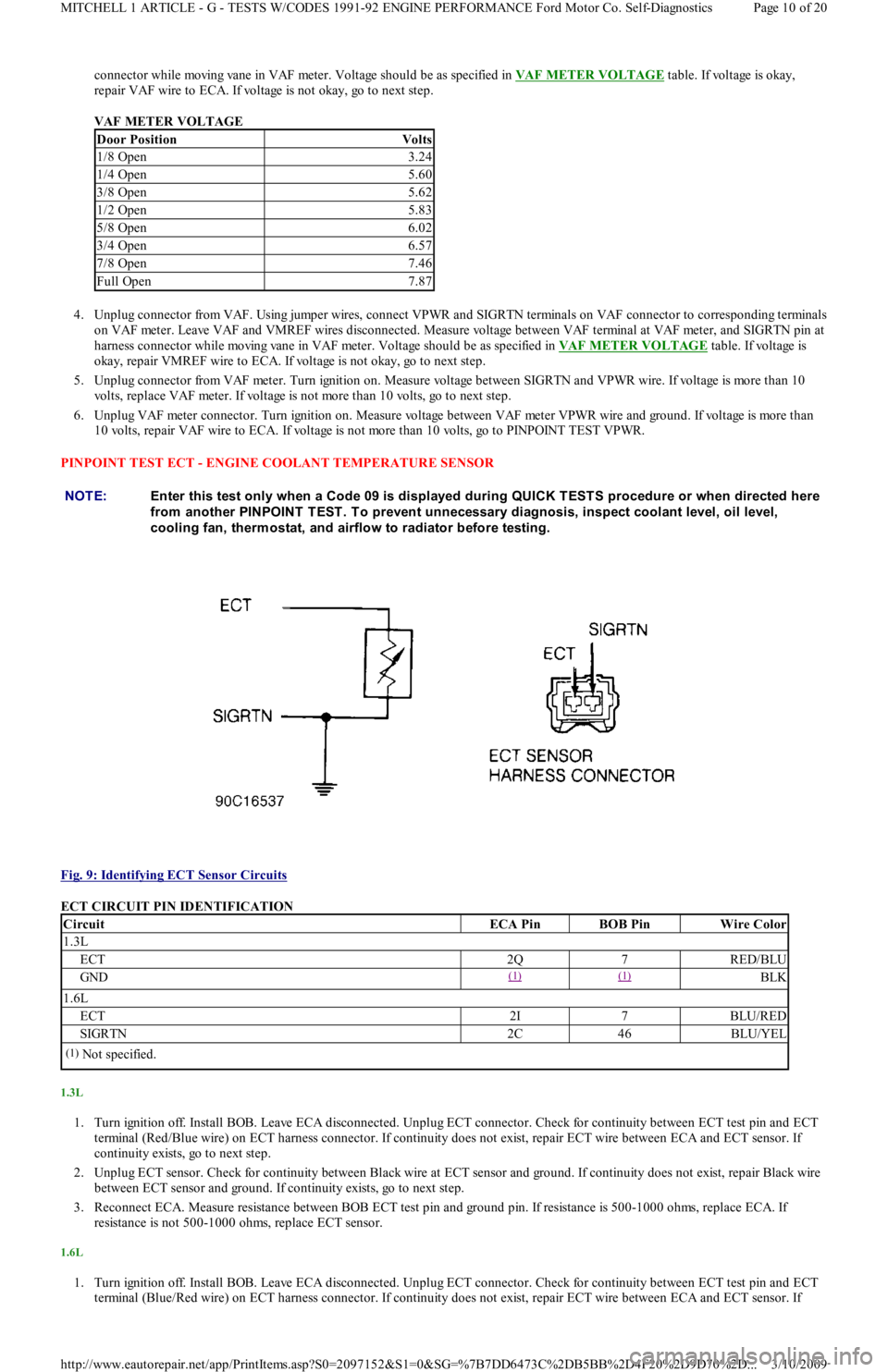
Fig. 9: Identifying ECT Sensor Circuits
ECT CIRCUIT PIN IDENTIFICATION
1.3L
1. Turn ignition off. Install BOB. Leave ECA disconnected. Unplug ECT connector. Check for continuity between ECT test pin and ECT
terminal (Red/Blue wire) on ECT harness connector. If continuity does not exist, repair ECT wire between ECA and ECT sensor. If
continuity exists, go to next step.
2. Unplug ECT sensor. Check for continuity between Black wire at ECT sensor and ground. If continuity does not exist, repair Black wire
between ECT sensor and ground. If continuity exists, go to next step.
3. Reconnect ECA. Measure resistance between BOB ECT test pin and ground pin. If resistance is 500-1000 ohms, replace ECA. If
resistance is not 500-1000 ohms, replace ECT sensor.
1.6L
1. Turn ignition off. Install BOB. Leave ECA disconnected. Unplug ECT connector. Check for continuity between ECT test pin and ECT
terminal (Blue/Red wire) on ECT harness connector. If continuity does not exist, repair ECT wire between ECA and ECT sensor. If
Door PositionVolts
1/8 Open3.24
1/4 Open5.60
3/8 Open5.62
1/2 Open5.83
5/8 Open6.02
3/4 Open6.57
7/8 Open7.46
Full Open7.87
NOTE:Enter this test only when a Code 09 is displayed during QUICK T EST S procedure or when directed here
from another PINPOINT T EST . T o prevent unnecessary diagnosis, inspect coolant level, oil level,
cooling fan, therm ostat, and airflow to radiator before testing.
CircuitECA PinBOB PinWire Color
1.3L
ECT2Q7RED/BLU
GND(1) (1) BLK
1.6L
ECT2I7BLU/RED
SIGRTN2C46BLU/YEL
(1)Not specified.
Page 10 of 20 MITCHELL 1 ARTICLE - G - TESTS W/CODES 1991-92 ENGINE PERFORMANCE Ford Motor Co. Self-Diagnostics
3/10/2009 http://www.eautorepair.net/app/PrintItems.asp?S0=2097152&S1=0&SG=%7B7DD6473C%2DB5BB%2D4F20%2D9D70%2D
...
Page 178 of 454
continuity exists, go to next step.
2. Install BOB. Connect ECT. Warm engine to normal operating temperature. Measure resistance between ECT test pin and SIGRTN pins.
If resistance is 500-1000 ohms, replace ECA. If resistance is not 500-1000 ohms, replace ECT sensor.
PINPOINT TEST VAT - VANE AIR TEMPERATURE SENSOR
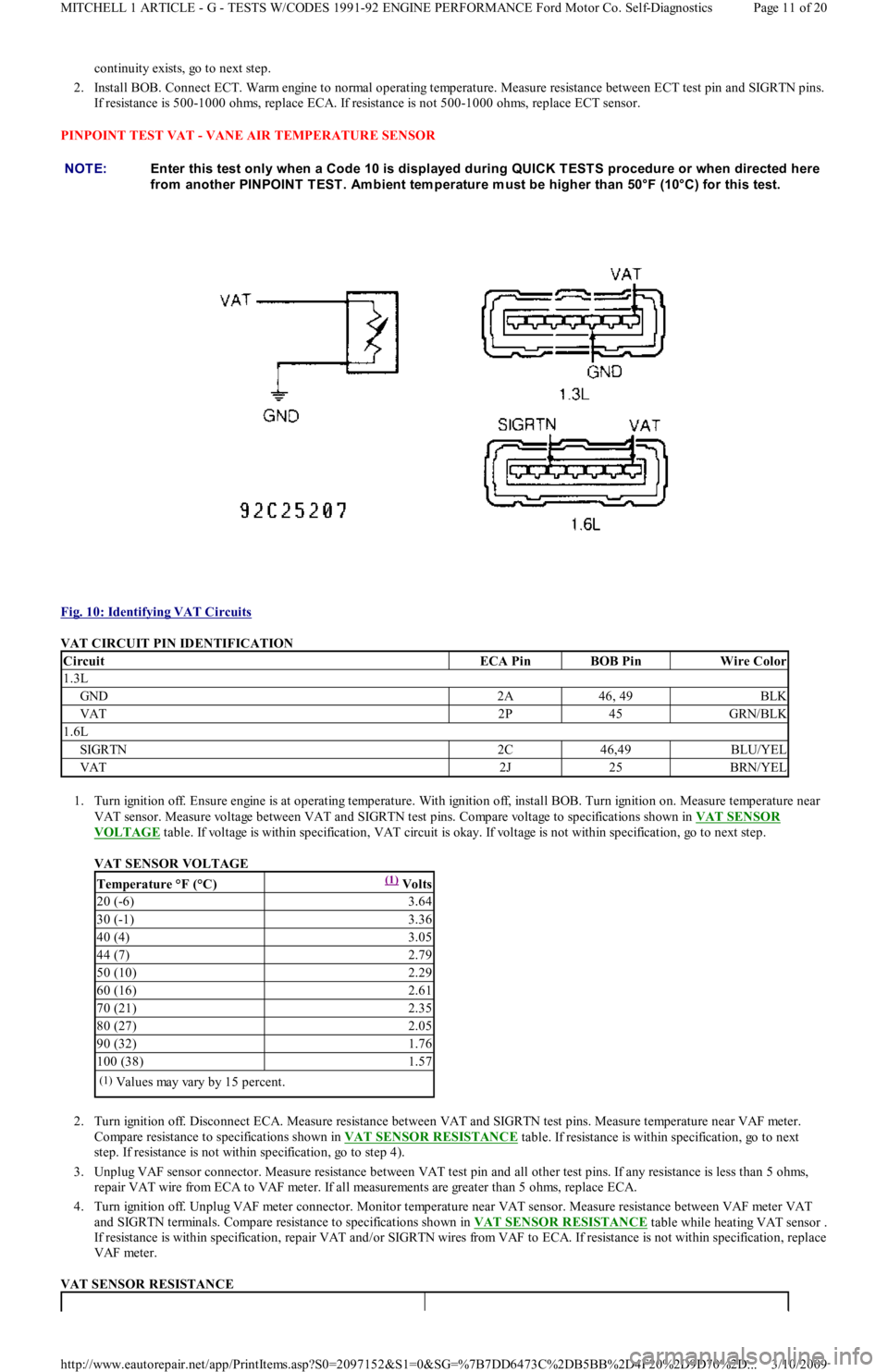
Fig. 10: Identifying VAT Circuits
VAT CIRCUIT PIN IDENTIFICATION
1. Turn ignition off. Ensure engine is at operating temperature. With ignition off, install BOB. Turn ignition on. Measure temperature near
VAT sensor. Measure voltage between VAT and SIGRTN test pins. Compare voltage to specifications shown in VAT SENSOR
VOLTAGE table. If voltage is within specification, VAT circuit is okay. If voltage is not within specification, go to next step.
VAT SENSOR VOLTAGE
2. Turn ignition off. Disconnect ECA. Measure resistance between VAT and SIGRTN test pins. Measure temperature near VAF meter.
Compare resistance to specifications shown in VAT SENSOR RESISTANCE
table. If resistance is within specification, go to next
step. If resistance is not within specification, go to step 4).
3. Unplug VAF sensor connector. Measure resistance between VAT test pin and all other test pins. If any resistance is less than 5 ohms,
repair VAT wire from ECA to VAF meter. If all measurements are greater than 5 ohms, replace ECA.
4. Turn ignition off. Unplug VAF meter connector. Monitor temperature near VAT sensor. Measure resistance between VAF meter VAT
and SIGRTN terminals. Compare resistance to specifications shown in VAT SENSOR RESISTANCE
table while heating VAT sensor .
If resistance is within specification, repair VAT and/or SIGRTN wires from VAF to ECA. If resistance is not within specification, replace
VAF meter.
VAT SENSOR RESISTANCE NOTE:Enter this test only when a Code 10 is displayed during QUICK T EST S procedure or when directed here
from another PINPOINT T EST . Am bient tem perature m ust be higher than 50°F (10°C) for this test.
CircuitECA PinBOB PinWire Color
1.3L
GND2A46, 49BLK
VAT2P45GRN/BLK
1.6L
SIGRTN2C46,49BLU/YEL
VAT2J25BRN/YEL
Temperature °F (°C)(1) Volts
20 (-6)3.64
30 (-1)3.36
40 (4)3.05
44 (7)2.79
50 (10)2.29
60 (16)2.61
70 (21)2.35
80 (27)2.05
90 (32)1.76
100 (38)1.57
(1)Values may vary by 15 percent.
Page 11 of 20 MITCHELL 1 ARTICLE - G - TESTS W/CODES 1991-92 ENGINE PERFORMANCE Ford Motor Co. Self-Diagnostics
3/10/2009 http://www.eautorepair.net/app/PrintItems.asp?S0=2097152&S1=0&SG=%7B7DD6473C%2DB5BB%2D4F20%2D9D70%2D
...
Page 179 of 454

PINPOINT TEST TP - THROTTLE POSITION SENSOR
Fig. 11: Identifying TP Circuits
TP CIRCUIT PIN IDENTIFICATION
1.6L
1. Turn ignition off. Install BOB. Turn ignition on. Measure voltage between BOB test pins TP and SIGRTN while opening throttle.
Compare voltage to specification in TP SENSOR OUTPUT VOLTAGE
table. Go to next step if output voltage is not within
specification.
TP SENSOR OUTPUT VOLTAGE
2. Turn ignition off. Unplug TP sensor connector at throttle body. Using jumper wires, connect VREF and SIGRTN wires on harness
Temperature °F (°C)Ohms
-4 (-23)15,000
32 (0)5210
68 (20)2500
104 (40)1100
140 (60)600
176 (80)300
NOTE:Enter this test only when a Code 12 is displayed during QUICK T EST S procedure or when directed here
from another PINPOINT TEST.
CircuitECA PinBOB PinWire Color
1.6L
IDL1E28GRN/ORG
SIGRTN2C46, 49BLK/YEL
TP2G47ORG
VREF2A26WHT/BLK
Throttle Opening(1) Voltage
1/81.00
1/41.60
3/82.37
1/22.74
5/83.15
3/43.43
7/83.60
(1)Voltage may vary by 15 percent.
Page 12 of 20 MITCHELL 1 ARTICLE - G - TESTS W/CODES 1991-92 ENGINE PERFORMANCE Ford Motor Co. Self-Diagnostics
3/10/2009 http://www.eautorepair.net/app/PrintItems.asp?S0=2097152&S1=0&SG=%7B7DD6473C%2DB5BB%2D4F20%2D9D70%2D
...
Page 180 of 454

connector to corresponding terminals on TP sensor connector. Turn ignition on. Measure voltage between TP and SIGRTN terminals on
TP sensor while opening throttle. Compare voltage to specification in TP SENSOR OUTPUT VOLTAGE
table. If voltage is within
specification, repair TP wire to ECA. Go to next step if voltage is not within specification.
3. Turn ignition off. Unplug TP harness connector. Turn ignition on. Measure voltage between VREF and SIGRTN wires on TP harness
connect-or. If voltage is 4-5 volts, replace TP sensor. If voltage is not 4.5-5.5 volts, go to next step.
4. Measure voltage between VREF wire on TP harness connector and ground. If voltage is 4-5 volts, adjust or replace throttle position
sensor. If voltage is not 4-5 volts, go to PINPOINT TEST VREF
.
PINPOINT TEST BP - BAROMETRIC PRESSURE SENSOR
Fig. 12: Identifying BP Sensor Circuits
1.3L
BP sensor is incorporated into ECA; it cannot be checked or serviced separately. If Code 14 is set and cannot be cleared, replace ECA.
1.6L
Turn ignition off. Connect BOB. Remove dust cover from BP sensor, located on passenger side cowl. Turn ignition on. Connect vacuum pump
to BP sensor. Measure voltage between pins BP and SIGRTN on BOB while applying vacuum to BP sensor. See BAROMETRIC
PRESSURE SENSOR OUTPUT VOLTAGE table. Replace BP sensor if voltage is not as specified.
BAROMETRIC PRESSURE SENSOR OUTPUT VOLTAGE
PINPOINT TEST EGO - EXHAUST GAS OXYGEN SENSOR
EGO CIRCUIT PIN IDENTIFICATION
1. Warm engine to operating temperature, and let idle. Unplug EGO sensor. Measure voltage between EGO sensor connector (sensor side) NOTE:Enter this procedure only when a Code 14 is displayed during QUICK T EST S procedure or when
directed here from another PINPOINT T EST . T o prevent unnecessary replacem ent of com ponents, note
following non-EEC item s m ay be at fault: unusually high or low atm ospheric pressure, blocked vacuum
lines, or basic m echanical engine com ponents.
Vacuum (In. Hg.)(1) Voltage
03.84
53.36
102.66
151.93
201.26
25.58
(1)Voltage may vary by 15 percent.
NOTE:Enter this test only when a Code 15 (lean) or Code 17 (rich) is displayed during QUICK TESTS
procedure.
CircuitECA PinBOB PinWire Color
EGO
1.3L2N29BLU
1.6L2D29BLK
Page 13 of 20 MITCHELL 1 ARTICLE - G - TESTS W/CODES 1991-92 ENGINE PERFORMANCE Ford Motor Co. Self-Diagnostics
3/10/2009 http://www.eautorepair.net/app/PrintItems.asp?S0=2097152&S1=0&SG=%7B7DD6473C%2DB5BB%2D4F20%2D9D70%2D
...
Page 181 of 454

and ground. With engine at idle, voltage should fluctuate between 0.2-0.8 volt.
2. Increase and decrease engine speed while reading voltmeter. When engine speed is decreasing, voltage should decrease. When engin e
speed is increasing, voltage should increase. If voltage is within specification, go to next step. If voltage is not within specification,
replace EGO sensor.
3. With ignition off, install BOB. Leave ECA disconnected. Unplug EGO sensor connector. Measure continuity between EGO test pin and
EGO sensor connector wire. If continuity exists, EGO circuit is okay; return to QUICK TESTS if sent here from there. If not sent here
from QUICK TESTS, replace ECA. If voltage is not as specified, repair VMREF wire to VAF. If continuity does not exist, service EGO
sensor wire to ECA.
PINPOINT TEST PRC - FUEL PRESSURE REGULATOR CONTROL SOLENOID
Fig. 13: Identifying PRC Circuit & Connector
PRC CIRCUIT PIN IDENTIFICATION
1. Locate Fuel Pressure Control (PRC) solenoid on cowl panel, next to canister purge solenoid. Unplug PRC solenoid connector. Remo ve
both vacuum lines. Plug vacuum port from engine vacuum source. Apply vacuum to remaining port. Replace PRC solenoid if it does not
hold vacuum.
2. Turn ignition off. Connect BOB. Leave ECA disconnected. Reconnect wiring to PRC solenoid. Turn ignition on. Apply vacuum to PRC
solenoid. Connect jumper wire between PRC test pin on BOB and ground. If vacuum drops to zero, PRC solenoid function is okay.
Return to QUICK TESTS if sent here from there. If vacuum does not drop to zero, go to next step.
3. Turn ignition off. Unplug PRC solenoid connector. Turn ignition on. Measure voltage between VPWR wire on harness connector and
gr o u n d . If vo l t a ge is n o t h igh e r t h a n 1 0 vo l t s, r e p a ir VP WR wir e t o ma in r e l a y. If vo l t a ge is h igh e r t h a n 1 0 vo l t s, go t o n e xt step.
4. Turn ignition off. Unplug PRC solenoid connector. Turn ignition on. Measure voltage between solenoid connector VPWR wire and
solenoid connector SIG wire. Connect jumper wire between PRC test pin on BOB and ground. If voltage is higher than 10 volts only
when solenoid is activated, replace solenoid. If voltage is not higher than 10 volts only when solenoid is activated, go to next step.
5. Turn ignition off. Connect BOB. Leave ECA disconnected. Unplug solenoid connector. Measure resistance between SIG test pin and
solenoid connector SIG wire. If resistance is not less than 5 ohms, repair SIG wire to ECA. If resistance is less than 5 ohms, go t o n e xt
step.
6. Turn ignition off. Connect BOB. Leave ECA disconnected. Unplug solenoid connector. Measure resistance between SIG test pin and all
other test pins. If resistance between SIG PRC test pin and any other pin is less than 5 ohms, repair PRC wire to ECA. If resistance
between PRC test pin and any other pin is greater than 10,000 ohms, replace ECA.
PINPOINT TEST CANP - CANISTER PURGE CONTROL SOLENOID
NOTE:Enter this test only when a Code 25 is displayed during QUICK T EST S procedure or when directed here
from another PINPOINT TEST.
CircuitECA PinBOB PinWire Color
PRC (1.6L)2K31BRN
NOTE:Enter this test only when a Code 26 is displayed during QUICK T EST S procedure or when directed here
from another PINPOINT TEST.
Page 14 of 20 MITCHELL 1 ARTICLE - G - TESTS W/CODES 1991-92 ENGINE PERFORMANCE Ford Motor Co. Self-Diagnostics
3/10/2009 http://www.eautorepair.net/app/PrintItems.asp?S0=2097152&S1=0&SG=%7B7DD6473C%2DB5BB%2D4F20%2D9D70%2D
...
Page 182 of 454
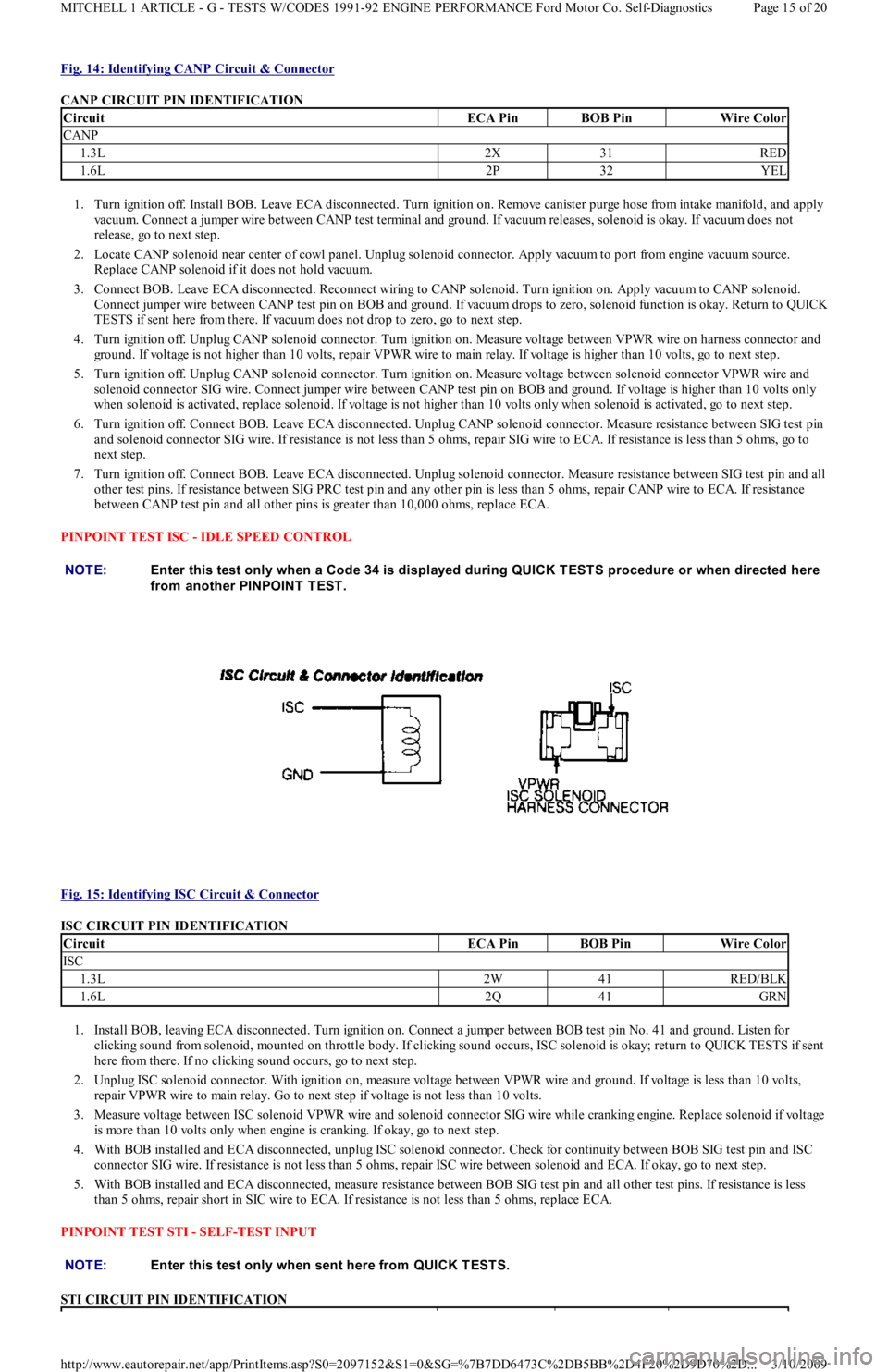
Fig. 14: Identifying CANP Circuit & Connector
CANP CIRCUIT PIN IDENTIFICATION
1. Turn ignition off. Install BOB. Leave ECA disconnected. Turn ignition on. Remove canister purge hose from intake manifold, and apply
vacuum. Connect a jumper wire between CANP test terminal and ground. If vacuum releases, solenoid is okay. If vacuum does not
release, go to next step.
2. Locate CANP solenoid near center of cowl panel. Unplug solenoid connector. Apply vacuum to port from engine vacuum source.
Replace CANP solenoid if it does not hold vacuum.
3. Connect BOB. Leave ECA disconnected. Reconnect wiring to CANP solenoid. Turn ignition on. Apply vacuum to CANP solenoid.
Connect jumper wire between CANP test pin on BOB and ground. If vacuum drops to zero, solenoid function is okay. Return to QUIC
K
TESTS if sent here from there. If vacuum does not drop to zero, go to next step.
4. Turn ignition off. Unplug CANP solenoid connector. Turn ignition on. Measure voltage between VPWR wire on harness connector and
gr o u n d . If vo l t a ge is n o t h igh e r t h a n 1 0 vo l t s, r e p a ir VP WR wir e t o ma in r e l a y. If vo l t a ge is h igh e r t h a n 1 0 vo l t s, go t o n e xt step.
5. Turn ignition off. Unplug CANP solenoid connector. Turn ignition on. Measure voltage between solenoid connector VPWR wire and
solenoid connector SIG wire. Connect jumper wire between CANP test pin on BOB and ground. If voltage is higher than 10 volts only
when solenoid is activated, replace solenoid. If voltage is not higher than 10 volts only when solenoid is activated, go to next step.
6. Turn ignition off. Connect BOB. Leave ECA disconnected. Unplug CANP solenoid connector. Measure resistance between SIG test pin
and solenoid connector SIG wire. If resistance is not less than 5 ohms, repair SIG wire to ECA. If resistance is less than 5 ohms, go to
next step.
7. Turn ignition off. Connect BOB. Leave ECA disconnected. Unplug solenoid connector. Measure resistance between SIG test pin and all
other test pins. If resistance between SIG PRC test pin and any other pin is less than 5 ohms, repair CANP wire to ECA. If resistance
between CANP test pin and all other pins is greater than 10,000 ohms, replace ECA.
PINPOINT TEST ISC - IDLE SPEED CONTROL
Fig. 15: Identifying ISC Circuit & Connector
ISC CIRCUIT PIN IDENTIFICATION
1. Install BOB, leaving ECA disconnected. Turn ignition on. Connect a jumper between BOB test pin No. 41 and ground. Listen for
clicking sound from solenoid, mounted on throttle body. If clicking sound occurs, ISC solenoid is okay; return to QUICK TESTS if sen t
here from there. If no clicking sound occurs, go to next step.
2. Unplug ISC solenoid connector. With ignition on, measure voltage between VPWR wire and ground. If voltage is less than 10 volts,
repair VPWR wire to main relay. Go to next step if voltage is not less than 10 volts.
3. Measure voltage between ISC solenoid VPWR wire and solenoid connector SIG wire while cranking engine. Replace solenoid if voltage
is more than 10 volts only when engine is cranking. If okay, go to next step.
4. With BOB installed and ECA disconnected, unplug ISC solenoid connector. Check for continuity between BOB SIG test pin and ISC
connector SIG wire. If resistance is not less than 5 ohms, repair ISC wire between solenoid and ECA. If okay, go to next step.
5. With BOB installed and ECA disconnected, measure resistance between BOB SIG test pin and all other test pins. If resistance is less
than 5 ohms, repair short in SIC wire to ECA. If resistance is not less than 5 ohms, replace ECA.
PINPOINT TEST STI - SELF-TEST INPUT
STI CIRCUIT PIN IDENTIFICATION
CircuitECA PinBOB PinWire Color
CANP
1.3L2X31RED
1.6L2P32YEL
NOTE:Enter this test only when a Code 34 is displayed during QUICK T EST S procedure or when directed here
from another PINPOINT TEST.
CircuitECA PinBOB PinWire Color
ISC
1.3L2W41RED/BLK
1.6L2Q41GRN
NOTE:Enter this test only when sent here from QUICK TESTS.
Page 15 of 20 MITCHELL 1 ARTICLE - G - TESTS W/CODES 1991-92 ENGINE PERFORMANCE Ford Motor Co. Self-Diagnostics
3/10/2009 http://www.eautorepair.net/app/PrintItems.asp?S0=2097152&S1=0&SG=%7B7DD6473C%2DB5BB%2D4F20%2D9D70%2D
...