1991 FORD FESTIVA engine
[x] Cancel search: enginePage 159 of 454
Article GUID: A00022698
Page 4 of 4 MITCHELL 1 ARTICLE - F - BASIC TESTING 1991-92 ENGINE PERFORMANCE Ford Motor Co. Basic Diagnostic Proced
...
3/10/2009 http://www.eautorepair.net/app/PrintItems.asp?S0=2097152&S1=0&SG=%7B959286D2%2D3A85%2D4BFC%2D9C5C%2D
...
Page 160 of 454
Back To Article
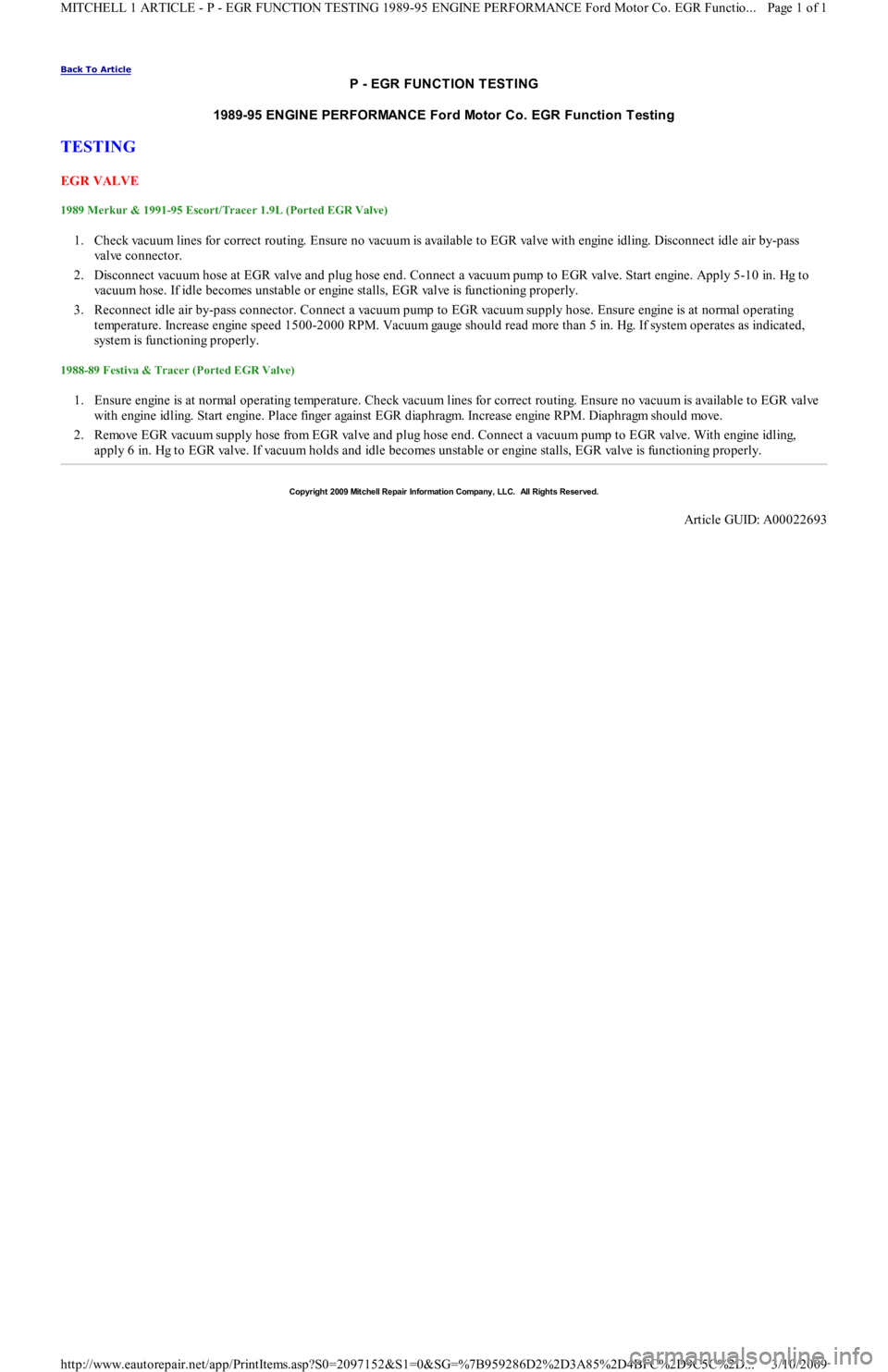
P - EGR FUNCT ION T EST ING
1989-95 ENGINE PERFORMANCE Ford Motor Co. EGR Function T esting
TESTING
EGR VALVE
1989 Merkur & 1991-95 Escort/Tracer 1.9L (Ported EGR Valve)
1. Check vacuum lines for correct routing. Ensure no vacuum is available to EGR valve with engine idling. Disconnect idle air by-pass
valve connector.
2. Disconnect vacuum hose at EGR valve and plug hose end. Connect a vacuum pump to EGR valve. Start engine. Apply 5-10 in. Hg to
vacuum hose. If idle becomes unstable or engine stalls, EGR valve is functioning properly.
3. Reconnect idle air by-pass connector. Connect a vacuum pump to EGR vacuum supply hose. Ensure engine is at normal operating
temperature. Increase engine speed 1500-2000 RPM. Vacuum gauge should read more than 5 in. Hg. If system operates as indicated,
system is functioning properly.
1988-89 Festiva & Tracer (Ported EGR Valve)
1. Ensure engine is at normal operating temperature. Check vacuum lines for correct routing. Ensure no vacuum is available to EGR valve
with engine idling. Start engine. Place finger against EGR diaphragm. Increase engine RPM. Diaphragm should move.
2. Remove EGR vacuum supply hose from EGR valve and plug hose end. Connect a vacuum pump to EGR valve. With engine idling,
apply 6 in. Hg to EGR valve. If vacuum holds and idle becomes unstable or engine stalls, EGR valve is functioning properly.
Copyr ight 2009 Mitchell Repair Information Company, LLC. All Rights Reserved.
Article GUID: A00022693
Page 1 of 1 MITCHELL 1 ARTICLE - P - EGR FUNCTION TESTING 1989-95 ENGINE PERFORMANCE Ford Motor Co. EGR Functio
...
3/10/2009 http://www.eautorepair.net/app/PrintItems.asp?S0=2097152&S1=0&SG=%7B959286D2%2D3A85%2D4BFC%2D9C5C%2D
...
Page 161 of 454

Back To Article
I - SYST EM/COMPONENT T EST S
1991 ENGINE PERFORMANCE Ford Motor Co. - Ford/Mercury System & Com ponent T esting
INTRODUCTION
Before testing separate components or systems, perform procedures in BASIC TESTING article in the ENGINE PERFORMANCE Section.
Since many computer-controlled and monitored components set a trouble code if they malfunction, also perform procedures in TESTS
W/CODES article in the ENGINE PERFORMANCE Section.
AIR INDUCTION SYSTEMS
TURBOCHARGERS
Wastegate Actuator
Disconnect air hose from wastegate actuator. Apply 7.0-8.6 psi (.5-.6 kg/cm2 ) regulated air pressure to wastegate inlet fitting. Replace
turbocharger if wastegate actuator rod does not move.
COMPUTERIZED ENGINE CONTROLS
ELECTRONIC CONTROL ASSEMBLY (ECA)
Ground Circuits
Turn ignition off. Connect BOB, leaving ECA disconnected. Measure resistance between each specified BOB pin and ground. See ECA
GROUND CIRCUIT RESISTANCE table. Repair indicated ECA ground circuit if resistance is greater than 5 ohms.
ECA GROUND CIRCUIT RESISTANCE
Power Circuits
Turn ignition off. Connect BOB, leaving ECA disconnected. Turn ignition on. Repair indicated ECA power circuit if battery voltage d o e s n o t
appear on specified BOB pin. See ECA POWER CIRCUITS RESISTANCE
.
ECA POWER CIRCUIT RESISTANCE
ENGINE SENSORS & SWITCHES
Check each component and all related wiring for any looseness or damage. Make all resistance and voltage measurements using Breakout Box
(BOB) unless specified otherwise.
BAROMETRIC PRESSURE SENSOR (1.3L)
This unit is incorporated into the ECA, and cannot be checked or serviced separately. If a Code 14 is set and cannot be cleared, replace the
ECA.
BAROMETRIC PRESSURE (BP) SENSOR (1.6L) NOTE:T esting individual com ponents does not isolate shorts or opens. Perform all voltage tests with a Digital
Volt-Ohm m eter (DVOM) with a m inim um 10-m egohm input im pedance, unless stated otherwise in test
procedure. Use ohm m eter and Breakout Box (BOB) (007-00033) to isolate wiring harness shorts or
opens.
ECA PinBOB PinWire Color
1.3L
2A39,40,44Black
2B20Black
2C16Black
2D46,49Black
2J (2) (3) 6(3) White/Red
2J (4) 6Black
1.6L
2R49Black
3A (1) (1) 20Black
3G (1) (1) 40Black
(1)Turbo only.
(2)A/T models only.
(3)No continuity on A/T models.
(4)M/T models only.
ECA PinBOB PinWire Color
1.3L: 1A1White/Red
1.6L: 3J1Black/Red
Page 1 of 7 MITCHELL 1 ARTICLE - I - SYSTEM/COMPONENT TESTS 1991 ENGINE PERFORMANCE Ford Motor Co. - Ford/Merc
...
3/10/2009 http://www.eautorepair.net/app/PrintItems.asp?S0=2097152&S1=0&SG=%7B7DD6473C%2DB5BB%2D4F20%2D9D70%2D
...
Page 162 of 454

Connect BOB. Remove dust cover from BP sensor, located on passenger side cowl. Turn ignition on. Connect vacuum pump to BP sensor.
Measure voltage between pins BP and SIGRTN on BOB while applying vacuum to BP sensor. See BAROMETRIC PRESSURE SENSOR
OUTPUT VOLTAGE . Replace BP sensor if voltage is not as specified.
BAROMETRIC PRESSURE SENSOR OUTPUT VOLTAGE
BRAKE ON-OFF (BOO) SWITCH
Unplug connector from BOO switch at brake pedal. Connect ohmmeter to switch terminals. With pedal released, ohmmeter should indicate no
continuity. Ohmmeter should indicate continuity with pedal depressed.
CLUTCH ENGAGE SWITCH (CES)
Unplug connector from CES switch at clutch pedal. Connect ohmmeter to switch terminals. With pedal released, ohmmeter should indicate
continuity. Ohmmeter should indicate no continuity with pedal depressed.
CRANKSHAFT POSITION SENSOR (CPS) (1.3L)
Unplug 3-wire connector from distributor. Measure resistance between CPS terminal on distributor (Yellow/Blue wire) and ground. Replace
CPS if resistance is not 210-250 ohms.
CYLINDER IDENTIFICATION (CID) SENSOR (1.6L)
Turn ignition off. Connect BOB, leaving ECA connected. Turn ignition on, but DO NOT start engine. Measure voltage at BOB pin No. 34
(Yellow wire). Volt- meter should indicate less than one volt or more than 10 volts. Start engine and run at idle. Voltmeter should indicate 3-
5 volts. Replace CID sensor if voltage is not as specified.
ENGINE COOLANT TEMPERATURE (ECT) SENSOR
1. Remove ECT sensor. ECT sensor is threaded into top of lower intake manifold on 1.3L, and on underside of intake manifold on 1.6L.
Place ECT sensor and thermometer into container of coolant.
2. Connect ohmmeter to coolant temperature sensor terminals. Cool or heat container. Note resistance at specified temperatures. See
ENGINE COOLANT TEMPERATURE SENSOR RESISTANCE
. Replace ECT sensor if resistance is not within specification.
ENGINE COOLANT TEMPERATURE SENSOR RESISTANCE
EXHAUST GAS OXYGEN (EGO) SENSOR
With engine at normal operating temperature, unplug connector from EGO in exhaust manifold. Measure voltage between EGO sensor
terminal and ground. Voltage should increase with increasing engine speed and decrease with decreasing engine speed. Voltage at idle should
fluctuate within a range of .2-.8 volt.
IDLE SW ITCH (1.6L)
Unplug connector from throttle position sensor on throttle body. Connect ohmmeter to switch terminals IDL and ground (Green/Orange and
Blue/Yellow wires on mating connector). Resistance must be less than 5 ohms with throttle in idle position, and more than 10,000 ohms with
throttle pedal depressed.
KNOCK SENSOR (1.6L TURBO)
Disconnect vacuum hose at distributor. Connect timing light. Start engine and record ignition timing. Tap intake plenum with a plastic mallet.
Knock sensor is okay if timing retards. If timing does not retard, check associated circuitry and components. See TIMING CONTROL
SYSTEMS under IGNITION SYSTEM.
NEUTRAL GEAR SWITCH (M/T)
1. Unplug connector near transmission. Place transmission in Neutral. Resistance across switch should be infinite.
2. Place transmission in any other gear. Resistance across switch should be zero ohms. If necessary, replace switch.
Vacuum In. Hg.(1) Voltage
03.84
53.36
102.66
151.93
201.26
25.58
(1)Voltage may vary by plus or minus 15 percent.
Temperature °F (°C)Ohms
-4 (-20)14,600-17,800
68 (20)2200-2700
104 (40)1000-1300
140 (60)500-650
176 (80)290-350
NOTE:A steady voltage higher than .55 volt indicates a continuously rich condition. A steady voltage lower
than .55 volt indicates a continuously lean condition.
Page 2 of 7 MITCHELL 1 ARTICLE - I - SYSTEM/COMPONENT TESTS 1991 ENGINE PERFORMANCE Ford Motor Co. - Ford/Merc
...
3/10/2009 http://www.eautorepair.net/app/PrintItems.asp?S0=2097152&S1=0&SG=%7B7DD6473C%2DB5BB%2D4F20%2D9D70%2D
...
Page 163 of 454

POWER STEERING PRESSURE SWITCH
1. Start engine and run it at idle. Remove connector from switch. Connect ohmmeter to switch terminals. Turn steering wheel from side to
side while observing ohmmeter.
2. Replace power steering switch if continuity does not exist with front wheels turned, or if continuity exists with wheels straight ahead.
THROTTLE POSITION SENSOR (1.6L)
Unplug connector from sensor. Connect ohmmeter to sensor terminals TP and SIGRTN (Orange and Blue/Yellow wires on mating connector).
Measure resistance at each throttle opening specified in THROTTLE POSITION SENSOR RESISTANCE
. Replace sensor if resistance is
not within specification.
THROTTLE POSITION SENSOR RESISTANCE
THROTTLE POSITION SWITCH (1.3L)
1. Ensure idle speed and ignition timing are adjusted to specification. Stop engine. Disconnect negative battery cable.
2. Unplug TPS connector at throttle body. Insert appropriate feeler gauge between throttle stop screw and stop lever. Check for continuity
between specified terminals on TPS connector. See ON-VEHICLE ADJUSTMENTS article and TPS CONTINUITY table.
TPS CONTINUITY
VANE AIRFLOW (VAF) METER
1. Check all wiring, harnesses, connectors and components for evidence of damage, overheating, shorting or looseness. If any defect exists,
repair as necessary.
2. Inspect vane airflow meter for damage and ensure measuring plate moves smoothly. Install BOB. Turn ignition on. Measure voltage
between BOB test pins VAF and ground on 1.3L, or between VAF and SIGRTN on 1.6L. Voltage measurements must be as specified in
VANE AIRFLOW METER VOLTAG
.
VANE AIRFLOW METER VOLTAGE
VANE AIR TEMPERATURE (VAT) SENSOR
1. Unplug connector from VAF meter. On 1.3L, connect ohmmeter to terminals VAT and ground (Green/Black and Black wires on mating
connector). On 1.6L, connect ohmmeter to VAF meter terminals VAT and SIGRTN (Brown and Blue/Yellow wires on mating
connector).
2. Measure intake air temperature. Measure resistance between specified terminals. See VANE AIR TEMPERATURE RESISTANCE
.
Replace VAF if resistance is not as specified.
Throttle Opening(1) Ohms
1/8989
1/41104
3/81278
1/21462
5/81480
3/41459
7/81144
Fully Open1072
(1)Resistance may vary by plus or minus 15 percent.
CAUT ION: DO NOT tam per with throttle stop screw at throttle lever. Doing so m ay result in dam age to the
throttle body.
Test Condition (1) Cont. Between IDL-TLCont. Between PSW-TL
.02" (.5 mm)YesNo
.03" (.7 mm)NoNo
Wide Open ThrottleNoYes
(1)Insert specified feeler gauge between throttle adjustment screw and stop lever.
Door Opening(1) Volts: 1.3L(1) Volts: 1.6L
Fully Closed.5-1.5(2) *
1/8.593.24
1/41.195.60
3/81.785.62
1/22.385.83
5/82.976.02
3/43.566.57
7/84.167.48
Fully Open4.5-5.07.87
(1)Voltage may vary by plus or minus 15 percent.
(2)Voltage not specified.
Page 3 of 7 MITCHELL 1 ARTICLE - I - SYSTEM/COMPONENT TESTS 1991 ENGINE PERFORMANCE Ford Motor Co. - Ford/Merc
...
3/10/2009 http://www.eautorepair.net/app/PrintItems.asp?S0=2097152&S1=0&SG=%7B7DD6473C%2DB5BB%2D4F20%2D9D70%2D
...
Page 164 of 454
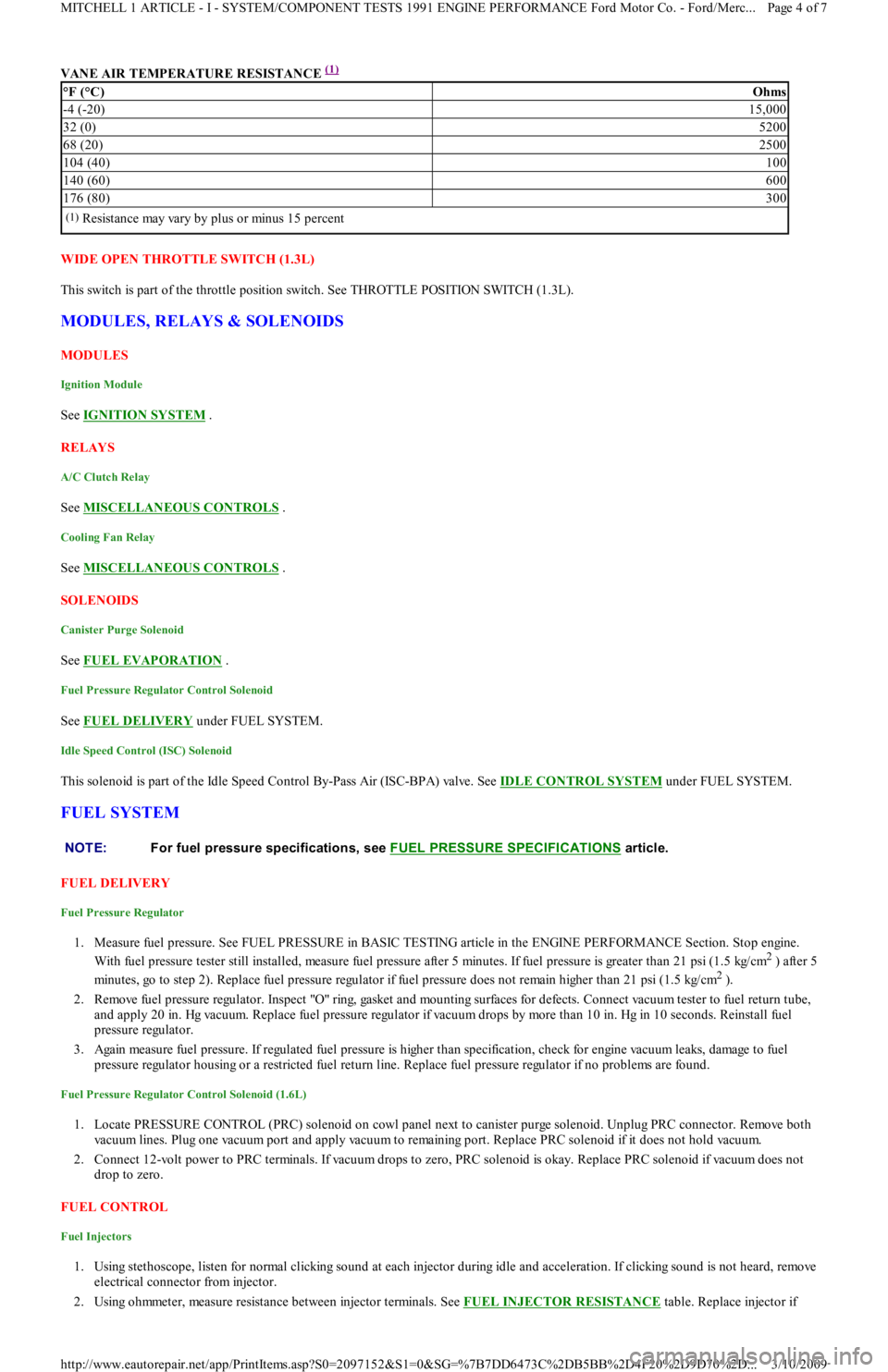
VANE AIR TEMPERATURE RESISTANCE (1)
WIDE OPEN THROTTLE SWITCH (1.3L)
This switch is part of the throttle position switch. See THROTTLE POSITION SWITCH (1.3L).
MODULES, RELAYS & SOLENOIDS
MODULES
Ignition Module
See IGNITION SYSTEM .
RELAYS
A/C Clutch Relay
See MISCELLANEOUS CONTROLS .
Cooling Fan Relay
See MISCELLANEOUS CONTROLS .
SOLENOIDS
Canister Purge Solenoid
See FUEL EVAPORATION .
Fuel Pressure Regulator Control Solenoid
See FUEL DELIVERY under FUEL SYSTEM.
Idle Speed Control (ISC) Solenoid
This solenoid is part of the Idle Speed Control By-Pass Air (ISC-BPA) valve. See IDLE CONTROL SYSTEM under FUEL SYSTEM.
FUEL SYSTEM
FUEL DELIVERY
Fuel Pressure Regulator
1. Measure fuel pressure. See FUEL PRESSURE in BASIC TESTING article in the ENGINE PERFORMANCE Section. Stop engine.
With fuel pressure tester still installed, measure fuel pressure after 5 minutes. If fuel pressure is greater than 21 psi (1.5 kg/cm
2 ) after 5
minutes, go to step 2). Replace fuel pressure regulator if fuel pressure does not remain higher than 21 psi (1.5 kg/cm
2 ).
2. Remove fuel pressure regulator. Inspect "O" ring, gasket and mounting surfaces for defects. Connect vacuum tester to fuel return tube,
and apply 20 in. Hg vacuum. Replace fuel pressure regulator if vacuum drops by more than 10 in. Hg in 10 seconds. Reinstall fuel
pressure regulator.
3. Again measure fuel pressure. If regulated fuel pressure is higher than specification, check for engine vacuum leaks, damage to fuel
pressure regulator housing or a restricted fuel return line. Replace fuel pressure regulator if no problems are found.
Fuel Pressure Regulator Control Solenoid (1.6L)
1. Locate PRESSURE CONTROL (PRC) solenoid on cowl panel next to canister purge solenoid. Unplug PRC connector. Remove both
vacuum lines. Plug one vacuum port and apply vacuum to remaining port. Replace PRC solenoid if it does not hold vacuum.
2. Connect 12-volt power to PRC terminals. If vacuum drops to zero, PRC solenoid is okay. Replace PRC solenoid if vacuum does not
drop to zero.
FUEL CONTROL
Fuel Injectors
1. Using stethoscope, listen for normal clicking sound at each injector during idle and acceleration. If clicking sound is not heard, remove
electrical connector from injector.
2. Using ohmmeter, measure resistance between injector terminals. See FUEL INJECTOR RESISTANCE
table. Replace injector if
°F (°C)Ohms
-4 (-20)15,000
32 (0)5200
68 (20)2500
104 (40)100
140 (60)600
176 (80)300
(1)Resistance may vary by plus or minus 15 percent
NOTE:For fuel pressure specifications, see FUEL PRESSURE SPECIFICAT IONS
article.
Page 4 of 7 MITCHELL 1 ARTICLE - I - SYSTEM/COMPONENT TESTS 1991 ENGINE PERFORMANCE Ford Motor Co. - Ford/Merc
...
3/10/2009 http://www.eautorepair.net/app/PrintItems.asp?S0=2097152&S1=0&SG=%7B7DD6473C%2DB5BB%2D4F20%2D9D70%2D
...
Page 165 of 454

resistance is not within specifications. If injector resistance is okay, check for 12 volts at each injector connector. Repair or replace
connector as necessary.
FUEL INJECTOR RESISTANCE
IDLE CONTROL SYSTEM
Idle Speed Control By-pass Air (ISC-BPA) Valve
1. Remove ISC-BPA valve from engine. Connect a hose from a hot water tap to coolant inlet nipple on ISC-BPA valve. Blow through
valve air port. Note resistance to airflow.
2. Supply hot water at 130°F (56°C) minimum to ISC-BPA valve and allow time for valve to respond. Blow through valve again. If
resistance to airflow does not increase when valve is hot, replace ISC-BPA valve.
3. Apply 12 volts to solenoid terminals. If solenoid does not click, replace ISC-BPA valve.
IGNITION SYSTEM
PICK-UP COIL
Check continuity of pick-up coil. If continuity exists, replace igniter unit. If continuity does not exist, replace pick-up coil.
TIMING CONTROL SYSTEMS
Advance Components (1.3L)
Ignition timing advance is controlled by the ECA.
Advance Components (1.6L Non-Turbo)
Ignition advance is controlled by a centrifugal advance mechanism within the distributor, and by a vacuum advance mechanism. If centrifugal
advance is not within specification, service the distributor. Replace the vacuum advance mechanism if vacuum advance is not within
specification. See IGNITION TIMING
. Also see IGNITION TIMING in ADJUSTMENTS article in the ENGINE PERFORMANCE Section.
IGNITION TIMING
Retard Components (1.6L Turbo)
Positive pressure to the vacuum advance cylinder on the distributor retards ignition timing. The ECA also retards ignition timing when it
receives a signal from a Knock Sensor (KS), Knock Control Unit (KC) and related circuitry.
1. Disconnect and plug hoses at distributor. Connect timing light and start engine. Record ignition timing. Tap intake plenum with plastic
mallet while observing ignition timing. If timing retards, knock control circuitry is okay. If timing does not retard, go to step 2).
2. Unplug KC sensor service connector near ECA. Tap intake plenum with plastic mallet while observing ignition timing. If ignition timing
retards, go to step 3). If timing does not retard, go to step 4).
3. Reconnect KC service connector. Tap intake plenum with plastic mallet while observing ignition timing. If ignition timing retards,
replace knock controller. If ignition timing does not retard, go to step 4).
4. Unplug KC service connector near ECA. Temporarily install a known good KS. Tap intake plenum with plastic mallet while observing
ignition timing. If ignition timing retards, replace KS. If ignition timing does not retard, go to step 5).
5. Turn ignition off. Connect BOB. Ensure VPWR and ground wires to KC are okay. Check all KC wiring for shorts or opens. If wiring is
okay, replace KC.
EMISSION SYSTEMS & SUB-SYSTEMS
FUEL EVAPORATION
Canister Purge Solenoid
1. Disconnect vacuum hoses from solenoid. See Fig. 1 . Blow through port "A". Ensure no air exhausts from port "B".
2. Disconnect 2-wire connector from solenoid. Connect 12 volts to one terminal and ground the other terminal of solenoid. Blow air
though port "A". Ensure air exhausts through port "B".
ApplicationOhms
1.3L & 1.6L12-16
NOTE:For basic ignition checks, see BASIC T EST ING article in the ENGINE PERFORMANCE Section.
ApplicationAuto. Trans.Man. Trans.
1.6L Non-Turbo1-3 @ 8500-4 @ 850
1.6L Turbo10-14 @ 8500-4 @ 850
Page 5 of 7 MITCHELL 1 ARTICLE - I - SYSTEM/COMPONENT TESTS 1991 ENGINE PERFORMANCE Ford Motor Co. - Ford/Merc
...
3/10/2009 http://www.eautorepair.net/app/PrintItems.asp?S0=2097152&S1=0&SG=%7B7DD6473C%2DB5BB%2D4F20%2D9D70%2D
...
Page 166 of 454
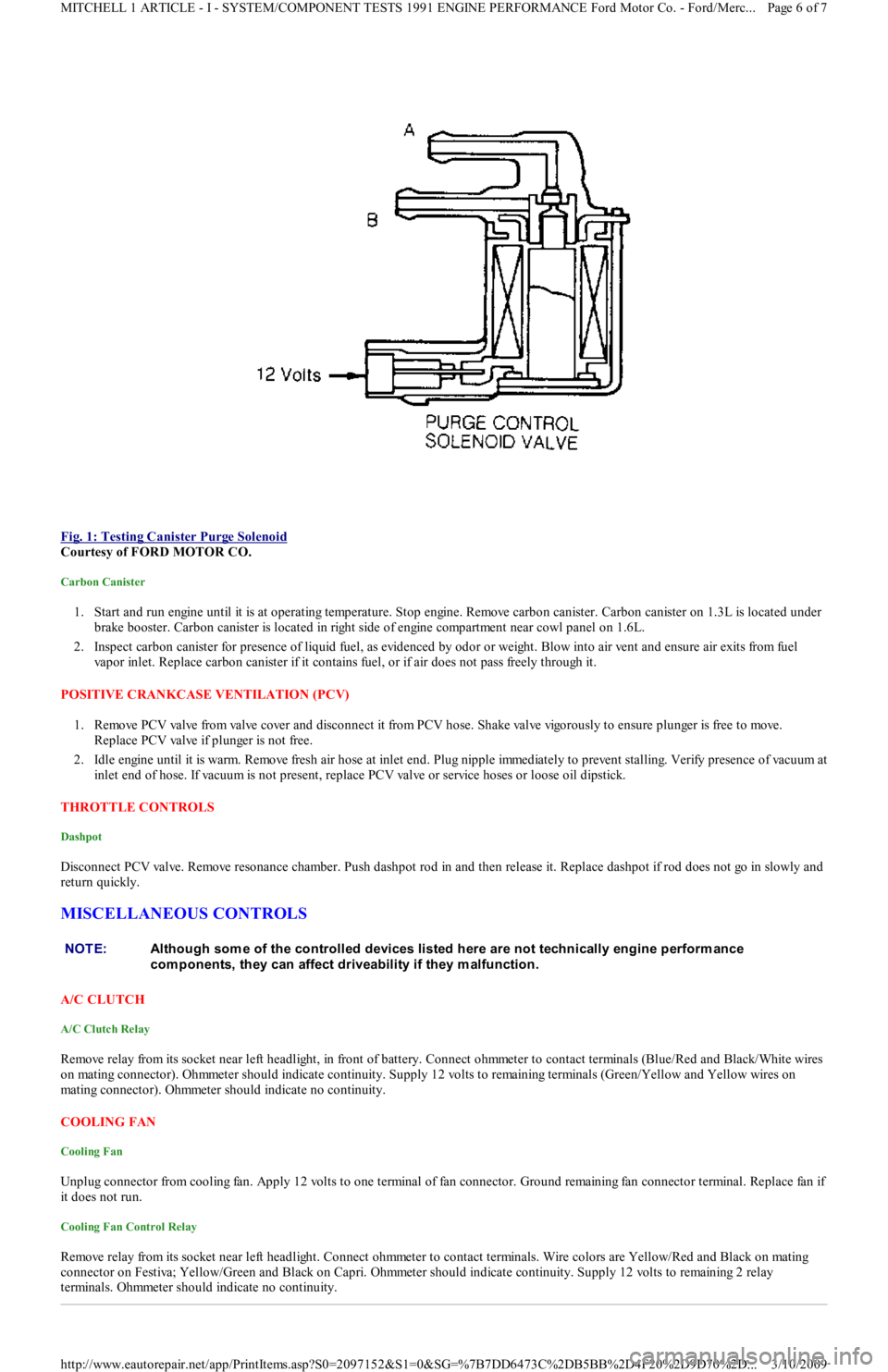
Fig. 1: Testing Canister Purge Solenoid
Courtesy of FORD MOTOR CO.
Carbon Canister
1. Start and run engine until it is at operating temperature. Stop engine. Remove carbon canister. Carbon canister on 1.3L is located under
brake booster. Carbon canister is located in right side of engine compartment near cowl panel on 1.6L.
2. Inspect carbon canister for presence of liquid fuel, as evidenced by odor or weight. Blow into air vent and ensure air exits fro m fu el
vapor inlet. Replace carbon canister if it contains fuel, or if air does not pass freely through it.
POSITIVE CRANKCASE VENTILATION (PCV)
1. Remove PCV valve from valve cover and disconnect it from PCV h o se . S h a ke va l ve vigo r o u sl y t o e n su r e p l u n ge r is fr e e t o mo ve .
Replace PCV valve if plunger is not free.
2. Idle engine until it is warm. Remove fresh air hose at inlet end. Plug nipple immediately to prevent stalling. Verify presence of vacuum at
inlet end of hose. If vacuum is not present, replace PCV valve or service hoses or loose oil dipstick.
THROTTLE CONTROLS
Dashpot
Disconnect PCV valve. Remove resonance chamber. Push dashpot rod in and then release it. Replace dashpot if rod does not go in slowly and
return quickly.
MISCELLANEOUS CONTROLS
A/C CLUTCH
A/C Clutch Relay
Remove relay from its socket near left headlight, in front of battery. Connect ohmmeter to contact terminals (Blue/Red and Black/White wires
on mating connector). Ohmmeter should indicate continuity. Supply 12 volts to remaining terminals (Green/Yellow and Yellow wires on
mating connector). Ohmmeter should indicate no continuity.
COOLING FAN
Cooling Fan
Unplug connector from cooling fan. Apply 12 volts to one terminal of fan connector. Ground remaining fan connector terminal. Replace fan if
it does not run.
Cooling Fan Control Relay
Remove relay from its socket near left headlight. Connect ohmmeter to contact terminals. Wire colors are Yellow/Red and Black on mating
connector on Festiva; Yellow/Green and Black on Capri. Ohmmeter should indicate continuity. Supply 12 volts to remaining 2 relay
terminals. Ohmmeter should indicate no continuity.
NOTE:Although som e of the controlled devices listed here are not technically engine perform ance
com ponents, they can affect driveability if they m alfunction.
Page 6 of 7 MITCHELL 1 ARTICLE - I - SYSTEM/COMPONENT TESTS 1991 ENGINE PERFORMANCE Ford Motor Co. - Ford/Merc
...
3/10/2009 http://www.eautorepair.net/app/PrintItems.asp?S0=2097152&S1=0&SG=%7B7DD6473C%2DB5BB%2D4F20%2D9D70%2D
...