1990 VOLKSWAGEN CORRADO technical specifications
[x] Cancel search: technical specificationsPage 594 of 906
I - SYSTEM/COMPONENT TESTS
Article Text (p. 7)
1990 Volkswagen Corrado
For Volkswagen Technical Site: http://vw.belcom.ru
Copyright © 1998 Mitchell Repair Information Company, LLC
Thursday, March 23, 2000 09:46PM
1) Disconnect throttle valve switch connector. With ohmmeter
set on 200-ohm scale, attach probes to male terminals. Ensure throttle
valve switch is completely closed. With throttle valve closed, meter
reading should be zero.
2) Position throttle valve to 1/2 open position. Ohmmeter
reading should be infinite. Position throttle to fully open position.
Ohmmeter reading should be zero. If any reading is incorrect, perform
throttle valve switch adjustment. See D - ADJUSTMENTS article.
3) If correct specifications cannot be obtained, check
throttle shaft play, accelerator cable adjustment and throttle switch
actuating cam. If okay, replace throttle valve switch.
RELAYS
FUEL PUMP RELAY (CABRIOLET, GOLF GL/GTI & JETTA)
1) Ensure fuel pump fuse (No. 5) is okay. Remove fuel pump
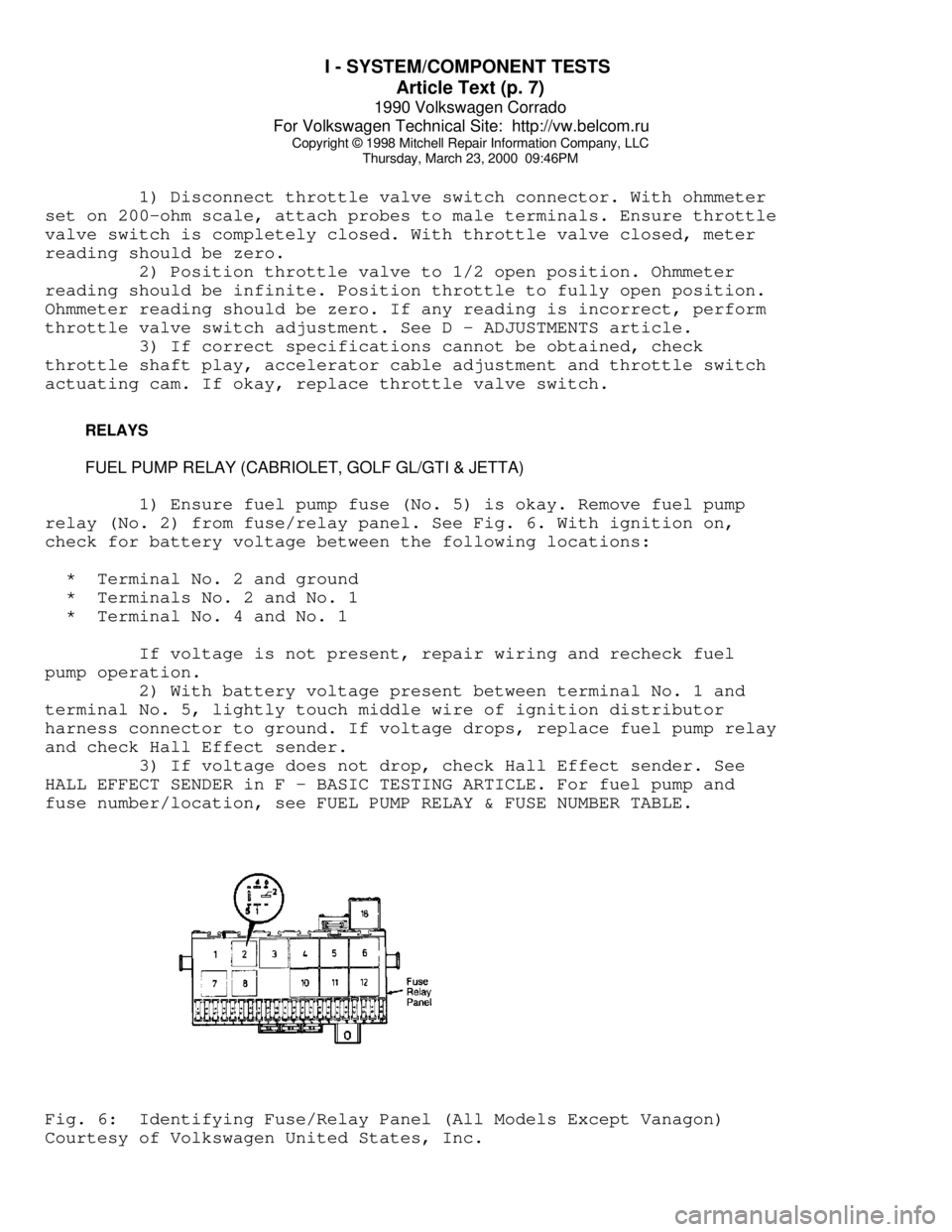
relay (No. 2) from fuse/relay panel. See Fig. 6. With ignition on,
check for battery voltage between the following locations:
* Terminal No. 2 and ground
* Terminals No. 2 and No. 1
* Terminal No. 4 and No. 1
If voltage is not present, repair wiring and recheck fuel
pump operation.
2) With battery voltage present between terminal No. 1 and
terminal No. 5, lightly touch middle wire of ignition distributor
harness connector to ground. If voltage drops, replace fuel pump relay
and check Hall Effect sender.
3) If voltage does not drop, check Hall Effect sender. See
HALL EFFECT SENDER in F - BASIC TESTING ARTICLE. For fuel pump and
fuse number/location, see FUEL PUMP RELAY & FUSE NUMBER TABLE.Fig. 6: Identifying Fuse/Relay Panel (All Models Except Vanagon)
Courtesy of Volkswagen United States, Inc.
Page 603 of 906

INSTRUMENT PANEL
Article Text
1990 Volkswagen Corrado
For Volkswagen Technical Site: http://vw.belcom.ru
Copyright © 1998 Mitchell Repair Information Company, LLC
Thursday, March 23, 2000 09:46PM
ARTICLE BEGINNING
1989-90 ACCESSORIES & EQUIPMENT
Volkswagen Instrument Panels
Cabriolet, Fox, Golt, GTI, Jetta, Jetta GLI, Vanagon
DESCRIPTION & OPERATION
Instrument cluster for most models includes speedometer, fuel
gauge and temperature gauge. Optional instruments include clock,
tachometer, voltmeter and oil temperature gauge.
Printed circuit provides voltage to gauges. A voltage
regulator attached to the printed circuit controls voltage to fuel and
temperature gauges. Light Emitting Diodes (LEDs) are used for most
warning lights. To replace diodes, pull from printed circuit sockets.
NOTE: Volkswagen Tester (1301) is required for resistance tests.
Tester settings are numerical. Settings do not indicate
resistance in ohms. Manufacturer does not supply resistance
value in ohms.
TESTING
FUEL & TEMPERATURE GAUGE
1) Disconnect wire from fuel tank or temperature sending
unit. Connect VW tester between wire and ground. Turn ignition on and
allow 2 minutes for gauge reading to stabilize. Use FUEL GAUGE TESTING
or TEMPERATURE GAUGE TESTING table to compare gauge reading. Gauge
should be within one pointer width of specification.
2) If gauge needle does not move, check continuity between
sender wire and gauge. If needle moves, but does not match
specifications, replace gauge. If gauge works correctly with tester,
but not sending unit, replace sending unit.
FUEL GAUGE TESTINGÄÄÄÄÄÄÄÄÄÄÄÄÄÄÄÄÄÄÄÄÄÄÄÄÄÄÄÄÄÄÄÄÄÄÄÄÄÄÄÄÄÄÄÄÄÄÄÄÄÄÄÄÄÄÄApplication Dial Setting Indicator
Cabriolet & Fox .......... 55 ................ Full
560 ................Empty
Golf, GTI, Jetta
& Jetta GLI .............. 52 ................ Full
550 ................Empty
Vanagon .................. 50 ................ Full
320 ................Empty
ÄÄÄÄÄÄÄÄÄÄÄÄÄÄÄÄÄÄÄÄÄÄÄÄÄÄÄÄÄÄÄÄÄÄÄÄÄÄÄÄÄÄÄÄÄÄÄÄÄÄÄÄÄÄÄTEMPERATURE GAUGE TESTING
ÄÄÄÄÄÄÄÄÄÄÄÄÄÄÄÄÄÄÄÄÄÄÄÄÄÄÄÄÄÄÄÄÄÄÄÄÄÄÄÄÄÄÄÄÄÄÄÄÄÄÄÄÄÄÄ
Page 636 of 906

MAINTENANCE INFORMATION
Article Text
1990 Volkswagen Corrado
For Volkswagen Technical Site: http://vw.belcom.ru
Copyright © 1998 Mitchell Repair Information Company, LLC
Thursday, March 23, 2000 09:48PM
ARTICLE BEGINNING
1990-94 MAINTENANCE
Volkswagen Maintenance Information
Corrado G60 (1990-92)
SLC (1992-94 USA)
VR6 (1992-94 Canada)
* PLEASE READ THIS FIRST *
NOTE: For scheduled maintenance intervals and the related fluid
capacities, fluid specifications and labor times for major
service intervals, see SCHEDULED SERVICES article in this
section. Warranty information and specifications for fluid
capacities, lubrication specifications, wheel and tire size,
and battery type are covered in this article.
MODEL IDENTIFICATION
VIN LOCATION
The Vehicle Identification Number (VIN) is located on the
left side of the dash panel at the base of the windshield. The VIN
chart explains the code characters.
VIN CODE ID EXPLANATION
Numbers preceding the explanations in the legend below refer
to the sequence of characters as listed on VIN identification label.
See VIN example below.ÚÄÄÄÄÄÄÄÄÄÄÄÄÄÄÄÄÄÄÄÄÄÄÄÄÄÄÄÄÄÄÄÄÄÄÄÄÄÄÄÄÄÄÄÄÄÄÄÄÄÄÄÄÄÄÄÄÄÄÄÄÄ¿
³ (VIN) W V W A B 0 5 3 2 M H 0 9 9 7 1 7
³
³ 1 2 3 4 5 6 7 8 9 10 11 12 13 14 15 16 17
³
ÀÄÄÄÄÄÄÄÄÄÄÄÄÄÄÄÄÄÄÄÄÄÄÄÄÄÄÄÄÄÄÄÄÄÄÄÄÄÄÄÄÄÄÄÄÄÄÄÄÄÄÄÄÄÄÄÄÄÄÄÄÄÙ1 - Manufacturing Country
W * Germany
1 * United States
3 * Mexico
9 * Brazil
2-3 - Manufacturer
VW * Volkswagen
4 - Series
D * 2-Door G60 (1990-92)
E * 2-Door SLC (1992-94 USA)
E * 2-Door VR6 (1992-94 Canada)
Page 645 of 906

MAINTENANCE INFORMATION
Article Text (p. 10)
1990 Volkswagen Corrado
For Volkswagen Technical Site: http://vw.belcom.ru
Copyright © 1998 Mitchell Repair Information Company, LLC
Thursday, March 23, 2000 09:48PM
SERVICE LABOR TIMES
SERVICE LABOR TIMES TABLE (HOURS)ÄÄÄÄÄÄÄÄÄÄÄÄÄÄÄÄÄÄÄÄÄÄÄÄÄÄÄÄÄÄÄÄÄÄÄÄÄÄÄÄÄÄÄÄÄÄÄÄÄÄÄÄÄÄÄÄÄÄÄÄÄÄÄÄÄ (1)(2) 15,000 (1)(2) 30,000 (60,000)
Application Mile Service Mile Service
Automatic Transmission ..... 1.6 .................. 3.3 (4.2)
Manual Transmission ........ 1.8 .................. 2.7 (3.6)
(1) - Add .2 hr. if equipped with A/C. Add .1 hr. if equipped
with cruise control.
(2) - Add 1.8 hrs. to replace camshaft timing belt (if equipped).
ÄÄÄÄÄÄÄÄÄÄÄÄÄÄÄÄÄÄÄÄÄÄÄÄÄÄÄÄÄÄÄÄÄÄÄÄÄÄÄÄÄÄÄÄÄÄÄÄÄÄÄÄÄÄÄÄÄÄÄÄÄÄÄÄÄ LUBRICATION SPECIFICATIONS
LUBRICATION SPECIFICATIONS TABLE
ÄÄÄÄÄÄÄÄÄÄÄÄÄÄÄÄÄÄÄÄÄÄÄÄÄÄÄÄÄÄÄÄÄÄÄÄÄÄÄÄÄÄÄÄÄÄÄÄÄÄÄÄÄÄÄÄÄÄÄÄÄÄÄÄÄApplication Fluid Specifications
Engine Oil (1)
Ambient Temperatures
Greater Than 50
øF (10øC) .............. SAE 20W-50 API SF/CD
14
øF To 50øF (-10øC To +10øC) ......... SAE 10W-40 API SF/CD
Less Than 14
øF (-10ø C) ................ SAE 5W-30 API SF/CD
Brake Fluid ........................ SAE J1703 (DOT 3 Or DOT 4)
Power Steering Fluid ......................... VW Hydraulic Oil
(G 002000) Or Equivalent
Automatic Transmission ........... Dexron-IIE ATF Or Equivalent
Manual Transaxle .......................... SAE 80W API GL-4 Or
SAE 75W-90 (G50 Synthetic Gear Oil)
Final Drive (A/T & M/T)
(Differential) .......... SAE 75W-90 (G50 Synthetic Gear Oil)
Wheel Bearings .................... NLGI Grade 2 Category GC-LB
Drive Shaft U-Joints .............. NLGI Grade 2 Category GC-LB
Steering Linkage (2)(3) ........... NLGI Grade 2 Category GC-LB
Ball Joints (2)(4) ................ NLGI Grade 2 Category GC-LB
Weatherstrip ....................... Dielectric Silicone Grease
(1) - SAE 15W-40 or 20W-40 engine oil is recommended for extreme
conditions or extended highway operation.
(2) - Use low pressure grease gun to prevent seal damage.
(3) - Fill until lubricant squeezes out from the base of seals.
(4) - Fill ball joint until seal starts to swell.
ÄÄÄÄÄÄÄÄÄÄÄÄÄÄÄÄÄÄÄÄÄÄÄÄÄÄÄÄÄÄÄÄÄÄÄÄÄÄÄÄÄÄÄÄÄÄÄÄÄÄÄÄÄÄÄÄÄÄÄÄÄÄÄÄÄ FLUID CAPACITIES
FLUID CAPACITIES TABLE
ÄÄÄÄÄÄÄÄÄÄÄÄÄÄÄÄÄÄÄÄÄÄÄÄÄÄÄÄÄÄÄÄÄÄÄÄÄÄÄÄÄÄÄÄÄÄÄÄÄÄÄÄÄÄÄÄÄÄÄÄÄÄÄÄÄ
Page 646 of 906

MAINTENANCE INFORMATION
Article Text (p. 11)
1990 Volkswagen Corrado
For Volkswagen Technical Site: http://vw.belcom.ru
Copyright © 1998 Mitchell Repair Information Company, LLC
Thursday, March 23, 2000 09:48PM
Application Quantity (1)
A/C System R-12 Refrigerant
1990-92 (up to 7/92) ............................. 37-40 Ozs.
A/C System R-134a Refrigerant (2)
1993-94 (from 7/92) ........................... 28.2-31.8 Ozs.
Cooling System
4-Cyl. ...................................... 6.8 Qts. (6.5L)
V6 .......................................... 9.1 Qts. (8.6L)
Engine Oil (3)
4-Cyl. ...................................... 4.3 Qts. (4.0L)
V6 .......................................... 6.3 Qts. (6.0L)
Fuel Tank
4-Cyl. ..................................... 14.5 Gals. (55L)
V6 ......................................... 18.5 Gals. (55L)
Automatic Transmission
Fluid Change ................................ 3.2 Qts. (3.0L)
Overhaul .................................... 5.9 Qts. (5.6L)
Manual Transmission ........................... 2.1 Qts. (2.0L)
Final Drive
Differential (A/T) (4) ....................... 0.8 Qt. (.75L)
(1) - Capacities are recommended or calculated levels. Always use
dipstick (if available) to measure level.
(2) - Use of R-12 in a R134a system will result in SEVERE DAMAGE.
(3) - Includes oil filter change.
(4) - Lifetime fill.ÄÄÄÄÄÄÄÄÄÄÄÄÄÄÄÄÄÄÄÄÄÄÄÄÄÄÄÄÄÄÄÄÄÄÄÄÄÄÄÄÄÄÄÄÄÄÄÄÄÄÄÄÄÄÄÄÄÄÄÄÄÄÄÄÄ WHEEL & TIRE SPECIFICATIONS
Wheel and tire sizes vary according to vehicle and equipment
and can be found on tire information label on each vehicle. Wheel and
tire specifications and tire inflation pressures are listed on a label
found inside fuel tank flap.
NOTE: Snow chains must be used on drive wheels, in pairs only.
WHEEL TIGHTENING
Tighten all wheel lugs to 80 ft. lbs. (110 N.m).
BATTERY SPECIFICATIONS
CAUTION: When battery is disconnected, vehicles equipped with
computers may lose memory data. When battery power is
restored, driveability problems may exist on some vehicles.
These vehicles may require a relearn procedure. See COMPUTER
RELEARN PROCEDURES article in the GENERAL INFORMATION
section.
All models use BCI group 41 batteries with cold crank rating
Page 674 of 906

N - REMOVE/INSTALL/OVERHAUL
Article Text
1990 Volkswagen Corrado
For Volkswagen Technical Site: http://vw.belcom.ru
Copyright © 1998 Mitchell Repair Information Company, LLC
Thursday, March 23, 2000 09:49PM
ARTICLE BEGINNING
1990 ENGINE PERFORMANCE
Removal, Overhaul & Installation
Volkswagen; Cabriolet, Corrado, Fox, Golf GL/GTI,
Jetta, Vanagon
INTRODUCTION
Removal, overhaul and installation procedures are covered in
this article. If component removal and installation is primarily an
unbolt and bolt-on procedure, only a torque specification may be
furnished. See TORQUE SPECIFICATIONS at the end of this article.
REMOVAL & INSTALLATION
DISTRIBUTOR (DIGIFANT)
Removal (AFC-Digifant II)
Turn engine crankshaft to TDC. Remove distributor cap. Rotor
should point to No. 1 cylinder mark on edge of distributor housing.
Index mark the distributor housing to the crankcase relation. Remove
distributor hold-down clamp and bolt. Remove distributor assembly.
Installation
Align rotor with No. 1 cylinder mark on edge of distributor
housing. Install distributor and align housing to index mark made on
crankcase. Install distributor hold-down clamp and bolt. Install
distributor cap. Check timing. Tighten hold-down bolt to
specification. See TORQUE SPECIFICATIONS.
DISTRIBUTOR (CIS SYSTEMS)
Removal (CIS-E & CIS-E Motronic)
1) Turn engine crankshaft to TDC. Marking on vibration
dampener pulley must align with drive belt guard pointer. Marking on
cam shaft gear sprocket must align with cylinder head cover.
2) Remove distributor cap and mark position of rotor. Rotor
should be pointing to No. 1 cylinder in distributor firing sequence.
Mark position of distributor housing for installation reference.
Remove distributor hold-down clamp and bolt. Remove distributor
assembly, noting position of rotor when distributor shaft gear is
disengaged from driving gear.
Installation
1) Align oil pump drive pinion lug parallel to crankshaft.
Set rotor pointing toward mark made when distributor was disengaged
from drive gear.
2) Install distributor. Rotor should now point to mark made
for No. 1 cylinder in distributor firing sequence. Align mark for
Page 675 of 906

N - REMOVE/INSTALL/OVERHAUL
Article Text (p. 2)
1990 Volkswagen Corrado
For Volkswagen Technical Site: http://vw.belcom.ru
Copyright © 1998 Mitchell Repair Information Company, LLC
Thursday, March 23, 2000 09:49PM
distributor housing and install distributor hold-down clamp and bolt.
Install distributor cap. Check timing. Tighten hold-down bolt to
specification. See TORQUE SPECIFICATIONS.
AIRFLOW SENSOR PLATE
Removal & Installation
1) Remove air filter and unscrew stop bracket. Using heat
gun, heat locking compound on fastening bolt. Remove bolt slowly. DO
NOT damage threads. Clean locking compound from bolt hole threads.
2) Install airflow sensor plate. Ensure 5 dimple marks are
up. Lightly tighten self-locking screw. Ensure sensor plate is
centered and rest position is correct. To complete installation,
reverse removal procedure. See TORQUE SPECIFICATIONS.
AIRFLOW SENSOR POTENTIOMETER
Removal & Installation
Remove differential pressure regulator. Remove insulating
compound covering mounting screws. Remove potentiometer. DO NOT touch
or damage slide contact and conductor. To install, reverse removal
procedure. See TORQUE SPECIFICATIONS. Adjust potentiometer. See D -
ADJUSTMENTS article.
FUEL DISTRIBUTOR (1.8L ONLY)
CAUTION: Fuel system pressure must be relieved before removing or
disconnecting any fuel lines. Wipe up all spilled fuel
BEFORE continuing service.
Removal
1) Disconnect battery and remove air cleaner. Disconnect all
fuel and injector lines from fuel distributor. Plug fuel supply and
return lines. Catch any spilled fuel.
2) Disconnect wiring from differential pressure regulator.
Remove screws holding fuel distributor to airflow sensor housing.
Remove fuel distributor by turning back and forth while lifting up.
Air Sensor Plate Rest Position
Upper edge of sensor plate must be .070-080" (1.80-2.10 mm)
below lower edge of sensor cone. See Fig. 1. If rest position is
incorrect, raise sensor plate. Open or close wire clip to change
position of sensor plate. DO NOT bend leaf spring.Fig. 1: Identifying Sensor Plate Rest Position
Courtesy of Volkswagen United States, Inc.
Page 678 of 906

N - REMOVE/INSTALL/OVERHAUL
Article Text (p. 5)
1990 Volkswagen Corrado
For Volkswagen Technical Site: http://vw.belcom.ru
Copyright © 1998 Mitchell Repair Information Company, LLC
Thursday, March 23, 2000 09:49PM
distributor. Install fuel distributor. See TORQUE SPECIFICATIONS for
tightening specifications. Connect all fuel lines except those to fuel
injectors. Check sensor plate adjusting lever and fuel distributor
control piston for smooth operation.
2) Remove fuel pump relay and bridge fuel pump circuit. Use
Jumper Switch (US 4480/3) in place of fuel pump relay. When pressure
has built up, turn off fuel pump. Move sensor plate from rest position
to end of travel.
3) Uniform resistance should be felt during entire movement.
No resistance should be felt during entire movement. No resistance
should be felt on quick return to rest position. Connect injector
lines. Install fuel pump relay. Start engine and check for leaks.
INJECTORS (DIGIFANT)
CAUTION: Fuel system pressure must be relieved before removing
injectors. Wipe up all spilled fuel BEFORE continuing
service.
Removal (AFC-Digifant II)
Disconnect negative battery cable. Disconnect main electrical
connector from fuel rail. Remove idle stabilizer valve. Loosen and
remove both hoses on each end of fuel rail. Remove fuel pressure
regulator and mounting bracket. Remove fuel rail mounting bolts. Pry
off injector mounting clips. Disconnect injector electrical
connectors. Remove fuel rail. Remove each injector from its insert.
Installation
To install injectors, reverse removal procedures. Use new "O"
rings when installing injectors. Replace hose clamps if necessary. See
TORQUE SPECIFICATIONS table at end of this article. Check for fuel
leaks.
INJECTORS (CIS SYSTEMS)
Removal (CIS-E & CIS-E Motronic)
Remove injectors from inserts in cylinder head with fuel
lines attached. Using 12-mm or 13-mm hex wrench, remove inserts from
head. Use 2 wrenches to remove injectors from fuel lines.
Installation
To install, reverse removal procedures. Use 2 wrenches when
tightening injector lines to injectors. Use new "O" rings lightly
lubricated. On models with 2-piece inserts, replace insert sealing
washer (against head) and use sealing compound on upper insert
threaded portion. See TORQUE SPECIFICATIONS.
OXYGEN (O2) SENSOR
Removal & Installation
Oxygen (O2) sensor is mounted in the exhaust pipe in front of
catalytic converter. Disconnect permanent pigtail from sensor. Ensure