1990 VOLKSWAGEN CORRADO check engine light
[x] Cancel search: check engine lightPage 412 of 906
ANTI-LOCK BRAKE SYSTEM
Article Text (p. 4)
1990 Volkswagen Corrado
For Volkswagen Technical Site: http://vw.belcom.ru
Copyright © 1998 Mitchell Repair Information Company, LLC
Thursday, March 23, 2000 09:42PM
seconds maximum and then stop. Depress brake pedal a few times; pump
should operate again for a few seconds. If pump motor does not
operate, check electrical system. If pump motor operates for more than
60 seconds, internal or external hydraulic leak may be indicated.
Check for external leaks. If external leak is not found, further
testing may be needed to check for internal leaks.
ANTI-LOCK WARNING LIGHT
Start engine. ANTI-LOCK warning light should come on, then
turn off after a few seconds. If light does not come on when engine is
started, check electrical system. If light comes on and stays on,
fault has been detected by the ECU and testing will be needed. See
SYSTEM TESTING under DIAGNOSIS & TESTING.
DIAGNOSIS & TESTING
SYSTEM TESTING
NOTE: Check battery condition, brake fluid level, electrical
connections and wiring for damage. If fluid level is
incorrect or battery and/or electrical connections are
faulty, correct problem before preceding. Perform each step,
in sequence, to test entire system, except for ECU. If
faulty ECU is suspected, replace with a known good one, and
retest system. Unplug ECU connector for all test steps.
Power Voltage-To-ECU Test
Turn ignition off. Unplug ECU connector. Turn ignition on.
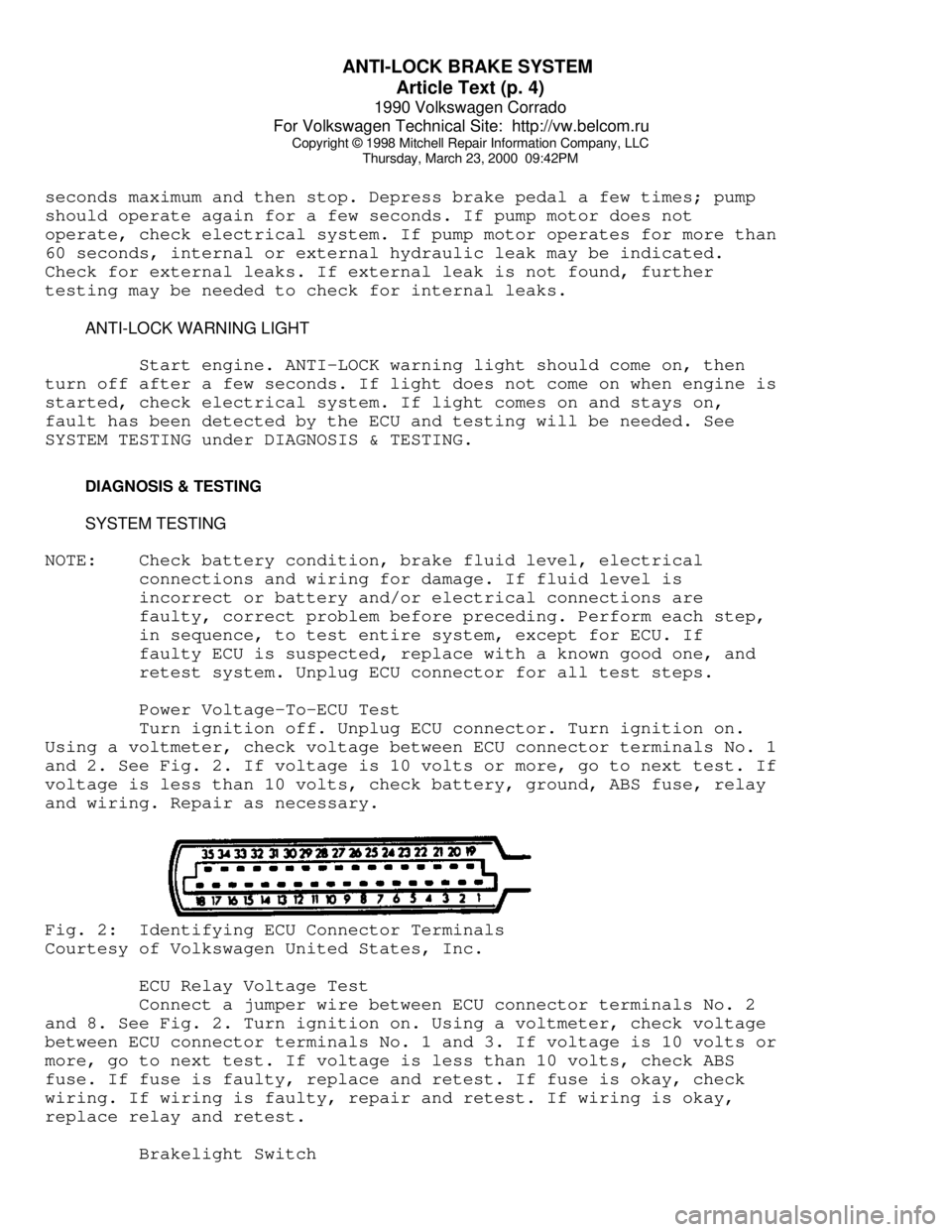
Using a voltmeter, check voltage between ECU connector terminals No. 1
and 2. See Fig. 2. If voltage is 10 volts or more, go to next test. If
voltage is less than 10 volts, check battery, ground, ABS fuse, relay
and wiring. Repair as necessary.Fig. 2: Identifying ECU Connector Terminals
Courtesy of Volkswagen United States, Inc.
ECU Relay Voltage Test
Connect a jumper wire between ECU connector terminals No. 2
and 8. See Fig. 2. Turn ignition on. Using a voltmeter, check voltage
between ECU connector terminals No. 1 and 3. If voltage is 10 volts or
more, go to next test. If voltage is less than 10 volts, check ABS
fuse. If fuse is faulty, replace and retest. If fuse is okay, check
wiring. If wiring is faulty, repair and retest. If wiring is okay,
replace relay and retest.
Brakelight Switch
Page 427 of 906

B - EMISSION APPLICATION
Article Text
1990 Volkswagen Corrado
For Volkswagen Technical Site: http://vw.belcom.ru
Copyright © 1998 Mitchell Repair Information Company, LLC
Thursday, March 23, 2000 09:43PM
ARTICLE BEGINNING
1990 ENGINE EMISSIONS
Emission Control Applications
Cabriolet, Corrado, Fox, Golf, Jetta, Passat, Vanagon
EMISSION CONTROL DEVICE APPLICATIONS
EMISSION CONTROL DEVICE APPLICATIONS TABLEÄÄÄÄÄÄÄÄÄÄÄÄÄÄÄÄÄÄÄÄÄÄÄÄÄÄÄÄÄÄÄÄÄÄÄÄÄÄÄÄÄÄÄÄÄÄÄÄÄÄÄÄÄÄÄÄÄÄÄÄÄÄÄÄÄApplication Devices
Cabriolet 1.8L (CIS-E) PCV, EVAP, TWC, SPK, O2, CEC,
EVAP-PV, EVAP-VC, SPK-CC, VA
Corrado 1.8L (PFI) PCV, EVAP, TWC, O2, CEC,
PCV-HCB, EVAP-PV, EVAP-VC, SPK-CC
Fox 1.8L (CIS-E) PCV, EVAP, TWC, EGR (Calif.), O2,
CEC, EVAP-VC, EVAP-VS, EGR-VA (Calif.),
EGR-TVV (Calif.), SPK-CC, VA
Golf & Jetta
1.8L (CIS-E) PCV, EVAP, TWC, SPK, O2, CEC,
CE, EVAP-VC, EVAP-PV, SPK-CC, VA
2.0L (CIS-E) PCV, EVAP, TWC, EGR, SPK, O2, CEC,
CE, EVAP-VC, EGR-TVV, SPK-CC,
Passat 2.0L CIS-E PCV, EVAP, TWC, EGR (Calif.),
SPK, O2, CEC, CE, EVAP-VC,
EVAP-SV, EGR-TVV, SPK-CC,
Vanagon PFI PCV, EVAP, TWC, EGR, SPK, O2, CEC, EMR,
CE, EVAP-VC, EVAP-PV, SPK-CC, VA, VR
ÄÄÄÄÄÄÄÄÄÄÄÄÄÄÄÄÄÄÄÄÄÄÄÄÄÄÄÄÄÄÄÄÄÄÄÄÄÄÄÄÄÄÄÄÄÄÄÄÄÄÄÄÄÄÄÄÄÄÄÄÄÄÄÄÄ ABBREVIATION DEFINITIONS
CEC - Computerized Engine Control
CE - Check Engine Light
CIS-E - Continuous Injection System-Electronic
EGR - Exhaust Gas Recirculation
EGR-VA - EGR-Vacuum Amplifier
EGR-TS - EGR Temperature Sensor
EGR-TVV - EGR Thermal Vacuum Valve
EVAP - Fuel Evaporation System
EVAP-CS - EVAP Control Solenoid
Page 438 of 906

D - ADJUSTMENTS
Article Text
1990 Volkswagen Corrado
For Volkswagen Technical Site: http://vw.belcom.ru
Copyright © 1998 Mitchell Repair Information Company, LLC
Thursday, March 23, 2000 09:43PM
ARTICLE BEGINNING
1990 ENGINE PERFORMANCE
On-Vehicle Adjustments
Volkswagen; Cabriolet, Corrado, Fox, Golf GL/GTI,
Jetta, Vanagon
ENGINE COMPRESSION
Check engine compression with engine at normal operating
temperature at specified cranking speed, all spark plugs removed and
throttle wide open.
ENGINE COMPRESSION TESTÄÄÄÄÄÄÄÄÄÄÄÄÄÄÄÄÄÄÄÄÄÄÄÄÄÄÄÄÄÄÄÄÄÄÄÄÄÄÄÄÄÄÄÄÄÄÄÄÄÄÄÄÄÄÄÄÄÄÄÄÄÄÄÄÄÄÄÄÄÄModel Standard Minimum
psi (kg/cm
ý) psi (kg/cmý)
Cabriolet ............. 131-174 (9.0-12.0) ............. 109 (7.5)
Corrado ............... 116-174 (8.0-12.0) .............. 87 (6.0)
Fox ................... 131-174 (9.0-12.0) ............. 102 (7.0)
Golf GL/GTI 1.8L ...... 131-174 (9.0-12.0) ............. 102 (7.0)
Jetta ................. 131-174 (9.0-12.0) ............. 102 (7.0)
Jetta GLi 2.0L ........ 145-190 (10.0-13.0) ............ 109 (7.5)
Vanagon ............... 87-131 (6.1-9.2) ................ 87 (6.0)
ÄÄÄÄÄÄÄÄÄÄÄÄÄÄÄÄÄÄÄÄÄÄÄÄÄÄÄÄÄÄÄÄÄÄÄÄÄÄÄÄÄÄÄÄÄÄÄÄÄÄÄÄÄÄÄÄÄÄÄÄÄÄÄÄÄÄÄÄÄÄ VALVE CLEARANCE
NOTE: All models use hydraulic lifters. No adjustments are
required.
IGNITION TIMING
NOTE: Basic timing readings are only valid when engine idle speed
and idle mixture are within specifications. For best
results, the manufacturer recommends ignition timing, idle
CO and idle speed be checked and adjusted in that order.
NOTE: Off idle timing is computer controlled on models with knock
sensor(s). Only idle ignition timing can be set.
ALL MODELS EXCEPT VANAGON
1) Warm engine to normal operating temperature (cooling fan
should cycle at least once). Remove the 27 mm plastic plug from timing
check hole on transaxle bellhousing.
2) With ignition off, connect a tachometer and timing light
to vehicle. Start engine, raise speed above 2100 RPM a few times, and
allow engine to idle normally. With distributor vacuum hoses
Page 439 of 906

D - ADJUSTMENTS
Article Text (p. 2)
1990 Volkswagen Corrado
For Volkswagen Technical Site: http://vw.belcom.ru
Copyright © 1998 Mitchell Repair Information Company, LLC
Thursday, March 23, 2000 09:43PM
connected, timing mark on flywheel should appear at pointer in hole.
NOTE: Before checking engine timing, raise engine speed above 2100
RPM at least 4 times. This must be done each time ignition
is turned off and restarted to clear ECU memory and by-pass
hot-start, fast-idle function.
3) If an adjustment is needed, turn ignition off and loosen
distributor hold-down bolt (2.0L has 2 hold-down bolts) just enough to
move distributor by hand. Start engine and allow to idle. Turn
distributor until timing mark is aligned with pointer in bellhousing.
4) Stop engine and tighten hold down bolt to 18 ft. lbs. (24
N.m). On 2.0L tighten hold-down bolts to 87 INCH lbs. (10 N.m). Check
and readjust if necessary and install plastic plug in inspection hole.
VANAGON
1) Engine oil temperature must be 176ø F (80ø C). Connect
timing light and tachometer. Start engine and allow to idle. Check
ignition timing at 800-1000 RPM.
NOTE: Before checking engine timing, raise engine speed above 2100
RPM at least 4 times. This must be done each time ignition
is turned off and restarted to clear ECU memory and by-pass
hot-start, fast-idle function.
2) If an adjustment is needed, turn ignition off and loosen
distributor hold-down bolt just enough to move distributor by hand.
Remove connectors from idle stabilizer by squeezing connectors then
pulling apart. Plug idle stabilizer connectors together.
3) Start and allow engine to idle. Turn distributor until
notch on V-belt pulley matches separation in case. Set timing and RPM.
Reconnect electrical connectors to idle stabilizer. Tighten
distributor clamp bolt.
IGNITION TIMING TABLE
IGNITION TIMING (Degrees BTDC @ RPM)
ÄÄÄÄÄÄÄÄÄÄÄÄÄÄÄÄÄÄÄÄÄÄÄÄÄÄÄÄÄÄÄÄÄÄÄÄÄÄÄÄÄÄÄÄÄÄÄÄÄÄÄÄÄÄÄÄÄÄÄÄÄÄÄÄÄÄÄÄÄÄApplication Checking Adjusting
1.8L ..................... 4-8 @ 870-930 ........... 5-7 @ 870-930
2.0L ..................... 4-8 @ 770-830 ........... 5-7 @ 770-830
2.1L ..................... 4-8 @ 800-900 ........... 5-7 @ 800-900
ÄÄÄÄÄÄÄÄÄÄÄÄÄÄÄÄÄÄÄÄÄÄÄÄÄÄÄÄÄÄÄÄÄÄÄÄÄÄÄÄÄÄÄÄÄÄÄÄÄÄÄÄÄÄÄÄÄÄÄÄÄÄÄÄÄÄÄÄÄÄ COLD (FAST) IDLE
Fast idle RPM is not adjustable.
IDLE SPEED & MIXTURE
Page 443 of 906
D - ADJUSTMENTS
Article Text (p. 6)
1990 Volkswagen Corrado
For Volkswagen Technical Site: http://vw.belcom.ru
Copyright © 1998 Mitchell Repair Information Company, LLC
Thursday, March 23, 2000 09:43PM
NOTE: Before checking engine timing, raise engine speed above 2100
RPM at least 4 times. This must be done each time ignition
is turned off and restarted to clear ECU memory and by-pass
hot-start, fast-idle function.
3) Connect an inductive tachometer or Tester (VW 1367) to
alternator, Test Lead (VW 1473) to ignition coil, and timing light
lead to No. 1 spark plug wire. See Fig. 2. Start engine and ensure
engine speed and timing are correct. If not, adjust to specification.
4) Remove the Blue cap from the CO tap tube rising from the
exhaust manifold and connect exhaust gas analyzer. Disconnect the
coolant sensor harness connector. Raise the oil dipstick slightly to
vent crankcase. Disconnect and plug the crankcase ventilation hose.
Start engine and raise engine speed to 2100 RPM at least 4 times.
Check idle, adjust if incorrect. check CO is correct. See IDLE & CO
LEVEL table. If CO adjustment is needed, the idle mixture screw anti-
tamper plug must be remove from the top of the air flow sensor.
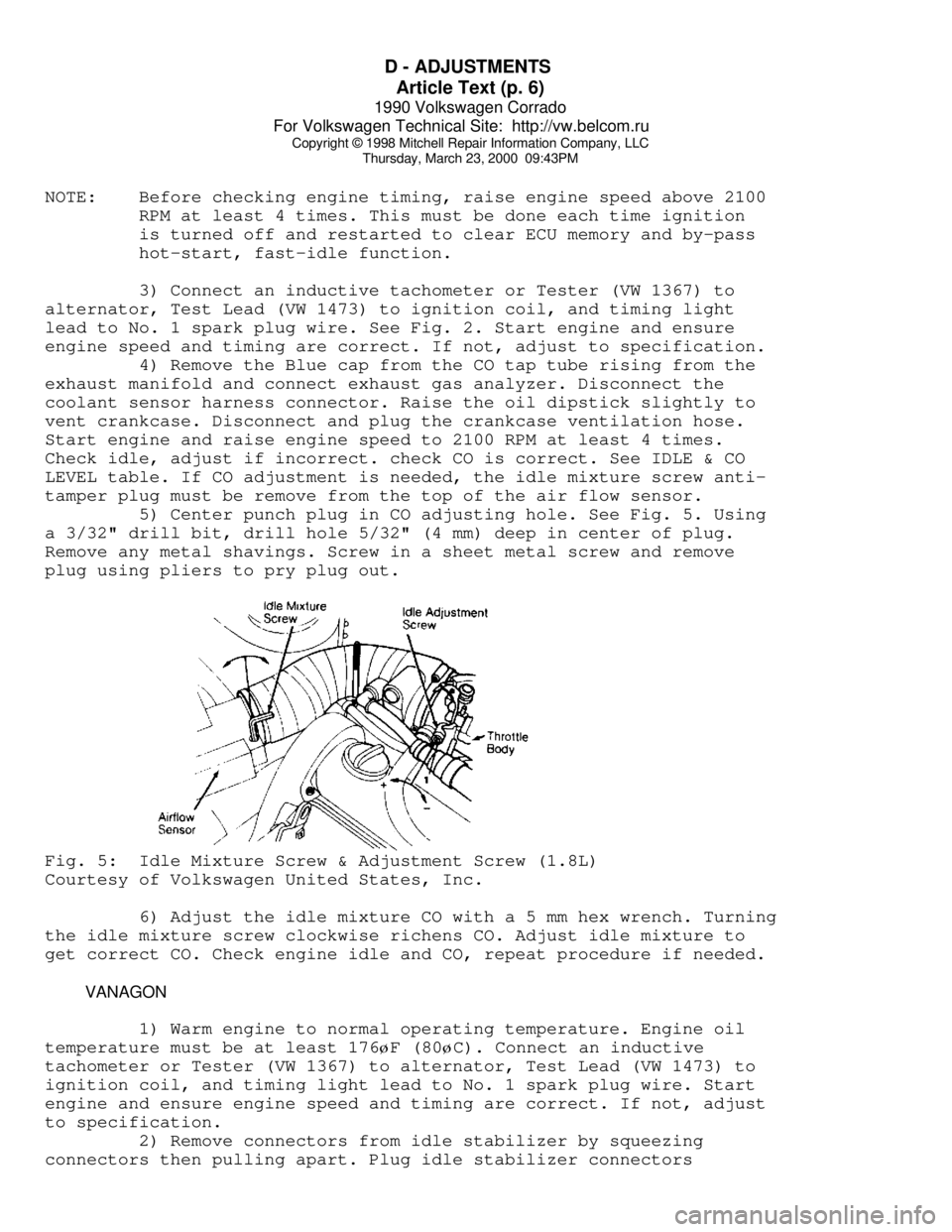
5) Center punch plug in CO adjusting hole. See Fig. 5. Using
a 3/32" drill bit, drill hole 5/32" (4 mm) deep in center of plug.
Remove any metal shavings. Screw in a sheet metal screw and remove
plug using pliers to pry plug out.Fig. 5: Idle Mixture Screw & Adjustment Screw (1.8L)
Courtesy of Volkswagen United States, Inc.
6) Adjust the idle mixture CO with a 5 mm hex wrench. Turning
the idle mixture screw clockwise richens CO. Adjust idle mixture to
get correct CO. Check engine idle and CO, repeat procedure if needed.
VANAGON
1) Warm engine to normal operating temperature. Engine oil
temperature must be at least 176øF (80øC). Connect an inductive
tachometer or Tester (VW 1367) to alternator, Test Lead (VW 1473) to
ignition coil, and timing light lead to No. 1 spark plug wire. Start
engine and ensure engine speed and timing are correct. If not, adjust
to specification.
2) Remove connectors from idle stabilizer by squeezing
connectors then pulling apart. Plug idle stabilizer connectors
Page 458 of 906
E - THEORY/OPERATION - DIGIFANT
Article Text (p. 8)
1990 Volkswagen Corrado
For Volkswagen Technical Site: http://vw.belcom.ru
Copyright © 1998 Mitchell Repair Information Company, LLC
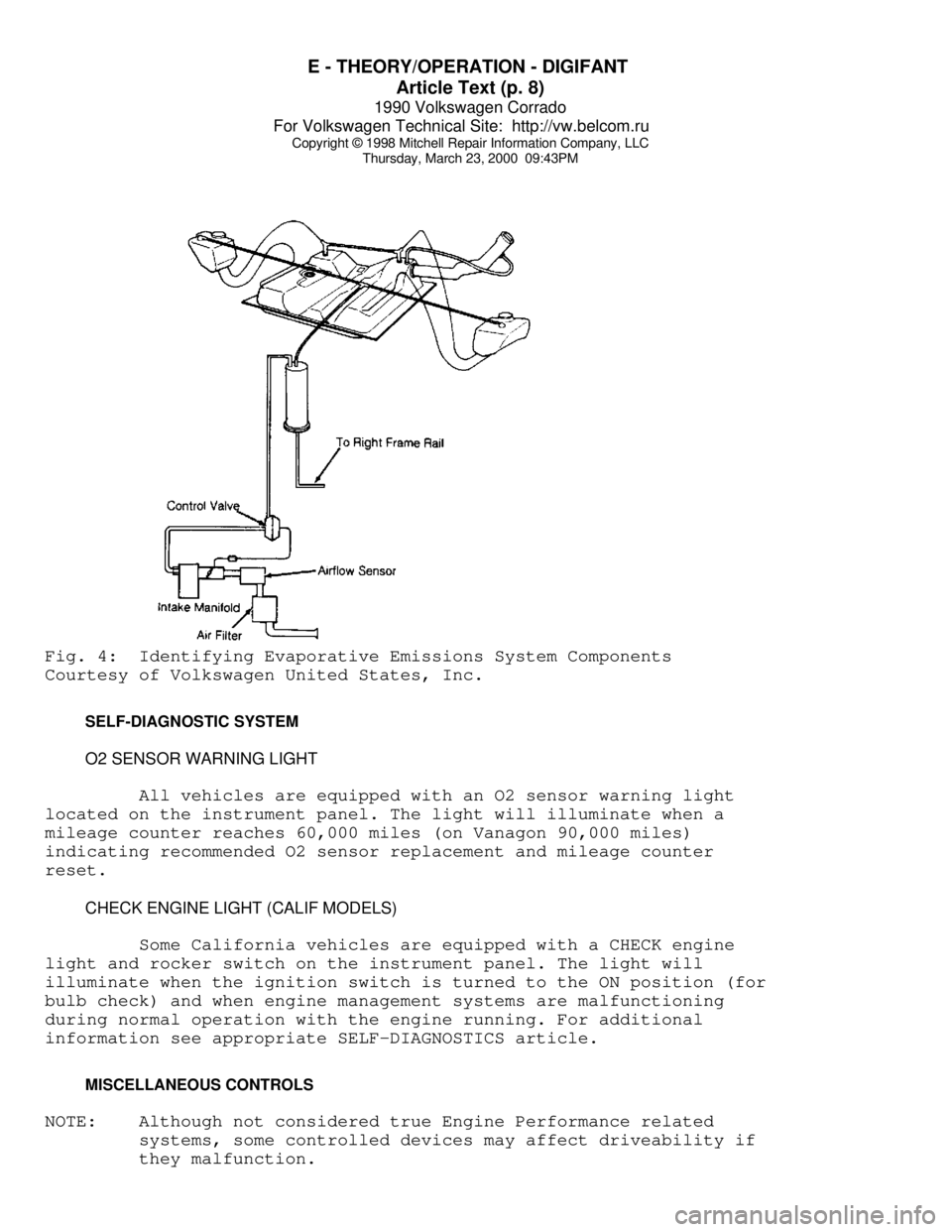
Thursday, March 23, 2000 09:43PMFig. 4: Identifying Evaporative Emissions System Components
Courtesy of Volkswagen United States, Inc.
SELF-DIAGNOSTIC SYSTEM
O2 SENSOR WARNING LIGHT
All vehicles are equipped with an O2 sensor warning light
located on the instrument panel. The light will illuminate when a
mileage counter reaches 60,000 miles (on Vanagon 90,000 miles)
indicating recommended O2 sensor replacement and mileage counter
reset.
CHECK ENGINE LIGHT (CALIF MODELS)
Some California vehicles are equipped with a CHECK engine
light and rocker switch on the instrument panel. The light will
illuminate when the ignition switch is turned to the ON position (for
bulb check) and when engine management systems are malfunctioning
during normal operation with the engine running. For additional
information see appropriate SELF-DIAGNOSTICS article.
MISCELLANEOUS CONTROLS
NOTE: Although not considered true Engine Performance related
systems, some controlled devices may affect driveability if
they malfunction.
Page 508 of 906
EMISSION CONTROL VISUAL INSPECTION PROCEDURES
Article Text (p. 14)
1990 Volkswagen Corrado
For Volkswagen Technical Site: http://vw.belcom.ru
Copyright © 1998 Mitchell Repair Information Company, LLC
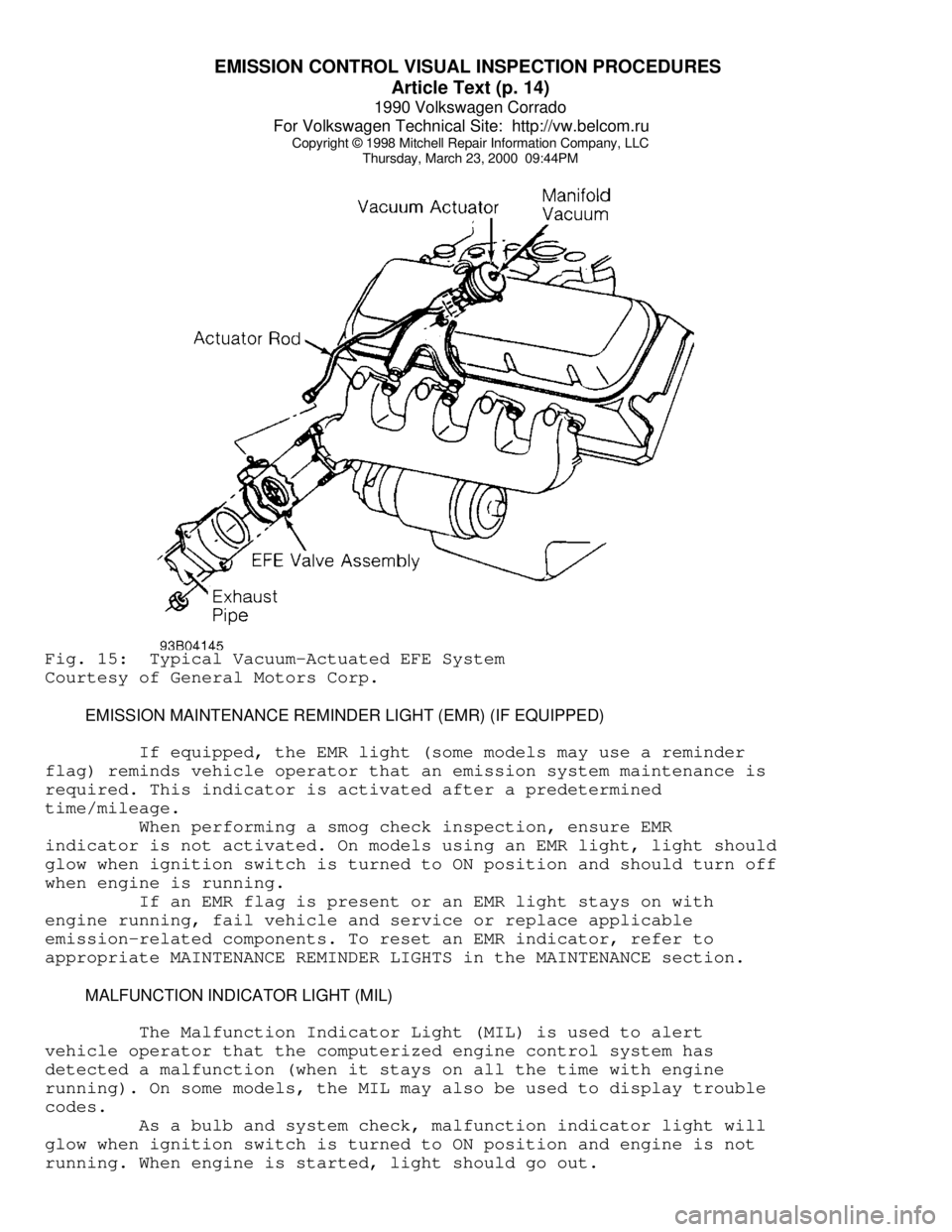
Thursday, March 23, 2000 09:44PMFig. 15: Typical Vacuum-Actuated EFE System
Courtesy of General Motors Corp.
EMISSION MAINTENANCE REMINDER LIGHT (EMR) (IF EQUIPPED)
If equipped, the EMR light (some models may use a reminder
flag) reminds vehicle operator that an emission system maintenance is
required. This indicator is activated after a predetermined
time/mileage.
When performing a smog check inspection, ensure EMR
indicator is not activated. On models using an EMR light, light should
glow when ignition switch is turned to ON position and should turn off
when engine is running.
If an EMR flag is present or an EMR light stays on with
engine running, fail vehicle and service or replace applicable
emission-related components. To reset an EMR indicator, refer to
appropriate MAINTENANCE REMINDER LIGHTS in the MAINTENANCE section.
MALFUNCTION INDICATOR LIGHT (MIL)
The Malfunction Indicator Light (MIL) is used to alert
vehicle operator that the computerized engine control system has
detected a malfunction (when it stays on all the time with engine
running). On some models, the MIL may also be used to display trouble
codes.
As a bulb and system check, malfunction indicator light will
glow when ignition switch is turned to ON position and engine is not
running. When engine is started, light should go out.
Page 511 of 906

ENGINE OVERHAUL PROCEDURES - GENERAL INFORMATION
Article Text (p. 2)
1990 Volkswagen Corrado
For Volkswagen Technical Site: http://vw.belcom.ru
Copyright © 1998 Mitchell Repair Information Company, LLC
Thursday, March 23, 2000 09:44PM
Cracks which are outlined by the particles cause an
interruption in the magnetic field. The dry powder method of Magnaflux
can be used in normal light. A crack will appear as an obvious bright
line.
Fluorescent liquid is used in conjunction with a blacklight
in a second Magnaflux system called Magnaglo. This type of inspection
demands a darkened room. The crack will appear as a glowing line in
this process. Both systems require complete demagnetizing upon
completion of the inspection. Magnetic particle inspection applies to
ferrous materials only.
PENETRANT INSPECTION
Zyglo
The Zyglo process coats the material with a fluorescent dye
penetrant. The part is often warmed to expand cracks that will be
penetrated by the dye. When the coated part is subjected to inspection
with a blacklight, a crack will glow brightly. Developing solution
is often used to enhance results. Parts made of any material, such as
aluminum cylinder heads or plastics, may be tested using this process.
Dye Check
Penetrating dye is sprayed on the previously cleaned
component. Dye is left on component for 5-45 minutes, depending upon
material density. Component is then wiped clean and sprayed with a
developing solution. Surface cracks will show up as a bright line.
ULTRASONIC INSPECTION
If an expensive part is suspected of internal cracking,
Ultrasonic testing is used. Sound waves are used for component
inspection.
X-RAY INSPECTION
This form of inspection is used on highly stressed
components. X-ray inspection maybe used to detect internal and
external flaws in any material.
PRESSURE TESTING
Cylinder heads can be tested for cracks using a pressure
tester. Pressure testing is performed by plugging all but one of the
holes in the head and injecting air or water into the open passage.
Leaks are indicated by the appearance of wet or damp areas when using
water. When air is used, it is necessary to spray the head surface
with a soap solution. Bubbles will indicate a leak. Cylinder head may
also be submerged in water heated to specified temperature to check
for cracks created during heat expansion.
CLEANING PROCEDURES