1990 VOLKSWAGEN CORRADO brake light
[x] Cancel search: brake lightPage 409 of 906

ANTI-LOCK BRAKE SYSTEM
Article Text
1990 Volkswagen Corrado
For Volkswagen Technical Site: http://vw.belcom.ru
Copyright © 1998 Mitchell Repair Information Company, LLC
Thursday, March 23, 2000 09:42PM
ARTICLE BEGINNING
1990-92 BRAKES
Volkswagen Anti-Lock Brake System
Corrado, Jetta, Passat
DESCRIPTION
All models use a Teves Anti-Lock Brake System (ABS). See
Fig. 1. This system reduces the chance of wheel lock-up during heavy
braking. The system consists of 4 wheel speed sensors, Electronic
Control Unit (ECU), hydraulic modulator/pump and solenoid valves,
ANTI-LOCK warning light and BRAKE warning light. There are 2 relays
located at fuse/relay panel, to protect the hydraulic modulator and
ECU.
NOTE: For more information on brake system, see appropriate BRAKE
SYSTEM article.
OPERATION
When pressure is applied to brake pedal, the ECU monitors
input signals from each wheel speed sensor. If ECU measures a rate of
reduction greater than what is programmed in ECU, the ECU will output
a signal to appropriate solenoid valve. Each solenoid valve allows
hydraulic pressure to increase or decrease to the appropriate wheel
cylinder.
If a system failure occurs, the ANTI-LOCK warning light,
located on instrument panel, will come on. System will be deactivated,
but conventional brake system will still operate. If brake fluid level
drops too low, BRAKE warning light, located on instrument panel, will
come on.
ANTI-LOCK BRAKE SAFETY PRECAUTIONS
* NEVER open a bleeder valve or loosen a hydraulic line while
ABS is pressurized,
* NEVER disconnect or reconnect any electrical connectors while
ignition is on. Damage to ABS control unit may result.
* Only use specially designed brake hoses/lines on ABS equipped
vehicles.
* DO NOT tap on speed sensor components (sensor, sensor rings).
Speed rings must be pressed, NOT hammered into hubs. Striking
these components can cause demagnetization or a loss of
polarization, affecting the accuracy of the speed signal
returning to the ABS control unit.
* DO NOT mix tire sizes. Increasing the width, as long as tires
remain close to the original diameter, is acceptable. Rolling
diameter must be identical for all 4 tires (and spare tire
also). Some manufacturers recommend tires of the same brand,
Page 412 of 906
ANTI-LOCK BRAKE SYSTEM
Article Text (p. 4)
1990 Volkswagen Corrado
For Volkswagen Technical Site: http://vw.belcom.ru
Copyright © 1998 Mitchell Repair Information Company, LLC
Thursday, March 23, 2000 09:42PM
seconds maximum and then stop. Depress brake pedal a few times; pump
should operate again for a few seconds. If pump motor does not
operate, check electrical system. If pump motor operates for more than
60 seconds, internal or external hydraulic leak may be indicated.
Check for external leaks. If external leak is not found, further
testing may be needed to check for internal leaks.
ANTI-LOCK WARNING LIGHT
Start engine. ANTI-LOCK warning light should come on, then
turn off after a few seconds. If light does not come on when engine is
started, check electrical system. If light comes on and stays on,
fault has been detected by the ECU and testing will be needed. See
SYSTEM TESTING under DIAGNOSIS & TESTING.
DIAGNOSIS & TESTING
SYSTEM TESTING
NOTE: Check battery condition, brake fluid level, electrical
connections and wiring for damage. If fluid level is
incorrect or battery and/or electrical connections are
faulty, correct problem before preceding. Perform each step,
in sequence, to test entire system, except for ECU. If
faulty ECU is suspected, replace with a known good one, and
retest system. Unplug ECU connector for all test steps.
Power Voltage-To-ECU Test
Turn ignition off. Unplug ECU connector. Turn ignition on.
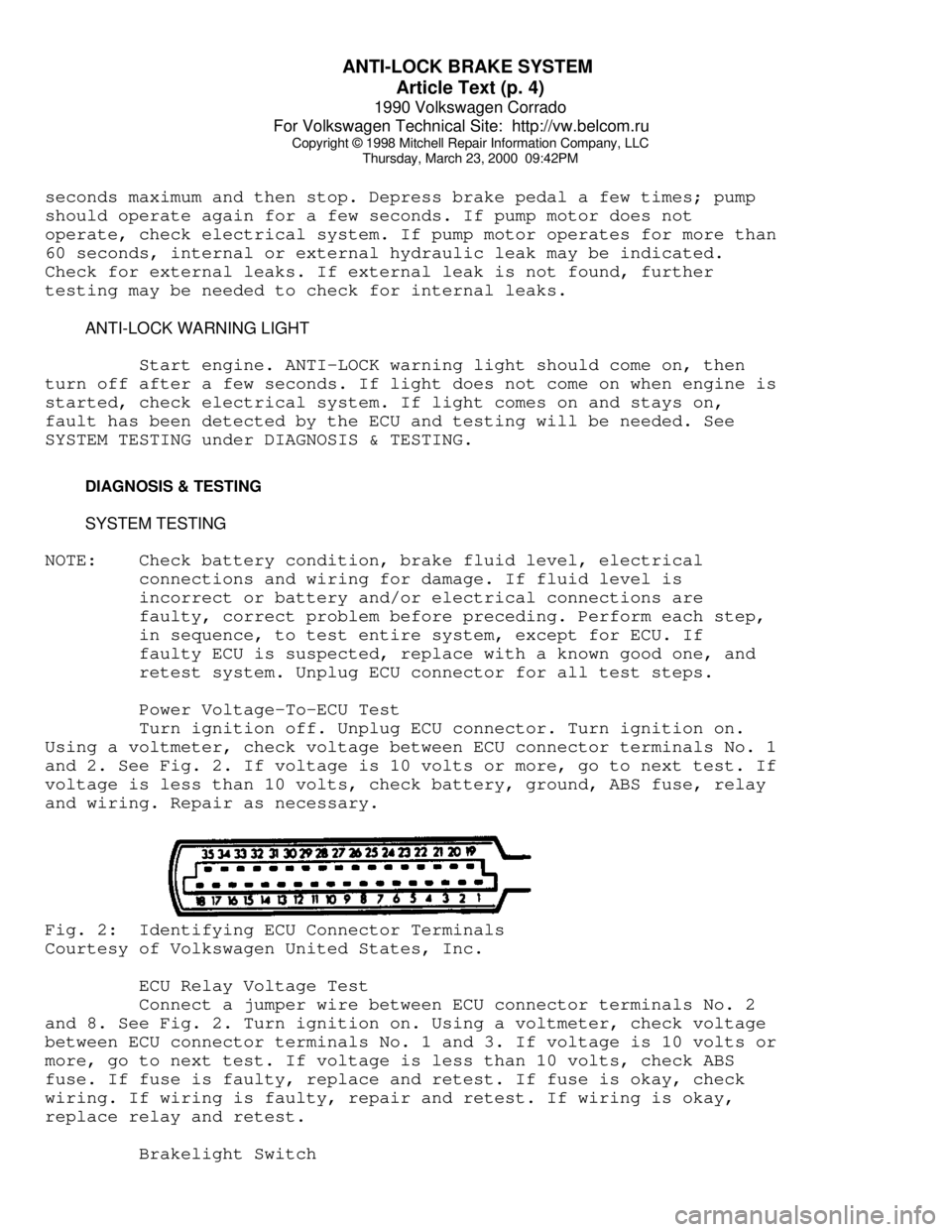
Using a voltmeter, check voltage between ECU connector terminals No. 1
and 2. See Fig. 2. If voltage is 10 volts or more, go to next test. If
voltage is less than 10 volts, check battery, ground, ABS fuse, relay
and wiring. Repair as necessary.Fig. 2: Identifying ECU Connector Terminals
Courtesy of Volkswagen United States, Inc.
ECU Relay Voltage Test
Connect a jumper wire between ECU connector terminals No. 2
and 8. See Fig. 2. Turn ignition on. Using a voltmeter, check voltage
between ECU connector terminals No. 1 and 3. If voltage is 10 volts or
more, go to next test. If voltage is less than 10 volts, check ABS
fuse. If fuse is faulty, replace and retest. If fuse is okay, check
wiring. If wiring is faulty, repair and retest. If wiring is okay,
replace relay and retest.
Brakelight Switch
Page 413 of 906

ANTI-LOCK BRAKE SYSTEM
Article Text (p. 5)
1990 Volkswagen Corrado
For Volkswagen Technical Site: http://vw.belcom.ru
Copyright © 1998 Mitchell Repair Information Company, LLC
Thursday, March 23, 2000 09:42PM
Turn ignition on. Apply brakes. Check for 12 volts between
terminals No. 12 and 1. If 12 volts are present, brakelight switch is
okay. If 12 volts are not present, check fuse, brakelight switch and
Black/Red wire from brakelight switch to ECU.
Hydraulic Modulator/Pump Relay Voltage Test
1) Turn ignition off. Unplug hydraulic modulator/pump
connector. Depress brake pedal 25 times. Turn ignition on. Using a
voltmeter, measure voltage between ECU connector terminals No. 1 and
32. See Fig. 2. If voltage is 10 volts or more, go to RIGHT REAR WHEEL
SPEED SENSOR VOLTAGE TEST under SYSTEM TESTING.
2) If voltage is less than 10 volts, check hydraulic
modulator/pump fuse. If fuse is okay, check wiring between ECU
connector terminal No. 32 and hydraulic modulator/pump connector
terminal No. 1 (large gauge Red/Black wire). See Figs. 2 and 4-9. If
wiring is not okay, repair wiring, and retest. If wiring is okay,
replace relay, and retest.
Right Rear Wheel Speed Sensor Voltage Test
Connect an AC voltmeter between ECU connector terminals No. 4
and 22. See Fig. 2. Rotate right rear wheel at one revolution per
second. Measure voltage with wheel rotating. If voltage is 0.075 volt
or more, go to next test. If voltage is less than 0.075 volt, check
wheel speed sensor and/or toothed ring for damage, wear and proper
installation. If damage or wear is found, replace faulty component and
retest. If not properly installed, reposition and retest. If
components are okay, replace wheel speed sensor and retest.
Left Rear Wheel Speed Sensor Voltage Test
Connect an AC voltmeter between ECU connector terminals No. 6
and 24. See Fig. 2. Rotate left rear wheel at one revolution per
second. Measure voltage with wheel rotating. If voltage is 0.075 volt
or more, go to next test. If voltage is less than 0.075 volt, check
wheel speed sensor and/or toothed ring for damage, wear and proper
installation. If damage or wear is found, replace faulty component and
retest. If not properly installed, reposition and retest. If
components are okay, replace wheel speed sensor and retest.
Right Front Wheel Speed Sensor Voltage Test
Connect an AC voltmeter between ECU connector terminals No. 7
and 25. See Fig. 2. Rotate right front wheel at one revolution per
second. Measure voltage with wheel rotating. If voltage is 0.075 volt
or more, go to next test. If voltage is less than 0.075 volt, check
wheel speed sensor and/or toothed ring for damage, wear and improper
installation. If damage or wear is found, replace faulty component,
and retest. If component is improperly installed, reposition
component, and retest. If components are okay, replace wheel speed
sensor, and retest.
Left Front Wheel Speed Sensor Voltage Test
Connect an AC voltmeter between ECU connector terminals No. 5
and 23. See Fig. 2. Rotate left front wheel at one revolution per
Page 418 of 906

ANTI-LOCK BRAKE SYSTEM
Article Text (p. 10)
1990 Volkswagen Corrado
For Volkswagen Technical Site: http://vw.belcom.ru
Copyright © 1998 Mitchell Repair Information Company, LLC
Thursday, March 23, 2000 09:42PM
modulator terminals No. 1 (Brown wire) and 6 (Black/Blue wire). See
Fig. 4-9. If resistance is 3-5 ohms, check wiring between hydraulic
modulator and ECU for open circuit. If resistance is not 3-5 ohms,
replace hydraulic modulator.
Hydraulic Modulator/Pump Relay Resistance Test
Turn ignition off. Unplug pressure switch connector from
hydraulic modulator. Using an ohmmeter, measure resistance between ECU
connector terminals No. 2 and 14. See Fig. 2. If resistance is 50-100
ohms, go to next test. If resistance is not 50-100 ohms, check wiring.
If wiring is faulty, repair wiring and retest. If wiring is okay,
replace relay and retest.
ABS Main Valve Function Test
Connect a jumper wire between ECU connector terminals No. 2
and 18. See Fig. 2. Depress brake pedal. Turn ignition on. Brake pedal
should rise slightly. If brake pedal did not rise slightly, check
wiring between terminals and hydraulic modulator. If wiring is okay,
replace hydraulic modulator.
Hydraulic Modulator/Pump Test
Turn ignition off. Depress brake pedal 25 times. Turn
ignition on. BRAKE and ANTI-LOCK lights should come on for 2-60
seconds. Pump should operate for 2-60 seconds, then turn off. If
lights do not come on, check wiring and warning light bulbs, and
retest. Also check bulb(s). If lights come on, then turn off, and pump
operates for 60 seconds maximum, then turns off, go to next test. If
pump does not operate and all other preceding tests have been
performed, replace hydraulic modulator/pump.
CAUTION: During VALVE BLOCK FUNCTION TESTS, DO NOT turn ignition on
longer than 60 seconds during any test.
Rear Valve Block Function Test
Connect a jumper wire ECU between ECU connector terminals No.
2, 17 and 33. See Fig. 2. Depress brake pedal. Rear wheels should be
locked up. Turn ignition on. Rear wheels should rotate. If wheels do
not rotate, replace hydraulic modulator. Turn ignition off.
Right Front Valve Block Function Test
Connect a jumper wire ECU between ECU connector terminals No.
2, 15 and 34. See Fig. 2. Depress brake pedal. Right front wheel
should be locked up. Turn ignition on. Right front wheel should
rotate. If wheel do not rotate, replace hydraulic modulator. Turn
ignition off.
Left Front Valve Block Function Test
Connect a jumper wire ECU between ECU connector terminals No.
2, 16 and 35. See Fig. 2. Depress brake pedal. Left front wheel should
be locked up. Turn ignition on. Left front wheel should rotate. If
wheel do not rotate, replace hydraulic modulator. Turn ignition off.
Page 437 of 906

COMPUTER RELEARN PROCEDURES
Article Text (p. 2)
1990 Volkswagen Corrado
For Volkswagen Technical Site: http://vw.belcom.ru
Copyright © 1998 Mitchell Repair Information Company, LLC
Thursday, March 23, 2000 09:43PM
"D" and allow engine to idle for one minute.
* Accelerate at normal throttle position (20-50%) until vehicle
shifts into top gear.
* Cruise at light to medium throttle.
* Decelerate to a stop, allowing vehicle to downshift, and use
brakes normally.
* Process may be repeated as necessary.
Manual Transmission
* Place transmission in Neutral position.
* Ensure emergency brake has been set and all accessories
are turned off.
* Start engine and bring to normal operating temperature.
* Allow vehicle to idle in Neutral for one minute.
* Initial relearn is complete: process will be completed during
normal driving.
Some manufacturers identify a specific relearn procedure
which will help establish suitable driveability during relearn stage.
These procedures are especially important if vehicle is equipped with
and electronically controlled automatic transmission or transaxle.
Always complete procedure before returning vehicle to customer.
END OF ARTICLE
Page 448 of 906

DRIVE AXLE - GEAR TOOTH CONTACT PATTERNS
Article Text
1990 Volkswagen Corrado
For Volkswagen Technical Site: http://vw.belcom.ru
Copyright © 1998 Mitchell Repair Information Company, LLC
Thursday, March 23, 2000 09:43PM
ARTICLE BEGINNING
1983-93 DRIVE AXLES
Gear Tooth Contact Patterns
All Models
INSPECTION
PRELIMINARY INSPECTION
Wipe lubricant from internal parts. Rotate gears and inspect
for wear or damage. Mount dial indicator to housing, and check
backlash at several points around ring gear. Backlash must be within
specifications at all points. If no defects are found, check gear
tooth contact pattern.
GEAR TOOTH CONTACT PATTERN
NOTE: Drive pattern should be well centered on ring gear teeth.
Coast pattern should be centered, but may be slightly toward
toe of ring gear teeth.
1) Paint ring gear teeth with marking compound. Wrap cloth or
rope around drive pinion flange to act as brake. Rotate ring gear
until clear tooth contact pattern is obtained.
2) Contact pattern will indicate whether correct pinion
bearing mounting shim has been installed and if drive gear backlash
has been set properly. Backlash between drive gear and pinion must be
maintained within specified limits, until correct tooth pattern is
obtained.
Page 488 of 906

ELECTRICAL COMPONENT LOCATOR
Article Text (p. 29)
1990 Volkswagen Corrado
For Volkswagen Technical Site: http://vw.belcom.ru
Copyright © 1998 Mitchell Repair Information Company, LLC
Thursday, March 23, 2000 09:44PM
Wheel Speed Sensor Mounted near hub assembly.ÄÄÄÄÄÄÄÄÄÄÄÄÄÄÄÄÄÄÄÄÄÄÄÄÄÄÄÄÄÄÄÄÄÄÄÄÄÄÄÄÄÄÄÄÄÄÄÄÄÄÄÄÄÄÄÄÄÄÄÄÄÄÄÄÄÄÄÄÄÄ SOLENOIDS & SOLENOID VALVES
ÄÄÄÄÄÄÄÄÄÄÄÄÄÄÄÄÄÄÄÄÄÄÄÄÄÄÄÄÄÄÄÄÄÄÄÄÄÄÄÄÄÄÄÄÄÄÄÄÄÄÄÄÄÄÄÄÄÄÄÄÄÄÄÄÄÄÄÄÄÄComponent Component Location
ÄÄÄÄÄÄÄÄÄÄÄÄÄÄÄÄÄÄÄÄÄÄÄÄÄÄÄÄÄÄÄÄÄÄÄÄÄÄÄÄÄÄÄÄÄÄÄÄÄÄÄÄÄÄÄÄÄÄÄÄÄÄÄÄÄÄÄÄÄÄIdle Stabilizer Valve Across from throttle valve,
near valve cover.
ÄÄÄÄÄÄÄÄÄÄÄÄÄÄÄÄÄÄÄÄÄÄÄÄÄÄÄÄÄÄÄÄÄÄÄÄÄÄÄÄÄÄÄÄÄÄÄÄÄÄÄÄÄÄÄÄÄÄÄÄÄÄÄÄÄÄÄÄÄÄ SWITCHES
ÄÄÄÄÄÄÄÄÄÄÄÄÄÄÄÄÄÄÄÄÄÄÄÄÄÄÄÄÄÄÄÄÄÄÄÄÄÄÄÄÄÄÄÄÄÄÄÄÄÄÄÄÄÄÄÄÄÄÄÄÄÄÄÄÄÄÄÄÄÄComponent Component Location
ÄÄÄÄÄÄÄÄÄÄÄÄÄÄÄÄÄÄÄÄÄÄÄÄÄÄÄÄÄÄÄÄÄÄÄÄÄÄÄÄÄÄÄÄÄÄÄÄÄÄÄÄÄÄÄÄÄÄÄÄÄÄÄÄÄÄÄÄÄÄA/C Pressure Switch In refrigerant line, near left
side of condenser.
Anti-Lock Brake (ABS) Pressure
Warning Switch Mounted in hydraulic modulator
below brake fluid reservoir.
Back-Up Light Switch Mounted near gear selector on
transmission.
Brake Fluid Level Switch In cap on brake fluid
reservoir.
Page 491 of 906
ELECTRICAL COMPONENT LOCATOR
Article Text (p. 32)
1990 Volkswagen Corrado
For Volkswagen Technical Site: http://vw.belcom.ru
Copyright © 1998 Mitchell Repair Information Company, LLC
Thursday, March 23, 2000 09:44PM
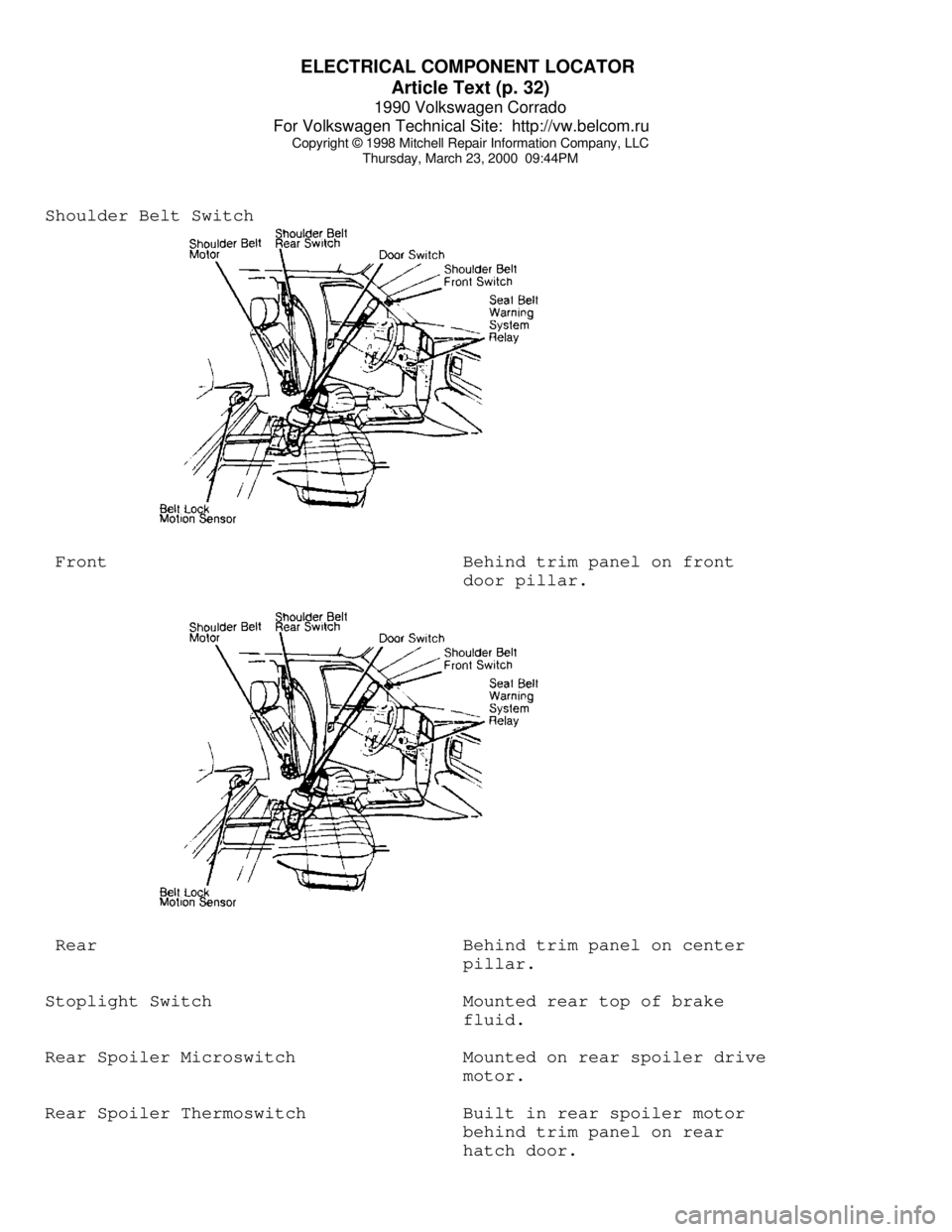
Shoulder Belt Switch Front Behind trim panel on front
door pillar. Rear Behind trim panel on center
pillar.
Stoplight Switch Mounted rear top of brake
fluid.
Rear Spoiler Microswitch Mounted on rear spoiler drive
motor.
Rear Spoiler Thermoswitch Built in rear spoiler motor
behind trim panel on rear
hatch door.