Page 1110 of 2103
AUTOMATICTRANSAXLE
ENGINE (TURBO) AND ENGINE> Transaxle Assembly
Engine>
Pre-removalOperationl Transaxle Fluid Draining(Refer to GROUP 00 Maintenance Service.)l Battery Removall Under Cover Removal(Refer to GROUP 42 Under Cover.)I
I
I
Post-installation Operationl Battery Installationl Under Cover Installation(Refer to GROUP 42 Under Cover.)l Transaxle Fluid Supplying(Refer to GROUP 00 Maintenance Service.)l Selector Lever Operation Check
30 Nm
5915
44Nm
TSB Revision
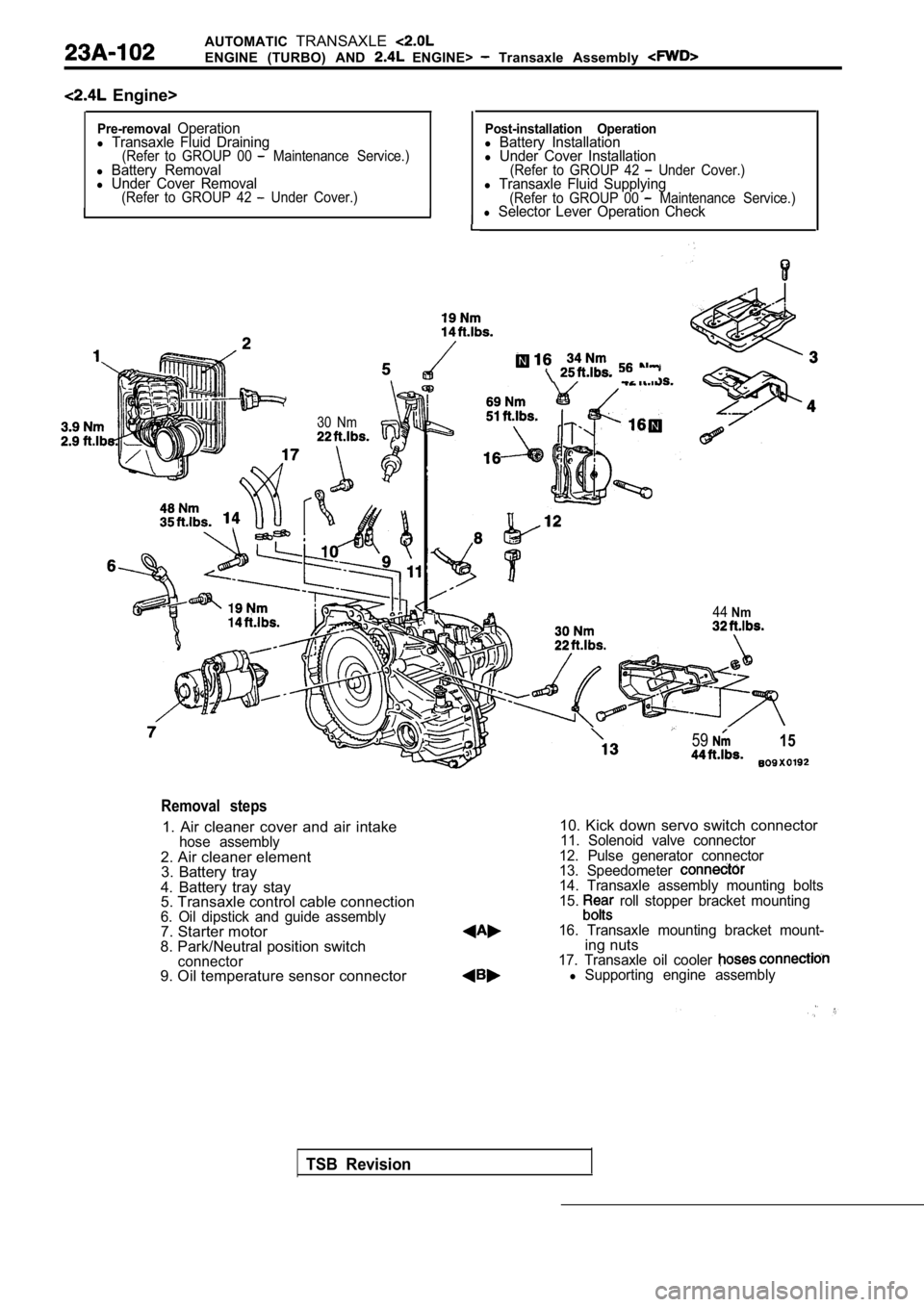
Removal steps
1. Air cleaner cover and air intakehose assembly2. Air cleaner element
3. Battery tray
4. Battery tray stay
5. Transaxle control cable connection
6. Oil dipstick and guide assembly7. Starter motor
8. Park/Neutral position switch
connector9. Oil temperature sensor connector
10. Kick down servo switch connector11. Solenoid valve connector
12. Pulse generator connector
13. Speedometer
14. Transaxle assembly mounting bolts
15. roll stopper bracket mounting
16. Transaxle mounting bracket mount-
ing nuts17. Transaxle oil cooler l Supporting engine assembly
Page 1114 of 2103
AUTOMATIC TRANSAXLE
ENGINE (TURBO) AND ENGINE> Transaxle Assembly
REMOVAL ANDINSTALLATION
23100570205
Operation
l Transaxle Fluid Draining
(Refer to GROUP 00
Maintenance Service)
l Battery Removal
l Under Cover Removal
(Refer to GROUP 42
Under Cover)
lFront Exhaust Pipe Removal (Refer to GROUP 15 Exhaust Pipe and Main Muffler)
l Transfer Assembly Removal (Refer to
3.92.9
Nm
Post-installation OperationlTransfer Assembly Installation l Front Exhaust Pipe Installation (Refer to GROUP
15 Exhaust Pipe and Main Muffler)
l Under Cover Installation
(Refer to GROUP 42
Under Cover)
l Battery Installation
l Transaxle Fluid Supplying
(Refer to GROUP 00
Maintenance Service)
30 Nm
22
23 17
69 Nm51
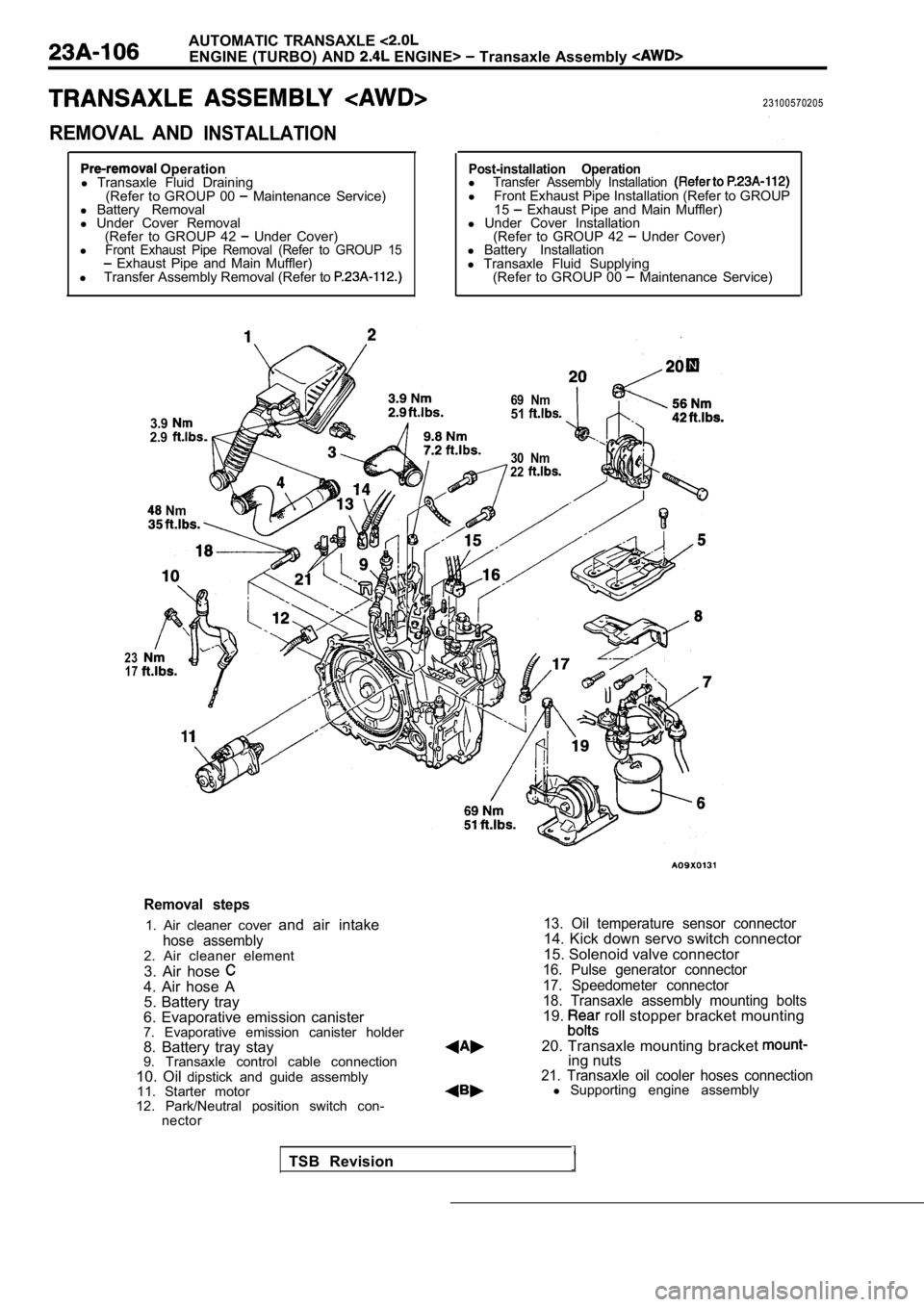
Removal steps
1. Air cleaner cover and air intake
hose assembly2. Air cleaner element
3. Air hose
4. Air hose A
5. Battery tray
6. Evaporative emission canister
7. Evaporative emission canister holder
8. Battery tray stay
9. Transaxle control cable connection
10. Oil dipstick and guide assembly
11. Starter motor
12. Park/Neutral position switch con- nector
13. Oil temperature sensor connector14. Kick down servo switch connector
15. Solenoid valve connector
16. Pulse generator connector
17. Speedometer connector
18. Transaxle assembly mounting bolts
19. roll stopper bracket mounting
20. Transaxle mounting bracket
ing nuts21. Transaxle oil cooler hoses connectionl Supporting engine assembly
TSB Revision
Page 1200 of 2103
AUTOMATIC TRANSAXLE
ENGINE (NON-TURBO)> Transaxle Assembly
TRANSAXLE ASSEMBLY
l Transaxle Fluid Draining
l Transaxle Fluid Draining
(Refer to GROUP 00 Maintenance service)
(Refer to GROUP 00 Maintenance service)
l Battery Removal
l Battery Removal
l Under Cover Removal
l Under Cover Removal
(Refer to GROUP 42
Under Cover)
(Refer to GROUP 42 Under Cover)
7454
Post-installation Operationl Under Cover Installation
(Refer to GROUP Under Cover)
l Battery Installation
l Transaxle Fluid Supplying
(Refer to GROUP 00
Maintenance Service)
l Selector Lever Operation Check
9.2
6
5140
69 Nm51 I
42
51
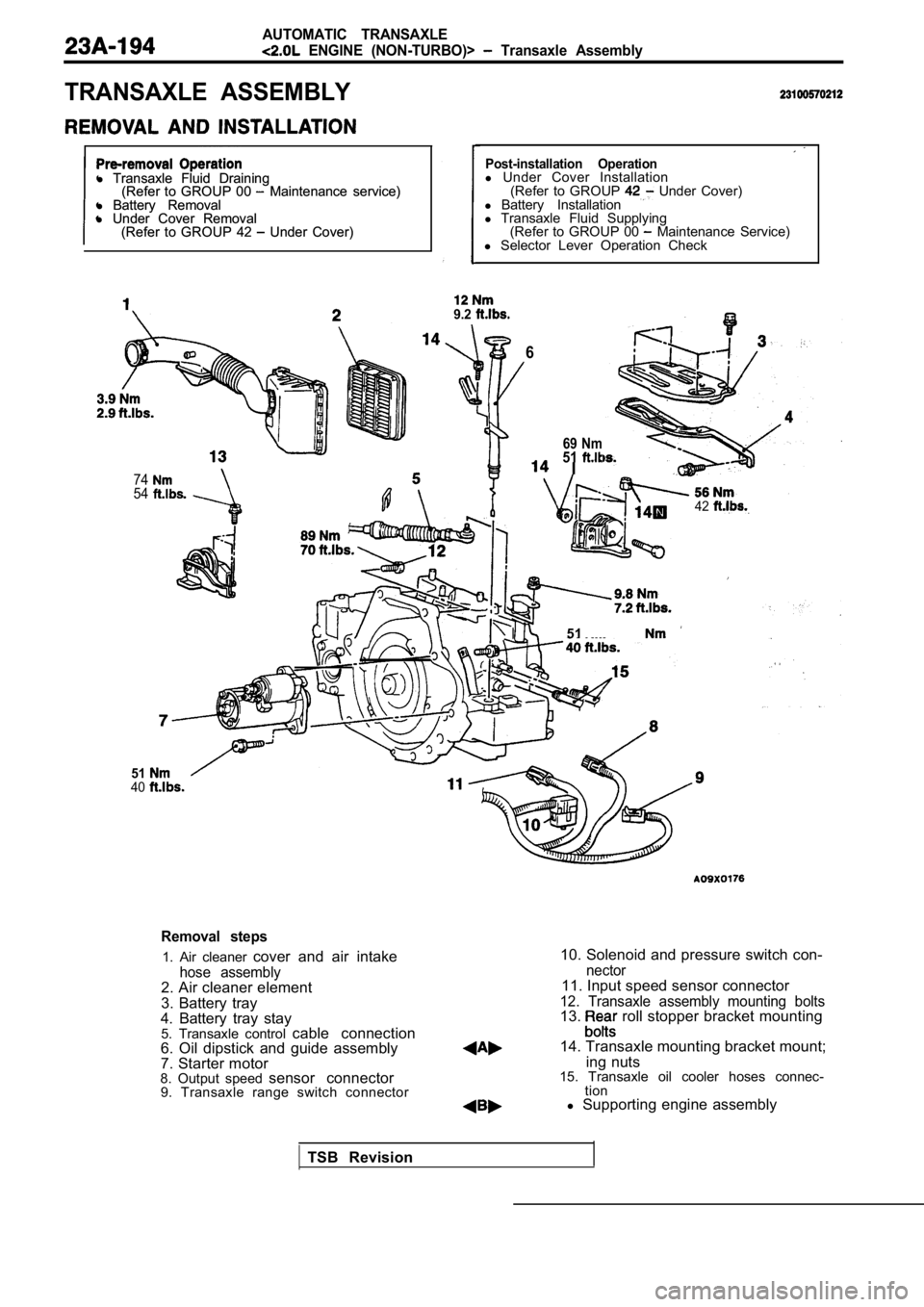
Removal steps
1. Air cleaner cover and air intake
hose assembly2. Air cleaner element
3. Battery tray
4. Battery tray stay 5. Transaxle control cable connection
6. Oil dipstick and guide assembly
7. Starter motor
8. Output speed sensor connector
9. Transaxle range switch connector
10. Solenoid and pressure switch con-
nector11. Input speed sensor connector
12. Transaxle assembly mounting bolts13. roll stopper bracket mounting
14. Transaxle mounting bracket mount; ing nuts
15. Transaxle oil cooler hoses connec- tion
l Supporting engine assembly
TSB Revision
Page 1647 of 2103
BASIC BRAKE SYSTEM
CLEARANCEB E T W E E N B R A K E A N D
REWALL
(1) Turn up thecarpet,etc. under the brake pedal,
(2) Start the engine, depress the brake pedal
with
490 (110 of force.
Standard value 90 mm (3.5 in.)
(3)If the clearance is less than the standard value, c
heck
for air trapped in the brake line,
the lining and the drum, and dragging in the parkin g
brake.
Adjust and replace defective parts as required.
(4) Turn back the carpet,
, .
No continuity Continuity
4
with auto-cruise
control systema
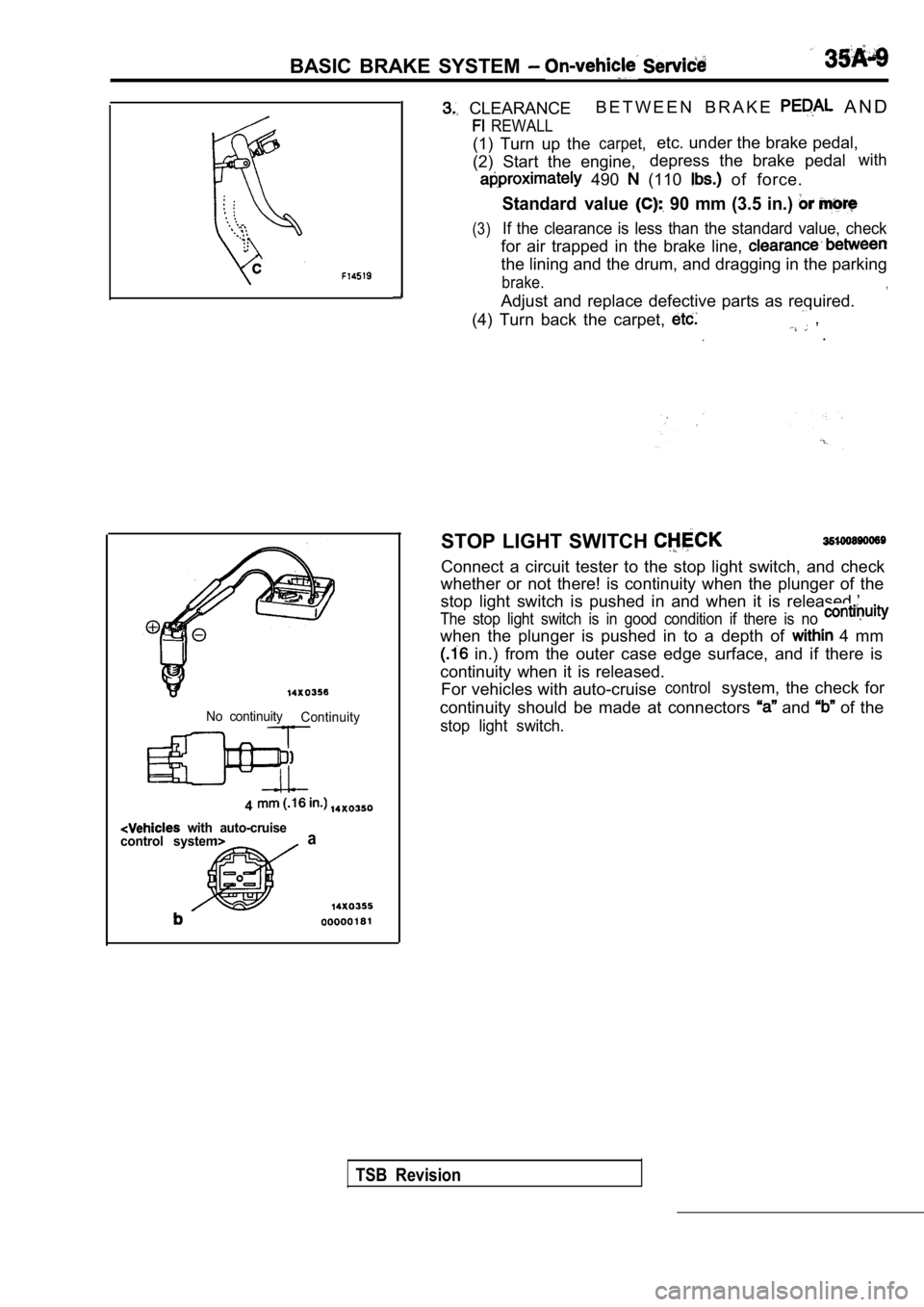
STOP LIGHT SWITCH
Connect a circuit tester to the stop light switch, and check
whether or not there! is continuity when the plunge r of the
stop light switch is pushed in and when it is relea sed.’
The stop light switch is in good condition if there is no
when the plunger is pushed in to a depth of 4 mm
in.) from the outer case edge surface, and if ther e is
continuity when it is released. For vehicles with auto-cruise
controlsystem, the check for
continuity should be made at connectors
and of the
stop light switch.
TSB Revision
Page 1648 of 2103
BASIC BRAKE SYSTEM On-vehicle Service
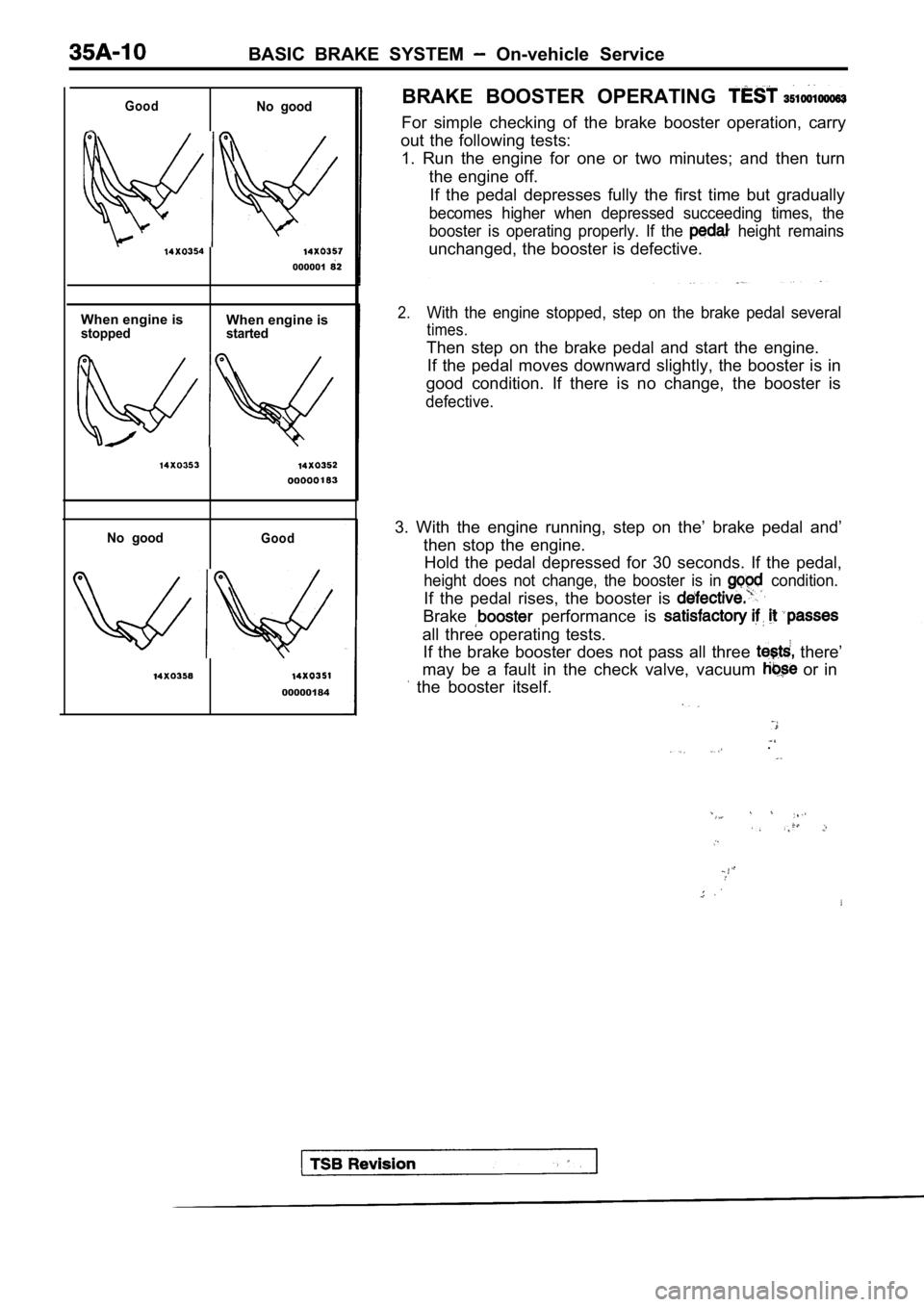
GoodNo good
000001
When engine isWhen engine isstopped started
No goodGood
00000184BRAKE BOOSTER OPERATING
For simple checking of the brake booster operation,
carry
out the following tests: 1. Run the engine for one or two minutes; and then turn
the engine off. If the pedal depresses fully the first time but gra dually
becomes higher when depressed succeeding times, the
booster is operating properly. If the
height remains
unchanged, the booster is defective.
2.With the engine stopped, step on the brake pedal se veral
times.
Then step on the brake pedal and start the engine.
If the pedal moves downward slightly, the booster i s in
good condition. If there is no change, the booster is
defective.
3. With the engine running, step on the’ brake peda l and’
then stop the engine. Hold the pedal depressed for 30 seconds. If the ped al,
height does not change, the booster is in condition.
If the pedal rises, the booster is
Brake performance is
all three operating tests.
If the brake booster does not pass all three
there’
may be a fault in the check valve, vacuum
or in
the booster itself.
.
Page 1654 of 2103
BASIC BRAKE SYSTEM On-vehicle Service
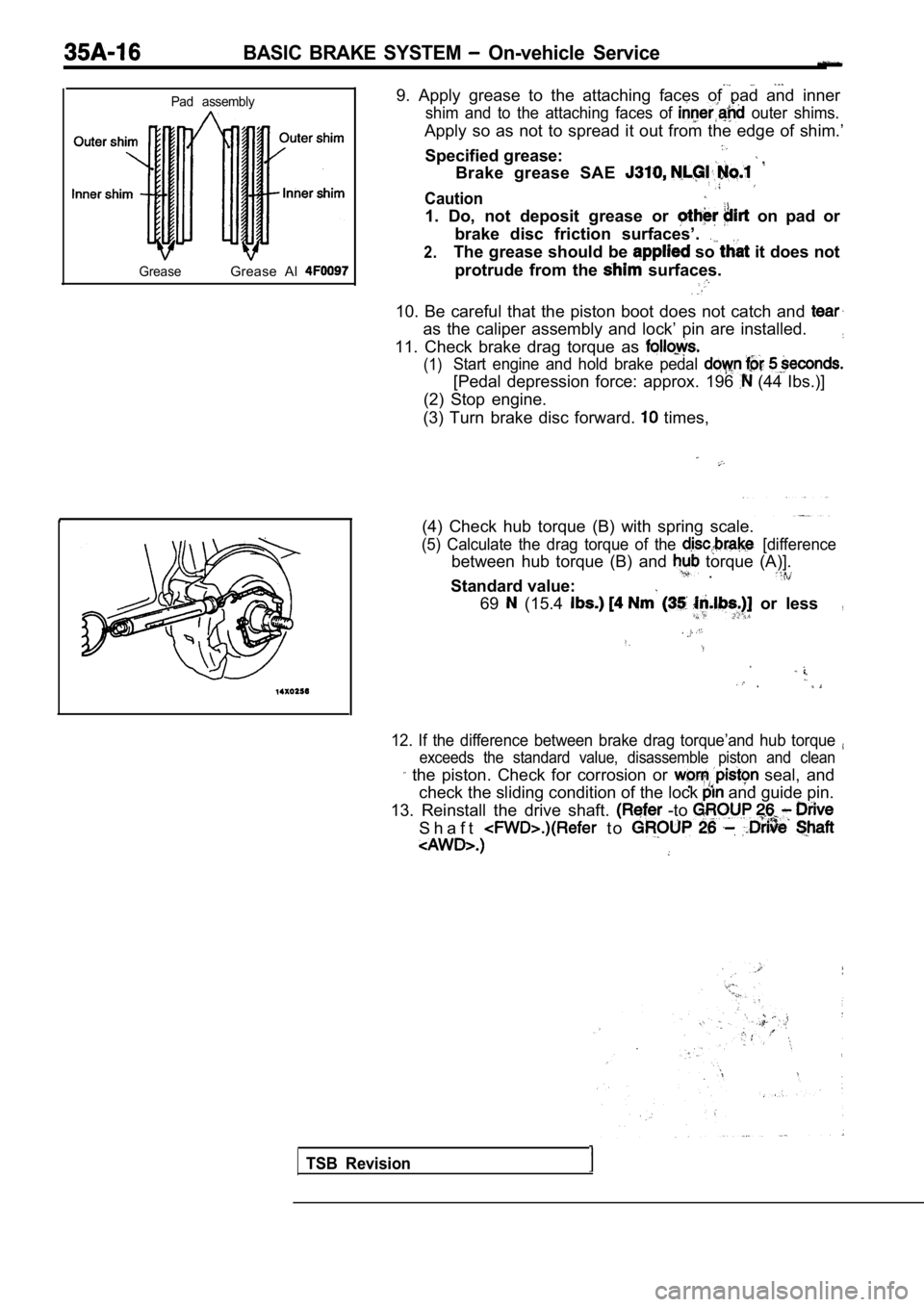
Pad assembly
Grease
Grease Al
9. Apply grease to the attaching faces of pad and i nner
shim and to the attaching faces of outer shims.
Apply so as not to spread it out from the edge of shim.’
Specified grease:
Brake grease SAE
Caution
1. Do, not deposit grease or on pad or
brake disc friction surfaces’.
2.The grease should be so it does not
protrude from the
surfaces.
10. Be careful that the piston boot does not catch and
as the caliper assembly and lock’ pin are installed.
11. Check brake drag torque as
(1)Start engine and hold brake pedal
[Pedal depression force: approx. 196 (44 Ibs.)]
(2) Stop engine.
(3) Turn brake disc forward.
times,
(4) Check hub torque (B) with spring scale.
(5) Calculate the drag torque of the [difference
between hub torque (B) and torque (A)]. .
Standard value:
69 (15.4 or less,
12. If the difference between brake drag torque’and hub torque
exceeds the standard value, disassemble piston and clean
the piston. Check for corrosion or seal, and
check the sliding condition of the lock
and guide pin.
13. Reinstall the drive shaft.
-to
S h a f t t o
TSB Revision
Page 1660 of 2103
BASIC BRAKE SYSTEM On-vehicle Service
TSB Revision
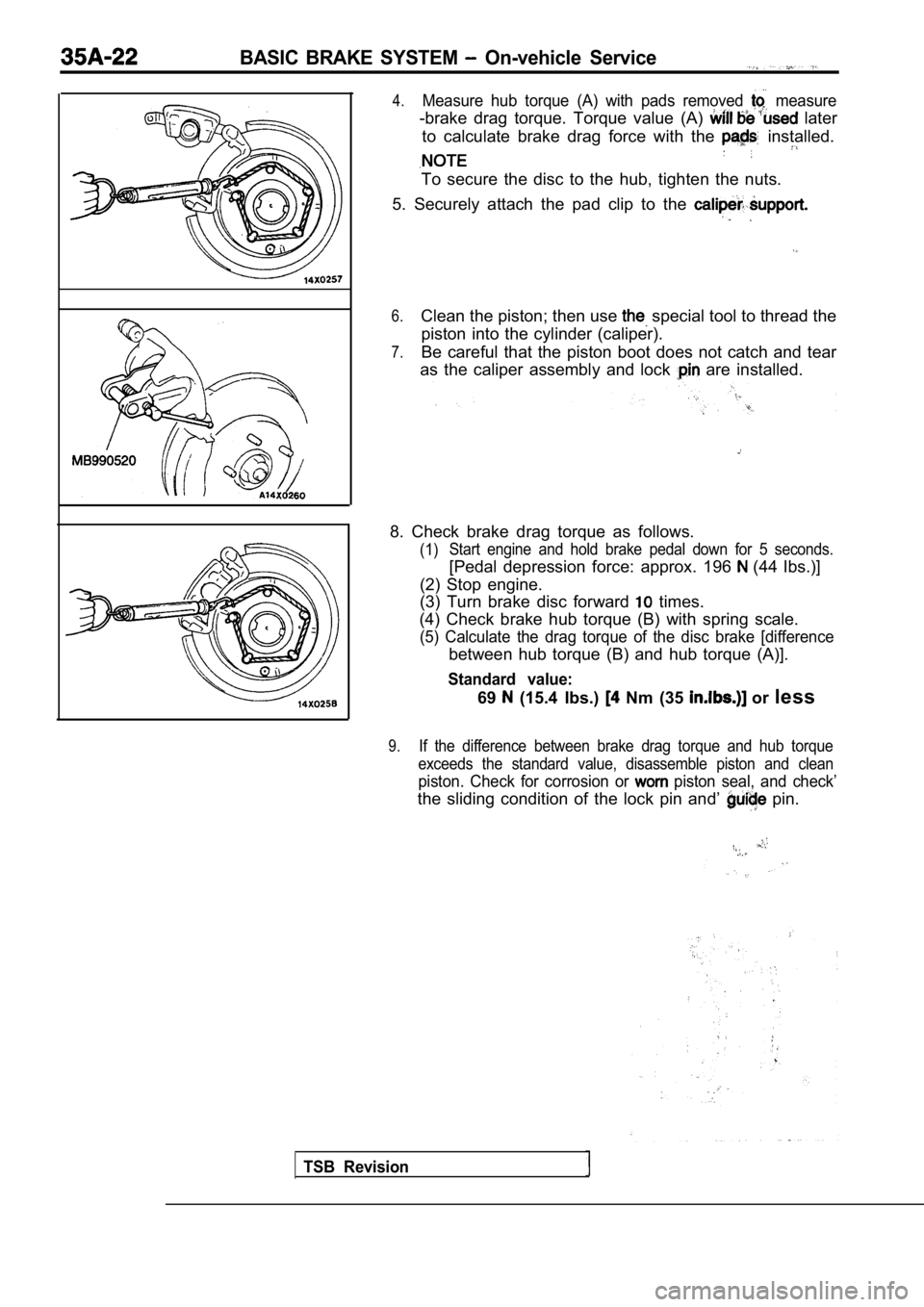
4.Measure hub torque (A) with pads removed measure
-brake drag torque. Torque value (A) later
to calculate brake drag force with the
installed.
To secure the disc to the hub, tighten the nuts.
5. Securely attach the pad clip to the
6.Clean the piston; then use special tool to thread the
piston into the cylinder (caliper).
7.Be careful that the piston boot does not catch and tear
as the caliper assembly and lock
are installed.
8. Check brake drag torque as follows.
(1) Start engine and hold brake pedal down for 5 second
s.
[Pedal depression force: approx. 196 (44 Ibs.)]
(2) Stop engine.
(3) Turn brake disc forward
times.
(4) Check brake hub torque (B) with spring scale.
(5) Calculate the drag torque of the disc brake [di fference
between hub torque (B) and hub torque (A)].
Standard value:
69 (15.4 Ibs.) Nm (35 or less
9.If the difference between brake drag torque and hub torque
exceeds the standard value, disassemble piston and clean
piston. Check for corrosion or piston seal, and check’
the sliding condition of the lock pin and’ pin.
Page 1695 of 2103
ABS Troubleshooting
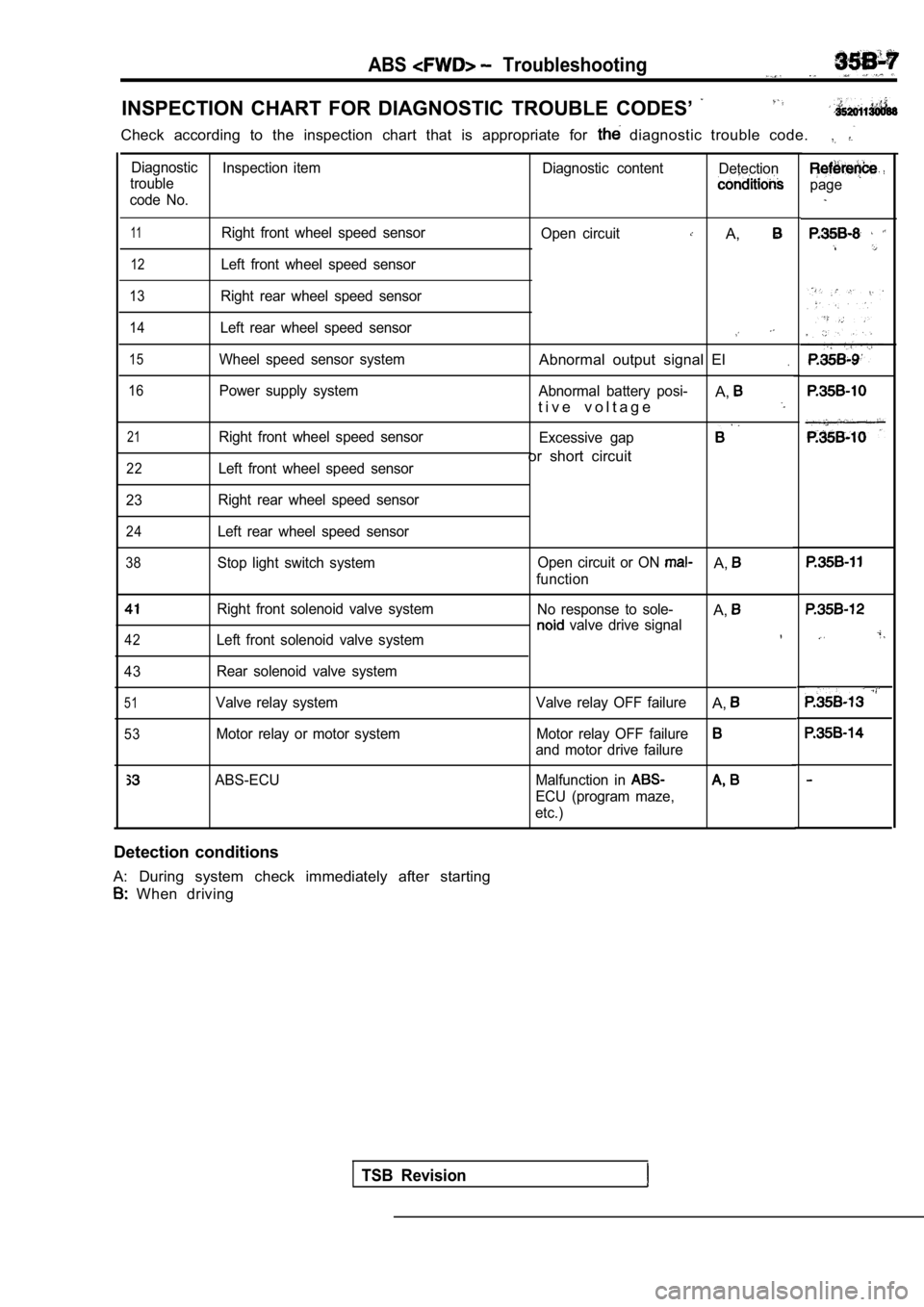
INSPECTION CHART FOR DIAGNOSTIC TROUBLE CODES’
Check according to the inspection chart that is appropriate for diagnostic trouble code.
Diagnostic
Inspection item Diagnostic contentDetection
trouble
code No.
11Right front wheel speed sensor
12Left front wheel speed sensor
13Right rear wheel speed sensor
14Left rear wheel speed sensor
15Wheel speed sensor system
16Power supply system
21Right front wheel speed sensor
22Left front wheel speed sensor
23 Right rear wheel speed sensor
24Left rear wheel speed sensor
38Stop light switch system
Right front solenoid valve system
42Left front solenoid valve system
43 Rear solenoid valve system
51Valve relay system
53Motor relay or motor system Open circuit
A,
Abnormal output signal El.
Abnormal battery posi-A,t i v e v o l t a g e
Excessive gap
or short circuit
Open circuit or ON A,
function
No response to sole-
A, valve drive signal
Valve relay OFF failureA,
Motor relay OFF failure
and motor drive failure
ABS-ECU Malfunction in
ECU (program maze,
etc.)
Detection conditions
A: During system check immediately after starting
When driving
TSB Revision
page