Page 1777 of 2103
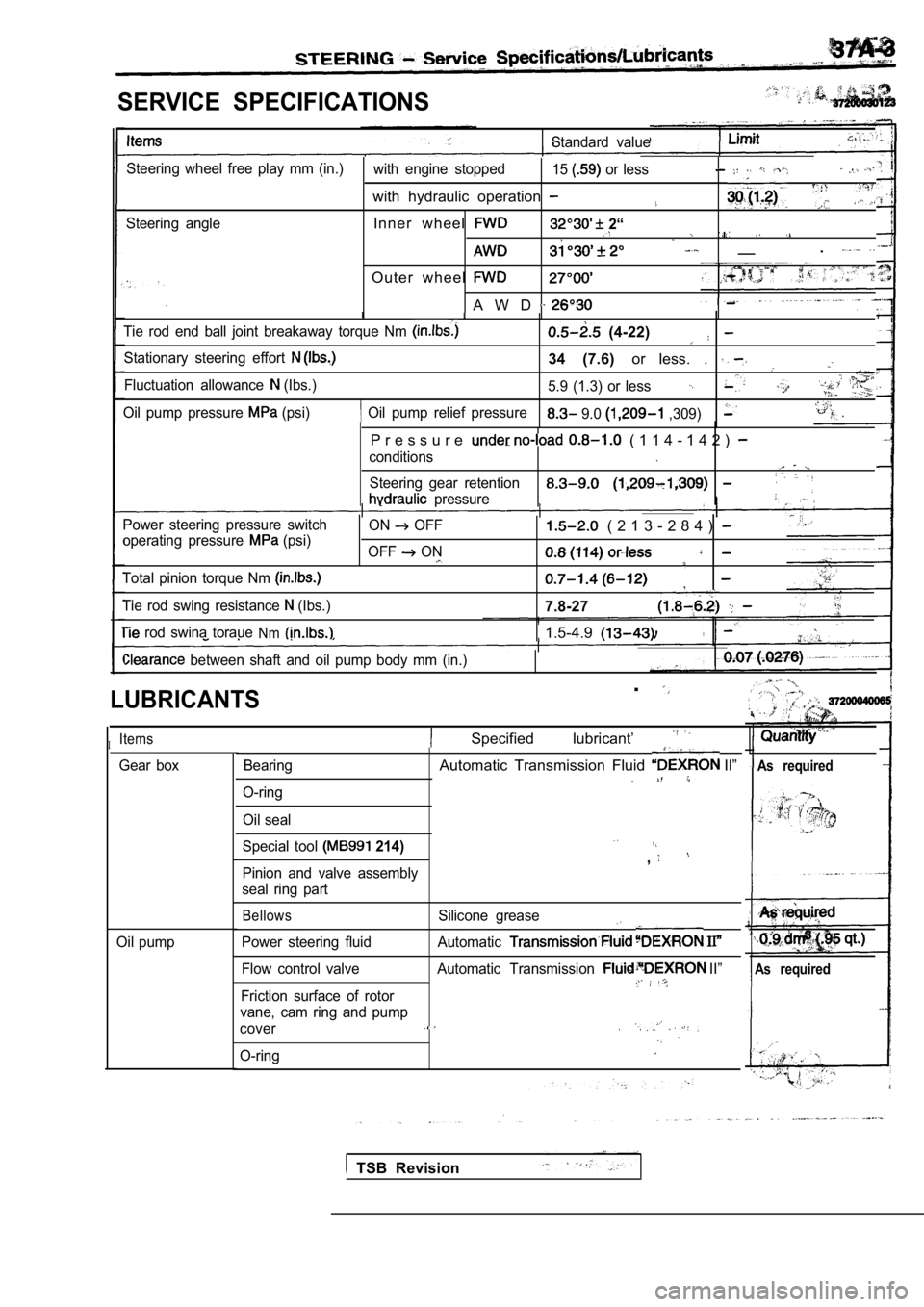
SERVICE SPECIFICATIONS
Standard value
Steering wheel free play mm (in.) with engine stopped15
or less,
with hydraulic operation
Steering angleInner wheel 2“
__
.
O u t e r w h e e l
A W D
Tie rod end ball joint breakaway torque Nm (4-22)
Stationary steering effort 34 (7.6) or less. .
Fluctuation allowance (Ibs.)
5.9 (1.3) or less
Oil pump relief pressureOil pump pressure (psi) 9.0 ,309)
P r e s s u r e ( 1 1 4 - 1 4 2 )
conditions
Steering gear retention
pressure
Power steering pressure switch
operating pressure
(psi)
Total pinion torque Nm
Tie rod swing resistance (Ibs.) ON
OFF
OFF
ON
( 2 1 3 - 2 8 4 )
7.8-27
rod swina toraueNm1.5-4.9
between shaft and oil pump body mm (in.)
LUBRICANTS
IItems
Bearing
O-ring
Oil seal
.
Specified lubricant’
Gear boxAutomatic Transmission Fluid II”
.As required
Oil pump Special tool
214)
Pinion and valve assembly
seal ring part
,
BellowsSilicone grease
Power steering fluid Automatic
Flow control valve Automatic Transmission II”
Friction surface of rotor
vane, cam ring and pump
cover.
O-ring
As required
TSB Revision
Page 1778 of 2103
SEALANTS
Sealants/Special Tools
.
I t e m s Specified sealant
Power
steering
gear box End plug screw ATD Part ‘No. or ‘equivalent
Power steering rack support cover screw
Dust cover lip for tie rod end ball joint
SPECIAL TOOLS
Tool
0
Tool number and name
or
Steering linkage puller
socket
Oil pressure gauge
assembly
548
Engine (Non-turbo)>
Power steering oil
gauge adapter
side)
Engine (Non-turbo)>
steering oil
gauge adapter
side)
or
Engine (Turbo)
Engine>
steering oil
gauge adapter
pump side)
Engine (Turbo)
Engine>
steering oil pressure adapter (hose side)
Generalservice tool
TSBRevision,
Application
Tie, rod knuckle
Tie rod end ball joint breakaway
torque check
Page 1781 of 2103
STEERING On-vehicle”
TSB Revision
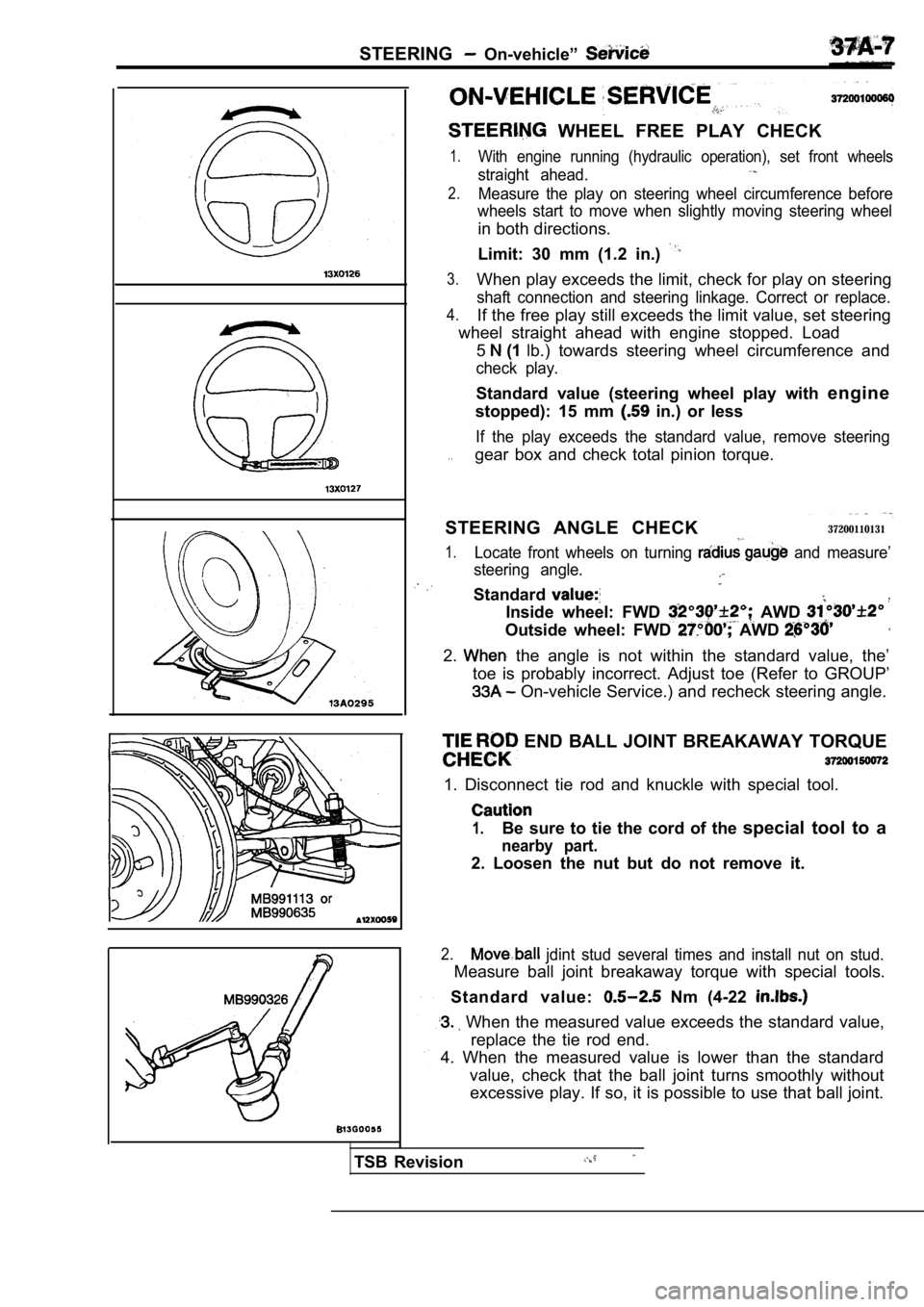
WHEEL FREE PLAY CHECK
1.With engine running (hydraulic operation), set front wheels
straight ahead.
2.Measure the play on steering wheel circumference be fore
wheels start to move when slightly moving steering wheel
in both directions.
Limit: 30 mm (1.2 in.)
3.When play exceeds the limit, check for play on steering
shaft connection and steering linkage. Correct or replace.
4.If the free play still exceeds the limit value, set steering
wheel straight ahead with engine stopped. Load
5
(1 lb.) towards steering wheel circumference and
check play.
Standard value (steering wheel play with engine
stopped): 15 mm
in.) or less
If the play exceeds the standard value, remove stee ring
. .gear box and check total pinion torque.
STEERING ANGLE CHECK
37200110131
1.Locate front wheels on turning and measure’
steering angle.
Standard
Inside wheel: FWD AWD
Outside wheel: FWD AWD
2. the angle is not within the standard value, the’
toe is probably incorrect. Adjust toe (Refer to GRO UP’
On-vehicle Service.) and recheck steering angle.
END BALL JOINT BREAKAWAY TORQUE
1. Disconnect tie rod and knuckle with special tool .
1.Be sure to tie the cord of the special tool to a
nearby part.
2. Loosen the nut but do not remove it.
2. jdint stud several times and install nut on stud.
Measure ball joint breakaway torque with special to ols.
Standard value:
Nm (4-22
When the measured value exceeds the standard value ,
replace the tie rod end.
4. When the measured value is lower than the standa rd
value, check that the ball joint turns smoothly wit hout
excessive play. If so, it is possible to use that b all joint.
Page 1782 of 2103
STEERING On-vehicle Service
S T E E R I N G
1. the vehicle stopped on a paved surface, turn
the steering wheel to the straight ahead ‘position.
2.Start the engine and set to 1,000
Caution
After checking the engine rpm., there
a
to the standard idling rpm.
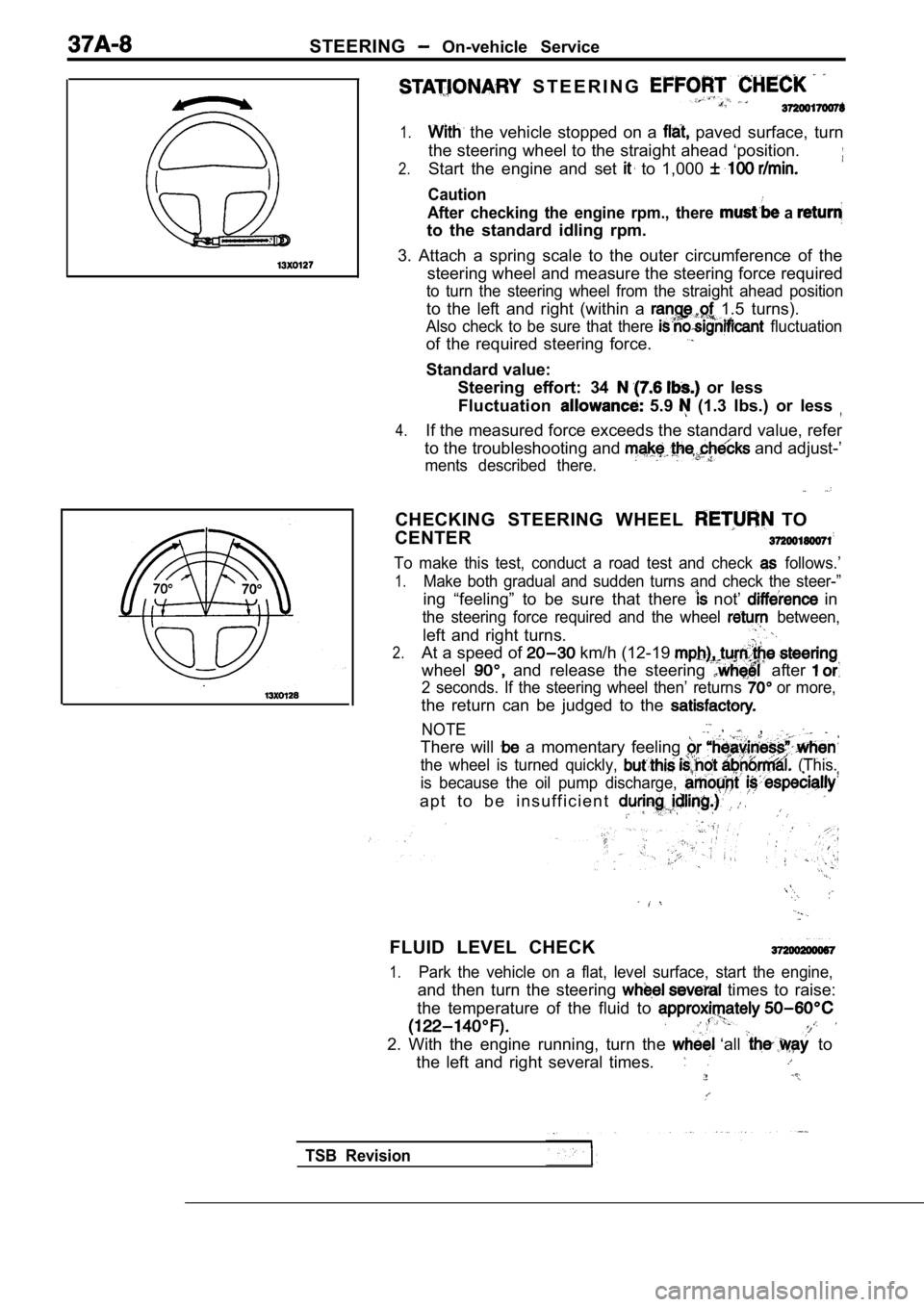
3. Attach a spring scale to the outer circumference of the
steering wheel and measure the steering force requi red
to turn the steering wheel from the straight ahead position
to the left and right (within a 1.5 turns).
Also check to be sure that there fluctuation
of the required steering force.
Standard value:
Steering effort: 34
or less
Fluctuation
5.9 (1.3 Ibs.) or less
4.If the measured force exceeds the standard value, r efer
to the troubleshooting and
and adjust-’
ments described there.
CHECKING STEERING WHEEL TO
CENTER
To make this test, conduct a road test and check follows.’
1.Make both gradual and sudden turns and check the st eer-”
ing “feeling” to be sure that there not’ in
the steering force required and the wheel between,
left and right turns.
2.At a speed of km/h (12-19
wheel and release the steering after
2 seconds. If the steering wheel then’ returns or more,
the return can be judged to the
NOTE ,
There will a momentary feeling
the wheel is turned quickly, (This.
is because the oil pump discharge,
a p t t o b e i n s u f f i c i e n t
FLUID LEVEL CHECK
1.Park the vehicle on a flat, level surface, start th e engine,
and then turn the steering times to raise:
the temperature of the fluid to
2. With the engine running, turn the ‘all to
the left and right several times.
TSB Revision
Page 1783 of 2103
STEERING On-vehicle
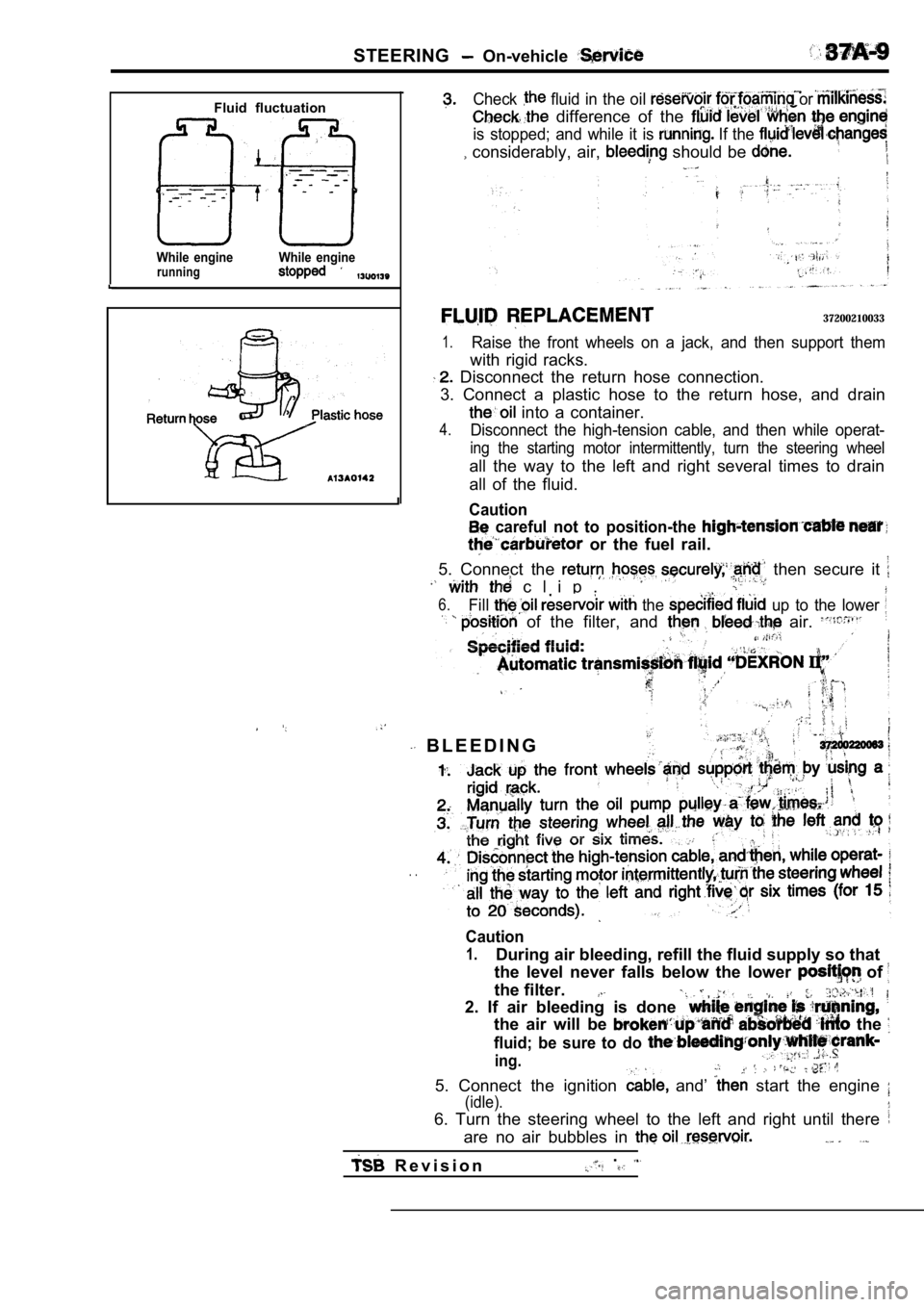
Fluid fluctuation
While enginerunningWhile engine
Check fluid in the oil or
difference of the
is stopped; and while it is If the
considerably, air, should be
37200210033
1.Raise the front wheels on a jack, and then support them
with rigid racks.
Disconnect the return hose connection.
3. Connect a plastic hose to the return hose, and d rain
into a container.
4.Disconnect the high-tension cable, and then while operat-
ing the starting motor intermittently, turn the steering wheel
all the way to the left and right several times to drain
all of the fluid.
Caution
careful not to position-the
or the fuel rail.
5. Connect the then secure it
c l i p .
6.Fill the up to the lower
of the filter, and air.
B L E E D I N G
. .
Caution
1.During air bleeding, refill the fluid supply so tha t
the level never falls below the lower
of
the filter.
2. If air bleeding is done
the air will be the
fluid; be sure to do
ing.
5. Connect the ignition and’ start the engine
(idle).
6. Turn the steering wheel to the left and right un til there
are no air bubbles in
R e v i s i o n.
Page 1784 of 2103
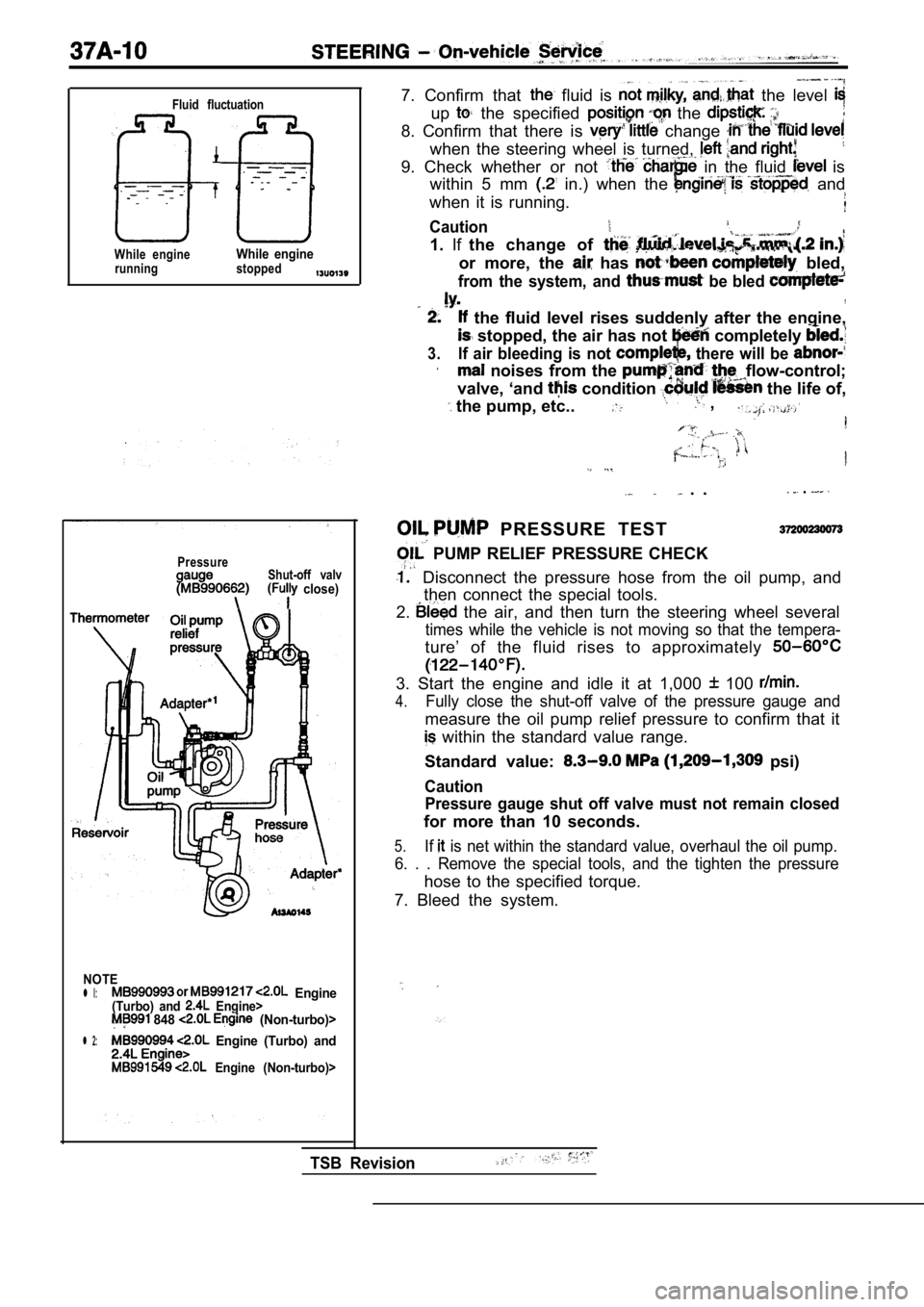
Fluid fluctuation
While engineWhile enginerunning stopped
PressureShut-off valv close)
NOTE
l l: Engine(Turbo) and Engine> 848 (Non-turbo)>
l 2: Engine (Turbo) and
Engine (Non-turbo)>
7. Confirm that fluid is the level
up the specified the
8. Confirm that there is change
when the steering wheel is turned,
9. Check whether or not in the fluid is
within 5 mm
in.) when the and
when it is running.
Caution
1. Ifthe change of
or more, the has bled,
from the system, and be bled ,
the fluid level rises suddenly after the engine,
stopped, the air has not completely
3.If air bleeding is not there will be
noises from the flow-control;
valve, ‘and
condition the life of,
the pump, etc.. ,
. . .
PRESSURE TEST
PUMP RELIEF PRESSURE CHECK
Disconnect the pressure hose from the oil pump, an d
then connect the special tools.
2.
the air, and then turn the steering wheel several
times while the vehicle is not moving so that the t empera-
ture’ of the fluid rises to approximately
3. Start the engine and idle it at 1,000 100
4.Fully close the shut-off valve of the pressure gaug e and
measure the oil pump relief pressure to confirm tha t it
within the standard value range.
Standard value:
psi)
Caution Pressure gauge shut off valve must not remain close d
for more than 10 seconds.
5.If is net within the standard value, overhaul the oil pump.
6. . . Remove the special tools, and the tighten th e pressure
hose to the specified torque.
7. Bleed the system.
TSB Revision
Page 1785 of 2103
STEERING On-vehicle’ Service
PressureShut-off valve(Fully open)
I
Thermometer
NOTE Engine
(Turbo) and
548 Engine (Non-turbo)>
l 2: Engine (Turbo) and
549 Engine (Non-turbo)>
. .. . ..
CHECKING
UNDER NO-LOAD
1. Disconnect. the pressure hose from the oil pump, and
then connect the special tools.
2. Bleed the air, and then turn the steering
several:
times the vehicle is not moving so that the tempera-
ture the fluid rises to approximately
3. the and idle it 100
4.Check whether or not the hydraulic pressure is
dard value when no-load conditions fully
opening the shut-off
of the pressure gauge.
value:
5.If it is not within the standard cause
is a malfunction of the oil
or so
6.
check these parts and repair
Remove the special tools, pressure
hose to the specified torque.
7. Bleed the system.
TSB Revision
Page 1786 of 2103
STEERING On-vehicle Service,.
Shut-off valve
Pressure gauge (Fully open)
I
Thermometer
NOTE
‘ 1 :(Turbo) and Engine> Engine (Non-turbo)>
l 2: Engine (Turbo) and Engine> 549 Engine (Non-turbo)>
STEERING GEAR RETENTION HYDRAULIC PRESSURE
CHECK
Disconnect the hose oil pump,
then connect the’ special tools.
2.Bleed the air, and then turn the steering wheel sev eral
times while the vehicle is moving so that
ture of the fluid rises a p p r o x i m a t e l y
3. Start the engine and it at 1,000 100
4. Fully open the shut-off valve of the pressure ga uge.
5.Turn the steering wheel all the way to the right;
then check whether or not the pressure
is the standard value.
Standard value:
6. not within the standard value; the steering
gear box. ,
Remeasure fluid pressure.:
7. Remove the special tools, and the tighten the pr essure
hose to the specified torque.
8. Bleed the system.
TSB Revision