Page 83 of 143

Engine Oil and Filter
Checking
Check the engine oil a couple of minutes after shutting the engine
off, with the car parked on level ground. Remove the dipstick and wipe it clean. Reinsert it all the way down, then pull it out and read
the level. The level should be between the upper and lower marks.
ENGINE OIL
FILLER CAP
Adding
If the level has dropped close to the lower mark, add oil until it is
even with the upper mark. 1 .Turn the oil filler cap counterclockwise to remove. Add oil, then check the level again. Do not overfill.
2. Reinstall the cap and twist clockwise until it stops.
CAUTION:
Be sure the oil filler cap is correctly replaced before starting the
engine.
Engine oil is a major factor affecting the performance and
service life of the engine; you should use only a premium quality
detergent oil labeled SG grade.
LOOK FOR THIS LABEL
ON THE OIL CONTAINER
Use the proper viscosity oil for the
climate in which you drive:
Some oil labels may also include additional designations of quality
such as CC or CD. However, these are acceptable only when
used together with SG.
NOTE:
5W-30 viscosity
oil is recommended for improved fuel economy.
(cont'd)
Ambient Temperature
UPPER
LOWER
DIPSTICKProCarManuals.comMain Menu t s
Page 84 of 143

Engine Oil and Filter (cont'd)
Fuel Efficient Oil
For the best fuel economy from your car, it is recommended that
you use a fuel efficient SG oil. This oil is usually identified by the words such as: "Energy Conserving II," "Gas Saving," and "Fuel
Saving," etc.
Changing Oil and FilterEngine oil and filter should be changed together every 6 months or
7,500 miles (12,000 km), whichever occurs first. The filter is on the
engine block, below the intake manifold.
CAUTION:
The oil filter cannot easily be removed from above the engine.For this reason it is recommended
that the oil filter change be done by a skilled mechanic.
1. Start the car to warm up the
engine, then shut it off.
2. Remove the engine oil filler cap and drain bolt, and drain the oil. ENGINE OIL DRAIN BOLT
A warmed-up engine and the oil in it are hot; be careful not to burn
yourself.
3. Remove the oil filter and let the remaining oil drain out.
4. Install a new fitter according to
instructions on or with the filter.
OIL FILTERProCarManuals.comMain Menu t s
Page 89 of 143

If the level is between the MIN and MAX marks on the dipstick
add a 50/50 solution of antifreeze and water to bring it up to MAX. If there is no coolant visible on the dipstick, the cooling system
should be checked for leaks and repaired if necessary. Coolantmust then be added to the radiator.
CAUTION:
Radiator coolant will damage paint. Quickly rinse any spilled
coolant from painted surfaces.
Wait until the engine is cool, then turn the radiator cap counterclock-wise until it stops. DO NOT PRESS DOWN WHILE TURNING THECAP. After any remaining pressure has been relieved, remove the
cap by pressing down and again turning it counterclockwise. Add
enough coolant to fill the radiator, and reinstall the cap. Be sure to
tighten it securely. Fill the reserve tank up to the MAX mark with
the engine cold.
Maintenance
1. Check the freeze protection level of the coolant with a hydrometer.
2. Keep the front of the radiator free of dirt and debris.
3. Check hoses and hose clamps regularly.
(cont'd)
MAX
MIN
RESERVE TANKProCarManuals.comMain Menu t s
Page 90 of 143

Cooling System (cont'd)
Thermostat The thermostat in the cooling system does not need to be changedfor summer or winter operation. However, for extremely cold
climates, an optional thermostat is available from your Honda dealer.
Replacing CoolantReplace coolant at 36 months or 45,000 miles (72,000 km),
whichever comes first. Thereafter, replace every 2 years or 30,000
miles (48,000 km), whichever comes first.
RADIATOR COOLANT
REFILL CAPACITY:
including reserve tank 0.75 l (0.198 US gal, 0.165 Imp gal)
Manual transmission 2.0 S: 5.15 l (1.361 US gal, 1.133 Imp gal)
2.0 Si,Si: 6.15 l (1.625 US gal, 1.353 Imp gal)
Automatic transmission 2.0S:5.85 l (1.546 US gal, 1.287 Imp gal)
2.0 Si,Si: 6.15 l (1.625 US gal, 1.353 Imp gal)
1. Set the heater temperature lever to maximum heat.
2. Remove the radiator cap and loosen the drain plug when the radiator is cool, and drain the radiator.
RADIATOR
CAP BLEED BOLT
DRAIN BOLT
3. Remove the drain bolt from the front side of the cylinder block, and drain the engine and heater.
4. Apply non-hardening sealant to the drain bolt threads, then reinstall the bolt and tighten it securely.
5. Tighten the radiator drain plug securely.
DRAIN
PLUGProCarManuals.comMain Menu t s
Page 94 of 143
Wiper Blades
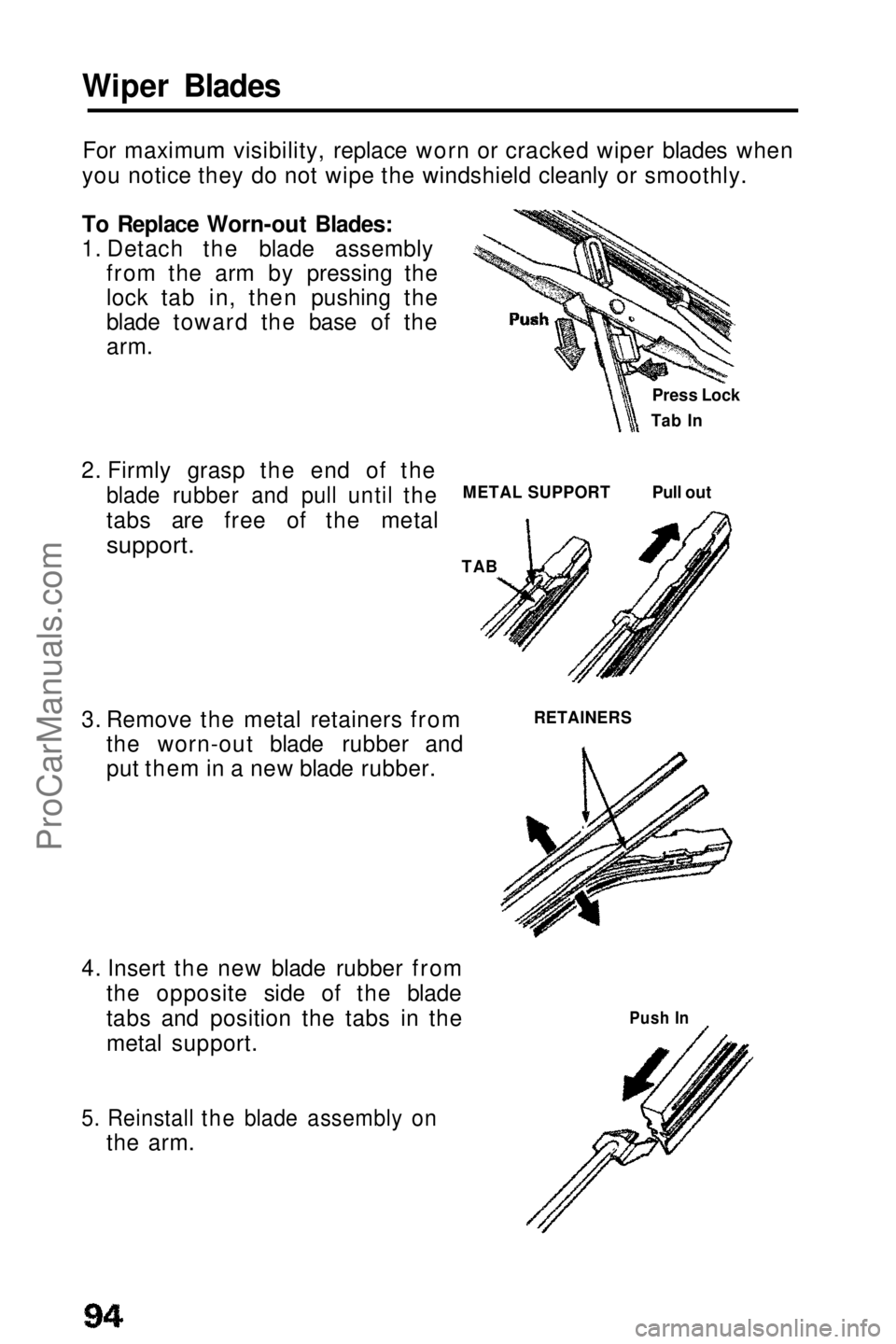
For maximum visibility, replace worn or cracked wiper blades when
you notice they do not wipe the windshield cleanly or smoothly.
To Replace Worn-out Blades:
1. Detach the blade assembly from the arm by pressing the
lock tab in, then pushing the
blade toward the base of the
arm.
2. Firmly grasp the end of the
blade rubber and pull until the
tabs are free of the metal
support.
METAL SUPPORT
TAB
Pull out
3. Remove the metal retainers from the worn-out blade rubber and
put them in a new blade rubber. RETAINERS
4. Insert the new blade rubber from the opposite side of the blade
tabs and position the tabs in the
metal support.
5. Reinstall the blade assembly on
the arm. Press Lock
Tab In
Push InProCarManuals.comMain Menu t s
Page 99 of 143
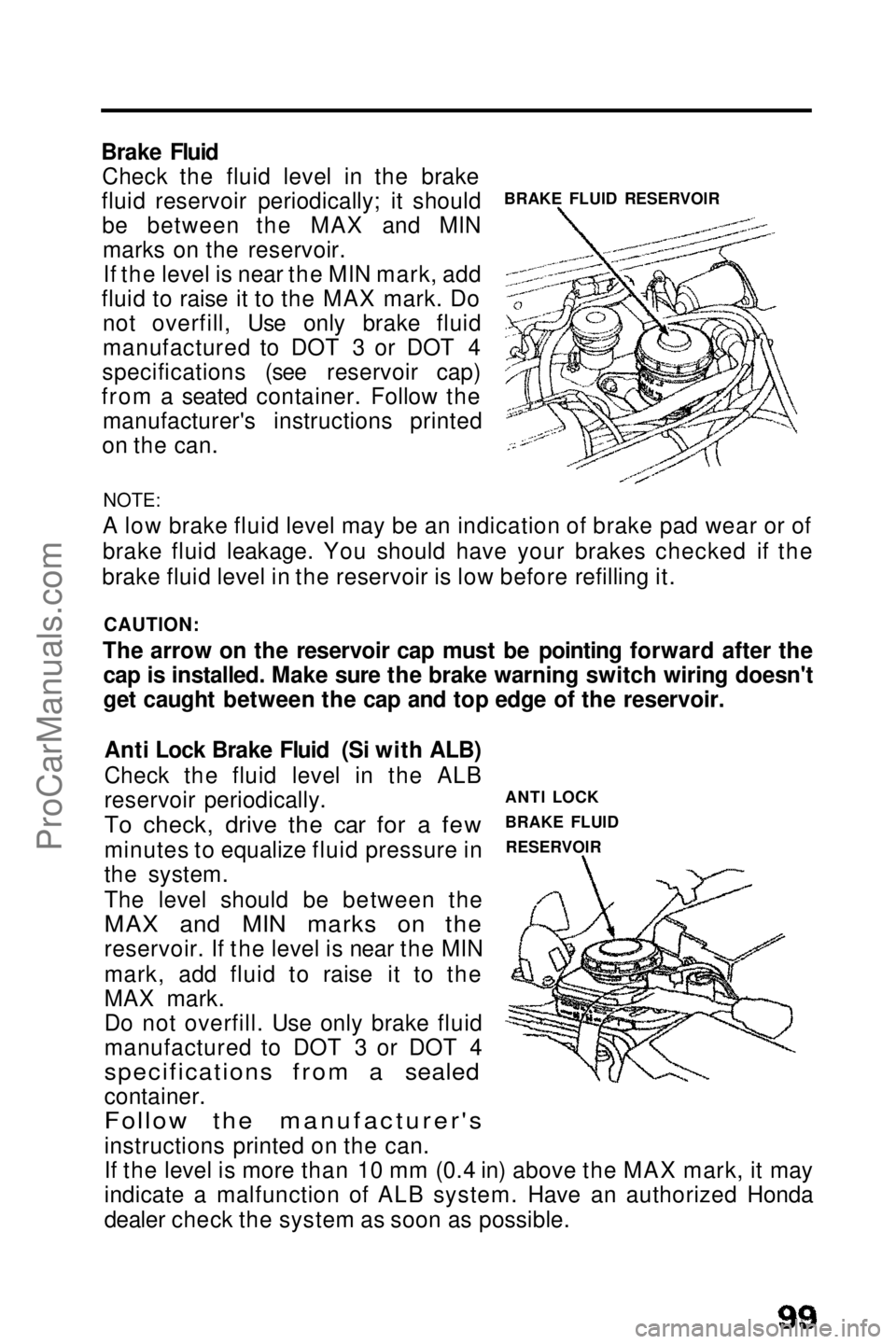
BRAKE FLUID RESERVOIR
Brake Fluid
Check the fluid level in the brake
fluid reservoir periodically; it should be between the MAX and MINmarks on the reservoir.If the level is near the MIN mark, add
fluid to raise it to the MAX mark. Do not overfill, Use only brake fluid
manufactured to DOT 3 or DOT 4
specifications (see reservoir cap)
from a seated container. Follow the manufacturer's instructions printed
on the can.
NOTE:
A low brake fluid level may be an indication of brake pad wear or of
brake fluid leakage. You should have your brakes checked if the
brake fluid level in the reservoir is low before refilling it.
CAUTION:
The arrow on the reservoir cap must be pointing forward after the cap is installed. Make sure the brake warning switch wiring doesn't
get caught between the cap and top edge of the reservoir.
ANTI LOCK
BRAKE FLUIDRESERVOIR
Anti Lock Brake Fluid (Si with ALB)
Check the fluid level in the ALB
reservoir periodically.
To check, drive the car for a few
minutes to equalize fluid pressure in
the system.
The level should be between the
MAX and MIN marks on the
reservoir. If the level is near the MIN
mark, add fluid to raise it to the
MAX mark.
Do not overfill. Use only brake fluid
manufactured to DOT 3 or DOT 4
specifications from a sealed
container.
Follow the manufacturer's
instructions printed on the can.
If the level is more than 10 mm (0.4 in) above the MAX mark, it may
indicate a malfunction of ALB system. Have an authorized Honda
dealer check the system as soon as possible.ProCarManuals.comMain Menu t s
Page 116 of 143
Changing a Flat Tire
Do not attempt to change a tire unless the car is on firm, level
ground and well out of the flow of traffic.
Park the car on a firm, level surface, apply the parking brake, turn
on the hazard warning switch and put the transmission in gear (Park
for automatic).
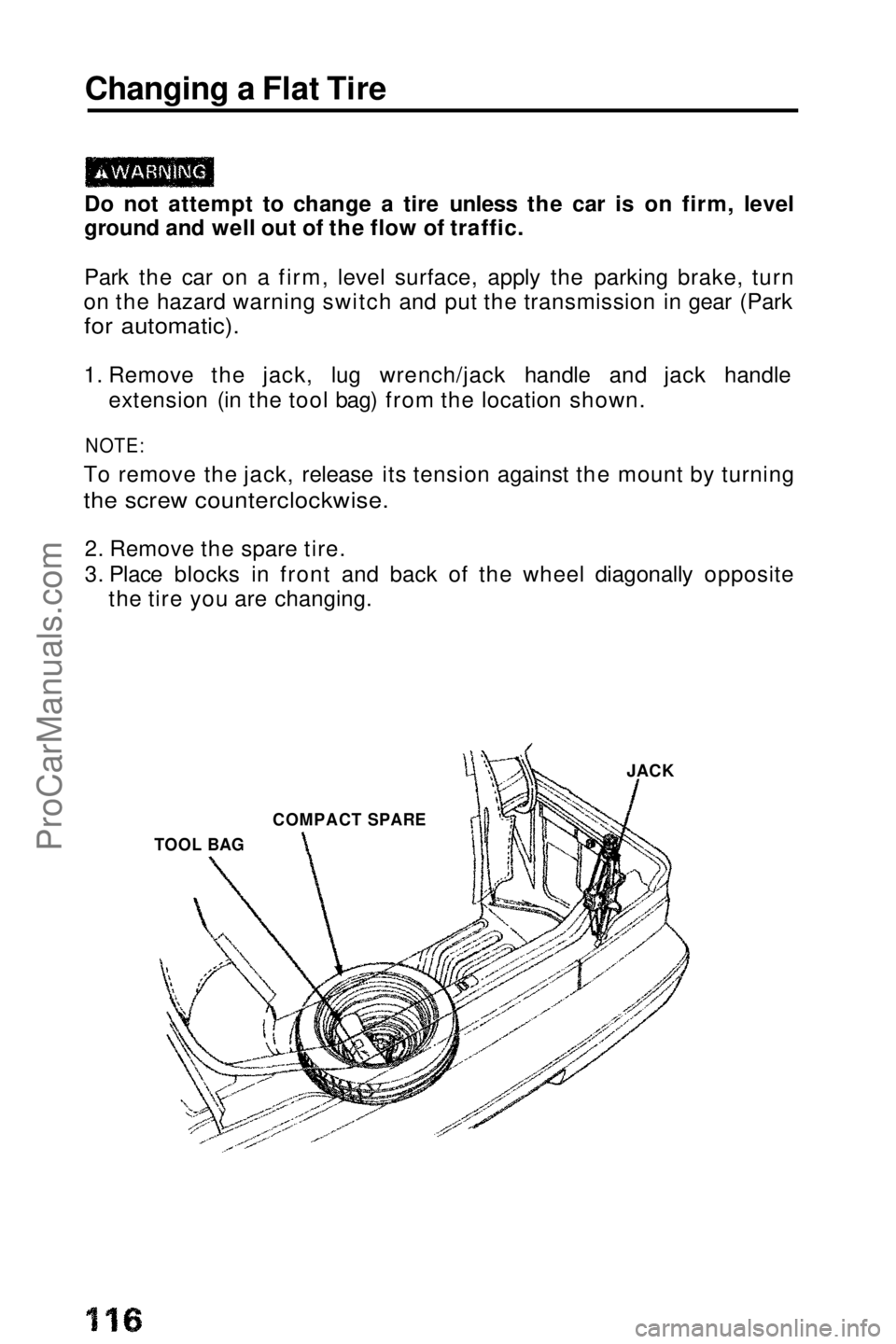
1. Remove the jack, lug wrench/jack handle and jack handle extension (in the tool bag) from the location shown.
NOTE:
To remove the jack, release its tension against the mount by turning
the screw counterclockwise.
2. Remove the spare tire.
3. Place blocks in front and back of the wheel diagonally opposite the tire you are changing.
JACK
COMPACT SPARE
TOOL BAGProCarManuals.comMain Menu t s
Page 117 of 143

4. (2.0 Si,Si)
Remove the center cap from the wheel cover by turning the lock
to 90°.
(Si with 4WS or ALB)
Remove the center cap from the wheel by prying it out with a
common flat screwdriver (not provided in the tool bag).
(2.0 Si,Si)
CAUTION:
(On the Si model with 4WS or ALB)
Hold the center cap with your hand then pry it off using a rag to
protect the
cap and the wheel.
5. Use the lug wrench to loosen the wheel lug nuts
counterclockwise one-half turn.
Follow tire changing preparations and procedures carefully to
reduce the possibility of injury. The jack
is designed for changing
tires only.
STAND CLEAR, DO NOT get under the car and DO NOT
run the engine when the car Is supported only by the jack.
6. Place the jack under the jack point nearest the wheel you are removing; align the jack head so the car frame will fit in the recess
as you raise the jack.
To reduce the possibility of injury, be sure to use the jack provided with the car and the correct jacking points; never use any otherpart of the car for jack support.
RAG
(cont'd)
CENTER CAP
CENTER CAP
(Si with 4WS or ALB)
FLAT
SCREWDRIVERProCarManuals.comMain Menu t s