Page 54 of 143
Sunroof (cont'd)
If the Sunroof Won't Close
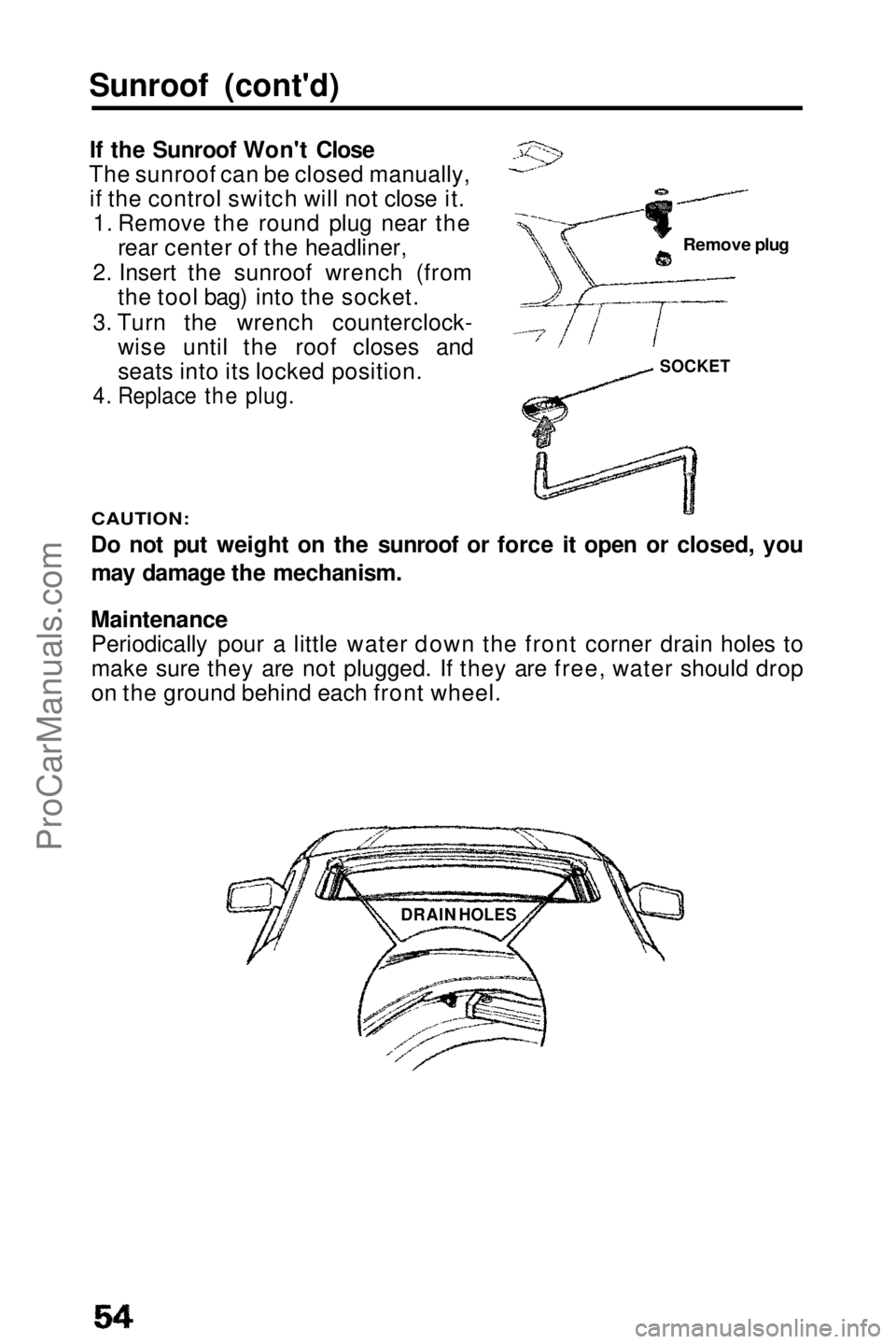
The sunroof can be closed manually, if the control switch will not close it. 1. Remove the round plug near the rear center of the headliner,
2. Insert the sunroof wrench (from the tool bag) into the socket.
3. Turn the wrench counterclock- wise until the roof closes and
seats into its locked position.
4. Replace the plug.
CAUTION:
Do not put weight on the sunroof or force it open or closed, you
may damage the mechanism.
Maintenance
Periodically pour a little water down the front corner drain holes to
make sure they are not plugged. If they are free, water should drop
on the ground behind each front wheel.
Remove plug
SOCKET
DRAIN HOLESProCarManuals.comMain Menu t s
Page 56 of 143

Gasoline (cont'd)
NOTE:
Fuel system damage or vehicle performance problems resulting
from the use of such fuels is not covered under the new car warranties. Honda cannot endorse the use of fuels containingmethanol since evidence of their suitability is as yet incomplete. Before purchasing fuel from an unfamiliar station, try to confirm
whether the fuel contains alcohol; of what kind, and how much. If
you notice any undesirable operating symptoms after using a
gasoline that contains alcohol, or one that you think contains
alcohol, switch to an unleaded gasoline, as recommended on page 55.
Operation In Foreign Countries In order to comply with U.S. Federal Emissions Regulations, you
must use unleaded fuels of the recommended octane rating. These
fuels may not be available in other countries. If you intend taking your car outside the U.S. or Canada, write to American Honda
Consumer Affairs (stating the year and model of your car) at the
address below for information regarding modifications you mayneed to have done.
American Honda Motor Co., Inc.
Consumer Affairs
100 W. AIondra Blvd.,
Gardena, CA 90248
Fuel Filler Door and Cap
Gasoline is extremely flammable and is explosive under certain
conditions. Perform this operation in a well-ventilated area with
the engine stopped. Do not smoke or allow open flames or sparks in the area or where gasoline is stored.
The fuel filler door is opened by pulling up on the lever at the leftside of the driver's seat.
The door will lock automatically when closed; push it until it clicks.
CAUTION:
You may hear a hiss when you open the filler cap. This sound is residual pressure escaping from the fuel tank. Open the cap slowly
and remove the cap after the hissing stops. Do not overfill the tank;
fill only until the gas pump clicks off automatically and never top off.ProCarManuals.comMain Menu t s
Page 58 of 143

Ignition Switch
The combined ignition switch/anti-theft lock is located on the right side of the steering column and has four positions:
0-LOCK position: The key can be removed or inserted in thisposition. To remove the key, push it in at position I, then turn it to
0 and pull it out. When the key is removed, the steering column
will lock.
NOTE:
On cars equipped with automatic transmissions, the transmission
must be in Park before pushing and turning the key to the O-LOCK position.
Never turn the ignition switch to the lock position or remove the
key while the car is in motion; the steering wheel can lock causing
a loss of directional control, and an accident could result. I-ACCESSORY position: In this position, the accessory circuit is
on, but the ignition circuit is off.
If the key is difficult to turn from the 0 to the I position, turn the
steering wheel slightly to relieve pressure on the lock.
II-ON position: This Is the normal running position.
III-START position: The starter will engage when the key is
turned to this position.
To remind you to remove the ignition key when leaving your car, a beeper will sound if the key is still in the ignition when you open the
driver's door. The beeper system is deactivated when you turn the ignition to 0 (Lock) and fully remove the key.ProCarManuals.comMain Menu t s
Page 63 of 143

Safety Items
Before driving away, check that: The doors are closed properly. The mirrors are properly adjusted, and the windows clean.
The driver and passengers are wearing properly adjusted seat
belts.
The head restraints are properly adjusted.
The warning and indicator lights are operating properly.
The brake pedal feels normal.
All luggage and cargo is secured.
Nothing is interfering with the driver's feet or blocking vision to
the rear.
While driving remember to: Always drive defensively; expect the unexpected. Reduce your speed during night hours and bad weather.
Follow at a safe distance; don't tailgate.
Get off the highway when you are tired; stop and take a rest.
When stopping for repairs: Park the car well off the road.
Turn on the hazard warning flasher. Use flares or other warning devices to warn other motorists.
After parking your car: Apply the parking brake and shift to first gear if equipped withmanual transmission, or PARK on automatic transmission
equipped cars.
Make sure the windows are closed and all doors are locked.
If parked on a hill:
Turn the front wheels away from the curb if facing uphill.
Turn the front wheels toward the curb if facing downhill. Never leave children unattended in a parked car.
Take your
keys.ProCarManuals.comMain Menu t s
Page 65 of 143
Shifting the 5 Speed
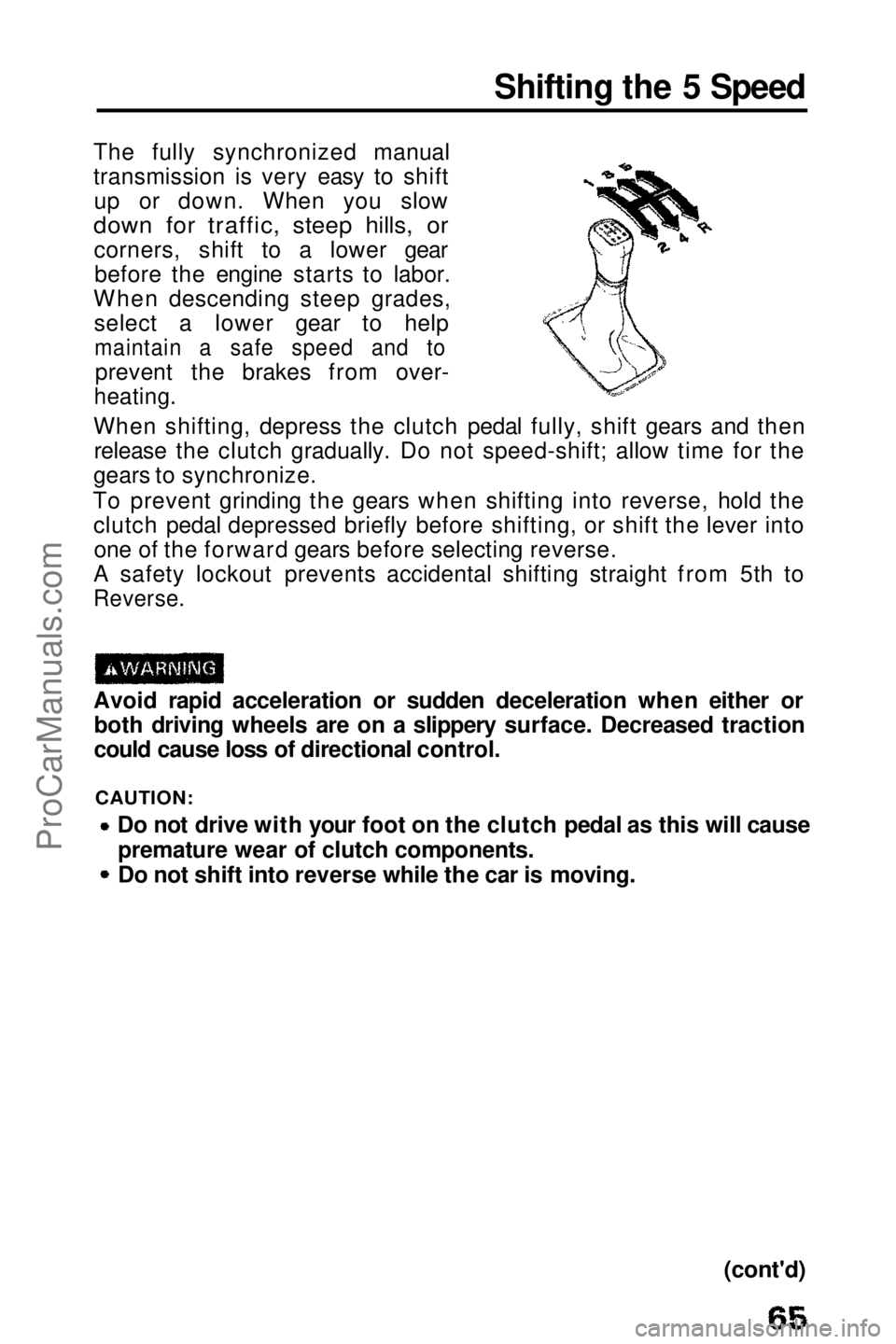
The fully synchronized manual
transmission is very easy to shift up or down. When you slow
down for traffic, steep hills, or
corners, shift to a lower gearbefore the engine starts to labor.
When descending steep grades, select a lower gear to help
maintain a safe speed and to
prevent the brakes from over-
heating.
When shifting, depress the clutch pedal fully, shift gears and then release the clutch gradually. Do not speed-shift; allow time for the
gears to synchronize.
To prevent grinding the gears when shifting into reverse, hold the clutch pedal depressed briefly before shifting, or shift the lever intoone of the forward gears before selecting reverse.
A safety lockout prevents accidental shifting straight from 5th to
Reverse.
Avoid rapid acceleration or sudden deceleration when either or both driving wheels are on a slippery surface. Decreased traction
could cause loss of directional control.
CAUTION:
Do not drive with your foot on the clutch pedal as this will causepremature wear of clutch components.
Do not shift into reverse while the car is moving.
(cont'd)ProCarManuals.comMain Menu t s
Page 67 of 143

Shifting the Automatic
The automatic transmission shift lever has a locking mechanism to prevent accidental shifting into Reverse (R), Park (P) or 2nd (2). Also,
the Automatic Shift Lock prevents you from shifting out of Park unless the brake pedal is already depressed and the ignition switch isin the II position.
Push the button on the shift handle to shift into 2nd, Reverse or
Park; depress the brake pedal and then push the button on the shifthandle to shift out of Park.
: Depress the brake pedal first and push the button, then shift.
: Push the button, then shift.
: Shift as desired.
If you cannot shift out of Park with
the brake pedal depressed and the ignition switch in the II position:
1. Turn the ignition switch off and
remove the key.
2. Insert the key in the Shift Lock Release located to the right of the
shift lever.
3. Press and hold the key down, then press the button on the shifthandle and move the shift lever to
Neutral.
4. Return the key to the ignition switch, depress the brake pedal
and restart the engine. Depress
buttonNOTE:
If you
encounter any problem shifting out of Park, have your
authorized Honda dealer check the system as soon as possible. KEY
Insert
SHIFT LOCK RELEASE
(cont'd)ProCarManuals.comMain Menu t s
Page 68 of 143

Operating Tips
For smoother operation, apply the brakes when shifting from
Neutral or Park to a forward or reverse gear.
When parking: bring the car to a stop with the foot brake, hold the brake on and shift into Park, set the hand brake and then turn off
the engine.
NOTE:
Your 4 speed automatic transmission is equipped with a torque
converter lock-up clutch. Because of this, you may notice what
feels like an extra shift as the clutch engages.
CAUTION: Shift into P only after the car has come to a complete stop.
Shift into or out of R only after the car has come to a complete
stop.
Do not "rev-up" the engine when the brake is on and the shift
lever is in D, S, 2 or R.
When stopped on a hill, use the brakes to hold your position, not the accelerator pedal.Do not shift from N or P into D, S, 2 or R when the engine is
above idle speed. Before shifting into gear, make sure your foot
is firmly on the brake pedal. Do not rest your hand on the shift lever or push the shift button
while driving.
Driving Technique
D-4th
Use the D range for normal in-town and highway driving. The car
will start off in 1st and shift automatically to 2nd, 3rd, and 4th. The
further down you push the accelerator, the later the transmission will shift and the faster the car will accelerate.
S3/S4
The "S" shift selector range changes the shift points under part
throttle acceleration, allowing the transmission to stay in each lower
gear for a longer period before automatically upshifting. With the shift selector in the "S" range, the "S3" indicator light in the dashpanel will come on and the transmission will shift from 1st to 2nd
and 3rd but not 4th. This is especially useful when climbing or
descending grades. While driving in the "S" range, the car's performance is improved but fuel economy is reduced.
Shifting the Automatic (cont'd)ProCarManuals.comMain Menu t s
Page 82 of 143
Fluid Locations
AUTOMATIC TRANSMISSIONFLUID DIPSTICK
POWER STEERING
FLUID RESERVOIR
ANTI LOCK BRAKE
FLUID RESERVOIR (Si with ALB) ENGINE OIL
FILLER CAP
CLUTCH FLUID
RESERVOIR (Manual Transmission Only)
RADIATOR
RESERVE
TANK CAP
RADIATOR
CAP ENGINE OIL
DIPSTICK WASHER FLUID
RESERVOIR BRAKE FLUID
RESERVOIRProCarManuals.comMain Menu t s