1988 FIAT TEMPRA belt
[x] Cancel search: beltPage 61 of 171

PART A: ENGINE
PART A: Contents
Job 1. Petrol engine. Timing belt
-
replacement and Job 12. Petrol engine. Mountings
-
replacement.
adjustment. Job 13. Diesel engine. Timing belt
-
replacement and
Job 2. Petrol engine. Cylinder head
-
removal. adjustment. •
Job 3. Petrol engine. Cylinder head and camshaft housing -Job 14. Diesel engine. Cylinder head
-
removal.
refitting. Job 15. Diesel engine. Cylinder head
-
refitting.
Job
4.
Petrol engine. Cylinder head
-
dismantling and Job 16. Diesel engine. Cylinder head
-
overhaul.
overhauling. Job 17. Diesel engine. Valve clearances
-
adjustment.
Job 5. Petrol engine
-
dismantling. Job 18. Diesel engine
-
removal.
Job
6.
Petrol engine
-
checking and reassembly. Job 19. Diesel engine
-
refitting.
Job
7.
Petrol engine. Valve clearances
-
adjustment. Job 20. Diesel engine. Mountings
-
replacement.
Job 8. Petrol engine/transmission
-
removal. Job 21. Diesel engine/transmission (removed from car)
-
Job
9.
Petrol engine/transmission
-
refitting. separation.
Job 10. Petrol engine/transmission (removed from car)
-
Job 22. Diesel engine/transmission (removed from car)
-
separation. reconnection.
Job 11. Petrol engine/transmission (removed from car)
-
Job 23. Diesel engine
-
dismantling.
reconnection. Job 24. Diesel engine
-
reassembly.
Job 1. Petrol engine. Timing belt
- replacement and adjustment.
Mi*^^ Zc+sc, / • The crankshaft pulley nut
n^^ will be difficult to turn.
• If the engine is in the car,
engage a gear (or 'Park' in the case of an automatic)
and have an assistant hold the footbrake down very
firmly. This will stop the engine from turning.
• Alternatively, with the starter motor removed, you
can have a helper prevent the flywheel ring gear from
turning with a large screwdriver.
• Step 4: Before removing the belt, put the pulley nut back
onto the crankshaft, take the car out of gear (if the engine is
still in the car) and remove the spark plugs. You can now turn
the engine in a clockwise direction using the refitted crank
pulley nut
-
without the pulley, of course!
• Step 5A: With
the timing belt still in
place, turn the engine
so that the timing
mark on the camshaft
sprocket lines up with
the one on the front
cover. On some
engines, the front
cover looks like this...
• Step 5B:
...while on the
majority, it looks
like this. The top
part of the cover
backplate slides
out so that the
plastic pip is level
with the camshaft
sprocket. Turn
the sprocket so that the timing mark on the sprocket lines up
with this pip.
IMPORTANT NOTE: It is false economy to refit a used
timing belt. If the belt breaks, it will cause complete
engine failure so always fit a new one.
• Step 1:
Disconnect the battery
and
remove the
alternator drivebelt as
described in PART C:
COOLING
SYSTEM
0 Step 2: Take off
the timing
belt cover.
This is held
by a total
of
four bolts (arrowed).
• Step 3: Take off
the
crankshaft pulley
nut and
remove the
pulley.
Page 62 of 171
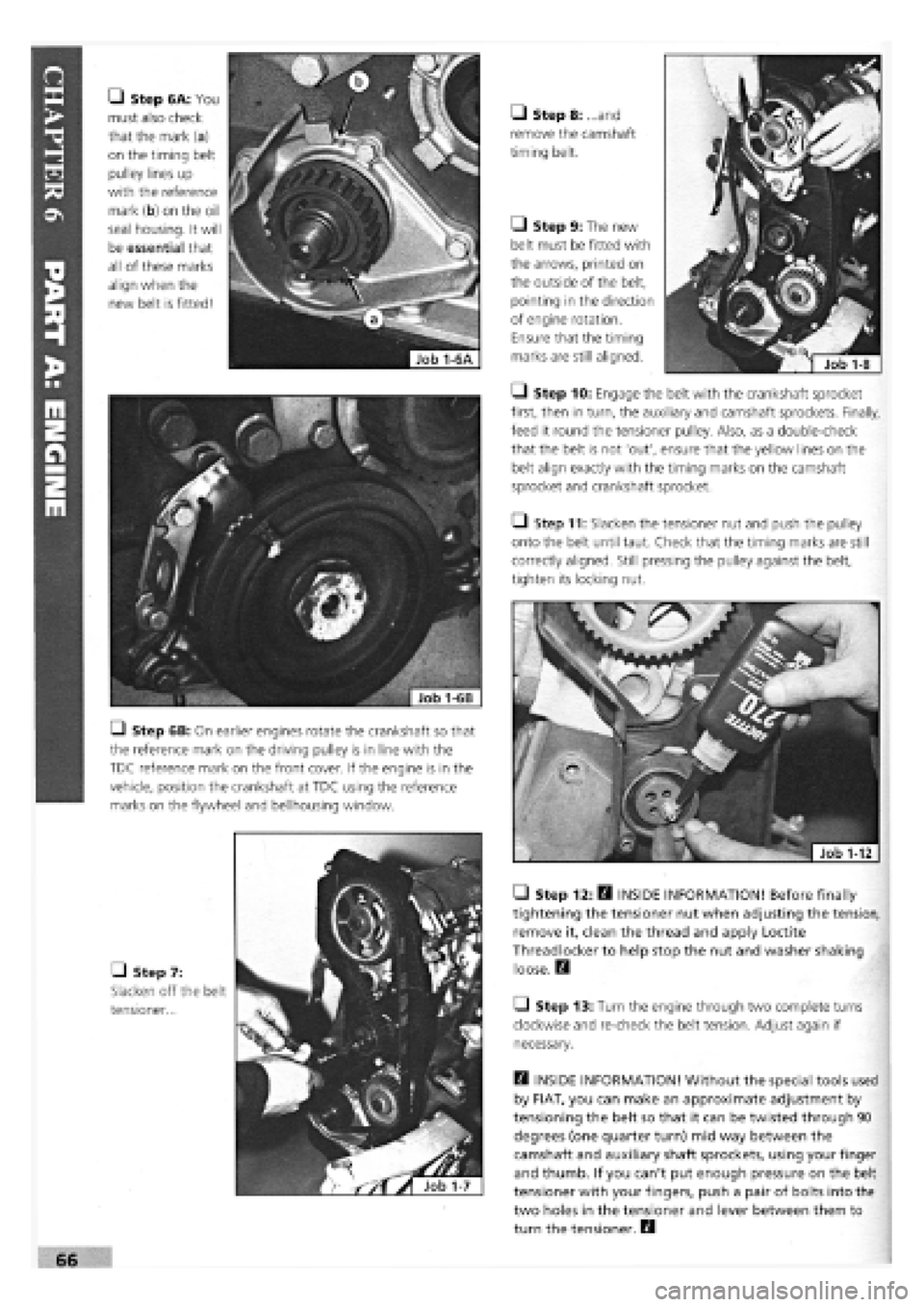
• Step 6A: You
must also check
that the mark (a)
on the timing belt
pulley lines up
with the reference
mark (b) on the oil
seal housing. It will
be essential that
all of these marks
align when the
new belt is fitted!
Q Step 6B: On earlier engines rotate the crankshaft so that
the reference mark on the driving pulley is in line with the
TDC reference mark on the front cover. If the engine is in the
vehicle, position the crankshaft at TDC using the reference
marks on the flywheel and bellhousing window.
• Step 7:
Slacken off the belt
tensioner...
• Step 8: ...and
remove the camshaft
timing belt.
Q Step 9: The new
belt must be fitted with
the arrows, printed on
the outside of the belt,
pointing in the direction
of engine rotation.
Ensure that the timing
marks are still aligned.
• Step 10: Engage the belt with the crankshaft sprocket
first, then in turn, the auxiliary and camshaft sprockets. Finally,
feed it round the tensioner pulley. Also, as a double-check
that the belt is not 'out', ensure that the yellow lines on the
belt align exactly with the timing marks on the camshaft
sprocket and crankshaft sprocket.
Q Step 11: Slacken the tensioner nut and push the pulley
onto the belt until taut. Check that the timing marks are still
correctly aligned. Still pressing the pulley against the belt,
tighten its locking nut.
• Step 12: H INSIDE INFORMATION! Before finally
tightening the tensioner nut when adjusting the tension,
remove it, clean the thread and apply Loctite
Threadlocker to help stop the nut and washer shaking
loose. Q
Q Step 13: Turn the engine through two complete turns
clockwise and re-check the belt tension. Adjust again if
necessary.
Q INSIDE INFORMATION! Without the special tools used
by FIAT, you can make an approximate adjustment by
tensioning the belt so that it can be twisted through 90
degrees (one quarter turn) mid way between the
camshaft and auxiliary shaft sprockets, using your finger
and thumb. If you can't put enough pressure on the belt
tensioner with your fingers, push a pair of bolts into the
two holes in the tensioner and lever between them to
turn the tensioner. B
Page 63 of 171

Job 2. Petrol engine. Cylinder
head • removal.
• Step 1: Take note of the parts shown in this drawing -
which is also relevant to several other jobs on Tipo and
Tempra petrol engines.
7
-
cirdip 8
-
plate 9
-
flywheel 10-spigot bearing
11 -
thrust bearing 12
-
main bearing 13-crankshaft
14 - sump 15 - sump gasket 16 - oil seal 17 - auxiliary shaft cover 18 - gasket 19 - front oil seal housing 20 - oil seal 21 - bush 22 - auxiliary shaft 23 - drive gear 24 - dipstick 25 - oil pump 26 - auxiliary shaft sprocket
1
-
piston 2
-
gudgeon pin 3
-
connecting rod 4
-
big-end bearing 5
-
big-end bolt 6
-
small-end bush
27 28 29 30 31 32 33 34 35 36 37 38 39
turbo 40 - exhaust manifold - turbo 41 - exhaust manifold - non-turbo 42 - heated air duct 43 - camshaft cover 44 - camshaft housing 45 - oil seal 46 - camshaft 47 - tappet shim 48 - oil seal 49 - tappet body 50
-
valve, top cap Job 2-1
- crankshaft sprocket - tensioner pulley - timing belt cover - camshaft sprocket - camshaft belt - bracket - end plate - cylinder head gasket - cylinder head - timing belt - rear cover - inlet manifolds - turbo - plenum chamber
-
turbo - inlet manifold - non-
51 - valve spring - inner 52 - valve spring
-
outer 53 - valve, top cap 54 - washer 55 - valve guide 56 - valve 57 - end plate 58 - rear oil seal housing 59 - block 60 - oil seal 61 - sump drain plug
Q INSIDE INFORMATION! • Before removing the
cylinder head, make sure the engine is stone cold.
• Undo the cylinder head bolts strictly in the order laid
out in Step 18.
• These precautions help to prevent cylinder head
distortion.
• The new cylinder head gasket should stay in its
packaging until required, to avoid contamination by oil
or grease.
B
FACT FILE: SPECIAL TOOL PROBLEMS
SOLVED!
• It is possible to remove and replace the
cylinder head complete with the camshaft
housing - but it is very difficult without
FIAT's special cranked tool to get round the camshaft
housing.
• You CAN undo the bolts with a ring spanner, but you
CAN'T torque them down properly again!
• Because the gasket between the housing and the head could
also be suspect, we strongly recommend that you do it 'our'
way, by removing the camshaft housing even though you will
have to re-set the valve clearances.
Page 65 of 171

• Step 14B: INJECTION ENGINES. Disconnect the
butterfly valve opening sensor connection (see illustration Job
2-13B,
part b) and the earth cable (Job
2-13B,
part c).
Q Step 15: Remove the
timing belt. See Job 1.
• Step 16: Unbolt and
remove the camshaft sprocket.
If necessary, use a screwdriver
held
through the sprocket
against a mounting bolt behind
it,
to stop it from turning.
• Step 17:
Remove the timing
belt
tensioner but
note
that it is in
three parts.
• Step 18: Unbolt and
remove
the timing belt
backplate. You could leave the
bottom half in place, if you are
going no further than removing
the
cylinder head.
• Step 19: Take
off
the six
nuts and
washers
holding the
cam
cover in place
and
remove it.
• Step 20: The
camshaft housing
can
now be
removed in order to
access
the cylinder
head
bolts. Slacken
the
12
housing
bolts
progressively,
so that
no strain is
put on
the housing
through
the valve
springs.
Job
2-20
|
• Step 21: The
camshaft housing
can now be lifted
away. Note the
gasket positioning
and fit a new one
on reassembly.
• Step 22:
H INSIDE
INFORMATION: If
the cam followers
are loose, you
may wish to
remove them now
so that they don't
fall out and lose
their position.
Keep them in the
correct order so that
they can go back
where they came from
on reassembly. D
• Step 23: Start
removing the cylinder
head by removing the 4
or 5 small cylinder head
bolts (according to
model)...
^Hob^l]
• Step 24:
...numbered
1
to
4 or 5, slackening
them in the order
shown.
• Step 25:
Now slacken the
remaining 10
bolts half a turn
at a time, in the
order shown'in
Step 24, until all
are loose, and
then remove
them with their
washers.
ft ft ft ft tt
Job 2-24
Page 67 of 171

G Step 6: Fit the four or five smaller bolts, according to
model (see illustration Job
3-4,
arrowed) close to the spark
plug holes, and tighten to their specified torque. See Chapter
3, Facts
and Figures.
G Step 7: All items previously removed in Job 2 can now be
fitted in reverse order. When connecting the exhaust always
use a
new flange gasket.
G Step 8: Ensure that all connections are sound and secure.
G Step 9: All items previously removed in Job 2 can now be
fitted in reverse order. Refer to Job
1
when fitting the timing
belt.
When connecting the exhaust always use a new flange
gasket.
G Step 10: Ensure that all connections are sound and
secure.
G Step 11: Top up the cooling system with the correct
50/50
solution of FL 'Tutela' anti-freeze solution. Check the
oil
level.
• Step 5: Clean and check all components for wear and
signs of 'scuffing'.
B INSIDE INFORMATION! If the camshaft is changed, the
followers should be changed as well. If the bores in the
housing have 'picked up', these cannot be machined and
the housing should be replaced together with new cam
followers. B
• Step 6: Refit the camshaft to the cam housing and insert
the cam followers and shims in their correct bores, using
grease to keep them in place. For adjustment of valve clear-
ances see Job 7.
2 ZeASt, s * when re'inserti"9the
nfW^c/ !X J?^ camshaft, it can be difficult
to get the camshaft fully in
to its end seal. DON'T try hammering it in
-
all you'll
do is damage the seal. Lubricate the seal with fresh
engine oil, insert the camshaft until it is aligned with
and just touching the seal. Push the camshaft with a
twisting motion until it eases its way into the seal.
Job 4. Petrol engine.
Cylinder head - dismantling and
overhauling.
G Step 3: Remove the
cam
followers and shims
from
the housing,
keeping them in the
correct order for refitting
in the
same positions.
Refer to the illustration Job
2-1
for the components covered
in this
Job.
G Step 1: Remove the camshaft housing from the cylinder
head. See Job 2.
G Step 2: Remove the
camshaft housing end
plate
(or the distributor
mounted in the same
place on
certain models).
G Step 4: Slide the
camshaft out, taking
care not to damage the
camshaft bearings with
the cam
lobes.
• Step 7: Use a suitable valve spring compressor to
compress each spring in turn to allow the removal of the split
collets from the valve stems. Inexpensive valve spring
compressors are readily available from auto, accessory stores.
Take care not to lose the collets when releasing the spring
compressor.
Q Step 9: The valve spring caps, springs and spring seats
can all be lifted clear and the valves withdrawn from their
guides.
• Step 8:
These are the
items to be
removed once
the valve is
withdrawn.
1 - flat washer 2 - lower cap 3 - inner spring
4 - outer spring 5 - upper cap 6 - collets Job 4-8
Page 69 of 171

G Step 17: Now repeat this operation on the remaining
valves.
G Step 18: Wash the whole cylinder head again using
paraffin and an old brush, making sure that all traces of
grinding paste are removed, then dry off. Use compressed air
if
available.
SAFETY FIRST!
•
Treat
compressed air with respect. Always wear
goggles
to protect your eyes.
•
Never
allow the airline nozzle near any of the body Sep apertures.
H INSIDE INFORMATION! Check the height of the valve
springs against new ones if possible, but if not, compare
them with each other. If any are shorter than the others,
play safe and replace the complete set. They are bound
to have suffered fatigue which could cause premature
valve failure. H
G Step 19: To install the valves, start from one end.
Lubricate a valve stem with fresh engine oil and slide it in to its
guide.
G Step 20: Locate a new valve stem seal over the stem of
the valve
(if applicable) and push down into contact with the
guide. Position the seal on its seat using a suitable metal tube.
G Step 21: Refit the flat washer and spring seat.
G Step 22: Position the inner and outer springs and the
spring
cap.
G Step 23: Re-apply the valve spring compressor and
compress
the springs enough to allow you to engage the split
collets
in
the stem grooves.
D INSIDE INFORMATION! Grease the grooves so that the
collets will 'stick' in place. The collets are easily fitted by
'sticking' the backs of them onto the end of a screw-
driver with some grease and feeding them into
position. B
G Step 24: Carefully release the spring compressor and
check
that the collets are correctly located. Tap the end of the
stem with
a hammer, to bed them in.
G Step 25: Fit the remaining valves.
Job 5. Petrol engine -
dismantling.
G Step 1: Familiarise yourself with the layout of the engine.
Refer to
illustration Job
2-1
for an exploded view of the
engine
components.
G Step 2: Drain the engine oil. Remove the cylinder head.
See
Job 2.
G Step 3: Remove the distributor. See PART D: IGNITION
• Step 4:
Remove the petrol
pump and spacer
block, if the
mechanical type
(a). (Electric fuel
pumps are in the
fuel tank.)
• Step 5:
Remove and
discard the oil filter
illustration Job
5-4,
• Step 6: Remove the water pump complete with its distri-
bution pipe, and the power steering pump (if fitted).
Q Step 7: Remove the alternator, the crankshaft pulley, the
crankshaft and camshaft sprockets, the cam belt tensioner
and the cam belt cover backplate.
• Step 8:
Remove the
auxiliary shaft
sprocket...
• Step 9: ...the
end plate and
seal, and remove
the auxiliary shaft.
• Step 10:
Undo and remove
the clutch, and
then the flywheel.
• Step 11: Turr
engine assembly c
remove the sump
and remove the crankcase breather (see
part b) with its pipe.
Page 73 of 171
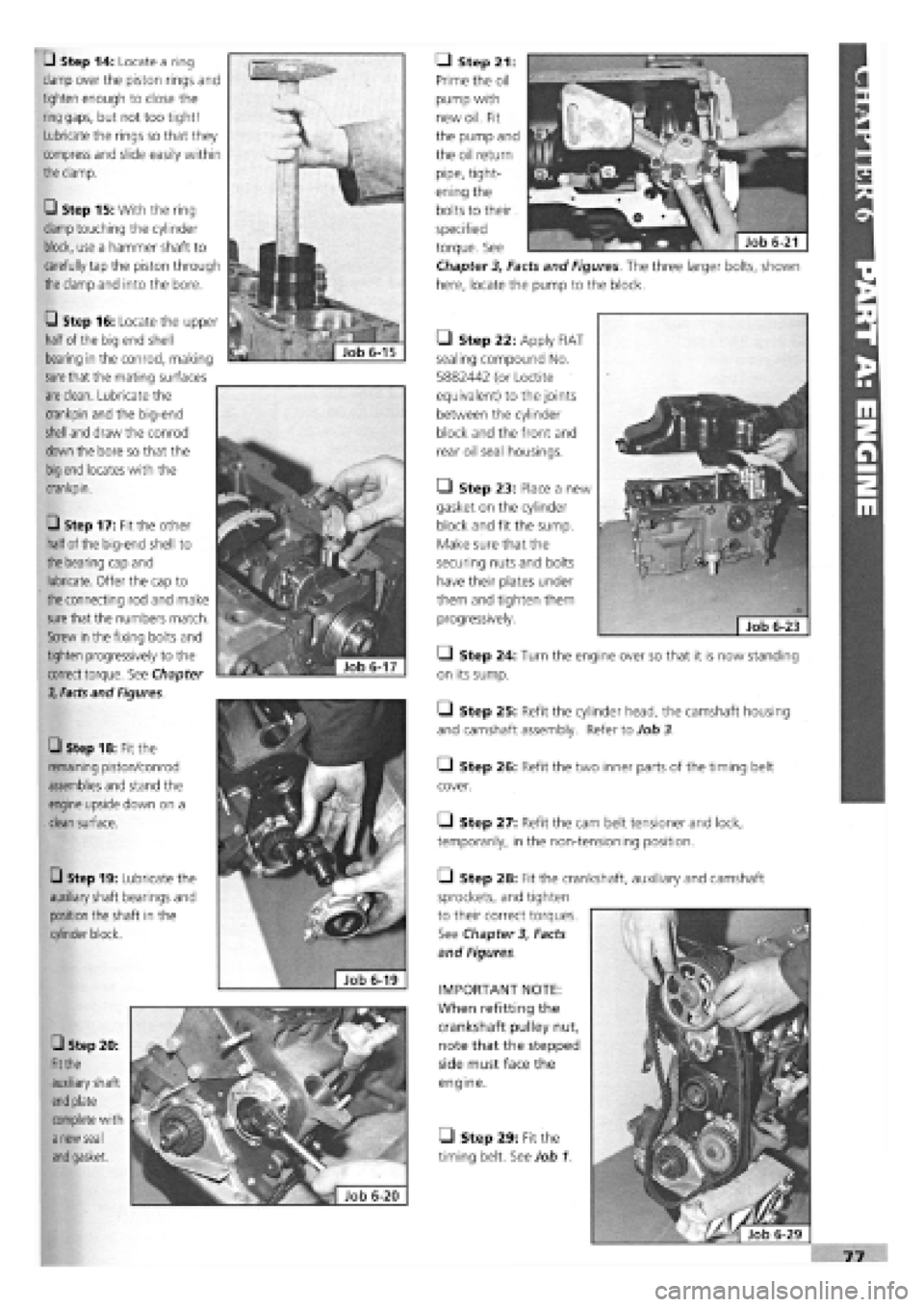
G Step 14: Locate a ring
clamp over the piston rings and
tighten enough to close the
ring
gaps, but not too tight!
Lubricate the rings so that they
compress and slide easily within
the
clamp.
• Step 15: With the ring
clamp
touching the cylinder
block, use a hammer shaft to
carefully tap the piston through
the
clamp and into the bore.
Q Step 27: Refit the cam belt tensioner and lock,
temporarily, in the non-tensioning position.
IMPORTANT NOTE:
When refitting the
crankshaft pulley nut,
note that the stepped
side must face the
engine.
• Step 29: Fit the
timing belt. See Job 1.
• Step 17: Fit the other
half of the big-end shell to
the
bearing cap and
lubricate. Offer the cap to
the
connecting rod and make
sure
that the numbers match.
Screw
in
the fixing bolts and
tighten progressively to the
correct torque. See Chapter
3, Facts
and Figures.
• Step 18: Fit the
remaining piston/conrod
assemblies and stand the
engine upside down on a
clean
surface.
• Step 19: Lubricate the
auxiliary shaft bearings and
position the shaft in the
cylinder block.
• Step 20:
Fit the
auxiliary shaft
end
plate
complete
with
a
new seal
and
gasket.
G Step 16: Locate the upper
half of the big end shell
bearing in the conrod, making
sure
that the mating surfaces
are clean.
Lubricate the
crankpin and the big-end
shell
and draw the conrod
down the bore so that the
big end
locates with the
crankpin.
• Step 21:
Prime the oil
pump with
new oil. Fit
the pump and
the oil return
pipe, tight-
ening the
bolts to their
specified
torque. See
Chapter
3,
Facts and Figures. The three larger bolts, shown
here, locate the pump to the block.
• Step 24: Turn the engine over so that it is now standing
on its sump.
• Step 25: Refit the cylinder head, the camshaft housing
and camshaft assembly. Refer to Job 3.
Q Step 26: Refit the two inner parts of the timing belt
cover.
• Step 23: Place a new
gasket on the cylinder
block and fit the sump.
Make sure that the
securing nuts and bolts
have their plates under
them and tighten them
progressively.
• Step 22: Apply FIAT
sealing compound No.
5882442 (or Loctite
equivalent) to the joints
between the cylinder
block and the front and
rear oil seal housings.
• Step 28: Fit the crankshaft, auxiliary and camshaft
sprockets, and tighten
to their correct torques.
See Chapter
3,
Facts
and Figures.
Page 74 of 171

• Step 30: Fit
the crankshaft
pulley and
tighten. See
Chapter 3,
Facts and
Figures.
• Step 31: Fit the
water pump and
distribution pipe.
• Step 32A: Refit the
flywheel. Do not unbolt the
TDC sensor (1) from the oil seal
housing at its mounting plate
bolts
(2)
unless it is essential to
do so.
• Step 32B: If
the sensor
mounting plate has
to be disturbed, you
will need the FIAT
special tool illus-
trated here (inset) in
order to reposition it
correctly. Position
the timing mark on
the crankshaft
pulley with the zero
degrees mark on the outer timing belt cover (and double
check that the timing mark on the flywheel
-
rubber bung
removed
-
is aligned at zero degrees).
With the bracket fitted to the oil seal housing, fit the FIAT
special tool onto the bracket in place of the sensor with a slot
in the tool fitting exactly over the TDC pin on the flywheel.
When everything is lined up, position the bracket accurately
and tighten the bolts. Remove the tool and refit the sensor.
IMPORTANT NOTE: During assembly, a shear-bolt will
have been fitted to prevent accidental movement of the
bracket. If you need to undo it, you will need to drill it
out and you should replace it with a new one obtained
from your FIAT dealership.
• Step 33: Refit the clutch. See PARTB: TRANSMISSION,
Job 4.
Q Step 34: Refit the fuel pump and pushrod using new
gaskets on both sides of the spacer block, 0.3 mm thick
between the spacer and the engine and 0.7 mm between the
spacer and the pump. See PART F: FUEL AND EXHAUST for
information on setting the pump position.
• Step 35:
Lubricate the sealing
ring and screw on a
new oil filter.
• Step 36:
Before refitting the
distributor, (see
PART D: IGNITION)
refit, if necessary,
the oil pump drive
gear.
• Step 37: Refit
all remaining
auxiliary compo-
nents (including the
oil vapour recovery
device, shown here),
using new gaskets
as necessary and
referring to
Chapter
3,
Facts
and Figures for the
torque settings.
Q Step 38: Reconnect the engine to the transmission. See
Job 11.
Q Step 39: Refit the complete unit to the car. See Job
9.
• Step 40: fl INSIDE INFORMATION! Before fitting the
spark plugs and with a fully charged battery, turn the
engine on the starter until the oil warning light goes
out. This primes the lubrication system and gives more
immediate oil pressure on initial start up after overhaul-
a critical time in the life of an engine. B
• Step 41: Fit the spark plugs and start the engine
-
this
might take a few seconds more than normal on the initial start
up.
• Step 42: Allow the engine to warm up on fast idle
until
it
reaches working temperature and then slow it down to its
normal speed (if adjustable
-
see PART F: FUEL AND
EXHAUST)