1988 FIAT TEMPRA belt
[x] Cancel search: beltPage 75 of 171
G Step 43: Stop the engine and allow it to cool, check the
oil
and coolant levels and look for any leaks.
G Step 44: Avoid over-rewing or overloading the engine
during its settling down period of 600 miles. We recommend
an oil
and filter change at this mileage
-
this will help to
extend the life of your new engine.
Job 7. Petrol engine.
Valve clearances - adjustment.
0 INSIDE INFORMATION! Adjustment should always be
made with the engine cold. B
G Step 1: Remove the camshaft cover and the spark plugs.
Jack up a front wheel and engage top gear. Turning the wheel
will rotate the engine and therefore the camshaft. If the
engine
is
out of the car, use a socket and long lever on the
crankshaft pulley nut. If the cylinder head is detached, turn
the
camshaft belt sprocket, by hand.
G Step 2: The inlet and exhaust valves use different clear-
ances
which are checked when each cam lobe is pointing
directly away from its follower. See Chapter
3,
Facts and
Figures.
G Step 3: The order in which the valves are fitted in the
cylinder head is:
Inlet: 2-3-6-7
Exhaust: 1-4-5-8
from
the timing cover end.
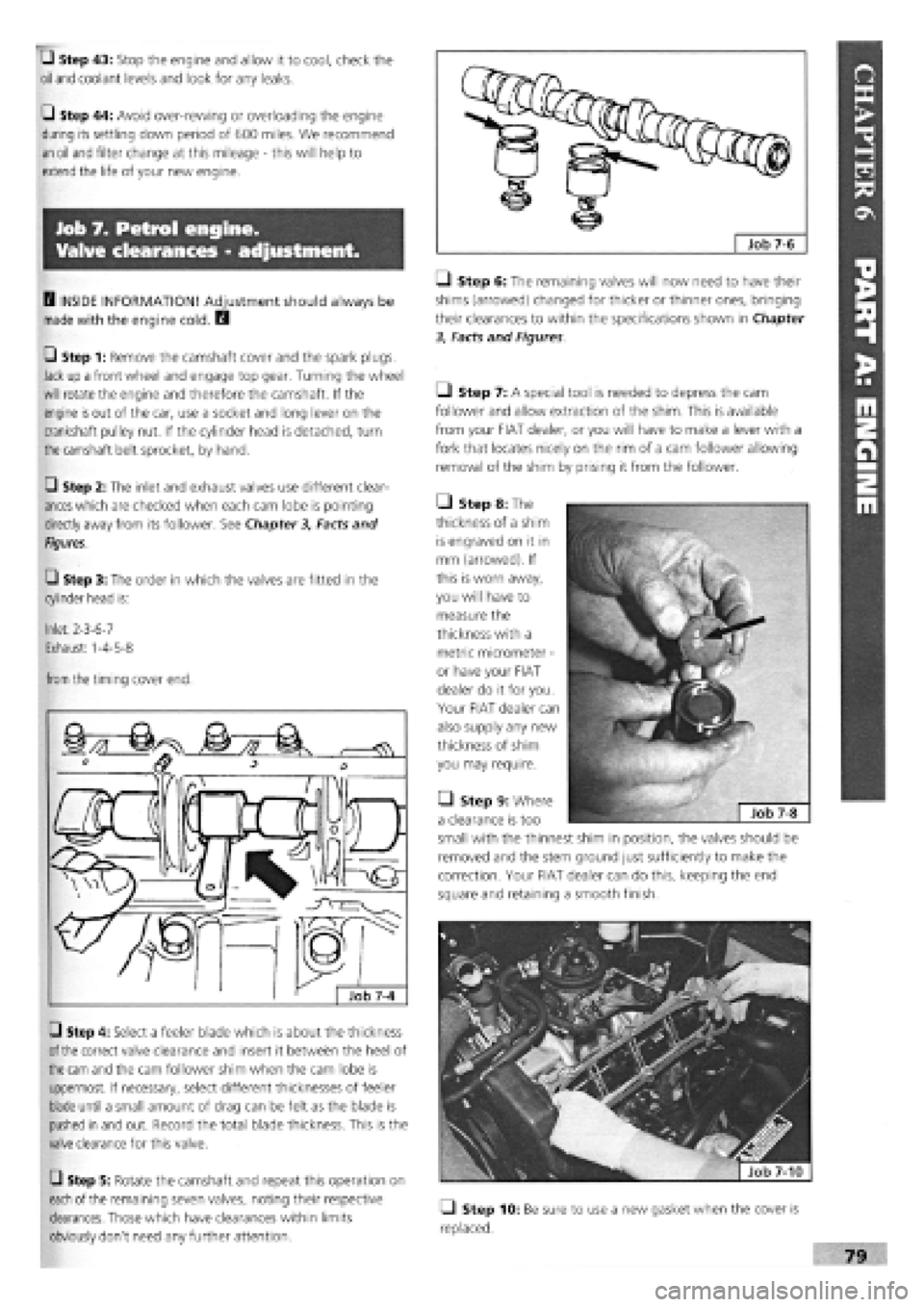
G Step 4: Select a feeler blade which is about the thickness
of the
correct valve clearance and insert it between the heel of
the cam
and the cam follower shim when the cam lobe is
uppermost. If necessary, select different thicknesses of feeler
blade until a small amount of drag can be felt as the blade is
pushed in and out. Record the total blade thickness. This is the
valve clearance for this valve.
G Step 5: Rotate the camshaft and repeat this operation on
each
of the remaining seven valves, noting their respective
clearances. Those which have clearances within limits
obviously don't need any further attention.
Q Step 6: The remaining valves will now need to have their
shims (arrowed) changed for thicker or thinner ones, bringing
their clearances to within the specifications shown in Chapter
3, Facts and Figures
Ll Step 7: A special tool is needed to depress the cam
follower and allow extraction of the shim. This is available
from your FIAT dealer, or you will have to make a lever with a
fork that locates nicely on the rim of a cam follower allowing
removal of the shim by prising it from the follower.
• Step 8: The
thickness of a shim
is engraved on it in
mm (arrowed). If
this is worn away,
you will have to
measure the
thickness with a
metric micrometer
-
or have your FIAT
dealer do it for you.
Your FIAT dealer can
also supply any new
thickness of shim
you may require.
• Step 9: Where
a clearance is too
small with the thinnest shim in position, the valves should be
removed and the stem ground just sufficiently to make the
correction. Your FIAT dealer can do this, keeping the end
square and retaining a smooth finish.
fjfefe^ | Job 7-10
Q Step 10: Be sure to use a new gasket when the cover is
replaced.
Page 80 of 171

FACT FILE: DIESEL ENGINES AND SPECIAL TOOLS
• As the
construction and
assembly of the
diesel engine is,
for the best part,
the same as the
petrol engines,
this section details
only those proce-
dures which are
specific to the
diesel.
• Major differ-
ences lie in the
areas of the
cylinder head and
camshaft drive
belt.
• Where
inspection of
components such
as crankshaft,
camshaft, pistons,
conrods, cylinder
head face, flywheel
etc. is not detailed
within this
section, refer to
the relevant infor-
mation in the
Petrol Engine
section, Job 6,
under Checking
for wear -
information which is common to all engine types.
• In view of the complexity of the diesel engine's camshaft drive arrangement, the need for special tooling and the
accuracy required in adjusting camshaft
timing and injection pump timing, we
strongly recommend that any work involving
disturbance of the timing belt or injection
pump is entrusted to a FIAT dealer.
• The following information is provided only
for those who have technical experience of
diesel engines, along with access to the
required tooling.
• Familiarise yourself with this drawing,
showing the cylinder head, block and other
major components referred to in the
following text.
1
-
cylinder block 2
-
sump 3
-
cylinder head 4
-
injection pump mounting 5
-
oil pick-up and pump 6
-
threaded bush 7
-
rear crank seal carrier 8
-
front cover/oil seal 9
-
plate
10
-
head gasket 11
-
camshaft rear bearing 12
-
camshaft front bearing 13
-
exhaust manifold 14
-
intake manifold 15
-
coolant pipe 16
-
water pump 17
-
cam cover 18
-
gasket
19-seal 20
-
valve 21
-
valve guide 22
-
spring seat 23
-
thermostat housing 24
-
oil filler cap 25
-
compression washer
1
-
strainer with gauze filter 2
-
geared oil pump 3
-
oil pressure relief valve 4
-
total capacity cartridge oil filter with safety valve to cut out filter element becomes blocked 5
-
main oil delivery pipe supplying various / components 6
-
oil delivery pipe to camshaft
IHSupply circuit I
I Return
circuit
a
-
camshaft b
-
vacuum pump c
-
bucket tappets d
-
valve guides e
-
valves f
-
piston g
-
gudgeon pin assemblie; h
-
conrod i
-
crankshaft j
-
crank journal k
-
flywheel
Page 81 of 171

Job 13. Diesel engine. Timing belt
- replacement and adjustment.
• Step 1: Undo
the bolts and remove
the
top timing belt
cover.
Q Step 2: Securely
support the car and
remove
the right
hand
front wheel for
access
to the wheel
arch
dust shield.
Undo
the fasteners
(arrowed) and
remove
the shield.
• Step 3: Slacken the power steering pump support
bracket securing
bolts (arrowed).
Q Step 4: Slacken
the bolts
holding the
power steering
pump
to the
bracket
(arrowed)
• Step 5: and
remove the drive
belt, allowing it to
hang on the engine
support bracket
(arrowed).
• Step 6: Slacken the alternator mounting bolts, and
remove the drive belt.
• Step 7: Ensure
that the notch on the
crankshaft
pulley/damper
(arrowed) is aligned
with the ridge on the
lower half of the
timing belt cover
(arrowed),
M
V// Job 13-7
• Step 8: .... then
undo the securing
bolts (arrowed) and
remove the cover
(inset).
• Step 9: Undo
the bolts (arrowed)
and remove the
flywheel cover guard
(inset).
IMPORTANT NOTE: From now on, one of two different
procedures will be required, depending upon the age of
your diesel engine, as modifications were made from
engine No. 1723291-on to allow fine adjustment of
camshaft timing. Both procedures require the use of FIAT
special tooling, which it may be possible to hire from
your local specialist
-
otherwise you will have to make
your own tools or have the work carried out for you.
85
Page 82 of 171

PART A
-
ENGINES PRIOR TO ENGINE NO. 1723291 • Step A15: Ease the timing belt off the sprockets.
Gl Step A10: Use a spanner on the crankshaft bolt (a) to
turn the engine until the timing marks on the crankshaft,
camshaft and injection pump sprockets align with their
respective reference marks. Align the crankshaft sprocket with
the notch on the front cover (b). Align the camshaft sprocket
with the hole in the timing belt cover (c). Align the injection
pump sprocket with the reference on the timing belt rear
guard (d).
• Step A11: Use
the FIAT flywheel
lock, part no.
1860766000 (or
construct your own
tool) to stop the
crankshaft from
turning.
• Step A12:
Remove the
alternator belt
pulley/damper.
• Step A13:
Using FIAT tool no.
1842128000 (see illustration Job
13-A10,
parte), lock the
injection pump sprocket to prevent it turning.
• Step A14: Slacken the belt tensioner nut (see illustration
Job
13-A10,
part f), move the tensioner away from the belt
and temporarily lock it in position.
• Step A16: Fit the new belt, first making sure that all of
the timing marks still align.
• Step A17: If you do not have access to the correct FIAT
tensioning tool, release the locknut, push the tensioner firmly
into the belt and lock it up by tightening its bolt.
If you do have the FIAT special tool (a weighted bar), attach it
to the tensioner, which will move to the position of correct
tension. Lock the tensioner bolt. Remove the special tool
locking the injection pump sprocket.
E3 INSIDE INFORMATION: If you can't put enough
pressure on the tensioner with your fingers, carefully use
a long screwdriver as a lever. Alternatively, push a pair of
bolts into the two holes in the tensioner and lever
between them to turn the tensioner. E9
Q Step A18: Rotate the engine through two revolutions. If
the belt is correctly tensioned you should just be able to twist
it through a quarter-turn when gripping it between thumb
and finger in the centre of its longest run between sprockets.
Adjust as necessary.
Q Step A19: Refit the remaining parts in the reverse order,
then check the injection timing (see Chapter
5,
Servicing
Your Car, Job
39)
PART B
-
ENGINES FROM ENGINE NO. 1723291-ON
Job 13-B10
Q Step B10: Turn the crankshaft in its normal direction of
rotation until the marks on the crankshaft sprocket (a) and
fuel injection pump sprocket (b) line up with the fixed marks
on the engine. This will place cylinder No. 1 at Top Dead
Centre TDC and set the camshaft for the power stroke of the
same cylinder. Lock the flywheel (see Step A11) and remove
the alternator belt pulley (see Step A12).
IMPORTANT NOTE: The hole for fixing the camshaft
sprocket (c) has a fine-adjustment slot, so it is possible
that the mark on the sprocket may not line up exactly
with the mark on the cover.
Page 83 of 171

Q Step B11: Undo the belt tensioner nut (see illustration
Job 13-B10, part d), then remove the timing belt.
Q Step B12: Undo the nuts securing the brake vacuum
pump to the cylinder head (see illustration Job
16-1),
and
remove it.
• Step B13: Fit FIAT tool no. 1860932000 (for setting
camshaft timing) to the vacuum pump end of the camshaft,
matching the camshaft groove (1) with the lug (2) on the tool
Secure
the tool to the cylinder head, positioning the centring
dowel
(3) as shown. The dowel must be perfectly centred on
the tool,
and if it isn't, you should adjust the hexagonal bolt
(4) with
a spanner, and centre it with tiny movements.
• Step B14:
Remove
the bolt
(arrowed) which
secures
the front
cover
to the engine
block,
then fit the
timing belt on the
crankshaft sprocket.
• Step B16:
Lock the injection
pump sprocket (see
StepA13). Now,
using FIAT tool no.
1860831000,
slacken the bolt
securing the
camshaft sprocket.
• Step B17: Continue fitting the timing belt in the
following sequence: crankshaft sprocket, fixed tensioner,
injection pump sprocket, timing sprocket, belt tensioner... and
check that the mark on the injection pump lines up with the
fixed mark on the rear cover.
• Step B18: Use the timing belt tensioner to correctly
tension the belt.
B INSIDE INFORMATION: If you do not have the correct
tensioning tool, follow Steps A16 and A17. B
• Step B19: Tighten the camshaft sprocket bolt to the 1
specified torque (see Chapter
3,
Facts and Figures).
Q Step B20: Turn the crankshaft by two revolutions
(clockwise), tighten the belt tensioner to the specified torque
(see Chapter
3,
Facts and Figures) and remove the
tensioning tools. If the belt is correctly tensioned you should
just be able to twist it through a quarter-turn when gripping it
between thumb and finger in the centre of its longest run
between sprockets. Adjust as necessary.
O Step B21: Refit the remaining components in the reverse
order of removal, then check the injection timing. See
Chapter
5,
Servicing Your Car, Job 25.
Job 14. Diesel engine.
Cylinder head - removal.
• Disconnecting the high pressure pipes on a diesel
injection system can be dangerous!
• Read the Safety First! information at the start of
PART F: FUEL AND EXHAUST SYSTEMS before
starting work.
Q Step 1: Refer to Job
13
and remove the timing belt.
• Step 2: Drain the cooling system and disconnect the air
pipes from the inlet manifold.
Q Step 3: Disconnect
and remove the oil vapour
pipes from the cylinder
block device.
Job 13-B13
• Step B15: Fit
FIAT tool
No.
1860933000 for
precise
determination
of TDC
on cylinder
No. 1. The
tool must
be secured
firmly by
two bolts
to the
crankshaft sprocket,
and by
another bolt
to the
crankshaft front cover (where the bolt was previously
removed in Step B14).
Page 85 of 171

SAFETY FIRST!
• The cylinder head is heavy and should be lifted from
the engine bay by two people.
Job 15. Diesel engine.
Cylinder head - refitting.
• Step 1: Put the
pistons at TDC
-
two
at a time
-
and
measure how much
they protrude above
the block surface.
This is ideally done
using a dial gauge
and holder (FIAT tools
1895882000 and
1870404000, respec-
tively) but if surfaces
• Step 15:
Unbolt the inlet
and
exhaust
manifold bolts...
• Step 16:
...and remove the
manifolds.
• Step 17:
Unscrew the
twelve bolts
and
remove
the cam
cover.
• Step 18:
Unbolt the cylinder
head (removing
the oil pipes, if
fitted)...
• Step 20: Not
forgetting the row
of five smaller,
outer bolts.
• Step 13:
Remove the bolt
securing the dipstick
tube (arrowed) and
the bolts fixing the
rear timing belt cover
to
the injection
pump support
bracket (arrowed).
Also, remove the
dipstick tube, if fitted
to the
support
bracket.
• Step 14: Undo
the
three exhaust
flange nuts (arrowed)
and
remove the
springs
from behind
them. Separate the
pipe from
the
manifold.
• Step 19:
...undoing the
head bolts half a
turn at a time, in
the order shown,
until all are loose. Job 14-19
• Step 21: Have
a good look to
check that there is
nothing still
connected and
preventing
removal of the
cylinder head.
With the help of
an assistant, lift
the cylinder head
from the engine
block. If you
prefer, you can lift the head complete with manifolding,
(turbo charger if fitted) and the inner top part of the timing
cover and remove them later.
Page 91 of 171
Q Step 2: Before starting the engine, make sure all your
electrical connections are sound and your fuel, oil and coolant
connections are correct and secure.
Q Step 3: Run the engine to working temperature and then
allow to cool. Re-check all fluid levels.
Job 20. Diesel engine.
Mountings - replacement.
See
Job
12
and Job
18,
Step 20
Job 21. Diesel engine/
transmission (removed from car)
- separation.
Q Step 1: Remove the starter motor.
• Step 2: On the turbo version, undo the flange bolts see
Job
18,
Step 16A and withdraw the drive-shaft extension, if
still
fitted.
Q Step 3: Unbolt and remove the rear engine plate and the
gearbox, being careful to support the gearbox weight as it is
withdrawn.
Job 22. Diesel engine/
transmission (removed from car)
- reconnection.
Q Step 1: Before proceeding, check the condition of the
clutch and
its release mechanism. Make sure the driven plate
is
properly centred on the flywheel
-
see PART B: TRANS-
MISSION.
Q Step 2: Now reverse the order of separation, but be
careful when
engaging the gearbox input shaft with the
clutch
driven plate that you don't 'hang' its weight on the
splines.
Also,
see
Job 11.
Job 23. Diesel engine -
dismantling.
This Job should
be read in conjunction with Job 5 The
engines are
broadly similar although the information given in
this Job takes
priority for diesel engines. It is MOST
IMPORTANT that you read the FACT FILE on page 84.
SAFETY FIRST!
•
The inside
of diesel engines are particularly filthy
places!
•
Old diesel
oil
is
carcinogenic!
•
Wear suitable
impervious gloves!
I
• Step 1: Remove the timing belt and cylinder head. See
Jobs
13
and 14.
Q Step 2: Remove the alternator, water pump and
thermostat housing distribution pipe.
• Step 3: Remove the crankshaft timing belt sprocket.
Q INSIDE INFORMATION! Note that the bolt securing
the crankshaft sprocket has a left-hand thread and must
be undone clockwise. D
• Step 4: Unbolt the timing belt tensioner and idler pulleys.
• Step 5: Remove the injection pump sprocket.
Q INSIDE INFORMATION! You will need two FIAT tools
for this operation. One (No. 1860473000) is to prevent
the sprocket from turning when undoing the nut, and
the other (extractor No. 1842128000) to pull the sprocket
from the injection pump shaft. Alternatively it may be
possible to improvise a means of preventing sprocket
rotation, and a suitable three-leg puller may be carefully
used to withdraw the sprocket. Take care not to lose the
pump shaft Woodruff key. B
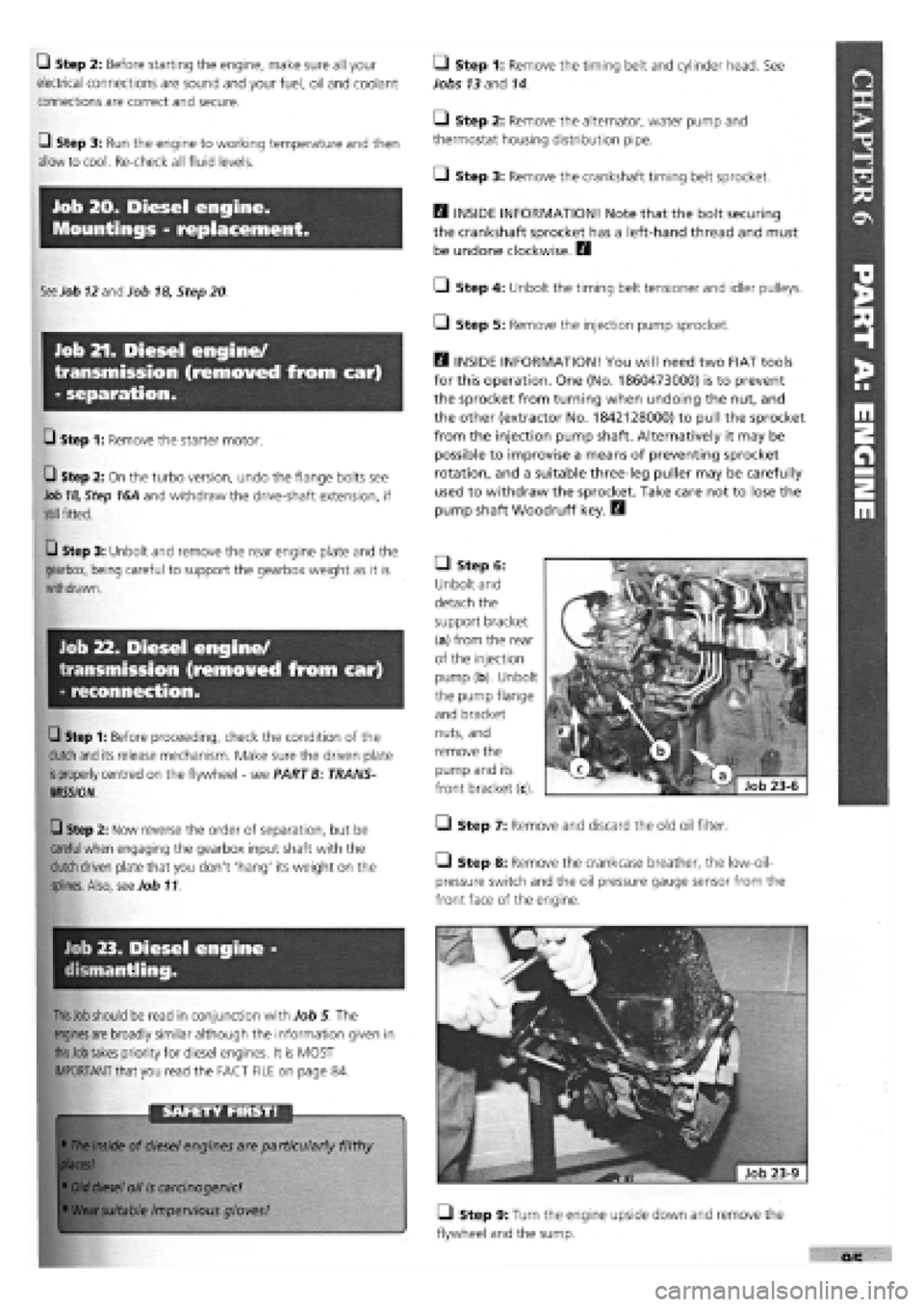
• Step 6:
Unbolt and
detach the
support bracket
(a) from the rear
of the injection
pump (b). Unbolt
the pump flange
and bracket
nuts, and
remove the
pump and its
front bracket (c).
• Step 7: Remove and discard the old oil filter.
Step 8: Remove the crankcase breather, the low-oil-
pressure switch and the oil pressure gauge sensor from the
front face of the engine.
• Step 9: Turn the engine upside down and remove the
flywheel and the sump.
Page 103 of 171
Job 5. Coolant pump -
replacement.
L) Step 4: Lower the switch into water until the thread is
just
covered and the terminals remain dry.
G Step 5: Heat the water slowly. The bulb should light just
below boiling point (90 to 94 degrees Celsius) and go out
when
the temperature falls below 85 to 89 degrees Celsius.
G Step 6: Refit with a new O-ring but do not over tighten.
Job 4. Thermostat - replacement.
G Step 1: Drain the cooling system.
G Step 2: Disconnect the hoses from the thermostat
housing. Illustration Type 1, part 4 (petrol), or Type 2, part
6 (diesel). Undo the bolts and remove the housing/thermostat
assembly.
G Step 3: Clean the mating surfaces, fit the new unit with a
new
gasket.
G Step 4: Reconnect the hoses and refill the cooling system
with
the correct 50/50 FL 'Paraflu' anti-freeze mixture. See
Chapter
5, Servicing Your Car.
E9 INSIDE INFORMATION! For location of the water pump,
see illustration Type 1 (petrol), or Type 2 (diesel). B
• Step 1: Raise the bonnet and drain the cooling system.
Remove the air cleaner.
• Step 2: Unplug the alternator leads, slacken the bolts and
remove the drive belt. Remove the alternator.
• Step 3: Disconnect the hoses and the metal transfer pipe
from the pump.
• Step 4: Undo the securing bolts and remove the coolant
pump.
• Step 5: Discard the old gasket and clean off the mating
surfaces.
Q Step 6: Refit in reverse order using a new gasket.
• Step 7: Adjust the drivebelt tension. See Chapter 5,
Servicing Your Car.
• Step 8: Fill the cooling system with the correct 50/50
solution of FL 'Paraflu' anti-freeze solution. See Chapter 3,
Facts and Figures.
PART D: IGNITION SYSTEMS
——
PART D: Contents
Job 1. Ignition component positions. Job 4. Distributor
-
removal and refitting (1.6 litre engine).
Job
2.
Ignition coil
-
replacement. Job 5. Electronic ignition.
Job
3.
Distributor
-
removal and refitting (1.4 litre engine).
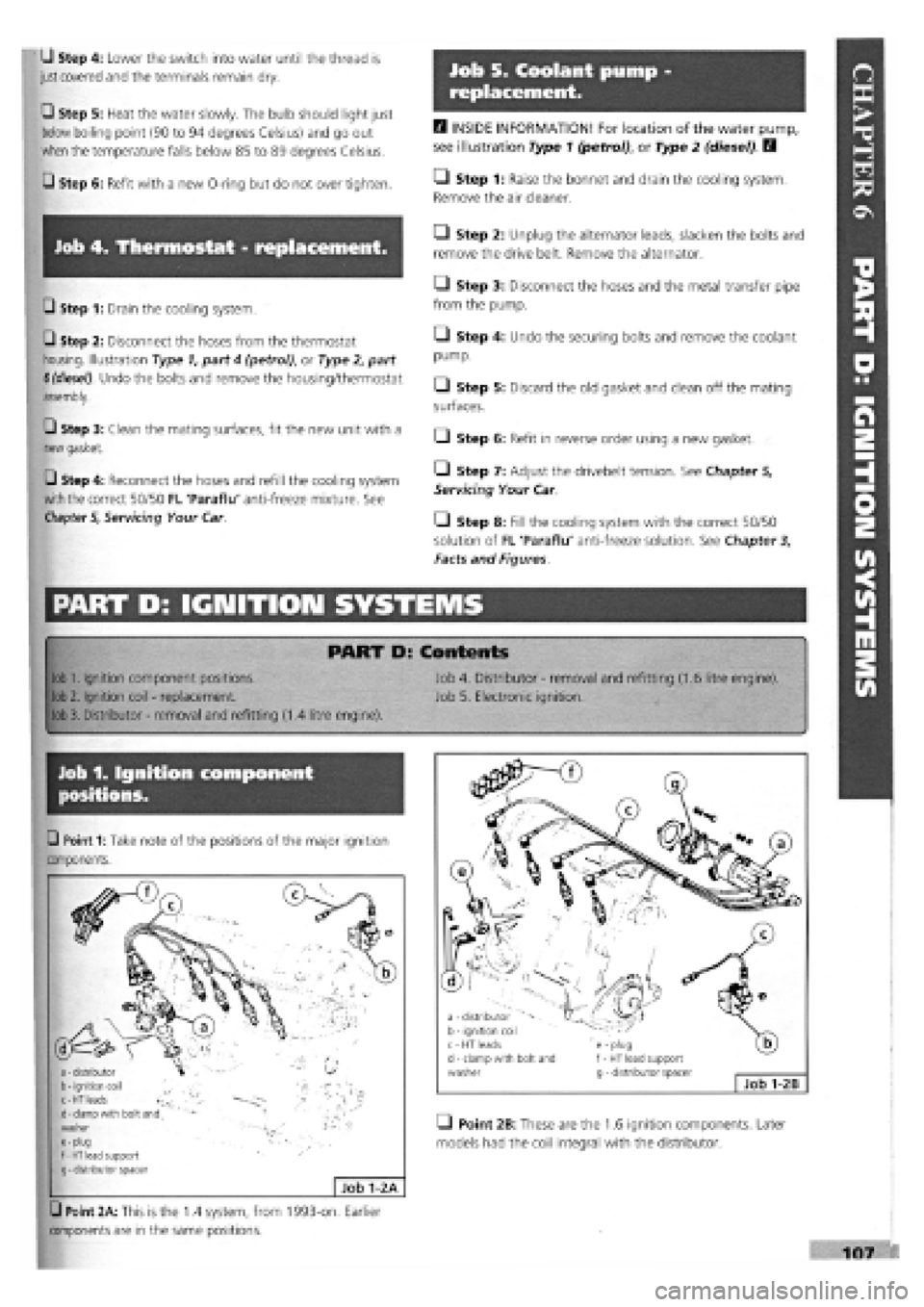
Job 1. Ignition component
positions.
washer g - distributor spacer Job 1-2B
G Point 1: Take note of the positions of the major ignition
components.
Q Point 2B: These are the 1.6 ignition components. Later
models had the coil integral with the distributor.
o
a
>
H
w
w
ON
(A
H
ri
S
VI
107
G Point 2A: This is the 1.4 system, from 1993-on. Earlier
components are in the same positions.
a
-
distributor b
-
ignition coil ^ c-HT leads ^ d
-
clamp with bolt and washer e
-
plug f
-
HT lead support g
-
distributor spacer
Job 1-2 A