Page 763 of 1865
5 STARTER (DIESEL ENGINE, 2.0 KW TYPE)
REMOVAL AND INSTALLATION
Removal is as follows:
1. Disconnect the negative battery cable.
2. Disconnect the wiring from the starter.
3. Remove the starter.
Install in the reverse order of removal.
Tightening torque:
Bolts 64—89 N-m
(6.5—9.1 m-kg, 47—66 ft-lb)
B terminal 9.8—11.8 N-m
(1.0—1.2 m-kg, 87—104 in-lb)
76G05X-044
DISASSEMBLY AND ASSEMBLY
1. Disassemble in the order shown in the figure.
2. Assemble in the reverse order of disassembly.
4BG05X-047
1. Yoke assembly 7. Over-running clutch assembly
2. Brush holder 8. Pinion gear
3. Armature 9. Steel ball
4. Magnetic switch assembly 10. Coil spring
5. Idler gear 11. Housing
6. Retainer and rollers
5—57
Page 768 of 1865

5 STARTER (DIESEL ENGINE, 2.0 KW TYPE)
4BG05X-082
4BG05X-103
Faulty repair
Bad Good
Mica
Undercut
Segments
4BG05X-084
2. Vibration of the commutator
(1) Place the armature on V blocks, and measure
the vibration by using a dial gauge.
(2) If the vibration is Limit or more, repair so that
it becomes standard by using a lathe, or re-
place the armature.
Standard vibration: 0.05 mm (0.002 in)
Limit: 0.4 mm (0.018 in)
Note
Before checking, be sure that there is no play
in the bearings.
3. Outer diameter of the commutator
Replace the armature if the outer diameter of the
commutator is grind limit or less.
4. Roughness of the commutator surface
(1) If the commutator surface is dirty, wipe it with
a cloth.
(2) If it is rough, repair it by using a lathe or fine
sandpaper.
Grind limit: 34 mm (1.34 in)
5. Segment groove depth
If the depth of the mold between segments is limit
depth or less, undercut the grooves by standard
depth.
Standard depth:
0.5—0.8 mm (0.020—0.031 in)
Limit depth: 0.2 mm (0.008 in)
Field Coil
1. Wiring damage
(1) Check for continuity between the connector
and brushes by using a circuit tester.
(2) Replace the yoke assembly if there is no con-
tinuity.
4BG05X-085
5-62
Page 772 of 1865
5 STARTER (DIESEL ENGINE, 2.0 KW TYPE)
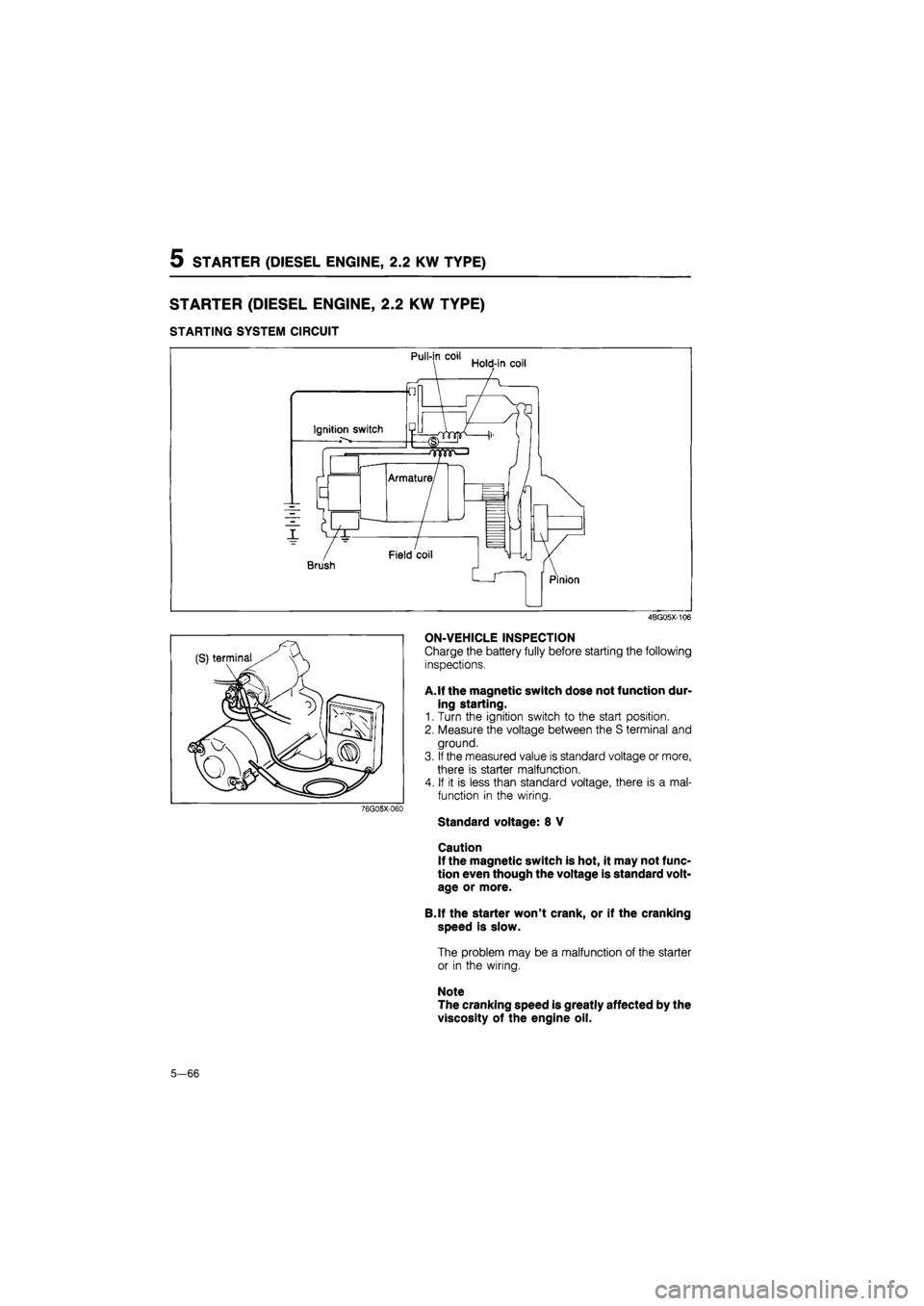
STARTER (DIESEL
ENGINE, 2.2
KW TYPE)
STARTING SYSTEM CIRCUIT
4BG05X-106
76G05X-060
ON-VEHICLE INSPECTION
Charge the battery fully before starting the following
inspections.
A. If the magnetic switch dose not function dur-
ing starting.
1. Turn the ignition switch to the start position.
2. Measure the voltage between the S terminal and
ground.
3.
If
the measured value is standard voltage or more,
there is starter malfunction.
4. If it is less than standard voltage, there is a mal-
function in the wiring.
Standard voltage: 8 V
Caution
If the magnetic switch is hot, it may not func-
tion even though the voltage is standard volt-
age or more.
B.lf the starter won't crank, or if the cranking
speed is slow.
The problem may be a malfunction of the starter
or in the wiring.
Note
The cranking speed is greatly affected by the
viscosity of the engine oil.
5—66
Page 773 of 1865
5 STARTER (DIESEL ENGINE, 2.0 KW TYPE)
REMOVAL AND INSTALLATION
Removal is as follows:
1. Disconnect the negative battery cable.
2. Disconnect the wiring from the starter.
3. Remove the starter.
Install in the reverse order of removal.
Tightening torque:
Bolts 64—89 N-m
(6.5—9.1 m-kg, 47—66 ft-lb)
B terminal 9.8—11.8 N-m
(1.0—1.2 m-kg, 87—104 in-lb)
76G05X-046
DISASSEMBLY AND ASSEMBLY
1. Disassemble in the numbered order shown in the figure.
2. Assembly in the reverse order of disassembly.
4BG05X-107
1. Magnetic switch 7. Lever
2. Rear cover 8. Cover
3. Brush-holder assembly 9. Drive pinion and over-running
4. Yoke clutch assembly
5. Armature 10. Reduction gear
6. Front housing 11. Center bracket
5—67
Page 777 of 1865
STARTER (DIESEL ENGINE, 2.2 KW TYPE) 5
4BG05X-113
4BG05X-080
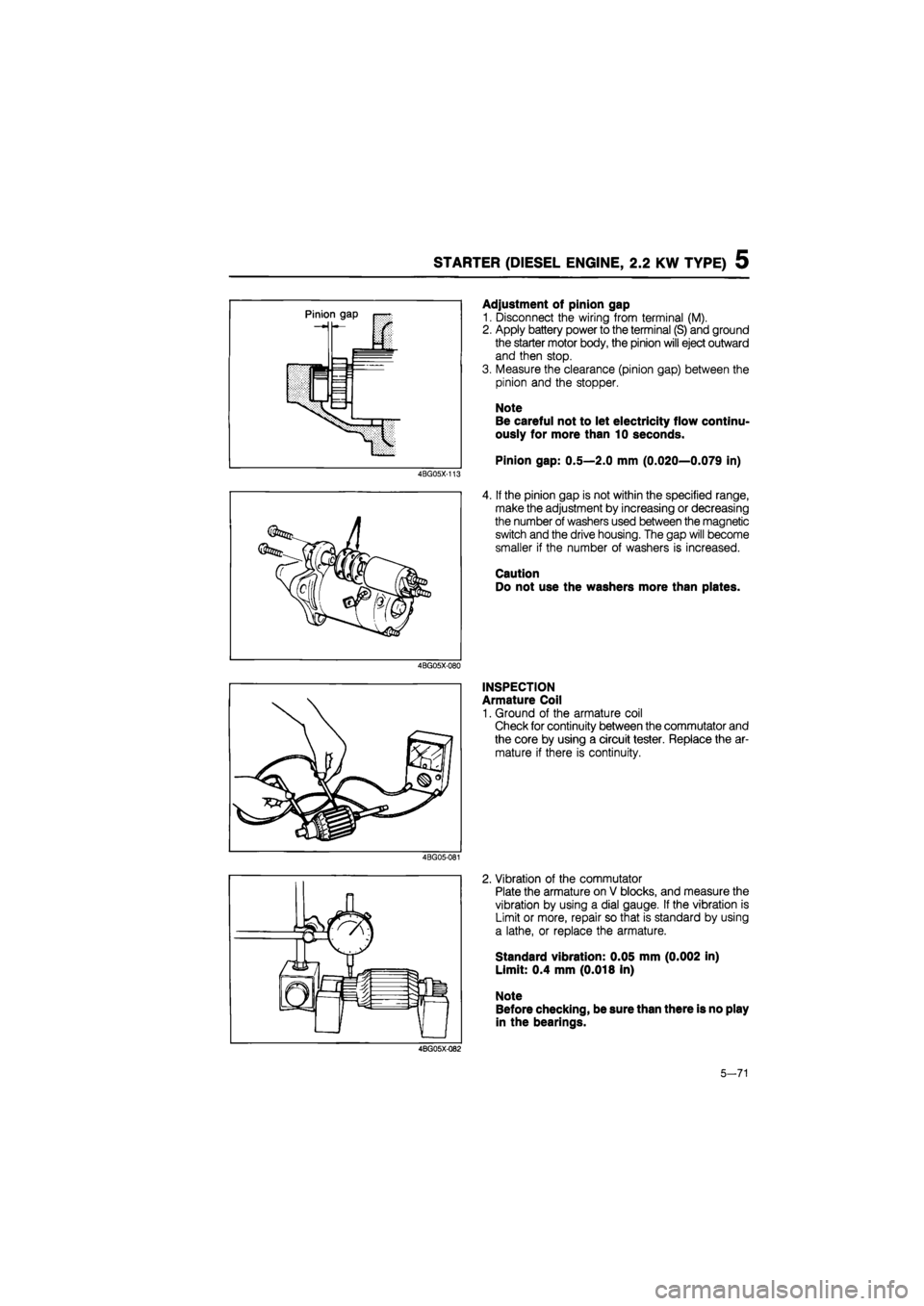
Adjustment of pinion gap
1. Disconnect the wiring from terminal (M).
2. Apply battery power to the terminal (S) and ground
the starter motor body, the pinion will eject outward
and then stop.
3. Measure the clearance (pinion gap) between the
pinion and the stopper.
Note
Be careful not to let electricity flow continu-
ously for more than 10 seconds.
Pinion gap: 0.5—2.0 mm (0.020—0.079 in)
4. If the pinion gap is not within the specified range,
make the adjustment by increasing or decreasing
the number of washers used between the magnetic
switch and the drive housing. The gap will become
smaller if the number of washers is increased.
Caution
Do not use the washers more than plates.
INSPECTION
Armature Coil
1. Ground of the armature coil
Check for continuity between the commutator and
the core by using a circuit tester. Replace the ar-
mature if there is continuity.
4BG05-081
2. Vibration of the commutator
Plate the armature on V blocks, and measure the
vibration by using a dial gauge. If the vibration is
Limit or more, repair so that is standard by using
a lathe, or replace the armature.
Standard vibration: 0.05 mm (0.002 in)
Limit: 0.4 mm (0.018 in)
Note
Before checking, be sure than there is no play
in the bearings.
4BG05X-Q82
5-71
Page 778 of 1865
5 STARTER (DIESEL ENGINE, 2.2 KW TYPE)
4BG05X-115
4BG05X-085
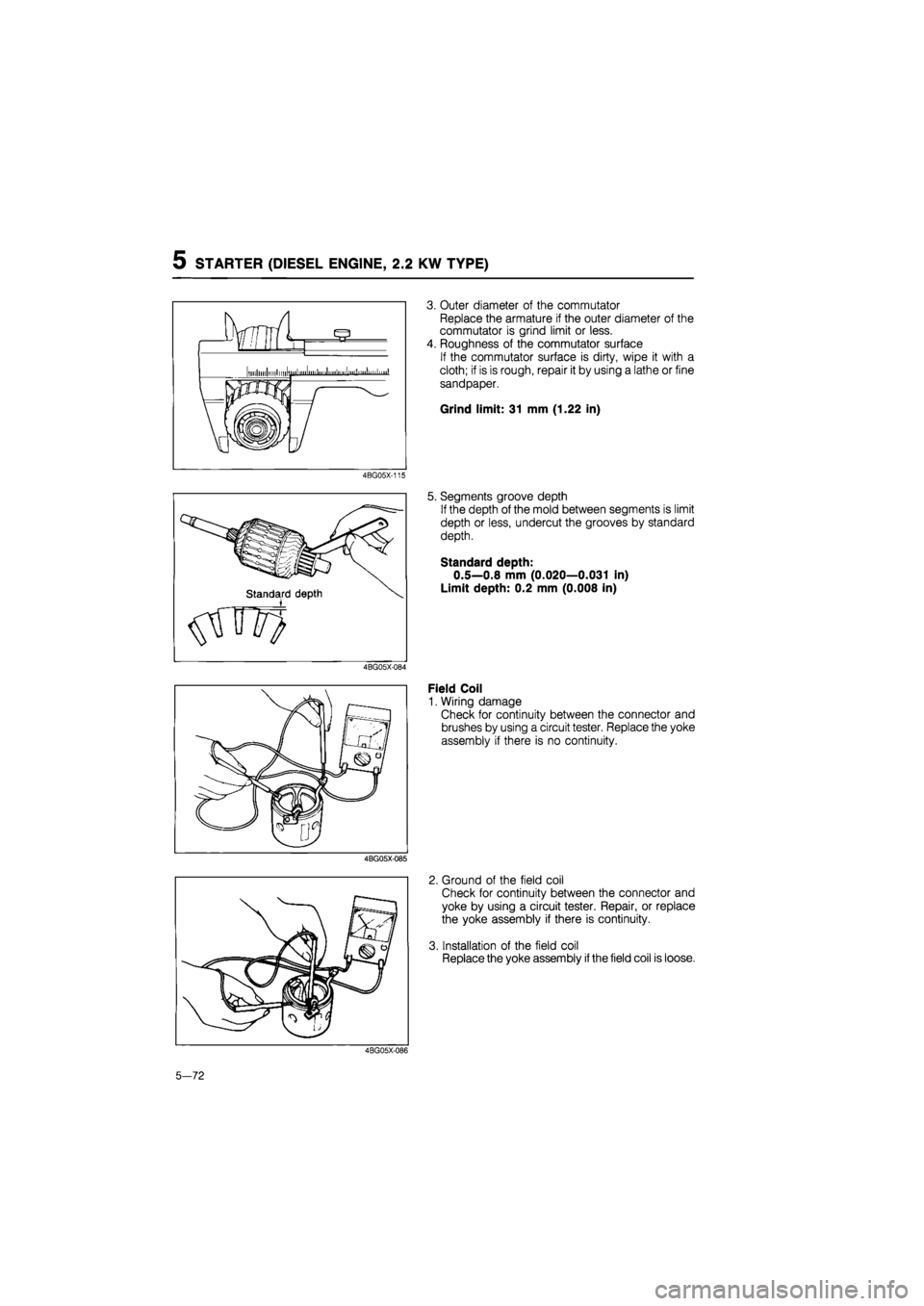
3. Outer diameter of the commutator
Replace the armature if the outer diameter of the
commutator is grind limit or less.
4. Roughness of the commutator surface
If the commutator surface is dirty, wipe it with a
cloth; if is is rough, repair it by using a lathe or fine
sandpaper.
Grind limit: 31 mm (1.22 in)
5. Segments groove depth
If the depth of the mold between segments is limit
depth or less, undercut the grooves by standard
depth.
Standard depth:
0.5—0.8 mm (0.020—0.031 in)
Limit depth: 0.2 mm (0.008 in)
Field Coil
1. Wiring damage
Check for continuity between the connector and
brushes by using a circuit tester. Replace the yoke
assembly if there is no continuity.
2. Ground of the field coil
Check for continuity between the connector and
yoke by using a circuit tester. Repair, or replace
the yoke assembly if there is continuity.
3. Installation of the field coil
Replace the yoke assembly
if
the field coil is loose.
4BG05X-086
5-72
Page 784 of 1865
QUICK START SYSTEM (QSS) 5
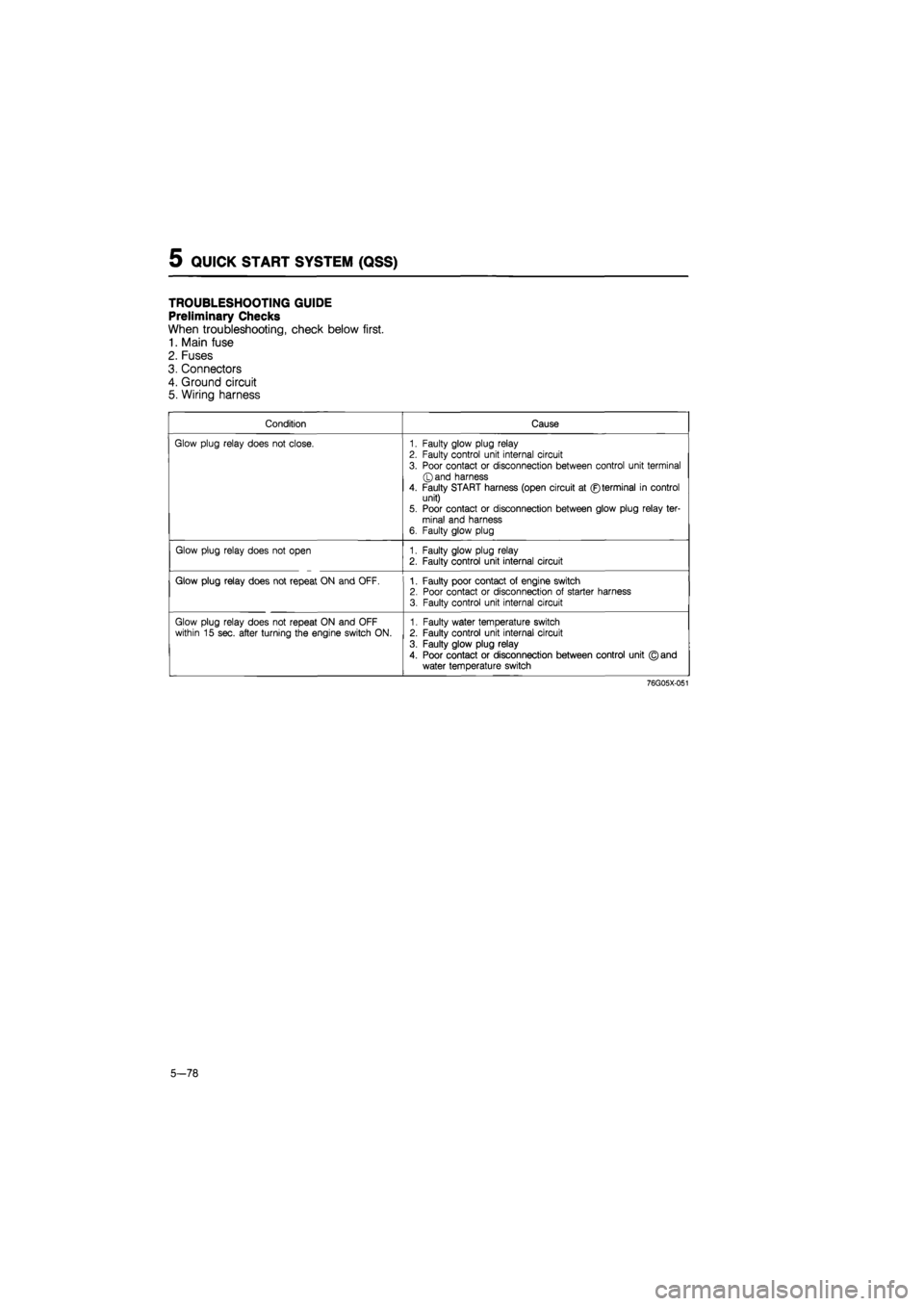
TROUBLESHOOTING GUIDE
Preliminary Checks
When troubleshooting, check below first.
1. Main fuse
2. Fuses
3. Connectors
4. Ground circuit
5. Wiring harness
Condition Cause
Glow plug relay does not close. 1. Faulty glow plug relay 2. Faulty control unit internal circuit
3. Poor contact or disconnection between control unit terminal ©and harness
4. Faulty START harness (open circuit at ©terminal in control unit) 5. Poor contact or disconnection between glow plug relay ter-minal and harness 6. Faulty glow plug
Glow plug relay does not open 1. Faulty glow plug relay 2. Faulty control unit internal circuit
Glow plug relay does not repeat ON and OFF. 1. Faulty poor contact of engine switch 2. Poor contact or disconnection of starter harness 3. Faulty control unit internal circuit
Glow plug relay does not repeat ON and OFF within 15 sec. after turning the engine switch ON. 1. Faulty water temperature switch 2. Faulty control unit internal circuit
3. Faulty glow plug relay
4. Poor contact or disconnection between control unit © and water temperature switch
76G05X-051
5-78
Page 785 of 1865

QUICK START SYSTEM (QSS) 5
CONTROL UNIT
Inspection
1. Connect a voltmeter to the control unit as shown
in the figure.
2. Check the voltage of the terminal.
3. Replace the control unit if necessary.
Caution
If the proper voltage is not indicated on the
voltmeter, check all wiring connections and
finally, check that component.
63G05X-337
Control Unit Connector
Terminal Input Output Connection to Operation condition Voltage Remark
for 6 sec. approx. 12V
L (GW) O Glow plug relay Engine switch: ON (No cranking) after 6 sec.
OV 12V Coolant temperature; below 30°C (86°F) after 6 sec.
OV Coolant temperature; above 30°C (86°F)
H
(B) — — Ground OV
E (BW) 0 Engine switch (ON) Engine switch: ON approx. 12V
F
(BR) O Engine switch (START) Engine switch: START approx. 12V
C o
Water
temperature switch
Engine switch: ON (No cranking)
approx. 12V Coolant temperature; below 30°C (86°F)
(BrB) o
Water
temperature switch
Engine switch: ON (No cranking)
approx. OV Coolant temperature;
above 30°C (86°F)
At cranking OV <- 12V
B 0 Glow plug
For 15 sec. after engine has started OV <-> 12V Coolant temperature;
(Gr) 0 Glow plug After 15 sec. OV below 30°C (86 °F)
After engine has started OV Coolant temperature; above 30°C (86°F)
K o Indicator Engine switch: ON
For 3 sec. OV
(WR) o Indicator Engine switch: ON after 3 sec. approx. 12V
76G05X-052
u® x y i © © X 1
© © X ®
5-79