Page 665 of 1865
4C CONTROL SYSTEM
Jjf (Terminal A)
n PI
WRED r^j
BLACK
BLACK 1 (Terminal C)
76G04C-189
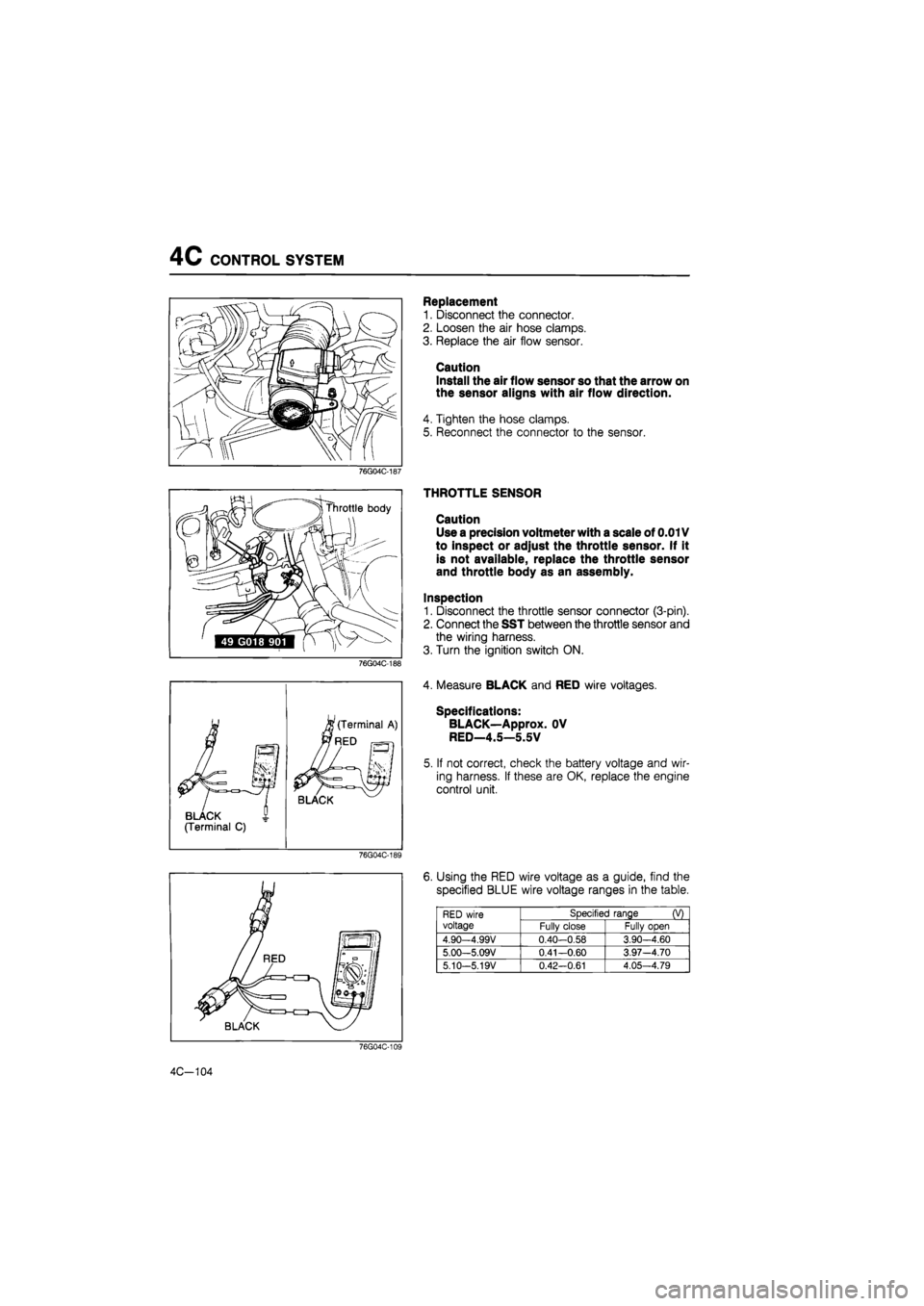
Replacement
1. Disconnect the connector.
2. Loosen the air hose clamps.
3. Replace the air flow sensor.
Caution
Install the air flow sensor so that the arrow on
the sensor aligns with air flow direction.
4. Tighten the hose clamps.
5. Reconnect the connector to the sensor.
THROTTLE SENSOR
Caution
Use a precision voltmeter with a scale of 0.01V
to inspect or adjust the throttle sensor. If it
is not available, replace the throttle sensor
and throttle body as an assembly.
Inspection
1. Disconnect the throttle sensor connector (3-pin).
2. Connect the SST between the throttle sensor and
the wiring harness.
3. Turn the ignition switch ON.
4. Measure BLACK and RED wire voltages.
Specifications:
BLACK—Approx. OV
RED—4.5—5.5V
5. If not correct, check the battery voltage and wir-
ing harness. If these are OK, replace the engine
control unit.
6. Using the RED wire voltage as a guide, find the
specified BLUE wire voltage ranges in the table.
RED wire voltage
Specified range (V) RED wire voltage Fully close Fully open
4.90—4.99V 0.40-0.58 3.90-4.60
5.00—5.09V 0.41—0.60 3.97-4.70
5.10-5.19V 0.42—0.61 4.05—4.79
4C-104
Page 667 of 1865

4C CONTROL SYSTEM
4. Make sure that the throttle valve is fully closed.
5. Turn the throttle sensor so that the BLUE wire volt-
age indicates within the specified closed range.
6. Tighten the throttle sensor mounting screw.
7. Recheck that the BLUE wire voltage is within the
specified range.
76G04C-195
8. Turn the ignition switch OFF.
9. Disconnect the SST and reconnect the throttle sen-
sor connector.
10. Disconnect the negative battery terminal and de-
press the brake pedal for 5 seconds to eliminate
the from the malfunction memory from the control
unit.
76G04C-196
76G04C-198
4C-106
IDLE SWITCH
Inspection
1. Disconnect the idle switch connector.
2. Check continuity between the switch and a ground.
Throttle valve condition Continuity
Fully closed Yes
Open No
3. If not correct, check condition of the wiring harness
of the idle switch. Replace the idle switch and throt-
tle body as an assembly, if necessary.
WATER THERMO SWITCH
Inspection
1. Remove the switch from the radiator.
2. Place the switch in water with a thermometer and
heat the water gradually.
3. Check for continuity of the switch with an
ohmmeter.
Coolant temp. Continuity
More than approx. 17°C (63°F) Yes
Less than approx. 10°C (63°F) No
4. If not correct, replace the water thermo switch.
Page 669 of 1865
4C CONTROL SYSTEM
Check connector: Green (6 pin)
cable
49 H018 9A1
Inspection of Sensitivity
1. Warm up the engine to the normal operating tem-
perature and run it at idle.
2. Connect the SST to the check connector.
Note
Digital code checker (49 G018 9A0) can be
used.
76G04C-213
Increase the engine speed to between 2,000 and
3,000 rpm, and check that the monitor lamp flash-
es for 10 seconds.
Monitor lamp: Flashes ON and OFF
more than 8 times/10 sec
86U04A-208
A B C D
/llkw^ - ®
I « ^
76G04C-201
4C—108
DISTRIBUTOR
On-vehicle Inspection
1. Remove the rubber boot from the distributor con-
nector.
2. Run the engine at idle.
3. Check terminal voltage with a voltmeter.
Terminal Voltaae
A (G signal) 1.0—2.4
B (Ne sianaB 1.8—2.2
C (Power supply) Approx. 12V
D (Ground) OV
4. If not correct, check the wiring harness for an open
or short circuit, then check the distributor for G sig-
nal or Ne signal.
Page 670 of 1865
CONTROL SYSTEM 4C
76G04C-203
76G04C-204
76G04C-205
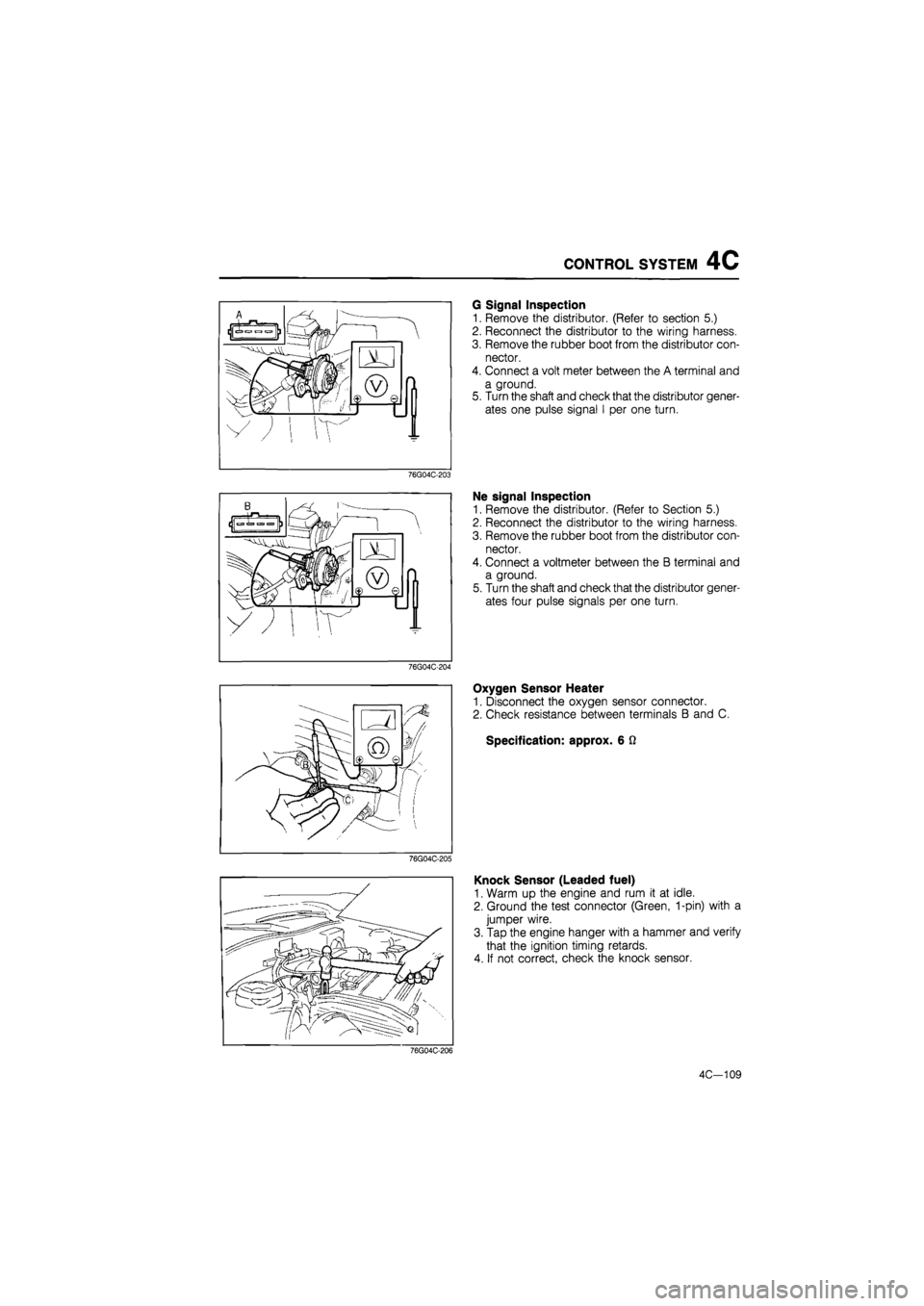
G Signal Inspection
1. Remove the distributor. (Refer to section 5.)
2. Reconnect the distributor to the wiring harness.
3. Remove the rubber boot from the distributor con-
nector.
4. Connect a volt meter between the A terminal and
a ground.
5. Turn the shaft and check that the distributor gener-
ates one pulse signal I per one turn.
Ne signal Inspection
1. Remove the distributor. (Refer to Section 5.)
2. Reconnect the distributor to the wiring harness.
3. Remove the rubber boot from the distributor con-
nector.
4. Connect a voltmeter between the B terminal and
a ground.
5. Turn the shaft and check that the distributor gener-
ates four pulse signals per one turn.
Oxygen Sensor Heater
1. Disconnect the oxygen sensor connector.
2. Check resistance between terminals B and C.
Specification: approx. 6 Q
Knock Sensor (Leaded fuel)
1. Warm up the engine and rum it at idle.
2. Ground the test connector (Green, 1-pin) with a
jumper wire.
3. Tap the engine hanger with a hammer and verify
that the ignition timing retards.
4. If not correct, check the knock sensor.
76G04C-206
4C-109
Page 713 of 1865

TROUBLESHOOTING GUIDE 5
TROUBLESHOOTING GUIDE
Problem Possible cause Remedy Page
Starter does not turn at all, or Its turning speed Is too slow to start the engine.
Battery and related parts Poor contact of battery terminals Poor grounding of negative cable Voltage drop caused by discharged battery Insufficient voltage caused by battery malfunction
Clean and tighten Clean and repair Recharge Replace
5- 8
5- 8 5- 8
Ignition switch and related parts Poor contact of ignition switch Loose ignition switch wiring or connector Broken wire between ignition switch and magnetic switch
Replace Repair Repair or replace 5-38,45,56,66
Magnetic switch and related parts Loose wiring and/or connectors Burnt magnetic switch contact plate or improper contact Broken wire in magnetic switch pull-in coil Broken wire magnetic switch holding coil
Repair Replace
Replace Replace
5-38,45,56,66 5-43,54,64,74
5-43,54,64,74 5-43,54.64,74
Starter Poor contact of brushes
Fatigued brush spring Poor grounding of field coil Poor soldering of field coil Commutator mulfunction Grounded armature Worn parts
Adjust contact or replace Replace Replace Repair Repair or Replace Replace Replace
5-43,54,64,74
Starting problem Gasoline engine Insufficient battery capacity Malfunction of spark plug (s)
Loose positive terminal Damaged distributor cap or rotor Ignition coil malfunction laniter malfunction
Recharge Clean, adjust or replace Tighten Replace Replace Renlane
5— 8 5— 9
5—16 5—10 5-16,20
Diesel engine Insufficient battery capacity QSS svstem malfunction Recharge ReDlace 5— 8 5-76
Starter turns but pinion gear does not mesh with ring gear
Starter Tip of overrunning clutch pinion is worn Weakened overrunning clutch drive spring Worn overrunning clutch Improper sliding of spline
Worn bushing Worn ring gear
Replace Replace Replace Adjust contact and repair, or replace Replace ReDlace
5-40,54,70
Starter turns continuously (does not stop) Magnetic switch Sticking contact place of magnetic switch Layer shorting coil of magnetic switch Ignition switch does not return
Replace Replace Rfinlanfi
5-43,54,64,74 5-43,54,64,74
Misfiring Dirty or damaged spark plug (s) Malfunction of wiring, or open circuit Damaged distributor cap
Clean or replace Repair or Replace Replace
5- 9 5—10 5—16
Discharging of battery Alternator Loose drive belt Grounded or broken stator coil Broken rotor coil Poor contact of brush and slip ring
Malfunction of rectifier Malfunction of IC regulator Battery and related parts Insufficient or unsuitable battery electrolyte Malfunction of battery electrode (internal short-circuit) Poor contact of battery terminal (s) Excessive electric load
Adjust Replace Replace Clean, repair or replace Replace Replace
Adjust Replace
Clean and tighten Check power consump-tion and short circuit
5-37 5-32 5-32 5-32
5-34
5— 8 5- 8
5— 8
Overcharging of battery IC regulator malfunction Operating in extremely high temperature Replace Reoair
Poor acceleration Mis-adjusted ignition timing Distributor malfunction Adjust Repair or replace 5—11 5—11
Knocking Mis-adjusted ignition timing | Distributor malfunction Adjust Repair or replace 5—11 5—11
76G05X-003
5-7
Page 720 of 1865
5 DISTRIBUTOR
FE General (MTX)
© a>
|18° ©
o> c (0 J*
c CO
O o 100 (3.94)250 (9.84)
mmHg (inHg)
o> c (0
c (0
FE 12 valve (Carb.)
13e
O 0 300
(11.81) mmHg (inHg)
FE West Germany (MTX)
© ©
O) ©
© 0)10° CO
c CO 6 0
FE West Germany MTX
120 245
(4.72) (9.65) mmHg (inHg)
FE General ATX
© S> o> © •o
O) 12 © CJ) c (0
c <0
O
100 200
(3.94) (7.87) mmHg (inHg)
FEE
© ©
O) ©
© O) C cd JC c CO
20 A chamber
/200
/(7-87) Vacuum
co -8 w
300
|(11.81)
[mm Hg (in Hg)]
B chamber
REMOVAL
1. Remove the high-tension leads.
2. Disconnect the vacuum hose(s) and wiring.
3. Loosen the distributor lock bolt(s).
4. Remove the distributor.
Note
Do riot turn the crankshaft after the distribu-
tor has been removed.
76G05X-010
5—14
Page 730 of 1865

5 ALTERNATOR
3. Alternator warning light operates properly, but battery discharged
OK
NG OK
1
a) Poor connection between B terminal and positive battery cable
b) Poor connection of negative battery cable c) Poor connection between alternator connector (2-pin) and positive battery terminal d) Stator coil or diodes malfunction (Refer to page 5—32 or 5—34.)
Perform TEST 2. (Refer to page 5--25.)
NG
Perform TEST 3. (Refer to Dage 5--26.)
I OK
Perfrom TEST 4. (Refer to page 5--26.)
NG
Perform TEST 5 (F Refer to page 5—26)
OK
Alternator normal.
Check other electrical components.
NG
Alternator normal.
Check other electrical components.
Perform TEST 5. (Refer to page 5—26.)
OK
Stator coil, diode, main fuse, or wiring har-ness between B ternimal and battery mal-function.
(Refer to page 5—32 or 5—34.)
IC regulator, bush, or rotor coil malfunction. (Refer to page 5—32 or 5—33)
NG
76G05X-027
4. Battery overcharged
Less than 14.1V
(At 20°C, 68°F)
More than 14.7V
(At 20oC,68°F)
IC regulator malfunction,
Perform TES T 6. (Refer to page 5—27.)
NG OK
Wiring harness malfunction.
76G05X-028
5—24
Page 738 of 1865
5 ALTERNATOR
86U05X-078
86U05X-080
86U05X-081
INSPECTION
Rotor
1. Wiring damage
(1) Check the resistance between the slip rings us-
ing an ohmmeter.
Specification: 2—6 U
(2) If it is not within specification, replace the rotor
2. Ground of the field coil
(1) Check for continuity between the slip ring and
the core using an ohmmeter.
(2) Replace the rotor if there is continuity.
3. Slip ring surface
If the slip ring surface is rough, use a lathe or fine
sandpaper to repair it.
Stator
1. Wiring damage
(1) Check for continuity between the stator coil
leads using an ohmmeter.
(2) Replace the stator if there is no continuity.
2. Ground of the stator coil
(1) Check for continuity between the stator coil
leads and the core using a circuit tester.
(2) Replace the stator if there is continuity.
86U05X-082
5—32


