Page 418 of 1865
![MAZDA 626 1987 Workshop Manual
DECELERATION CONTROL SYSTEM 4 A
SLOW FUEL CUT SYSTEM [FE 8VALVE—UNLEADED FUEL]
76G04A-096
This system shuts the primary slow fuel passage to prevent run-on and overheating of the exhaust
system](/manual-img/28/57059/w960_57059-417.png "MAZDA 626 1987 Workshop Manual
DECELERATION CONTROL SYSTEM 4 A
SLOW FUEL CUT SYSTEM [FE 8VALVE—UNLEADED FUEL]
76G04A-096
This system shuts the primary slow fuel passage to prevent run-on and overheating of the exhaust
system")
DECELERATION CONTROL SYSTEM 4 A
SLOW FUEL CUT SYSTEM [FE 8VALVE—UNLEADED FUEL]
76G04A-096
This system shuts the primary slow fuel passage to prevent run-on and overheating of the exhaust
system when the ignition switch is turned OFF or during deceleration (engine speed above 2,300
rpm and idle switch ON). The slow fuel cut solenoid is actuated by the engine control unit and ignition
switch.
Troubleshooting
Note
Make the system inspection first. If no problem is found, continue with the next inspec-
tion of the Troubleshooting Guide. (Refer to page 4A—47.)
Possible cause System inspection Slow fuel cut solenoid valve
Page 4A—53 4A—34
Check order 1 2
System Inspection
1. Warm up the engine and run it at idle.
2. Connect a tachometer to the engine.
3. Connect a voltmeter to the carburetor connector
terminal (BW wire).
4. Increase the engine speed to 4,000 rpm; then re-
lease the throttle lever.
5. Measure the terminal voltage.
Engine speed Voltage
Above approx. 2,300 rpm Approx. 12V
Below approx. 2,300 rpm Below 1.5V
76G04A-097
4A-53
Page 469 of 1865
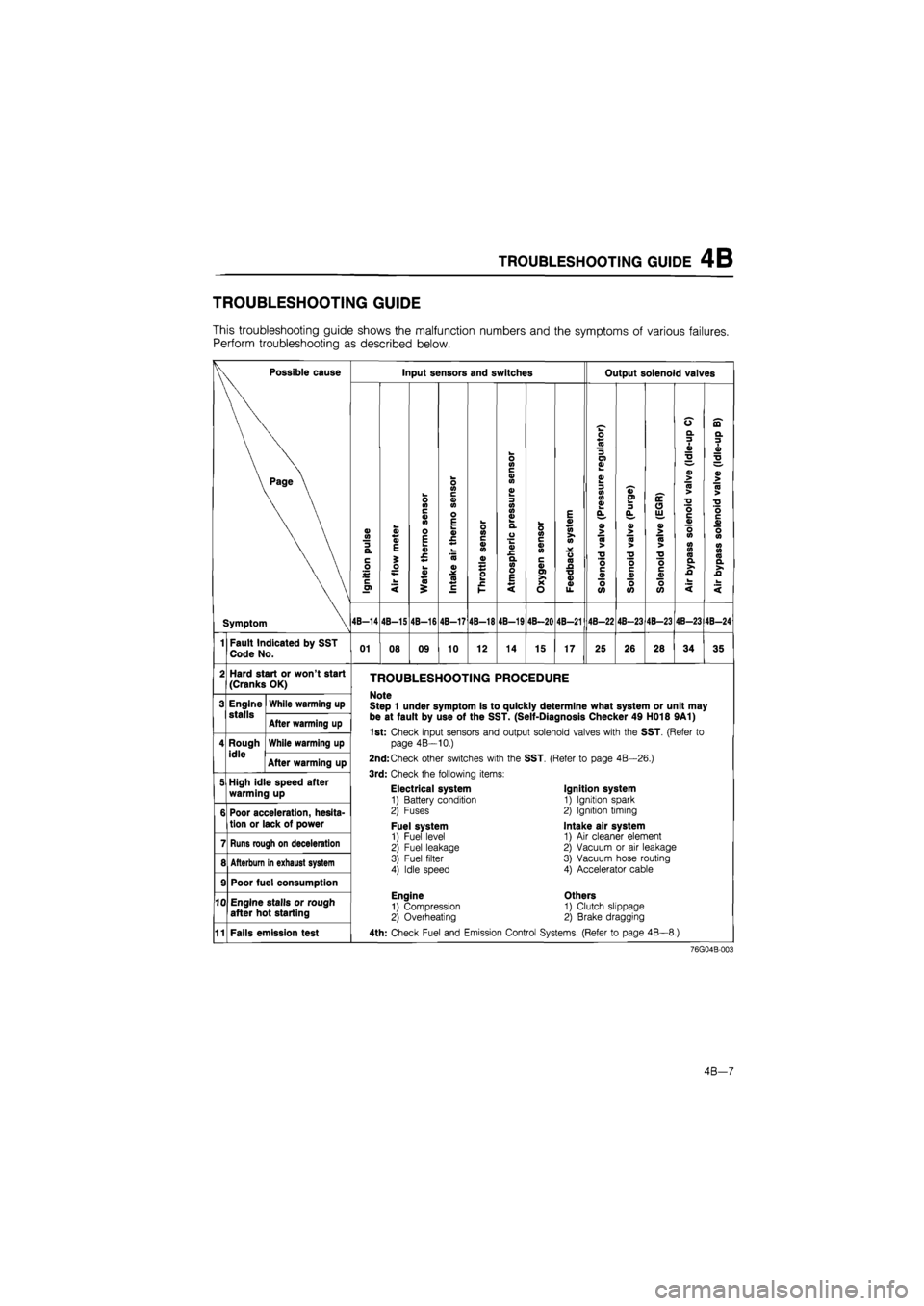
TROUBLESHOOTING GUIDE 4B
TROUBLESHOOTING GUIDE
This troubleshooting guide shows the malfunction numbers and the symptoms of various failures.
Perform troubleshooting as described below.
Possible cause
Symptom
Input sensors and switches
o>
Q.
C
0
Jh c 01
4B-14
a> 4)
E
o
4B-1S
o in c « m o E k_ 0) c.
0 <0 £
4B-16
o CO c a> 0) o E
a>
.x
co
4B-17
o 10 c a) co
4B-18
o in c a> (0
o> o> a>
a) £ a VI o E
4B-19
0 <0 c a> 0) c a> 01
S? o
4B-20
E a> in (0
o 10 A •o 0) 0> u.
4B-21
Output solenoid valves
o «
3 O) 0)
0) 0) 01
0> > 10 >
•o o c V o tt)
4B-22
0)
OI
0> > CO >
TJ
O c 0> o CO
4B-23
oc O u
o> > 75 >
•o o c a> o 05
4B-23
0 a. 3 1
2
0) > (0 >
"D O
o 0> in in a a >. £
4B-23
ffl a 3 • a>
2
a> > 10 >
"O o c a> o
CO Q. >. JO
4B-24
Fault Indicated by SST
Code No. 01 08 09 10 12 14 15 17 25 26 28 34 35
Hard start or won't start
(Cranks OK)
Engine stalls
Rough
idle
While warming up
After warming up
While warming up
After warming up
High idle speed after
warming up
TROUBLESHOOTING PROCEDURE
Note
Step 1 under symptom is to quickly determine what system or unit may be at fault by use of the SST. (Self-Diagnosis Checker 49 H018 9A1)
1st:
Check input sensors and output solenoid valves with the
SST.
(Refer
to
page 4B—10.)
2nd:
Check other switches with the
SST.
(Refer
to
page 4B—26.)
3rd:
Check the following items:
11
Poor acceleration, hesita-
tion or lack of power
Runs rough on deceleration
Afterburn in exhaust system
Poor fuel consumption
Engine stalls or rough after hot starting
Electrical system
1) Battery condition
2) Fuses
Fuel system
1) Fuel level 2) Fuel leakage
3) Fuel filter 4) Idle speed
Engine
1) Compression 2) Overheating
Ignition system
1) Ignition spark 2) Ignition timing
Intake air system
1)
Air
cleaner element 2) Vacuum
or air
leakage 3) Vacuum hose routing
4) Accelerator cable
Others
1) Clutch slippage 2) Brake dragging
Fails emission test 4th:
Check Fuel and Emission Control Systems. (Refer
to
page 4B—8.)
76G04B-003
4B—7
Page 570 of 1865

TROUBLESHOOTING GUIDE 4C
TROUBLESHOOTING GUIDE
This troubleshooting guide shows the malfunction numbers and the symptoms of various failures.
Perform troubleshooting as described below.
Input sensors and switches
Possible cause
Page
Symptom and No. CO
T O
a c OI '35
O
I o Tt
o in
a> in
8 c
o
o (A C 0) in
S o
I o
c $
o E
00 T-I O
T o I-ij
o in c at at o E « £
2 a
o>
o
e o •C H
I O
o at e 0) o>
o CM I o
E a> «-» in >• in a o (0 A •o a> d>
CM I o
Output solenoid valve
o> > <0 >
2
—.
§8 £ c
O O
(0
O
CVI I o
c 0 u « 01 w 3 a
o z «
> 73 >
"O o c a> o (/)
CM CM
o
O o 0) o>
Q. CM
V >
CB >
•o o c 4) o CO
CM CM
O
oc (9 UJ, g
n >
•o o c a> o <0
CO CM
O
o o •o w « a in «
2
s
5 •o o c »
o CO
CO CM
o
n
£
o in c a* (A c a> o>
o
CM
O
w q) t « s > c w QJ O)
"8 g> IS n « £
a> >
a >
T3 O C ai o CO
TT CM
o
Fault Indicated by SST
Code No. 02 03 05 *i 08 09 11 12 *2 15 • 2 17 *2 25 26 *2 27 *2 28 • 2 34 36 • 2 41
Hard start or won't start
(Cranks OK)
Engine stalls
Rough
Idle
During warm up
After warm up
During warm up
After warm up
High idle speed after warm up
Poor acceleration, hesita-tion or lack of power
TROUBLESHOOTING PROCEDURE
Note
Code No. Is to quickly determine which system or unit may be at fault by use of the SST. (Self-Diagnosis Checker 49 H018 9A1 or Digital Code Checker 49 G018 9A0 with Adaptor harness 49 9200 180)
1st: Check input sensors and output solenoid valves with the SST. (Refer to
page
AC—11.)
2nd: Check other switches with the SST. (Refer to page AC—25.)
3rd: Check the following items:
Electrical system
1) Battery condition 2) Fuses
Runs rough on deceleration
Afterburn in exhaust
system
9
10
Poor fuel consumption
Engine stalls or runs
rough after hot starting
11
12
Knocking
Fuel system
1) Fuel level
2) Fuel leakage 3) Fuel filter 4) Idle speed (with test connec-tor grounded)
Engine
1) Compression 2) Overheating
Ignition system 1) Ignition spark
2) Ignition timing (with test connec-tor grounded)
Intake air system 1) Air cleaner element 2) Vacuum or air leakage 3) Vacuum hose routing 4) Accelerator cable
Others 1) Clutch slippage
2) Brake dragging
Fails emission test 4th: Check Fuel and Emission Control Systems. (Refer to page 4C—10.)
*1..
*2„
.Leaded fuel
.Unleaded fuel
76G04C-009
4C—9