1983 FIAT UNO ECO mode
[x] Cancel search: ECO modePage 163 of 303
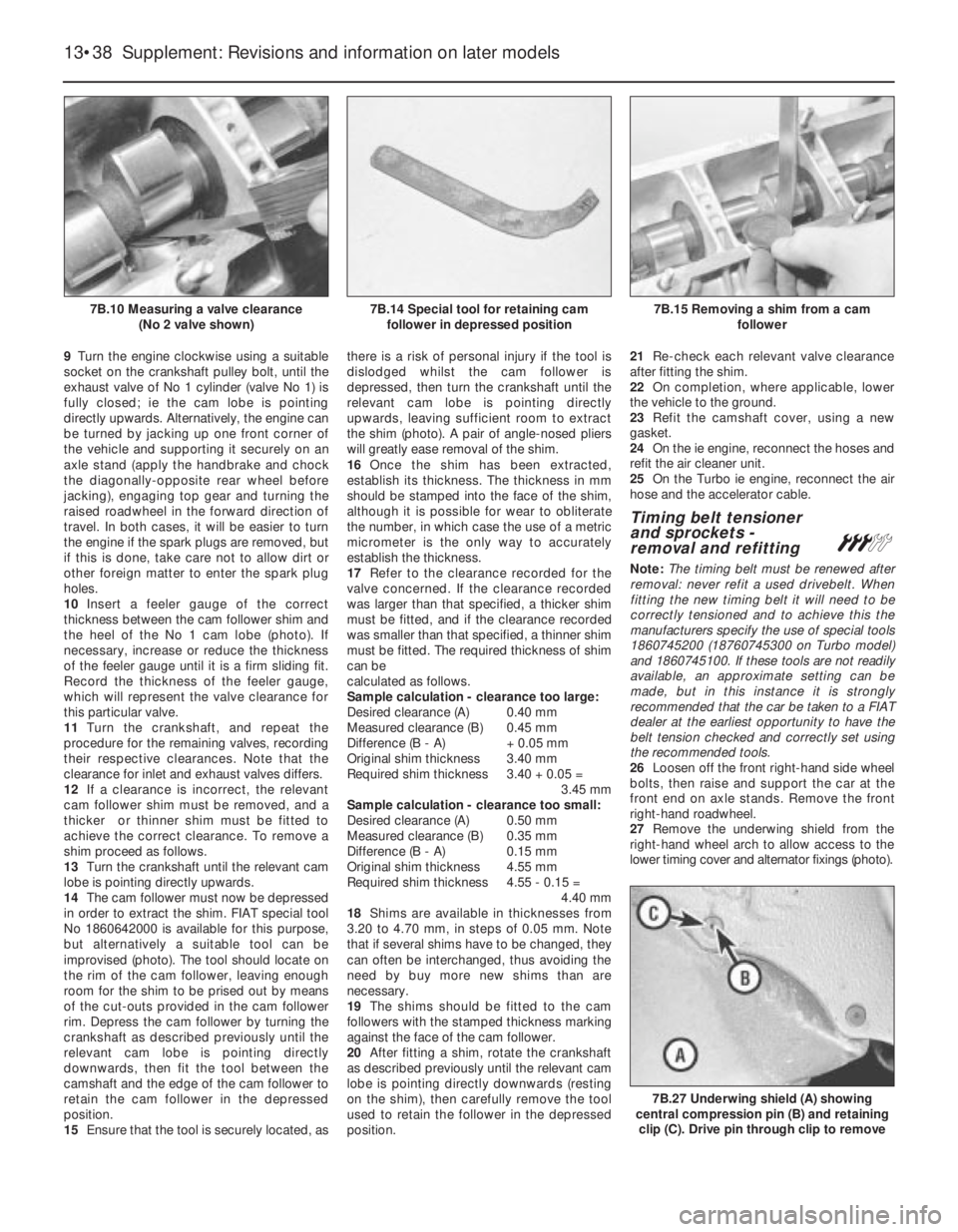
9Turn the engine clockwise using a suitable
socket on the crankshaft pulley bolt, until the
exhaust valve of No 1 cylinder (valve No 1) is
fully closed; ie the cam lobe is pointing
directly upwards. Alternatively, the engine can
be turned by jacking up one front corner of
the vehicle and supporting it securely on an
axle stand (apply the handbrake and chock
the diagonally-opposite rear wheel before
jacking), engaging top gear and turning the
raised roadwheel in the forward direction of
travel. In both cases, it will be easier to turn
the engine if the spark plugs are removed, but
if this is done, take care not to allow dirt or
other foreign matter to enter the spark plug
holes.
10Insert a feeler gauge of the correct
thickness between the cam follower shim and
the heel of the No 1 cam lobe (photo). If
necessary, increase or reduce the thickness
of the feeler gauge until it is a firm sliding fit.
Record the thickness of the feeler gauge,
which will represent the valve clearance for
this particular valve.
11Turn the crankshaft, and repeat the
procedure for the remaining valves, recording
their respective clearances. Note that the
clearance for inlet and exhaust valves differs.
12If a clearance is incorrect, the relevant
cam follower shim must be removed, and a
thicker or thinner shim must be fitted to
achieve the correct clearance. To remove a
shim proceed as follows.
13Turn the crankshaft until the relevant cam
lobe is pointing directly upwards.
14The cam follower must now be depressed
in order to extract the shim. FIAT special tool
No 1860642000 is available for this purpose,
but alternatively a suitable tool can be
improvised (photo). The tool should locate on
the rim of the cam follower, leaving enough
room for the shim to be prised out by means
of the cut-outs provided in the cam follower
rim. Depress the cam follower by turning the
crankshaft as described previously until the
relevant cam lobe is pointing directly
downwards, then fit the tool between the
camshaft and the edge of the cam follower to
retain the cam follower in the depressed
position.
15Ensure that the tool is securely located, asthere is a risk of personal injury if the tool is
dislodged whilst the cam follower is
depressed, then turn the crankshaft until the
relevant cam lobe is pointing directly
upwards, leaving sufficient room to extract
the shim (photo). A pair of angle-nosed pliers
will greatly ease removal of the shim.
16Once the shim has been extracted,
establish its thickness. The thickness in mm
should be stamped into the face of the shim,
although it is possible for wear to obliterate
the number, in which case the use of a metric
micrometer is the only way to accurately
establish the thickness.
17Refer to the clearance recorded for the
valve concerned. If the clearance recorded
was larger than that specified, a thicker shim
must be fitted, and if the clearance recorded
was smaller than that specified, a thinner shim
must be fitted. The required thickness of shim
can be
calculated as follows.
Sample calculation - clearance too large:
Desired clearance (A) 0.40 mm
Measured clearance (B) 0.45 mm
Difference (B - A) + 0.05 mm
Original shim thickness 3.40 mm
Required shim thickness 3.40 + 0.05 =
3.45 mm
Sample calculation - clearance too small:
Desired clearance (A) 0.50 mm
Measured clearance (B) 0.35 mm
Difference (B - A) 0.15 mm
Original shim thickness 4.55 mm
Required shim thickness 4.55 - 0.15 =
4.40 mm
18Shims are available in thicknesses from
3.20 to 4.70 mm, in steps of 0.05 mm. Note
that if several shims have to be changed, they
can often be interchanged, thus avoiding the
need by buy more new shims than are
necessary.
19The shims should be fitted to the cam
followers with the stamped thickness marking
against the face of the cam follower.
20After fitting a shim, rotate the crankshaft
as described previously until the relevant cam
lobe is pointing directly downwards (resting
on the shim), then carefully remove the tool
used to retain the follower in the depressed
position.21Re-check each relevant valve clearance
after fitting the shim.
22On completion, where applicable, lower
the vehicle to the ground.
23Refit the camshaft cover, using a new
gasket.
24On the ie engine, reconnect the hoses and
refit the air cleaner unit.
25On the Turbo ie engine, reconnect the air
hose and the accelerator cable.
Timing belt tensioner
and sprockets -
removal and refitting
#
Note: The timing belt must be renewed after
removal: never refit a used drivebelt. When
fitting the new timing belt it will need to be
correctly tensioned and to achieve this the
manufacturers specify the use of special tools
1860745200 (18760745300 on Turbo model)
and 1860745100. If these tools are not readily
available, an approximate setting can be
made, but in this instance it is strongly
recommended that the car be taken to a FIAT
dealer at the earliest opportunity to have the
belt tension checked and correctly set using
the recommended tools.
26Loosen off the front right-hand side wheel
bolts, then raise and support the car at the
front end on axle stands. Remove the front
right-hand roadwheel.
27Remove the underwing shield from the
right-hand wheel arch to allow access to the
lower timing cover and alternator fixings (photo).
13•38 Supplement: Revisions and information on later models
7B.27 Underwing shield (A) showing
central compression pin (B) and retaining
clip (C). Drive pin through clip to remove
7B.15 Removing a shim from a cam
follower7B.14 Special tool for retaining cam
follower in depressed position7B.10 Measuring a valve clearance
(No 2 valve shown)
Page 164 of 303
28Loosen off the retaining clips and detach
the air intake pipe from the air filter.
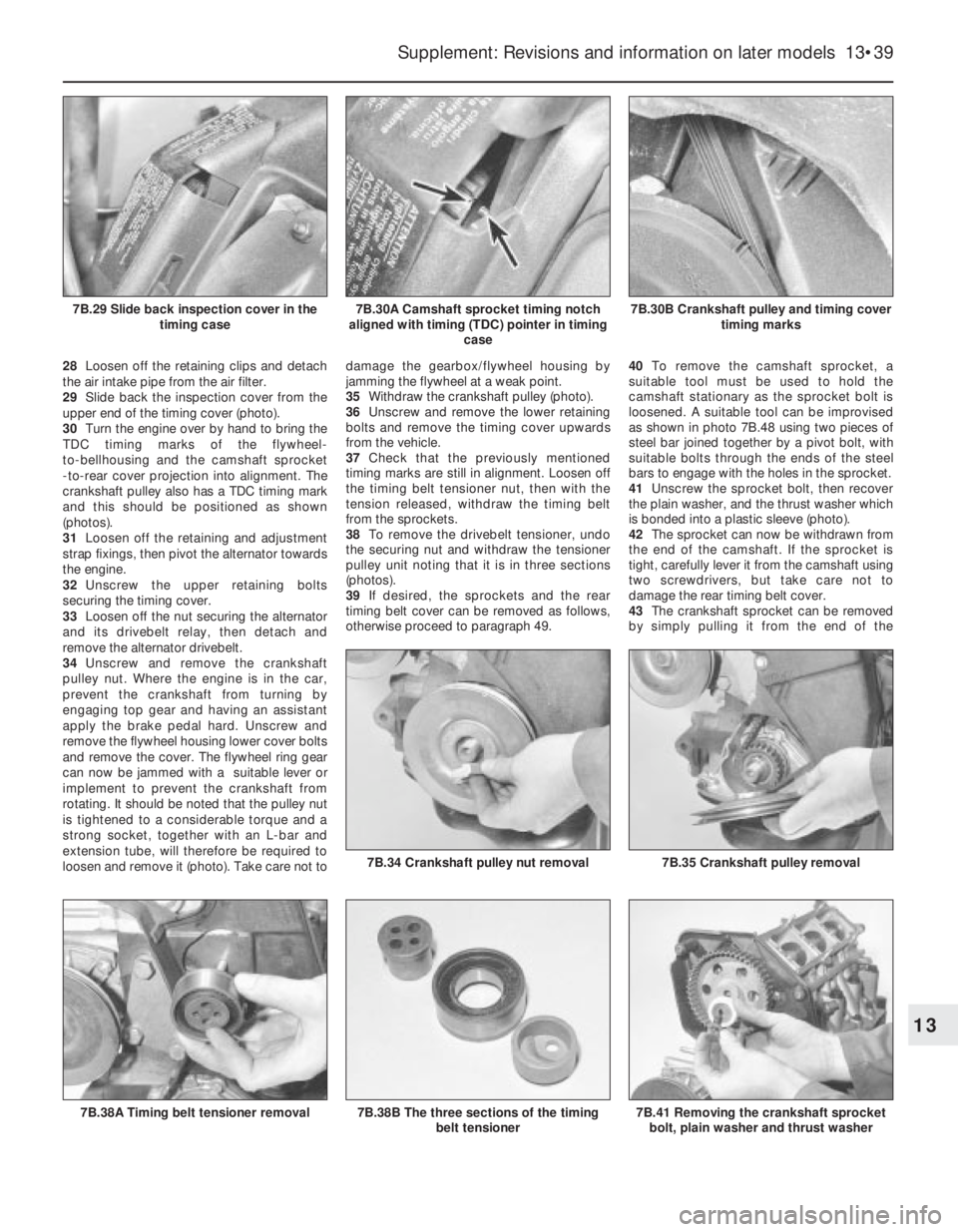
29Slide back the inspection cover from the
upper end of the timing cover (photo).
30Turn the engine over by hand to bring the
TDC timing marks of the flywheel-
to-bellhousing and the camshaft sprocket
-to-rear cover projection into alignment. The
crankshaft pulley also has a TDC timing mark
and this should be positioned as shown
(photos).
31Loosen off the retaining and adjustment
strap fixings, then pivot the alternator towards
the engine.
32Unscrew the upper retaining bolts
securing the timing cover.
33Loosen off the nut securing the alternator
and its drivebelt relay, then detach and
remove the alternator drivebelt.
34Unscrew and remove the crankshaft
pulley nut. Where the engine is in the car,
prevent the crankshaft from turning by
engaging top gear and having an assistant
apply the brake pedal hard. Unscrew and
remove the flywheel housing lower cover bolts
and remove the cover. The flywheel ring gear
can now be jammed with a suitable lever or
implement to prevent the crankshaft from
rotating. It should be noted that the pulley nut
is tightened to a considerable torque and a
strong socket, together with an L-bar and
extension tube, will therefore be required to
loosen and remove it (photo). Take care not todamage the gearbox/flywheel housing by
jamming the flywheel at a weak point.
35Withdraw the crankshaft pulley (photo).
36Unscrew and remove the lower retaining
bolts and remove the timing cover upwards
from the vehicle.
37Check that the previously mentioned
timing marks are still in alignment. Loosen off
the timing belt tensioner nut, then with the
tension released, withdraw the timing belt
from the sprockets.
38To remove the drivebelt tensioner, undo
the securing nut and withdraw the tensioner
pulley unit noting that it is in three sections
(photos).
39If desired, the sprockets and the rear
timing belt cover can be removed as follows,
otherwise proceed to paragraph 49.40To remove the camshaft sprocket, a
suitable tool must be used to hold the
camshaft stationary as the sprocket bolt is
loosened. A suitable tool can be improvised
as shown in photo 7B.48 using two pieces of
steel bar joined together by a pivot bolt, with
suitable bolts through the ends of the steel
bars to engage with the holes in the sprocket.
41Unscrew the sprocket bolt, then recover
the plain washer, and the thrust washer which
is bonded into a plastic sleeve (photo).
42The sprocket can now be withdrawn from
the end of the camshaft. If the sprocket is
tight, carefully lever it from the camshaft using
two screwdrivers, but take care not to
damage the rear timing belt cover.
43The crankshaft sprocket can be removed
by simply pulling it from the end of the
Supplement: Revisions and information on later models 13•39
7B.30B Crankshaft pulley and timing cover
timing marks7B.30A Camshaft sprocket timing notch
aligned with timing (TDC) pointer in timing
case7B.29 Slide back inspection cover in the
timing case
7B.41 Removing the crankshaft sprocket
bolt, plain washer and thrust washer7B.38B The three sections of the timing
belt tensioner
7B.35 Crankshaft pulley removal7B.34 Crankshaft pulley nut removal
7B.38A Timing belt tensioner removal
13
Page 165 of 303
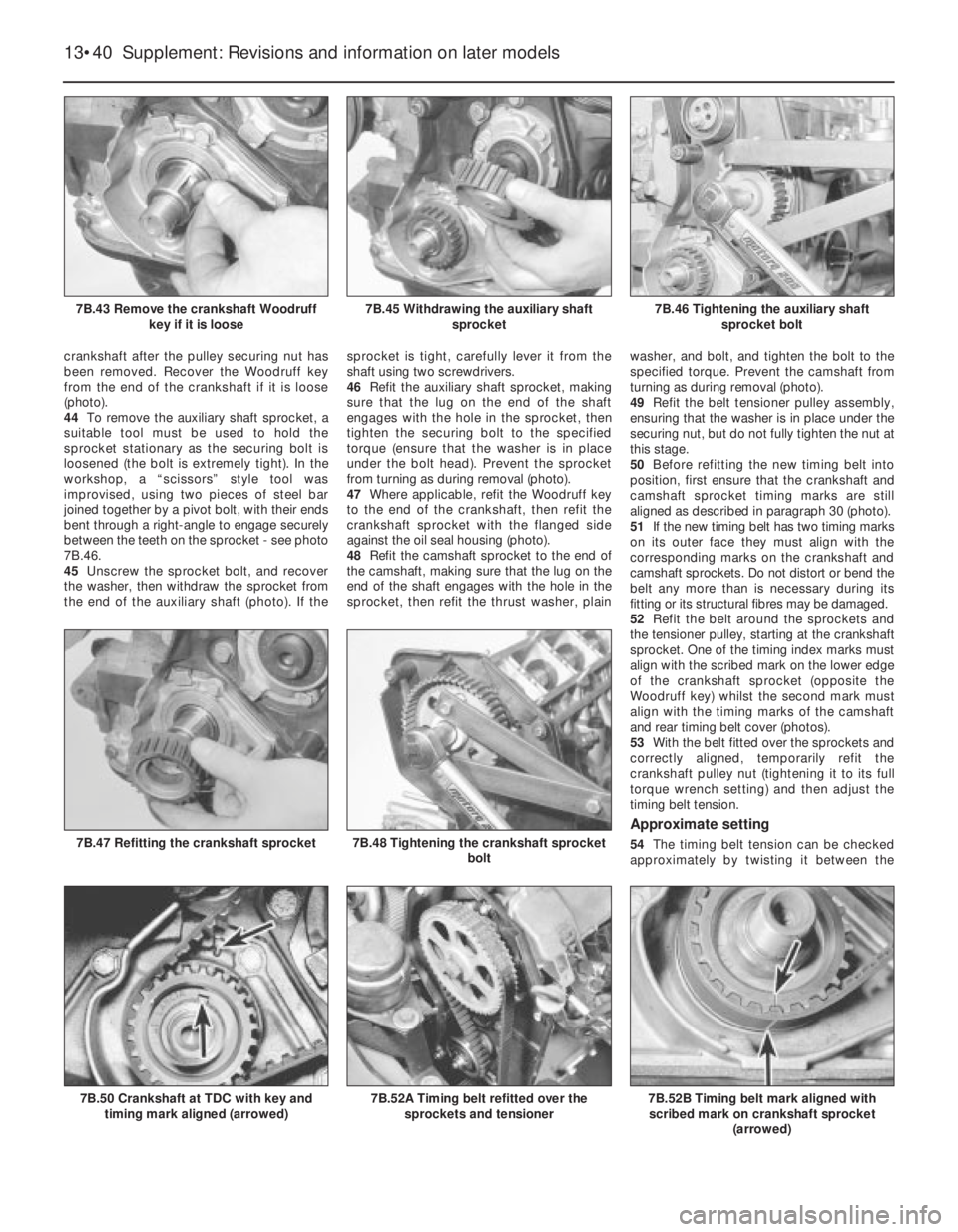
crankshaft after the pulley securing nut has
been removed. Recover the Woodruff key
from the end of the crankshaft if it is loose
(photo).
44To remove the auxiliary shaft sprocket, a
suitable tool must be used to hold the
sprocket stationary as the securing bolt is
loosened (the bolt is extremely tight). In the
workshop, a “scissors” style tool was
improvised, using two pieces of steel bar
joined together by a pivot bolt, with their ends
bent through a right-angle to engage securely
between the teeth on the sprocket - see photo
7B.46.
45Unscrew the sprocket bolt, and recover
the washer, then withdraw the sprocket from
the end of the auxiliary shaft (photo). If thesprocket is tight, carefully lever it from the
shaft using two screwdrivers.
46Refit the auxiliary shaft sprocket, making
sure that the lug on the end of the shaft
engages with the hole in the sprocket, then
tighten the securing bolt to the specified
torque (ensure that the washer is in place
under the bolt head). Prevent the sprocket
from turning as during removal (photo).
47Where applicable, refit the Woodruff key
to the end of the crankshaft, then refit the
crankshaft sprocket with the flanged side
against the oil seal housing (photo).
48Refit the camshaft sprocket to the end of
the camshaft, making sure that the lug on the
end of the shaft engages with the hole in the
sprocket, then refit the thrust washer, plainwasher, and bolt, and tighten the bolt to the
specified torque. Prevent the camshaft from
turning as during removal (photo).
49Refit the belt tensioner pulley assembly,
ensuring that the washer is in place under the
securing nut, but do not fully tighten the nut at
this stage.
50Before refitting the new timing belt into
position, first ensure that the crankshaft and
camshaft sprocket timing marks are still
aligned as described in paragraph 30 (photo).
51If the new timing belt has two timing marks
on its outer face they must align with the
corresponding marks on the crankshaft and
camshaft sprockets. Do not distort or bend the
belt any more than is necessary during its
fitting or its structural fibres may be damaged.
52Refit the belt around the sprockets and
the tensioner pulley, starting at the crankshaft
sprocket. One of the timing index marks must
align with the scribed mark on the lower edge
of the crankshaft sprocket (opposite the
Woodruff key) whilst the second mark must
align with the timing marks of the camshaft
and rear timing belt cover (photos).
53With the belt fitted over the sprockets and
correctly aligned, temporarily refit the
crankshaft pulley nut (tightening it to its full
torque wrench setting) and then adjust the
timing belt tension.
Approximate setting
54The timing belt tension can be checked
approximately by twisting it between the
13•40 Supplement: Revisions and information on later models
7B.52B Timing belt mark aligned with
scribed mark on crankshaft sprocket
(arrowed)7B.52A Timing belt refitted over the
sprockets and tensioner7B.50 Crankshaft at TDC with key and
timing mark aligned (arrowed)
7B.48 Tightening the crankshaft sprocket
bolt7B.47 Refitting the crankshaft sprocket
7B.46 Tightening the auxiliary shaft
sprocket bolt7B.45 Withdrawing the auxiliary shaft
sprocket7B.43 Remove the crankshaft Woodruff
key if it is loose
Page 167 of 303
79Recover the gasket.
80Removal of the camshaft from the
housing, and inspection of the components is
described in the following sub-Section.
81Commence refitting by cleaning the
gasket mating surfaces of the camshaft
housing and cylinder head.
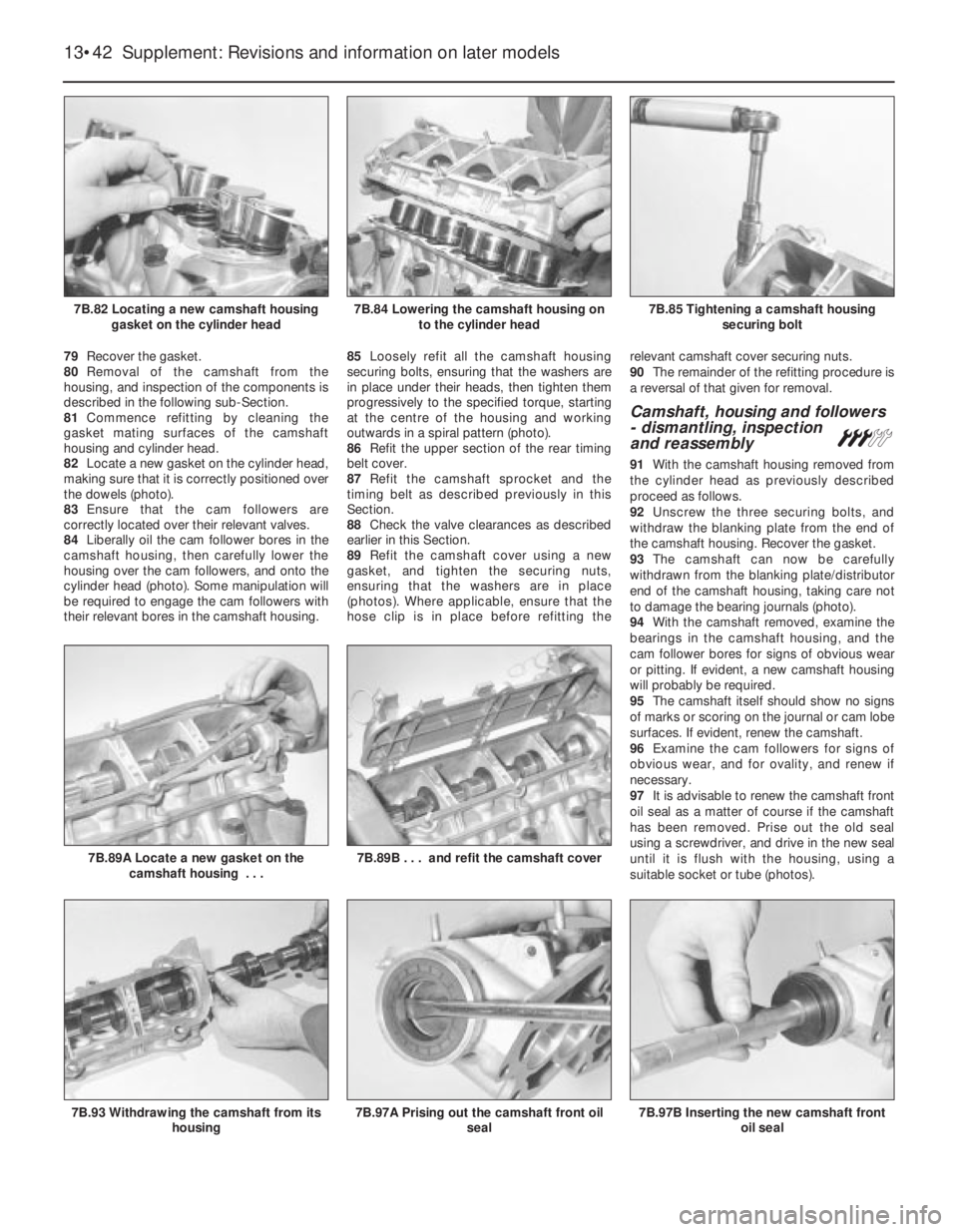
82Locate a new gasket on the cylinder head,
making sure that it is correctly positioned over
the dowels (photo).
83Ensure that the cam followers are
correctly located over their relevant valves.
84Liberally oil the cam follower bores in the
camshaft housing, then carefully lower the
housing over the cam followers, and onto the
cylinder head (photo). Some manipulation will
be required to engage the cam followers with
their relevant bores in the camshaft housing.85Loosely refit all the camshaft housing
securing bolts, ensuring that the washers are
in place under their heads, then tighten them
progressively to the specified torque, starting
at the centre of the housing and working
outwards in a spiral pattern (photo).
86Refit the upper section of the rear timing
belt cover.
87Refit the camshaft sprocket and the
timing belt as described previously in this
Section.
88Check the valve clearances as described
earlier in this Section.
89Refit the camshaft cover using a new
gasket, and tighten the securing nuts,
ensuring that the washers are in place
(photos). Where applicable, ensure that the
hose clip is in place before refitting therelevant camshaft cover securing nuts.
90The remainder of the refitting procedure is
a reversal of that given for removal.
Camshaft, housing and followers
- dismantling, inspection
and reassembly
#
91With the camshaft housing removed from
the cylinder head as previously described
proceed as follows.
92Unscrew the three securing bolts, and
withdraw the blanking plate from the end of
the camshaft housing. Recover the gasket.
93The camshaft can now be carefully
withdrawn from the blanking plate/distributor
end of the camshaft housing, taking care not
to damage the bearing journals (photo).
94With the camshaft removed, examine the
bearings in the camshaft housing, and the
cam follower bores for signs of obvious wear
or pitting. If evident, a new camshaft housing
will probably be required.
95The camshaft itself should show no signs
of marks or scoring on the journal or cam lobe
surfaces. If evident, renew the camshaft.
96Examine the cam followers for signs of
obvious wear, and for ovality, and renew if
necessary.
97It is advisable to renew the camshaft front
oil seal as a matter of course if the camshaft
has been removed. Prise out the old seal
using a screwdriver, and drive in the new seal
until it is flush with the housing, using a
suitable socket or tube (photos).
13•42 Supplement: Revisions and information on later models
7B.97B Inserting the new camshaft front
oil seal7B.97A Prising out the camshaft front oil
seal7B.93 Withdrawing the camshaft from its
housing
7B.89B . . . and refit the camshaft cover7B.89A Locate a new gasket on the
camshaft housing . . .
7B.85 Tightening a camshaft housing
securing bolt7B.84 Lowering the camshaft housing on
to the cylinder head7B.82 Locating a new camshaft housing
gasket on the cylinder head
Page 168 of 303

98Commence reassembly by liberally oiling
the bearings in the housing, and the oil seal lip.
99Carefully insert the camshaft into the
housing from the blanking plate/distributor
end, taking care to avoid damage to the
bearings.
100Refit the blanking plate using a new
gasket.
101Refit the camshaft housing as described
previously in this Section.
Cylinder head
(1372 cc ie engine) -
removal and refitting
#
Note: The following instructions describe
cylinder head removal and refitting leaving the
camshaft, manifolds and associated items in situ
In the head. If required, these items can be
removed separately. When removing the
cylinder head the engine must be cold - do not
remove the head from a hot engine. A new
cylinder head gasket and any associated gaskets
must be used during reassembly. FIAT specify
that the main cylinder head bolts should be
renewed after they have been used (ie tightened)
four times. If in any doubt as to the number of
times that they have been used renew them as a
precaution against possible failure.
Warning: Refer to the beginning
of Section 9 before starting any
work.
102Depressurise the fuel supply system as
described in Section 9 of this Chapter.
103Disconnect the battery negative lead.
104Drain the engine coolant as described in
Section 8.
105Remove the air cleaner unit as described
in Section 9.
106Remove the timing belt as described
previously in this Section.107Disconnect the crankcase ventilation
hose from the cylinder head and the SPi
injector unit.
108Disconnect the accelerator cable at the
engine end.
109Detach the engine idle speed check
actuator lead, the inlet manifold vacuum
sensor lead, the coolant temperature sensor
lead, the injector supply lead, the throttle
position switch lead and the distributor cap
(with HT leads). Position them out of the way.
110Disconnect the brake servo hose from
the manifold.
111Disconnect the coolant hoses from the
thermostat and the inlet manifold.
112Slowly release the fuel supply and return
hose retaining clips and detach the hoses
from the injector unit housing and
connections. Catch any fuel spillage in a clean
cloth and plug the hoses to prevent the
ingress of dirt and further fuel loss.
113Unbolt and detach the exhaust downpipe
from the manifold.
114Loosen off the cylinder head retaining
bolts in a progressive manner, reversing the
sequence shown in Fig. 13.17. When all of the
bolts are loosened off, extract them and
collect the washers.
115Check that all fittings and associated
attachments are clear of the cylinder head,
then carefully lift the head from the cylinder
block. If necessary tap the head lightly with a
soft-faced mallet to free it from the block, but
do not lever it free between the joint faces.
Note that the cylinder head is located on
dowels.116Recover the old cylinder head gasket and
discard it.
117Clean the cylinder head and block mating
surfaces by careful scraping. Take care not to
damage the cylinder head - it is manufactured in
light alloy and is easily scored. Cover the coolant
passages and other openings to prevent dirt and
carbon from falling into them. Mop out all the oil
from the cylinder head bolt holes - if oil is left in
them, hydraulic pressure, caused when the bolts
are refitted, could cause the block to crack.
118If required the cylinder head can be
dismantled and overhauled as described in
paragraphs 129 to 131 of this Section.
119The new gasket must be removed from
its protective packing just before it is fitted.
Do not allow any oil or grease to come into
contact with the gasket. Commence refitting
the cylinder head by locating the new gasket
on the cylinder block so that the word “ALTO”
is facing up (photo).
120With the mating faces scrupulously
clean, refit the cylinder head into position and
engage it over the dowels. Refer to the note at
the beginning of this part of the Section, then
refit the ten main cylinder head bolts and
washers. Screw each bolt in as far as possible
by hand to start with. Do not fit the smaller
(M8 x 1.25) bolts at this stage (photos).
121The bolts must now be tightened in stages
and in the sequence shown in Fig. 13.17. Refer
to the specified torque wrench settings and
tighten all bolts to the Stage 1 torque, then
using a suitable angle gauge, tighten them to
the second stage, then the third stage (photos).
122With the main cylinder head bolts fully
Supplement: Revisions and information on later models 13•43
7B.120B . . . and engage the positioning
dowels in their holes7B.120A Lower the cylinder head onto the
block . . .7B.119 Locating a new cylinder head
gasket on the cylinder block (engine
shown on dismantling stand)
7B.121A Tighten main cylinder head bolts
to specified torque . . .Fig. 13.17 Cylinder head bolt tightening
sequence on the 1372 cc ie and Turbo ie
engines (Sec 7B)
13
7B.121B . . . and then through the specified
angle
Page 169 of 303
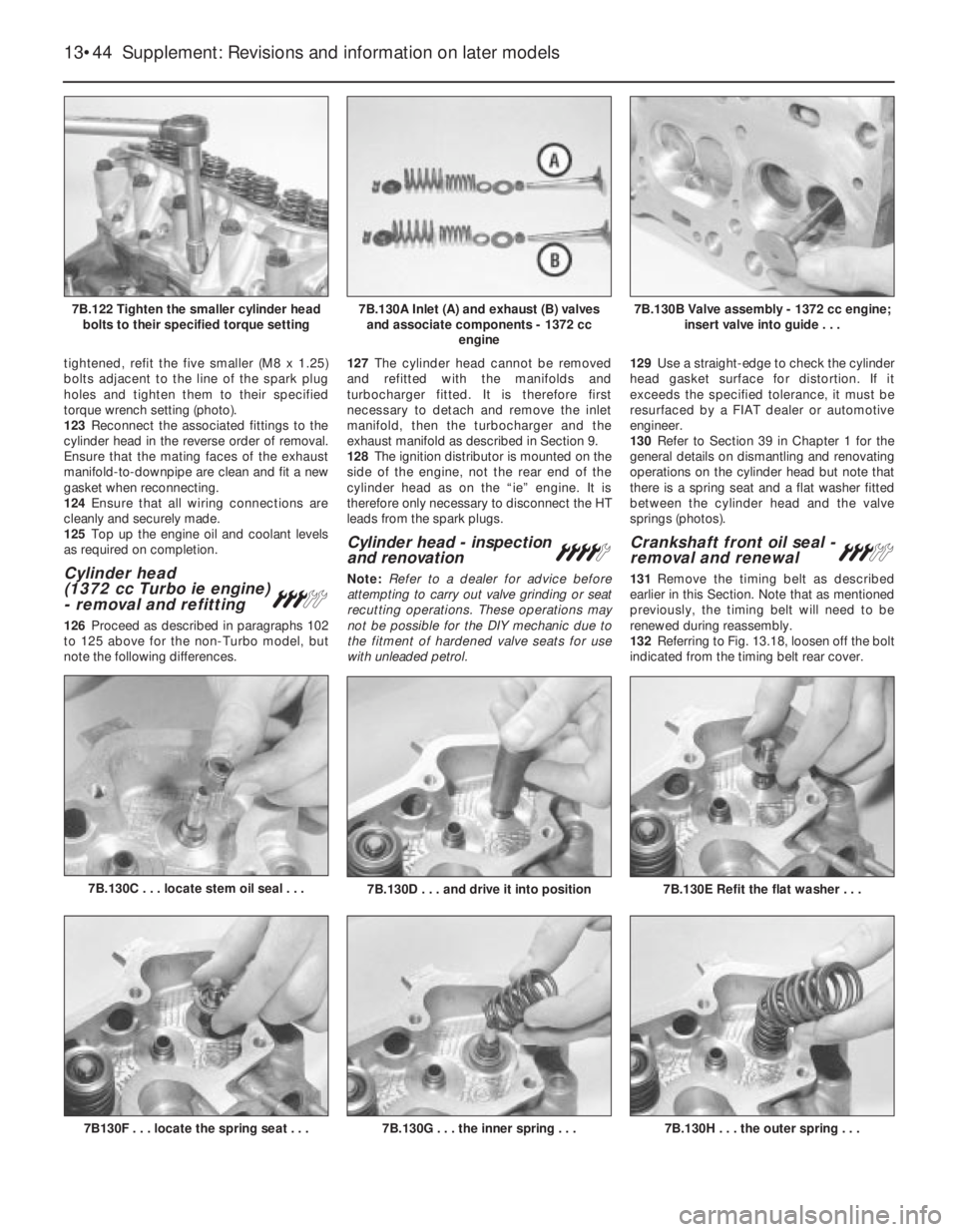
tightened, refit the five smaller (M8 x 1.25)
bolts adjacent to the line of the spark plug
holes and tighten them to their specified
torque wrench setting (photo).
123Reconnect the associated fittings to the
cylinder head in the reverse order of removal.
Ensure that the mating faces of the exhaust
manifold-to-downpipe are clean and fit a new
gasket when reconnecting.
124Ensure that all wiring connections are
cleanly and securely made.
125Top up the engine oil and coolant levels
as required on completion.
Cylinder head
(1372 cc Turbo ie engine)
- removal and refitting
#
126Proceed as described in paragraphs 102
to 125 above for the non-Turbo model, but
note the following differences.127The cylinder head cannot be removed
and refitted with the manifolds and
turbocharger fitted. It is therefore first
necessary to detach and remove the inlet
manifold, then the turbocharger and the
exhaust manifold as described in Section 9.
128The ignition distributor is mounted on the
side of the engine, not the rear end of the
cylinder head as on the “ie” engine. It is
therefore only necessary to disconnect the HT
leads from the spark plugs.
Cylinder head - inspection
and renovation¢
Note: Refer to a dealer for advice before
attempting to carry out valve grinding or seat
recutting operations. These operations may
not be possible for the DIY mechanic due to
the fitment of hardened valve seats for use
with unleaded petrol.129Use a straight-edge to check the cylinder
head gasket surface for distortion. If it
exceeds the specified tolerance, it must be
resurfaced by a FIAT dealer or automotive
engineer.
130Refer to Section 39 in Chapter 1 for the
general details on dismantling and renovating
operations on the cylinder head but note that
there is a spring seat and a flat washer fitted
between the cylinder head and the valve
springs (photos).
Crankshaft front oil seal -
removal and renewal#
131Remove the timing belt as described
earlier in this Section. Note that as mentioned
previously, the timing belt will need to be
renewed during reassembly.
132Referring to Fig. 13.18, loosen off the bolt
indicated from the timing belt rear cover.
13•44 Supplement: Revisions and information on later models
7B.130H . . . the outer spring . . .7B.130G . . . the inner spring . . .7B130F . . . locate the spring seat . . .
7B.130E Refit the flat washer . . .7B.130D . . . and drive it into position7B.130C . . . locate stem oil seal . . .
7B.130B Valve assembly - 1372 cc engine;
insert valve into guide . . .7B.130A Inlet (A) and exhaust (B) valves
and associate components - 1372 cc
engine7B.122 Tighten the smaller cylinder head
bolts to their specified torque setting
Page 170 of 303

133Drain the engine oil from the sump into a
suitable container. Disconnect the lead from
the engine oil level sensor in the sump.
134Where applicable, unscrew and remove
the bolts retaining the gear linkage mounting
bracket and the clutch housing lower cover
bolts. Remove the cover from the clutch
housing.
135Unscrew the sump retaining nuts and
bolts, then lower and remove the sump.
136Unscrew the timing belt rear cover
retaining bolts.
137Move the timing belt rear cover towards
the front of the car to gain access to the
retaining bolt and then unscrew and remove
the three oil seal housing retaining bolts.
Remove the crankshaft front oil seal housing.
138Note the orientation of the seal in its
housing prior to its removal. Support the
underside of the housing and carefully drive
the old oil seal from the housing using a
punch or a tubular drift of suitable diameter.
An alternative method is to punch or drill a
small hole in the face of the oil seal (but take
care not to drill into the housing) and insert a
self-tapping screw into the seal. Withdraw the
seal by gripping the screw with pliers and
pulling the seal from the housing. If necessary,
fit a second screw into the seal on the
opposite side to provide an even pull.
139Clean the mating faces of the housing
and the front of the crankcase using a suitable
scraper.
140Drive or press the new seal into positionin the housing in the reverse order of removal,
but ensure that it is correctly orientated as
noted during removal (photo).
141Refit the oil seal housing with a new
gasket and tighten the retaining bolts to the
specified torque setting (photos).
142Refit the sump as described later in this
Section using a new gasket. Tighten its
retaining nuts and bolts to the specified
torque. Refit the clutch cover and the gear
linkage mounting bracket.
143Fit the new timing belt, adjust its tension
and refit the crankshaft pulley as described
earlier in this Section.
144Reconnect the remaining components
that were detached during removal in the
reverse order and top up the engine oil level to
complete.
Crankshaft rear oil seal -
removal and renewal#
145If the engine is still in the car, disconnect
the battery negative lead.
146Remove the flywheel as described in the
next sub-Section.
147Punch or drill a small hole in the rear face
of the rear oil seal (but take care not to drill
into the housing) and insert a self-tapping
screw into the seal. Withdraw the seal by
gripping the screw with pliers and pulling it
from the housing. If necessary, fit a second
screw into the seal on the opposite side to
provide an even pull.
148Clean the seal housing, then locate the
Supplement: Revisions and information on later models 13•45
Fig. 13.18 Timing belt rear cover bolt
(arrowed) - 1372 cc ie and Turbo ie engines
(Sec 7B)7B.130J Compress spring and refit the split
collets7B.130I . . . and cap
7B.140 Driving a new crankshaft front oil
seal into its housing7B.141B . . . ensuring it is flush with the
face of the cylinder block7B.141A Refit the crankshaft front oil seal
housing . . .
Fig. 13.20 Removing the timing belt rear
cover on the 1372 ie and Turbo ie engines
(Sec 7B)
Fig. 13.19 Unscrew the bolts at the points
indicated to release the gear linkage
mounting bracket - 1372 cc ie and Turbo ie
engines (Sec 7B)
13
Page 171 of 303

new oil seal, ensuring that it is correctly
orientated, and drive it squarely into position.
149Refit all disturbed components.
Flywheel - removal,
inspection and refitting#
150If not already done, remove the clutch as
described in Chapter 5.
151Prevent the flywheel from turning by
jamming the ring gear teeth, or by bolting a
strap between the flywheel and the cylinder
block.
152Make alignment marks on the flywheel
and the end of the crankshaft, so that the
flywheel can be refitted in its original position.
153Unscrew the securing bolts and remove
the washer plate, then withdraw the flywheel.
Do not drop it, it is very heavy.
154With the flywheel removed, the ring gear
can be examined for wear and damage.
155If the ring gear is badly worn or has
missing teeth it should be renewed. The old
ring gear can be removed from the flywheel by
cutting a notch between two teeth with a
hacksaw and then splitting it with a cold
chisel. Wear eye protection when doing this.
156Fitting of a new ring gear requires heating
the ring to a temperature of 80ºC (176ºF). Do
not overheat, or the hard-wearing properties
will be lost. The gear has a chamfered inner
edge which should fit against the shoulder on
the flywheel. When hot enough, place the gear
in position quickly, tapping it home ifnecessary, and let it cool naturally without
quenching in any way.
157Ensure that the mating faces are clean,
then locate the flywheel on the rear of the
crankshaft, aligning the previously made
marks on the flywheel and crankshaft.
158Fit the washer plate, and insert the
securing bolts, then prevent the flywheel from
turning as described in paragraph 151 whilst
the bolts are tightened progressively to the
specified torque setting in a diagonal
sequence (photos).
159If applicable, refit the clutch as described
in Chapter 5.
Sump -
removal and refittingÁ
160Drain the engine oil from the sump as
described in Chapter 1.
161Disconnect the lead from the engine oil
level sensor in the sump.
162Unscrew and remove the bolts retaining the
gear linkage mounting bracket (where applicable)
and the clutch housing lower cover bolts.
Remove the cover from the clutch housing.
163Unscrew and remove the sump retaining
bolts and nuts and lower the sump from the
crankcase. Recover the gasket.
164Clean all traces of old gasket from the
sump, crankcase and both oil seal housing
mating surfaces.
165Commence reassembly by applying
sealing compound (FIAT No. 5882442 orequivalent) to the joints between the
crankshaft front and rear oil seal housings and
the mating face of the crankcase (photo).
166Locate the new gasket in position on the
crankcase then fit the sump. As it is fitted it
will need to be twisted to avoid fouling the oil
pump unit. Refit the retaining bolts and nuts
and tighten them to the specified torque
(photos).
167Check that the sump drain plug is refitted
and fully tightened. If the engine is in the car,
top up the engine oil level.
Oil pump - removal,
checking and refittingª
168Drain the engine oil and remove the
sump as described in the previous
sub-Section.
169Unscrew the retaining bolts then
withdraw the oil pump and intake pipe/filter
from its location within the crankcase.
Remove the gasket.
170If oil pump wear is suspected, first check
the cost and availability of new parts and the
cost of a new pump. Then examine the pump
as described below and decide whether
renewal or repair is the best course of action.
171Unscrew the three securing bolts and
remove the oil pump cover (photo). Note that
as the cover is removed, the oil pressure relief
valve components will be released.
172Recover the oil pressure relief valve,
spring and spring seat.
13•46 Supplement: Revisions and information on later models
7B.166C . . . and insert the retaining bolts7B.166B . . . refit the sump . . .7B.166A Locate the new gasket . . .
7B.165 Apply sealant to the front oil seal
housing/cylinder block joint7B.158B . . . tighten the bolts to the
specified torque7B.158A Locate the flywheel, washer plate
and bolts . . .