GM – CAMARO 1982-1992 – Repair Guide (Checked by WxMax) 386
FUEL INJECTION
1. Remove the air cleaner.
2. Drain the radiator.
3. Disconnect: a. Battery cables at the battery.
b. Upper radiator and heater hoses at the manifold.
c. Crankcase ventilation hoses as required.
d. Fuel line at the carburetor.
e. Accelerator linkage.
f. Vacuum hose at the distributor, if equipped.
g. Power brake hose at the car buretor base or manifold, if
applicable.
h. Temperature sending switch wires.
4. Remove the distributor cap and scribe the rotor position relative to the
distributor body, and engine.
5. Remove the distributor.
6. If applicable, remove the alternator upper bracket. As required, remove
the air cleaner bracket, and accelerator bellcrank.
7. Remove the manifold-to-head attachi ng bolts, then remove the manifold
and carburetor as an assembly.
8. Mark and disconnect all emission re lated items (e.g.: wiring, vacuum
hoses, etc.) which are connected to manifold mounted items.
9. If the manifold is to be replaced , transfer the carburetor (and mounting
studs), water outlet and thermostat (use a new gasket) heater hose
adapter, EGR valve (use new gasket) and, if applicable, TVS switch(s)
and the choke coil.
To install: 10. Before installing the manifold, thoroughly clean the gasket and sealing
surfaces of the cylinder heads and manifold.
11. Install the manifold end seals, folding the tabs if applicable, and the
manifold/head gaskets, using a s ealing compound around the water
passages.
Make sure that the new manifold gaskets match the old ones EXACTLY.
12. When installing the manifold, care should be taken not to dislocate the
end seals. It is helpful to use a pilo t in the distributor opening. Tighten the
manifold bolts to 30 ft. lbs. (40 Nm) for 5.0L or 20-25 ft. lbs. (27-34 Nm)
for 2.8L in the sequence illustrated.
13. Install the distributor with the rotor in its original location as indicated by
the scribe line. If the engi ne has been disturbed, refer to the previous
Distributor Removal and Installation procedure.
14. If applicable, install the alter nator upper bracket and adjust the belt
tension.
15. Connect all disconnected components at their original locations.
16. Fill the cooling system, start the engine, check for leaks and adjust the
ignition timing and carburetor idle speed and mixture.
GM – CAMARO 1982-1992 – Repair Guide (Checked by WxMax) 406
10. Fill the cooling syst
em, start the engine and check for leaks.
V6 ENGINES 1. Disconnect the negative battery cable.
2. Drain the cooling system.
3. Remove the air intake duct and air cleaner, if necessary.
4. Remove the drive belt.
5. Disconnect the heater and radiator hoses from the water pump.
6. Remove the power steering pump bracket and swing aside.
7. Remove the water pump bolts. Mark the bolts to their corresponding
locations for proper installation.
To install: 8. Clean the gasket surface.
9. Install the water pump with a new gasket. Apply sealer to the bolt
threads.
10. Tighten the large bolts to 25 ft lbs. ( 34 Nm), medium bolts to 15 ft lbs. (21
Nm) and the small bolts to 88 inch lbs. (10 Nm).
11. Install the power steering pump bracket.
12. Connect the heater and radiator hoses.
13. Install the drive belt.
14. Install the air cleaner and duct.
15. Fill the cooling syst em. Start the engine and check for leaks.
V8 ENGINES
Fig. 2: Removing the heater hoses
GM – CAMARO 1982-1992 – Repair Guide (Checked by WxMax) 544
TESTING
TANK PRESSURE CONTROL VALVE
1. Using a hand-held vacuum pump, apply a vacuum of 15 in. Hg. (51 kPa)
through the control vacuum signal tube to the purge valve diaphragm. If
the diaphragm does not hold 5 in. Hg . at least for 10 seconds, the
diaphragm is leaking. Repl ace the control valve.
2. With the vacuum still applied to t he control vacuum tube, attach a short
piece of hose to the valve's tank tube side and blow into the hose. Air \
should pass through the valve. If it does not, replace the control valve.
REMOVAL & INSTALLATION
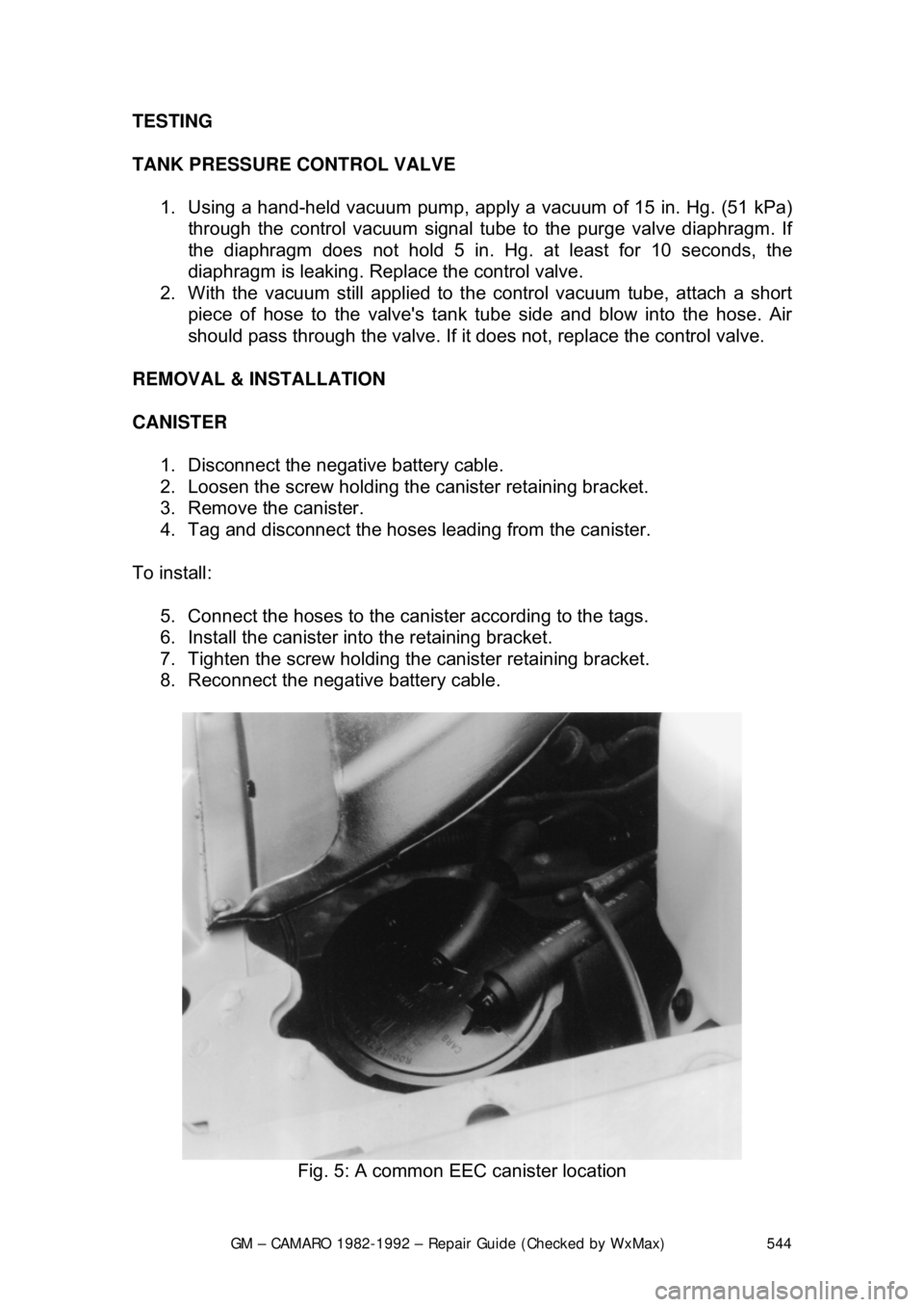
CANISTER 1. Disconnect the negative battery cable.
2. Loosen the screw holding the c anister retaining bracket.
3. Remove the canister.
4. Tag and disconnect the hoses leading from the canister.
To install: 5. Connect the hoses to the cani ster according to the tags.
6. Install the canister into the retaining bracket.
7. Tighten the screw holding the c anister retaining bracket.
8. Reconnect the negative battery cable.
Fig. 5: A common EEC canister location
GM – CAMARO 1982-1992 – Repair Guide (Checked by WxMax) 586
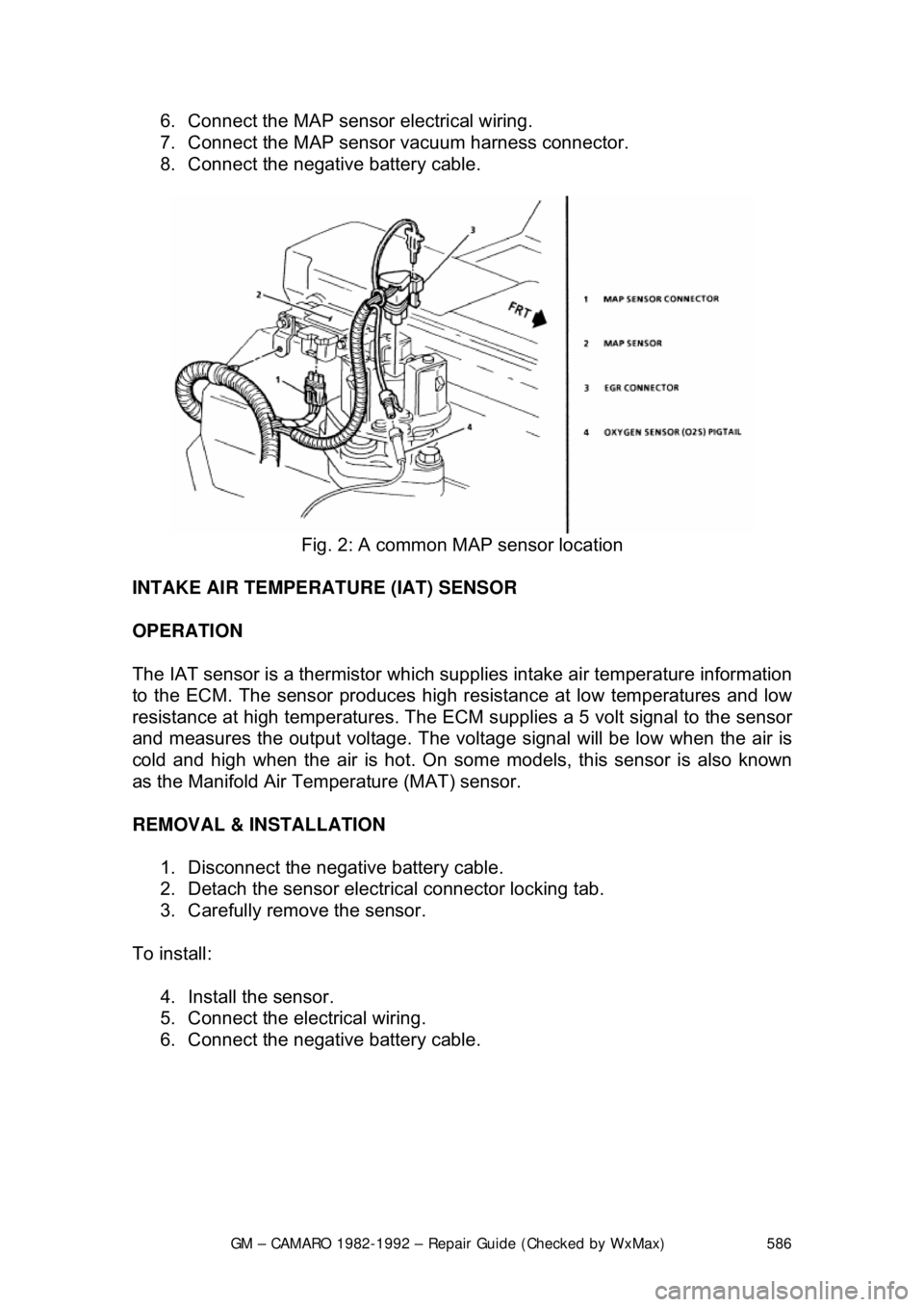
6. Connect the MAP sensor
electrical wiring.
7. Connect the MAP sensor vacuum harness connector.
8. Connect the negative battery cable.
Fig. 2: A common MAP sensor location
INTAKE AIR TEMPERATURE (IAT) SENSOR
OPERATION
The IAT sensor is a thermistor which su pplies intake air temperature information
to the ECM. The sensor produces high re sistance at low temperatures and low
resistance at high temperatures. The ECM supplies a 5 volt signal to the sensor
and measures the output voltage. The vo ltage signal will be low when the air is
cold and high when the air is hot. On so me models, this sensor is also known
as the Manifold Air Tem perature (MAT) sensor.
REMOVAL & INSTALLATION 1. Disconnect the negative battery cable.
2. Detach the sensor electr ical connector locking tab.
3. Carefully remove the sensor.
To install: 4. Install the sensor.
5. Connect the electrical wiring.
6. Connect the negative battery cable.