1982 CHEVROLET CAMARO light
[x] Cancel search: lightPage 782 of 875

GM – CAMARO 1982-1992 – Repair Guide (Checked by WxMax) 782
10. Refill the engine with the correct amount
of fresh oil. Please refer to the
Capacities chart at the end of this section.
11. Check the oil level on the dipstick. It is normal for the level to be a bit
above the full mark. Start the engine and allow it to idle for a few
minutes.
CAUTION - Do not run the engi ne above idle speed until it has built up oil
pressure, as indicated w hen the oil light goes out
12. Shut off the engine and allow the oil to flow back to the crankcase for a
minute, then recheck the oil level. C heck around the filter and drain plug
for any leaks, and correct as necessary.
MANUAL TRANSMISSIONS
FLUID RECOMMENDATIONS
• 1982-85 4-speed manual transmissi ons - SAE 80W/90 GL-5 gear
lubricant
• 1986-87 4-speed manual transmission - Dexron®®II automatic
transmission fluid
• 1982-84 5-speed manual transmissions - use SAE 80W/90 GL-5 gear
lubricant (SAE 80W GL-5 in Canada)
• 1985-92 5-speed manual transmissi ons - Dexron®II automatic
transmission fluid
LEVEL CHECK
The oil in the manual tr ansmission should be check ed every 12 months or
15,000 miles.
1. Raise the car and support on jackstands as close to level as possible. \
2. Remove the filler plug from the side of the transmission housing.
3. If lubricant begins to trickle out of the hole, there is enough and you need
not go any further. Otherwise, carefully insert your finger (watch out for
sharp threads) and check to see if the oil is up to the edge of the hol\
e.
4. If not, add oil through the hole until the level is at the edge of the hole.
Most lubricants come in a plasti c squeeze bottle with a nozzle; making
additions simple.
5. Install and tighten the filler plug.
DRAIN AND REFILL
The fluid in the manual transmission do es not require changing. If you do
choose to change the transmission fluid, the fluid can be drained out through
the lower drain plug hole on the side of the transmission. Fill the transmission
with the recommended lubricant to the bottom of the filler plug hole and install
the filler plug.
Page 785 of 875

GM – CAMARO 1982-1992 – Repair Guide (Checked by WxMax) 785
The automatic transmission fluid and fi
lter should be changed every 15,000
miles (24,000km) if your Camaro is driven in heavy city traffic in hot weather, in
hilly or mountainous terrain, frequent trailer pulling, or uses such as found in
taxi, police car or delivery service. If your Camaro is driven under other than
listed above conditions, change the fl uid and filter every 30,000 miles
(48,300km).
1. Raise and support the car on jackst ands. Place an oil catch pan under
the transmission.
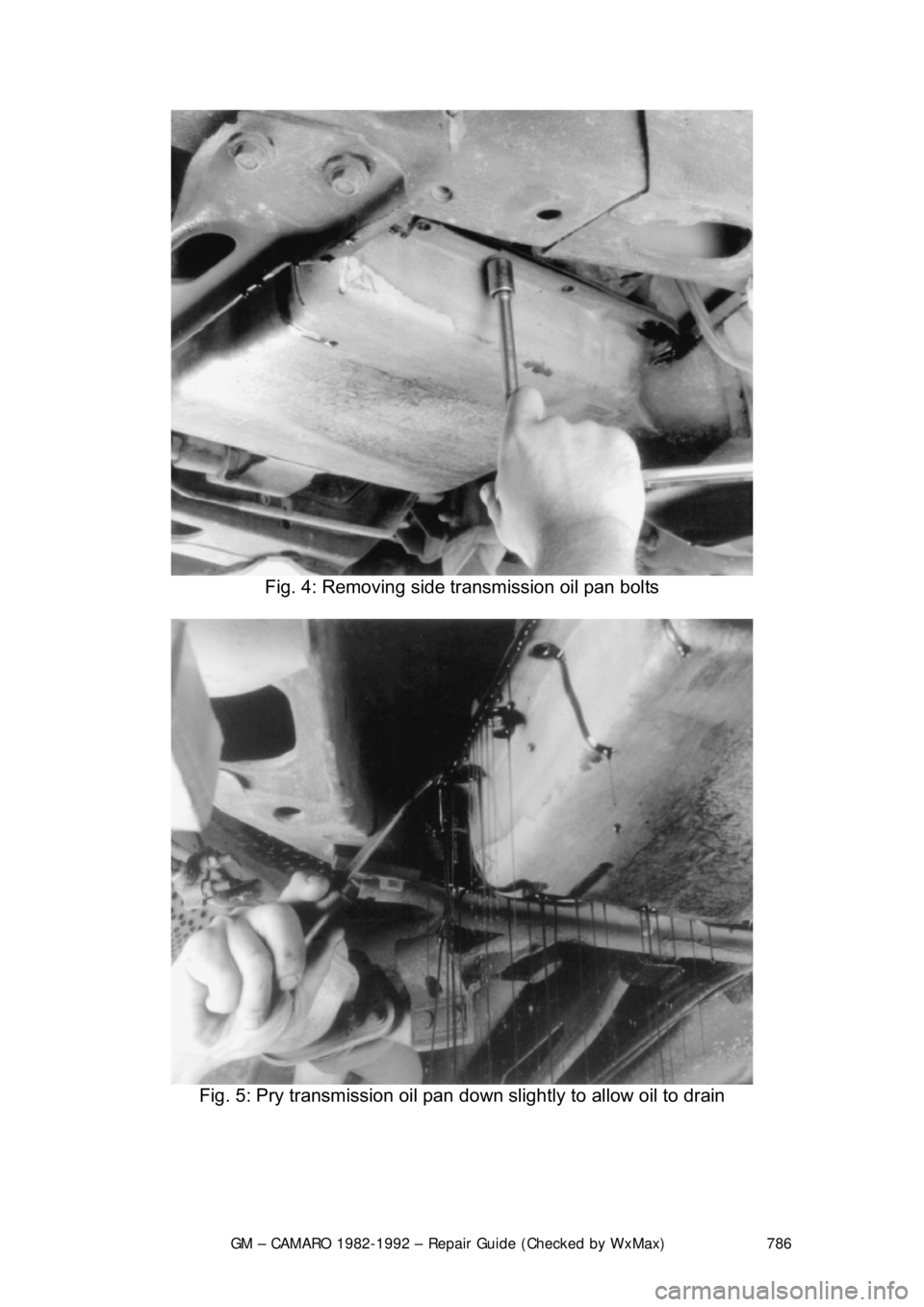
2. Remove the oil pan bolts fr om the front and sides only.
3. Loosen rear oil pan bolts approximately 4 turns.
WARNING - Do not damage the transmission case or oil pan sealing surfaces.
4. Lightly tap the oil pan with a rubber mallet or gently pry it downward to
allow fluid to drain.
5. Remove the remaining oil pan bolt s, then remove the oil pan and pan
gasket.
6. Remove the filter and seal.
7. Clean the transmission case and oi l pan gasket surfaces with suitable
solvent and air dry. Make sure to re move all traces of the old gasket.
To install: 8. Coat the seal with a sm all amount of Transjel®.
9. Install the new s eal onto the filter.
10. Install the new filter into the case.
11. Install the oil pan and new gasket.
On 1991 and later vehicles, inspect t he oil pan screws and washer assemblies.
The screws must not be used if the coni cal washer is reversed. Failure to
replace the screw and washer assembly may result in improper fastening of
system components.
12. Install the oil pan bolts and tighten them to 12 ft. lbs. (16 Nm).
13. Lower the car.
14. Fill the transmission to proper level with Dexron®II fluid.
15. Check cold fluid level reading fo r initial fill. Do not overfill the
transmission.
16. Follow the fluid level che ck procedure described before.
17. Check the oil pan gasket for leaks.
Page 786 of 875
GM – CAMARO 1982-1992 – Repair Guide (Checked by WxMax) 786
Fig. 4: Removing side transmission oil pan bolts
Fig. 5: Pry transmission oil pan down slightly to allow oil to drain
Page 811 of 875

GM – CAMARO 1982-1992 – Repair Guide (Checked by WxMax) 811
CAUTION
- NEVER hook the batteries up in a series circuit or the entire
electrical system will go up in smoke, including the starter!
Vehicles equipped with a diesel engine may utilize two 12 volt batteries. If so,
the batteries are connected in a parallel circuit (positive terminal to positive
terminal, negative terminal to negative te rminal). Hooking the batteries up in
parallel circuit increases battery cranki ng power without increasing total battery
voltage output. Output remains at 12 vo lts. On the other hand, hooking two 12
volt batteries up in a series circuit (positive terminal to negative terminal,
positive terminal to negative terminal) incr eases total battery output to 24 volts
(12 volts plus 12 volts).
JUMP STARTING PRECAUTIONS
• Be sure that both batteries are of t he same voltage. Vehicles covered by
this information and most vehicles on the road today utilize a 12 volt
charging system.
• Be sure that both batteries are of the same polarity (have the same
terminal, in most cases NEGATIVE grounded).
• Be sure that the vehicles are not touching or a short could occur.
• On serviceable batteries, be sure the v ent cap holes are not obstructed.
• Do not smoke or allow sparks anywhere near the batteries.
• In cold weather, make sure the battery electrolyte is not frozen. This can
occur more readily in a battery that has been in a state of discharge.
• Do not allow electrolyte to c ontact your skin or clothing.
JUMP STARTING PROCEDURE 1. Make sure that the voltages of the 2 batteries are the same. Most
batteries and charging systems are of the 12 volt variety.
2. Pull the jumping vehicle (with t he good battery) into a position so the
jumper cables can reach the dead battery and that vehicle's engine.
Make sure that the ve hicles do NOT touch.
3. Place the transmissions of both vehicles in Neutral (MT) or P (AT), as
applicable, then firmly set their parking brakes.
If necessary for safety reasons, the hazard lights on both vehicles may be
operated throughout the entir e procedure without significantly increasing the
difficulty of jumping the dead battery.
4. Turn all lights and accessories OFF on both vehicles. Make sure the ignition switches on both vehicles are turned to the OFF position.
5. Cover the battery cell caps with a rag, but do not cover the terminals.
6. Make sure the terminals on both batte ries are clean and free of corrosion
or proper electrical connection wil l be impeded. If necessary, clean the
battery terminals before proceeding.
7. Identify the positive (+) and negat ive (-) terminals on both batteries.
8. Connect the first jumper cable to the positive (+) terminal of the dead
battery, then connect the other end of that cable to the positive (+)
terminal of the booster (good) battery.
Page 812 of 875

GM – CAMARO 1982-1992 – Repair Guide (Checked by WxMax) 812
9. Connect one end of the other jumper
cable to the negative (-) terminal on
the booster battery and the final cable clamp to an engine bolt head,
alternator bracket or ot her solid, metallic point on the engine with the
dead battery. Try to pick a ground on the engine that is positioned away
from the battery in order to minimi ze the possibility of the 2 clamps
touching should one l oosen during the procedure. DO NOT connect this
clamp to the negative (-) term inal of the bad battery.
CAUTION - Be very careful to keep the jum per cables away from moving parts
(cooling fan, belts, etc.) on both engines.
10. Check to make sure that the c ables are routed away from any moving
parts, then start the d onor vehicle's engine. Run the engine at moderate
speed for several minutes to allow the dead battery a chance to receive
some initial charge.
11. With the donor vehicle's engine still r unning slightly above idle, try to start
the vehicle with the dead battery. Crank the engine for no more than 10 \
seconds at a time and let the starter cool for at least 20 seconds between
tries. If the vehicl e does not start in 3 tries, it is likely that something else
is also wrong or that the battery needs additional time to charge.
12. Once the vehicle is star ted, allow it to run at idle for a few seconds to
make sure that it is operating properly.
13. Turn ON the headlight s, heater blower and, if equipped, the rear
defroster of both vehicles in order to reduce the severity of voltage spikes
and subsequent risk of dam age to the vehicles' electrical systems when
the cables are disconnected. This st ep is especially important to any
vehicle equipped with computer control modules.
14. Carefully disconnect the cables in the reverse order of connection. Star\
t with the negative cable that is attached to the engine ground, then the
negative cable on the donor battery. Di sconnect the positive cable from
the donor battery and finally, disconnect the positive cable from the
formerly dead battery. Be careful when disconnecting the cables from the
positive terminals not to allow the alli gator clips to touch any metal on
either vehicle or a short and sparks will occur.
JACKING
Your vehicle was supplied with a jack for emergency road repairs. This jack is
fine for changing a flat tire or other s hort term procedures not requiring you to
go beneath the vehicle. If it is used in an emergency situation, carefully follow
the instructions provided eit her with the jack or in your owner's manual. Do not
attempt to use the jack on any portions of the vehicle other than specified by the
vehicle manufacturer. Always block the diagonally opposite wheel when using a
jack.
A more convenient way of jacking is the use of a garage or floor jack. You may
use the floor jack to raise the vehicle in the areas shown in the illustration .
Page 847 of 875

GM – CAMARO 1982-1992 – Repair Guide (Checked by WxMax) 847
DISARMING
1. Turn the steering wheel to align the w heels in the straight-ahead position.
2. Turn the ignition switch to the LOCK position.
3. Remove the SIR air bag fuse from the fuse block.
4. Remove the left side trim panel and disconnect the yellow 2-way SIR
harness wire connector at the bas e of the steering column.
To enable system: 5. Turn the ignition switch to the LOCK position.
6. Reconnect the yello w 2-way connector at the base of the steering
column.
7. Reinstall the SIR fuse and the left side trim panel.
8. Turn the ignition switch to the RUN position.
9. Verify the SIR indicator light flashes 7-9 times, if not as specified, inspect
system for malfunction or c ontact the manufacturer.
For more details on the SIR system - including disarming instructions for
passenger bags - please refer to Chassis Electrical in this repair guide.
SUPPLEMENTAL INFLATABLE REST RAINT (SIR) COIL ASSEMBLY
After performing repairs on the inter nals of the steering column the coil
assembly must be centered in order to avoid damaging the coil or accidental
deployment of the air bag. There are 2 different styles of coils, one rotates
clockwise and the other rotates counterclockwise.
ADJUSTMENT (CENTERING THE COIL) 1. With the system properly disarmed, hold the coil assembly with the clear
bottom up to see the coil ribbon.
2. While holding the coil assembly, depr ess the lock spring and rotate the
hub in the direction of the arrow until it stops. The coil should now be
wound up snug against the center hub.
3. Rotate the coil assembly in the opposite direction approximately 2
1/2
turns and release the lock spring between the locking tabs in front of the
arrow.
4. Install the coil assembly onto the steering shaft.
STEERING WHEEL
WARNING - Before attempting any repairs involving the steering wheel or
disassembly of it, ensure that the Supple mental Inflatable Restraint (Air Bag)
system is properly disarmed.
REMOVAL & INSTALLATION
If the vehicle is equipped with a SIR (A ir Bag) system, ensure that the proper
disarming procedure is followed.
Page 871 of 875

GM – CAMARO 1982-1992 – Repair Guide (Checked by WxMax) 871
6. Refill the pump with fluid and
bleed by turning the pulley
counterclockwise (viewed from the front). Stop the bleeding when air
bubbles no longer appear.
7. Install the pump belt on the pulley and adjust the tension.
SYSTEM BLEEDING 1. Fill the reservoir with power steering fluid.
The use of automatic transmission flui d in the power steering system is NOT
recommended.
2. Allow the reservoir and fluid to sit undisturbed for a few minutes.
3. Start the engine, allow it to run for a mome nt, then turn it off.
4. Check the reservoir fluid level and add fluid if necessary.
5. Repeat the above steps until the fluid level stabilizes.
6. Raise the front of the vehicle so that the wheels are off of the ground.
7. Start the engine and increase t he engine speed to about 1500 rpm.
8. Turn the front wheels right to le ft (and back) several times, lightly
contacting the wheel stops at the ends of travel.
9. Check the reservoir fluid level. Add fluid as required.
10. Repeat step 8 until the fluid leve l in the reservoir stabilizes.
11. Lower the vehicle and repeat steps 8 and 9.