1971 CHEVROLET CAMARO air condition
[x] Cancel search: air conditionPage 30 of 88
Downloaded from www.Manualslib.com manuals search engine "
Selector (Upper Lever)
This lever provides a selection of
systems available to handle various
heating and cooling requirements
throughout the year. The positions
of the Selector lever are separated
into four (4) major operational
groups
"Off", IIAir Conditioning",
IIVent" and IIHeating". The "Air
Conditioning" and IIHeating"
groups have several positions which
improve the effectiveness of
the
system for various demands.
Fan
The fan lever has four (4) posi
tions from Lo at the top to High at
the bottom. Blower speed
is auto
matically maintained when the
ignition switch
is in the "ON" posi
tion, regardless of the position of
the selector lever. The blower re
mains
ON with the Selector lever
in the
OFF position and the igni
tion switch
ON in order to purge moisture
from the evaporator core
and distributor ducts, thereby help
ing to prevent inadvertent flash
fogging of the windows when the
system
is turned on.
Selector Lever Operation
uOFF" -Shuts the entire system off
but blower automatically remains
operative.
uMAX"-Air from the passenger
compartment is recirculated
through the system and discharged
from the upper outlets when the
temperature lever
is in "Max." cold.
(If the liTem perature" lever is
moved warmer, the system will
automatically
go on outside air.)
The
IIMax." position is used when
maximum cooling
is required under
conditions of high temperature and
humidity.
uNORMAL" -Outside air is passed
through the system and discharged
through the
Ale outlets. This posi-
27
tion is recommended for most air
conditioning situations because of
reduced blower noise and reduction
of cigarette smoke within the
ve
hicle.
uBI-LEVEL"-Outside air is passed
through the system and discharged
from both the upper and lower out
lets. This position
is recommended
for sunny cooler weather where
warm air
is required on the feet
with cooler air above to provide
comfortable breath level. Temper
ature may be adjusted
as desired.
(<> BI-Level position)
NOTE: This position will clear
fogged windows rapidly due to the
dehumidifying effect of the cooling
coils when the outside temperature
is above 30°F.
UVENT" -Air flow and tempera
ture control are the same
as "BI
Level"
except that the compressor
Page 31 of 88
Downloaded from www.Manualslib.com manuals search engine . ~
is off. This position is provided for
cool to moderate weather when
refrigeration
is not required.
"HEATER"-Outside air is deliv
ered through the
lower outlets.
Temperature may be adjusted
as
required. This position is recom
mended for most winter driving.
"DE~FOG"-Outside air is deliv
ered from the lower outlets and the
defroster duct to provide comfort
and keep the windshield clear un
der low, fogging conditions.
Operating tip: When driving in
snow, if defog or deice
is not re
quired to keep the windshield from
fogging, it
is recommended that the
"Heater" position be used. This
keeps the windshield cold so that
snow will not stick and melt and
will provide a cleaner view.
"DE-ICE" -Outside air is deliv
ered through the defroster outlets only.
Temperature and blower
speeds
may be adjusted as required .
This position
is recommended for
conditions of severe fogging and
icing only.
Four Season System
Air Outlets
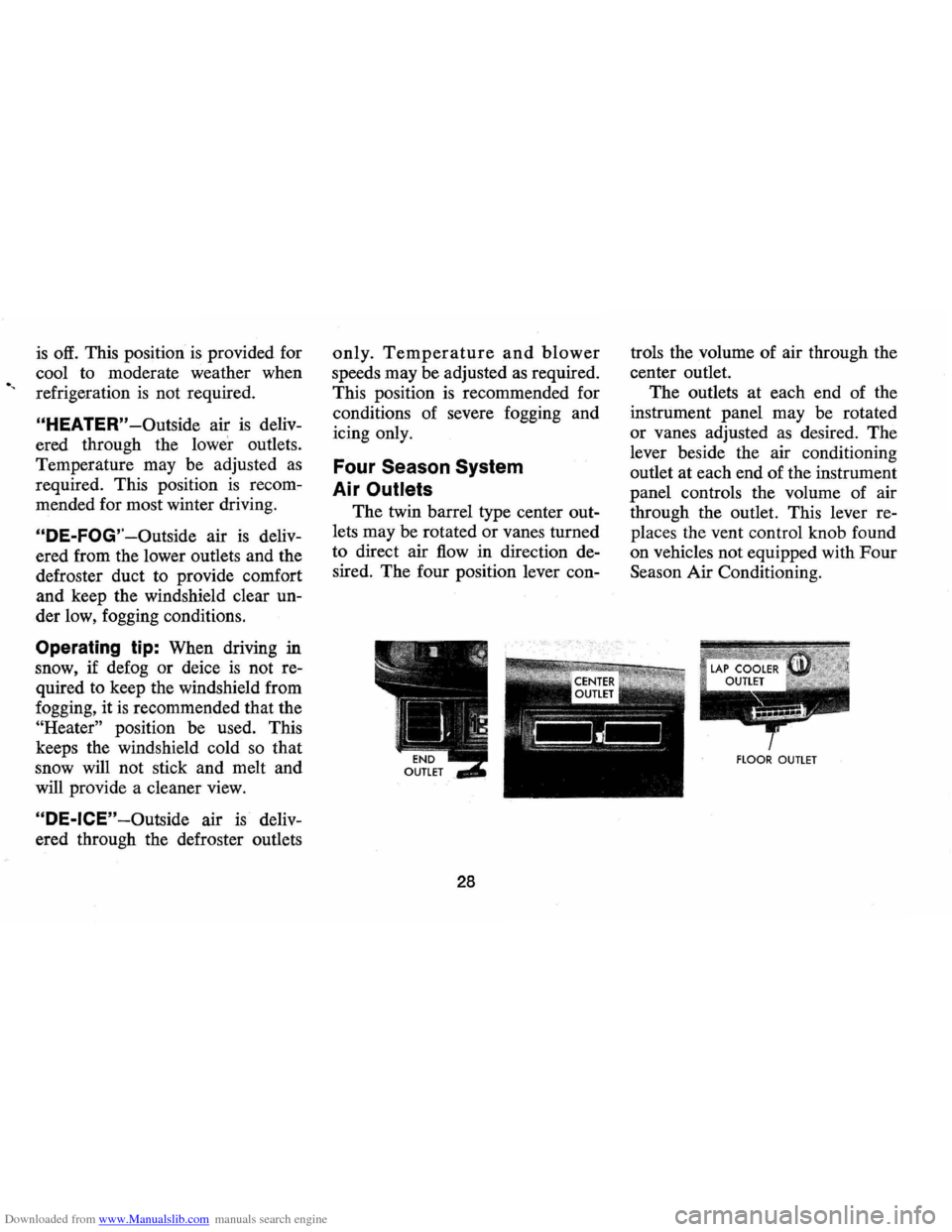
The twin barrel type center out
lets may be rotated or vanes turned
to direct air
flow in direction de
sired. The four position lever con-
28
troIs the volume of air through the
center outlet.
The outlets at each end of the
instrument panel may be rotated
or vanes adjusted
as desired . The
lever beside the air conditioning
outlet at each end of the instrument
panel controls the volume of air
through the outlet. This lever re
places the vent control knob found
on vehicles not equipped with Four
Season Air Conditioning.
flOOR OUTLET
Page 36 of 88
Downloaded from www.Manualslib.com manuals search engine SAFETY CHECKS
Your Camaro not only conforms to all U.S. Fed
eral Motor Vehicle
Safety Standards applicable at
time of manufacture, but also incorporates other im
portant General Motors safety features. Even with
these safety features, however, continued safe and
dependable operation depends greatly upon regular
vehicle maintenance.
This section discusses the various components and
systems of your vehicle that should be checked regu-
CHECK OFF EACH ITEM UNDER MIlEAGE AS SERVICE IS PERFORMED. Brakes and Power Steering -Check all lines and hoses. Check condition of brake linings and parking brake adjustment. Chassis lube and check all fluid levels,· Check condition of front and rear suspension and steerine system. Exhaust System -Check condition of system and underbody. Tires and Wheels-Check condition. (Check tire pressure at least monthly.) Engine -Change oil.· Check condition 01 all belts. -Replace oil filter (at 1st oil change and tllen every 2nd chanie). -Check air cleaner every 12,000 miles; replace every 24,000 miles. .-Replace PCV valve. -Service exhaust emission control systems (see Owner's Manual). -Change toolanl every Iwo years. Throttle linkage -Check operation and condition . Headlights -Aim. Transmission (Automatic)-Change fluid and service filter. 0 ,', III · 0
33
larly to help maintain continued safe and dependable
vehicle operation.
Some checks should be made by
your dealer or service station, and can be done con
veniently while your vehicle
is in the shop for other
regular maintenance services.
Other checks can be
made easily by owners.
CHECKS TO BE PERFORMED BY YOUR
DEALER OR SERVICE STATION
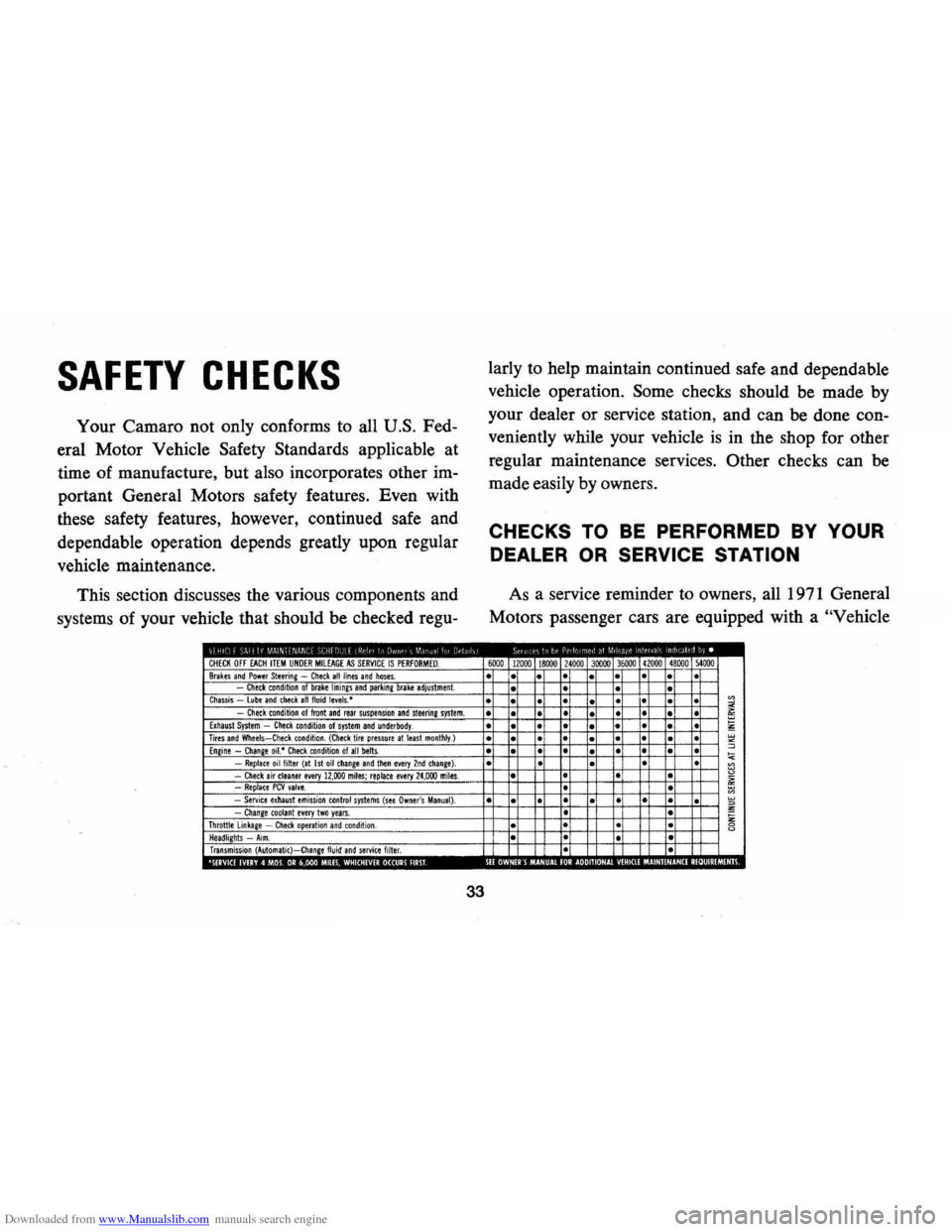
As a service reminder to owners, all 1971 General
Motors passenger cars are equipped with a
"Vehicle
6000 12000 18000 24000 30000 36000 41000 48000 )4000
• •
• •
• • • •
• • •
• •
• • • • • • •
• • • • • • • • • • •
• • • •
• • •
• •
• • • •
• • • • • • •
• • • • •
• •
• •
• • •
• •
• • • • •
• • • • • •
•
• • •
· • · •
• • • • •
• 0 o· 00 0 ·
0
Page 40 of 88

Downloaded from www.Manualslib.com manuals search engine lights, turn signals, backup lamps, and hazard
warning flashers. Have someone observe operation
of each light while you activate the controls.
• Starter Safety Switch (Automatic Transmis
sion Cars)
CAUTION: Before making the following check, be sure to have a clear distance ahead and behind the car, set the parking brake and firmly apply the foot brake. Do not depress accelerator pedal. Be prepared to turn ott ignition switch immediately if engine should start.
Check starter safety switch by placing the transmis
sion in each of the driving gears while attempting to
start the engine. The starter should operate only in the
Park ("P") or Neutral ("N") positions.
• Starter Interlock (Manual Transmission Cars)
-To check a manual transmission equipped car,
depress the clutch halfway, place the transmission
in neutral, and attempt to start.
The starter should
operate only when clutch
is fully depressed.
• Transmission Shift Indicator-Check to be sure
shift indicator accurately indicates the shift posi
tion selected.
• Horn-Blow the horn occasionally to be sure that
it works.
37
• Seat Back LatcheS-Check to see that seat bac k
latches are holding by pulling forward on the seat
back top.
• Rearview Mirrors and Sun Visors-Check that
friction joints are properly adjusted so mirrors and
sun visors stay in the selected position.
• Door LatcheS-Check for positive closing, la tch
ing and locking.
• Hood Latches-Check to make sure hood closes
firmly . Check also for broken , d amaged or missing
parts which might prevent secure latching.
• Fluid LeakS-Check for fuel, water, oil or other
fluid leaks by observing the ground beneath the
vehicle after it has been parked for a while . (Water
dripping from air conditioning system after use
is
normal). If gasoline fumes are noticed at any time,
the cause should be determined
and corrected with
out delay because of the possibility of fire.
• Exhaust System-See engine exhaust gas caution
at beginning of starting and operating section of
this manual for suggested driver observations and
checks.
Page 45 of 88
Downloaded from www.Manualslib.com manuals search engine under the proper conditions, they react with other
gases to form photochemical smog, which
is so prev
alent in Los Angeles.
In addition, carbon monoxide emissions have been
reduced by about 65 percent compared with 1960
model cars without controls. Although carbon mon
oxide does not enter into the complex photochemical
smog reaction, it
is toxic at high concentrations and
thus, has been controlled to prevent high atmospheric
concentrations.
Recent Developments
Another important advancement in air pollution
control has been the removal of lead from gasoline.
(Certain lead compounds have been used for many
years
as additives to increase octane ratings.) All
1971 General Motors cars including your Camaro
are designed
to operate on unleaded or low-lead
(zero to
0.5 grams per gallon) gasolines. However,
any gasoline with
91 Research Octane Number or
42
higher will satisfy your engine's octane requirements.
Use of unleaded or low-lead gasoline will keep your
engine running efficiently and play an important part
in reducing exhaust emissions of hydrocarbons and
particulates.
Your Role In Controlling Air Pollution
1. Use Unleaded or Low-Lead Fuels-To obtain
maximum results
In the reduction of automotive
emissions, use an unleaded gasoline.
If such gaso
line
is not available, you may use a leaded regu
lar grade gasoline.
2. Have The Air Pollution Control Systems on Your
Car Serviced Regularly -
The following pages of
this section describe the emission control systems
on Chevrolet vehicles and provide information
on their proper maintenance. By following these
recommended maintenance services you will help
assure cleaner air and provide a better running,
longer lasting engine and greater all around satis
faction, economy and performance.
Page 46 of 88

Downloaded from www.Manualslib.com manuals search engine POSITIVE CRANKCASE
VENTILATION (PCV)
~F"'FILnREDAIR --+ B = BLOW BY GASES :lI." HB ~COMBUSTlBlEMIXTURE
pey
VALVE
OPERATION: All General Motors gasoline engine
powered vehicles are equipped with Positive
Crank
case Ventilation-a system which permits no crank
case emissions to be discharged into the atmosphere.
To function properly, the system depends on the
43
PCV Valve which returns blow-by gases to the com
bustion chamber where they are burned.
MAINTENANCE: This valve must be clean in
order to maintain efficient engine operation.
An
inspection of the ventilation filter should be
made at the first oil change
(4 months or 6,000
miles, whichever occurs first). At each subse
quent oil change, the ventilation filter
should
be inspected and replaced if necessary. Re
place filter at least every 24,000 miles. Under
normal driving conditions, the PCV Valve should
be replaced every 24 months or 24,000 miles,
whichever occurs first, and
all hoses and fit·
tings
should be inspected and cleaned or re
placed, as necessary. Replace the PCV Valve
and inspect related parts every 12 months or
12,000 miles when the vehicle is used in a ser
vice requiring more frequent engine oil change
as covered on page 53.
NOTE: Emission control systems in this section are Illustrated on V-8 engines; systems on 4 and 6 cylinder engines are similar.
Page 49 of 88

Downloaded from www.Manualslib.com manuals search engine EVAPORATION CONTROL SYSTEM
LIQUID/VAPOR SEPARATOR
OPERATION: All General Motors passenger cars
and light trucks are equipped with an Evaporation
Control
System. This system is designed to minimize
the escape of fuel vapors to the atmosphere. Included
in the system are a special fuel tank, liquid-vapor
separator, carbon canister, canister purge hoses, and
carburetor modifications. Fuel vapors which would
otherwise escape to the atmosphere are directed into
the carbon canister. The carbon adsorbs the vapors
and stores them. The vapor
is removed from the
46
canister during periods of engine operation as mani
fold vacuum draws the vapors into the engine and
burns them.
NOTE: Th. G.n.r.' Motora E".por.tlon Control Sy.t.m I. de.'gn.d to control ."aporatlon 10 •••• trom your c.r und.r normal condition. u.'ng 9 lb. R.ld Vapor Pr ••• ur. tu.' .p.cltl.d by F.d.r.' .nd C.lltorn/a t •• t r.qulr.m.nt •. How.".r, It 'Iou .hould u.. tu.' ot .bnorm.lly high "o/.tlllty tor .x/.tlnll t.mperatur.
condition., you may d.t.ct • ga.olln. odor during or att.r dr/,,· Ing In h •• "y tr.mc. It 'Iou find thl. obJ.ctlonabl., you may pr.t.r to u ••• low.r "o/atlllty tu.'.
MAINTENANCE: For proper system perform
ance, periodic canister tllter servicing II re
quired. Every
12 months or 12,000 miles, which
ever comes first (more often under dusty con
ditions) the filter
In the base of the can liter
should be replaced and the canister Inspected.
NOTE: Should It .".r b. n.c •••• ry to r.pl.c. the tu.' tank cap, u •• only the .peclfl.d c.p.
NOTE: For your convenience, all of the recom
mended services for air pollution control systems
previously discussed are summarized
by time and
mileage intervals in the Maintenance Schedule of
this manual.
Page 54 of 88
Downloaded from www.Manualslib.com manuals search engine SERVICE AND MAINTENANCE
The time or mileage intervals on
the following pages are intended
as
a guide for establishing regular
maintenance and lubrication
periods for your car. Sustained
Fuel
Requirements
Your Camaro is designed to
operate efficiently on fuel of
ap
proximately 91 Research Octane
Number or higher, commonly sold
in the United
States and Canada.
Use of a fuel which is too low in
anti-knock quality will result in
"spark knock" and/or "after-run."
Since
the anti-knock quality of all
gasoline
is not the same and factors
such
as altitude, terrain, and air
temperature affect operating
effi-
heavy duty or high speed operations
or operation under adverse condi
tions may necessitate more frequent
servicing. To determine specific
recommendations for conditions
ciency, knocking
and/or after-run
may result even though you are
using the fuel recommended.
If
these conditions persist consult
your authorized Chevrolet Dealer.
In any case, continuous or
ex
cessive knocking may result in en
gine damage and constitutes mis
use of the engine for which Chev
rolet Division is not responsible
under the terms of the New Vehicle
Warranty.
NOTE: Read page 42 regarding
the importance
of using unleaded
or
low lead gasolines.
51
under which you use your car, con
sult your Authorized Chevrolet
Dealer.
Gas Cap-The fuel tank filler cap
has a new two-step removal and
installation procedure plus a
pres
sure-vacuum safety relief valve. It
is equipped with a double set of
locking tangs.
To remove:
• Rotate cap one-half turn coun
terclockwise to clear the first set
of tangs from the slots inside the
filler neck. This will allow any
residual pressure to escape.
• Pull the cap outward and rotate
one-quarter turn counterclock
wise to clear second set of tangs
and remove the cap.
• To install, reverse this procedure.