1969 FORD MUSTANG tow
[x] Cancel search: towPage 286 of 413
06-03-07
Ford Design Four-Speed Transmission
06 03-07
and a retainer washer in each end of
the gear.
REVERSE IDLER GEAR
BEARINGS
1.
Slip the reverse idler sliding gear
off the reverse idler gear (Fig. 18).
2.
Remove the dummy shaft, two
bearing retainer washers and the 44
roller bearings from the reverse idler
gear.
3.
Coat the bore in each end of the
reverse idler gear with grease.
4.
Hold the dummy shaft in the
gear and install the 22 roller bearings
and the retainer washer in each end of
the gear.
5. Install the reverse idler sliding
gear on the reverse idler gear making
sure that the shift fork groove is
toward the front (Fig. 18).
INPUT SHAFT SEAL
1.
Remove the seal from the input
shaft bearing retainer as shown in Fig.
19.
2.
Coat the sealing surface with lu-
bricant.
3.
Install the seal as shown in Fig.
20
ASSEMBLY
1.
Coat the countershaft gear thrust
surfaces in the case with a thin film of
lubricant and position a thrust washer
(Fig. 17) at each end of the case.
2.
Position the countershaft gear,
dummy shaft, and roller bearings in
the case.
3.
Place the case in a vertical posi-
tion.
Align the gear bore and the
thrust washers with the bores in the
case and install the countershaft.
4.
Place the case in a horizontal
position and check the countershaft
gear end play with a feeler gauge. The
end play should be 0.004-0.0018 with-
in specification. If not within these
limits,
replace the thrust washers.
5. After establishing the correct end
play, install the dummy shaft in the
countershaft gear and allow the gear
to remain at the bottom of the case.
6. Coat the reverse idler gear thrust
surfaces in the case with a thin film of
lubricant and position the two thrust
washers (Fig. 18) in place.
7. Position the reverse idler gear,
sliding gear, dummy shaft and the
roller bearings in place making sure
that the shift fork groove in the slid-
ing gear is toward the front of the
case.
8. Align the gear bore and thrust
washers with the case bores and install
the reverse idler shaft.
9. Measure the reverse idler gear
REVERSE GEAR CAM AND SHAFT-7C124
•
FIRST AND SECOND SPEED CAM AND SHAFT-7C124
O-RING-7288
THIRD AND FOURTH SPEED
CAMANDSHAFT-7C124
FIRST AND SECOND SPEED SHIFT LEiVER-7290
44727-S
34807-S
33800-S
THIRD AND FOURTH SPEED SHIFT LEVER-7285
44727-S'
34807-S 33800-S C1767-A
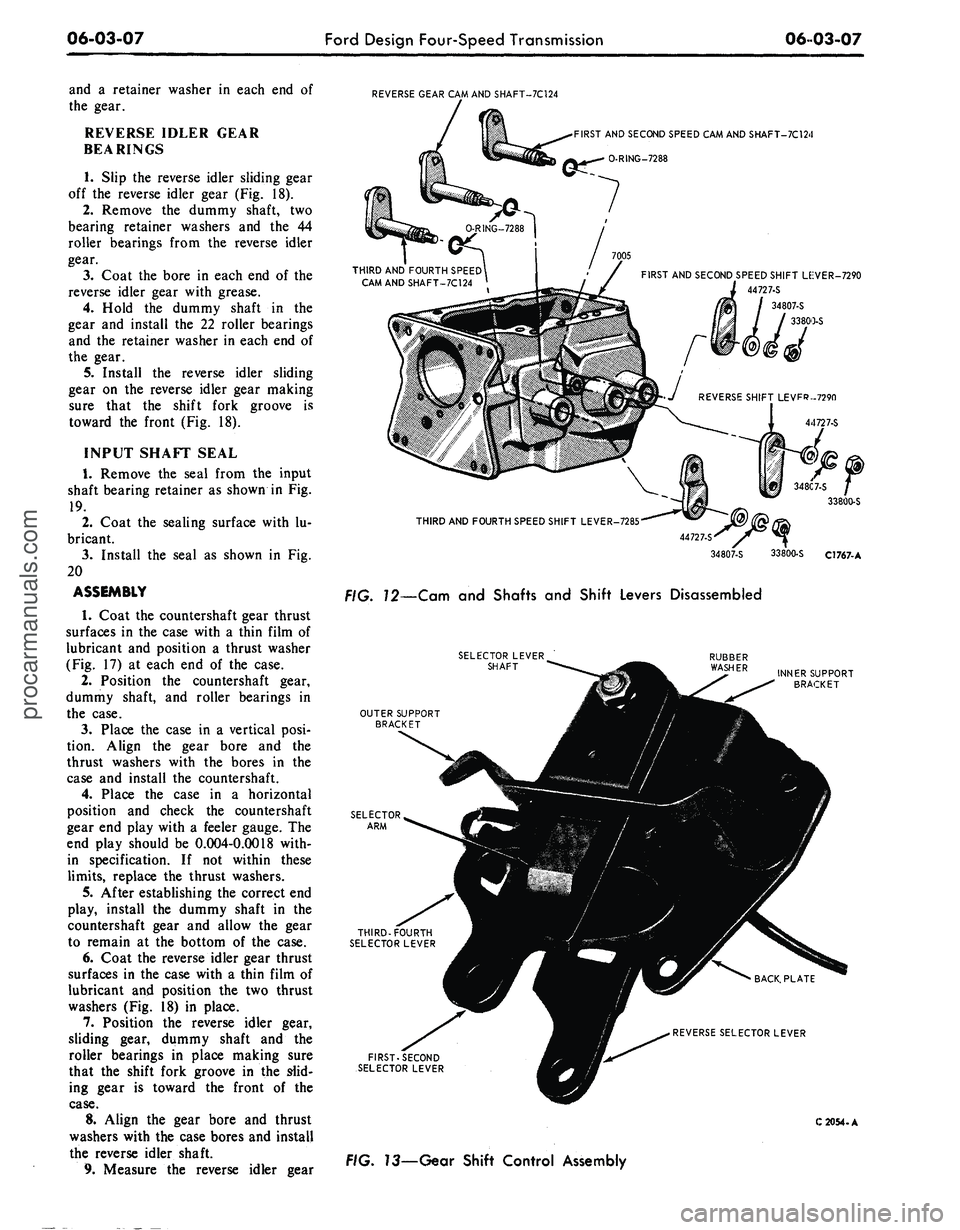
FIG. 12—Cam and Shafts and Shift Levers Disassembled
SELECTOR LEVER
SHAFT
INNER SUPPORT
BRACKET
OUTER SUPPORT
BRACKET
REVERSE SELECTOR LEVER
FIRST-SECOND
SELECTOR LEVER
C 2054.A
FIG. 13—Gear Shift Control Assemblyprocarmanuals.com
Page 287 of 413
06-03-08
Ford Design Four-Speed Transmission
06-03-08
ROLLER BEARINGS
SNAP RINGS
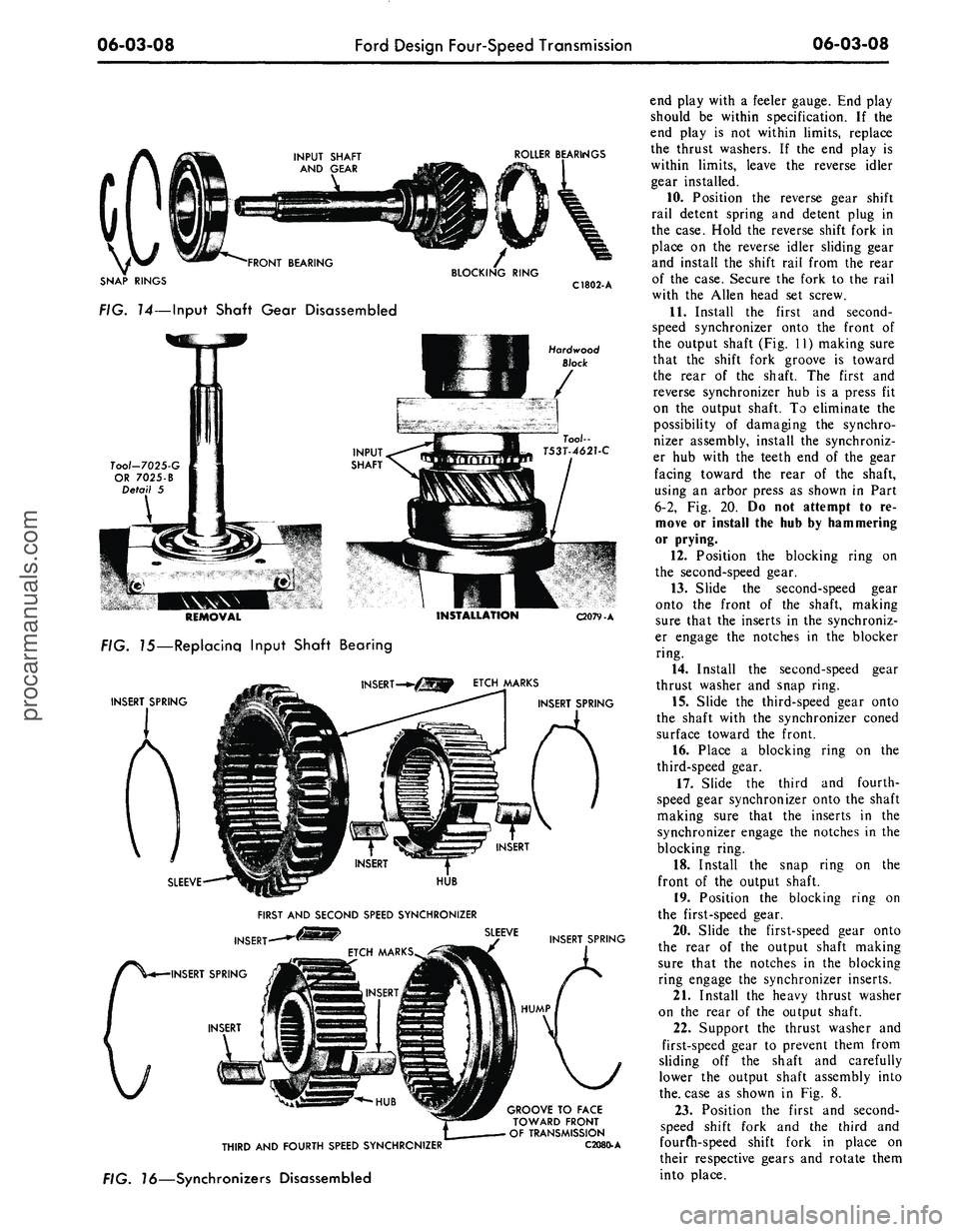
FIG. 14—Input Shaft Gear Disassembled
C1802-
A
Hardwood
Block
Tool-7025-G
OR
7025-B
Detail
5
REMOVAL
FIG. 15—Replacing Input Shaft Bearing
INSERT SPRING
INSTALLATION
ETCH MARKS
C2079-A
INSERT SPRING
SLEEVE
HUB
FIRST AND SECOND SPEED SYNCHRONIZER
INSERT
INSERT SPRING
INSERT
SLEEVE
INSERT SPRING
HUMP
THIRD
AND
FOURTH SPEED SYNCHRONIZER
FIG. 16—Synchronizers Disassembled
GROOVE
TO
FACE
TOWARD FRONT
OF TRANSMISSION
C2080.A
end play with
a
feeler gauge. End play
should
be
within specification.
If the
end play
is not
within limits, replace
the thrust washers.
If the end
play
is
within limits, leave
the
reverse idler
gear installed.
10.
Position
the
reverse gear shift
rail detent spring
and
detent plug
in
the case. Hold
the
reverse shift fork
in
place
on the
reverse idler sliding gear
and install
the
shift rail from
the
rear
of
the
case. Secure
the
fork
to the
rail
with
the
Allen head
set
screw.
11.
Install
the
first
and
second-
speed synchronizer onto
the
front
of
the output shaft (Fig.
11)
making sure
that
the
shift fork groove
is
toward
the rear
of the
shaft.
The
first
and
reverse synchronizer
hub is a
press
fit
on
the
output shaft.
To
eliminate
the
possibility
of
damaging
the
synchro-
nizer assembly, install
the
synchroniz-
er
hub
with
the
teeth
end of the
gear
facing toward
the
rear
of the
shaft,
using
an
arbor press
as
shown
in
Part
6-2,
Fig. 20. Do not
attempt
to re-
move
or
install
the
hub
by
hammering
or prying.
12.
Position
the
blocking ring
on
the second-speed gear.
13.
Slide
the
second-speed gear
onto
the
front
of the
shaft, making
sure that
the
inserts
in the
synchroniz-
er engage
the
notches
in the
blocker
ring.
14.
Install
the
second-speed gear
thrust washer
and
snap ring.
15.
Slide
the
third-speed gear onto
the shaft with
the
synchronizer coned
surface toward
the
front.
16.
Place
a
blocking ring
on the
third-speed gear.
17.
Slide
the
third
and
fourth-
speed gear synchronizer onto
the
shaft
making sure that
the
inserts
in the
synchronizer engage
the
notches
in the
blocking ring.
18.
Install
the
snap ring
on the
front
of the
output shaft.
19.
Position
the
blocking ring
on
the first-speed gear.
20.
Slide
the
first-speed gear onto
the rear
of the
output shaft making
sure that
the
notches
in the
blocking
ring engage
the
synchronizer inserts.
21.
Install
the
heavy thrust washer
on
the
rear
of the
output shaft.
22.
Support
the
thrust washer
and
first-speed gear
to
prevent them from
sliding
off the
shaft
and
carefully
lower
the
output shaft assembly into
the.
case
as
shown
in Fig. 8.
23.
Position
the
first
and
second-
speed shift fork
and the
third
and
fourfh-speed shift fork
in
place
on
their respective gears
and
rotate them
into place.procarmanuals.com
Page 288 of 413

06-03-09
Ford Design Four-Speed Transmission
06-03-09
24.
Place a detent plug (Fig. 5) in
the detent bore. Place the reverse shift
rail into neutral position.
25.
Coat the third and fourth-
speed shift rail interlock pin with
grease and position it in the shift rail.
26.
Align the third and fourth-
speed shift fork with the shift rail
bores and slide the shift rail into place
making sure that the three detents are
facing toward the outside of the case.
Place the front synchronizer into
third-speed position and install the set
screw in the third and fourth-speed
shift fork. Move the synchronizer to
the neutral position. Install the third
and fourth-speed shift rail detent plug,
spring and bolt in the left side of the
transmission case (Fig. 5). Place the
interlock plug (tapered ends) in the
detent case.
27.
Align the first and second-
speed shift fork with the case bores
and slide the shift rail into place. Se-
cure the fork with the set screw.
28.
Coat the input gear bore with a
thin film of grease, then install the 15
roller bearings in the bore. A thick
film of grease could plug the lubricant
holes and restrict lubrication of the
bearings.
29.
Position the front blocking ring
in the third and fourth-speed synchro-
nizer.
Place the input shaft gear in the
transmission case making sure that
the output shaft pilot enters the roller
bearings in the input gear.
30.
Place a new gasket on the input
shaft bearing retainer. Dip the attach-
ing bolts in sealer and install and
tighten them to specifications.
31.
Install the output shaft bearing
as shown in Fig. 21. Install the snap
ring to retain the bearing.
32.
On some transmissions, position
the speedometer gear iometer drive
gear retaining clip on the output shaft
with the lower tang in the retaining
hole.
Align the groove in the gear with
the clip and slide the gear forward
until the upper tang on the clip locks
the gear (Fig. 4).
33.
Place the transmission in a ver-
tical position as shown in Fig. 22.
Align the countershaft gear bore and
thrust washers with the bore in the
case.
Install the countershaft.
34.
Use a new gasket and secure
the extension housing to the case with
the attaching screws. Use a sealer on
the extension housing attaching
screws. Torque the screws to specifica-
tions.
35.
Install the filler plug and drain
plug (if so equipped) in the case if
they were removed. Make sure that
COUNTIERSHAFT
7111
RETAINER WASHER
378559 • S
THRUST WASHER -7119
THRUST
WASHER
7119
ROLLER BEARINGS- 7121(21)
COUNTERSHAFT GEAR - 7113
ROLLER BEARINGS'7121(21)
RETAINER
WASHER
378559 • S
FIG. 17—Countershaft Gear Disassembled
C2081-A
REVERSE IDLER
GEAR SHAFT
7140
ROLLER BEARINGS
7D271 22)
THRUST WASHER
7149
RETAINER
WASHER
351529 - S
REVERSE IDLER GEAR -7142
'REVERSE SLIDING GEAR • 7D223
•THRUST WASHER • 7149
FIG. 78—Reverse Idler Gear Disassembled
C2082-A
the magnetic plug (if so equipped) is
installed in the bottom of the case.
36.
Pour the specified lubricant
over the entire gear train while rotat-
ing the input shaft.
37.
Place each shift fork in all posi-
tions to make sure that they operate
properly.
38.
Install the remaining detent
plug in the case. Install the long
spring (which is retained by the case)
to secure the detent plug.
39.
Use a new cover gasket and in-
stall the cover. Coat the cover attach-
ing screws with sealer and install and
tighten them to specifications.
40.
Coat the third- and fourth-
speed shift rail plug bore with a sealer
and install a new expansion plug.
41.
If the extension housing bush-
ing and seal are to be replaced, refer
to Section 1.procarmanuals.com
Page 317 of 413

07-02-09
C4 Automatic Transmission
07-02-09
11.
Remove the handle from the se-
lector lever.
12.
Install the selector housing and
lever assembly as shown in Figure 8.
Torque the attaching bolts 4-6 ft-lbs.
13.
Connect the dial indicator light.
14.
Install the pointer back-up
shield on the housing and lever assem-
bly.
15.
Install the dial housing and
tighten the attaching screws.
16.
Install the selector lever handle
and tighten the attaching screw.
17.
Position the selector lever in the
D position.
18.
Raise the vehicle. Install the
transmission manual lever rod to the
selector lever. Adjust the manual link-
age.
19.
Lower the vehicle and check the
transmission operation in each selo:c-
tor lever detent position.
BAND ADJUSTMENT
INTERMEDIATE BAND
1.
Clean all the dirt from the band
adjusting screw area. Remove and dis-
card the locknut.
2.
Install a new locknut on the ad-
justing screw. With the tool shown in
Fig. 13, tighten the adjusting screw
until the tool handle clicks. The tool is
a pre-set torque wrench which clicks
and overruns when the torque on the
adjusting screw reaches 10 ft-lbs.
I D1854-A
FIG. 13—Adjusting Intermediate
Band
Tool-T59P-77370-B
D1855-A
FIG. 14—Adjusting Low-Reverse
Band
3.
Back off the adjusting screw ex-
actly 1 3/4 turns.
4.
Hold the adjusting screw from
turning and torque the lock nut to
specification.
LOW-REVERSE BAND
1.
Clean all the dirt from the band
adjusting screw area. Remove and dis-
card the locknut.
2.
Install a new locknut on the ad-
justing screw with the tools shown in
Fig. 14, tighten the adjusting screw
until the tool handle clicks. The tool is
a pre-set torque wrench which clicks
and overruns when the torque on the
adjusting screw reaches 10 ft-lbs.
3.
Back off the adjusting screw ex-
actly 3 full turns.
4.
Hold the adjusting screw from
turning and torque the lock nut to
specification.
OIL PAN AND CONTROL
VALVE BODY REPLACEMENT
1.
Raise the vehicle so the trans-
mission oil pan is accessible.
2.
Drain the transmission fluid.
If the same fluid is to be used
again, filter the fluid through a 100
mesh screen. Re-use the fluid only if it
is in good condition.
3.
Remove the transmission fluid
pan attaching bolts, pan and gasket.
4.
Remove the valve body-to-case
attaching bolts (Fig. 25). Remove the
valve body from the case and the
transmission inner control levers.
5.
Refer to the Major Repair Oper-
ation for control valve body repair op-
eration.
6. Thoroughly clean and remove all
the gasket material from the pan and
the pan mounting face of the case. In-
stall the valve body to the case, engag-
ing the transmission inner control le-
vers with the valve body manual and
downshift valves.
7.
Install the eight valve body to
case attaching bolts. Torque the bolts
to specification. Operate the external
manual and downshift levers to check
for proper travel of the valve body
manual and downshift valves.
8. Place a new gasket on the pan.
Install the pan and attaching bolts.
Torque the bolts to specification. In-
stall the fluid filler tube if it was re-
moved. Torque the attaching nut to
specifications.
9. Lower the vehicle and fill the
transmission with fluid. Check the
transmission pan area for fluid leak-
age.
INTERMEDIATE SERVO
REPLACEMENT
1.
Raise the vehicle and remove the
four servo cover-to-case attaching
bolts.
2.
Remove the servo cover, gasket,
piston, and piston return spring. Re-
move the piston from the cover (Fig.
45).
3.
Remove the piston seals and
cover gasket.
4.
Install new piston seals on the
piston. Lubricate the piston seals with
clean transmission fluid. Install the
servo piston in the cover.
5.
Install the piston retvrn spring in
the case. Place a new gasicet on the
cover. Install the piston and cover into
the transmissic se. Use two 5/16
18 x 1 1/4 bolts, 180 degrees apart to
position the cover against the case.
6. Install the two servo cover at-
taching bolts. Remove the two 1 1/4
inch bolts and install two attaching
bolts.
Torque the bolts to specifica-
tion.
7.
Adjust the intermediate band.
Lower the vehicle and check the trans-
mission fluid level.
8. If the band can not be adjusted
properly, the struts are not in posi-
tion. Remove the pan and valve body.
Install the struts, valve body, pan, and
adjust the band. Refill the transmis-
sion with fluid.
LOW-REVERSE SERVO
PISTON REPLACEMENT
1.
Raise the vehicle on a hoist.
2.
Loosen the reverse band adjust-
ing screw lock nut. Tighten the reverse
band adjusting screw to 10 ft-lbs tor-
que.
(Tightening the screw will insure
that the band strut will be held against
the case by the band, preventing it
from falling down when the reverse
servo piston assembly is removed).
3.
Remove the four servo cover to
case attaching bolts. Remove the iden-
tification tag and vent tube retaining
clip.
Remove the servo cover and s»»^
from the case.
4.
Remove the servo piston from
the case. The piston seal cannot be re-
placed, without replacing the piston.
The seal is bonded to the piston.
5. To remove the piston from the
stem, insert a small screw driver in the
hole of the piston (Fig. 44). Remove
the piston attaching nut.
6. Position the accumulator spring
and spacer (Fig. 43) on the piston
stem. Make sure the crowned side of
the spring is facing toward the rod.
Install.a new piston on the piston re-
taining shaft. Install the attaching nut.
Torque the nut to specification.procarmanuals.com
Page 320 of 413

07-02-12
C4 Automatic Transmission
07-02-12
MAJOR REPAIR OPERATIONS
Before removing
any of the sub-
assemblies, thoroughly clean
the out-
side
of the
transmission
to
prevent dirt
from entering
the
mechanical parts.
During
the
repair operations, refer
to
Part 7-1
for
common adjustments
and
repairs
or
cleaning
and
inspection
pro-
cedures.
During
the
transmission disassem-
bly
or
assembly operations,
ten
thrust
washers located between
the sub-
assemblies must
be
removed
and in-
stalled.
It is
important that each
thrust washer
be in the
correct posi-
tion during
the
assembly operation.
To properly locate
and
identify
the
thrust washers,
the
various positions
of
the
thrust washers
are
shown
in the
illustrations
and are
numbered
1
through
10. No. 1 is at the
first thrust
washer located
at the
front pump.
The
last thrust washer,
No. 10, is
located
at
the
parking pawl ring gear.
DISASSEMBLY
OF
TRANSMISSION
1.
Remove
the
converter from
the
transmission front pump
and
convert-
er housing.
2.
Remove
the
transmission vacuum
unit with
the
tool shown
in Fig. 22.
Remove
the
vacuum unit gasket and
the control
rod.
GRIND OFF
SHADED AREA
TO DIMENSION SHOWN L .
SNAP-ON
Tool-FCO-24
(Reworked)
D1380-A
FIG. 22—Removing Vacuum Unit
3.
Remove
the
primary throttle
valve (Fig.
23)
from
the
opening
at the
rear
of the
case.
4.
Remove
the two
extension
housing-to-case bolts shown
in Fig. 24
and mount
the
transmission
in the
holding fixture.
5.
Remove
the
transmission
pan at-
taching bolts,
pan and
gasket.
6. Remove
the
control valve body
attaching bolts (Fig.
25).
Remove
the
control valve body from
the
case.
7.
Loosen
the
intermediate band
adjusting screw
(Fig. 26) and
remove
the intermediate band struts from
the
case.
Loosen
the
low-reverse band
ad-
justing screw
and
remove
the low-
reverse band struts.
TRANSMISSION END
PLAY CHECK
1.
To
keep
the
output shaft
in
alignment during
the end
play check,
install
the
extension housing
oil
seal
replacer tool
or a
front universal
D1861-A
FIG. 23—Removing
or
Installing
Primary Throttle Valve
Tool-T57L-500-A
or 6005-M or 6005-MS
D1862-A
joint yoke in the extension housing.
2.
Remove
one of the
converter
housing-to-case attaching bolts
and
mount
the
dial indicator
as
shown
in
Fig. 27.
3.
The
input shaft
is a
loose part
and
has to be
properly engaged with
the spline
of the
forward clutch
hub
during
the end
play checking proce-
dure.
Move
the
input shaft
and
gear
train toward
the
rear
of the
transmis-
sion case.
V*
- 20 x
V/7 INCH
V*
- 20 x 1
INCH
V*
- 20 x 1
INCH
D1863-A
FIG. 25—Control Valve Body
Attaching Bolts
INTERMEDIATE
BAND STRUTS
INTERMEDIATE BAND
ADJUSTING SCREW
I
LOW-REVERSE BAND
ADJUSTING SCREW
LOW-REVERSE
BAND STRUTS
D
1384-B
FIG.
24—Transmission
Mounted
in Holding Fixture
FIG. 26—Band Adjusting Screws
and Struts—Typicalprocarmanuals.com
Page 324 of 413

07-02-16
C4 Automatic Transmission
07-02-16
COVER SEAL
STEM NUT
SERVO PISTON STEM
PISTON RETURN SPRING PISTON AND SEAL
(SEAL BONDED TO PISTON)
FIG. 43—Low-Reverse Servo Disassembled
PARTS REPAIR OR
REPLACEMENT
During the repair of the sub-
assemblies, certain general instructions
which apply to all units of the trans-
missions must be followed. These in-
structions are given here to avoid un-
necessary repetition.
Handle all transmission parts care-
fully to avoid nicking or burring the
bearing or mating surfaces.
Lubricate all internal parts of the
transmission before assembly with
clean automatic transmission fluid. Do
not use any other lubricants except on
gaskets and thrust washers which may
be coated with vaseline to facilitate
assembly. Always install new gaskets
when assembling the transmission.
Tighten all bolts and screws to the
recommended torque as outlined in
the Specification Section.
TRANSMISSION CASE AND
LINKAGE REPAIR
Low-Reverse Servo
1.
Remove the four servo cover-
to-case attaching bolts. Remove the
vent tube and retaining clip from the
case.
2.
Remove the servo cover, cover
seal, servo piston and piston return
spring from the case (Fig. 43).
3.
The servo piston seal is bonded
to the piston. If the seal has to be re-
placed, replace the piston assembly
which includes the seal. Disassemble
the servo piston from the piston stem
by inserting a small screwdriver in the
hole of the piston stem and removing
the piston attaching nut (Fig. 44).
Position the accumulator spring and
spacer (Fig. 43) on the piston stems.
Make sure the crowned side of the
spring is facing toward the rod. Install
the new servo piston and attaching nut
COVER
D1880-A
LOW-REVERSE
PISTON
D1881-A
FIG. 44—Removing or Installing
Low-Reverse Servo Piston
on the stem, torque the nut to specifi-
cation.
4.
Place the piston return spring in
the servo bore of the case. Lubricate
the piston seal with clean transmission
fluid and install the servo pistion into
the bore of the case.
5.
Place a new cover seal on the
cover and install the servo cover. In-
stall the vent tube and retaining clip.
Install the four cover attaching bolts.
Torque the cover-to-case retaining
bolts to specifications.
Intermediate Servo
1.
Remove the transmission
identif-
ication tag and the four servo cover to
case attaching bolts.
2.
Remove the servo cover, gasket,
servo piston, and piston return spring
from the case (Fig. 45).
3.
Remove the intermediate servo
piston from the cover.
4.
Remove the seal rings from the
servo piston and cover.
5.
Install a new seal on the cover
and servo piston. Figure 46 shows the
correct servo piston and cover for
each transmission model. Lubricate
the seals with clean transmission fluid.
Install the piston into the cover. Be
careful not to damage the piston seal.
6. Install the piston return spring in
the servo bore of the case.
7.
Place a new gasket on the servo
cover. Position the servo piston and
cover assembly into the case with the
piston stem slot in a horizontal posi-
tion to engage the strut. Use two
5/16-18 bolts, 1 1/4 inch long, 180
degrees apart, to position the cover
against the case. Install two cover at-
taching bolts. Remove the two 1 1/4
V-8 ENGINE
COVER
RETURN SPRING
PISTON
COVER SEAL COVER^ GASKET
PISTON SEALS
6 CYLINDER ENGINE
COVER
D1882-A
FIG. 45—Intermediate Servo Disassembledprocarmanuals.com
Page 325 of 413

07-02-17
C4 Automatic Transmission
07-02-17
Vehicle
Ford,
Meteor
Fairlane,
Montegc,
Falcon,
Mustang
Ford,
Meteor
Fairlane,
Montego,
Mustang
Mustang
Falcon
Engine
302-2V
302-2V
240-IV
250-1V
200-1V
170-1V
200-1V
Transmi ssion
PEA-MI,
Nl
PEE-M,
V, AC
PEA-A2
PEE-AD,
AE,
AF
PEB-B2
PEB-C2
Servo Piston
Dia.
A
3.7875
3.7875
3.3265
Dia.
B
2.8265
2.7065
2.4865
Servo Cover
Dia.
C
None
None
3.340
Dia.
D
2.840
2.975
2.500
Spring
Free Length
(Inches)
2.480
2.480
2.480
Color
Cniif
White
White
White
D 1800-D
FIG. 46—Intermediate Servo Piston, Cover and Spring Identification
inch bolts and install the transmission
identification tag and the other two
cover attaching bolts. Torque the bolts
to specifications.
Downshift and Manual
Linkage
1.
Apply penetrating oil to the
outer lever attaching nut to prevent
UPPER RETAINING RING
breaking the inner lever shaft. Remove
the downshift outer lever nut. Remove
the downshift outer and inner lever.
From inside the transmission case, re-
move the upper retaining ring from
the manual lever link (Fig. 47). Re-
move the upper end of the lever link
from the case retaining pin.
2.
From the back of the transmis-
sion case, remove the upper retaining
INNER MANUAL
'ER ATTACHING NUT
mmMm
INNER MANUAL LEVER MANUAL LEVER LINK
FIG. 47—Case Internal Linkage
ring and flat washer from the parking
pawl link (Fig. 48). Remove the pawl
link from the case retaining pin.
3.
From the back of the transmis-
sion case, remove the parking pawl
link, toggle rod, and manual lever link
as an assembly (Fig. 49).
UPPER
r RETAINING
RING
D1885-A
FIG. 48—Parking Pawl Link
/7^-MANUAL LEVER LINK
D1405-B
FIG. 49—Removing or Installing
Parking Pawl Link
4.
Remove the rear parking pawl
link lower retaining ring, flat washer
and link from the toggle rod (Fig. 50).
5.
Remove the manual lever link,
lower retaining ring, flat washer, and
link from the toggle rod.
6. Install the manual and marking
pawl links, flat washers and retaining
rings to the toggle rods.
7.
Remove the inner manual lever
attaching nut and lever. Remove the
outer manual lever from the case.
8. To remove the manual lever seal,
use the tools shown in Fig. 51. To in-
stall the new seal, use a driver that fits
the ID of the seal.
9. Install the outer manual lever in
the case. Install the inner manual
lever and attaching nut with the cham-
fer facing toward the lever (Fig. 47).
Torque the nut to specification.
10.
From the back of the transmis-
sion case, install the parking toggle
rod and link assembly into the case
(Fig. 49).
11.
Install the parking pawl link on
the case retaining pin. Install the flat
washer and link retaining ring (Fig.
48).procarmanuals.com
Page 329 of 413

07-02-21
C4 Automatic Transmission
07-02-21
D1893-A
FIG. 58—Removing or Installing
Throttle Booster Valve
4.
Insert the line pressure coasting
boost valve and spring in the body
(Fig. 57).
5.
Place the main regulator valve in
the body (Fig. 57) with the large di-
ameter facing inward. Install the two
springs and the pressure booster valve
and sleeve.
6. Hold the pressure booster valve
cover plate in place and install the
three attaching screws and torque
them to specification.
7.
Place the intermediate servo ac-
cummulator valve and spring in the
body. Install the interim iiate accum-
mulator sleeve and 3-2 control valve.
Secure the cover to the body with the
attaching screw. Torque the screw to
specifications.
8. Position the spring, D2 valve and
the I-2 shift valve in the body.
9. Place the throttle modulator
valve, spring, and 2-3 shift valve in the
body.
10.
Secure the 1-2 shift valve and
the 2-3 valve cover plate to the body
and torque the screws to specifica-
tions.
11.
Place the manual low valve,
spring, and the 2-3 back-out valve in
the body.
12.
Place the cut-back valve in the
body.
13.
Secure the cut-back and the
back-out cover plate to the body with
two screws. Torque the screws to
specifications.
14.
Slide the manual valve into the
body making sure that the notch for
the manual lever is toward the inside
and that the detent notches are facing
upward.
15.
Place the detent plunger and
spring in the body. Depress the spring
and install a new roll pin.
16.
Position a new rubber check
valve in the upper valve body (Fig.
55).
17.
Position the check valve and
spring in the upper valve body (Fig.
55).
Place a new gasket, the separator
plate and the lower valve body in
place on the upper valve body and se-
cure it with the seven attaching
screws. Torque the screws to specifica-
tions.
18.
Secure the oil screen to the
body with the eight attaching screws.
Torque the screws to specifications.
FRONT PUMP
Disassembly
1.
Remove the four seal rings from
stator support.
2.
Remove the five bolts that attach
the stator support to the front pump
housing. Remove the stator support
from the pump housing (Fig. 59).
3.
Remove the front and rear stator
bushings if they are worn or damaged.
Use the cape chisel (Fig. 60) and cut
along the bushing seam until the chisel
D 1731-A
FIG. 60—Removing Stator
Support Bushing
breaks through the bushing wall. Pry
the loose ends of the bushing up with
an awl and remove the bushing.
4.
Remove the drive and driven
gears from the front pump housing.
5.
Press the bushing from the front
pump housing as shown in Fig. 61.
Assembly
1.
Press a new bushing into the
pump housing with the handle and
tool shown in Fig. 61. Make sure the
bushing is installed with the slot and
groove positioned to the rear of the
pump body and 60 degrees below the
horizontal center line.
2.
Install the drive and driven gears
in the pump housing. Each gear has
an identification mark on the side of
the gear teeth that are chamfered. The
chamfered side with the identification
PUMP HOUSING
STATOR SUPPORT
FRONT PUMP SEAL
SEAL RINGS
SELECTIVE
THRUST WASHERS
GASKET
D 1894-B
59—Front Pump and Stator Support Disassembledprocarmanuals.com