1969 FORD MUSTANG ECU
[x] Cancel search: ECUPage 50 of 413

CABLE ASSEMBLY
2A635 R.H.
DUAL EXHAUST
PRONGS MUST BE SECURELY
LOCKED IN PLACE
EXTENSION SIDE MEMBER
EQUALIZER
2A602
VIEW IN CIRCLE R
TYPICAL 2 PLACES
CONVERTIBLE ONLY
VIEWY
VIEWZ
HI646-A
36—Parking Brake System—Mustang and Cougarprocarmanuals.com
Page 51 of 413

BOLT
2-REQUIRED
PARKING BRAKE
CONTROL ASSEMBLY
2780
2.00 ARMOR
I
A RKING
RRAKE
HONT CABLE-2853
ADJUSTING NUT
EQUALIZER-2A602
2628
CLIP
VIEWY 2A814 ASSEMBLY
BOLT-2 REQUIRED 2A706
2853 ASSEMBLY
PARKING BRAKE REAR
CABLE-2A635 2 REQUIRED
BRACKET-2A813
SCREW
4 REQUIRED
VIEWZ
8~-
VIEWX
HAIRPIN RETAINER-74277-S
PARKING BRAKE FRONT CABLE-2853
BOLT-374032-S 2 REQUIRED
7-12 LB. FT. APPLY CAULKING CORD
(AB19560-A) OVER HEADS OF SCREWS
AFTER ASSEMBLY.
WIRING HARNESS
HOSE
BRAKE SUPPORT
PARKING BRAKE
REAR CABLE-2A635
PARKING BRAKE
REAR CABLE-2A635
PARKING BRAKE
REAR CABLE-2A635
HAIRPIN RETAINER
( 2 REQUIRED
V1EWW
PARKING BRAKE
REAR CABLE-2A635
CLIP 2 REQUIRED
PRONGS MUST BE SECURELY
LOCKED IN PLACE
VtEWU
BOLT 2 REQUIRED
VIEWY
VIEWT
CABLE WllHIN BRAKE DRUM
H 1529-B
FIG. 38
Parking Brake System—Lincoln Continentalprocarmanuals.com
Page 52 of 413
PARKING BRAKE CONTROL
TO-ACTUATOR CABLE AND
CONDUIT ASSEMBLY-2853
PARKING BRAKE CABLE ASSEMBLY-2A635 R.H.
2A635 PARKING BRAKE CABLE
ASSEMBLY R.H. TO BE POSITIONED
WITH RUBBER LOCATERS CENTERED
IN 2649 AND
2A 720
BRACKETS
NO.
4 CROSSMEMBER
NO.
4 CROSSMEMBER
BRACKET
(2 REQUIRED)
PARKING BRAKE
CABLE ASSEMBLY
2A635 R.H.
BOLT-382062-S2
(2 REQUIRED)
EQUALIZER.TO-ACTUATOR
CABLE ASSEMBLY-2A815
2A635 ASSEMBLY R.H.
ACTUATOR ASSEMBLY-2A7U
CABLE WITHIN BRAKE DRUM
L.H. SHOWN (R.H. TYPICAL)
PARKING BRAKE
CABLE ASSEMBLY
2A809 UH.
2780 ASSEMBLY
2795
2A809
ASSEMBLY
L.H.
PRONGS MUST BE
SECURELY LOCKED IN PLACE
PARKING BRAKE CABLE
ASSEMBLY-2A809 L.H.
PARKING BRAKE
CONTROL ASSEMBLY-2780
BOLT-378735-S2
(2 REQUIRED)
LB.
FT.
2A791 (2 REQUIRED)
PARKING BRAKE
CABLE ASSEMBLY
2A809 L.H.
NUT-2A812
EQUALIZER-2A602
PARKING BRAKE
CABLE ASSEMBLY
2A635 R.H.
NUT-379930-S2
(2 REQUIRED)
12-18 LB. FT.
CONTROL-TO-ACTUATOR
CABLE AND CONDUIT
ASSEMBLY-2853
381877-S2
RETAINER-74277-S
BOLT-378180-S
12-18 LB. FT.
EQUALIZER.TO-ACTUATOR
CABLE ASSEMBLY-2A815
H1542-C
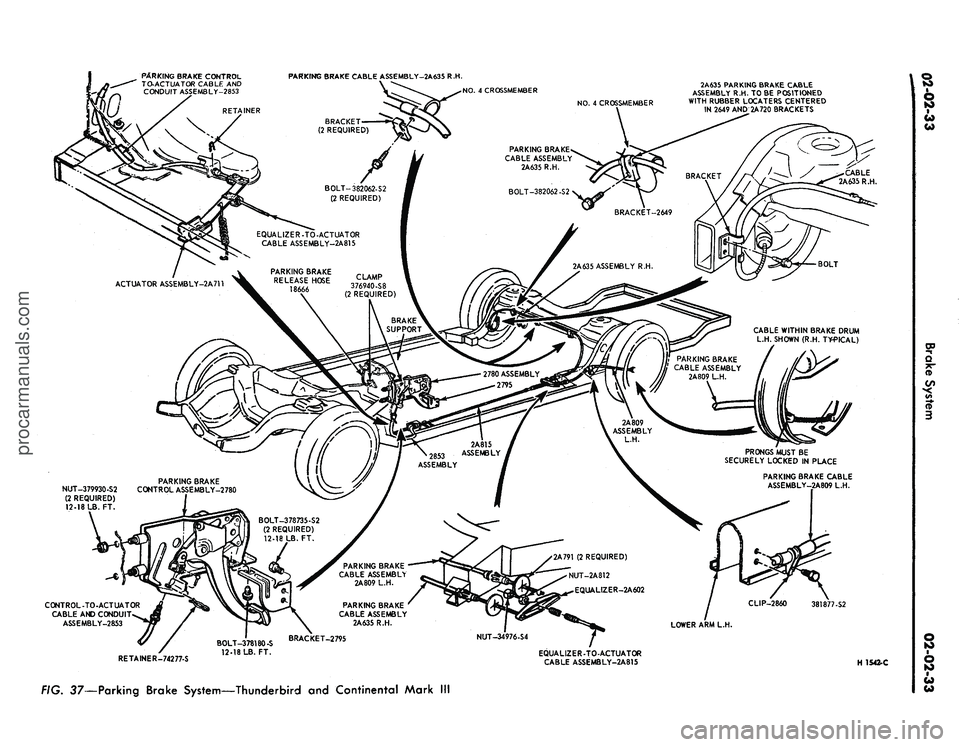
FIG. 37—Parking Brake System—Thunderbird and Continental Mark IIIprocarmanuals.com
Page 54 of 413
02-02-35
Brake System
02-02-35
4.
Attach a wire to the end of the
cable to assist in routing new cable.
5.
Lower the vehicle.
6. Remove the parking brake front
cable ball retaining clip from the
clevis.
7.
Disconnect the cable ball from
the notch in the brake clevis.
8.. Remove the hairpin retainer and
remove the cable assembly from the
brake control assembly.
9. Pull the cable assembly up through
the opening in the floor and remove
the wire from the end of the cable.
Installation
Refer to Fig. 36.
1.
Connect the wire to the end of
the cable assembly and pull the cable
down through the opening in the
floor. Remove the wire.
2.
Connect the cable assembly to
the brake control assembly and in-
stall the hairpin retainer.
3.
Position the ball end of the
cable in the notch of the brake clevis.
4.
Raise the vehicle on a hoist.
5.
Pull the cable grommet into po-
sition and route the cable through
the access holes in the side rail and
under the fuel line.
6. Insert the cable into the body
bracket and install the hairpin re-
tainer.
7.
Position the spring, spring seat,
and equalizer on the cable and install
the two nuts.
8. Adjust the parking brake.
LINCOLN CONTINENTAL
Removal
1.
Raise the car on a hoist. Dis-
connect the parking brake cable from
the equalizer lever underneath the
car (Fig. 38).
2.
Remove the retaining clip at the
cable bracket, and disengage the cable
from the bracket (Fig. 38).
3.
Remove the supporting clip re-
taining bolts and remove the support
plate from the underbody.
4.
Lower the car on a hoist.
5.
With the parking brake in the
fully released position, disconnect the
cable at the control assembly.
6. Raise the vehicle on a hoist. Re-
move the left front fender apron
splash shield retaining bolts and the
splash shield.
7.
Remove the two bolts securing
the parking brake control to equaliz-
er cable bracket to the dash panel
and remove the cable from the vehicle.
Installation
1.
Route the parking brake control
to equalizer cable to the control as-
sembly and the equalizer, and install
the two bolts that retain the cable
to the dash panel (Fig. 38).
2.
Install the left fror%/ender apron
splash shield and the ^u attaching
bolts.
3.
Lower the vehicle.
4.
Connect the control cable to the
clevis on the control assembly.
5.
Raise the car on a hoist.
6. Position the supporting clip and
cable on the vehicle and install the
retaining bolts. Do not tighten the
bolts.
Position the cable armor ap-
proximately 1/2 inch to the right of
the clip (looking toward the rear of
the car) and tighten the retaining
bolts.
7.
Position the equalizer control
cable to the support bracket and in-
stall the retaining hairpin clip.
8. Connect the ball end of the con-
trol cable to the equalizer lever.
9. Adjust the parking brake linkage
(Part
2-1,
Section 2).
10.
Check the operation of the auto-
matic release mechanism.
PARKING BRAKE
ACTUATOR-TO-EQUALIZER
CABLE
FORD, MERCURY,
METEOR, THUNDERBIRD
AND CONTINENTAL
MARK III
Removal
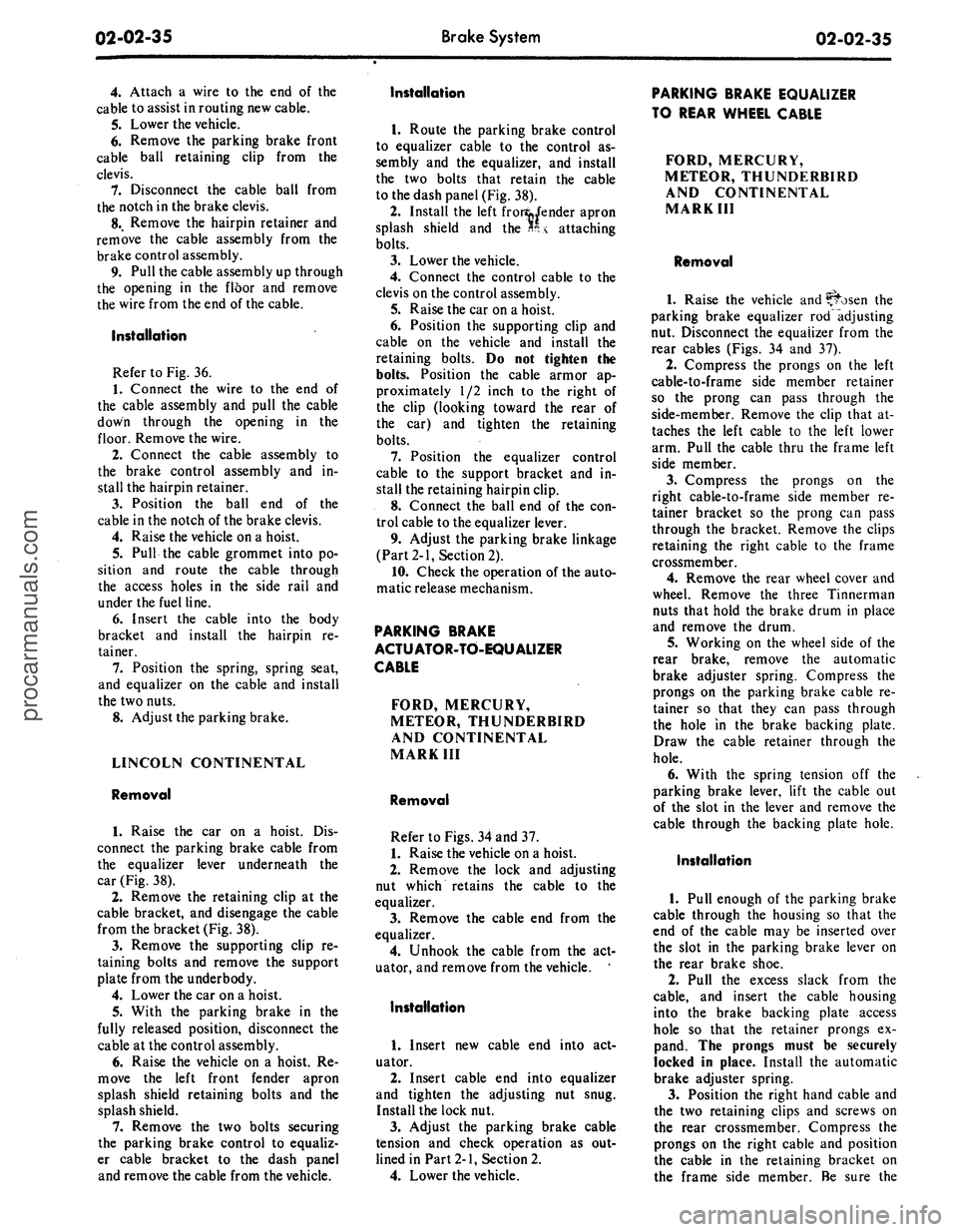
Refer to Figs. 34 and 37.
1.
Raise the vehicle on a hoist.
2.
Remove the lock and adjusting
nut which retains the cable to the
equalizer.
3.
Remove the cable end from the
equalizer.
4.
Unhook the cable from the act-
uator, and remove from the vehicle. *
Installation
1.
Insert new cable end into act-
uator.
2.
Insert cable end into equalizer
and tighten the adjusting nut snug.
Install the lock nut.
3.
Adjust the parking brake cable
tension and check operation as out-
lined in Part
2-1,
Section 2.
4.
Lower the vehicle.
PARKING BRAKE EQUALIZER
TO REAR WHEEL CABLE
FORD, MERCURY,
METEOR, THUNDERBIRD
AND CONTINENTAL
MARK III
Removal
1.
Raise the vehicle and tffosen the
parking brake equalizer rod" adjusting
nut. Disconnect the equalizer from the
rear cables (Figs. 34 and 37).
2.
Compress the prongs on the left
cable-to-frame side member retainer
so the prong can pass through the
side-member. Remove the clip that at-
taches the left cable to the left lower
arm. Pull the cable thru the frame left
side member.
3.
Compress the prongs on the
right cable-to-frame side member re-
tainer bracket so the prong can pass
through the bracket. Remove the clips
retaining the right cable to the frame
crossmember.
4.
Remove the rear wheel cover and
wheel. Remove the three Tinnerman
nuts that hold the brake drum in place
and remove the drum.
5.
Working on the wheel side of the
rear brake, remove the automatic
brake adjuster spring. Compress the
prongs on the parking brake cable re-
tainer so that they can pass through
the hole in the brake backing plate.
Draw the cable retainer through the
hole.
6. With the spring tension off the
parking brake lever, lift the cable out
of the slot in the lever and remove the
cable through the backing plate hole.
Installation
1.
Pull enough of the parking brake
cable through the housing so that the
end of the cable may be inserted over
the slot in the parking brake lever on
the rear brake shoe.
2.
Pull the excess slack from the
cable, and insert the cable housing
into the brake backing plate access
hole so that the retainer prongs ex-
pand. The prongs must be securely
locked in place. Install the automatic
brake adjuster spring.
3.
Position the right hand cable and
the two retaining clips and screws on
the rear crossmember. Compress the
prongs on the right cable and position
the cable in the retaining bracket on
the frame side member. Be sure theprocarmanuals.com
Page 55 of 413
02-02-36
Brake System
02-02-36
locating stripe on the cable is midway
between the retaining clips and tighten
all retaining clip screws.
4.
Position the left cable, retaining
clip and screw on the left lower sus-
pension arm. Compress the prongs on
the left cable and position the cable
through the frame side-member. The
prongs must be securely locked in
place.
5.
Insert the ball ends of the cables
into the equalizer assembly.
6. Install the rear drum(s) and
tighten the three Tinnerman nuts and
secure the drum. Install the wheel and
tire and the wheel cover.
7.
Adjust the parking brake linkage
as outlined in Part 2-1, Section 2. Ad-
just the rear brakes, as required (Part
2-1,
Section 2).
FAIRLANE, MONTEGO,
MUSTANG AND COUGAR—
EXCEPT STATION WAGON
Removal
1.
Remove the equalizer lock nut
and adjusting nut, equalizer, spring
and spring seat.
2.
With the cables slack, discon-
nect the ball-ends from the connector
(Figs.
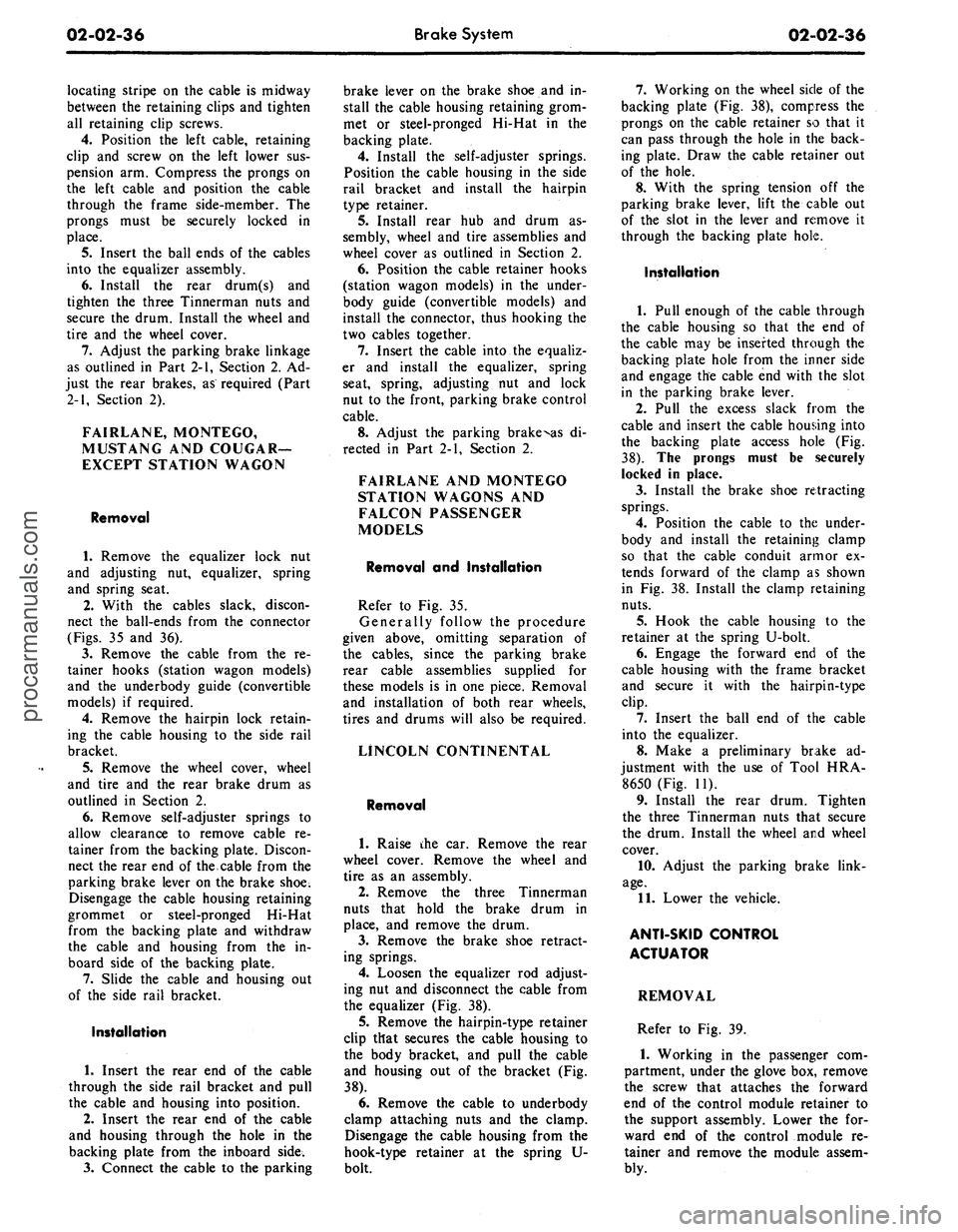
35 and 36).
3.
Remove the cable from the re-
tainer hooks (station wagon models)
and the underbody guide (convertible
models) if required.
4.
Remove the hairpin lock retain-
ing the cable housing to the side rail
bracket.
5.
Remove the wheel cover, wheel
and tire and the rear brake drum as
outlined in Section 2.
6. Remove self-adjuster springs to
allow clearance to remove cable re-
tainer from the backing plate. Discon-
nect the rear end of the cable from the
parking brake lever on the brake shoe.
Disengage the cable housing retaining
grommet or steel-pronged Hi-Hat
from the backing plate and withdraw
the cable and housing from the in-
board side of the backing plate.
7.
Slide the cable and housing out
of the side rail bracket.
Installation
1.
Insert the rear end of the cable
through the side rail bracket and pull
the cable and housing into position.
2.
Insert the rear end of the cable
and housing through the hole in the
backing plate from the inboard side.
3.
Connect the cable to the parking
brake lever on the brake shoe and in-
stall the cable housing retaining grom-
met or steel-pronged Hi-Hat in the
backing plate.
4.
Install the self-adjuster springs.
Position the cable housing in the side
rail bracket and install the hairpin
type retainer.
5.
Install rear hub and drum as-
sembly, wheel and tire assemblies and
wheel cover as outlined in Section 2.
6. Position the cable retainer hooks
(station wagon models) in the under-
body guide (convertible models) and
install the connector, thus hooking the
two cables together.
7.
Insert the cable into the equaliz-
er and install the equalizer, spring
seat, spring, adjusting nut and lock
nut to the front, parking brake control
cable.
8. Adjust the parking brake^as di-
rected in Part 2-1, Section 2.
FAIRLANE AND MONTEGO
STATION WAGONS AND
FALCON PASSENGER
MODELS
Removal and Installation
Refer to Fig. 35.
Generally follow the procedure
given above, omitting separation of
the cables, since the parking brake
rear cable assemblies supplied for
these models is in one piece. Removal
and installation of both rear wheels,
tires and drums will also be required.
LINCOLN CONTINENTAL
Removal
1.
Raise the car. Remove the rear
wheel cover. Remove the wheel and
tire as an assembly.
2.
Remove the three Tinnerman
nuts that hold the brake drum in
place, and remove the drum.
3.
Remove the brake shoe retract-
ing springs.
4.
Loosen the equalizer rod adjust-
ing nut and disconnect the cable from
the equalizer (Fig. 38).
5.
Remove the hairpin-type retainer
clip that secures the cable housing to
the body bracket, and pull the cable
and housing out of the bracket (Fig.
38).
6. Remove the cable to underbody
clamp attaching nuts and the clamp.
Disengage the cable housing from the
hook-type retainer at the spring U-
bolt.
7.
Working on the wheel side of the
backing plate (Fig. 38), compress the
prongs on the cable retainer so that it
can pass through the hole in the back-
ing plate. Draw the cable retainer out
of the hole.
8. With the spring tension off the
parking brake lever, lift the cable out
of the slot in the lever and remove it
through the backing plate hols.
Installation
1.
Pull enough of the cable through
the cable housing so that the end of
the cable may be inserted through the
backing plate hole from the inner side
and engage the cable end with the slot
in the parking brake lever.
2.
Pull the excess slack from the
cable and insert the cable housing into
the backing plate access hole (Fig.
38).
The prongs must be securely
locked in place.
3.
Install the brake shoe retracting
springs.
4.
Position the cable to the under-
body and install the retaining clamp
so that the cable conduit armor ex-
tends forward of the clamp as shown
in Fig. 38. Install the clamp retaining
nuts.
5.
Hook the cable housing to the
retainer at the spring U-bolt.
6. Engage the forward end of the
cable housing with the frame bracket
and secure it with the hairpin-type
clip.
7.
Insert the ball end of the cable
into the equalizer.
8. Make a preliminary brake ad-
justment with the use of Tool HRA-
8650 (Fig. 11).
9. Install the rear drum. Tighten
the three Tinnerman nuts that secure
the drum. Install the wheel and wheel
cover.
10.
Adjust the parking brake link-
age.
11.
Lower the vehicle.
ANTI-SKID CONTROL
ACTUATOR
REMOVAL
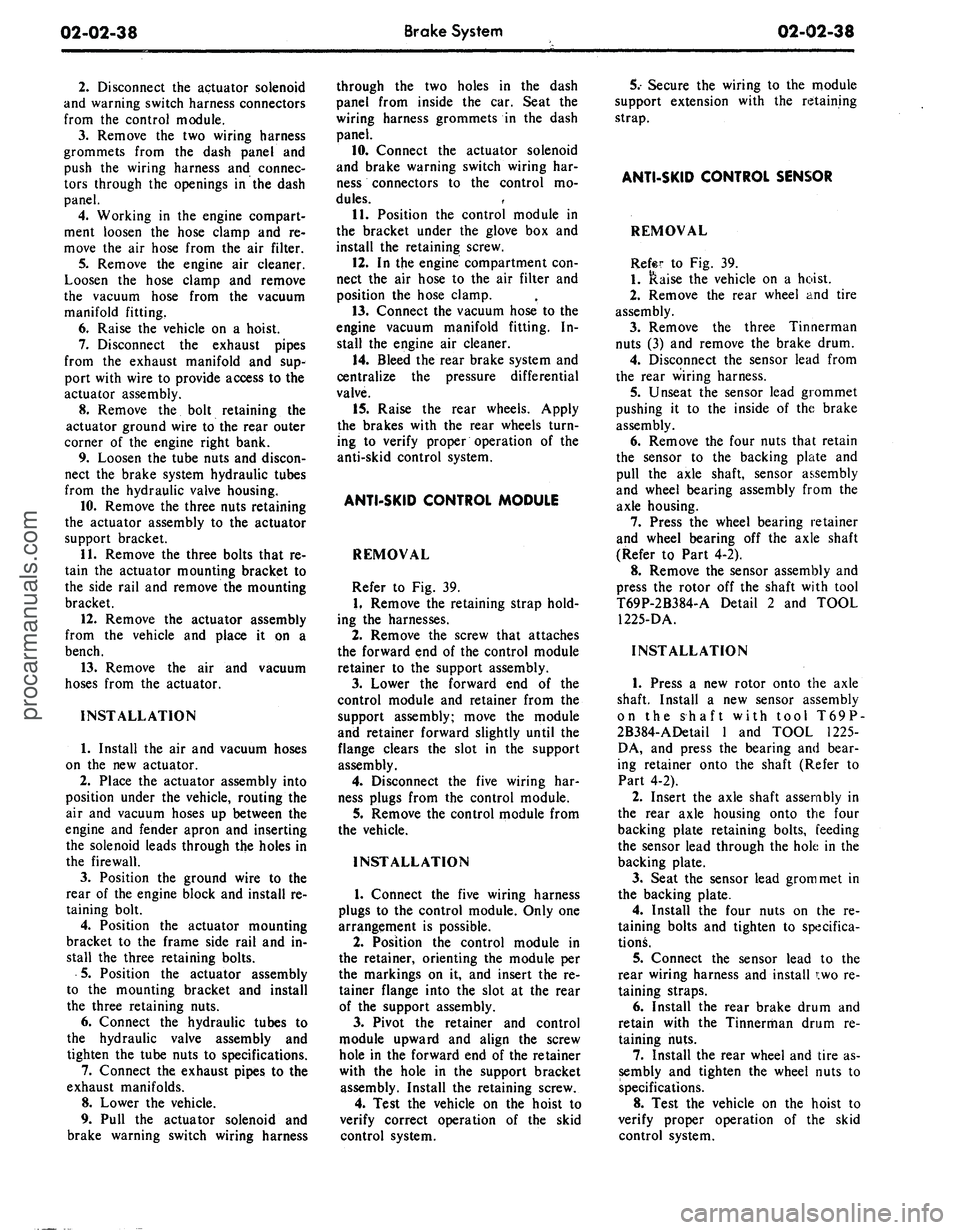
Refer to Fig. 39.
1.
Working in the passenger com-
partment, under the glove box, remove
the screw that attaches the forward
end of the control module retainer to
the support assembly. Lower the for-
ward end of the control module re-
tainer and remove the module assem-
bly.procarmanuals.com
Page 57 of 413
02-02-38
Brake System
02-02-38
2.
Disconnect the actuator solenoid
and warning switch harness connectors
from the control module.
3.
Remove the two wiring harness
grommets from the dash panel and
push the wiring harness and connec-
tors through the openings in the dash
panel.
4.
Working in the engine compart-
ment loosen the hose clamp and re-
move the air hose from the air filter.
5.
Remove the engine air cleaner-
Loosen the hose clamp and remove
the vacuum hose from the vacuum
manifold fitting.
6. Raise the vehicle on a hoist.
7.
Disconnect the exhaust pipes
from the exhaust manifold and sup-
port with wire to provide access to the
actuator assembly.
8. Remove the bolt retaining the
actuator ground wire to the rear outer
corner of the engine right bank.
9. Loosen the tube nuts and discon-
nect the brake system hydraulic tubes
from the hydraulic valve housing.
10.
Remove the three nuts retaining
the actuator assembly to the actuator
support bracket.
11.
Remove the three bolts that re-
tain the actuator mounting bracket to
the side rail and remove the mounting
bracket.
12.
Remove the actuator assembly
from the vehicle and place it on a
bench.
13.
Remove the air and vacuum
hoses from the actuator.
INSTALLATION
1.
Install the air and vacuum hoses
on the new actuator.
2.
Place the actuator assembly into
position under the vehicle, routing the
air and vacuum hoses up between the
engine and fender apron and inserting
the solenoid leads through the holes in
the firewall.
3.
Position the ground wire to the
rear of the engine block and install re-
taining bolt.
4.
Position the actuator mounting
bracket to the frame side rail and in-
stall the three retaining bolts.
5.
Position the actuator assembly
to the mounting bracket and install
the three retaining nuts.
6. Connect the hydraulic tubes to
the hydraulic valve assembly and
tighten the tube nuts to specifications.
7.
Connect the exhaust pipes to the
exhaust manifolds.
8. Lower the vehicle.
9. Pull the actuator solenoid and
brake warning switch wiring harness
through the two holes in the dash
panel from inside the car. Seat the
wiring harness grommets in the dash
panel.
10.
Connect the actuator solenoid
and brake warning switch wiring har-
ness connectors to the control mo-
dules.
'
11.
Position the control module in
the bracket under the glove box and
install the retaining screw.
12.
In the engine compartment con-
nect the air hose to the air filter and
position the hose clamp.
13.
Connect the vacuum hose to the
engine vacuum manifold fitting. In-
stall the engine air cleaner.
14.
Bleed the rear brake system and
centralize the pressure differential
valve.
15.
Raise the rear wheels. Apply
the brakes with the rear wheels turn-
ing to verify proper operation of the
anti-skid control system.
ANTI-SKID CONTROL MODULE
REMOVAL
Refer to Fig. 39.
1.
Remove the retaining strap hold-
ing the harnesses.
2.
Remove the screw that attaches
the forward end of the control module
retainer to the support assembly.
3.
Lower the forward end of the
control module and retainer from the
support assembly; move the module
and retainer forward slightly until the
flange clears the slot in the support
assembly.
4.
Disconnect the five wiring har-
ness plugs from the control module.
5.
Remove the control module from
the vehicle.
INSTALLATION
1.
Connect the five wiring harness
plugs to the control module. Only one
arrangement is possible.
2.
Position the control module in
the retainer, orienting the module per
the markings on it, and insert the re-
tainer flange into the slot at the rear
of the support assembly.
3.
Pivot the retainer and control
module upward and align the screw
hole in the forward end of the retainer
with the hole in the support bracket
assembly. Install the retaining screw.
4.
Test the vehicle on the hoist to
verify correct operation of the skid
control system.
5.-
Secure the wiring to the module
support extension with the retaining
strap.
ANTI-SKID CONTROL SENSOR
REMOVAL
Refer to Fig. 39.
1.
Raise the vehicle on a hoist.
2.
Remove the rear wheel and tire
assembly.
3.
Remove the three Tinnerman
nuts (3) and remove the brake drum.
4.
Disconnect the sensor lead from
the rear wiring harness.
5.
Unseat the sensor lead grommet
pushing it to the inside of the brake
assembly.
6. Remove the four nuts that retain
the sensor to the backing plate and
pull the axle shaft, sensor assembly
and wheel bearing assembly from the
axle housing.
7.
Press the wheel bearing retainer
and wheel bearing off the axle shaft
(Refer to Part 4-2).
8. Remove the sensor assembly and
press the rotor off the shaft with tool
T69P-2B384-A Detail 2 and TOOL
1225-DA.
INSTALLATION
1.
Press a new rotor onto the axle
shaft. Install a new sensor assembly
on the shaft with tool T69P-
2B384-ADetail 1 and TOOL 1225-
DA, and press the bearing and bear-
ing retainer onto the shaft (Refer to
Part 4-2).
2.
Insert the axle shaft assembly in
the rear axle housing onto the four
backing plate retaining bolts, feeding
the sensor lead through the hole in the
backing plate.
3.
Seat the sensor lead grommet in
the backing plate.
4.
Install the four nuts on the re-
taining bolts and tighten to specifica-
tions.
5.
Connect the sensor lead to the
rear wiring harness and install two re-
taining straps.
6. Install the rear brake drum and
retain with the Tinnerrhan drum re-
taining nuts.
7.
Install the rear wheel and tire as-
sembly and tighten the wheel nuts to
specifications.
8. Test the vehicle on the hoist to
verify proper operation of the skid
control system.procarmanuals.com
Page 58 of 413
02-02-39
Brake System
02-02-39
MAJOR REPAIR OPERATIONS
BRAKE DRUM REFINISHING
Minor scores on a brake drum can
be removed with sandpaper. A drum
that is excessively scored or shows a
total indicator runout of over 0.007
inch should be turned down. Remove
only enough stock to eliminate the
scores and true up the drum. The refi-
nished diameter must not exceed 0.060
inch oversize.
Check the inside diameter of the
brake drum with a brake drum mi-
crometer (Tool FRE-14^1).
If the drum diameter is less than
0.030 inch oversize after refinishing^
standard lining may be installed. If
the drum diameter is 0.030—0.060
inch oversize after refinishing, oversize
lining must be installed.
After a drum is turned down, wipe
the refinished surface with a cloth
soaked in clean denatured alcohol. If
one drum is turned down, the opposite
drum on the same axle should also be
cut down to the same size.
ROTOR REFINISHING
Rotunda Disc Brake Attachment,
FRE-2249-2, is the only recommended
tool to refinish the disc brake rotors.
The step-by-step resurfacing procedure
provided with the tool must be ad-
hered to.
The finished braking surfaces of the
rotor must be flat and parallel within
0.0007 inch; lateral runout must not
exceed 0.003 inch total indicator read-
ing, and the surface finish of the brak-
ing surfaces are to be 80/15 micro
inches. The minimum limiting dimen-
sions (Figs. 11 and 12, Part 2-1) from
the inboard bearing cup to the out-
board rotor face and from the inboard
bearing cup to the inboard rotor face
must be observed when removing ma-
terial from the rotor braking surfaces.
On all models except Lincoln Con-
tinental, the limiting dimensions are to
be measured with a ball and gage bar
(Rotunda Kit FRE-70160).
BRAKE SHOE RELINING
Brake linings that are worn to with-
in 1/32 inch of the rivet head or are
less than 0.030 inch thick (bonded lin-
ing) or have been contaminated with
brake fluid, grease or oil must be re-
placed. Failure to replace worn linings
will result in a scored drum. When it
is necessary to replace linings, they
must also be replaced on the wheel on
the opposite side of the vehicle.
Inspect brake shoes for distortion,
cracks, or looseness. If this condition
exists,
the shoe must be discarded. Do
not attempt to repair a defective brake
shoe.
1.
Wash the brake shoes thoroughly
in a clean solvent. Remove all burrs
or rough spots from the shoes.
2.
Check the inside diameter of the
brake drum with a brake drum mi-
crometer (tool FRE-1431). If the di-
ameter is less than 0.030 inches over-
size,
standard lining may be installed.
If the diameter is 0.030—0.060 inches
oversize, oversize lining should be in-
stalled.
3.
Position the new lining on the
shoe.
Starting in the center, insert and
secure the rivets, working alternately
towards each end. Replacement lin-
ings are ground and no further grind-
ing is required.
4.
Check the clearance between the
shoe and lining. The lining must seat
tightly against the shoe with not more
than 0.008 inch clearance between any
two rivets.
RETAINER - 2B245
DUAL MASTER CYLINDER
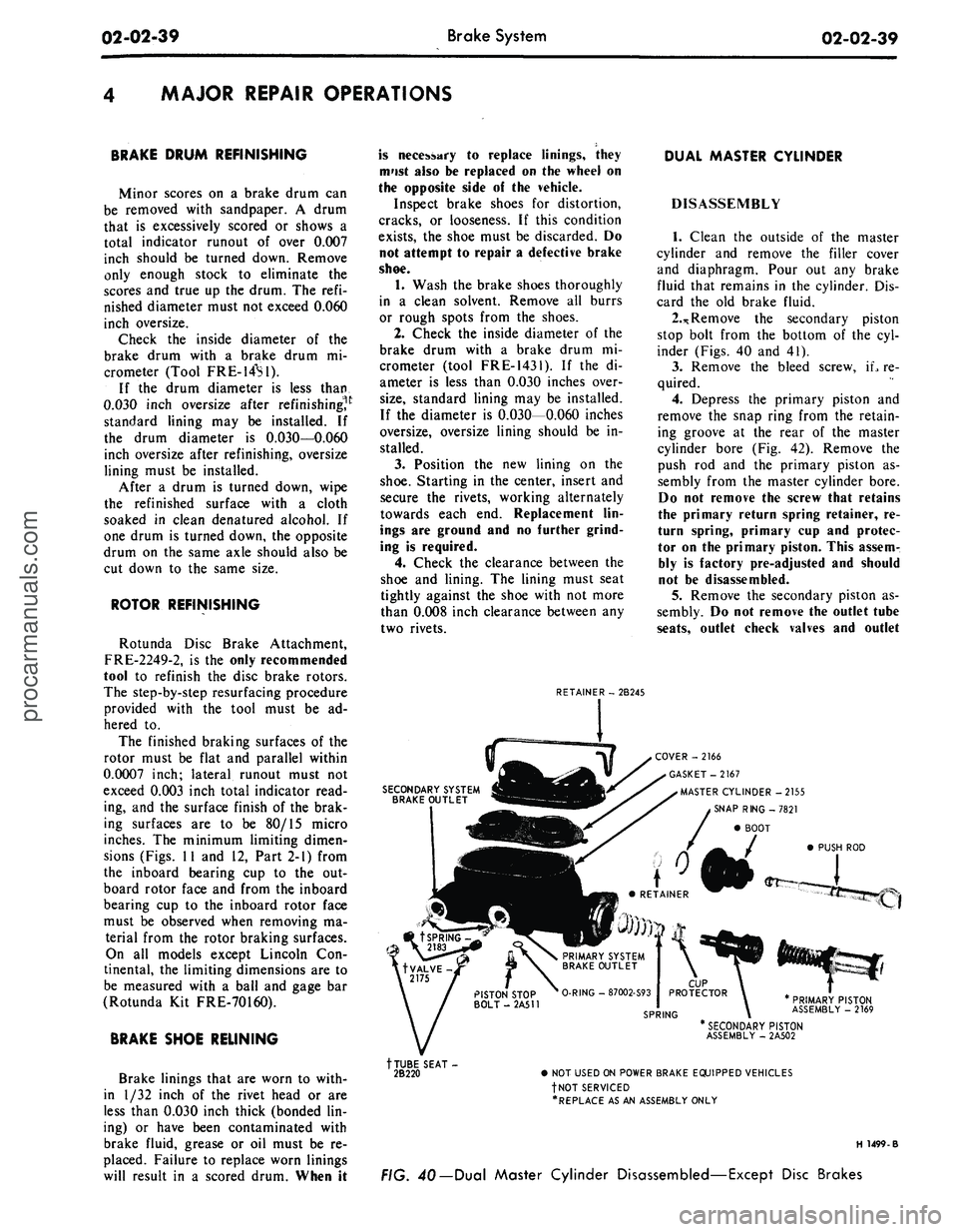
DISASSEMBLY
1.
Clean the outside of the master
cylinder and remove the filler cover
and diaphragm. Pour out any brake
fluid that remains in the cylinder. Dis-
card the old brake fluid.
2.*
Remove the secondary piston
stop bolt from the bottom of the cyl-
inder (Figs. 40 and 41).
3.
Remove the bleed screw, iL re-
quired.
4.
Depress the primary piston and
remove the snap ring from the retain-
ing groove at the rear of the master
cylinder bore (Fig. 42). Remove the
push rod and the primary piston as-
sembly from the master cylinder bore.
Do not remove the screw that retains
the primary return spring retainer, re-
turn spring, primary cup and protec-
tor on the primary piston. This assem-
bly is factory pre-adjusted and should
not be disassembled.
5.
Remove the secondary piston as-
sembly. Do not remove the outlet tube
seats,
outlet check valves and outlet
SECONDARY SYSTEM
BRAKE OUTLET
COVER -2166
GASKET-2167
MASTER CYLINDER -2155
SNAP RING -7821
BOOT
PUSH ROD
PRIMARY PISTON
ASSEMBLY - 2169
tTUBE SEAT-
2B220
* SECONDARY PISTON
ASSEMBLY - 2A502
• NOT USED ON POWER BRAKE EQUIPPED VEHICLES
fNOT SERVICED
•REPLACE AS AN ASSEMBLY ONLY
H 1499-B
FIG. 40— Dual Master Cylinder Disassembled—Except Disc Brakesprocarmanuals.com
Page 59 of 413

02-02-40
Brake System
02-02-40
RETAINER - 2B245
PRIMARY PISTON
ASSEMBLY-2169
GASKET-2167
RETURN SPRING
RETAINER
\ CUP
\\PROTECTOR
^\i # PISTON
fNOT SERVICED
* REPLACE AS
ASSEMBLY ONLY
*O-RING
PUMPING CUP
tVALVE
2175
SECONDARY
BRAKE SYSTEM
OUTLET
*SECONDARY PISTON
ASSEMBLY-2A502
H 1550-B
FIG. 41—Dual Master Cylinder Disassembled—Disc Brakes
check valve springs from the master
cylinder body.
open and free of foreign matter. Use
an air hose to blow out dirt and clean-
ing solvent. Place all parts on a clean
pan or paper.
3.
Inspect the master cylinder bore
for signs of etching, pitting, scoring or
rust. If it is necessary to hone the
master cylinder bore to repair dam-
age,
do not exceed allowable hone
specifications.
ASSEMBLY
1.
Dip all parts except the master
cylinder body in clean Rotunda Extra
Heavy Duty Brake Fluid.
2.
Carefully insert the complete
secondary piston and return spring as-
sembly in the master cylinder bore.
3.
Install the primary piston assem-
bly in the master cylinder bore.
4.
Depress the primary piston and
install the snap ring in the cylinder
bore groove.
5.
Install the push rod, boot and re-
tainer on the push rod, if so equipped.
Install the push rod assembly into the
primary piston. Make sure the retain-
er is properly seated and holding the
push rod securely.
6. Position the inner end of the
push rod boot (if so equipped) in the
master cylinder body retaining groove.
7.
Install the secondary piston stop
INSPECTION AND REPAIR
1.
Clean all parts in clean isopropyl
alcohol, and inspect the parts for
chipping, excessive wear or damage.
When using a master cylinder repair
kit, install all the parts supplied.
2.
Check all recesses, openings and
internal passages to be sure they are
Snap Ring Pliers
SNAP RING
H1477-C
FIG. 42—Removing Snap
Ring—Typical
INNER BRAKE
SHOE AND LINING
ASSEMBLY-2019
OUTER SHOE
RETAINING CLIPS
2066
STABILIZER
2B295
LOCATING PIN
2B296
ANCHOR PLATE
2B293(L.H.)
2B292 (R.H.)
MOVABLE CALIPER
2B119(L.H.)
2B118(R.H.)
H 1573-C
FIG. 43—Caliper Assembly—Disassembled-
All Models Except Lincoln Continentalprocarmanuals.com