1969 FORD MUSTANG ABS
[x] Cancel search: ABSPage 78 of 413

03-02-02
Suspension
03-02-02
COMPONENT INDEX
REAR SPRING
Disassembly
and
Overhaul
Removal
and
Installation
REAR SUSPENSION
Description
REAR SUSPENSION LOWER
ARM
Removal
and
Installation
REAR SUSPENSION UPPER
ARM
Removal
and
Installation
SPRING LEAVES
AND
TIE-BOLT
Removal
and
Installation
STABILIZER
Removal
and
Installation
TRACK
BAR
Removal
and
Installation
UPPER
ARM
-
REMOVED
Removal
and
Installation
UPPER
ARM
SHAFT AND/OR BUSHING
Removal
and
Installation
UPPER BALL JOINT
Removal
and
Installation
MODEL APPLICATION
All
Models
Ford
N/A
02-23
02-02
02-24
02-25
N/A
02-11
02-25
N/A
N/A
02-08
Mercury
N/A
02-23
02-02
02-24
02-25
N/A
02-11
02-25
N/A
N/A
02-08
Meteor
N/A
02-23
02-02
02-24
02-25
N/A
02-11
02-25
N/A
N/A
02-08
Cougar
N/A
02-25
02-04
N/A
N/A
N/A
02-11
N/A
N/A
02-09
02-08
Fairlane
N/A
02-25
02-04
N/A
N/A
N/A
02-11
N/A
N/A
02-09
02-08
Falcon
N/A
02-25
02-04
N/A
N/A
N/A
02-11
N/A
N/A
02-09
02-08
Montego
N/A
02-25
02-04
N/A
N/A
N/A
02-11
N/A
N/A
02-09
02-08
Mustang
N/A
02-25
02-04
N/A
N/A
N/A
02-11
N/A
N/A
02-09
02-08
Lincoln-
Continental
02-28
02-26
02-04
N/A
N/A
02-29
N/A
N/A
02-27
N/A
02-10
Thunderbird
N/A
02-23
02-02
02-24
02-25
N/A
02-11
02-25
N/A
N/A
02-08
Continental-
Mark III
N/A
02-23
02-02
02-24
02-25
N/A
02-11
02-25
N/A
N/A
02-08
A page number indicates that
the
item
is
for the
vehicle listed
at
the
head
of
the
column.
N/A indicates that
the
item
is
not
applicable
to
the
vehicle listed.
DESCRIPTION
FRONT SUSPENSION
Each front wheel rotates
on a
spindle.
The
upper
and
lower ends
of
the spindle
are
attached
to
upper
and
lower ball joints which
are
mounted
to
an upper
and
lower
arm
respectively.
The upper
arm
pivots
on a
bushing
and shaft assembly which
is
bolted
to
the frame.
The
lower
arm
pivots
on a
bolt
in the
front crossmember (Figs.
1,
2
and 3). A
coil spring seats between
the lower (upper
on
Cougar, Fairlane,
Falcon, Montego
and
Mustang)
arm
and
the top of the
spring housing.
A
double action shock absorber
is
bolted
to
the arm and the top of the
spring
housing.
REAR SUSPENSION
FORD, MERCURY,
METEOR, THUNDERBIRD
AND
CONTINENTAL MARK
III
Each rear wheel,
hub, and
brake
drum assembly
is
bolted
to the
rear
axle shaft flange.
The
axle shaft
as-
sembly rotates
in the
rear axle hous-
ing.
The rear axle housing
is
suspended
from
the
frame
by a
coil spring
and
shock absorber
at
each side
of the ve-
hicle
and by
three arms
(one
upper
and
two
lower) which pivot
in the
frame members
(Fig.
4).
Each coil spring
is
mounted
be-
tween
a
lower seat, which
is
welded
to
the axle housing,
and an
upper seat
which
is
integral with
the
frame.
The upper
end
of
the
rear shock
ab-
sorber
is
attached
to the
spring upper
seat;
the
lower
end is
bolted
to a
bracket
on the
axle housing.
The upper suspension
arm
attaches
to
the
right side
of the
axle housing
through
an
eccentric pivot bolt
and a
bracket which
is
welded
to the top of
the housing.
The
forward
end of the
arm
is
connected
by a
pivot bolt
to
the frame crossmember.
Each lower suspension
arm
attaches
to
one end of the
axle housing
through
a
pivot bolt
and a
bracket
which
is
welded
to the
underside
of
the housing.
The
forward
end of the
arm
is
connected
by a
pivot bolt
to
the frame side member.
A track
bar is
connected between
the upper
arm
bracket
on the
axle
housing
and a
mounting bracket
on
the left frame side rail.
procarmanuals.com
Page 80 of 413

03-02-04
Suspension
03-02-04
COUGAR, FAIRLANE,
FALCON, MONTEGO,
MUSTANG
LINCOLN CONTINENTAL
Each rear wheel, hub and brake
drum assembly is bolted to the rear
axle shaft flange. The wheel and axle
shaft assembly rotates in the rear axle
housing. Two spring pads, integral
with the axle housing, rest on two leaf
spring assemblies. The axle housing is
fastened to the center of the springs
by spring clips (U-bolts), retainers,
and nuts (Figs. 5 and 6). Each spring
assembly is suspended from the under-
body side rail by hanger and shackle
assemblies at the front and rear. The
integral mounting stud at the upper
end of each shock absorber is attached
to the crossmember by a mounting
plate. The lower end is mounted to a
stud which is integral with a bracket
welded to the axle housing.
SHOCK ABSORBER
UPPER MOUNTING
BRACKET
SPRING
SHOCK ABSORBER
UPPER ARM
FIG. 2—Front Suspension—Typical—Cougar, Fairlane, Falcon,
Montego, Mustang
F
1497.
A
3—Front Suspension—Lincoln Continentalprocarmanuals.com
Page 85 of 413

03-02-09
Suspension
03-02-09
WOOD BLOCK
F
1287-A
FIG. 9—Upper
Arm
Support—
Montego, Falcon
and
Fairlane
Tool-T62F-3006-A
ARM SUPPORT
LOWER BALL JOINT
SLEEVE
Too/-T57P-3006-A
F 1157-C
FIG. TO—Loosening Ball Joint
Studs
in
Spindle—Typical
from
the
spindle.
Do not
loosen
the
stud with tool pressure alone. Raise
the stud
out of the
spindle bore.
6. Using
a
large chisel,
cut off the
three upper ball joint retaining rivets
and remove
the
ball joint.
7.
Clean
the end of the arm, and
remove
all
burrs from
the
hole edges.
Check
for
cracks
in the
metal
at the
holes,
and
replace
the arm if it is
cracked.
8. Attach
the new
ball joint
to the
upper
arm. Use
only
the
specified
bolts,
nuts,
and
washers.
Do not
rivet
the
new
ball joint
to the
arm. Torque
the nuts
to
specification (Part 3-13).
9. Position
the
lower ball joint stud
in
the
spindle bore,
and
torque
the at-
taching
nut to
specification. Install
a
new cotter
pin and
tighten
the nut if
necessary
to
line
up the
cotter
pin
hole.
Install
a new
cotter
pin in the
lower ball joint
if it was
removed.
1495-A
FIG. 11 —Shaft Centered
in
Arm—Typical
F 1494- A
FIG. 12—Torque Upper
Arm
Inner Shaft Bushings—Typical
10.
Lubricate
the
ball joint,
and in-
stall
the
wheel
and
tire. Torque
the
lug nuts
to
specification (Part 3-13).
11.
Remove
the
safety stands,
and
lower
the
vehicle.
12.
Remove
the
support from
be-
tween
the
upper
arm and
frame.
13.
Check
and, if
necessary, adjust
caster, camber,
and
toe-in.
UPPER ARM SHAFT AND/OR
BUSHING REPLACEMENT
COUGAR, FAIRLANE,
FALCON, MONTEGO,
MUSTANG
1.
Remove
the
shock absorber
and
upper mounting bracket
as an
assem-
bly.
2.
Raise
the
vehicle
on a
hoist,
in-
stall safety stands,
and
remove
the
wheel cover
or hub cap.
3.
Remove
the
grease
cap
from
the
hub;
then, remove
the
cotter
pin, nut
lock, adjusting
nut and
outer bearing
from
the hub.
4.
Pull
the
wheel, tire,
and the hub
and drum
off the
spindle
as an
assem-
bly.
5.
Install
the
spring compressor
tool (Figs.
20, 21 and 22).
6. Remove
2
upper arm-to-spring
tower attaching nuts
and
swing
the
upper
arm
outboard from
the
spring
tower.
7.
Rotate
the
inner shaft
so
that
the
studs
can be
removed. Remove
the
studs with
a
soft mallet.
8. Unscrew
the
bushings from
the
shaft
and
suspension
arm;
then,
re-
move
the
shaft from
the arm.
9. Position
the
shaft
in the. arm,
apply grease
to the new
bushings
and
O-rings,
and
install
the
bushings loose
on
the
shaft
and
arm. Turn
the
bush-
ings
so
that
the
shaft
is
exactly
cen-
tered.
The
shaft will
be
properly
cen-
tered when dimensions
A and B in
Fig.
11 are
equal.
10.
Fabricate
a
spacer from
a sec-
tion
of
3/4-inch diameter pipe
or
metal
of
comparable size
and
strength.
The
spacer should
be 6
15/16 inches long.
11.
Position
the
spacer parallel with
the inner shaft,
and
force
the
spacer
between
the
flanges
of the
upper
arm
(Fig.
12).
If
the
spacer cannot
be
forced
be-
tween
the arm
flanges due
to
excessive
distortion, replace
the
upper
arm as-
sembly.
12.
With
the
spacer positioned
in
the
arm,
torque
the
bushings
to
speci-
fication. Move
the arm on the
shaft
to
be sure that
no
binding exists, then
re-
move
the
spacer.
13.
Attach
the
suspension upper
arm
to the
underbody. Release
the
front spring.
14.
Remove
the
spring compressor
and position
the
wheel, tire,
and hub
and drum
on the
spindle.
15.
Install
the
bearing, washer,
ad-
justing
nut and nut
lock. Adjust
the
wheel bearing
as
outlined
in
Part
3-12
and install
the
cotter
pin,
grease
cap
and
hub cap or
wheel cover.
16.
Lower
the
vehicle
and
install
the shock absorber
and
upper mount-
ing bracket.
17.
Check caster, camber,
and toe-
in,
and
adjust
as
necessary (Part 3-1).
LOWER BALL JOINT
REPLACEMENT-
ARM
IN
VEHICLE
FORD, MERCURY,
METEOR, THUNDERBIRD,
CONTINENTAL MARK
III
1.
Raise
the
vehicle high enough
to
provide working space, leaving
theprocarmanuals.com
Page 88 of 413

03-02-12
Suspension
03-02-12
ECCENTRIC
WASHER
F1504-A
FIG. 76 —Measuring Pinion Angle
specification whenever the rear axle
has been removed.
Before checking the drive shaft pin-
ion angle, alignment height spacer
(Tool T65P-3OOO-B or C) must be in-
stalled at a height of 4.30 inches (Fig.
14).
Checking Procedure
The checking and adjusting proce-
dure must be done with the weight of
the vehicle on the front and rear sus-
pension.
UPPER ARM
KET
ECCENTRIC
WASHER
AXLE HOUSING
E1761-A
FIG.
17
—
Pinion
Angle Adjustment
1.
Position the magnetized Tool
T68P-4602-A on a U-joint bearing
cap as shown in Fig. 15.
2.
With the tool suspended straight
down and the adjusting screw to the
left, adjust the dial on the tool until
the left-hand edge of the bubble is ex-
actly on the zero line.
3.
Position the vee magnet on the
drive shaft away from welds and bal-
ance weights (Fig. 15).
4.
Position the magnetized tool
(T68P-4602-A) on the vee magnet
with the adjusting screw to the left in
the same relative position as it was on
the bearing cap (Fig. 16).
5.
Read the position of the bubbles
left-hand edge on the scale to deter-
mine the drive shaft pinion angle. The
reading should be 3 1/2 degrees plus 1
degree on Ford, Mercury or Meteor
models, 7 1/4 degrees plus 3/4 degree
on Thunderbird or Continental Mark
III models.
Adjustment
If the pinion angle is not within
specifications, adjust the pinion angle
as follows:
The upper arm-to-axle housing bolt
and two eccentric washers form an ad-
justing cam mechanism (Fig. 17)
which will tilt the axle housing to the
required angle.
1.
Loosen the upper arm pivot bolt
nuts.
2.
If the angle is less than specifica-
tions,
rotate the adjusting cam for-
ward and recheck the angle. If the
angle is more than specification, ro-
tate the adjusting cam rearward and
recheck the angle.
3.
When the axle housing is adjust-
ed in such a way that the drive shaft
angle reading is within specification,
install new pivot bolt nuts and torque
to specification (Fig. 17).
4.
Lower the vehicle and road test
for proper axle operation.
REMOVAL AND INSTALLATION
HOISTING INSTRUCTIONS
Damage to steering linkage compo-
nents and front suspension struts may
occur if care is not exercised when po-
sitioning the hoist adapters of 2 post
hoists prior to lifting the vehicle.
If a 2 post hoist is used to lift the
vehicle, place the adapters under the
lower arms or the No. 1 crossmember.
Do not allow the adapters to contact
the steering linkage. If the adapters
are placed under the crossmember, a
piece of wood (2 x 4 x 16 inches)
should be placed on the hoist channel
between the adapters. This will pre-
vent the adapters from damaging the
front suspension struts.
FRONT SPRING
REPLACEMENT
FORD, MERCURY,
METEOR, THUNDERBIRD,
CONTINENTAL MARK HI
Removal
1.
Raise the vehicle and support the
front end of the frame with jack
stands.
2.
Place a jack under the lower arm
to support it.
3.
Disconnect the lower end of the
shock absorber from the lower arm.
4.
Remove the bolts that attach the
strut and the rebound bumper to the
lower arm.
5.
Disconnect the lower end of the
sway bar stud from the lower arm.
6. Remove the nut and bolt that se-
cures the inner end of the lower arm
to the crossmember.
7.
Carefully lower the jack slowly
to relieve the spring pressure on the
lower arm, then remove the spring
(Fig. 18).
Installation
1.
Position the spring on the lower
arm so that the lower end properly
engages the seat.
2.
Raise the lower arm carefully
with a jack while guiding the inner
end to align with the bolt hole in the
crossmember. Insert the attaching bolt
in the rear of the crossmember andprocarmanuals.com
Page 89 of 413

03-02-13
Suspension
03-02-13
BALL JOINT BOLT HEAD
STABILIZER
F1370-A
FIG. 18 —Removing or Installing Front Spring
TURN TO COMPRESS
NUT
•
Tool T 63 P-53J0-A
SHAFT SCREW
Lower Adapter Plate
CAVITY
Upper Adapter Plate
T67P-5370-A
FIG. 79—Spring Tool Installation
through the lower arm. Install and
torque the nut to specification.
3.
Secure the lower end of the
shock absorber to the lower arm with
the two attaching bolts.
4.
Secure the strut and the rebound
bumper to the lower arm with the two
F
1492.
A
attaching bolts. Torque the bolts to
specification
5.
Connect the sway bar to the
lower arm with the attaching washer
and insulators as shown in Fig. 1.
Torque the nut to specification.
6. Check the front end alignment
and adjust it to the recommended
specifications if required.
COUGAR, FAIRLANE,
FALCON, MONTEGO,
MUSTANG
Removal
1.
Remove the shock absorber and
upper mounting bracket as an assem-
bly.
2.
Raise the vehicle on a hoist, in-
stall safety stands, and remove the
wheel cover or hub cap.
3.
Remove the grease cap from the
hub;
then, remove the cotter pin, nut
lock, adjusting nut and outer bearing
from the hub.
4.
Pull the wheel, tire and the hub
and drum off the spindle as an assem-
bly.
5.
Install the spring compressor
tool as shown in Figs. 19, 20 and 21.
6. Remove 2 upper arm-to-spring
tower attaching nuts and swing the
upper arm outboard from the spring
tower (Fig. 21).
7.
Release the spring compressor
tool and remove the tool from the
spring. Then, remove the spring from
the vehicle.
Installation
1.
Place the spring upper insulator
on the spring and secure in place with
tape.
2.
Position the spring in the spring
tower. Install the spring compressor,
(Fig. 19) and compress the spring.
3.
Swing the upper arm inboard
and insert the bolts through the holes
in the side of the spring tower. Then,
install the attaching nuts and torque
them to specification.
4.
Release the spring pressure and
guide the spring into the upper arm
spring seat. The end o! the spring
must seat against the tab on the
spring seat.
5. Remove the spring compressor
and position the wheel, tire, and hub
and drum on the spindle.
6. Install the bearing, washer, ad-
justing nut and lock nut. Adjust the
wheel bearing as outlined in Part 3-12
and install the cotter pin, grease cap,
and hub cap or wheel cover.
7.
Lower the vehicle and install the
shock absorber and upper mounting
bracket.
8. Check caster, camber, and toe-in
and adjust as necessary (Part 3-1).procarmanuals.com
Page 90 of 413

03-02-14
Suspension
03-02-14
FRONT SPRING AND
LOWER ARM
LINCOLN CONTINENTAL
Removal
1.
Raise the vehicle. Place a sup-
port under each underbody side rail to
the rear of the lower arm in the lifting
pad area.
2.
Remove the wheel and tire from
the hub.
3.
Remove 2 bolts and washers that
attach the caliper to the spindle. Re-
move the caliper from the rotor and
wire it to the underbody to prevent
damage to the brake hose.
4.
Remove the hub and rotor from
the spindle.
5.
Loosen the splash shield to pro-
vide clearance at the end of the arm
when it is lowered.
6. Remove the shock absorber.
7.
Disconnect the stabilizing strut
(drag strut) from the lower arm.
8. Disconnect the stabilizer bar
from the suspension bar.
9. Remove the cotter pin from the
slotted nut attaching the lower ball
joint to the end of the spindle boss.
Loosen the nut one to two turns.
10.
Place a box wrench over the
lower end of the ball joint remover
tool, and position the tool as in Fig.
13.
The tool should seat firmly against
the ends of both studs, and not
against the lower stud nut.
11.
Turn the wrench until both
studs are under tension, then, tap the
spindle with a hammer near the lower
stud to loosen it from the spindle. Do
not loosen the stud with tool pressure
alone.
12.
Place a jack under the outer
end of the lower arm and raise the
arm several inches.
13.
Install the spring compressor
Tool 5310-A (Fig. 23) inside the
spring with the jaws of the tool
toward the center of the vehicle.
14.
Remove the nut from the ball
joint stud. Lower the jack until the
spindle and spring are free, and re-
move the spring and insulators.
15.
Remove the lower arm- to-
crossmember nut, bolt, washers, and
spacer, then remove the arm.
Installation
1.
Connect the inner end of the
lower arm to the underbody
crossmember. Do not tighten the at-
taching nut at this time. Refer to Fig.
22.
Basic Tool Adapter F 1288-B
FIG. 20—Spring Compressor Tool Installed—Upper View—Typical
DETAIL NO 3 T63P-5310-A DETAIL NO.4
DETAIL
NO.
I
21 —Compressing Spring—Lower View—Montego, Falcon
and Fairlaneprocarmanuals.com
Page 92 of 413
03-02-16
Suspension
03-02-16
2.
Place a jack under the outer end
of the arm.
3.
Tape the upper and lower spring
insulators to the spring.
4.
Compress the coil spring with
Tool 5310-A (Fig. 23) and place the
spring and insulators in position. Be
sure both ends of the spring are prop-
erly seated, and raise the arm. Guide
the spindle boss over the ball joint
stud.
5.
Install the ball joint stud retain-
ing nut and torque it to specification.
Continue tightening the nut to line up
the cotter pin hole. Install a new cot-
ter pin.
6. Connect the stabilizer bar to the
lower arm. Torque the nut to specifi-
cation.
7.
Connect the drag strut to the
lower arm. Torque the nuts to specifi-
cation.
8. Install the shock absorber.
9. Tighten the splash shield attach-
ing bolts to specifications.
10.
Install the hub and rotor on the
spindle and adjust the wheel bearings.
11.
Install the caliper to the spindle
and tighten the attaching bolts to
specifications. Check for the correct
flexible hose routing (Part 2-2).
12.
Install the wheel and tire on the
hub.
Torque the wheel lug nuts to
specifications and remove the support
stands.
13.
With the front end weight of
the car on the wheels, torque the
lower arm-to-crossmember bolt at-
taching nut to specification.
FRONT SUSPENSION
LOWER ARM
FORD, MERCURY,
METEOR, THUNDERBIRD,
CONTINENTAL MARK III
Removal
1.
Raise the front of the vehicle and
position safety stands under both sides
of the frame just back of the lower
arms.
2.
Remove the hub cap or wheel
cover.
3.
If equipped with drum type
brakes—Remove the wheel and tire
and brake drum as an assembly. Re-
move the brake backing plate attach-
ing bolts and remove the backing
plate from the spindle. Wire the back-
ing plate to the underbody to prevent
damage to the brake hose.
4.
If equipped with disc brakes-
—Remove the wheel and tire from the
•Tool—5310-A
F 1491-A
FIG. 23—Coil Spring Compressed
for Installation
F1437-A
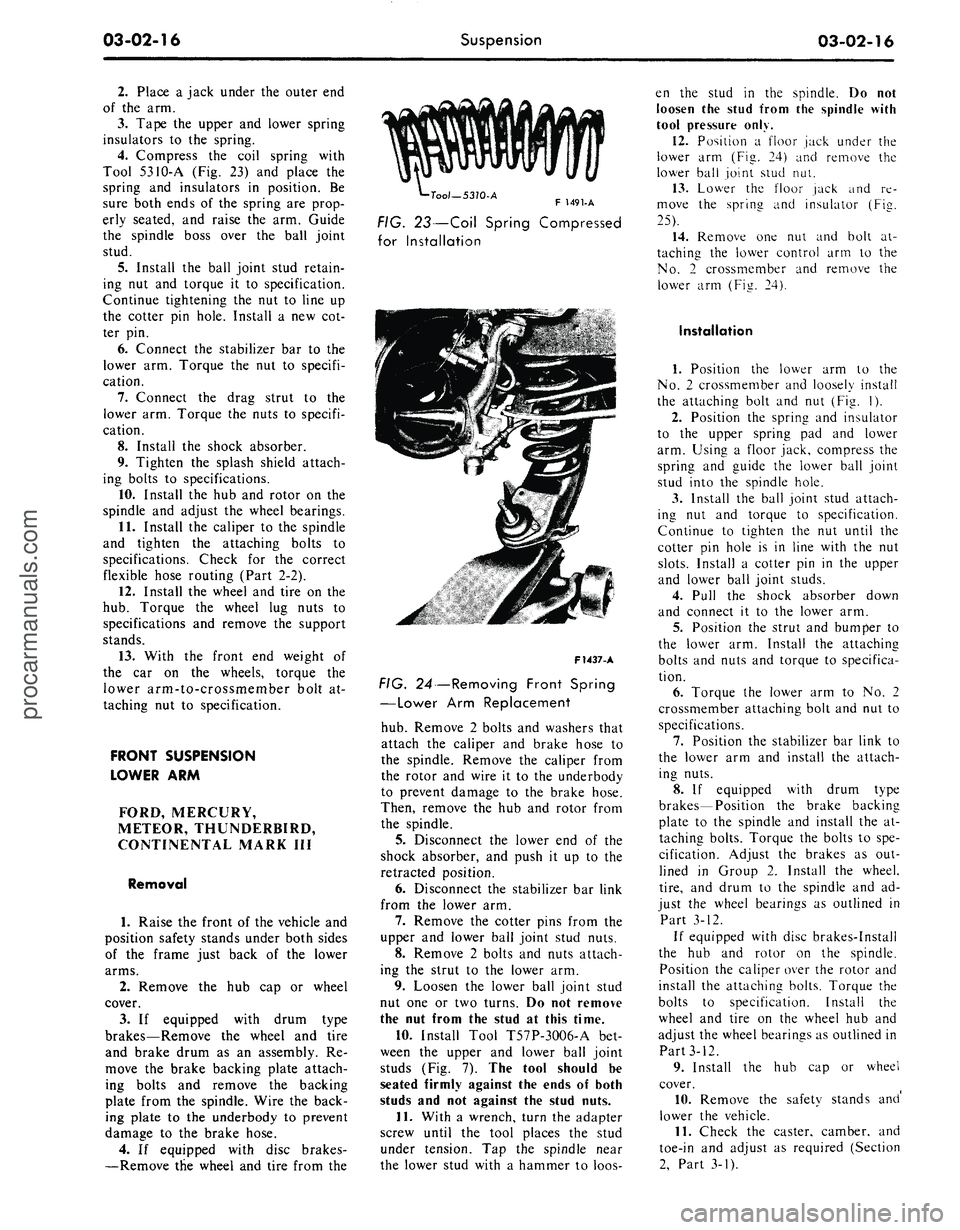
FIG. 24—Removing Front Spring
—Lower Arm Replacement
hub.
Remove 2 bolts and washers that
attach the caliper and brake hose to
the spindle. Remove the caliper from
the rotor and wire it to the underbody
to prevent damage to the brake hose.
Then, remove the hub and rotor from
the spindle.
5.
Disconnect the lower end of the
shock absorber, and push it up to the
retracted position.
6. Disconnect the stabilizer bar link
from the lower arm.
7.
Remove the cotter pins from the
upper and lower ball joint stud nuts.
8. Remove 2 bolts and nuts attach-
ing the strut to the lower arm.
9. Loosen the lower ball joint stud
nut one or two turns. Do not remove
the nut from the stud at this time.
10.
Install Tool T57P-3OO6-A bet-
ween the upper and lower ball joint
studs (Fig. 7). The tool should be
seated firmly against the ends of both
studs and not against the stud nuts.
11.
With a wrench, turn the adapter
screw until the tool places the stud
under tension. Tap the spindle near
the lower stud with a hammer to loos-
en the stud in the spindle. Do not
loosen the stud from the spindle with
tool pressure only.
12.
Position a floor jack under the
lower arm (Fig. 24) and remove the
lower ball joint stud nut.
13.
Lower the floor jack and re-
move the sprina and insulator (Fie.
25).
14.
Remove one nut and bolt at-
taching the lower control arm to the
No.
2 crossmember and remove the
lower arm (Fig. 24).
Installation
1.
Position the lower arm to the
No.
2 crossmember and loosely install
the attaching bolt and nut (Fig. 1).
2.
Position the spring and insulator
to the upper spring pad and lower
arm. Using a floor jack, compress the
spring and guide the lower ball joint
stud into the spindle hole.
3.
Install the ball joint stud attach-
ing nut and torque to specification.
Continue to tighten the nut until the
cotter pin hole is in line with the nut
slots.
Install a cotter pin in the upper
and lower ball joint studs.
4.
Pull the shock absorber down
and connect it to the lower arm.
5.
Position the strut and bumper to
the lower arm. Install the attaching
bolts and nuts and torque to specifica-
tion.
6. Torque the lower arm to No. 2
crossmember attaching bolt and nut to
specifications.
7.
Position the stabilizer bar link to
the lower arm and install the attach-
ing nuts.
8. If equipped with drum type
brakes—Position the brake backing
plate to the spindle and install the at-
taching bolts. Torque the bolts to spe-
cification. Adjust the brakes as out-
lined in Group 2. Install the wheel,
tire,
and drum to the spindle and ad-
just the wheel bearings as outlined in
Part 3-12.
If equipped with disc brakes-Install
the hub and rotor on the spindle.
Position the caliper over the rotor and
install the attaching bolts. Torque the
bolts to specification. Install the
wheel and tire on the wheel hub and
adjust the wheel bearings as outlined in
Part 3-12.
9. Install the hub cap or wheel
cover.
10.
Remove the safety stands and'
lower the vehicle.
11.
Check the caster, camber, and
toe-in and adjust as required (Section
2,
Part 3-1).procarmanuals.com
Page 94 of 413

03-02-18
Suspension
03-02-18
5.
Remove the cotter pin from the
upper ball joint stud nut.
6. Loosen the upper ball joint stud
nut one or two turns. Do not remove
the nut from the stud at this time.
7.
Install tool T57P-3006-A be-
tween the upper and lower ball joint
studs with the adapter screw on top
(Fig. 13). The tool should be seated
firmly against the ends of both studs
and not against the nuts or lower stud
cotter pin.
8. With a wrench, turn the adapter
screw until the tool places the stua
under tension. Tap the spindle near
the upper stud with a hammer to loos-
en the stud in the spindle. Do not
loosen the stud from the spindle with
tool pressure only.
9. Remove the tool from between
the ball joint studs and place a floor
jack under the lower arm.
10.
Raise the floor jack to relieve
the pressure from the upper ball joint
stud nut and remove the nut.
11.
Remove the upper arm inner
shaft attaching bolts. Remove the
upper arm and inner shaft as an as-
sembly (Fig. 1).
12.
Remove the bumpei from the
upper arm.
Installation
1.
Position the bumper to the upper
arm and install the nut and washer.
Torque the nut to specifications.
2.
Position the upper arm inner
shaft to the frame side rail and install
the 2 attaching bolts and washers
snug.
3.
Connect the upper ball joint stud
to the spindle and install the attaching
nut. Torque the nut to specification
and continue to tighten the nut until
the cotter pin hole in the stud is in
line with the nut slots. Then, install
the cotter pin.
4.
If equipped with drum type bra-
kes—Adjust the brakes as outlined in
Part 2-2. Install the wheel, tire, and
drum to the spindle and adjust the
wheel bearings as outlined in Part
3-12.
5.
If equipped with disc brak-
es—Install the wheel and tire on the
hub and adjust the wheel bearings as
outlined in Part 3-12.
6. Install the hub cap or wheel
cover.
7.
Remove the safety stands and
lower the front of the vehicle.
8. Check caster, camber, and toe-in
and adjust as required (Section 2, Part
3-D.
COUGAR, FAIRLANE,
FALCON, MONTEGO,
MUSTANG
Removal
1.
Raise the front of the vehicle,
position safety stands under the
frame, and lower the vehicle slightly.
2.
Remove the wheel and tire.
3.
Remove the shock absorber
lower attaching nuts and washers.
4.
Remove the shock absorber
upper mounting bracket attaching
nuts,
and remove the shock absorber
and bracket as an assembly (Fig. 26).
On all 8-cylinder vehicles, remove
the air cleaner to obtain access for
tool installation.
5.
Install the spring compressor
tool and compress the spring (Figs.
19,
20 and 21).
6. Position a safety stand under the
lower arm.
7.
Remove the cotter pin from the
nut on the upper ball joint stud, and
loosen the nut one or two turns. Do
not remove the nut from the stud at
this time.
8. Position the ball joint remover
tool between the upper and lower ball
joint studs as shown in Fig. 10. The
tool should seat firmly against the
ends of both studs and not against the
stud nuts.
9. Turn the tool with a wrench until
the tool places the studs under consid-
erable tension; then, hit the spindle
smartly near the upper stud with a
hammer to break the stud loose in the
spindle. Do not loosen the stud in the
spindle with tool pressure only. If
both arms are being removed, loosen
the lower stud in the same manner as
the upper stud.
10.
Remove the nut from the upper
stud and lift the stud out of the
spindle.
11.
Remove the upper arm inner
shaft attaching nuts from the engine
compartment, and remove the upper
arm.
12.
Wipe off all loose dirt from the
upper arm parts. Do not wash the ball
joint with a solvent.
Installation
1.
Position the upper arm on the
underbody mounting bracket, and in-
stall the nuts and lock washers on the
two inner shaft attaching bolts. The
specified keystone-type lock washers
must be used. Torque the nuts to
soecification.
2.
Position the upper ball joint stud
in the top of the wheel spindle, and in-
stall the stud nut. Torque the nut to
specification, and continue to tighten
it until the cotter pin hole and slots
line up. Install a new cotter pin.
3.
Release the coil spring, remove
the tool, and install the front shock
absorber and the wheel and tire.
LINCOLN CONTINENTAL
Removal
1.
Place a jack under the outer end
of the suspension lower arm and raise
the arm. Refer to Fig. 22.
2.
Remove the wheel and tire.
3.
Remove the cotter pin from the
upper ball joint stud. Loosen the nut
one or two turns.
4.
Place a box wrench over the
lower end of the ball joint remover
tool, and position the tool as in Fig.
13.
The tool should seat firmly against
the ends of both studs, and not
against the upper stud nut.
5.
Turn the wrench until both studs
are under tension, and then, tap the
spindle with a hammer near the upper
stud to loosen it from the spindle. Do
not loosen the stud with tool pressure
alone. Remove the nut.
UPPER MOUNTING BRACKET
LOWER RETAINING BOLTS F 1490-A
FIG. 26—Removing or Installing
Front Shock Absorber—Typicalprocarmanuals.com