1969 DATSUN B110 wheel
[x] Cancel search: wheelPage 64 of 136
r
Brakes
Moreover
In
order
to
prevent
brake
squeahng
a
shIm
IS
Inserted
behind
the
pad
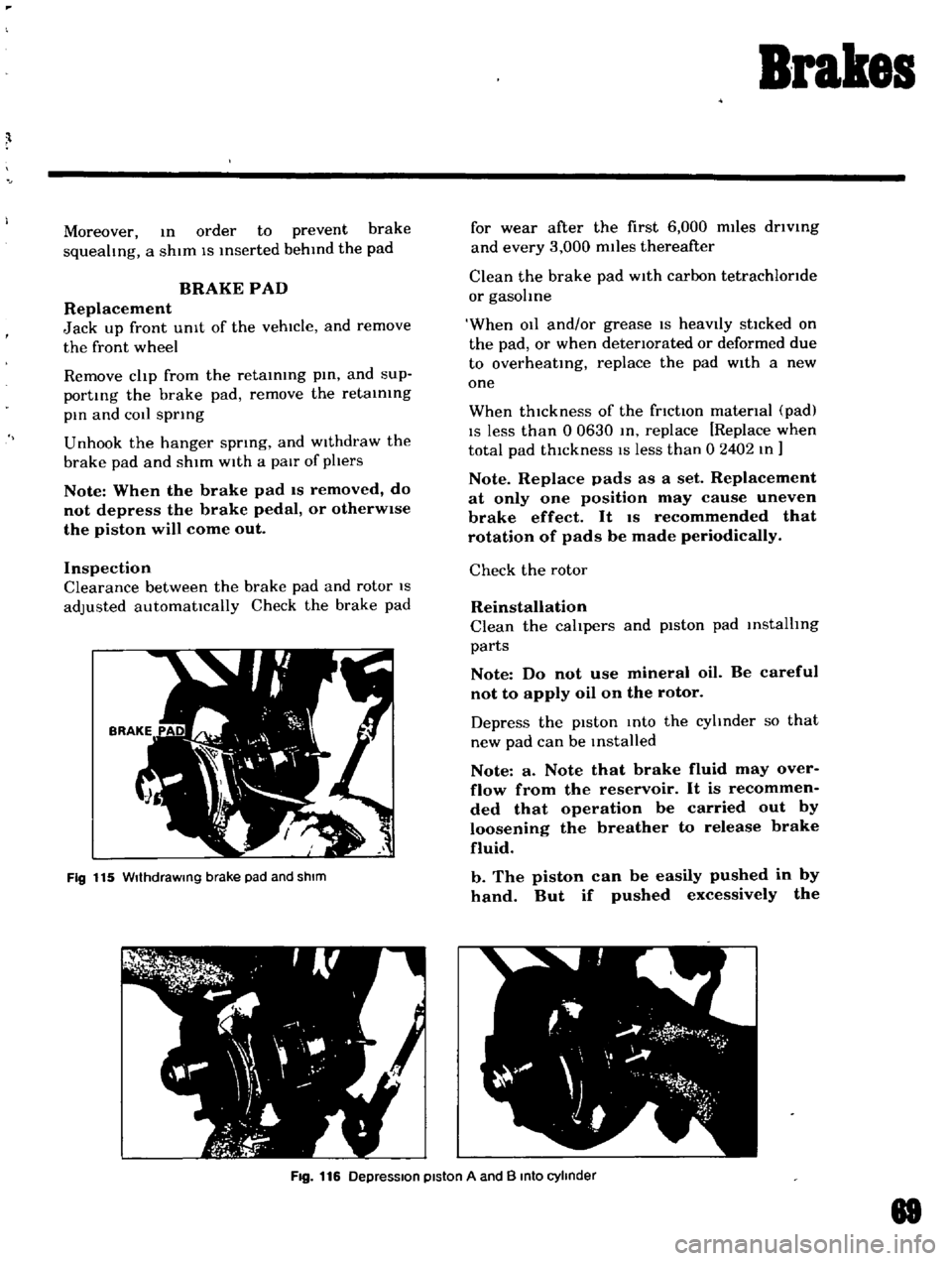
BRAKE
PAD
Replacement
Jack
up
front
UnIt
of
the
vehicle
and
remove
the
front
wheel
Remove
clip
from
the
retaining
pin
and
sup
porting
the
brake
pad
remove
the
retaining
pin
and
COil
spring
Unhook
the
hanger
spring
and
Withdraw
the
brake
pad
and
shim
With
a
pair
of
phers
Note
When
the
brake
pad
IS
removed
do
not
depress
the
brake
pedal
or
otherWise
the
piston
will
come
out
Inspection
Clearance
between
the
brake
pad
and
rotor
IS
adjusted
automatically
Check
the
brake
pad
Fig
115
WIthdraWing
brake
pad
and
shIm
for
wear
after
the
first
6
000
miles
driVing
and
every
3
000
miles
thereafter
Clean
the
brake
pad
With
carbon
tetrachloride
or
gasohne
When
011
and
or
grease
IS
heavIly
stlcked
on
the
pad
or
when
deteriorated
or
deformed
due
to
overheating
replace
the
pad
With
a
new
one
When
thickness
of
the
friction
material
pad
IS
less
than
0
0630
In
replace
Replace
when
total
pad
thIckness
IS
less
than
0
2402
In
Note
Replace
pads
as
a
set
Replacement
at
only
one
position
may
cause
uneven
brake
effect
It
IS
recommended
that
rotation
of
pads
be
made
periodically
Check
the
rotor
Reinstallation
Clean
the
calipers
and
piston
pad
installing
parts
Note
Do
not
use
mineral
oil
Be
careful
not
to
apply
oil
on
the
rotor
Depress
the
pIston
Into
the
cyhnder
so
that
new
pad
can
be
Installed
Note
a
Note
that
brake
fluid
may
over
flow
from
the
reservoir
It
is
recommen
ded
that
operation
be
carried
out
by
loosening
the
breather
to
release
brake
fluid
b
The
piston
can
be
easily
pushed
in
by
hand
But
if
pushed
excessively
the
Fig
116
DepreSSion
piston
A
and
B
Into
cylinder
88
Page 65 of 136
Brakes
groove
of
pIston
goes
insIde
of
seal
as
shown
in
Figure
117
and
the
seal
will
be
damaged
When
the
piston
is
pushed
ex
cesslvely
mto
the
cylinder
remove
the
brake
assembly
disassemble
It
push
out
the
piston
to
the
arrow
direction
as
shown
in
Figure
117
and
reassemble
Install
pad
and
antt
squeal
shim
assemble
the
anti
squeal
spring
and
retaining
pin
and
ecure
them
with
cltp
Install
the
shim
so
that
the
arrow
mark
pOints
the
rotor
forward
rotating
directIOn
Apply
the
COIl
spring
to
the
retaining
pin
which
IS
distanced
from
the
atr
bleeder
111
PlSton
seal
I
2
I
Normal
position
I
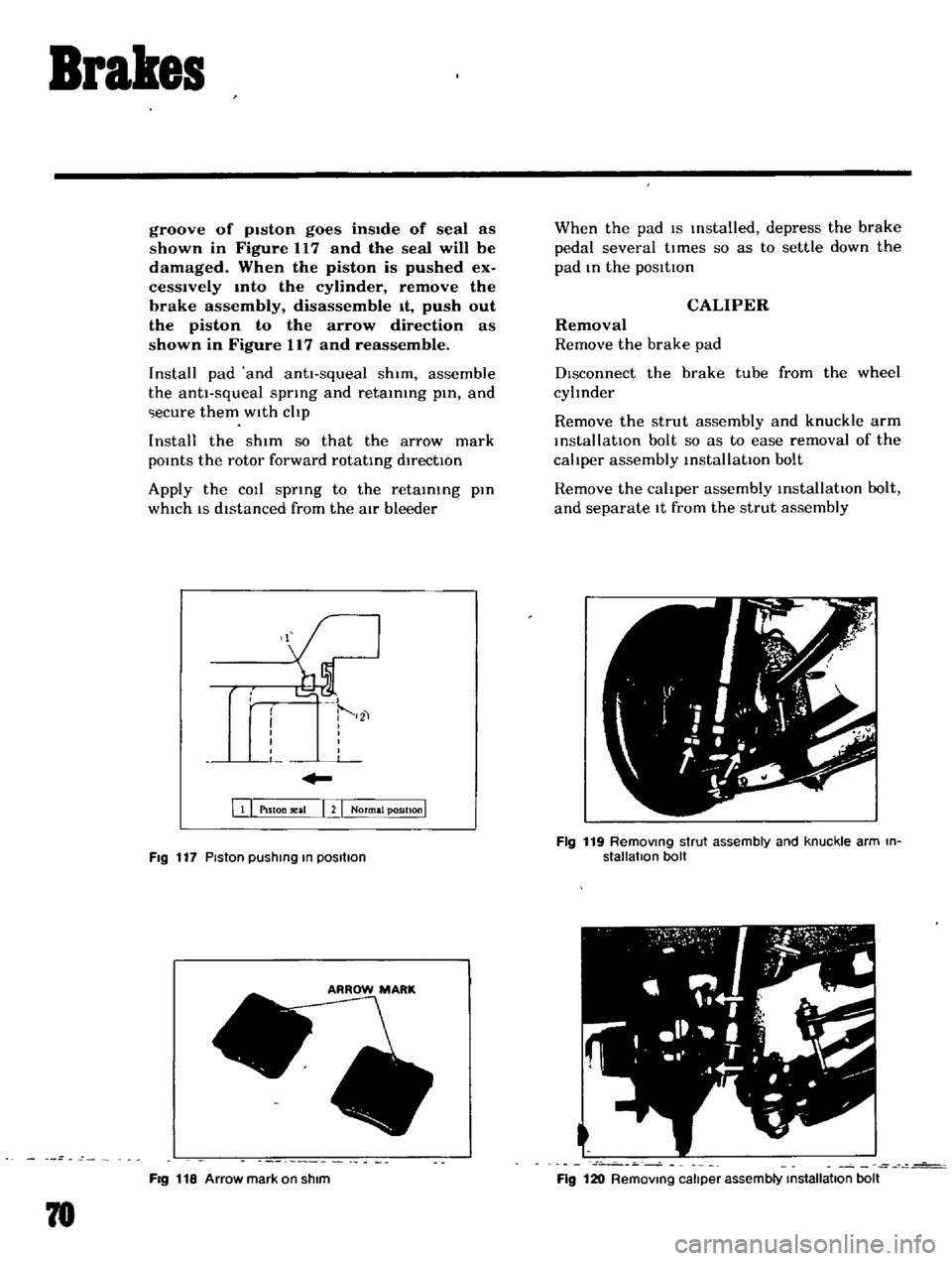
Fig
117
Piston
pushIng
In
posllIon
FIg
118
Arrow
mark
on
shim
78
When
the
pad
IS
Installed
depress
the
brake
pedal
several
tl
mes
so
as
to
settle
down
the
pad
In
the
posltton
CALIPER
Removal
Remove
the
brake
pad
DIsconnect
the
brake
tube
from
the
wheel
cyltnder
Remove
the
strut
assembly
and
knuckle
arm
installatIOn
bolt
so
as
to
ease
removal
of
the
cahper
assembly
installatIOn
bolt
Remove
the
cahper
assembly
installatIOn
bolt
and
separate
It
from
the
strut
assembly
Fig
119
RemOVing
strut
assembly
and
knuckle
arm
in
stallatIon
bolt
Fig
120
RemOVing
caliper
assembly
Installallon
bolt
Page 66 of 136
Brakes
DIsassembly
Remove
mud
and
other
contamInations
from
the
caLiper
as
embly
before
dlsa
sembly
DraIn
bl
ake
fluId
flOm
the
wheel
cylinder
Loosen
the
aIr
bleeder
and
depres
the
pistons
A
and
B
Into
the
cylInder
See
FIg
125
Secure
the
yoke
In
a
vIse
and
tap
the
yoke
head
with
a
hammer
The
cylinder
body
can
then
be
removed
from
the
yoke
When
remOVIng
the
cylinder
body
be
careful
not
to
allow
the
piston
A
comIng
out
from
the
cylIn
der
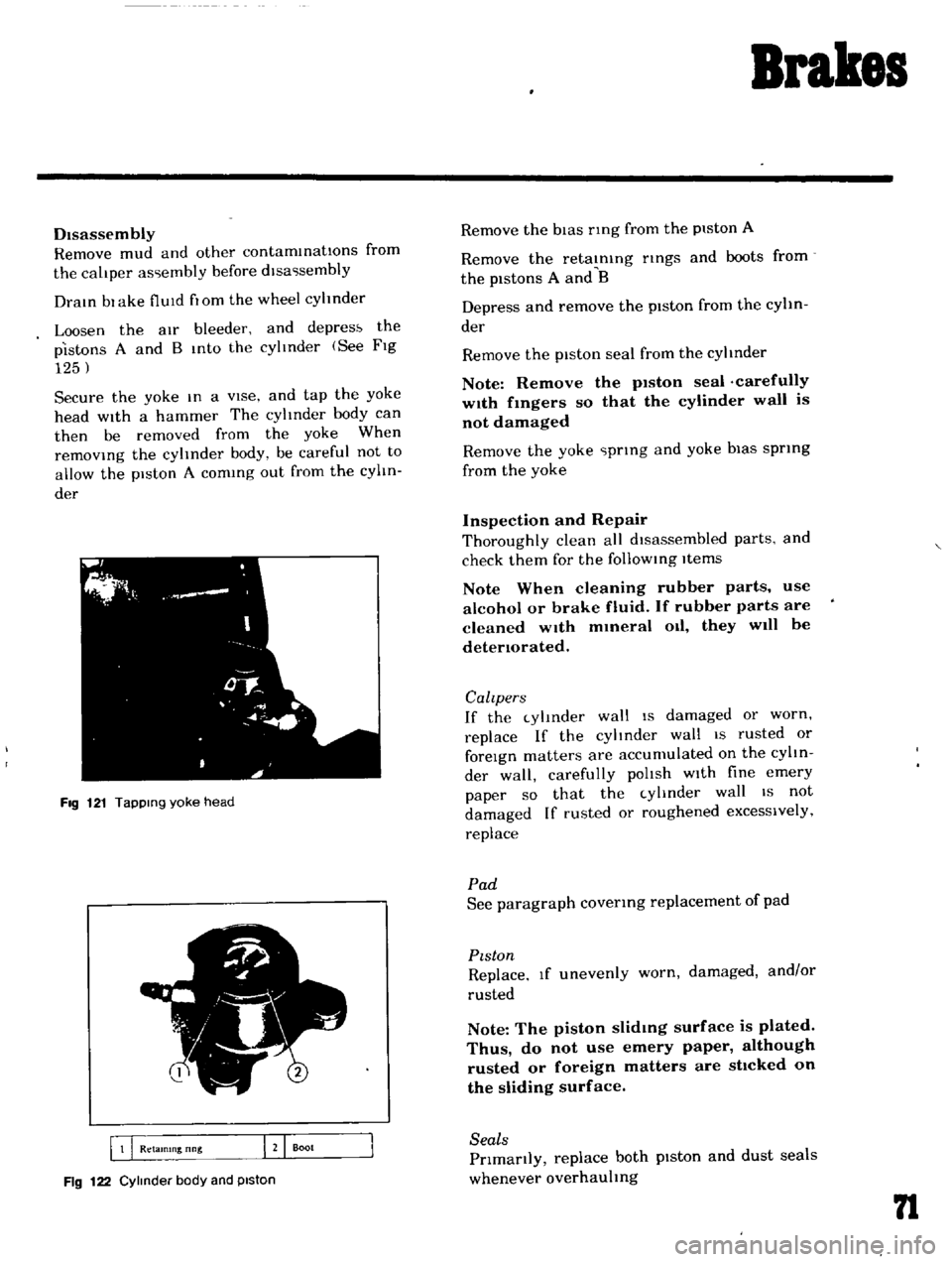
FIg
121
TapPing
yoke
head
5
I
B
Q
Retamlng
nng
J
Boot
Fig
122
Cylinder
body
and
piston
Remove
the
bIas
nng
from
the
piston
A
Remove
the
retaInIng
nngs
and
boots
from
the
pistons
A
and
B
Depress
and
remove
the
piston
from
the
cylin
der
Remove
the
piston
seal
from
the
cylinder
Note
Remove
the
p1ston
seal
carefully
w1th
fmgers
so
that
the
cylinder
wall
is
not
damaged
Remove
the
yoke
prIng
and
yoke
bias
sprIng
from
the
yoke
Inspection
and
Repair
Thoroughly
clean
all
dIsassembled
parts
and
check
them
for
the
follOWIng
Items
Note
When
cleaning
rubber
parts
use
alcohol
or
brake
fluid
If
rubber
parts
are
cleaned
wIth
mmeral
Oil
they
will
be
detenorated
Calzpers
If
the
cylInder
wall
IS
damaged
or
worn
replace
If
the
cylinder
wall
IS
rusted
or
foreIgn
matters
are
accumulated
on
the
cylIn
der
wall
carefully
polIsh
wIth
fine
emery
paper
so
that
the
cylInder
wall
IS
not
damaged
If
rusted
or
roughened
excessively
replace
Pad
See
paragraph
covenng
replacement
of
pad
PIston
Replace
If
unevenly
worn
damaged
and
or
rusted
Note
The
piston
slidmg
surface
is
plated
Thus
do
not
use
emery
paper
although
rusted
or
foreign
matters
are
sttcked
on
the
sliding
surface
Seals
Prlmanly
replace
both
pIston
and
dust
seals
whenever
overhauling
n
Page 69 of 136
Brakes
c
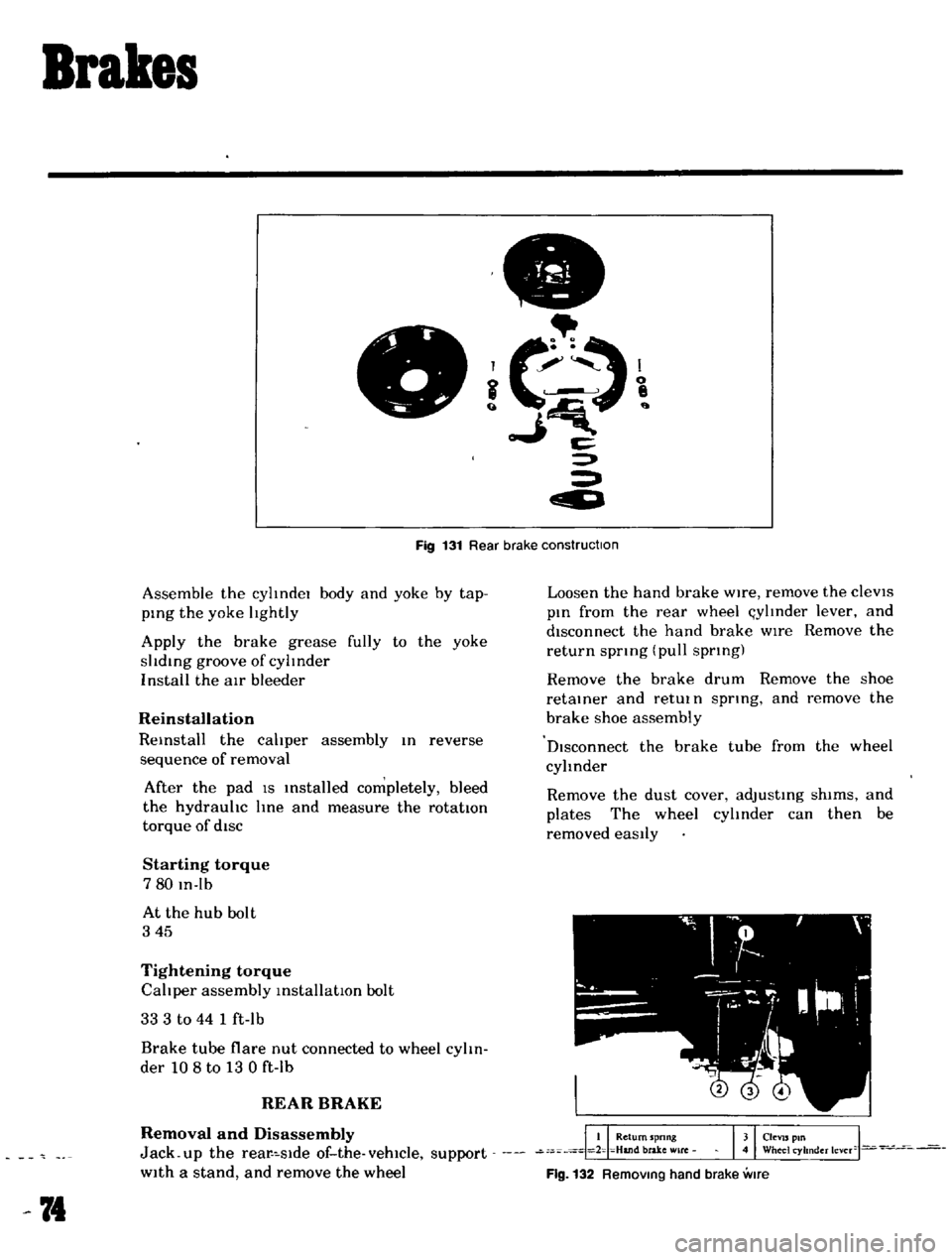
Fig
131
Rear
brake
construction
Assemble
the
cylIndel
body
and
yoke
by
tap
ping
the
yoke
lIghtly
Apply
the
brake
grease
fully
to
the
yoke
slIding
groove
of
cylInder
I
nstall
the
air
bleeder
Reinstallation
Reinstall
the
calIper
assembly
In
reverse
sequence
of
removal
After
the
pad
IS
Installed
completely
bleed
the
hydraulIc
line
and
measure
the
rotatton
torque
of
diSC
Starting
torque
780
In
Ib
At
the
hub
bolt
345
Tightening
torque
CalIper
assembly
installatIOn
bolt
33
3
to
44
1
ft
lb
Brake
tube
flare
nut
connected
to
wheel
cylIn
der
108
to
13
0
ft
lb
REAR
BRAKE
Removal
and
Disassembly
Jack
up
the
rear
slde
of
the
vehicle
support
With
a
stand
and
remove
the
wheel
74
Loosen
the
hand
brake
Wire
remove
the
cleVIS
pin
from
the
rear
wheel
l
ylInder
lever
and
disconnect
the
hand
brake
wIre
Remove
the
return
spnng
pull
spnng
Remove
the
brake
drum
Remove
the
shoe
retainer
and
retUl
n
spnng
and
remove
the
brake
shoe
assembly
DIsconnect
the
brake
tube
from
the
wheel
cylinder
Remove
the
dust
cover
adjusting
shims
and
plates
The
wheel
cylInder
can
then
be
removed
eaSily
Flg
132
RemOVing
hand
brake
vme
Page 70 of 136
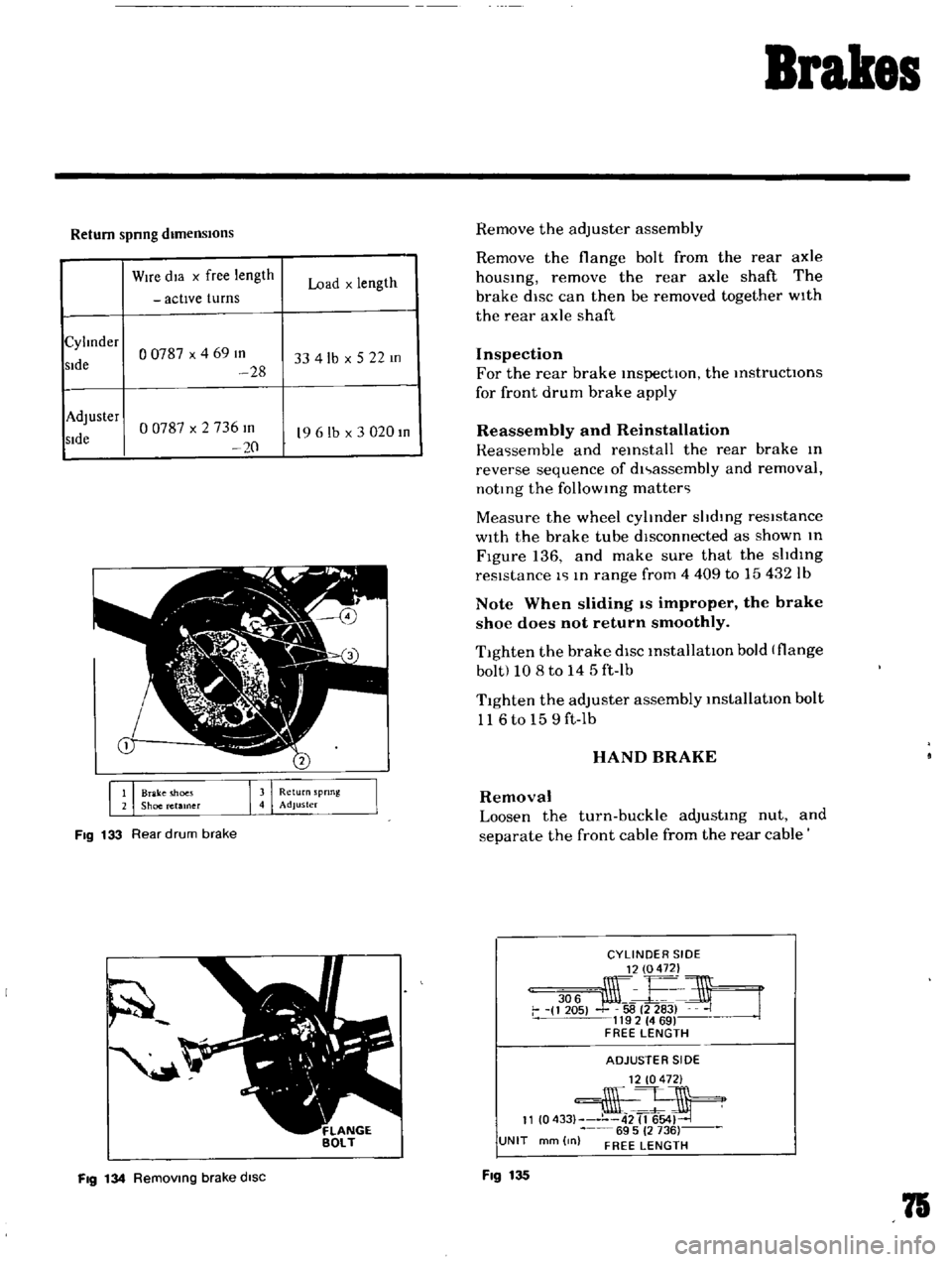
Brakes
Return
spnng
dimensIOns
Wire
dla
x
free
length
Load
x
length
actIve
turns
Cylmder
o
0787
x
4
69
III
sIde
33
4lb
x
5
22
m
28
Adjuster
00787
x
2
736
m
sIde
19
6
lb
x
3
020
III
20
1
Brake
moes
2
Shoe
retamer
Fig
133
Rear
drum
brake
Fig
134
Removmg
brake
disc
Remove
the
adjuster
assembly
Remove
the
flange
bolt
from
the
rear
axle
housing
remove
the
rear
axle
shaft
The
brake
disc
can
then
be
removed
together
wIth
the
rear
axle
shaft
Inspection
For
the
rear
brake
inspectIOn
the
instructIOns
for
front
drum
brake
apply
Reassembly
and
Reinstallation
Rea
semble
and
reinstall
the
rear
brake
In
reverse
sequence
of
dl
assembly
and
removal
noting
the
follOWing
matter
Measure
the
wheel
cylinder
shdlng
resistance
With
the
brake
tube
dIsconnected
as
shown
In
Figure
136
and
make
sure
that
the
slIding
resIstance
1
In
range
from
4
409
to
15432
Ib
Note
When
sliding
IS
improper
the
brake
shoe
does
not
return
smoothly
Tighten
the
brake
diSC
installatIOn
bold
flange
bolt
10
8
to
14
5
ft
Ib
T1ghten
the
adjuster
assembly
installatIOn
bolt
116to
159ft
Ib
HAND
BRAKE
Removal
Loosen
the
turn
buckle
adjusting
nut
and
separate
the
front
cable
from
the
rear
cable
CYLINDER
SIDE
306
j
E
i
1
205
58
2
283
J
1192
469
FREE
LENGTH
ADJUSTE
R
51
DE
12
0472
2
11
0433
42
1654
69
5
2
736
UNIT
mm
0
FREE
LENGTH
Fig
135
75
Page 71 of 136
Brakes
Remove
the
lock
plate
located
Immediately
III
front
of
the
turn
buckle
remove
the
clip
III
the
passenger
compartment
SIde
and
discon
nect
the
front
cable
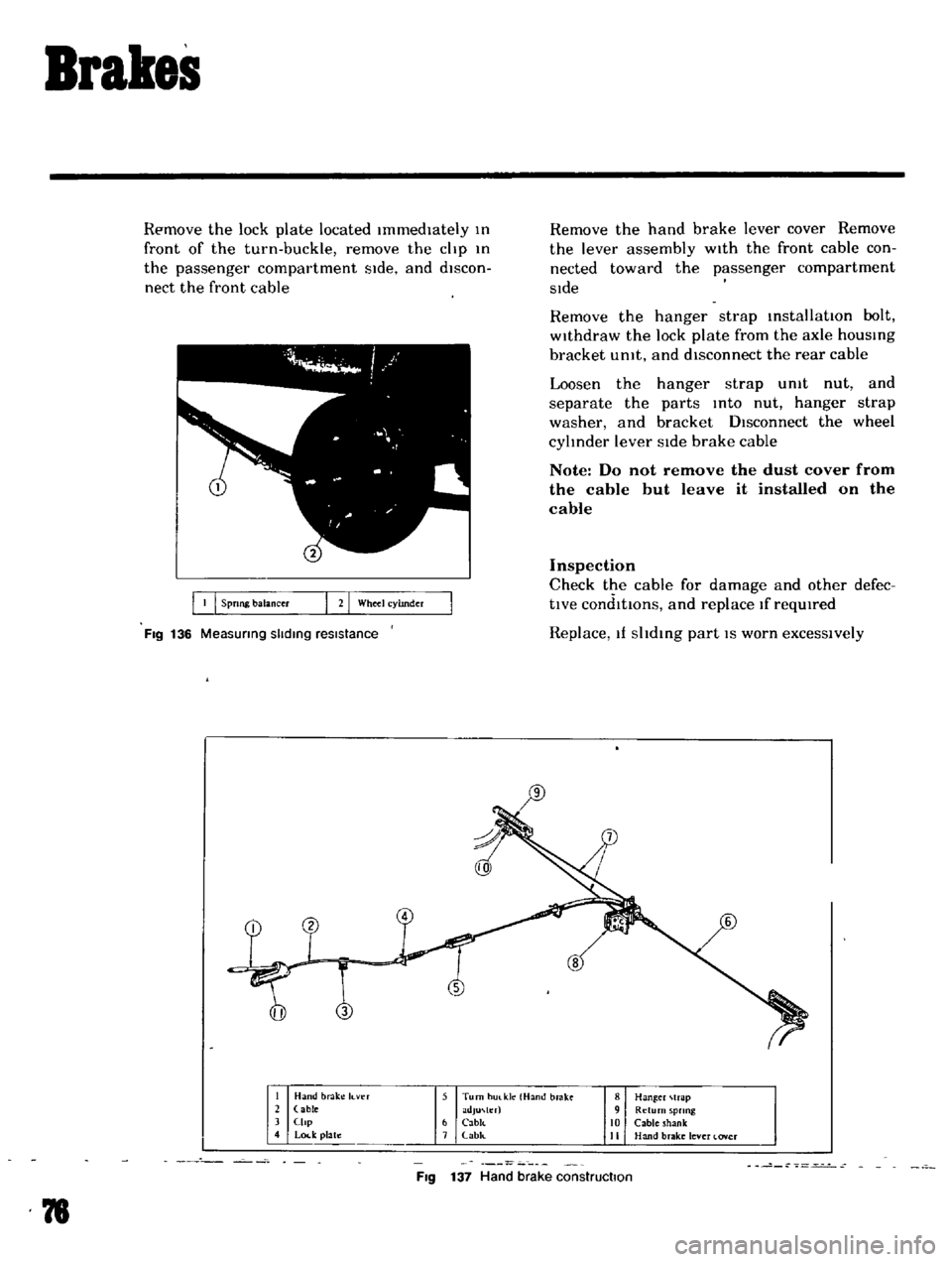
I
Spong
balancer
G
Wheel
cyhnder
FIg
136
Measunng
slidIng
resistance
Remove
the
hand
brake
lever
cover
Remove
the
lever
assembly
wIth
the
front
cable
con
nected
toward
the
passenger
compartment
SIde
Remove
the
hanger
strap
installatIOn
bolt
withdraw
the
lock
plate
from
the
axle
hOUSIng
bracket
umt
and
disconnect
the
rear
cable
Loosen
the
hanger
strap
umt
nut
and
separate
the
parts
Into
nut
hanger
strap
washer
and
bracket
DIsconnect
the
wheel
cylinder
lever
SIde
brake
cable
Note
Do
not
remove
the
dust
cover
from
the
cable
but
leave
it
installed
on
the
cable
Inspection
Check
the
cable
for
damage
and
other
defec
tlve
condlttons
and
replace
If
reqUIred
Replace
If
shdIng
part
IS
worn
excessively
1
Hand
brake
It
ver
2
able
J
Clip
4
Lock
plate
5
Turn
hUlkle
Hand
brake
adJU
h
r
6
CabJc
7
abk
8
Han
er
trap
9
Return
sprmg
10
Cable
shank
II
Hand
brake
lever
lover
FIg
137
Hand
brake
construction
78
Page 73 of 136
Brakes
ADJUSTMENT
Front
Disc
Brake
Ordinarily
adJu
tment
IS
not
requIred
because
clearance
between
pad
and
rotor
IS
adjusted
automattcally
by
elasttclty
of
the
pIston
seal
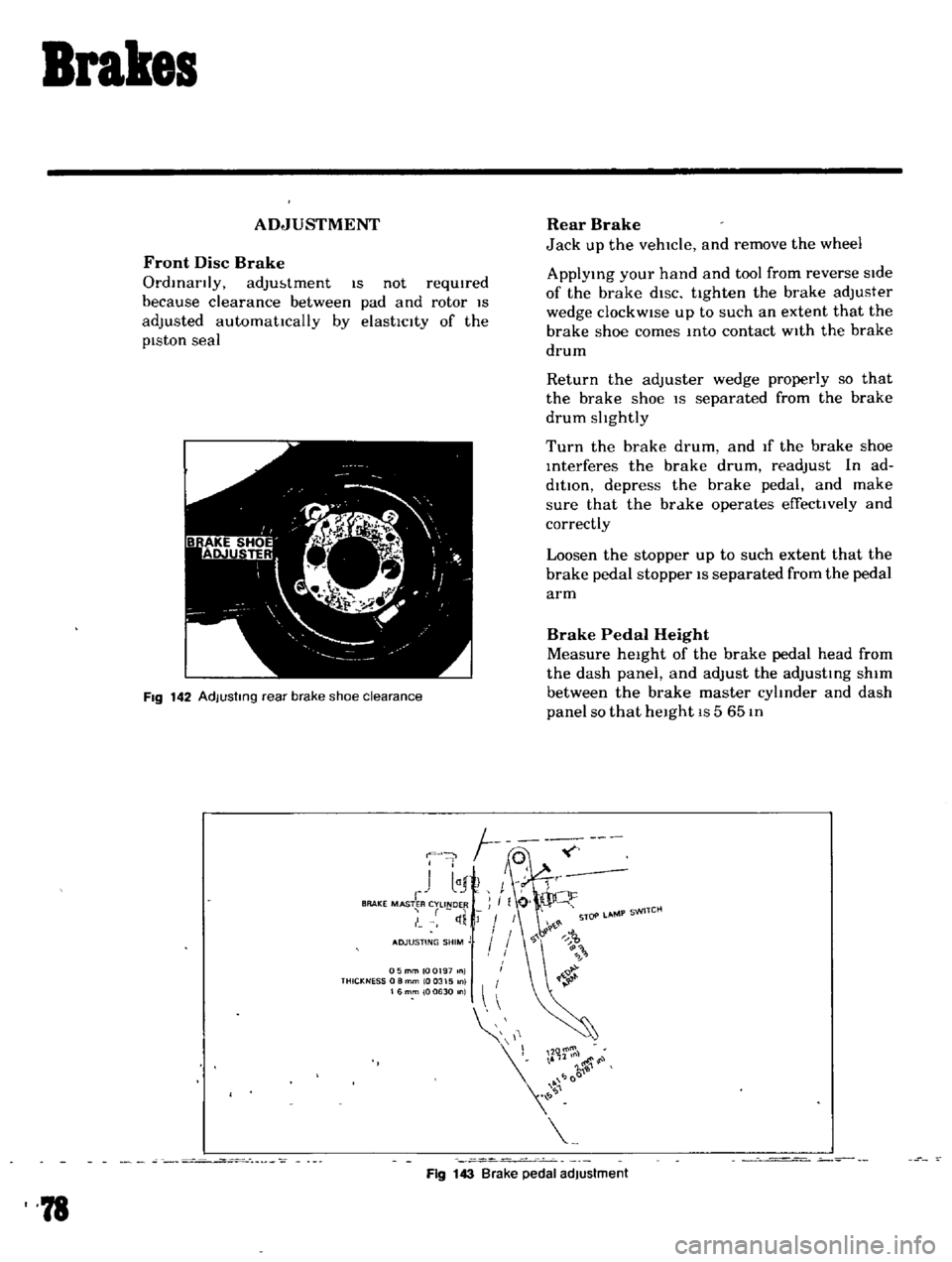
I
iJ
1
el
i
C
1
FIg
142
AdJustmg
rear
brake
shoe
clearance
F
J
I
1
I
r
BRAKE
MASTER
CYLINDER
I
tI
Rear
Brake
Jack
up
the
vehicle
and
remove
the
wheel
ApplYing
your
hand
and
tool
from
reverse
side
of
the
brake
diSC
ttghten
the
brake
adjuster
wedge
clockWise
up
to
such
an
extent
that
the
brake
shoe
comes
Into
contact
With
the
brake
drum
Return
the
adjuster
wedge
properly
so
that
the
brake
shoe
IS
separated
from
the
brake
drum
slIghtly
Turn
the
brake
drum
and
If
the
brake
shoe
Interferes
the
brake
drum
readjust
In
ad
dition
depress
the
brake
pedal
and
make
sure
that
the
brake
operates
effecttvely
and
correctly
Loosen
the
stopper
up
to
such
extent
that
the
brake
pedal
stopper
IS
separated
from
the
pedal
arm
Brake
Pedal
Height
Measure
height
of
the
brake
pedal
head
from
the
dash
panel
and
adjust
the
adjusting
shim
between
the
brake
master
cylInder
and
dash
panel
so
that
height
IS
5
65
In
05mmlOQ197
nl
THICKNESS
0
8
mm
10
0315
0
16mm
100630
n
11
r
l00
Fig
143
Brake
pedal
adjustment
78
Page 74 of 136
Brakes
Adjusting
shIm
thickness
for
selectIOn
o
0197
In
00315
In
o
0630
In
Note
When
adjusting
be
sure
to
use
ad
Jusbng
sh1ms
having
same
th1ckness
for
upper
and
lower
brake
master
cylinder
IOstallahon
bolts
Upon
completIOn
of
adjusting
shIm
adjust
ment
tighten
the
stopper
down
to
such
an
ex
tent
that
heIght
of
the
pedal
head
IS
5
57
pO
0787
In
and
tighten
the
lock
nut
becurely
Free
travel
of
the
brake
pedal
IS
0
197
to
0591
tn
and
the
stroke
IS
4
72
In
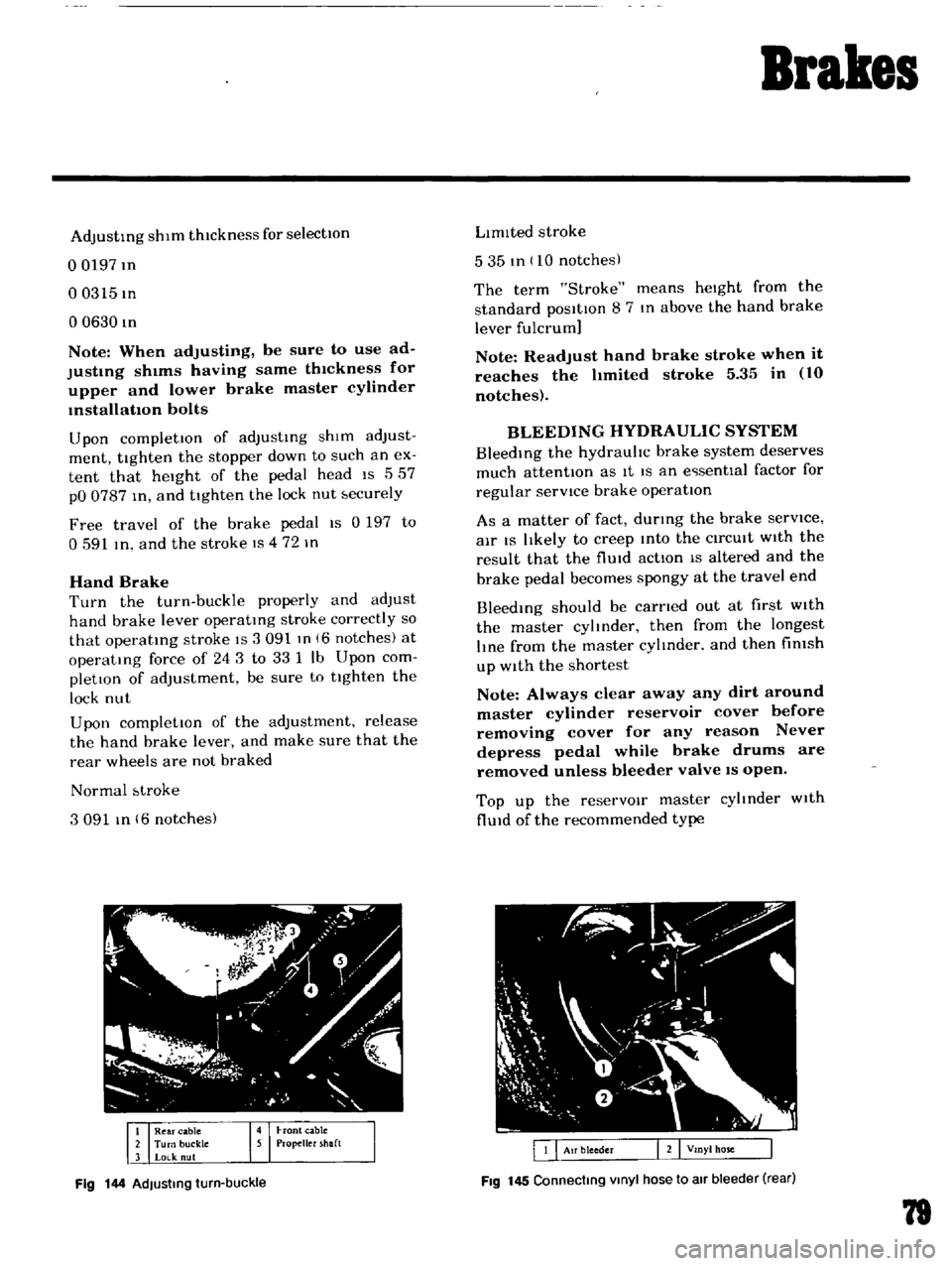
Hand
Brake
Turn
the
turn
buckle
properly
and
adjust
hand
brake
lever
operatmg
stroke
correctly
so
that
operatmg
stroke
IS
3
091
m
16
notches
at
operatIng
force
of
243
to
331
Ib
Upon
com
pletIOn
of
adjustment
be
sure
to
tIghten
the
lock
nut
Upon
completIOn
of
the
adjustment
release
the
hand
brake
lever
and
make
sure
that
the
rear
wheels
are
not
braked
Normal
btroke
3091
In
6
notches
Fig
144
AdJusting
turn
buckle
LImIted
stroke
535
tn
10
notches
The
term
Stroke
means
heIght
from
the
standard
posItIon
8
7
In
above
the
hand
brake
lever
fulcrum
Note
Readjust
hand
brake
stroke
when
it
reaches
the
hmited
stroke
5
35
in
10
notches
BLEEDING
HYDRAULIC
SYSTEM
BleedIng
the
hydrauhc
brake
system
deserves
much
attentIOn
as
It
IS
an
e
senttal
factor
for
regular
servICe
brake
operatIon
As
a
matter
of
fact
durmg
the
brake
serVice
air
IS
lIkely
to
creep
Into
the
CirCUIt
WIth
the
result
that
the
flUId
actIon
IS
altered
and
the
brake
pedal
becomes
spongy
at
the
travel
end
Bleedmg
should
be
carned
out
at
first
WIth
the
master
cylmder
then
from
the
longest
lIne
from
the
master
cylmder
and
then
fimsh
up
With
the
shortest
Note
Always
clear
away
any
dirt
around
master
cylinder
reservoir
cover
before
removing
cover
for
any
reason
Never
depress
pedal
while
brake
drums
are
removed
unless
bleeder
valve
IS
open
Top
up
the
reservOIr
master
cyltnder
With
flUId
of
the
recommended
type
Fig
145
Connecting
Vinyl
hose
to
air
bleeder
rear
79