1967 CHEVROLET CAMARO turn
[x] Cancel search: turnPage 309 of 659

SECTION 6M
ENGINE FUEL
CONTENTS OF THIS SECTION
Page
Carburetors 6M-1 Fuel Pumps .
Air Cleaners 6M-7 Special Tools
Page
6M-10
6M-12
CARBURETORS
INDEX
Page
General Description 6M-1
Service Procedures 6M-1
Preliminary Checks 6M-1
Idle Speed and Mixture Adjustment ........... 6M-1
Fast Idle Adjustment .................. 6M-3
Choke Adjustment 6M-3
Float Adjustment 6M-4
Page
Additional Adjustments 6M-4
Removal 6M-4
Test Before Installation 6M-5
Installation 6M-5
Fuel Filter Maintenance 6M-5
Choke Coil Replacement 6M-5
Throttle Linkage Adjustment . . 6M-6
GENERAL DESCRIPTION
Various carburetors (fig. lc) are used with Chevrolet,
Chevelle, Chevy II, Camaro and Corvette passenger
vehicles. These carburetors are designed to meet the
particular requirements of engines, transmissions and
vehicles, therefore carburetors that look alike are not
always interchangeable. (Refer to carburetor part num-
ber and/or specifications.)
Because many service procedures for the various
carburetors are similar, typical illustrations and pro-
cedures are used except where specific illustrations or
procedures are necessary to clarify the operation.
This section covers removal, installation and adjust-
ments (on engine) of carburetors. Also covered in this
section are maintenance procedures for choke coils,
throttle linkage and fuel filters. For carburetor .over-
haul procedures and additional adjustments (bench), re-
fer to Section 6M of the Overhaul Manual under the
carburetor being serviced.
Specifications for carburetors are located in the back
of this manual.
SERVICE PROCEDURES
Preliminary Checks
1.
Thoroughly warm-up engine. If the engine is cold,
allow to run for at least 15 minutes.
2.
Inspect torque of carburetor to intake manifold bolts
and intake manifold to cylinder head bolts to exclude
the possibility of air leaks.
3.
Inspect manifold heat control valve (if used) for free-
dom of action and correct spring tension.
Idle Speed and Mixture Adjustment (Except Air Injection
Reactor System)
NOTE:
This adjustment should be performed
with engine at operating temperature and park-
ing brake applied.
1.
Remove Air Cleaner.
2.
Connect tachometer and vacuum gauge to engine, then
set hand brake and shift transmission into neutral.
3.
As a preliminary adjustment, turn idle mixture
screws lightly to seat and back out 1-1/2 turns.
CAUTION: Do not turn idle mixture screw
tightly against seat or damage may result.
4.
With engine running (choke wide open) adjust idle
speed screw to specified idle speed, (automatic
transmission in drive, synchronized transmission in
neutral).
5. Adjust idle mixture screw to obtain highest steady
vacuum at specified idle speed.
NOTE:
On air conditioned vehicles, turn air
conditioning to the "on" position and hold the
hot idle compensator valve closed while adjust-
ing idle speed and idle mixture screws.
NOTE:
On Rochester BV carburetors the idle
mixture screw should be turned out 1/4 turn
from the "lean roll" position. The definition
of "lean roll" point is a 20 to 30 rpm drop
in engine speed obtained by leaning the idle
mixture.
6. Repeat Steps 4 and5 as needed for final adjustment.
NOTE:
If necessary, final adjustment of the \
carburetor may be made with the air cleaner
installed.
7. Turn engine off, remove gauges and install air
clearer.
CHEVROLET CHASSIS SERVICE MANUAL
Page 311 of 659

ENGINE FUEL 6M-3
Idle Speed and Mixture Adjustment (With Air Injection
Reactor System)
The following is the recommended procedure for Air
Injection Reactor System equipped engines.
NOTE: This adjustment should be performed
with engine at operating temperature and parking
brake applied.
1.
Remove air cleaner.
2.
Connect tachometer to engine, then set hand brake
and shift transmission into neutral.
3.
As a preliminary adjustment, turn idle mixture
screws lightly to seat and back out 3 turns.
CAUTION: Do not turn idle mixture screw
tightly against seat or damage may result."
4.
With engine running (choke wide open) adjust idle
speed screw to specified idle speed. (Automatic
transmission in dirve, synchronized transmission in
neutral).
5.
Adjust idle mixture screw (turn in) to "lean roll"
position; then turn screw out 1/4 turn (1/4 turn
rich from "lean roll"). The definition of "lean
roll" point is a 20 to 30 rpm drop in engine speed,
obtained by leaning the idle mixture.
NOTE: On air conditioned vehicles, turn air
conditioning "OFF" on in-line, 283, 327, and'
350 cu. in. engines, and turned "ON" and hot
idle compensator held closed on 396 and 427 cu.
in. engines.
6. Repeat Steps 4 and 5 as needed for final adjustment.
NOTE: If necessary, final adjustment of the
carburetor may be made with air cleaner
installed.
7.
Shut down the engine, remove gauges and install air
cleaner. *
Fast Idle Adjustment
Rochester
4MV and Holley
With fast idle lever on high step of cam and choke valve
open (engine warm) set fast idle to give specified engine
rpm. Adjust sejrew on Rochester 4MV and bend fast
idle lever *pn Holley. .
Choke Adjustment
With Remote Choke (Fig. 2c)
1.
Remove air cleaner and check to see that choke
valve and rod move freely.
2.
Disconnect choke rod at choke lever.
3.
Check choke adjustment as follows:
On all except 275 and 300 h.p. 327 cu. in. engines,
hold choke valve closed and pull.rod up against stop.
The top of choke rod end should be 1/2-1 rod diame-
ter above top of hole in choke valve lever.
On 275 and 300 h.p. 327 cu. in. engines, hold choke
valve closed and push rod down against stop on ther-
mostat bracket. The top of the choke rod should be
1/2-1 rod diameter below the top of the hole in the
choke lever.
4.
If necessary, adjust rod length by bending rod at
offset bend. (Bend must be such that rod enters
choke lever hole freely and squarely).
5.
Connect rod at choke lever and install air cleaner.
With Manual Choke (Carter YF)
1.
Remove air cleaner.
CHOKE VALVE
COMPLETELY
CLOSED
PULL UPWARD ON
ROD TO END OF
TRAVEL
BEND ROD
TO ADJUST
ROD IN BOTTOM
OF SLOT
BOTTOM OF
ROD SHOULD
BE EVEN WITH
TOP OF
HOLE
CHOKE VALVE
CLOSED
BOTTOM OF
ROD SHOULD
BE EVEN WITH
TOP OF HOLE
TOP OF ROD
SHOULD BE EVEN
WITH BOTTOM
OF HOLE (CHOKE
CLOSED)
BEND ROD TO
ADJUST
PULL DOWNWARD'
ON ROD TO CON-
TACT STOP
L6 (TYPICAL)
[
V8 327-275 HP
V8 350-295 HP
BEND ROD
TO ADJUST
PULL UPWARD ON
ROD TO CONTACT
STOP ON BRACKET
ALL V8 (EXCEPT 327-275 HP
AND 350-295 HP)
Fig.
2C—Remote Choke Adjustment
CHEVROLET CHASSIS SERVICE MANUAL
Page 312 of 659

ENGINE FUEL 6M-4
Fig.
3C-Fuel Level Sight Plug
2.
Push hand choke knob in to within 1/8" of instru-
ment panel.
3.
Loosen choke cable clamp at carburetor bracket and
adjust cable through the clip until the choke valve
is wide open.
4.
Tighten cable clamp at carburetor bracket and check
operation of choke valve to ensure full closed and
wide open positions.
5. Install air cleaner.
Float Adjustment
Ho/fey (Model 4150
Center
Inlet & Model 2300)
1.
Remove air cleaner then remove the fuel level sight
plugs (Fig. 3c)
2.
With parking brake on, and transmission in neutral,
start the engine and allow it to idle.
3.
With the car on a level surface, the fuel level should
be on a level with the threads at the bottom of the
sight plug port (plus or minus 1/32 inch).
NOTE:
No float drop adjustment is required
on this carburetor.
4.
If necessary to adjust (either or both bowls), loosen
inlet needle lock screw and turn the adjusting nut
clockwise to lower or counter-clockwise to raise
fuel level, then tighten lock screw.
NOTE:
1/6 turn of adjusting nut equals ap-
proximately 1/16" fuel level change.
5. Allow a minute for fuel level to stabilize then re-
check the level at sight plug.
6. Readjust, if necessary, until proper level is obtained,
then install sight plug and air cleaner.
NOTE:
To assure proper secondary float level
setting it is advisable to accelerate primary
throttles slightly and hand operate secondary
throttle. This assures a stabilized secondary
fuel level.
Additional Adjustments
The following adjustments may be made without re-
moving the carburetor from the engine. For procedure
refer to Section 6M of the Overhaul Manual under the
carburetor being serviced.
Rochester BV
• Float
• Idle Vent
• Choke Rod (Fast Idle)
• Choke Vacuum Break
• Choke Unloader
Rochester 2GV
• Float
• Accelerator Pump
• Idle Vent
• Choke Rod (Fast Idle)
• Choke Vacuum Break
• Choke Unloader
• Secondary Throttle Opening
• Secondary Throttle Lockout
Rochester 4MV
• Float
• Accelerator Pumj)
• Idle Vent
• Air Valve
• Choke Rod
• Choke Vacuum Break
• Choke Unloader
• Air Valve Lockout
• Secondary Opening
• Secondary Lockout
Carter YF
• Float
• Idle Vent
• Choke Rod (Fast Idle)
• Choke Vacuum Break
• Choke Unloader
Holley 4160 and 4150
(Except End
Inlet)
• Float
• Air Vent Valve
• Accelerator Pump
• Choke Vacuum Break
• Choke Unloader
Holley 2300 and 4150
(End
Inlet)
• Air Vent Valve (except 2300)
• Accelerator Pump
• Choke Vacuum Break
• Choke Unloader
Removal
Flooding, stumble on acceleration and other perform-
mance complaints are, in many instances, caused by the
presence of dirt, water, or other foreign matter in the
carburetor. To aid in diagnosing the cause of the com-
plaint, the carburetor should be carefully removed from
the engine without draining the fuel from the bowl.
The contents of the fuel bowl may then be examined for
contamination as the carburetor is disassembled.
1.
Remove air cleaner and gasket.
2.
Disconnect fuel and vacuum lines from carburetor.
CHEVROLET CHASSIS SERVICE MANUAL
Page 314 of 659

ENGINE FUEL 6M-6
Fig.
6C-Choke Coil-V8 Engine
• Remove bracket and choke coil assembly.
WITH ROCHESTER 4MV AND
HOLLEY CARBURETORS
• Remove the choke coil shield by prying with a
screw driver in the cut out provided then lift
shield carefully over rod.
• Remove choke rod, bracket screw and choke
coil assembly
3.
Install a new choke coil assembly being sure the
locating tab is in the forward hole of the intake
manifold then install mounting screw.
4.
Complete installation as follows:
WITH ROCHESTER 2GV CARBURETOR
• Check that the choke rod eye of the coil is
below the stop tab on the bracket then install
the choke
ro
• Install the choke coil shield over the choke coil
and move shield to best fit along manifold.
WITH ROCHESTER 4MV AND
HOLLEY CARBURETORS
• Install the choke rod and adjust as necessary
(without choke coil shield installed).
• Disconnect choke rod upper end and lower choke
coil shield over choke rod and install over choke
coil.
• Move shield to best fit along manifold and con-
nect upper end of choke rod.
5. Be sure choke valve moves freely from full open
to full closed position.
6. Start and warm up the engine and check operation
of the choke.
7. Install the air cleaner.
Throttle Linkage Adjustment (Fig. 7c or 8c)
1.
Disconnect throttle rod swivel at throttle lever on
carburetor.
2.
On automatic transmission equipped vehicles dis-
connect TV rod at throttle lever.
3.
Hold carburetor throttle in wide open position, push
throttle rod rearward (to position accelerator pedal
at the floor mat) and adjust swivel to just enter hole
in throttle lever.
4.
Connect swivel to throttle lever and install accelera-
tor return spring.
CAMARO & CHEVY II V8
CHEVELLE & CHEVROLET
V8
CAMARO
&
CHEVY
II
V8
CHEVELLE &
CHEVROLET V8
ALL SERIES
IN LINE
ALL SERIES
INLINE
Fig.
7C—Throttle Linkage—Chevrolet, Chevelle, Chevy II and Camaro
CHEVROLET CHASSIS SERVICE MANUAL
Page 321 of 659
SECTION 6T
AIR INJECTION REACTOR SYSTEM
INDEX
Page
General Description 6T-1
Maintenance Procedures 6T>1
Drive Belt. ...-..' 6T-1
Inspection 6T-1
, Adjustment . . 6T-1
Replacement 6T-1
Drive Pulley . . . . 6T-1
Replacement 6T-1
Pump Pulley ....................... 6T-1
Replacement. 6T-1
Air Manifold, Hose and Tube
...........>*.
6T-2
Inspection . . 6T-2
Replacement 6T-2
Check Valve (s) 6T-3
Page
Inspection 6T-3
Replacement . . 6T-3
Mixture Control Valve 6T-3
Inspection 6T-3
Replacement 6T-3
Air Injection Tube 6T-4
Inspection . . . ... . . . .... 6T-4
Replacement 6T-4
Air Injection Pump 6T-4
Inspection 6T-4
Replacement . 6T-4
Pressure Relief Valve Replacement 6T-4
Special Tools 6T-5
GENERAL
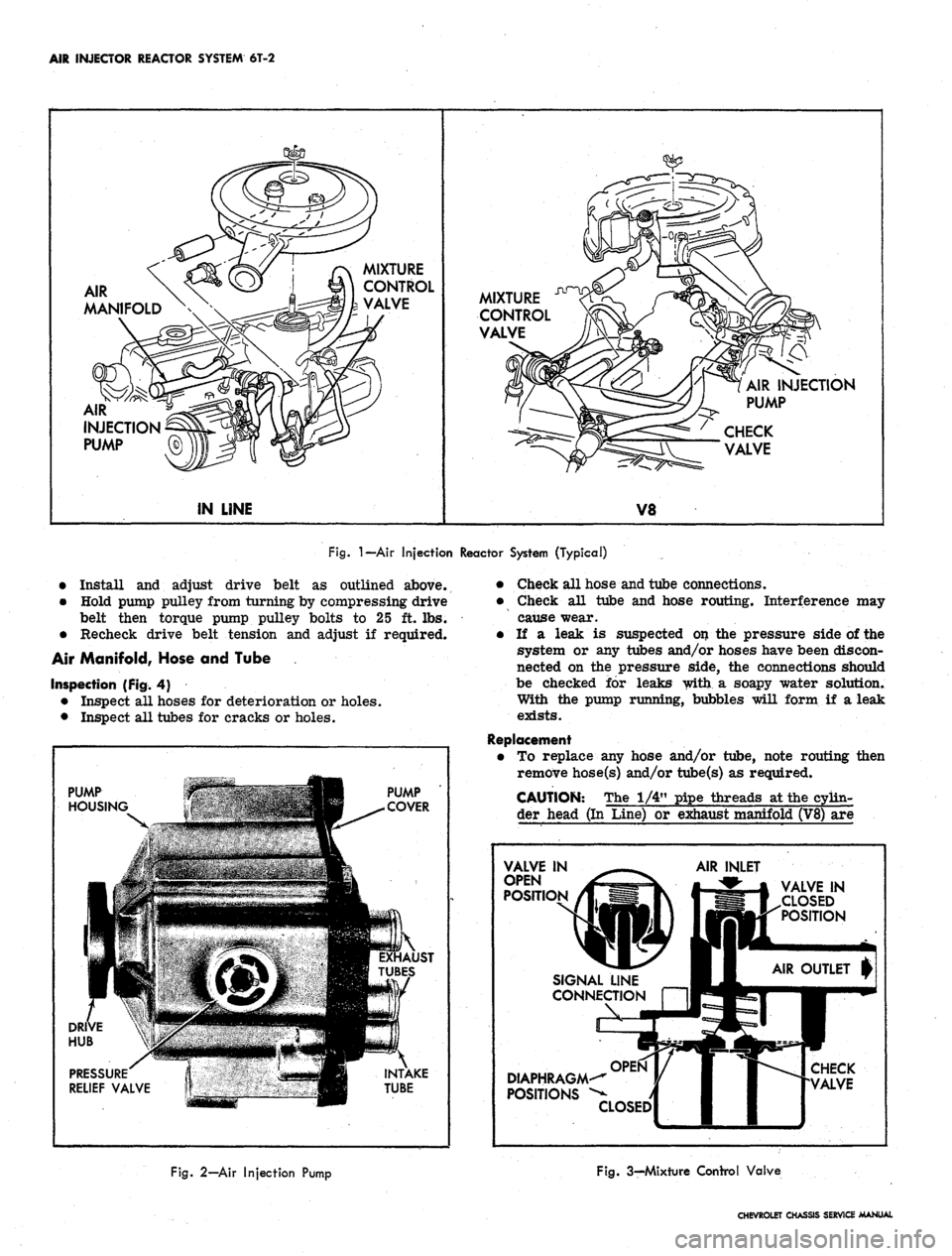
The Air Injection Reactor (A.I.R.) System (fig. 1) con-
sists of: the air injection pump (with necessary brackets
and drive attachments), air injection tubes (one for each
cylinder), a mixture control valve, check valves (one for
In Line engines, two for V8 engines) and air manifold as-
semblies, tubes and hoses necessary to connect the
various components.
Carburetors and distributors for engines with the
A.I.R. System are designed, particularly, for these en-
gines;
therefore, they should not be interchanged with or
replaced by a carburetor or distributor designed for an
engine without the A.I.R. System.
The air injection pump (fig. 2) picks up fresh filtered
air from the air cleaner, compresses the air and injects
it through the air manifolds, hoses and injection tubes
into the exhaust system in the area of the exhaust valves.
The fresh air ignites and burns the unburned portion of
the exhaust gases in the exhaust system, thus minimizing
exhaust contamination.
The mixture control valve (fig. 3) when triggered by a
sharp increase in manifold vacuum, supplies the intake
manifold with fresh filtered air to lean out the fuel-air
DESCRIPTION
mixture and prevent exhaust system backfire.
The check valve(s) prevent exhaust gases from entering
and damaging the air injection pump, as back flow can
occur even under normal operating conditions.
When properly installed and maintained, the A.I.R.
System will keep exhaust emissions well below require-
ments. However, if any A.I.R. component or any engine
component that operates in conjunction with the A.I.R.
system should malfunction, the exhaust emissions might
be increased.
Because of the relationship between "Engine Tune
Up"
and "Unburned Exhaust Gases", the condition of
Engine Tune Up should be checked whenever the A.I.R.
System seems to be malfunctioning. Particular care
should be taken in checking items that affect fuel - air
ratio such as the crankcase ventilation system, the
carburetor and the carburetor air cleaner.
Because of the similarity of many parts, typical illus-
trations and procedures are used except where specific
illustrations or procedures are necessary to clarify the
operation. For Repair Procedures on the Air Injection
Pump,
refer to the Passenger Chassis Overhaul Manual.
MAINTENANCE PROCEDURES
Drive Belt
Inspection
• Inspect drive belt for wear, cracks or deterioration
and replace if required.
• Inspect belt tension and adjust if below 50 lb. using a
strand tension gauge.
Adjustment
• Loosen pump mounting bolt and pump adjustment
bracket bolt.
• Move pump until belt is tight (55±5 lb. used belt or
75±5 lb. new belt using a strand tension gauge) then
tighten adjustment bracket bolt and mounting bolt.
CAUTION: Do not pry on the pump housing.
Distortion of the housing will result in extensive
damage to the Air Injection Pump.
Replacement
• Loosen pump mounting bolt and pump adjustment
bracket bolt then swing pump until drive belt may be
removed.
• Install a new drive belt and adjust as outlined above.
Drive Pulley .
Replacement
• Remove drive belt as outlined above then replace
drive pulley.
• Install and adjust drive belt as outlined above.
Pump Pulley
Replacement
• Hold pump pulley from turning by compressing drive
belt then loosen pump pulley bolts.
• Remove drive belt as outlined above then remove
pump pulley.
• Install pump pulley with retaining bolts hand tight.
CHEVROLET CHASSIS SERVICE MANUAL
Page 322 of 659
AIR INJECTOR REACTOR SYSTEM
6T-2
AIR
MANIFOLD
MIXTURE
CONTROL
VALVE
AIR
INJECTION
PUMP
IN LINE
MIXTURE
CONTROL
VALVE
AIR INJECTION
PUMP
CHECK
VALVE
V8
Fig.
I—Air
Injection Reactor System (Typical)
• Install
and
adjust drive belt
as
outlined above.
• Hold pump pulley from turning
by
compressing drive
belt then torque pump pulley bolts
to 25 ft. lbs.
• Recheck drive belt tension
and
adjust
if
required.
Air Manifold, Hose and Tube
Inspection (Fig. 4)
• Inspect
all
hoses
for
deterioration
or
holes.
• Inspect
all
tubes
for
cracks
or
holes.
PUMP
HOUSING
91
DRIVE V
HUB
PRESSURE
RELIEF VALVE
•H
PUMP
'
Mm ^
COVER
A.
J^HTEXHAUST
wBBE
TUBES
SB
^1 INTAKE
JH TUBE
• Check
all
hose and tube connections.
• Check
all
tube
and
hose routing. Interference
may
cause wear.
•
If a
leak
is
suspected
on the
pressure side
of the
system
or any
tubes and/or hoses have been discon-
nected
on the
pressure side,
the
connections should
be checked
for
leaks with
a
soapy water solution.
With
the
pump running, bubbles will form
if
aleak
exists.
Replacement
•
To
replace
any
hose and/or tube, note routing then
remove hose(s) and/or tube(s)
as
required.
CAUTION:
The 1/4"
pipe threads
at the
cylin-
der head
(In
Line)
or
exhaust manifold
(V8) are
VALVE
IN
OPEN
POSITION
INLET
VALVE
IN
CLOSED
POSITION
DIAPHRAGM
POSITIONS
SIGNAL
LINE
CONNECTION
ALVE
Fig.
2—Air Injection Pump
Fig.
3—Mixture Control Valve
CHEVROLET CHASSIS SERVICE MANUAL
Page 333 of 659

ENGINE-ELECTRICAL 6Y-8
1
FIELD RELAY^I^p2
"LATCH"
^PFN?^
"P1
TERMINAL
JyJvJCTl^
NO. 2 TERMINAD^5^^^«
NO.
3 TERMINAL ^S5«£
NO.
4 TERMINAL ^^^
m
# / VOLTAGE
¥ REGULATOR
1
ACCESS PLUG TO
VOLTAGE ADJUSTMENT
No 4 TERMINAL
Double Contact
Fig.
2c—Voltage Regulator Assemblies
Transistor
regulator to handle the higher field current and enables it
to absorb the increased inductive voltages of the field
coil with satisfactory contact point life.
The double-contact regulator assembly (fig. 2c) con-
sists of a double contact voltage regulator unit and a field
relay unit. This unit uses two sets of contact points on
the voltage regulator unit to obtain desired field excita-
tion under variable conditions. Internal circuit wiring
diagrams of the double contact regulator are shown in
Figures 3c and 4c.
The transistor regulator (fig. 2c) is an assembly com-
posed principally of transistors, diodes, resistors, a
capacitor, and a thermistor to form a completely static
voltage regulating unit in combination with a conventional
vibrating type field relay.
The transistor is an electrical device which limits the
generator voltage to a preset value by controlling the
generator field current. The diodes, capacitor and re-
sistors act together to aid the transistors in controlling
the generator voltage. This is the only function that the
regulator performs in the charging circuit. The
thermistor provides a temperature-compensated voltage
setting. Wiring diagrams of the transistor regulator are
shown in Figures 3c and 4c.
The voltage at which the generator operates is deter-
mined by the regulator adjustment. The regulator voltage
setting can be adjusted externally by removing a pipe plug
in the cover (fig. 2c) and turning the adjusting arm inside
the regulator. This procedure is explained in the followr
ing section, and permits regulator adjustments without
removing the cover.
FUSIBLE
DOUBLE CONTACT
FUSIBLE LINK-^
JUNCTION HORN
BLOCK RELAY
RESISTOR
Q FIELD Q>
DELCOTRON TR-
TRANSISTOR
FUSIBLE LINK-
Fig.
3c-Circuity - Voltage Regulator Assemblies (Except Corvette)
CHEVROLET CHASSIS SERVICE MANUAL
Page 335 of 659
ENGINE-ELECTRICAL 6Y-10
circuit. Make absolutely certain all connections in
the circuit are secure.
5.
Do not short across or ground any of the terminals
on the generator or regulator.
6. Do not attempt to polarize the generator.
7.
Do not disconnect lead at generator without first dis-
connecting battery ground cable.
Trouble in the A.C. charging system will usually be
indicated by one or more of the following conditions:
1.
Faulty indicator lamp or ammeter operation.
2.
An undercharged battery (usually evidenced by slow
cranking speeds).
3.
An overcharged battery (usually evidenced by exces-
sive battery water usage).
4.
Excessive generator noise or vibration.
Described below are a series of on-the-vehicle quick
checks which are designed to assist the service tech-
nician in locating troubles within the various components
of the engine electrical system. Additional checks, ad-
justments and overhaul procedures of these components
are also described in the "Charging Systems—Service
Operations Section" and should be referred to as
necessary.
STATIC CHECKS
Before making any electrical checks, perform the fol-
lowing static checks:
1.
Check for loose fan belt.
2.
Check for defective battery. (Refer to Battery).
3.
Inspect all connections, including the slip-on con-
nectors at the regulator and Delcotron.
NOTE: Do not short field to ground to check if
generator is charging since this will seriously
damage the charging system.
SYSTEM CONDITION TEST
This test is used .to indicate the overall condition of the
charging system (both good and defective) and to isolate
the malfunctioning unit if the system is defective.
NOTE: On Corvette models difficulty may be
encountered -when attempting to make the re-
quired test connections at the voltage regulator.
It is advisable to remove the regulator from its
mounting location to perform the necessary con-
nections at the regulator for the following tests
but make sure unit is grounded.
1.
With ignition off, perform the prescribed Static
Checks outlined in this section. Then set hand brake
and shift transmission
into
neutral.
2.
Connect a voltmeter from junction block relay to
ground at regulator base.
CAUTION: Be sure meter clip does not touch a
resistor or terminal extension under regulator,
3.
Connect a tachometer on engine.
4.
Models equipped with Indicator Lamp: Turn ignition
switch on "ON" position and check indicator lamp.
If lamp fails to glow, perform appropriate tests and
corrections (Indicator Lamp Circuit Tests) before
continuing.
Models equipped with Ammeter: Turn ignition
switch to "ACC" with an accessory on and check
ammeter. If ammeter fails to read discharge, check
ammeter circuit before continuing.
5.
Models equipped with Indicator Lamp: If lamp glows,
start the engine and run' it at 1500 rpm or above.
Check indicator lamp. If lamp fails to go out, per-
form appropriate test and corrections (Indicator
Lamp Circuit Test) before continuing.
Models equipped with Ammeter: If ammeter reads
discharge, start the engine and observe ammeter. If
meter fails to move toward charge (from original
position), perform appropriate test and corrections
(Field Circuit Tests) before continuing.
NOTE: At this point a field circuit has been
established and any other problem will lie in
generator or regulator.
6. Turn on high-beam headlights and heater blower
motor to high speed, run engine at or above 1500
rpm (for a few minutes, if necessary) and read the
voltage on meter.
AIR GAP
ADJUSTING NUT
ONLY
ADJUSTING SCREW
(Turn To Adjust
Voltage Setting)
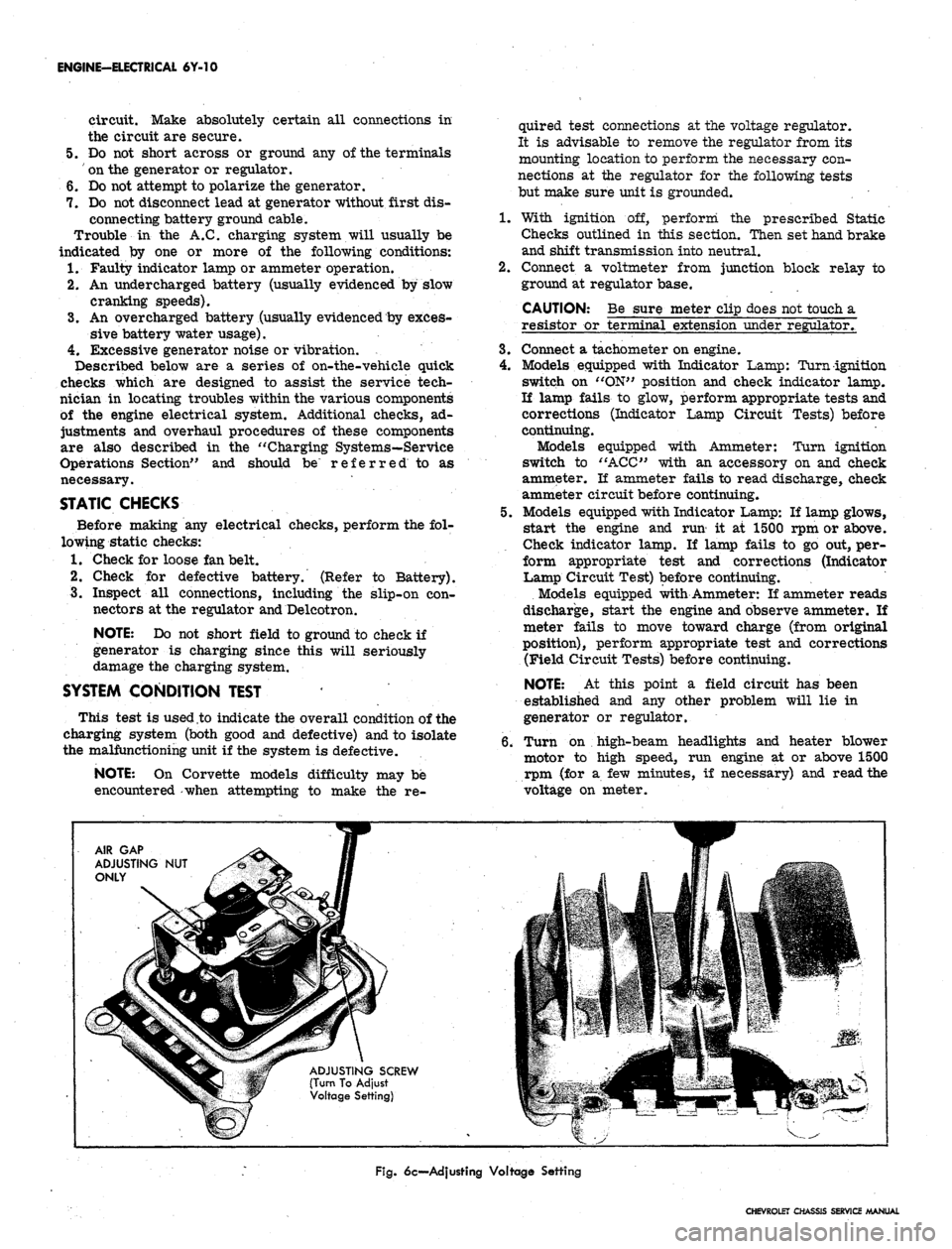
Fig.
6c—Adjusting Voltage Setting
CHEVROLET CHASSIS SERVICE MANUAL