1967 CHEVROLET CAMARO turn
[x] Cancel search: turnPage 369 of 659

CLUTCH AND TRANSMISSIONS 7-10 ,
GENERAL DESCRIPTION
The overdrive unit is essentially a two-speed planetary-
transmission attached to the rear of a conventional three-
speed transmission. In overdrive, engine speed is ap-
proximately 30 per cent slower at a given road speed
since the drive train includes planetary gears which pro-
vide a lower overall gear ratio than that obtained in high
gear with the conventional transmission.
The electrical equipment which controls the automatic
action of the mechanical portion of the overdrive unit
consists of a solenoid, a speed-sensitive governor switch,
a relay and a kickdown switch. The circuit including this
equipment makes it possible to operate in overdrive above
a pre-set cut-in speed, or in .conventional drive at any
speed.
With the overdrive unit engaged, the transmission
should not be left in any forward gear with intent of lock-
ing the drive-line as the overrunning clutch is a free-
wheeling condition.
SERVICING THE OVERDRIVE
With the,overdrive assembly removed from the trans-
mission, service operations on the transmission proper
are the same as for the standard three-speed trans-
mission.
Repairs to the overdrive housing, output shaft, ring
gear assembly, clutch cam, roller retainer, pinion cage,
sun gear, shift rail, sun gear control plate, output shaft
bearing, oil seal, speedometer drive gear, solenoid pawl
and interlock plunger may be performed underneath the
car, if so desired, by removing the overdrive housing
without disturbing the transmission. Refer to Overhaul
Manual for Service Procedure.
If the transmission mainshaft, overdrive adapter or
transmission rear bearing which is retained in adapter
require replacement, the entire transmission and over-
drive assembly should be removed and overhauled on the
bench.
MAINTENANCE AND ADJUSTMENTS
Servicing of the overdrive governor switch and pinion,
the sun gear solenoid, oil seal and cable bracket, the out-
put shaft rear oil seal, the control shaft lever, and the
speedometer driven gear may be accomplished without
removing the overdrive from the vehicle, as discussed
in the following paragraphs:
GOVERNOR SWITCH AND PINION
To remove governor switch, disconnect wires at gover-
nor switch and screw governor
out
of housing, using Tool
J-4653 on the flat hexagonal surface of governor case.
The pinion may be separated from the governor by re-
moving the snap ring on the shaft.
SUN GEAR SOLENOID, OIL SEAL AND
CONTROL CABLE BRACKET
Remove the solenoid by taking out the two mounting
bolts and lock washers, removing
the.
cable bracket with
the lower bolt. Turn the solenoid 1/4 turn and
pull,
sole-
noid plunger out of adapter. The oil seal may be pried
out of the adapter.
CASE REAR OIL SEAL
Removal
1.
Remove propeller shaft as outlined in Section 4.
2.
Using a punch against seal in housing, pry out seal
from housing.
Installation
1.
Prelubricate between sealing lips and coat outside of
new oil seal with a suitable sealant, then start seal
into bore in overdrive housing.
2.
Using Tool J-5154 drive oil seal into counterbore.
3.
Install propeller shaft as outlined in Section 4.
CONTROL SHAFT LEVER AND/OR "O" RING
OIL SEALS
To remove- the control shaft, disconnect the cpntrol
cable, remove tapered pin and pull lever out. Replace
the two "0" ring seals on the control shaft. Insert shaft
and new "O" ring seals into housing and install tapered
pin. Connect control wire to lever.
SPEEDOMETER DRIVEN GEAR
Disconnect speedometer cable, remove lock plate to
housing bolt and lock washer and remove lock plate. In-
sert screw driver in lock plate slot in fitting and pry
fitting, gear and shaft from housing. Pry "O" ring from
groove in guide.
Install new "O" ring in groove in fitting and insert
shaft.
Hold the assembly so slot in fitting is toward lock plate
boss on housing and install in housing. Push fitting into
housing until lock plate can be inserted in groove and
attached to housing.
L
dl
ZAIR GAP
km (CHECK WITH
M*= POINTS BARELY
'A
AoWER
|^
POINT
0 ADJUST
=^ i
SUPPORT
Fig. IB - Checking Relay Air Gap
CHEVROLET CHASSIS SERVICE MANUAL
Page 371 of 659

CLUTCH AND TRANSMISSIONS 7-12
DIAGNOSIS-OVERDRIVE
MECHANICAL
Any one of the following general complaints may be due
to non-standard mechanical conditions in the overdrive
unit:
1.
Does not drive unless locked up manually.
2.
Does not engage, or lock-up does not release.
3.
Engages with a severe jolt, or noise.
4.
Free-wheels at speeds over 30 mph.
These^ troubles may be diagnosed and remedied as de-
scribed in the following paragraphs.
1.
Does not drive unless locked up manually.
a. Occasionally, the unit may not drive the car for-
ward in direct drive, unless locked up by pulling
the dash control. This may be caused by one or
more broken rollers in the roller clutch, the
remedy for which is the replacement of the entire
set of rollers.
b.
This may also be caused by sticking of the roller
retainer upon the cam. This retainer must move
freely to push the rollers into engaging position,
under the pressure of the two actuating springs.
c. Sometimes this is due to slight indentations, worn
in the cam faces by the rollers spinning, remedied
by replacement of the cam.
2.
Does not engage, or lock-up does not release
.. a. Dash control improperly connected—-Unless the
overdrive dash control wire is connected to the
lockup lever on the left side of the overdrive
housing in such a manner as to move the lever
all the way back when the dash control knob is
pushed in, it may hold the shift rail in such a po-
sition as to interlock the pawl against full engage-
ment resulting in a buzzing noise when overdrive
engagement is attempted.
To correctly make this connection, loosen bind-
ing post at lever, pull dash control knob out 1/4",
move lever all the way to the rear, and tighten
binding post.
b.
Transmission and overdrive improperly aligned—
The same symptoms as above may also result
from misalignment, at assembly, of the overdrive
housing to the transmission case, resulting in
binding of the overdrive shift rail, so that the re-
tractor spring cannot move the rail fully forward,
when the dash control knob is pushed in, and the
transmission is not in reverse. Under such con-
ditions, the unit may remain fully locked up.
To test for this, be sure that the transmission
is not in reverse; disconnect the dash control
wire from the lockup lever, and feel the lever for
free forward movement. If the lever can be
moved forward more than 1/4", it indicates that
misalignment probably exists. To correct this,
Jposen the capscrews between the overdrive hous-
ing and transmission case, and tap the adpater
plate and overdrive housing until a position is
found where the rail shifts freely; tighten cap-
screws.
c. Kickdown switch improperly adjusted—The posi-
tion of the kickdown switch should be adjusted,
by means of the two large nuts which clamp the
switch shank, so the switch plunger travels 3/16"
before the throttle lever touches its stop.
Occasionally the large nuts which clamp the
switch through the switch bracket are tightened
sufficiently to bend the switch shank, thus pre-
venting free motion of the switch stem. This may
usually be remedied by loosening the upper of the
two nuts.
d. Improper installation of solenoid—If car cannot
be rolled backward under any circumstances and
there is no relay click when the ignition is turned
on, it probably indicates that the solenoid has
been installed directly, without twisting into the
bayonet lock between solenoid stem and pawl, thus
jamming the pawl permanently into overdrive en-
gagement. If the car will occasionally roll back-
wards, but not always, (and there is no relay click
when the ignition switch is turned on) it may indi-
cate that, upon installation, the bayonet lock was
caught, and the solenoid forcibly twisted into
alignment with the attaching flange, thus shearing
off the internal keying of the solenoid. Under
these circumstances, the end of the solenoid stem
may not catch in the pawl, and upon release of the
solenoid, the pawl will not be withdrawn promptly
from engagement, but simply drift out. If the
solenoid stem end has its two flats exactly facing
the two solenoid flange holes, it will not withdraw
the pawl properly. If the stem can be rotated
when grasped by a pair of pliers, it indicates that
the internal keying has been sheared.
e. Improper positioning of blocker ring—Occasion-
ally, either in assembly at the factory, or in
service operations in the field, the internal parts
of the overdrive unit may have been rotated with
the solenoid pawl removed, causing the blocker
ring to rotate, so that its two lugs are not located
with respect to- the pawl as shown in Figure 12B.
In other words, the solid portion of the blocker
ring may be in alignment with the pawl, which will
prevent fill} engagement of the pawl with the sun
gear control plate/
To test for this condition, remove solenoid
cover, pull dash control knob out, roll car 2 ft.
forward. Push dash control in, turn ignition
switch on. Then ground the "KD" terminal of
relay, and watch movement of center stem of
solenoid. It should not move more than 1/8" when
the solenoid clicks. Then, with the relay terminal
still grounded, shift into low gear, and roll car
forward by hand. Solenoid stem should then move
an additional 3/8", as the pawl engages fully.
These two tests indicate proper blocker action.
Unless both tests are met, the blocker ring is
probably not in the correct position.
3.
Engages with a severe jolt or noise
Insufficient blocker ring friction may cause the ring
to lose its grip on the hub of the sun gear control
plate. Check the fit and tension of the ring as de-
scribed under "Cleaning and Inspection".
4.
Free-wheels at speeds over 30 MPH
If cam roller retainer spring tension is weak the unit
will free wheel at all times. Check spring action as
described under "Cleaning and Inspection".
CHEVROLET CHASSIS SERVICE MANUAL
Page 378 of 659

CLUTCH AND TRANSMISSIONS 7-19
2.
With handle in full down position—adjust cable to ac-
quire dimension shown, be certain that cable is pulled
taut.
3.
Tighten set screw to 15-20 in. lbs.
4.
Bend excess wire and cut - be certain that wire does
not interfere with I.D. of lever or threads of shifter
knob.
NOTE: Handle must return freely from any
position.
SPEEDOMETER DRIVEN GEAR AND OIL SEAL
Replacement
Disconnect speedometer cable, remove retainer to
housing bolt and lock washer and remove retainer. In-
sert screw driver in slot in fitting and pry fitting, gear
and shaft from housing. Pry "O" ring in groove in fitting.
Install new "O" ring in groove and insert shaft Hold
the assembly so slot in fitting is toward boss on housing
and install in housing. Push fitting into housing until re-
tainer can be inserted in groove and install retainer lock
washer and bolt.
Fig.
5M - Installing Side Cover Assembly
TRANSMISSION SIDE COVER
Removal
1.
Disconnect control rods from levers.
2.
Shift transmission into second speed before removing
cover, by moving 1-2 (Rear Cover) shifter lever into
forward detent position.
3.
Remove cover assembly -from transmission case
carefully and allow oil to drain.
Disassembly (Fig. 4M)
1.
Remove the outer shifter lever nuts,*lock washers
and flat washers. Pull levers from shafts.
2.
Remove both shift forks from shifter shaft and detent
plate assemblies. Remove both shifter shaft assem-
blies from cover. Lip seals in side cover may now
be pryed out if replacement is required because of
damage.
1-2 DETENT CAM DETENT SPRING
3-4 DETENT CAM
1-2 SHIFTER SHAFT
1-2 SHIFT FORK
3-4 SHIFT
FORK
DETENT CAM \ 3-4 SHIFTER SHAFT
RETAINER RING
DETENT CAM PIVOT PIN
3.
Remove detent cam spring and pivot retainer "C"
ring. Remove both detent cams.
4.
Replace necessary parts.
Assembly (Fig. 4M)
1.
Install 1-2 detent cam to cover pivot pin first, then
install 3-4 detent cam so the detent spring notches
are offset or opposite each other. Detent cam
notches must be facing downward.
2.
Install detent cam retaining "C" ring to pivot shaft,
and hook spring into detent cam notches.
3.
Install both shifter shaft assemblies in cover being
careful not to damage lip seals. Install both shift
forks to detent plates, lifting up on detent cam to
allow forks to fully seat into position.
4.
Install outer shifter levers, flat washers, lock wash-
ers and nuts.
Installation (Fig. 5M)
1.
Shift 1-2 shifter lever into second speed (forward)
position. Position cover gasket on case.
2.
Carefully position side cover into place making sure
the shift forks are aligned with their respective
mainshaft clutch sliding sleeves.
3.
Install cover attaching bolts and tighten evenly to
15-20 ft. lbs. torque.
4.
Remove filler plug and add lubricant specified in
Section 0, to level of filler plug hole.
EXTENSION OIL SEAL
Replacement
1.
Remove propeller shaft.
2.
Pry out the extension oil seal.
3.
Prelubricate between sealing lips and press new oil
seal carefully into place in extension using J-5154 or
similar tool.
Fig.
4M - Transmission Side Cover/ Shift Fork and
Detent Assembly
CAUTION: Do not excessively force the seal
against the seat in the extension.
CHEVROLET CHASSIS SERVICE MANUAL
Page 382 of 659

CLUTCH
AND
TRANSMISSIONS
7-23
Assembly (Fig.
4X)
1.
With detent spring tang projecting
up
over
the 3rd
and
4th
shifter shaft cover opening install
the
first
and second detent
cam
onto
the
detent
cam
pivot
pin.
With
the
detent spring tang projecting
up
over
the
first
and
second shifter shaft cover hole install
the
3rd
and 4th
detent
cam,
NOTE:
The 1-2
detent
cam has a
.090" greater
contour
on the
inside detent notch.
2.
3.
Install detent
cam
retaining
"C"
ring
to
pivot shaft,
and hook spring into detent
cam
notches.
Install
1-2 and 3-4
shifter shaft assemblies
in
cover
being careful
not to
damage seals. Install both shift
forks
to
shifter shaft assemblies, lifting
up on
detent
cam
to
allow forks
to
fully seat into position.
4.
Install reverse detent ball
and
spring
to
cover, then
install reverse shifter shaft assembly
to
cover.
5.
Install outer shifter levers, flat washers, lock wash-
ers
and
bolts.
Installation
1.
Shift shifter levers into neutral detent (center) posi-
tion. Position cover gasket
on
case.
2.
Carefully position side cover into place making sure
the shift forks
are
aligned with their respective
mainshaft clutch sliding sleeves.
Install cover attaching bolts
and
tighten evenly
to
specified torque.
Remove filler plug
and add
lubricant specified
in
Section
0, to
level
of
filler plug hole.
3.
4.
ALUMINUM POWERGLIDE
INDEX
Page
General
Description
7-23
Maintenance
and
Adjustments .............. 7—23
Oil
Level Check
7-23
Periodic
Oil
Change
7-24
Periodic
Low
Band Adjustment
7-24
Manual
Shift Linkage Check
and
Adjust
7-24
Floor
Shift Linkage
7-25
Floor
Mounted Control Lever
and
Bracket
Assembly
7-29
Throttle
Valve Linkage
.... 7-29
Neutral
Safety Switch
.. . 7-30
Throttle
Return Check Valve (Dashpot)
7-30
Component
Parts Replacement
7-30
Transmission
Replacement .............. 7—30
Page
Other
Service Operations
7-32
Diagnosis
7-32
Warming
Up
Transmission
7-32
Shop
Warm
Up , 7-32
Road
Warm
Up 7-32
Checking
Fluid Level
and
Condition
7-32
Manual
Linkage
7-32
Oil
Leaks
7-33
Basic
Pressure Checks
7-33
Wide
Open Throttle Upshift Pressure Check
.... 7-33
Idle
Pressure
in
Drive Range
7-33
Manual
"Low"
Range Pressure Check .......
7-33
Drive
Range Overrun (Coast) Pressure
.
.......
7-33
Powerglide
Shift Points
. . 7-35
GENERAL DESCRIPTION
The case
and
converter housing
of the two
speed alumi-
num Powerglide Transmission
is a
single case aluminum
unit. When
the
manual control
is
placed
in the
drive
po-
sition,
the
transmission automatically shifts
to low
gear
for initial vehicle movement.
As the car
gains speed
and
depending
on
load
and
throttle position,
an
automatic shift
is made
to
high gear.
A
forced downshift feature
pro-
vides
a
passing gear
by
returning
the
transmission
to low
range.
The
oil
pump assembly
is a
conventional gear type
and
the
oil
pump housing
is of the
large diameter type acting
as
the
front bulkhead
of the
transmission.
The
torque
converter
is a
conventional three element welded design
bolted
to the
engine flywheel which drives through
a
two-
speed planetary gearset.
The
high clutch assembly
is
typical
of the
designs used
in
this type transmission.
The
aluminum Powerglide uses
an
output shaft mounted
gov-
ernor which requires
a
hole through
the
output shaft.
The
reverse clutch assembly
is a
multiple disc type clutch.
The steel plates
are
splined directly
to the
case while
the
face plates
are
splined
to the
internal
or
ring gear.
The
clutch piston operates within
the
rear portion
of the
case.
The internal diameter
of the
pistoh
is
sealed to
an
integral
hub portion
of the
case rear bulkhead.
The
outside
dia-
meter
is
sealed
to a
machined portion
of the
case.
The
piston
is
hydraulically applied
and is
released
by
separate
coil springs.
The
valve body assembly
is
bolted
to the
bottom
of the
transmission case
and is
accessible
for
service
by
removing
the oil pan
assembly.
The
valve
body consists
of an
upper
and
lower body located
on
either
side
of a
transfer plate.
The
vacuum modulator
is lo-
cated
on the
left rear face
of the
transmission case.
The
modulator valve bore
is
located
in the
upper valve body.
MAINTENANCE
AND
ADJUSTMENTS
OIL LEVEL CHECK
The transmission
oil
level should
be
checked period-
ically
as
recommended
in
Section
0. Oil
should
be
added
only when level
is on or
below
the
"ADD" mark
on the dip
stick with
oil hot or at
operating temperature.
The oil
level
dip
stick
is
located
at the
right rear
of the
engine
compartment. Fill with
oil
specified
in
Section
0.
In order
to
check
oil
level accurately,
the
engine should
be idled with
the
transmission
oil hot and the
control
lever
in
neutral (N) position.
It
is
important that
the oil
level
be
maintained
no
higher than
the
"FULL" mark
on the
transmission
oil
level gauge.
DO NOT
OVERFILL,
for
when
the oil
level
CHEVROLET CHASSIS SERVICE MANUAL
Page 383 of 659

CLUTCH AND TRANSMISSIONS 7-24
is at the full mark on the dip stick, it is just slightly be-
low the planetary gear unit. If additional oil is added,
bringing the oil level above the full mark, the planetary
unit will run in the oil, foaming and aerating the oil. This
aerated oil carried through the various oil pressure pas-
sages (low servo, reverse servo, clutch apply, converter,
etc.) may cause malfunction of the transmission assem-
bly, resulting in cavitation noise in the converter and
improper band or clutch application. Overheating may
also occur.
If the transmission is found consistently low on oil, a
thorough inspection should be made to find and correct
all external oil leaks.
PERIODIC OIL CHANGE
The transmission oil should be changed periodically as
recommended in Section 0, and whenever transmission is
to be removed from the vehicle for repairs.
1.
Run engine for one minute in neutral prior to chang-
ing.
2.
Be sure vehicle is level or raise from the rear only.
3.
Remove the oil pan drain plug and allow oil to drain
thoroughly into a pan or can.
Replace drain plug and refill with approximately two
quarts of oil specified in Section 0.
NOTE: To refill the transmission, remove dip
stick from oil filler tube and refill transmission
with oil specified in Section 0 using filler tube
and funnel J-4264. Then, after shifting into all
ranges at idle speed to fill all oil passages, the
engine should be run at 800-1000 rpm with the
transmission in Neutral until the oil warms up,
then add oil as required to raise the fluid level
to the full mark on the dip stick. Refill capacity
is approximately 2 qts.
4.
Fig.
1PG - Adjusting Low Band Using J-21848
PERIODIC LOW BAND ADJUSTMENT (Fig. 1PG)
Low band adjustment should be periodically performed
at 12,000 mile intervals, or sooner, as necessary if op-
erating performance indicates low band slippage.
1.
Raise vehicle and place selector lever in neutral.
2.
Remove protective cap from transmission adjusting
screw.
3.
a. On Corvette Models: Drop left exhaust pipe for
clearance.
b.
On Chevelle Models: To gain clearance between
underbody and transmission, it may be necessary
to remove rear mount bolts from crossmember,
and move transmission slightly toward passenger
side of vehicle. .
4.
Loosen adjusting screw lock nut 1/4 turn and hold in
this position with wrench.
5.
Using Special Tool J-21848 adjust band to 70 in. lbs.
and back off four (4) complete turns for a band which
has been in operation for 6,000 miles or more,.or
three (3) turns for one in use less than 6,000 miles.
CAUTION: Be sure to hold the adjusting screw
lock nut at 1/4 turn loose with a wrench during"
the.adjusting procedure.
6. Tighten the adjusting screw lock nut to specified
torque.
CAUTION: The amount of back-off is not an
approximate figure, it must be exact.
MANUAL SHIFT LINKAGE CHECK & ADJUST
(Column Type)
1.
The shift tube and lever assembly must be free in the
mast jacket. See Section 9 for alignment of steering
column assembly if necessary.
2.
To check for proper shift linkage adjustment, lift
the transmission selector lever towards the steering
wheel. Allow the selector lever to be positioned in
drive (D) by the transmission detent.
NOTE: Do not use the indicator pointer as a
reference to position the selected lever. When
performing linkage adjustment, pointer is ad-
justed last.
3.
Release the selector lever. The lever should be in-
hibited from engaging low range unless the lever is
lifted.
4.
Lift the selector lever towards the steering wheel,
and allow the lever to be positioned in neutral (N) by
the transmission detent.
5.
Release the selector lever. The lever should now
be inhibited from engaging reverse range unless the
lever is lifted.
6. A properly adjusted linkage will prevent the selector
lever from moving beyond both the neutral detent, and
the drive detent unless the lever is lifted to pass
over the mechanical stop in the steering column.
7.
In the event that an adjustment is required, place
the selector lever in drive (D) position as determined
by the transmission detent. See Steps 2 and 3.
8. Loosen the adjustment swivel at the cross-shaft,
and rotate the transmission lever so that it contacts
the drive stop in the steering column.
9. Tighten the swivel and recheck the adjustment. See
2 and 6.
CHEVROLET CHASSIS SERVICE MANUAL
Page 384 of 659

CLUTCH AND TRANSMISSIONS 7-25
Fig.
2PG - Chevrolet Shift Linkage Adjustments
10.
11.
Readjust indicator needle if necessary to agree with
the transmission detent positions. See Section 9.
Readjust neutral safety switch if necessary to pro-
vide the correct relationship to the transmission
detent positions. See Section 12.
CAUTION: Any inaccuracies in the above ad-
justment may result in premature failure of the
transmission due to operation without controls
in full detent. Such operation results in reduced
oil pressure and in turn partial engagement of
the affected clutches. Partial
of the
clutches with sufficient pressure to cause ap-
parent normal operation of the vehicle will
result in failure of the clutches or other in-
ternal parts after only a few miles of operation.
Floor Shift Linkage
Chevrolet Linkage Adjustment (Fig. 6PG)
1.
Loosely assemble Nuts (A) and (B) on Lower Rod (C).
2.
Set Transmission Lever (D) in drive position.
NOTE:
Obtain drive position by moving Trans-
mission Lever counter-clockwise to low detent,
then clockwise one detent position to drive.
3.
Set Control Pawl Lever Rod (E) in Neutral or drive
notch of Detent (F). See View A.
4.
Apply load in direction of Arrow (Y) on Actuating
Lever (G) until pawl Rod comes in contact with
Detent at Contact Point (Z). See View A.
5. Place a 7/64" Spacer (H) between Nut (A) and Swivel
(J),
run Nut (A) until it touches spacer. Remove
Spacer and apply load in the direction on Arrow (X)
until it touches Nut (A). Tighten Nut (B) against
Swivel and lock Swivel between Nuts (A) and (B).
See View B.
Chevelle Linkage Adjustment (Fig. 7PG)
1.
Assemble Nuts (A) and (B) on Lower Rod (C) loosely.
2.
Set Transmission Lever (D) in drive position.
NOTE:
Obrain drive position by moving Trans-
CHEVROLET CHASSIS SERVICE MANUAL
Page 389 of 659
CLUTCH AND TRANSMISSIONS
7*30
V-8 Models-With Uni-Directional Linkage
1.
Remove air cleaner.
2.
Disconnect accelerator linkage at carburetor.
3.
Disconnect accelerator return and TV rod return
springs.
4.
With right hand, pull TV upper rod forward until
transmission is through detent. With left hand, open
carburetor to wide open throttle position. Carbure-
tor must reach wide open throttle position at the
same time the ball stud contacts end of slot in upper
TV rod.
5. Adjust swivel on end of upper TV rod to obtain set-
ting described in Step 4. Allowable tolerance is
approximately 1/32".
6. Connect and adjust accelerator linkage as described
in Section 6.
7. Check for throttle linkage freedom.
Neutral Safety Switch Adjustment
The adjustment at the neutral safety switch is de-
scribed in the Electrical Section 12.
Throttle Return Check Valve (Dashpot) Adjustment
The adjustment of the throttle return check valve is
described in Section 6M for each carburetor installation.
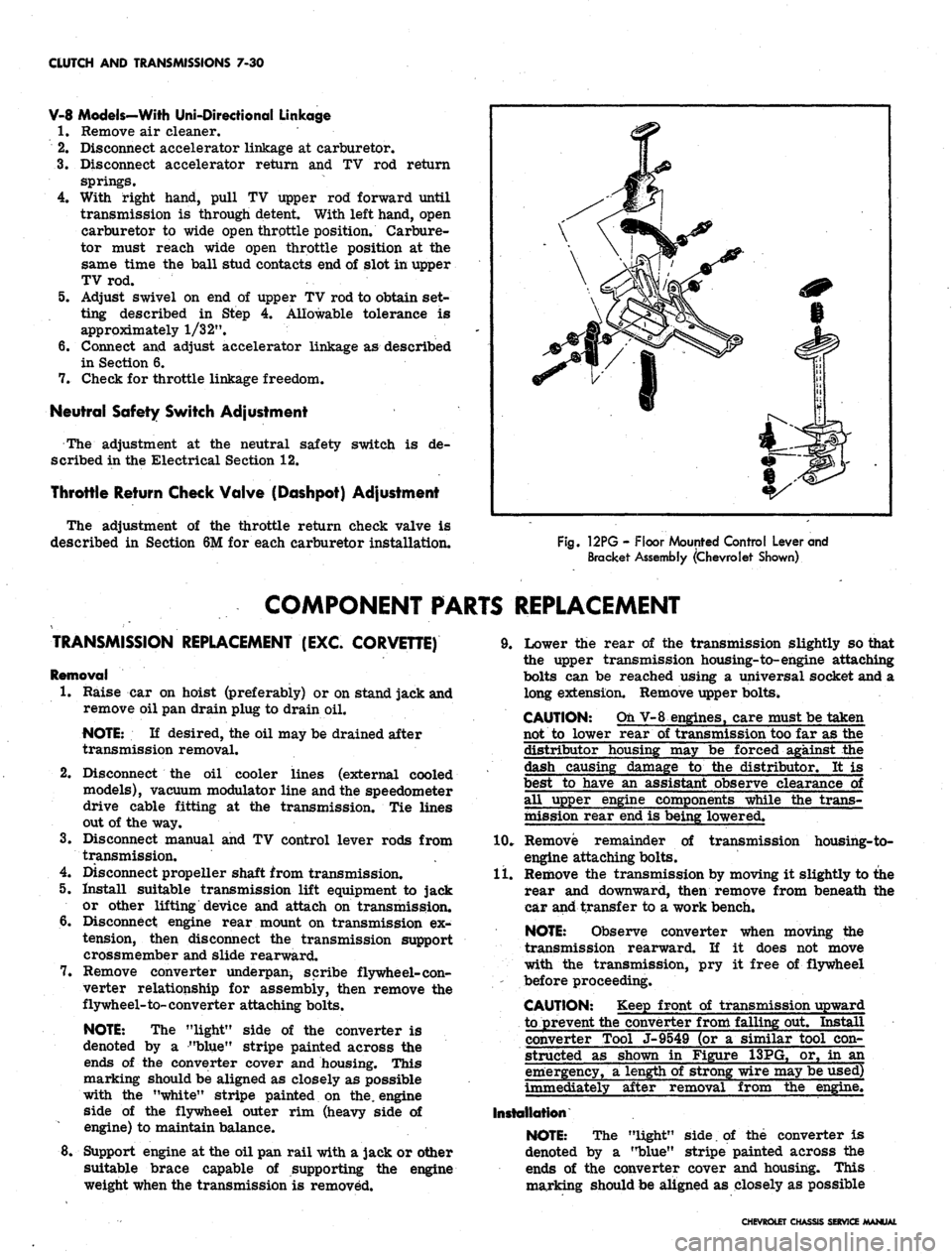
Fig.
12PG - Floor Mounted Control Lever and
Bracket Assembly (Chevrolet Shown)
COMPONENT PARTS REPLACEMENT
TRANSMISSION REPLACEMENT (EXC. CORVETTE)
Removal
1.
Raise car on hoist (preferably) or on stand jack and
remove oil pan drain plug to drain oil.
NOTE:
If desired, the oil may be drained after
transmission removal.
2.
Disconnect the oil cooler lines (external cooled
models), vacuum modulator line and the speedometer
drive cable fitting at the transmission. Tie lines
out of the way.
3.
Disconnect manual and TV control lever rods from
transmission.
4.
Disconnect propeller shaft from transmission.
5. Install suitable transmission lift equipment to jack
or other lifting device and attach on transmission.
6. Disconnect engine rear mount on transmission ex-
tension, then disconnect the transmission support
crossmember and slide rearward.
7. Remove converter underpan, scribe flywheel-con-
verter relationship for assembly, then remove the
flywheel-to-converter attaching bolts.
NOTE:
The "light" side of the converter is
denoted by a "blue" stripe painted across the
ends of the converter cover and housing. This
marking should be aligned as closely as possible
with the "white" stripe painted on the. engine
side of the flywheel outer rim (heavy side of
engine) to maintain balance.
8. Support engine at the oil pan rail with a jack or other
suitable brace capable of supporting the engine
weight when the transmission is removed.
9. Lower the rear of the transmission slightly so that
the upper transmission housing-to-engine attaching
bolts can be reached using a universal socket and a
long extension. Remove upper bolts.
CAUTION: Oh V-8 engines, care must be taken
not to lower rear of transmission too far as the
distributor housing may be forced against the
dash causing damage to the distributor. It is
best to have an assistant observe clearance of
all upper engine components while the trans-
mission rear end is being lowered.
10.
Remove remainder of transmission housing-to-
engine attaching bolts.
11.
Remove the transmission by moving it slightly to the
rear and downward, then remove from beneath the
car and transfer to a work bench.
NOTE:
Observe converter when moving the
transmission rearward. If it does not move
with the transmission, pry it free of flywheel
before proceeding.
CAUTION: Keep front of transmission upward
to prevent the converter from falling out. Install
converter Tool J-9549 (or a similar tool con-
structed as shown in Figure 13PG, or, in an
emergency, a length of strong wire may be used)
immediately after removal from the engine.
Installation
NOTE:
The "light" side, of the converter is
denoted by a "blue" stripe painted across the
ends of the converter cover and housing. This
marking should be aligned as closely as possible
CHEVROLET CHASSIS SERVICE MANUAL
Page 395 of 659

CLUTCH AND TRANSMISSIONS 7-36
TURBO HYDRA-MATIC TRANSMISSION
INDEX
Page
General Description . . , . 7-36
Maintenance and Adjustments . 7-37
Transmission Fluid 7-37
Fluid Level Indicator 7-37
Shift Control Linkage Adjustment ........... 7-37
Neutral Safety Switch Adjustment 7-37
Draining and Refilling Transmission . . . 7-37
Pressure Regulator Valve 7-38
Control Valve Body . 7-39
Governor ..'.... 7-40
Modulator and Modulator Valve 7-40
Parking Linkage . . 7-40
Page
Rear Seal -. 7-40
Other Service Operations . . 7-40
Transmission Replacement 7-40
Turbo Hydra-Matic Diagnosis Procedure. ......... 7-41
Sequence . ; ; 7-41
Oil Level and Condition Check 7-41
Manual Linkage 7-41
Oil Leaks .' 7-41
Case Porosity - Repair ................ 7-42
Oil Pressure Check 7-42
Transmission Shift Points 7-42
Special Tools 7-43
GENERAL DESCRIPTION
The Turbo Hydra-Matic transmission is a fully auto-
matic unit consisting primarily of a 3-element hydraulic
torque converter and a compound planetary gear set.
Three multiple-disc clutches, one sprag unit, one roller
clutch and two bands provide the friction elements re-
quired to obtain the desired function of the compound
planetary gear set.
The torque converter couples the engine to the plane-
tary gears through oil and provides hydraulic torque
multiplication when required. The compound planetary
gear set produces three forward speeds and reverse.
The
3-
element torque converter consists of a pump or
driving member, a turbine or driven member, and a
stator assembly. The stator is mounted on a one-way
roller clutch which will allow the stator to turn clock-
wise but not counter-clockwise.
The torque converter housing is filled with oil and
is attached to the engine crankshaft by a flex plate and
always rotates at engine speed. The converter pump is
an integral part of the converter housing, therefore the
pump blades, rotating at engine speed, set the oil within
the converter into motion and direct it to the turbine,
causing the turbine to rotate.
As the oil passes through the turbine it is traveling in
such a direction that if it were not re-directed by the
stator it would hit the rear of the converter pump blades
and impede its pumping action. So at low turbine speeds,
the oil is re-directed by the stator to the converter pump
in such a manner that it actually assists the converter
pump to deliver power or multiply engine torque.
As turbine speed increases, the direction of the oil
leaving the turbine changes and flows against the rear
side of the stator vanes in a clockwise direction. Since
the stator is now impeding the smooth flow of oil, its
roller clutch releases and it revolves freely on its shaft.
Once the stator becomes inactive, there is no further
multiplication of engine torque within the converter. At
this point, the converter is merely acting as a fluid
coupling as both the converter pump and turbine are
being driven at approximately the same speed - or at a
one-to-one ratio.
A hydraulic system pressurized by a gear type pump
provides the working pressure required to operate the
friction elements and automatic controls.
External control connections to transmission are:
Manual Linkage
Engine Vacuum
12 Volt Electrical
Signal
To select the desired op-
erating range.
To operate a vacuum mod-
ulator unit.
To operate an electrical
detent solenoid.
A vacuum modulator is used to automatically sense
any change in the torque input to the transmission. The
vacuum, modulator transmits this signal to the pressure
regulator for line pressure control, to the 1-2 accumula-
tor valve, and to the shift valves so that all torque re-
quirements of the transmission are met and smooth
shifts are obtained at all throttle openings.
The detent solenoid is activated by an alectric switch
on the carburetor. When the throttle is fully opened, the
switch on the carburetor is closed, activating the detent
solenoid and. causing the transmission to downshift at
speeds below approximately 70 MPH.
The selector quadrant has six selector positions: P,R,
N,D,
L2,L1.
P.
*
- Park position positively locks the output shaft to
the transmission case by means of a locking pawl
to prevent the vehicle from rolling in either di-
rection. The engine may be started in Park
position.
R. - Reverse enables the vehicle to be operated in a
reverse direction.
N.
- Neutral position enables the engine to be started
and run without driving the vehicle.
D,
- Drive Range is used for all normal driving condi-
tions and maximum economy. Drive Range has
three gear ratios, from the starting ratio to
direct drive. Detent downshifts are available by
depressing the accelerator to the floor.
L2.
- L2 Range has the same starting ratio as Drive
Range, but prevents the transmission from shift-
ing above second speed to retain second speed
acceleration when extra performance is desired.
L2 Range can also be used for engine braking.
L2 Range can be selected at any vehicle speed,
and the transmission will shift to second gear and
remain in second until the vehicle speed or the
throttle are changed to obtain first gear operation
in the same manner as in D Range.
CHIVROLET CHASSIS SERVICE MANUAL