1967 CHEVROLET CAMARO engine oil
[x] Cancel search: engine oilPage 353 of 659

ENGINE-ELECTRICAL 6Y-28
terminals on eoil. On Corvettes equipped with radio,
remove bolts securing ignition shield over distribu-
tor and coil.
2.
Pull high tension wire from center terminal of coil.
3.
Remove the two coil support mounting bolts or loosen
friction clamp screw and remove coil.
4.
Place new coil in position and install attaching bolts
or tighten clamp screw.
5.
Place high tension lead securely in center terminal
of coil and connect ignition switch and distributor
primary leads to terminals on coil. Replace ignition
shield on Corvettes.
6. Start engine and test coil operation.
IGNITION PULSE AMPLIFIER
DISASSEMBLY
To check the amplifier for defective components, pro-
ceed as follows:
1.
Remove the bottom plate from the amplifier.
2.
To aid in reassembly, note the locations of the lead
connections to the panel board.
3.
Remove the three panel board attaching screws, and
lift the assembly from the housing.
4.
To aid in reassembly, note any identifying markings
on the two transistors and their respective locations
on the panel board and heat sink assembly.
5.
Note the insulators between the transistors.and the
heat sink, and the insulators separating the heat sink
from the panel board.
6. Remove the transistor attaching screws, and sepa-
rate the two transistors and heat sink from the panel
board.
7.
Carefully examine the panel board for evidence of
damage.
MOUNTING
SCREW
RESISTOR R5 jgSfe. / DIODE Dl
TRANSISTOR TR2
(UNDERNEATH)
1H L >©V
[So
To
I
/'%**jt\
\
TRANSISTC>R"""
1 X ^^w^ X \ (UNDERNEATH)
9^ESISTORR^^^H|^^^^^H
^B
RESISTOR
R4
^HPH^^H
WM'
RESISTOR
R3
I^B^^^^I^U
N .6 ®
mm
N%|/MOUNTING
• tr^i^w ^\ vjR SCREW
CAPACITOR
Cl\
pNkj^^A^
\
RESISTOR
Rl
MOUNTING ^55S^^ \ CAPACITOR C3
SCREW I RESISTOR R6 CAPACITOR C2
TRANSISTOR TR3
COMPONENT CHECKS (Figs. \7\ and 18i)
With the two transistors separated from the assembly,
an ohmmeter may be used to check the transistors and
components on the panel board for defects. An ohmmeter
having a 1-1/2 volt cell, which is the type usually found
in service stations, is recommended. The low range
scale on the ohmmeter should be used except where
specified otherwise.
A 25 watt soldering gun is recommended, and a 60% tin
40%
lead solder should be used when re-soldering. Avoid
excessive heat which may damage the panel board. Chip
away any epoxy involved, and apply new epoxy which is
commercially available.
In order to check the panel board assembly, it is
necessary to unsolder at the locations indicated in Fig-
ure 18i the two capacitors C2 and C3. In all of the fol-
lowing checks, connect the ohmmeter as shown and then
reverse the ohmmeter leads to obtain two readings. The
amplifier circuitry is shown in Figure 19i.
1.
Transistors TR1 and TR2: Check each transistor by
referring to Figure 20i. If both readings in Step 1
are zero, the transistor is shorted. If both readings
in Step 2 are zero, the transistor is shorted; and if
both readings are infinite, the transistor is open.
Interpret Step 3 the same as Step 2.
2.
Trigger Transistor TR3:
11
both readings in Step 1
are zero, the transistor is shorted. If both readings
in Step 2 are zero, the transistor is shorted; and if
both readings are infinite, the transistor is open.
Interpret Step 3 the same as Step 2.
3.
Diode Dl: 11 both readings are zero, the diode is
shorted; and if both readings are infinite, the diode
is open.
4.
Capacitor Cl: If both readings are zero, the capaci-
tor is shorted.
5.
Capacitors C2 and C3: Connect the ohmmeter across
CHECKING
RESISTOR Rl
UNSOLDER
I
CHECKING TRIGGER
TRANSISTOR TR3
CHECKING
CAPACITOR C
Fig.
171—Pulse Amplifier Panel Board
Fig.
18i—Pulse
Amplifier
Component
Checks
CHEVROLET CHASSIS SERVICE MANUAL
Page 357 of 659

ENGINE-ELECTRICAL 6Y-32
STARTER CIRCUIT
INDEX
Page
General Description 6Y-32
Maintenance and Adjustments . '. . 6Y-32
Resistance Checks 6Y-32
Starting Motor and Solenoid Check 6Y-33
Page
Service Operations 6Y-33
Starter Motor 6Y-33
Removal and Installation 6Y-33
GENERAL DESCRIPTION
The function of the starting system, composed of the
starting motor, solenoid and battery, is to crank the
engine. The battery supplies the electrical energy, the
solenoid completes the circuit to the starting motor, and
the motor then does the actual work of cranking the
engine.
The starting motor (fig. Is) consists primarily of the
drive mechanism, frame, armature, brushes, and field
windings. The starting motor is a pad mounted 12-volt
extruded frame type, having four pole shoes and four
fields,
connected with the armature. The aluminum drive
end housing is extended to enclose the entire shift lever
and plunger mechanism, protecting them from dirt,
splash, and icing. The flange mounted solenoid switch
operates the overrunning clutch drive by means of a
linkage to the shaft lever.
The V-8 wiring harness differs from the in-line engine
in that the ignition lead to the coil from the switch is at-
tached at the coil instead of at the starter solenoid (fig.
2s).
CONTACT
FINGER
PINION
STOP
BRUSH
INSULATED BRUSH HOLDER \ FIELD COIL
BRUSH SPRING ARMATURE
GROUNDED BRUSH HOLDER
OVERRUNNING
CLUTCH
Fig.
Is—Starting Motor Cross Section (Typical)
MAINTENANCE AND ADJUSTMENTS
No periodic lubrication of the starting motor or sole-
noid is required. Since the starting motor and brushes
cannot be inspected without disassembling the unit, no.
service is required on these units between overhaul
periods.
RESISTANCE CHECKS
Although the starting motor cannot be checked against
specifications on the car, a check can be made for. exces-
sive resistance in the starting circuit. Place a volt-
meter across points in the cranking circuit as outlined
below and observe the reading with the starting switch
closed and the motor cranking (distributor primary lead
grounded to prevent engine firing).
1.
From battery positive post To solenoid battery
terminal.
CHEVROLET CHASSIS SERVICE MANUAL
Page 363 of 659

CLUTCH AND TRANSMISSIONS 7-4
5.
Install Tool J-5824 to support the clutch assembly
during removal.
NOTE: Look for "X" mark on flywheel and on
clutch cover. If MX" mark is not evident, prick
punch marks on flywheel and clutch cover for
indexing purposes during installation.
6. Loosen the clutch-to-flywheel attaching bolts evenly
1 turn at a time until spring pressure is released,
then remove the bolts, and remove clutch assembly.
Installation to Vehicle
Clean pressure plate and flywheel face. (They should
be free of oil, grease, metal deposits or burned spots).
1.
Position the clutch disc and pressure plate in relar
tive installed position and support them with align-
ment Tool J-5824.
NOTE: The driven disc on the 4 and 6 cylinder
engines is installed with the damfper springs to
the flywheel side; the V-8 is opposite, however,
THE GREASE SLINGER IS ALWAYS ON THE
TRANSMISSION SIDE.
2.
Turn clutch assembly until "X" mark on cover lines
up with "X" mark oh flywheel, then align cover bolt
holes to nearest flywheel holes.
3.
Install a bolt in every hole and tighten down evenly
and gradually until tight (to avoid possible clutch
distortion).
NOTE: Cover loads are as high as 1-1/4 tons.
4.
Remove pilot tool.
5.
Unhook clutch fork and lubricate ball socket and fork
fingers at release bearing end with a high melting
point grease such as graphite and reinstall fork on
ball stud. On Corvette models use Moly Grease.
6. Lubricate the recess on the inside of throwout bear-
ing collar and the throwout fork groove with a light
coat of graphite grease (fig. 4). On Corvette models
use Moly Grease.
7.
Install clutch fork and dust boot into clutch housing
and install throwout bearing to the throwout fork, then
install flywheel housing.
8. Install transmission as outlined in transmission
section.
9. Connect fork push rod and spring.
10.
Adjust shift linkage as outlined in transmission
section.
11.
Perform linkage adjustment for pedal free play and
check clutch release position.
CLUTCH PEDAL
The clutch pedal is the pendant-type hung from a sup-
Fig. 5 - Release Bearing Lubrication and Comparison
port brace common to the brake pedal and must be re-
moved to remove brake pedal. Refer to Section 5 for
brake and clutch pedal service procedure.
CLUTCH CROSS SHAFT (Figs. 6, 7 & 8)
Removal
1.
Remove linkage return and lower linkage springs and
disconnect clutch pedal and fork push rods from re-
spective cross shaft levers.
2.
Loosen outboard ball stud nut and slide stud out of
bracket slot.
3.
Move cross shaft outboard, and as required to clear
inboard ball stud, then merely lift out to remove
from vehicle.
Repairs
The cross shaft has nylon ball stud seats which should
be inspected for wear or damage. Also check condition
of engine bracket ball stud assembly and special anti-
rattle "O" ring. Figures 6, .7
&
8 show component parts
of cross shaft. Replace parts as necessary based on wear
or damage. Lubricate ball studs and seats with graphite
grease before reassembly.
Installation
1.
Reverse removal procedure to install.
2.
Adjust clutch linkage as previously outlined.
CHEVROLET CHASSIS SERVICE MANUAL
Page 365 of 659
CLUTCH AND TRANSMISSIONS 7-6
L6 ENGINE
V8 ENGINE
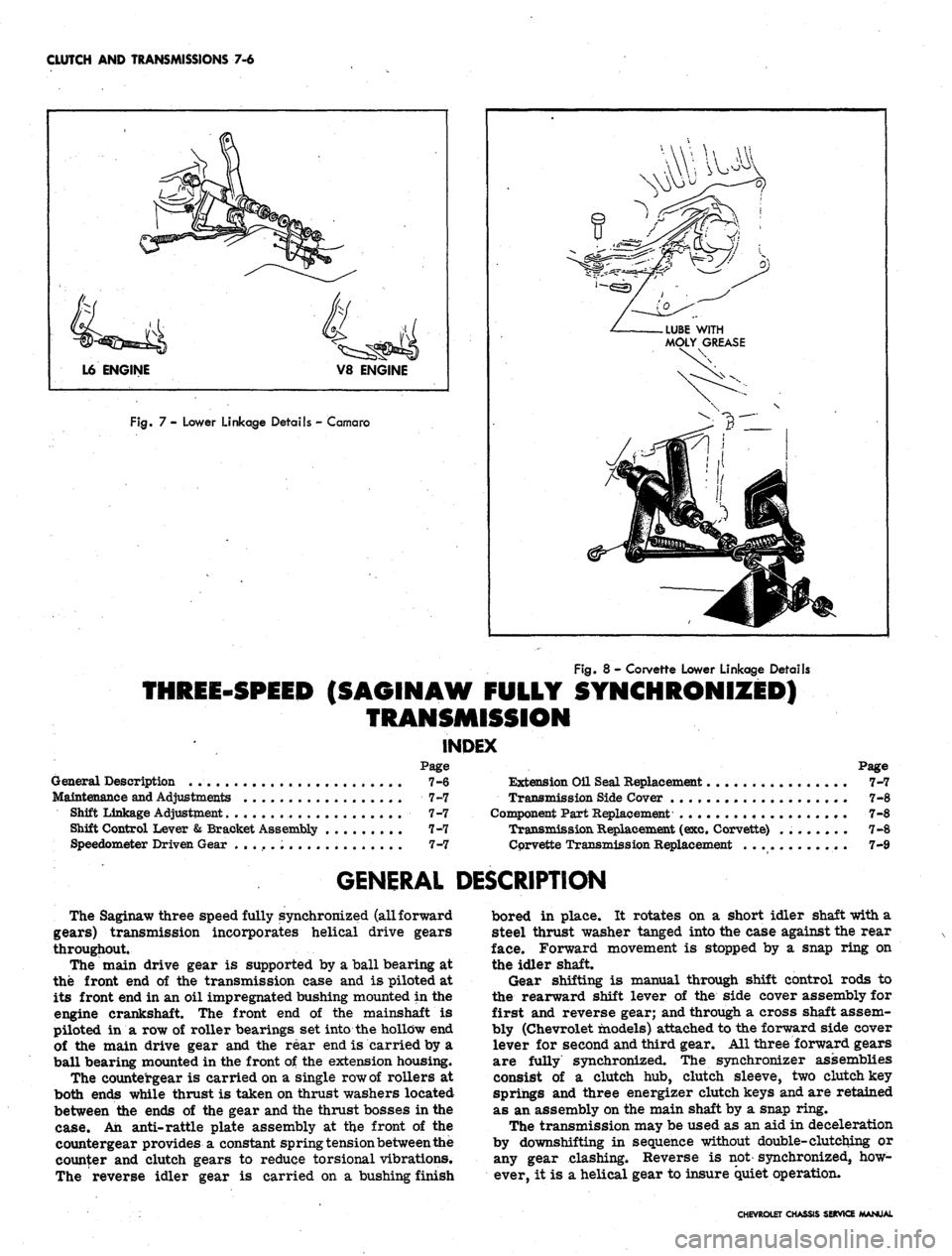
Fig.
7 - Lower Linkage Details - Camaro
Fig.
8 - Corvette Lower Linkage Details
THREE-SPEED (SA6INAW FULLY SYNCHRONIZED)
TRANSMISSION
General Description . .
Maintenance and Adjustments
Shift Linkage Adjustment
Shift Control Lever
&
Bracket Assembly
Speedometer Driven Gear ..........
INDEX
Page Page
7-6 Extension Oil Seal Replacement 7-7
7-7 Transmission Side Cover 7-8
7-7 Component Part Replacement 7-8
7-7 Transmission Replacement (exc. Corvette) . 7-8
7-7 Corvette Transmission Replacement 7-9
GENERAL DESCRIPTION
The Saginaw three speed fully synchronized (all forward
gears) transmission incorporates helical drive gears
throughout.
The main drive gear is supported by a ball bearing at
the front end of the transmission case and is piloted at
its front end in an oil impregnated bushing mounted in the
engine crankshaft. The front end of the mainshaft is
piloted in a row of roller bearings set into the hollow end
of the main drive gear and the rear end is carried by a
ball bearing mounted in the front of the extension housing.
The countergear is carried on a single row of rollers at
both ends while thrust is taken on thrust washers located
between the ends of the gear and the thrust bosses in the
case.
Ah anti-rattle plate assembly at the front of the
countergear provides a constant spring tension between the
counter and clutch gears to reduce torsional vibrations.
The reverse idler gear is carried on a bushing finish
bored in place. It rotates on a short idler shaft with a
steel thrust washer tanged into the case against the rear
face. Forward movement is stopped by a snap ring on
the idler shaft.
Gear shifting is manual through shift control rods to
the rearward shift lever of the side cover assembly for
first and reverse gear; and through a cross shaft assem-
bly (Chevrolet models) attached to the forward side cover
lever for second and third gear. All three forward gears
are fully synchronized. The synchronizer assemblies
consist of a clutch hub, clutch sleeve, two clutch key
springs and three energizer clutch keys and are retained
as an assembly on the main shaft by a snap ring.
The transmission may be used as an aid in deceleration
by downshifting in sequence without double-clutching or
any gear clashing. Reverse is not- synchronized, how-
ever, it is a helical gear to insure quiet operation.
CHEVROLET CHASSIS SERVICE MANUAL
Page 366 of 659

CLUTCH AND TRANSMISSIONS 7-7
MAINTENANCE AND ADJUSTMENTS
CHEVROLET, CHEVELLE, CHEVY II, CAMARO,
SHIFT LINKAGE ADJUSTMENT
In cases where the gearshift linkage has been discon-
nected, it should be adjusted as follows:
1.
Move both transmission shift levers until transmis-
sion is in neutral. Neutral detents in transmission
cover must both be engaged to make this adjustment
correctly. (To check, start engine with clutch dis-
engaged, and release clutch slowly.)
2.
Move selector lever to neutral position. Align first
and reverse tube lever with the second and third
shifter tube lever on the mast jacket. This may be
done by having an assistant hold the mast .jacket shift
levers aligned in neutral position or use a simple
gauge or pin to align these levers in neutral.
3.
Make necessary adjustment to align shift control
rods and transmission levers in neutral position.
Move selector lever through all positions to check ad-
justment and to insure over-travel in all positions.
FLOOR SHIFT LINKAGE ADJUSTMENT
1.
Set Transmission Levers (K) and (L) in neutral de-
tent position.
2.
Move Transmission Control Lever (A) to neutral de-
tent and insert Locating Pin (D) into notch of Lever
and Bracket Assembly.
3.
Install Nut (N) and Clevis (M) on Rod (J) loosely,
attach Rod to Lever (B) and secure with retainer.
4.
With Lever (B) against Locating Pin, adjust Clevis
at Lever (L) until Clevis pin passes freely through
holes and secure with washer and cotter pin. Tighten
Nut (N).
5.
Install Nuts (E) and (G) and Swivel (F) loosely on Rod
(H),
attach Rod to Lever (K) and secure with retainer.
6. With Lever (C) against Locating Pin, attach Swivel to
lever and secure with retainer. iRun Nut (G) against
Swivel, then tighten Nut (E) against Swivel.
7.
Remove Locating Pin and check shifts to insure
proper operation. Readjust clevis and swivel if nec-
essary.
LEVER (A)
LEVER (L) CLEVIS (M)-NUT (N
LEVER (C)
ROD(J).
" - -
LEVER (K) ROD (H)^ NUT '(G) SWIVEL (F) ^NUT (E)
SHIFT CONTROL LEVER AND BRACKET ASSEMBLY
If disassembly of this control lever and bracket assem-
bly is necessary refer to Figure 2A for parts breakdown
and relative positioning for assembly.
SPEEDOMETER DRIVEN GEAR
Disconnect speedometer cable, remove lock plate to ex-
tension bolt and lock washer and remove lock plate. In-
sert screwdriver in lock plate slot in fitting and pry fitting
gear and shaft from extension. Pry "O" ring from groove
in fitting.
Install new "OM ring in groove in fitting. Coat "O" ring
and driven gear shaft with transmission lubricant and in-
sert shaft.
Hold the assembly so slot in fitting is toward lock plate
boss on extension and install in extension. Push fitting
into extension until lock plate can be inserted in groove
and attach to extension.
EXTENSION OIL SEAL REPLACEMENT
.1.
Remove propeller shaft as outlined in Section 4 and
disconnect any necessary items to obtain clearance.
2.
Pry seal out of extension.
3.
Wash counterbore with cleaning solvent and inspect
for damage.
4.
Prelubricate between sealing lips and coat new seal
O.D. with Permatex or equivalent and start straight
in bore in case extension. Using Tool J-5154, tap
seal into counterbore until flange bottoms against
extension.
Fig.
1A- Shift Linkage Adjustment (Typical)
Fig.
2A - Corvette 3 Speed Control Lever and Bracket Assembly
CHEVROLET CHASSIS SERVICE MANUAL
Page 367 of 659

CLUTCH AND TRANSMISSIONS 7-3
DETENT CAM
DETENT SPRING
DETENT CAM
2-3 SHIFT
FORK
DETENT CAM
PIVOT PIN
1ST & REV. 1ST& REV.
SHIFTER SHAFT SHIFT FORK
DETENT CAM
RETAINER RING
2-3 SHIFTER SHAFT
Fig. 3A
•*
Transmission Side Cover, Shift Fork and Detent Assembly
5. Reinstall propeller shaft and any items removed to
obtain clearance.
TRANSMISSION SIDE COVER
Removal •
1.
Disconnect control rods from levers; remove 2-3
cross shaft (Chevrolet)
2.
Shift transmission into neutral detent positions before
removing cover.
3.
Remove cover assembly from transmission case
carefully and allow oil to drain.
Disassembly (Fig. 3A)
1.
Remove the outer shifter levers.
2.
Remove both shift forks from shifter shaft assem-
blies.
Remove both shifter shaft assemblies from
cover. "OM ring seals around shifter shaft may now
be pryed out if replacement is required because of
damage.
3.
Remove detent cam spring and pivot retainer "C"
ring. Remove both detent cams.
4.
Replace damaged parts.
Assembly (Fig. 3A)
1.
With,
detent spring tang projecting up over the
2nd
and
3rd shifter shaft cover opening install the first and
reverse detent cam onto the detent cam pivot pin.
With the detent spring tang projecting up over the
first and reverse shifter shaft cover hole install the
2nd an£ 3rd detent cam.
2.
Install detent cam retaining "C" ring to pivot shaft,
and hook spring into detent cam notches.
3.
Install both shifter shaft assemblies in cover being
careful not to damage seals. Install both shift forks
to shifter shaft assemblies^ lifting up on detent cam
to allow forks to fully seat into position.
4.
Install outer shifter levers, flat washers, lock wash-
ers and bolts.
Installation
1.
Shift shifter levers into neutral detent (center) posi-
tion.
Position cover gasket on case.
2.
Carefully position side cover into place making sure'
the shift forks are aligned with their respective
mainshaft clutch sliding sleeves.
3.
Install cover attaching bolts and tighten evenly to
specified torque.
4.
Remove filler plug and add lubricant specified in
Section 0, to level of filler plug hole.
COMPONENT PART REPLACEMENT
TRANSMISSION REPLACEMENT (EXC. CORVETTE)
Removal From Vehicle
1.
Remove propeller shaft assembly.
2.
Disconnect speedometer cable at transmission.
3.
Disconnect shifter rods at transmission levers.
4.
Support engine assembly.
5. Remove transmission to clutch housing bolts.
6. Remove transmission crossmember to mount bolts.
7. Loosen transmission crossmember and move rear-
ward or remove.
8. Slide transmission rearward and remove.
Installation in Vehicle
1.
Raise transmission into position and slide forward
piloting clutch gear retainer into clutch housing.
2.
Install transmission to clutch housing retaining bolts
and lock washers, torque to 50 ft. lbs.
3.
Repositioning transmission crossmember and install
retaining bolts.
4.
Install transmission crossmember to mount bolts.
5. Connect and adjust shift rods at transmission levers
and cordon shaft to 2nd and 3rd lever on Chevrolet
Models. (Fig. 4A)
Fig. 4A - Chevrolet 2-3 Shift Lever Cordon Shaft
CHEVROLET CHASSIS SERVICE MANUAL
Page 368 of 659
CLUTCH AND TRANSMISSIONS 7-9
6. Connect speedometer cable.
7. Install propeller shaft assembly.
8. Fill transmission with lubricant specified in Section
O.
CORVETTE TRANSMISSION REPLACEMENT
, 1. Disconnect battery ground cable.
2.
Pisassemble transmission shift control lever by un-
screwing ball from lever, lifting out
"T"
handle re-
turn spring and "T" handle, then remove the anti-
rattle bushings.
3.
Raise front and rear of vehicle.
4.
Insert a block of wood between the top of the dif-
ferential carrier housing and the underbody (to pre-
vent upward travel of the carrier when the carrier
front support is disconnected).
5. Disconnect the differential carrier front supportfrom
its frame bracket, by removing the nut on the under-
side of the biscuit mount.
6. Pry the carrier downward to relieve load while re-
moving the two center mounting bolts from the car-
rier front support. (To pry carrier downward insert
crowfoot end of a pry bar through the opening in the
carrier front support, hooking end of bar over top of
the center mounting bolt pad cast in the underside of
the carrier.)
7. Pivot carrier support downward for access to prop
shaft "U" joint.
8.
.
Disconnect prop shaft front and then rear "U" bolts.
9. Disconnect parking brake cable from ball socket at
idler lever located near center of underbody.
10.
Remove prop shaft by moving shaft forward.
11.
Remove heat deflectors from the right and left ex-
haust pipe.
12.
Remove left bank exhaust pipe.
13.
Remove right bank exhaust pipe and heat riser.
14.
Disassemble the transmission mount, as follows:
a. Remove the two bolts that attach rear mount
cushion to the rear mount bracket.
b.
Support engine under oil pan and raise engine to
remove load from rear mount cushion.
CAUTION: To avoid damage to oil pan, a suit-
able wide base, heavy wood platform should be
placed between the jack pad and the oil pan.
c. Remove the three transmission mount bracket-
to-
crossm ember bolts and remove mount bracket.
d. Remove the two bolts from mount pad to trans-
mission case and remove rubber mount cushion
and exhaust pipe "yoke".
15.
Disconnect transmission linkage by removing the
shift levers at the transmission side cover.
16.
Disconnect speedo cable at transmission extension.
17.
Remove transmission output shaft slip yoke.
NOTE:
The yoke is removed to avoid tearing
the heat reflecting pad on the underbody, when
the transmission is being removed.
18.
Remove two bolts to disconnect the transmission
gearshift control lever and bracket assembly from
its adapter plate on side of transmission. Lower
transmission assembly from the vehicle, letting the
gearshift lever slide down and through the dust boot
in the console.
19.
Remove transmission-to-clutch housing attaching
bolts.
20.
Slide transmission assembly rearward from clutch
and rotate transmission for access to the three flat
head machine screws in the control lever bracket
adapter plate. Remove adapter plate. Rotate trans-
mission back to the upright position.
21.
To allow room for transmission removal slowly
lower the rear of engine until the tachometer drive
cable at the distributor just clears the horizontal
ledge across the front of dash.
CAUTION: The tachometer cable can be easily
damaged by heavy contact with the dash. Slide
transmission rearward out of the clutch, then
tip front end of transmission downward and
lower the assembly from vehicle.
22.
Reinstall transmission assembly by performing above
steps in reverse order.
TRANSMISSION OVERDRIVE
INDEX
Page
General
Description 7-10
Maintenance
and Adjustments 7—10
Governor
Switch and Pinion .............. 7-10
Sun
Gear Solenoid Oil Seal and Control
Cable
Bracket 7-10
Case
Rear Oil Seal 7-10
Removal
7-10
Installation
. . . . . 7-10
Control
Shaft Lever and Oil Seal 7-10
Speedometer
Driven Gear 7-10
Electrical
Unit Checks 7-11
Overdrive
Relay . 7-11
Page
Air
Gap 7-11
Point
Opening 7-11
Closing
Voltage 7-11
Solenoid
. 7-11
Closing
Coil 7-11
Engaging
Spring . - 7-11
Ignition
Grounding Contact . 7-11
Governor
Switch 7-11
Kickdown
Switch 7-11
Diagnosis
- Overdrive 7-12
Mechanical
. 7-12
Electrical
7-13
CHEVROLET CHASSIS SERVICE MANUAL
Page 369 of 659

CLUTCH AND TRANSMISSIONS 7-10 ,
GENERAL DESCRIPTION
The overdrive unit is essentially a two-speed planetary-
transmission attached to the rear of a conventional three-
speed transmission. In overdrive, engine speed is ap-
proximately 30 per cent slower at a given road speed
since the drive train includes planetary gears which pro-
vide a lower overall gear ratio than that obtained in high
gear with the conventional transmission.
The electrical equipment which controls the automatic
action of the mechanical portion of the overdrive unit
consists of a solenoid, a speed-sensitive governor switch,
a relay and a kickdown switch. The circuit including this
equipment makes it possible to operate in overdrive above
a pre-set cut-in speed, or in .conventional drive at any
speed.
With the overdrive unit engaged, the transmission
should not be left in any forward gear with intent of lock-
ing the drive-line as the overrunning clutch is a free-
wheeling condition.
SERVICING THE OVERDRIVE
With the,overdrive assembly removed from the trans-
mission, service operations on the transmission proper
are the same as for the standard three-speed trans-
mission.
Repairs to the overdrive housing, output shaft, ring
gear assembly, clutch cam, roller retainer, pinion cage,
sun gear, shift rail, sun gear control plate, output shaft
bearing, oil seal, speedometer drive gear, solenoid pawl
and interlock plunger may be performed underneath the
car, if so desired, by removing the overdrive housing
without disturbing the transmission. Refer to Overhaul
Manual for Service Procedure.
If the transmission mainshaft, overdrive adapter or
transmission rear bearing which is retained in adapter
require replacement, the entire transmission and over-
drive assembly should be removed and overhauled on the
bench.
MAINTENANCE AND ADJUSTMENTS
Servicing of the overdrive governor switch and pinion,
the sun gear solenoid, oil seal and cable bracket, the out-
put shaft rear oil seal, the control shaft lever, and the
speedometer driven gear may be accomplished without
removing the overdrive from the vehicle, as discussed
in the following paragraphs:
GOVERNOR SWITCH AND PINION
To remove governor switch, disconnect wires at gover-
nor switch and screw governor
out
of housing, using Tool
J-4653 on the flat hexagonal surface of governor case.
The pinion may be separated from the governor by re-
moving the snap ring on the shaft.
SUN GEAR SOLENOID, OIL SEAL AND
CONTROL CABLE BRACKET
Remove the solenoid by taking out the two mounting
bolts and lock washers, removing
the.
cable bracket with
the lower bolt. Turn the solenoid 1/4 turn and
pull,
sole-
noid plunger out of adapter. The oil seal may be pried
out of the adapter.
CASE REAR OIL SEAL
Removal
1.
Remove propeller shaft as outlined in Section 4.
2.
Using a punch against seal in housing, pry out seal
from housing.
Installation
1.
Prelubricate between sealing lips and coat outside of
new oil seal with a suitable sealant, then start seal
into bore in overdrive housing.
2.
Using Tool J-5154 drive oil seal into counterbore.
3.
Install propeller shaft as outlined in Section 4.
CONTROL SHAFT LEVER AND/OR "O" RING
OIL SEALS
To remove- the control shaft, disconnect the cpntrol
cable, remove tapered pin and pull lever out. Replace
the two "0" ring seals on the control shaft. Insert shaft
and new "O" ring seals into housing and install tapered
pin. Connect control wire to lever.
SPEEDOMETER DRIVEN GEAR
Disconnect speedometer cable, remove lock plate to
housing bolt and lock washer and remove lock plate. In-
sert screw driver in lock plate slot in fitting and pry
fitting, gear and shaft from housing. Pry "O" ring from
groove in guide.
Install new "O" ring in groove in fitting and insert
shaft.
Hold the assembly so slot in fitting is toward lock plate
boss on housing and install in housing. Push fitting into
housing until lock plate can be inserted in groove and
attached to housing.
L
dl
ZAIR GAP
km (CHECK WITH
M*= POINTS BARELY
'A
AoWER
|^
POINT
0 ADJUST
=^ i
SUPPORT
Fig. IB - Checking Relay Air Gap
CHEVROLET CHASSIS SERVICE MANUAL