Page 264 of 372

2644-1. DRIVING TIPS
Additional weight increases fuel
consumption.
Attached parts on the vehicle
impair the aerodynamics and
increase the fuel consumption.
Open windows increase air
resistance and therefore lead to
greater fuel consumption.
Tires can affect consumption in
various ways, for instance tire
size may influence consump-
tion.
Check and, if needed, correct
the tire inflation pressure at least
twice a month and before start-
ing on a long trip.
Low tire inflation pressure
increases rolling resistance and
thus raises fuel consumption
and tire wear.Do not wait for the engine to
warm-up while the vehicle
remains stationary. Start driving
right away, but at moderate
engine speeds.
This is the quickest way of
warming the cold engine up to
operating temperature.
Driving smoothly and proactively
reduces fuel consumption.
Avoid unnecessary acceleration
and braking.
By maintaining a suitable dis-
tance to the vehicle driving
ahead of you.
Driving at low engine speeds
lowers fuel consumption and
reduces wear.
If necessary, observe the vehi-
cle's gear shift indicator, refer to
page 148.
When approaching a red light,
take your foot off the accelerator
and let the vehicle coast to a
halt.
For going downhill take your foot
off the accelerator and let the
Remove unnecessary
cargo
Remove attached parts fol-
lowing use
Closing the windows
Tires
General information
Check the tire inflation pres-
sure regularly
Drive away without delay
Look well ahead when
driving
Avoid high engine speeds
Use coasting conditions
Page 270 of 372

2705-1. MOBILITY
This chapter describes all stan-
dard, country-specific and
optional features offered with
the series. It also describes fea-
tures and functions that are not
necessarily available in your
vehicle, e.g., due to the selected
options or country versions. This
also applies to safety-related
functions and systems. When
using these functions and sys-
tems, the applicable laws and
regulations must be observed.
The tire characteristics and tire
inflation pressure influence the
following:
• The service life of the tires.
• Road safety.
• Driving comfort.
• Fuel consumption.The tire inflation pressure table,
refer to page 273, contains all
tire inflation pressure specifica-
tions for the specified tire sizes
at the ambient temperature. The
tire inflation pressure values
apply to tire sizes approved by
the manufacturer of the vehicle
for the vehicle type.
To identify the correct tire infla-
tion pressure, please note the
following:
If the tire's speed code cannot
be found, then the tire inflation
pressure for the corresponding
tire size applies.
• Tire sizes of your vehicle.
• Maximum permitted driving
speed.
Wheels and tires
Vehicle features and
options
Tire inflation pressure
General information
Safety information
WARNING
A tire with too little or no tire infla-
tion pressure may heat up signifi-
cantly and sustain damage. This
will have a negative impact on
aspects of handling, such as
steering and braking response.
There is a risk of an accident.
Regularly check the tire inflation
pressure, and correct it as
needed, for instance twice a
month and before a long trip.
Tire inflation pressure
specifications
In the tire inflation pressure
table
Page 271 of 372

2715-1. MOBILITY
5
MOBILITY
The current tire inflation pres-
sure values and the intended
tire inflation pressure values for
the mounted tires can be dis-
played on the Control Display.
To ensure that they are dis-
played correctly, the tire sizes
must be stored in the system
and must have been set, refer to
page 287, for the mounted tires.
The current tire inflation pres-
sure value is located on each
tire.
The reference tire inflation pres-
sure value is located in the
lower area of the Control Dis-
play.
Tires heat up while driving. The
tire inflation pressure increases
with the tire temperature.
Tires have a natural, consistent
loss of tire inflation pressure.
The displays of inflation devices
may under-read by up to 0.1
bar/2 psi.The tire inflation pressure speci-
fications in the tire inflation pres-
sure table only relate to cold
tires or tires at the same tem-
perature as the ambient tem-
perature.
Only check the tire inflation
pressure levels when the tires
are cold, i.e.:
• Driving range of max. 1.25
miles/2 km has not been
exceeded.
• If the vehicle has not moved again for at least 2 hours after
a trip.
Check the tire inflation pressure
of the emergency wheel in the
cargo area regularly, and correct
it as needed.
1 Determine, refer to page 270,
the intended tire inflation
pressure levels for the
mounted tires.
2 Check the tire inflation pres-
sure in all four tires, using a
pressure gauge, for example.
3 Correct the tire inflation pres-
sure if the actual tire inflation
pressure deviates from spec-
ified tire inflation pressure.
4 Check whether all valve caps
are screwed onto the tire
valves.
On the Control Display
Checking the tire inflation
pressure
General information
Checking using tire inflation
pressure specifications in
the tire inflation pressure
table
Page 272 of 372

2725-1. MOBILITY
Via Toyota Supra Command:
1"My vehicle"
2 "Vehicle status"
3 "Tire Pressure Monitor"
4 Check whether the current
tire inflation pressure levels
deviate from the intended tire
pressure value.
5 Correct the tire inflation pres-
sure if the actual tire inflation
pressure deviates from spec-
ified tire inflation pressure.
The display of the current tire
pressure may be limited when
the vehicle is stationary. After a
short drive, the tire pressure is
updated.
With tires that cannot be found
in the tire pressure values on
the Control Display, reset the
Tire Pressure Monitor TPM.
For speeds of up to 100
mph/160 km/h and for optimum
driving comfort, note the pres-
sure values in the tire inflation
pressure table, refer to page
273, and adjust as necessary. These pressure values can also
be found on the tire inflation
pressure label on the driver's
door pillar.
Do not exceed a speed of 100
mph/160 km/h.
Checking using the tire infla-
tion pressure specifications
on the Control Display
After correcting the tire infla-
tion pressure
Tire inflation pressures up
to 100 mph/160 km/h
Page 273 of 372
2735-1. MOBILITY
5
MOBILITY
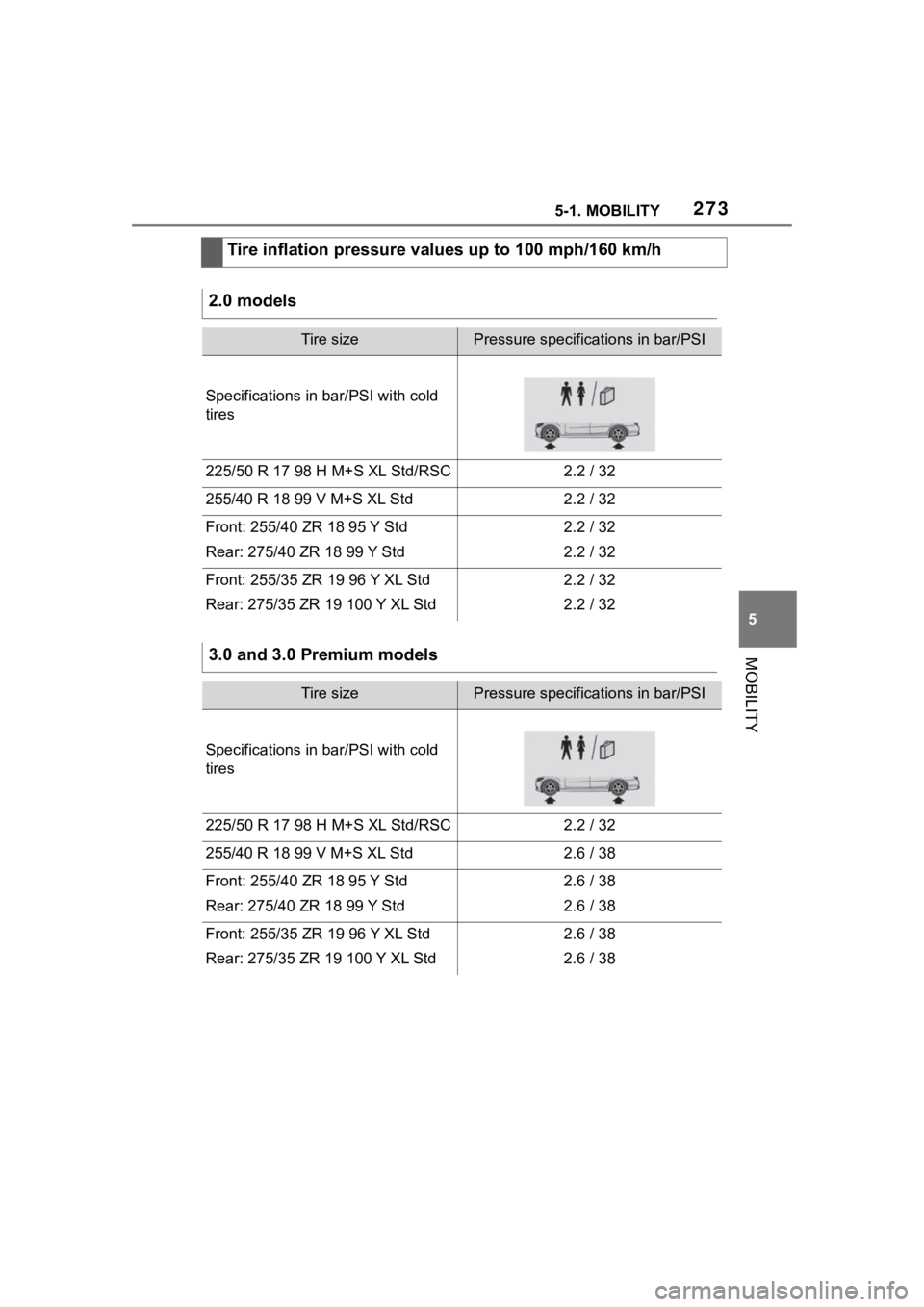
Tire inflation pressure values up to 100 mph/160 km/h
2.0 models
Tire sizePressure specifications in bar/PSI
Specifications in bar/PSI with cold
tires
225/50 R 17 98 H M+S XL Std/RSC2.2 / 32
255/40 R 18 99 V M+S XL Std2.2 / 32
Front: 255/40 ZR 18 95 Y Std
Rear: 275/40 ZR 18 99 Y Std2.2 / 32
2.2 / 32
Front: 255/35 ZR 19 96 Y XL Std
Rear: 275/35 ZR 19 100 Y XL Std2.2 / 32
2.2 / 32
3.0 and 3.0 Premium models
Tire sizePressure specifications in bar/PSI
Specifications in bar/PSI with cold
tires
225/50 R 17 98 H M+S XL Std/RSC2.2 / 32
255/40 R 18 99 V M+S XL Std2.6 / 38
Front: 255/40 ZR 18 95 Y Std
Rear: 275/40 ZR 18 99 Y Std2.6 / 38
2.6 / 38
Front: 255/35 ZR 19 96 Y XL Std
Rear: 275/35 ZR 19 100 Y XL Std2.6 / 38
2.6 / 38
Page 274 of 372
2745-1. MOBILITY
For speeds over 100 mph/160
km/h and for optimum driving
comfort, note the pressure val-
ues in the tire inflation pressure
table, refer to page 275, and
adjust as necessary.Tire inflation pressures at
max. speeds above 100
mph/160 km/h
WARNING
In order to drive at maximum
speeds in excess of 100 mph/160
km/h, please obser
ve, and, if nec-
essary, adjust tir e pressures for
speeds exceeding 100 mph/160
km/h from t he relevant table on
the following pages. Otherwise,
tire damage and accidents could
occur.
Page 275 of 372
2755-1. MOBILITY
5
MOBILITY
Tire inflation pressure values over 100 mph/160 km/h
2.0 models
Tire sizePressure specifications in bar/PSI
Specifications in bar/PSI with cold
tires
225/50 R 17 98 H M+S XL Std/RSC2.2 / 32
255/40 R 18 99 V M+S XL Std2.2 / 32
Front: 255/40 ZR 18 95 Y Std
Rear: 275/40 ZR 18 99 Y Std2.2 / 32
2.2 / 32
Front: 255/35 ZR 19 96 Y XL Std
Rear: 275/35 ZR 19 100 Y XL Std2.2 / 32
2.2 / 32
3.0 and 3.0 Premium models
Tire sizePressure specifications in bar/PSI
Specifications in bar/PSI with cold
tires
225/50 R 17 98 H M+S XL Std/RSC2.2 / 32
255/40 R 18 99 V M+S XL Std2.6 / 38
Front: 255/40 ZR 18 95 Y Std
Rear: 275/40 ZR 18 99 Y Std2.6 / 38
2.6 / 38
Front: 255/35 ZR 19 96 Y XL Std
Rear: 275/35 ZR 19 100 Y XL Std2.6 / 38
2.6 / 38
Page 278 of 372

2785-1. MOBILITY
Winter and all-season tires with
better cold weather performance
than summer tires.
Do not drive with a tire tread of
less than 0.12 in/3 mm, other-
wise there is an increased risk
of hydroplaning.
Do not drive with a tire tread of
less than 0.16 in/4 mm, as such
tires are less suitable for winter
operation.Distributed over the tire circum-
ference are the tire manufac-
turer's wear indicators with a
height of at least 0.06 in/1.6
mm, which serve as an indicator
of tire tread wear.
The positions of the wear indica-
tors are marked on the tire side-
wall with TWI, Tread Wear
Indicator.
Irrespective of the wear indica-
tors, observe the statutory regu-
lations on the minimum tread
depth.
Inspect your tires regularly for
damage, foreign objects lodged
in the tread, and tread wear.
Driving over rough or damaged
road surfaces, as well as debris,
curbs and other obstacles can
cause serious damage to
wheels, tires and suspension
parts. This is more likely to
WARNING
The temperature grade for this tire
is established for a tire that is
properly inflated and not over-
loaded. Excessive speed, under-
inflation, or excessive loading,
either separately or in combina-
tion, can cause heat buildup and
possible tire failure.
M+S
Tire tread
Summer tires
Winter tires
Minimum tread depth
Tire damage
General information