2023 TOYOTA SUPRA suspension
[x] Cancel search: suspensionPage 9 of 372

91-1. NOTES
1
NOTES
turer to optimize vehicle func-
tions.
The majority of this data is vola-
tile and is only processed within
the vehicle itself. Only a small
share of data is stored in event
or fault memories based on an
event.
When servicing, for instance
during repairs, service pro-
cesses, warranty cases, and
quality assurance measures,
this technical information can be
read out from the vehicle
together with the vehicle identifi-
cation number.
Your Toyota dealer can read out
the information. The socket for
OBD Onboard Diagnosis
required by law in the vehicle is
used to read out the data.
The data is collected, pro-
cessed, and used by the rele-
vant organizations in the service
network. The data documents
technical conditions of the vehi-
cle, helps with the identification
of the fault, compliance with
warranty obligations and quality
improvement.
The data from the vehicle can
also be used to check customer
claims for warranty and guar-
anty.
Fault and event memories in the
vehicle can be reset when your
Toyota dealer performs repair or
servicing work.Depending on the vehicle equip-
ment, comfort and Customize
settings can be stored in the
vehicle and modified or reset at
any time.
For example, this includes:
• Setting for the seat position.
• Suspension and climate con-
trol settings.
If necessary, data can be trans-
ferred to the entertainment and
communication system of the
vehicle, e.g. via smartphone.
This includes the following
depending on the respective
equipment:
• Multimedia data such as music, films or photos for
playback in an integrated mul-
timedia system.
• Address book data for use in conjunction with an integrated
hands-free system or an inte-
grated navigation system.
• Entered navigation destina- tions.
• Data on the use of Internet services.
This data can be stored locally
in the vehicle or is found on a
device that has been connected
to the vehicle, e.g., a smart-
phone, USB stick or MP3 player.
If this data is stored in the vehi- Data entry and data trans-
fer into the vehicle
General information
Page 137 of 372
1373-1. CONTROLS
3
CONTROLS
Adaptive variable suspension.
Steering.
Display in the instrument clus-
ter.
Cruise control.
When drive-ready state is
switched on, the NORMAL driv-
ing mode is selected automati- cally.
■Concept
Balanced tuning between
dynamic and efficient driving.
■Concept
Dynamic tuning for higher agility
with an optimized chassis and
suspension.
■Switching on
■Concept
Customize settings can be
adjusted in the customize driv-
ing mode.
■Configuration
Via Toyota Supra Command:
1 "My Vehicle"
2 "Vehicle settings"
3 "Configure SPORT INDIVID-
UAL"
4 Select the desired setting.
Reset Customize to the stan-
dard settings:
"Reset to SPORT STANDARD".
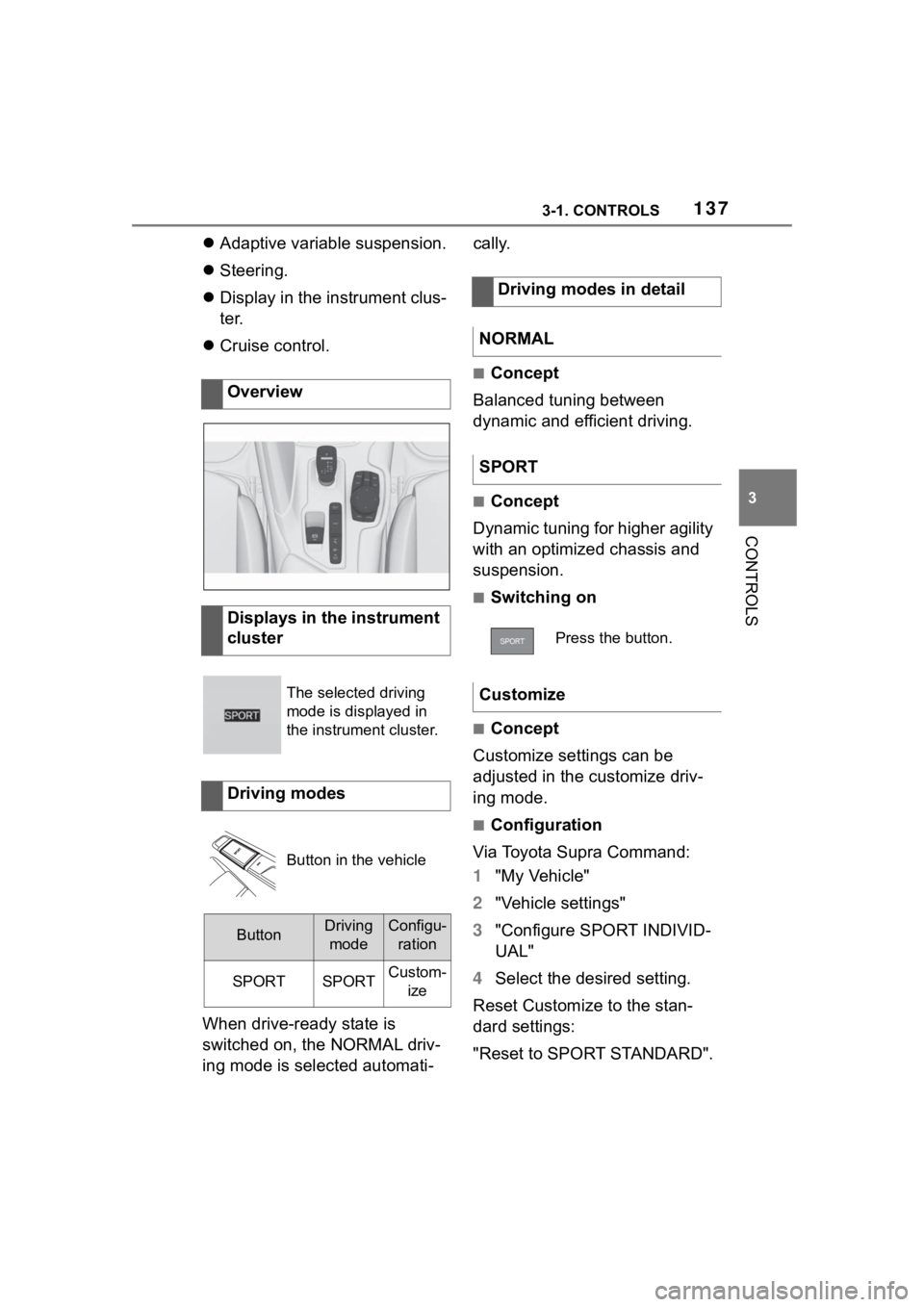
Overview
Displays in the instrument
cluster
The selected driving
mode is displayed in
the instrument cluster.
Driving modes
Button in the vehicle
ButtonDriving
modeConfigu- ration
SPORTSPORTCustom- ize
Driving modes in detail
NORMAL
SPORT
Press the button.
Customize
Page 231 of 372
2313-1. CONTROLS
3
CONTROLS
Additional information:
• Radar sensors, refer to page 42.
The system may not be fully
functional in the following situa-
tions:
In tight curves.
When crossing objects move
at a very slow or a very fast
speed.
If other objects are in the cap-
ture range of the sensors, that
hide cross traffic. This chapter describes all stan-
dard, country-specific and
optional features offered with
the series. It also describes fea-
tures and functions that are not
necessarily available in your
vehicle, e.g., due to the selected
options or country versions. This
also applies to safety-related
functions and systems. When
using these functions and sys-
tems, the applicable laws and
regulations must be observed.
The chassis components are
optimized for the vehicle and its
scope of application and thereby
ensure the best possible Driving
Dynamics.
*: if equipped
The Adaptive variable suspen-
sion is an intelligent, controllable
sport chassis/suspension.
The suspension reduces body
movements with a sporty driving
style or on an uneven road.
System limits
System limits of the sensors
Functional limitations
Driving comfor t
Vehicle features and
options
Chassis components
Adaptive variable suspen-
sion*
Principle
Page 278 of 372

2785-1. MOBILITY
Winter and all-season tires with
better cold weather performance
than summer tires.
Do not drive with a tire tread of
less than 0.12 in/3 mm, other-
wise there is an increased risk
of hydroplaning.
Do not drive with a tire tread of
less than 0.16 in/4 mm, as such
tires are less suitable for winter
operation.Distributed over the tire circum-
ference are the tire manufac-
turer's wear indicators with a
height of at least 0.06 in/1.6
mm, which serve as an indicator
of tire tread wear.
The positions of the wear indica-
tors are marked on the tire side-
wall with TWI, Tread Wear
Indicator.
Irrespective of the wear indica-
tors, observe the statutory regu-
lations on the minimum tread
depth.
Inspect your tires regularly for
damage, foreign objects lodged
in the tread, and tread wear.
Driving over rough or damaged
road surfaces, as well as debris,
curbs and other obstacles can
cause serious damage to
wheels, tires and suspension
parts. This is more likely to
WARNING
The temperature grade for this tire
is established for a tire that is
properly inflated and not over-
loaded. Excessive speed, under-
inflation, or excessive loading,
either separately or in combina-
tion, can cause heat buildup and
possible tire failure.
M+S
Tire tread
Summer tires
Winter tires
Minimum tread depth
Tire damage
General information
Page 287 of 372
2875-1. MOBILITY
5
MOBILITY
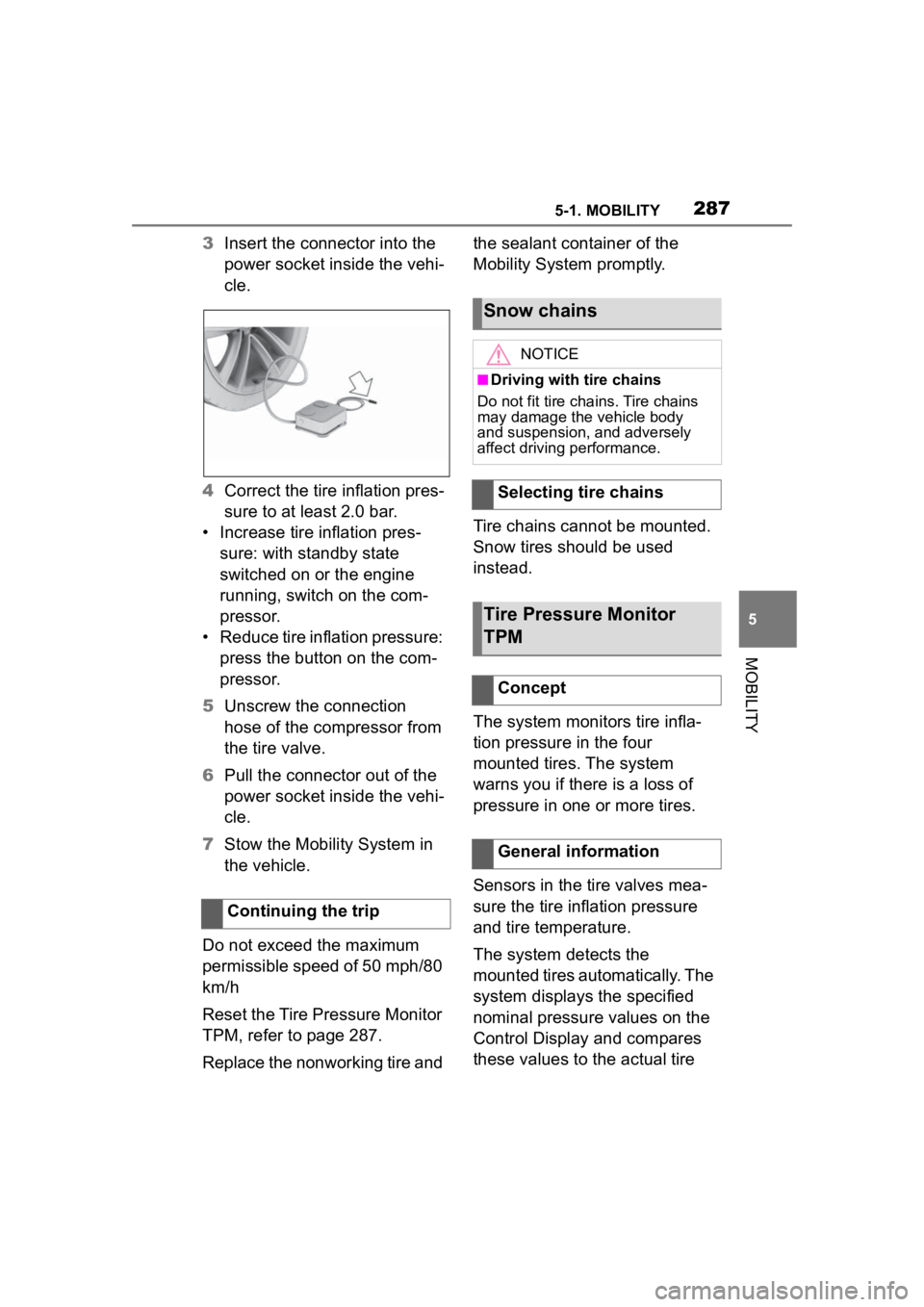
3Insert the connector into the
power socket inside the vehi-
cle.
4 Correct the tire inflation pres-
sure to at least 2.0 bar.
• Increase tire inflation pres- sure: with standby state
switched on or the engine
running, switch on the com-
pressor.
• Reduce tire inflation pressure: press the button on the com-
pressor.
5 Unscrew the connection
hose of the compressor from
the tire valve.
6 Pull the connector out of the
power socket inside the vehi-
cle.
7 Stow the Mobility System in
the vehicle.
Do not exceed the maximum
permissible speed of 50 mph/80
km/h
Reset the Tire Pressure Monitor
TPM, refer to page 287.
Replace the nonworking tire and the sealant container of the
Mobility System promptly.
Tire chains cannot be mounted.
Snow tires should be used
instead.
The system monitors tire infla-
tion pressure in the four
mounted tires. The system
warns you if there is a loss of
pressure in one or more tires.
Sensors in the tire valves mea-
sure the tire inflation pressure
and tire temperature.
The system detects the
mounted tires automatically. The
system displays the specified
nominal pressure values on the
Control Display and compares
these values to the actual tire
Continuing the trip
Snow chains
NOTICE
■Driving with tire chains
Do not fit tire chains. Tire chains
may damage the vehicle body
and suspension, and adversely
affect driving performance.
Selecting tire chains
Tire Pressure Monitor
TPM
Concept
General information
Page 326 of 372
3265-1. MOBILITY
2Attach one terminal clamp of
the positive jumper cable to
the positive terminal of the
battery, or to the correspond-
ing starting aid terminal of the
vehicle providing assistance.
3 Attach the terminal clamp on
the other end of the cable to
the positive terminal of the
battery, or to the correspond-
ing starting aid terminal of the
vehicle to be started.
4 Attach one terminal clamp of
the negative jumper cable to
the negative terminal of the
battery, or to the correspond-
ing engine or body ground of
assisting vehicle.
5 Attach the second terminal
clamp to the negative termi-
nal of the battery, or to the
corresponding engine or
body ground of the vehicle to
be started.
Never use spray fluids to start
the engine.
1 Start the engine of the assist-
ing vehicle and let it run for
several minutes at an
increased idle speed.
2 Start the engine of the vehicle
that is to be started in the
usual way.
If the first starting attempt is not
successful, wait a few minutes
before making another attempt in order to allow the discharged bat-
tery to recharge.
3
Let both engines run for sev-
eral minutes.
4 Disconnect the jumper
cables in the reverse order.
Check the battery and recharge,
if needed.
Starting the engine
Tow-starting and towing
Safety information
WARNING
Due to system limits, individual
functions can malfunction during
tow-starting/towing with the Toy-
ota Supra Safety systems acti-
vated. There is a risk of an
accident. Switch all Toyota Supra
Safety systems off prior to
tow-starting/towing.
Manual transmission
Safety information
NOTICE
The vehicle can become dam-
aged when lifting and securing it.
There is a risk of damage to prop-
erty.
●Lift the vehicle using suitable
means.
●Do not lift or secure the vehicle
by its tow fitting, body parts, or
suspension parts.
Page 328 of 372

3285-1. MOBILITY
To remove a broken-down vehi-
cle from the hazardous area,
push it for a short distance at a
speed of no more than 6 mph/10
km/h.
For rolling or pushing the vehi-
cle, refer to page 133.
The vehicle should only be
transported on a loading plat-
form.
Switch on the hazard warning
system, depending on local reg-
ulations.
If the electrical system has
failed, clearly identify the vehicle
being towed by placing a sign or a warning triangle in the rear
window.
The tow fittings used should be
on the same side on both vehi-
cles.
Should it prove impossible to
avoid mounting the tow bar at
an offset angle, please follow
the following:
Maneuvering capability is lim-
ited going around corners.
The tow bar will generate lat-
eral forces if it is secured with
an offset.
NOTICE
●Do not lift or se cure the vehicle
by its tow fitting, body parts, or
suspension parts.
Pushing the vehicle
Tow truck
Towing other vehicles
General information
Safety information
WARNING
If the approved gross vehicle
weight of the towing vehicle is
lighter than the vehicle to be
towed, the tow fitting can tear off
or it will not be possible to control
the vehicle's response. There is a
risk of an accident. Make sure
that the gross v ehicle weight of
the towing vehicle is heavier than
the vehicle to be towed.
NOTICE
If the tow bar or tow rope is
attached incorrectly, damage to
other vehicle pa rts can occur.
There is a risk of damage to prop-
erty. Correctly a ttach the tow bar
or tow rope to the tow fitting.
Tow bar
Page 360 of 372

360Alphabetical Index
Alphabetical Index
A
A/C button, see Air conditioning............................................... 235
ABS, Antilock Brake System . 199
ACC, see Dynamic radar cruise control with fu ll-speed range
............................................... 209
Acceleration Assistant, see Launch Control..................... 135
Accessories and parts ............... 6
Activated charcoal filter ........ 238
Active Guard, see Toyota Supra Safety .................................... 176
Adaptive brake assist ............ 199
Adaptive variable suspension ............................................... 231
Additional coolant tank cooling, Capacity ................................ 342
Additives, engine oil types .... 304
Air circulation, see Recircu- lated-air mode....................... 236
Air conditioning ...................... 235
Air distribution, manual ......... 237
Air flow, automa tic air condition-
ing .......................................... 237
Air outlets, see Ventilation .... 238
Air pressure, tires .................. 270
Airbags .................................... 164
Airbags, indicator and warning light........................................ 166
Alarm system ............................ 95
Alarm, unintentional................. 96
All-season tires, see Winter tires ............................................... 281
Antilock Brake System, ABS . 199
Anti-slip control, see VSC ..... 200
Anti-theft protection, locking .. 82
Anti-theft protection, see Lug bolt lock ................................ 296
Apple CarPlay, connection to the vehicle ..................................... 76 Approved axle load ................341
Approved total weight ............341
Assistance when driving off, see
Hill-start assist control.........200
Assistance with breakdown ..322
AUTO program, automatic air conditioning ........ ..................236
Auto Start/Stop function ........ 119
Automatic air conditioning ....233
Automatic cruise control with Stop & Go ..............................209
Automatic Curb Monitor, exte- rior mirror .............................. 110
Automatic deactivation, front-seat passenger airbags...............................................175
Automatic headlight control ..157
Automatic high-beam .............160
Automatic locking ....................94
Automatic transmission.........131
Automatic transmission, Fluid ...............................................342
Automatic transmission, see Automatic transm ission.......131
Automatic unlocking ................94
Automatic vehicle wash .........331
Autonomous Emergency Brak- ing ..........................................196
Axle loads, weights ................341
B
Backrest curvature, see Lumbar support ................ ..................103
Backrest tilt .............................102
Backrest, seats .........................99
Backrest, width .......................103
Bar for tow-starting/towing....328
Battery, changing, remote con- trol of the vehicle ....................84
Battery, disposing of ..............314
Battery, vehicle .. .....................313