2023 TOYOTA RAIZE light
[x] Cancel search: lightPage 231 of 516
2294-5. Using the driving support systems
RAIZE_OM_General_BZ358E
Driving
4
⚫The projection range may be different depending on the vehicle and
road conditions.
⚫The projection range of the rear-view camera is limited. The camera
does not capture items located near both edges of the bumper or those
located under the bumper.
⚫Since the rear-view camera uses a special lens, the distance in the cam-
era view is different from the actual distance.
⚫The colors of the rear-view camera image may appear different from the
actual colors.
⚫Anything placed above the rear-view camera may not appear on the
monitor.
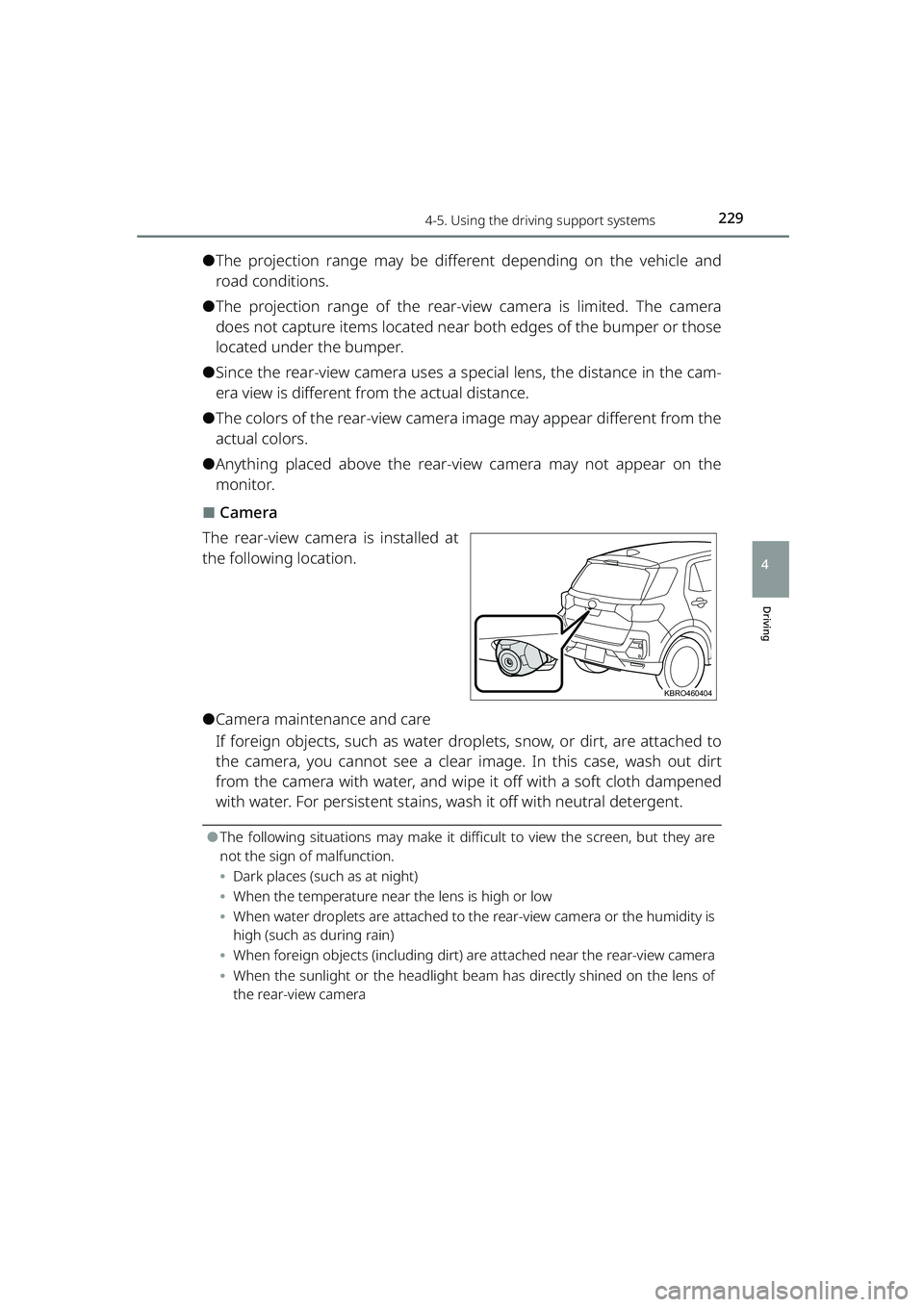
⬛Camera
The rear-view camera is installed at
the following location.
⚫Camera maintenance and care
If foreign objects, such as water dr oplets, snow, or dirt, are attached to
the camera, you cannot see a clear image. In this case, wash out dirt
from the camera with water, and wipe it off with a soft cloth dampened
with water. For persistent stains, wash it off with neutral detergent.
⚫The following situations may make it diff icult to view the screen, but they are
not the sign of malfunction.
⦁ Dark places (such as at night)
⦁ When the temperature near the lens is high or low
⦁ When water droplets are attached to th e rear-view camera or the humidity is
high (such as during rain)
⦁ When foreign objects (including dirt) are attached near the rear-view camera
⦁ When the sunlight or the headlight be am has directly shined on the lens of
the rear-view camera
KBRO460404
RAIZE_OM_General_BZ358E.book 229 ページ 2022年5月17日 火曜日 午後1時59分
Page 233 of 516
2314-5. Using the driving support systems
RAIZE_OM_General_BZ358E
Driving
4
NOTICE
⬛Camera handling
⚫Be careful with the following since they could cause the rear-view camera to
malfunction.
⦁Do not install any item around the camera, which could interfere with the
camera’s field of view (such as an item blocking the view or light-emitting
objects, items made of shiny materials).
⦁ Do not apply strong impact to the ca mera unit, such as hitting it hard or
bumping it against another object. Doing so could cause the camera posi-
tion or mounting angle to be deviated.
⦁ The camera unit has a waterproof structure. Do not remove, disassemble
or alter it.
⦁ When you wash the camera lens, use water to wash the dirt off from the
camera and wipe it off with a so ft cloth dampened with water.
If you rub the camera lens too hard, it could scratch the camera lens, and
you will not be able to see clear images.
⦁ The camera’s cover is made of resin. Do not allow organic solvents, body
wax, oil film remover, and glass coating agent to get attached to it. If they
get attached, wipe it off immediately.
⦁ Do not expose it to rapid temperature changes, such as by pouring hot
water over it in cold weather.
⦁ Do not splash water directly to the camera or areas around the camera
using a high-pressure washer during a car wash. The high water pressure
adds stress and may prevent the system from working properly.
⚫Applying shock to the camera unit may cause the camera to malfunction.
Have the vehicle inspected at your Toyo ta dealer in your earliest conveni-
ence.
RAIZE_OM_General_BZ358E.book 231 ページ 2022年5月17日 火曜日 午後1時59分
Page 235 of 516

2334-5. Using the driving support systems
RAIZE_OM_General_BZ358E
Driving
4
When VSC/TRC is operating
When VSC/TRC is operating, the slip
indicator flashes.
To s t o p T R C
If TRC is activated when escaping from a muddy, sandy, or snowy road, the
engine output may not increase even when the accelerator pedal is
depressed, making it difficult to escape. In such a case, pressing
may make it easier to escape.
Press to stop TRC
The TRC OFF indicator lights.
Press again to return to system
ready state.
⬛To stop VSC and TRC
To stop VSC and TRC, press and hold for 3 seconds or more when the
vehicle has come to a stop.
The TRC OFF indicator and VS C OFF indicator light up.
Press again to return to system ready state.
⬛When the TRC OFF indicator lights up without pressing
The TRC and hill-start assist control ca nnot be activated. Contact your Toyota
dealer.
KBRO460201E
KBRO460202E
RAIZE_OM_General_BZ358E.book 233 ページ 2022年5月17日 火曜日 午後1時59分
Page 236 of 516

2344-5. Using the driving support systems
RAIZE_OM_General_BZ358E
⬛Activation of ABS/VSC
ABS/VSC does not work at low speeds. The operation is the same as the nor-
mal brake.
⬛Activation sound and vibration of the ABS, brake assist, VSC, TRC, and hill-
start assist control
⚫A sound may be heard from the engine compartment when the brake pedal
is depressed repeatedly, when the engine is started or just after the vehicle
begins to move. This sound does not indicate that a malfunction has
occurred in any of these systems.
⚫Any of the following conditions may occur when the above systems are oper-
ating. None of them indicates that a malfunction has occurred.
⦁ Vibrations may be felt through th e vehicle body and steering wheel
⦁ A motor sound may be heard even after the vehicle has come to a stop
⦁ The brake pedal may pulsate slightly after the ABS is activated
⦁ The brake pedal may move down slightly after the ABS is activated
⬛EPS motor operation sound
When the steering wheel is operated, a motor sound (whirring sound) may be
heard, but this does not indicate a malfunction.
⬛Automatic reactivation of VSC and TRC
After turning the TRC and VSC systems off, the systems will return to the ready
state in the following situations:
⚫When the engine switch is turned to “OFF”
⚫If only the TRC system is turned off, when vehicle speed increases
If both the TRC and VSC systems are tu rned off, automatic reactivation will
not occur when vehicle speed increases.
⬛Reduced effectiveness of the EPS system
The effectiveness of the EPS system is reduced to prevent the system from
overheating when there is frequent steering input over an extended period of
time. The steering wheel ma y feel heavy as a result.
Should this occur, refrain from excessive steering input or stop the vehicle and
turn the engine off. It should re turn to normal within 10 minutes.
RAIZE_OM_General_BZ358E.book 234 ページ 2022年5月17日 火曜日 午後1時59分
Page 238 of 516

2364-5. Using the driving support systems
RAIZE_OM_General_BZ358E
WARNING
⬛The ABS does not operate effectively when
⚫Do not overly rely on the ABS.
The limits of tire gripping performance have been exceeded (such as exces-
sively worn tires on a snow covered road).
⚫The vehicle hydroplanes while driving at high speed on wet or slick roads.
⬛Stopping distance when the ABS is operating may exceed that of normal
conditions
The ABS is not designed to shorten th e vehicle’s stopping distance. Always
maintain a safe distance from the vehicle in front of you, especially in the fol-
lowing situations:
⚫When driving on dirt, grav el or snow-covered roads
⚫When driving with tire chains
⚫When driving over bumps in the road
⚫When driving over roads with potholes or roads with uneven surfaces
⬛TRC/VSC may not operate effectively when
⚫Do not overly rely on the TRC/VSC.
Directional control and power may not be achievable while driving on slip-
pery road surfaces, even if the TRC/VSC system is operating.
Drive the vehicle carefully in condit ions where stability and power may be
lost.
⚫The VSC and TRC may not function proper ly when tire chains are installed.
⬛Hill-start assist control does not operate effectively when
⚫Do not overly rely on hill-start assist control. Hill-start assist control may not
operate effectively on steep inclines an d dirt, gravel or snow-covered roads.
⚫Unlike the parking brake, hill-start assist control is not intended to hold the
vehicle stationary for an extended period of time. Do not attempt to use hill-
start assist control to hold the vehicle on an incline, as doing so may lead to
an accident.
⚫The hill-start assist control may no t become activated depending on the
number of occupants or luggage weight in the vehicle, or if the driver did not
step on the brake pedal strong enough when stopping.
⬛When the VSC is activated
The slip indicator light flashes. Always drive carefully. Reckless driving may
cause an accident. Exercise particular care when the indicator light flashes.
⬛When the ABS warning light or slip indicator is on
The emergency brake signal ( ➞P. 232) may not be activated.
RAIZE_OM_General_BZ358E.book 236 ページ 2022年5月17日 火曜日 午後1時59分
Page 240 of 516

238
RAIZE_OM_General_BZ358E
4-6. Driving tips
Winter driving tips
Carry out the necessary preparations and inspections before driving
the vehicle in winter. Always drive the vehicle in a manner appropri-
ate to the prevailing weather conditions.Preparation for winter
⚫Use fluids that are appropriate to the prevailing outside temperatures.
⦁ Engine oil
⦁ Coolant
⦁ Washer fluid
⚫Have a service technician inspec t the condition of the battery.
Before driving
Perform the following according to the driving conditions:
⚫Do not try to forcibly open a window or move a windshield wiper that is
frozen. Pour warm water over the frozen area to melt the ice. Wipe away
the water immediately to prevent it from freezing.
⚫To ensure proper operation of the air conditioning system fan, remove
any snow that has accumulated on the air inlet vents in front of the
windshield.
⚫Check for and remove any excess ice or snow that may have accumu-
lated on the exterior lights, vehicle’s roof, around the tires or on the
brakes.
⚫Look under the vehicle and check that there are no ice blocks around
the ground. Remove any attached ice blocks with great care to avoid
damaging vehicle components. Also check that the pedals and steering
wheel move smoothly.
⚫Remove any snow or mud from the bottom of your shoes before getting
in the vehicle.
RAIZE_OM_General_BZ358E.book 238 ページ 2022年5月17日 火曜日 午後1時59分
Page 241 of 516
2394-6. Driving tips
RAIZE_OM_General_BZ358E
Driving
4
When driving the vehicle
⚫Accelerate the vehicle slowly, keep a safe distance between you and the
vehicle ahead, and drive at a reduced speed suitable to road conditions.
⚫During snowfall or cold weather, water adhering to the brake system
may freeze, and the brakes may become less effective. If brake perfor-
mance is poor, paying close attention to the surrounding safety, lightly
depress the brake pedal several times to confirm that the brakes work
properly until their effectiveness is restored.
⚫When driving on snowy roads, snow attached to the back of the wheel
wells freezes and may grad ually accumulate, making it difficult to steer.
Check that there is no abnormal build-up of snow from time to time. The
lights may become dark due to snow during driving, so make sure that
there is no abnormal build-up of snow from time to time.
When parking the vehicle
⚫The parking brake may freeze up, preventing it from being released. For
continuously variable transmission vehicles, set the shift lever to P. For
the manual transmission vehicles, set the shift lever to R on a downhill,
and set it to the gear 1 on an uphill to park. Do not apply the parking
brake at this time, and make sure to use wheel chocks.
Failure to do so may be dangerous because it may cause the vehicle to
move unexpectedly, possibly leading to an unforeseen accident.
⚫When you park the continuously variable transmission vehicle without
applying the parking brake, confirm that the shift lever will not move*
with the shift lever being placed in P.
*The shift lever will be locked if it is attempted to be shifted from P to any other
position without depressing the brake pe dal. If the shift lever can be shifted,
there may be a problem with the shift lo ck system. Have the vehicle inspected at
your Toyota dealer immediately.
RAIZE_OM_General_BZ358E.book 239 ページ 2022年5月17日 火曜日 午後1時59分
Page 243 of 516
2414-6. Driving tips
RAIZE_OM_General_BZ358E
Driving
4
Eco-friendly driving tips
For improved fuel economy and reduced CO2 emissions, pay atten-
tion to the following points:
◆Accelerator pedal/brake pedal operation
Drive your vehicle smoothly. Avoid abrupt acceleration and deceleration.
Gradual acceleration and deceleration will help reduce excessive fuel con-
sumption.
◆When braking
Observe conditions in front of and around the vehicle, and estimate your
stopping position. Release the accele rator pedal early and continue coast-
ing. Use the brake pedal to adjust your stopping position.
Make sure to operate the brake pedal gently.
◆Delays
Repeated acceleration and deceleration, as well as long waits at traffic
lights, will lead to bad fuel economy. Check traffic reports before leaving
and avoid delays as much as possible.
◆Highway driving
Control and maintain the vehicle at a constant speed. Before stopping at a
toll booth or similar, allow plenty of time to release the accelerator pedal
and gently apply the brakes.
◆Air conditioning
Use the air conditioning only when necessary. Doing so can help
reduce excessive fuel consumption.
In summer: When the ambient temper ature is high, use the recirculated
air mode. Doing so will help to redu ce the burden on the air conditioning
system and reduce fuel consumption as well.
In winter: Turn the A/C switch on on ly when both heating and dehumidify-
ing are needed, and if only heating is needed, turn the A/C switch off.
Turning the A/C switch on when unnece ssary leads to excessive fuel con-
sumption.
RAIZE_OM_General_BZ358E.book 241 ページ 2022年5月17日 火曜日 午後1時59分