2023 SUBARU BRZ lock
[x] Cancel search: lockPage 232 of 432
Fuel
2266. Stop filling the tank after the fuel filler
pump automatically stops. Do not add any
more fuel.
7. Put the cap back on and turn it clock-
wise until you hear a clicking noise. Be
certain not to catch the tether under the
cap while tightening.
8. Close the fuel filler lid completely.
NOTE You will see the “ ” sign in the
fuel gauge. This indicates that the fuel
filler lid is located on the right side of
the vehicle.
If the fuel filler cap is not tightened
until it clicks or if the tether is caught
under the cap, the CHECK ENGINE
warning light/malfunction indicator
light may illuminate. Refer to "CHECK
ENGINE Warning Light/Malfunction
Indicator Light" P136.
To lock the fuel filler lid, perform one
of the operations below. However if
these operations are performed when
the fuel filler lid is open, the fuel filler
lid will not lock when it is subsequently
closed. - Press the “ ” button on the key
fob.
- Press the lock side of the power
door locking switch.
WARNING
When refueling, insert the fuel
nozzle securely into the fuel filler
pipe. If the nozzle is lifted or not
fully inserted, its automatic stop-
ping mechanism may not func-
tion, causing fuel to overflow the
tank and creating a fire hazard. Stop refueling when the auto-
matic stop mechanism on the fuel
nozzle activates. If you continue
to add fuel, temperature changes
or other conditions may cause
fuel to overflow from the tank and
create a fire hazard.
CAUTION
Make sure that the cap is tightened
until it clicks to prevent fuel spillage
in the event of an accident.
CAUTION
Do not let fuel sp ill on the exterior
surfaces of the vehicle. Because
fuel may damage th e paint, be sure
to wipe off any spilled fuel quickly.
Paint damage caused by spilled fuel
is not covered under the SUBARU
Limited Warranty.
CAUTION
Never add any cleaning agents to
the fuel tank. Th e addition of a
cleaning agent may cause
damage to the fuel system. After refuelin g, turn the cap to the
right until it clicks to ensure that it
is fully tightened. If the cap is not
securely tightened, fuel may leak
out while the vehicle is being
driven or fuel spillage could
occur in the event of an accident,
creating a fire hazard. Do not let fuel spill on the exterior
surfaces of the vehicle. Because
fuel may damage the paint, be
sure to wipe off any spilled fuel
quickly. Paint damage caused by
spilled fuel is not covered under
the SUBARU Limited Warranty. Always use a genuine SUBARU
fuel filler cap. If you use the
wrong cap, it may not fit or have
proper venting and your fuel tank
and emission control system may
be damaged. It could also lead to
fuel spillage and a fire.
BRZ_U.book 226 ページ 2022年3月29日 火曜日 午後3時59分
Page 233 of 432
State Emission Testing (U.S. Only)
227
Starting and Operating7
– CONTINUED –
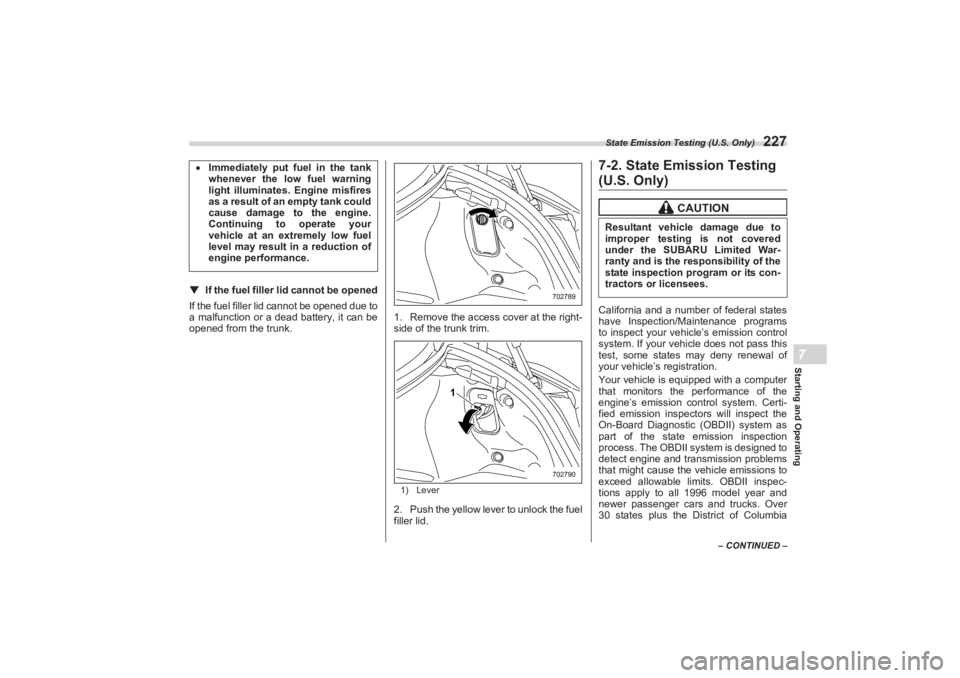
▼If the fuel filler lid cannot be opened
If the fuel filler lid cannot be opened due to
a malfunction or a dead battery, it can be
opened from the trunk. 1. Remove the access cover at the right-
side of the trunk trim.
1) Lever2. Push the yellow lever to unlock the fuel
filler lid.
7-2. State Emission Testing (U.S. Only)California and a number of federal states
have Inspection/Maintenance programs
to inspect your vehicle’s emission control
system. If your vehicle does not pass this
test, some states may deny renewal of
your vehicle’s registration.
Your vehicle is equipped with a computer
that monitors the performance of the
engine’s emission control system. Certi-
fied emission inspectors will inspect the
On-Board Diagnostic (OBDII) system as
part of the state emission inspection
process. The OBDII system is designed to
detect engine and transmission problems
that might cause the vehicle emissions to
exceed allowable limits. OBDII inspec-
tions apply to all 1996 model year and
newer passenger cars and trucks. Over
30 states plus the District of Columbia
Immediately put fuel in the tank
whenever the low fuel warning
light illuminates. Engine misfires
as a result of an empty tank could
cause damage to the engine.
Continuing to operate your
vehicle at an extremely low fuel
level may result in a reduction of
engine performance.
702789
1
702790
CAUTION
Resultant vehicle damage due to
improper testing is not covered
under the SUBARU Limited War-
ranty and is the responsibility of the
state inspection program or its con-
tractors or licensees.
BRZ_U.book 227 ページ 2022年3月29日 火曜日 午後3時59分
Page 236 of 432

Starting and Stopping Engine
230On rare occasions, it may be difficult
to start the engine depending on the
fuel and the usage condition (repeated
driving of a distance in which the
engine has not warmed up suffi-
ciently). In such a case, it is recom-
mended that you change to a different
brand of fuel.
On rare occasions, transient
knocking may be heard from the
engine when the accelerator is oper-
ated rapidly such as a rapid start-up
and a rapid acceleration. This is not a
malfunction.
The engine starts more easily when
the headlights, air conditioner and rear
window defogger are turned off.■ Starting Engine
NOTEWhen pressing the push-button
ignition switch while depressing the
clutch pedal (MT models) or the brake
pedal (AT models): - The engine starter operates for a
maximum of 10 seconds and after
starting the engine, the starter stops
automatically.
- The engine can be started
regardless of the power status.
If the engine does not start, check
the security indicator light. Then press
the push-button ignition switch
without depressing the clutch pedal
(MT models) or the brake pedal (AT
models) to switch the power to “OFF”. - If the light had illuminated, try to
start the engine again.
- If the light had been off, press the
push-button ignition switch while
depressing the clutch pedal (MT
models) or the brake pedal (AT
models) more forcefully.
The engine start procedures may
not function depending on the radio
wave conditions around the vehicle. In
such a case, refer to "Starting Engine"
P326.
If the vehicle battery is discharged,
the steering cannot be unlocked.
Charge the battery.
WARNING
There are some general precau-
tions when starting the engine.
Carefully read the precautions
described in "General Precau-
tions When Starting Engine"
P229. If the steering lock cannot be
released after the engine has
started, never drive the vehicle.
The steering is still locked, and it
may result in an accident.
CAUTION
If a system malfunction warning
message is displayed on the
combination meter, there may be
a malfunction with the vehicle.
Contact a SUBARU dealer imme-
diately. If a steering lock warning
message is displayed on the
combination me ter after the
engine has started, it means that
the steering is still locked. While
moving the steering wheel right
and left, depress the brake pedal,
and press the push-button igni-
tion switch. Do not continue pressing the
push-button ignition switch for
more than 10 seconds. Doing so
could cause a malfunction. If the
engine does not start, stop
pressing the push -button ignition
switch. Instead, press the push-
button ignition switch without
depressing the clutch pedal (MT
models) or the brake pedal (AT
models) to switch the power
status to “OFF”. Wait 10 seconds,
and then press the push-button
ignition switch to start the
engine.
BRZ_U.book 230 ページ 2022年3月29日 火曜日 午後3時59分
Page 238 of 432
Starting and Stopping Engine
232■Stopping Engine1. Stop the vehicle completely.
2. Move the shift lever to neutral (MT
models) or select leve r to the “P” position
(AT models).
3. Press the push-button ignition switch.
The engine will stop, and the power will be
switched off.
NOTEAlthough you can stop the engine by
operating the push -button ignition
switch, do not stop the engine during
driving except in an emergency.■ When Access Key Fob Does
Not Operate ProperlyRefer to "Access Key Fob – If Access Key
Fob Does Not Operate Properly" P325.■ Steering LockAfter stopping the engine and any door is
opened, the steering wheel will be locked
due to the steering lock function.
When the engine is restarted, the steering
lock will be automatically released.
WARNING
Do not touch the push-button
ignition switch during driving.
When the push-button ignition
switch is operated as follows, the
engine will stop.–The switch is pressed and held
for 2 seconds or longer.–The switch is pressed briefly 3
times or more in succession.When the engine stops, the brake
booster will not function. A
greater foot pressure will be
required on the brake pedal.The power steering system will
not operate either. A greater
force will be required to steer,
and it may result in an accident.
If the engine stops during driving,
do not operate the push-button
ignition switch or open any of the
doors until the vehicle is stopped
in a safe location. It is dangerous
because the steering lock may be
activated. Stop the vehicle in a
safe place, and contact a
SUBARU dealer immediately.
CAUTION
For AT models:Do not stop the engine while the
select lever is in a position other
than the “P” position. If the engine is stopped while the
select lever is in a position other
than the “P” position, the power
will be in “ACC”. If the vehicle is
left in this cond ition, the battery
may be discharged.
BRZ_U.book 232 ページ 2022年3月29日 火曜日 午後3時59分
Page 239 of 432
Manual Transmission
233
Starting and Operating7
– CONTINUED –
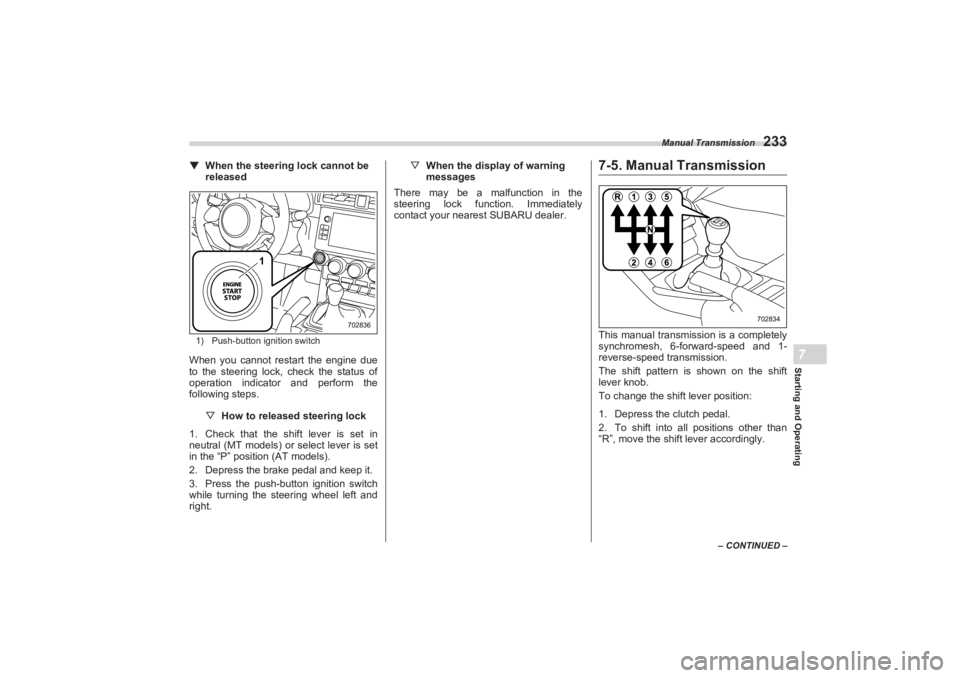
▼When the steering lock cannot be
released1) Push-button ignition switchWhen you cannot restart the engine due
to the steering lock, check the status of
operation indicator and perform the
following steps.
▽How to released steering lock
1. Check that the shift lever is set in
neutral (MT models) or select lever is set
in the “P” position (AT models).
2. Depress the brake pedal and keep it.
3. Press the push-button ignition switch
while turning the steering wheel left and
right. ▽
When the display of warning
messages
There may be a malfunction in the
steering lock function. Immediately
contact your nearest SUBARU dealer.
7-5. Manual TransmissionThis manual transmission is a completely
synchromesh, 6-forward-speed and 1-
reverse-speed transmission.
The shift pattern is shown on the shift
lever knob.
To change the shift lever position:
1. Depress the clutch pedal.
2. To shift into all positions other than
“R”, move the shi ft lever accordingly.
1
702836
702834
BRZ_U.book 233 ページ 2022年3月29日 火曜日 午後3時59分
Page 241 of 432
Automatic Transmission
235
Starting and Operating7
– CONTINUED –
■Driving TipsNOTEIf the accelerator and brake pedals are
depressed at the same time, driving
torque may be restrained. This is not a
malfunction.
Do not drive with your foot resting on the
clutch pedal and do not use the clutch to
hold your vehicle at a standstill on an
upgrade. Either of those actions may
cause clutch damage.
Do not drive with your hand resting on the
shift lever. This may cause wear on the
transmission components. When it is necessary to reduce vehicle
speed due to slow traffic, turning corners,
or driving up steep hills, downshift to a
lower gear before the engine starts to
labor.
On steep downgrades, downshift the
transmission to 5th, 4th, 3rd or 2nd gear
as necessary; this helps to maintain a safe
speed and to extend brake pad life.
In this way, the engine provides a braking
effect. Remember, if you “ride” (over use)
the brakes while descending a hill, they
may overheat and not work properly.
The engine may, on rare occasions, knock
when the vehicle rapidly accelerates or
rapidly pulls away from a standstill. This
phenomenon is not an indication of a
problem in your vehicle.
With the exception of cases where sudden
acceleration is required, do not drive the
vehicle with the pointer of the tachometer
inside the red area. Failure to observe this
precaution can lead to excessive engine
wear and poor fuel economy.
7-6. Automatic TransmissionThe automatic transmission is electroni-
cally controlled and provides 6 forward
speeds and 1 reverse speed. It also has a
manual mode.
WARNING
When shifting down a gear, ensure
that the engine speed does not
enter the red zone. Failure to
observe this precaution can lead to
engine over-revving and this in turn
can result in engine damage.In addition, sudden application of
engine brakes when the vehicle is
travelling on a slippery surface can
lead to wheel locking; as a conse-
quence, control of the vehicle may
be lost and the risk of an accident
increased.
WARNING
Do not shift from the “P” or “N”
position into the “D” or “R” position
while depressing the accelerator
pedal. This may cause the vehicle to
lurch forward or backward.
CAUTION
Observe the following precau-
tions. Failure to observe these
precautions could cause damage
to the transmission.
- Shift into the “P” or “R” posi- tion only after the vehicle has
completely stopped.- Do not shift from the “D” posi- tion into the “R” position or
vice versa until the vehicle
has completely stopped.
BRZ_U.book 235 ページ 2022年3月29日 火曜日 午後3時59分
Page 243 of 432
Automatic Transmission
237
Starting and Operating7
– CONTINUED –
▼P (Park)
This position is for parking the vehicle and
starting the engine. In this position, the
transmission is mechanically locked to
prevent the vehicle from rolling freely.
When you park the vehicle, first apply the
parking brake, then shift into the “P” posi-
tion. Do not hold the vehicle with only the
mechanical friction of the transmission.
To shift the select lever from the “P” to any
other position, you should depress the
brake pedal fully then move the select
lever. This prevents the vehicle from
lurching when it is started.
▼ R (Reverse)
This position is for backing the vehicle. To
shift from the “N” to “R” position, stop the
vehicle completely th en move the lever to
the “R” position.
▼ N (Neutral)
This position is for restarting a stalled
engine. In this position, the transmission is
neutral, meaning that the wheels and
transmission are not locked. Therefore,
the vehicle will roll freely, even on the
slightest incline unless the parking brake
or foot brake is applied. ▼
D (Drive)
This position is for normal driving. The
transmission shifts automatically into a
suitable gear according to the vehicle
speed and the acceleration you require.
Also, while driving up and down a hill, the
transmission assists and controls the
driving performance and engine braking
while corresponding to the road grade.
When more acceleration is required in “D”
position, depress the accelerator pedal
fully to the floor and hold that position. The
transmission will auto matically downshift.
When you release the pedal, the transmis-
sion will return to the original gear posi-
tion.
To use the manual mode, move the lever
from this position into the manual gate.
If one of the shift paddles behind the
steering wheel is operated while driving in
the “D” position, the transmission will
temporarily switch to the manual mode. In
this mode, you can shift into any gear position using the shift paddles. For
details about the manual mode, refer to
"Selection of Manual Mode" P239.
Once the vehicle speed stabilizes, the
transmission will switch from the manual
mode back to the “D” position for normal
driving.
▽ While climbing a grade
When driving up a hill, undesired upshift is
prevented from taking place when the
accelerator is releas ed. This minimizes
the chance of subsequent downshifting to
a lower gear when accelerating again.
This prevents repeated upshifting and
downshifting resulting in a smoother oper-
ation of the vehicle.
NOTEThe transmission may downshift,
depending on the way the accelerator
pedal is depressed to accelerate the
vehicle again.■ Adaptive ControlIn order to realize smoother driving while
driving in “D” position, an appropriate gear
is automatically selected by limiting
upshifting and performing downshifting
operations according to driver operations
and driving conditions.
WARNING
Do not drive the vehicle with the
select lever in the “N” (neutral)
position. Engine braking has no
effect in this co ndition and the risk
of an accident is consequently
increased.
BRZ_U.book 237 ページ 2022年3月29日 火曜日 午後3時59分
Page 244 of 432
Automatic Transmission
238When driving uphill, prevents unneces-
sary upshifting and downshifting.
When driving downhill, downshifting is
performed at engine speeds higher than
usual.
When driving on curves, prevents
upshifting even when accelerating.
When the brake pedal is depressed
firmly, downshifting is automatically
performed, fully utilizing engine braking.
When the accelerator pedal is
suddenly released, prevents upshifting.NOTEAdaptive control operates automati-
cally when the select lever is in the “D”
position. The function is canceled
when the paddle shift levers are oper-
ated or the select lever is shifted to the
“M” position.■ Shift Lock FunctionThe shift lock function helps prevent the
improper operation of the select lever.
The select lever cannot be operated
unless the ignition switch is turned to the
“ON” position and the brake pedal is
depressed.
The select lever cannot be moved from
the “P” position to any other position
before the brake pedal is depressed. Depress the brake pedal first, and then
operate the select lever.
Only the “P” position allows you to turn
the push-button ignition switch to the
“OFF” position.
▼ Shift lock release
If the select lever cannot be operated, turn
the ignition switch back to the “ON” posi-
tion then move the select lever to the “P”
position with the brake pedal depressed.
If the select lever does not move after
performing the above procedure, refer to
"Shift lock release using the shift lock
release portion" P238. ▼
Shift lock release using the shift
lock release portion
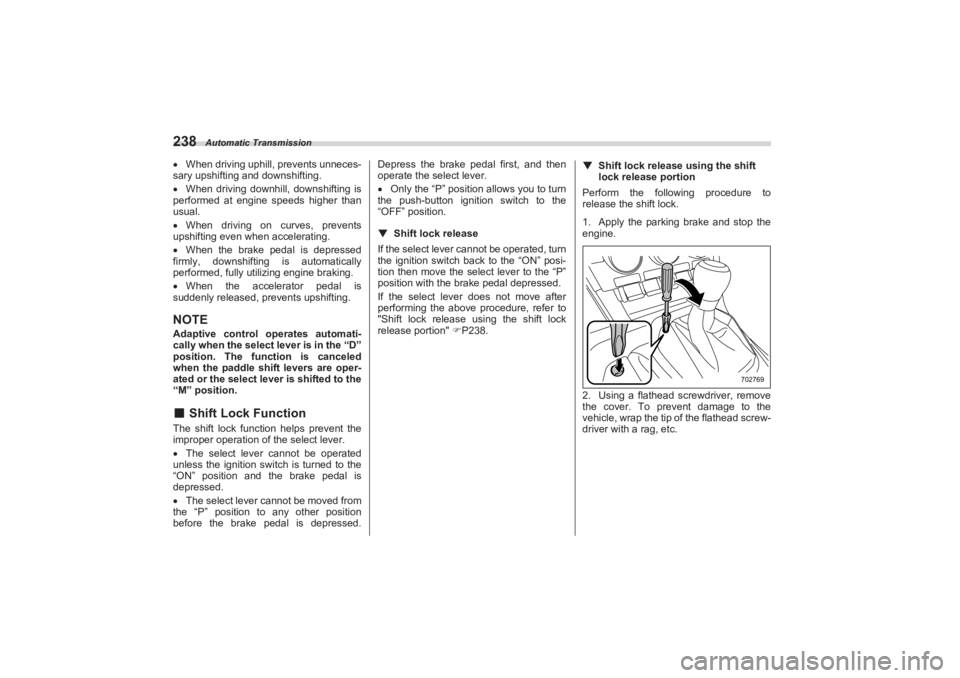
Perform the following procedure to
release the shift lock.
1. Apply the parking brake and stop the
engine.
2. Using a flathead screwdriver, remove
the cover. To prevent damage to the
vehicle, wrap the tip of the flathead screw-
driver with a rag, etc.
702769
BRZ_U.book 238 ページ 2022年3月29日 火曜日 午後3時59分