2023 SUBARU BRZ lock
[x] Cancel search: lockPage 339 of 432

Exterior Care
333
Appearance Care10
– CONTINUED –
▼Using a warm water washer
Keep a good distance of 12 in (30 cm)
or more between the washer nozzle and
the vehicle.
Do not wash the same area continu-
ously.
If a stain will not come out easily, wash
by hand. Some warm water washers are
of the high temperature, high pressure
type, and they can damage or deform the
resin parts such as moldings, or cause
water to leak in to the vehicle.■Waxing and PolishingAlways wash and dry the vehicle before
waxing and polishing.
Use a good quality polish and wax and
apply them according to the manufac-
turer’s instructions. Wax or polish when
the painted surface is cool. Be sure to polish and wax the chrome trim,
as well as the painted surfaces. Loss of
wax on a painted surface leads to loss of
the original luster and also quickens the
deterioration of the surface. It is recom-
mended that a coat of wax be applied at
least once a month, or whenever the
surface no longer repels water.
If the appearance of the paint has dimin-
ished to the point wher e the luster or tone
cannot be restored, lightly polish the
surface with a fine-grained compound.
Never polish just the affected area, but
include the surrounding area as well.
Always polish in only one direction. A No.
2000 grain compound is recommended.
Never use a coarse-grained compound.
Coarser grained compounds have a
smaller grain-size number and could
damage the paint. After polishing with a
compound, coat with wax to restore the
original luster. Frequent polishing with a
compound or an incorrect polishing tech-
nique will result in removing the paint layer
and exposing the undercoat. When in
doubt, it is always best to contact your
SUBARU dealer or an auto paint
specialist.
NOTEBe careful not to block the windshield
washer nozzles with wax when waxing
the vehicle.■ Cleaning Alloy WheelsPromptly wipe the alloy wheels clean of
any kind of grime or agent. If dirt is left on
too long, it may be difficult to clean off.
Do not use soap containing grit to clean
the wheels. Be sure to use a neutral
cleaning agent, and later rinse thoroughly
with water. Do not clean the wheels with a
stiff brush or expose them to a high-speed
washing device.
Clean the vehicle (including the alloy
wheels) with water as soon as possible
when it has been splashed with sea water,
exposed to sea breezes, or driven on
roads treated with salt or other agents.
CAUTION
Be careful not to damage brake
hoses, sensor harnesses, and
other parts when washing
suspension components. Be careful not to flush the engine
bottom for a long time. It may
cause damage of some electrical
parts.
CAUTION
Do not use any agents with organic
solvents on the surface of the bulb
assembly cover. However, if a pol-
ish or wax with organic solvents is
applied to the cover surface, com-
pletely wipe off the polish or wax.
Otherwise, the cover surface may
be damaged.
BRZ_U.book 333 ページ 2022年3月29日 火曜日 午後3時59分
Page 341 of 432
Cleaning the Interior
335
Appearance Care10
– CONTINUED –
Check the interior of the vehicle for water
and dirt accumulation under the floor mats
because that could cause corrosion.
Occasionally check under the mats to
make sure the area is dry.
Keep your garage dry. Do not park your
vehicle in a damp, poorly ventilated
garage. In such a garage, corrosion can
be caused by dampness. If you wash the
vehicle in the garage or put the vehicle
into the garage when wet or covered with
snow, that can cause dampness.
If your vehicle is operated in cold weather
and/or in areas where road salts and other
corrosive materials are used, the door
hinges and locks, trun k lid lock, and hood
latch should be inspected and lubricated
periodically.
10-3. Cleaning the InteriorUse a soft, damp cloth to clean the climate
control panel, audio equipment, instru-
ment panel, center console, combination
meter panel, and switches. (Do not use
organic solvents.)■ Seat Fabric MaterialRemove loose dirt, dust or debris with a
vacuum cleaner. If the dirt is caked on the
fabric or hard to remove with a vacuum
cleaner, use a soft brush then vacuum it.
Wipe the fabric surface with a tightly
wrung cloth and dry the seat fabric thor-
oughly. If the fabric is still dirty, wipe using
a solution of mild soap and lukewarm
water then dry thoroughly.
If the stain does not come out, try a
commercially available fabric cleaner. Use
the cleaner on a hidden place and make
sure it does not affect the fabric adversely.
Use the cleaner according to its instruc-
tions.
NOTEAs the color of the meter visor may
transfer, do not place anything on top
of it.■ Leather Seat MaterialsThe leather used by SUBARU is a high
quality natural product which will retain its
distinctive appearance and feel for many
years with proper care.
Allowing dust or road dirt to build up on the
surface can cause leather to become
brittle and wear prematurely. To maintain
its resiliency, leather should be cleaned
monthly or whenever it becomes soiled.
Before cleaning leather upholstery,
vacuum it to remove dust. Use a soft and
lint-free cloth dampened with lukewarm
water and mild soap, taking care not to
soak the leather or allow water to pene-
trate the stitched seams. Use a gentle
circular motion while cleaning the leather -
do not rub or apply extreme pressure.
Wipe the leather again with another clean,
slightly damp cloth to remove soap
residue and dry with a soft cloth.
Minor surface blemishes or difficult dirt
spots may be treated with a commercial
leather spray. Never use alcohol, cleaning
solvents, leather oils, varnishes or
polishes on your leather as it will dry out
the leather finish.
CAUTION
When cleaning the seat, do not use
benzine, paint thinner, or any simi-
lar materials. Doing so could dam-
age the surface and cause the color
to deteriorate.
BRZ_U.book 335 ページ 2022年3月29日 火曜日 午後3時59分
Page 347 of 432
Maintenance Tips
341
Maintenance and Service11
– CONTINUED –
■When Checking or Servicing
in the Engine Compartment
While the Engine Is Running
11-3. Maintenance TipsSome clips and fender linings must be
removed before replacing the air cleaner
element or specific bulbs.■ Removing and Reinstalling
Clips▼ Removing clips
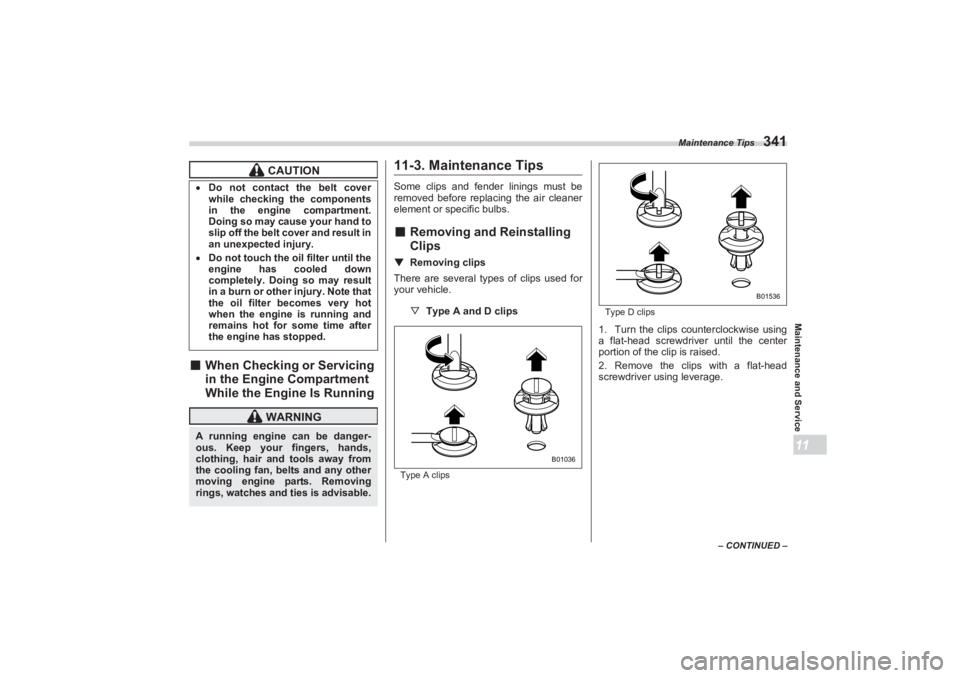
There are several types of clips used for
your vehicle.
▽Type A and D clipsType A clips Type D clips
1. Turn the clips co
unterclockwise using
a flat-head screwdriver until the center
portion of the clip is raised.
2. Remove the clips with a flat-head
screwdriver using leverage.
CAUTION
Do not contact the belt cover
while checking the components
in the engine compartment.
Doing so may cause your hand to
slip off the belt cover and result in
an unexpected injury. Do not touch the o il filter until the
engine has cooled down
completely. Doing so may result
in a burn or other injury. Note that
the oil filter becomes very hot
when the engine is running and
remains hot for so me time after
the engine has stopped.
WARNING
A running engine can be danger-
ous. Keep your fingers, hands,
clothing, hair and tools away from
the cooling fan, belts and any other
moving engine parts. Removing
rings, watches and ties is advisable.
B01036
B01536
BRZ_U.book 341 ページ 2022年3月29日 火曜日 午後3時59分
Page 348 of 432
Maintenance Tips
342
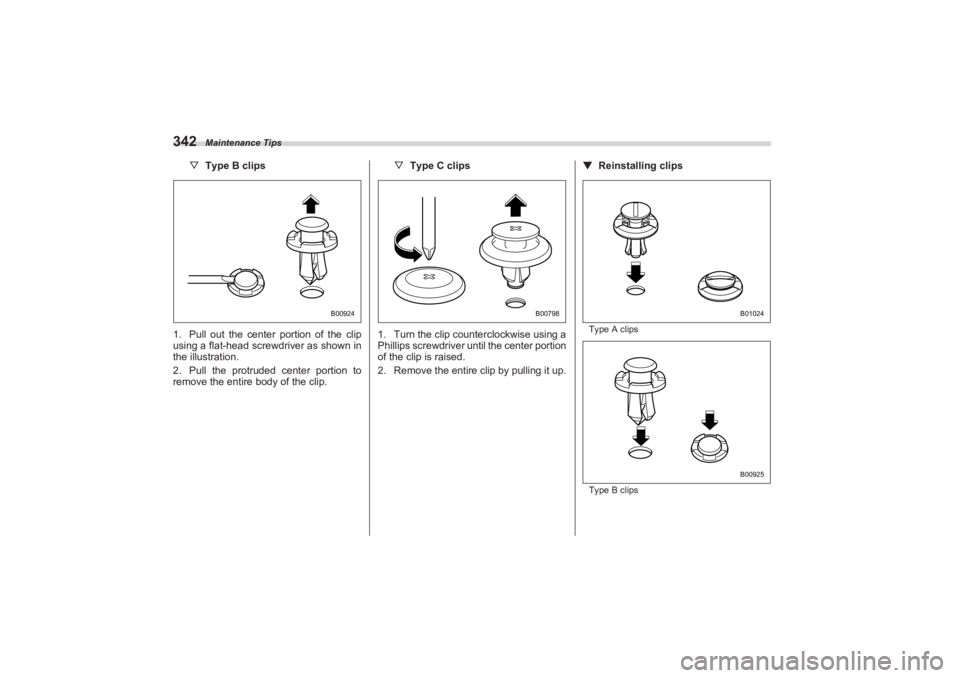
▽Type B clips
1. Pull out the center portion of the clip
using a flat-head screwdriver as shown in
the illustration.
2. Pull the protruded center portion to
remove the entire body of the clip. ▽
Type C clips
1. Turn the clip counterclockwise using a
Phillips screwdriver until the center portion
of the clip is raised.
2. Remove the entire clip by pulling it up. ▼
Reinstalling clips
Type A clips
Type B clips
B00924
B00798
B01024B00925
BRZ_U.book 342 ページ 2022年3月29日 火曜日 午後3時59分
Page 350 of 432
Engine Hood
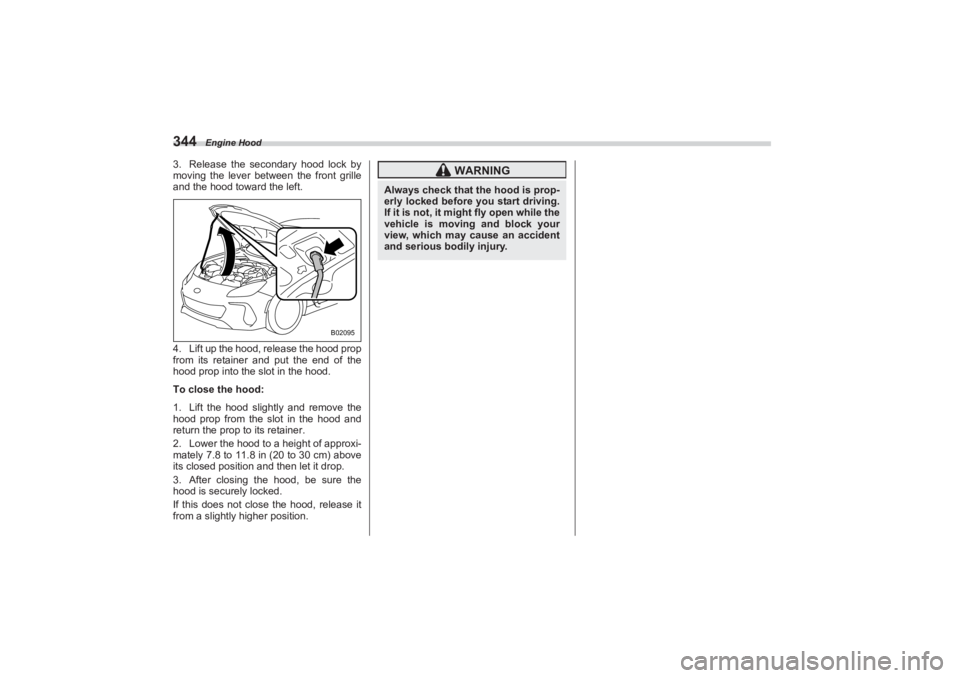
3443. Release the secondary hood lock by
moving the lever between the front grille
and the hood toward the left.
4. Lift up the hood, release the hood prop
from its retainer and put the end of the
hood prop into the slot in the hood.
To close the hood:
1. Lift the hood slightly and remove the
hood prop from the slot in the hood and
return the prop to its retainer.
2. Lower the hood to a height of approxi-
mately 7.8 to 11.8 in (20 to 30 cm) above
its closed position and then let it drop.
3. After closing the hood, be sure the
hood is securely locked.
If this does not close the hood, release it
from a slightly higher position.
B02095
WARNING
Always check that the hood is prop-
erly locked before you start driving.
If it is not, it might fly open while the
vehicle is moving and block your
view, which may cause an accident
and serious bodily injury.
BRZ_U.book 344 ページ 2022年3月29日 火曜日 午後3時59分
Page 363 of 432
Parking Brake Stroke
357
Maintenance and Service11
The disc brakes have audible wear indica-
tors on the brake pads. If the brake pads
wear close to their service limit, the wear
indicator makes a very audible scraping
noise when the brake pedal is applied.
If you hear this scraping noise each time
you apply the brake pedal, have the brake
pads serviced by your SUBARU dealer as
soon as possible.■ Breaking-in of New Brake
Pad s and LiningsWhen replacing the brake pad or lining,
use only genuine SUBARU parts. After
replacement, the new parts must be
broken in as follows.
▼ Brake pad and lining
While maintaining a speed of 30 to 40 mph
(5 0 to 65 km/h), step on the brake pedal
lightly. Repeat this five or more times.
▼ Parking brake lining1. Drive the vehicle at a speed of approx-
imately 22 mph (35 km/h).
2. With the parking brake release button
pushed in, pull the parking brake lever
SLOWLY and GENTLY (pulling with a
force of approximately 33.7 lbf [150 N,
15.3 kgf]). 3. Drive the vehicle for approximately
220 yards (200 meters) in this condition.
4. Wait 5 to 10 minutes for the parking
brake to cool down. Repeat this proce-
dure.
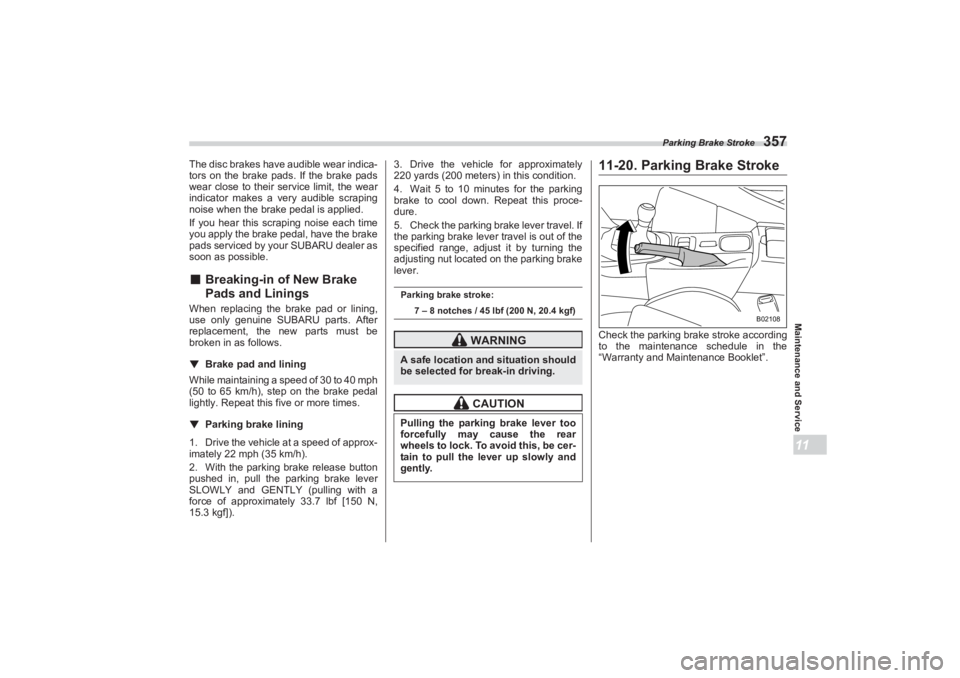
5. Check the parking brake lever travel. If
the parking brake lever travel is out of the
specified range, adjust it by turning the
adjusting nut located on the parking brake
lever.
11-20. Parking Brake StrokeCheck the parking brak e stroke according
to the maintenance schedule in the
“Warranty and Maintenance Booklet”.
Parking brake stroke:
7 – 8 notches / 45 lbf (200 N, 20.4 kgf)
WARNING
A safe location and situation should
be selected for break-in driving.
CAUTION
Pulling the parking brake lever too
forcefully may cause the rear
wheels to lock. To avoid this, be cer-
tain to pull the lever up slowly and
gently.
B02108
BRZ_U.book 357 ページ 2022年3月29日 火曜日 午後3時59分
Page 373 of 432
Replacement of Wiper Blades
367
Maintenance and Service11
– CONTINUED –
If you fill the windshield washer tank with
a fluid with a different concentration from
the one used previously, purge the old
fluid from the piping between the wind-
shield washer tank and washer nozzles by
operating the washer for a certain period
of time. Otherwise, if the concentration of
the fluid remaining in the piping is too low
for the outside temperature, it may freeze
and block the nozzles.
11-24. Replacement of Wiper BladesGrease, wax, insects, or other material on
the windshield or the wiper blade results in
jerky wiper operation and streaking on the
glass. If you cannot remove the streaks
after operating the windshield washer or if
the wiper operation is jerky, clean the
outer surface of the windshield using a
sponge or soft cloth with a neutral deter-
gent or mild-abrasive cleaner. Do not,
however, use detergent to clean the blade
rubbers. Use only a sponge or soft cloth
(and no neutral deterge nt or mild abrasive
cleaner) when you clean the blade
rubbers. If you wipe the rubber of the
blade strongly, the black coating compo-
nent will peel off, which will cause the
wiper to judder. Also, after wiping it off,
check that the rubber has not come loose.
After cleaning the window glass and wiper
blade rubbers, be sure to rinse them with
clean water. Rinse the window until the
water does not form beads on the glass.
This indicates that the glass is clean.
CAUTION
Never use engine coolant as washer
fluid because it could cause paint
damage.
CAUTION
Adjust the washer fluid concen-
tration appropriately for the
outside temperature. If the
concentration is inappropriate,
sprayed washer fluid may freeze
on the windshield and obstruct
your view, and the fluid may
freeze in the windshield washer
tank. Be careful foreign matter does
not contaminate the washer fluid
when filling the tank. Contamina-
tion could cause malfunctions,
such as clogging the pump.
State or local regulations on vola-
tile organic compounds may
restrict the use of methanol, a
common windshield washer anti-
freeze additive. Washer fluids
containing non-methanol anti-
freeze agents should be used
only if they provide cold weather
protection without damaging
your vehicle’s paint, wiper blades
or washer system.
CAUTION
Do not clean the wiper blades
with gasoline or a solvent, such
as paint thinner or benzine. This
will cause deterioration of the
wiper blades.
BRZ_U.book 367 ページ 2022年3月29日 火曜日 午後3時59分
Page 374 of 432

Replacement of Wiper Blades
368
If you cannot eliminate the streaking even
after following this method, replace the
wiper blades using the following proce-
dures.■ Windshield Wiper Blade
AssemblyNOTEDo not lower the wi per arm while the
wiper blade assembly is removed.
1. Raise the wiper arm off the windshield.
First raise the driver’s side wiper arm and
then raise the front passenger’s side wiper
arm.
1) Lock cover2. Hold the wiper blade connection by
hand, open the lock cover to release the
lock.
When you wish to raise the
passenger-side wiper arm, first
raise the driver-side wiper arm.
Otherwise, the passenger-side
wiper assembly and driver-side
wiper assembly will touch each
other, possibly resulting in
scratches. Return the passenger-side wiper
arm to its original position before
returning the dr iver-side wiper
arm to its original position. Other-
wise, the passenger-side wiper
assembly and driver-side wiper
assembly will touch each other,
possibly resulting in scratches. When returning the raised wipers
to the original positions, return
the wipers slowly on the wind-
shield by hand. Returning the
wipers from the detached posi-
tions by the spring operation
might change the shape of the
wiper arm or scratch the wind-
shield. While removing the wiper blades
from the wiper arms, do not
return the wiper ar ms to the orig-
inal positions. Otherwise, the
windshield surface may be
scratched.
B01729
CAUTION
Hold the wiper arm when replacing
the wiper blade. Holding the wiper
blade, may result in blade deforma-
tion.
1
B02111
BRZ_U.book 368 ページ 2022年3月29日 火曜日 午後3時59分