2023 SUBARU BRZ fuel pressure
[x] Cancel search: fuel pressurePage 32 of 432
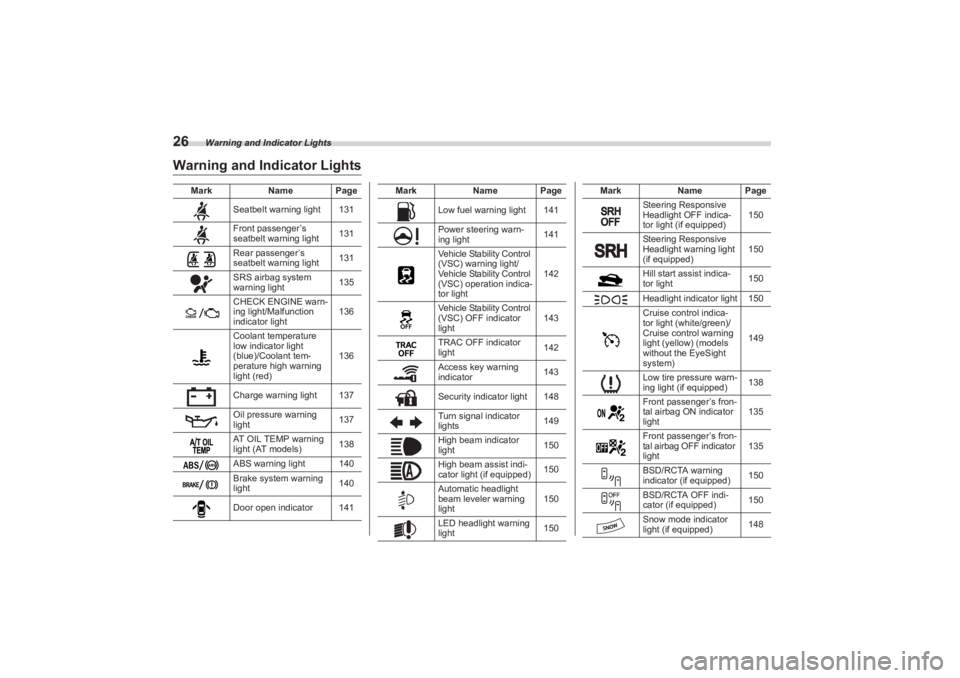
Warning and Indicator Lights
26
MarkName Page
Seatbelt warning light 131
Front passenger’s
seatbelt warning light 131
Rear passenger’s
seatbelt warning light 131
SRS airbag system
warning light 135
CHECK ENGINE warn-
ing light/Malfunction
indicator light 136
Coolant temperature
low indicator light
(blue)/Coolant tem-
perature high warning
light (red) 136
Charge warning light 137
Oil pressure warning
light 137
AT OIL TEMP warning
light (AT models) 138
ABS warning light 140
Brake system warning
light 140
Door open indicator 141
Low fuel warning light 141
Power steering warn-
ing light 141
Vehicle Stability Control
(VSC) warning light/
Vehicle Stability Control
(VSC) operation indica-
tor light 142
Vehicle Stability Control
(VSC) OFF indicator
light 143
TRAC OFF indicator
light 142
Access key warning
indicator 143
Security indicator light 148
Turn signal indicator
lights 149
High beam indicator
light 150
High beam assist indi-
cator light (if equipped) 150
Automatic headlight
beam leveler warning
light 150
LED headlight warning
light 150
Mark
Name Page
Steering Responsive
Headlight OFF indica-
tor light (if equipped) 150
Steering Responsive
Headlight warning light
(if equipped) 150
Hill start assist indica-
tor light 150
Headlight indicator light 150
Cruise control indica-
tor light (white/green)/
Cruise control warning
light (yellow) (models
without the EyeSight
system) 149
Low tire pressure warn-
ing light (if equipped) 138
Front passenger’s fron-
tal airbag ON indicator
light 135
Front passenger’s fron-
tal airbag OFF indicator
light 135
BSD/RCTA warning
indicator (if equipped) 150
BSD/RCTA OFF indi-
cator (if equipped) 150
Snow mode indicator
light (if equipped) 148
Mark
Name Page
Warning and Indicator LightsBRZ_U.book 26 ページ 2022年3月29日 火曜日 午後3時59分
Page 129 of 432
Instruments and Controls3
Instruments and Controls
3-1. Push-Button Ignition Switch ..............................125
Safety Precautions ............................................ ...........125
Operating Range for Push-Button Start System .......125
Switching Power Status ...............................................125
When Access Key Fob Does Not Operate
Properly.......................................................................126
3-2. Hazard Warning Flasher .....................................127
3-3. Meters and Gauges .............................................127
Speedometer .................................................................127
Tachometer ...................................................................127
Odometer and Double Trip Meter................................128
Fuel Gauge ....................................................................129
Engine Coolant Temperature Gauge ..........................129
Outside Temperature ...................................................129
Combination Meter Settings ........................................130
3-4. REV indicator light and buzzer ..........................130
3-5. Illumination Brightness Control ........................130
Auto Dimmer Cancel Function ....................................131
3-6. Warning and Indicator Lights ............................131
Seatbelt Warning Light and Chime .............................131
SRS Airbag System Warning Light .............................135
Front Passenger’s Frontal Airbag ON and OFF Indicators ....................................................................135
CHECK ENGINE Warning Light/Malfunction
Indicator Light ............................................................136
Coolant Temperature Low Indicator Light/Coolant Temperature High Warning Light .............................136
Charge Warning Light ..................................................137
Oil Pressure Warning Light .........................................137
AT OIL TEMP Warning Light (AT Models) .................138
Low Tire Pressure Warning Light (If Equipped) ........138
ABS Warning Light .......................................................140
Brake System Warning Light... ....................................140Low Fuel Warning Light .............................................. 141
Door Open Indicator .................................................... 141
Power Steering Warning Light ................................... 141
TRAC OFF Indicator Light........................................... 142
Vehicle Stability Control (VSC) Warning Light/
Vehicle Stability Control (VSC) Operation
Indicator Light............................................................ 142
Vehicle Stability Control (VSC) OFF Indicator
Light ........................................................................... 143
Warning Chimes and Warning Indicator of the
Keyless Access with Push-Button Start System.... 143
Security Indicator Light............................................... 148
Drive Mode Indicator Light (If Equipped) .................. 148
Select Lever (AT Models Only)/Gear Position
Indicator ..................................................................... 149
Cruise Control Indicator Light (White/Green)/
Cruise Control Warning Light (Yellow) (Models
without the EyeSight System) .................................. 149
Turn Signal Indicator Lights ....................................... 149
High Beam Indicator Light .......................................... 150
High Beam Assist Indicator (If Equipped) ................. 150
Automatic Headlight Beam Leveler Warning
Light ............................................................................ 150
LED Headlight Warning Light ..................................... 150
Steering Responsive Headlight OFF Indicator
Light (If Equipped) ..................................................... 150
Steering Responsive Headlight Warning Light
(If Equipped)............................................................... 150
Headlight Indicator Light ............................................ 150
Hill Start Assist Indicator Light .................................. 150
BSD/RCTA Warning Indicator (If Equipped).............. 150
BSD/RCTA OFF Indicator (If Equipped) ..................... 150
Icy Road Surface Warning Indicator .......................... 151
BRZ_U.book 123 ページ 2022年3月29日 火曜日 午後3時59分
Page 137 of 432
Warning and Indicator Lights
131
Instruments and Controls3
– CONTINUED –
NOTEWhen the control dial is turned fully
upward, the illumination brightness
becomes the maximum and the auto-
matic dimming function does not work
at all.
The brightness setting is not
canceled even when the ignition switch
is turned to th e “OFF” position.■Auto Dimmer Cancel Func -
tionWhen the ambient light is bright, the illumi-
nation brightness is set to the maximum
regardless of the position of the control
dial. In this case, you cannot adjust the
illumination brightness by using the
control dial. When the ambient light is
dark, you can dim the illumination bright-
ness as described above.
The operational/non-operational setting
and sensitivity of the auto dimmer cancel
function can be changed by your
SUBARU dealer. Contact your SUBARU
dealer for details.
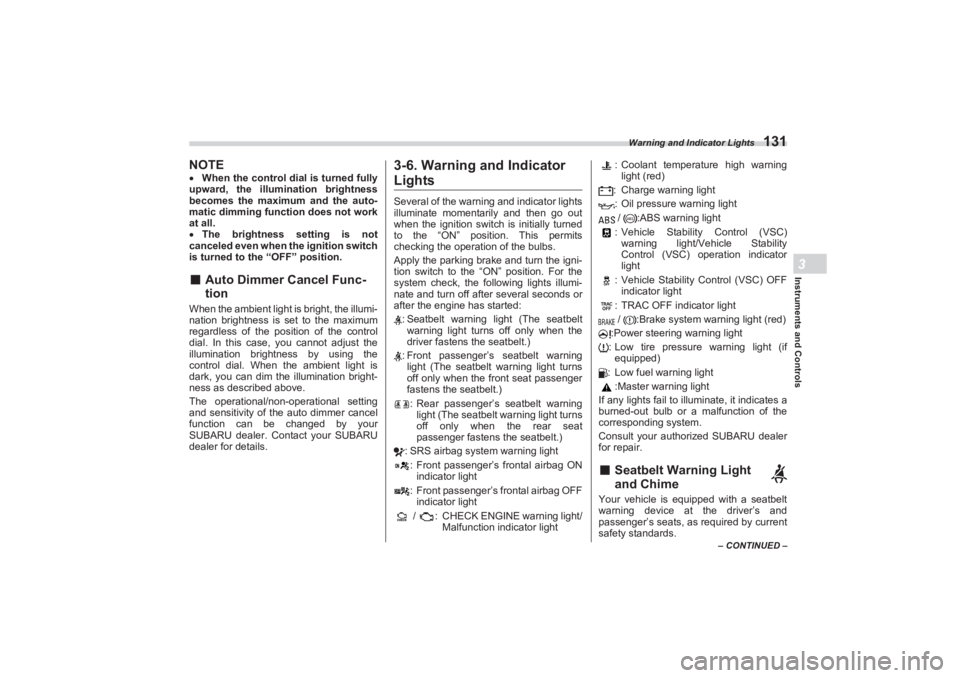
3-6. Warning and Indicator LightsSeveral of the warning and indicator lights
illuminate momentarily and then go out
when the ignition switch is initially turned
to the “ON” position. This permits
checking the operation of the bulbs.
Apply the parking brake and turn the igni-
tion switch to the “ON” position. For the
system check, the following lights illumi-
nate and turn off after several seconds or
after the engine has started:
: Seatbelt warning light (The seatbelt
warning light turns off only when the
driver fastens the seatbelt.)
: Front passenger’s seatbelt warning
light (The seatbelt warning light turns
off only when the front seat passenger
fastens the seatbelt.)
: Rear passenger’s seatbelt warning
light (The seatbelt warning light turns
off only when the rear seat
passenger fastens the seatbelt.)
: SRS airbag system warning light
: Front passenger’s frontal airbag ON
indicator light
: Front passenger’s frontal airbag OFF
indicator light
/ : CHECK ENGINE warning light/ Malfunction indicator light : Coolant temperature high warning
light (red)
: Charge warning light : Oil pressure warning light
/ :ABS warning light
: Vehicle Stability Control (VSC)
warning light/Vehicle Stability
Control (VSC) operation indicator
light
: Vehicle Stability Control (VSC) OFF
indicator light
: TRAC OFF indicator light / :Brake system warning light (red)
:Power steering warning light
: Low tire pressure warning light (if
equipped)
: Low fuel warning light :Master warning light
If any lights fail to i lluminate, it indicates a
burned-out bulb or a malfunction of the
corresponding system.
Consult your authorized SUBARU dealer
for repair.
■ Seatbelt Warning Light
and ChimeYour vehicle is equipped with a seatbelt
warning device at the driver’s and
passenger’s seats, as required by current
safety standards.
BRZ_U.book 131 ページ 2022年3月29日 火曜日 午後3時59分
Page 144 of 432
Warning and Indicator Lights
138engine at the first safe opportunity and
contact your nearest SUBARU dealer
immediately.■ AT OIL TEMP Warning
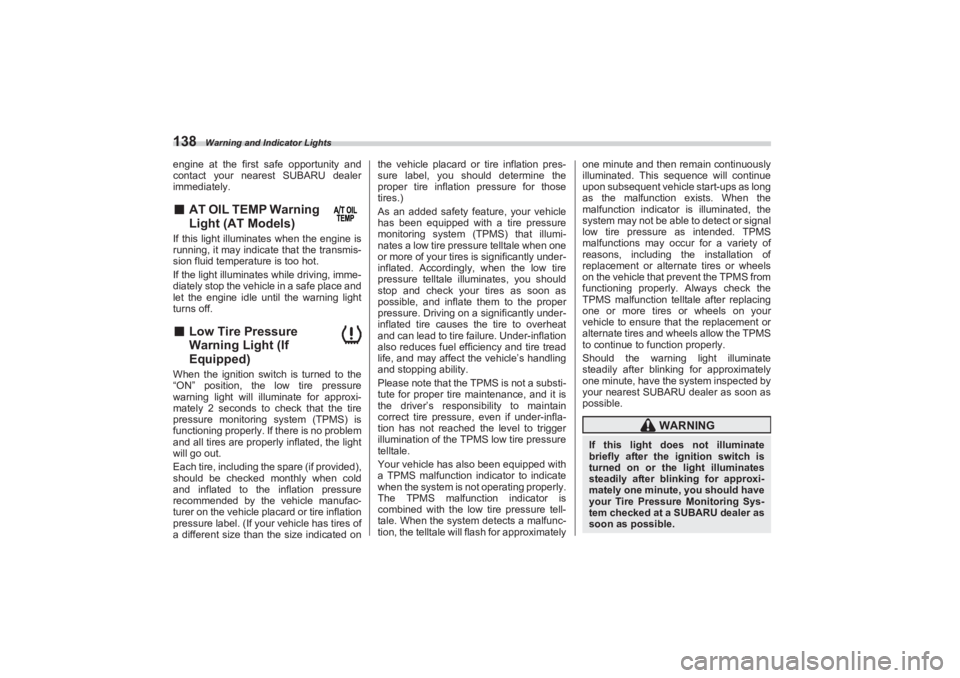
Light (AT Models) If this light illuminates when the engine is
running, it may indicate that the transmis-
sion fluid temperature is too hot.
If the light illuminates while driving, imme-
diately stop the vehicle in a safe place and
let the engine idle until the warning light
turns off.■ Low Tire Pressure
Warning Light (If
Equipped)When the ignition switch is turned to the
“ON” position, the low tire pressure
warning light will illuminate for approxi-
mately 2 seconds to check that the tire
pressure monitoring system (TPMS) is
functioning properly. If there is no problem
and all tires are properly inflated, the light
will go out.
Each tire, including the spare (if provided),
should be checked monthly when cold
and inflated to the inflation pressure
recommended by the vehicle manufac-
turer on the vehicle placard or tire inflation
pressure label. (If your vehicle has tires of
a different size than the size indicated on the vehicle placard or tire inflation pres-
sure label, you should determine the
proper tire inflation pressure for those
tires.)
As an added safety feature, your vehicle
has been equipped with a tire pressure
monitoring system (TPMS) that illumi-
nates a low tire pressure telltale when one
or more of your tires is significantly under-
inflated. Accordingly, when the low tire
pressure telltale illuminates, you should
stop and check your tires as soon as
possible, and inflate them to the proper
pressure. Driving on a significantly under-
inflated tire causes the tire to overheat
and can lead to tire failure. Under-inflation
also reduces fuel efficiency and tire tread
life, and may affect the vehicle’s handling
and stopping ability.
Please note that the TP MS is not a substi-
tute for proper tire maintenance, and it is
the driver’s responsibility to maintain
correct tire pressure, even if under-infla-
tion has not reached the level to trigger
illumination of the TPMS low tire pressure
telltale.
Your vehicle has also been equipped with
a TPMS malfunction indicator to indicate
when the system is no t operating properly.
The TPMS malfunction indicator is
combined with the low tire pressure tell-
tale. When the system detects a malfunc-
tion, the telltale will flash for approximately one minute and then remain continuously
illuminated. This sequence will continue
upon subsequent vehicle start-ups as long
as the malfunction exists. When the
malfunction indicator is illuminated, the
system may not be able to detect or signal
low tire pressure as intended. TPMS
malfunctions may occur for a variety of
reasons, including the installation of
replacement or alternate tires or wheels
on the vehicle that prevent the TPMS from
functioning properly. Always check the
TPMS malfunction telltale after replacing
one or more tires or wheels on your
vehicle to ensure that the replacement or
alternate tires and wheels allow the TPMS
to continue to function properly.
Should the warning light illuminate
steadily after blinking for approximately
one minute, have the system inspected by
your nearest SUBARU dealer as soon as
possible.
WARNING
If this light does not illuminate
briefly after the ig nition switch is
turned on or the light illuminates
steadily after blinking for approxi-
mately one minute, you should have
your Tire Pressure Monitoring Sys-
tem checked at a SUBARU dealer as
soon as possible.
BRZ_U.book 138 ページ 2022年3月29日 火曜日 午後3時59分
Page 147 of 432

Warning and Indicator Lights
141
Instruments and Controls3
– CONTINUED –
If the brake system warning light should
illuminate while driving (with the parking
brake fully released and with the ignition
switch positioned in “ON”), it could be an
indication of leaking of brake fluid or worn
brake pads. If this occurs, immediately
stop the vehicle at the nearest safe place
and check the brake fluid level. If the fluid
level is below the “MIN” mark in the reser-
voir, do not drive the vehicle. Have the
vehicle towed to the nearest SUBARU
dealer for repair.▼ Electronic Brake Force Distribution
(EBD) system warning
If the warning light remains on even
though the parking brake is released, the
brake fluid level may be low or there could
be a problem with the EBD system. Park
the vehicle in a safe place immediately
and contact a SUBARU dealer.
▼ Vacuum pressure system warning
The brake system warning light will illumi-
nate when the vacuum pressure sensor is
malfunctioning or brake booster pressure
is decreasing. If the light continues to illu-
minate for several minutes after starting
the engine, there may be a malfunction in
the vacuum system. In this case, drive the
vehicle carefully and have the system
inspected by a SUBARU dealer.
■ Low Fuel Warning LightThe low fuel warning light illuminates
when the tank is nearly empty approxi-
mately 1.8 US gal (7.0 liters, or 1.5 Imp
gal). It only operates when the ignition
switch is in the “ON” position.■ Door Open IndicatorWhen any of the doors or the trunk lid is
not fully closed, the door open indicator
appears. This function is effective even if
the ignition switch is in the “OFF” or “ACC”
position.
The open door is indicated by the corre-
sponding part of the door open indicator.
Always make sure this indicator does not
appear before you start to drive.■ Power Steering
Warning LightWhile the engine is running, a warning
light illuminates and a buzzer sounds if a malfunction is detected in the electric
power steering system.
NOTEIf the steering wheel is operated in the
following ways, the power steering
control system may temporarily limit
the power assist in order to prevent
the system components, such as the
control computer and drive motor,
from overheating.
The steering wheel is operated
frequently and turned sharply while the
vehicle is maneuvered at extremely low
speeds, such as while frequently
turning the steering wheel during
parallel parking.
The steering wheel remains in the
fully turned position for a long period
of time.
At this time, there will be more resis-
tance when steering. However this is
not a malfunction. Normal steering
CAUTION
Promptly put fuel in the tank when-
ever the low fuel warning light illu-
minates. Engine misfires as a result
of an empty tank could cause dam-
age to the engine.
CAUTION
When the power steering warning
light is illuminated, there may be
more resistance when the steering
wheel is operated. Drive carefully to
the nearest SUBARU dealer and
have the vehicle inspected immedi-
ately.
BRZ_U.book 141 ページ 2022年3月29日 火曜日 午後3時59分
Page 227 of 432

Starting and Operating7
Starting and Operating
7-1. Fuel.......................................................................223
Fuel Requirements .......................................................223
Fuel Filler Lid and Cap .................................................224
7-2. State Emission Testing (U.S. Only) ...................227
7-3. Preparing to Drive ...............................................228
7-4. Starting and Stopping Engine ...........................229
Safety Precautions ............................................ ...........229
Operating Range for Push-Button Start System .......229
General Precautions When St arting Engine ..............229
Starting Engine .............................................................230
Stopping Engine ...........................................................232
When Access Key Fob Does Not Operate
Properly.......................................................................232
Steering Lock ................................................................232
7-5. Manual Transmission .........................................233
Shifting Speeds ............................................................234
Driving Tips ...................................................................235
7-6. Automatic Transmission ....................................235
Select Lever ..... .......................................... ...................236
Adaptive Control...........................................................237
Shift Lock Function ......................................................238
Selection of Manual Mode ...........................................239
Driving Tips ...................................................................240
7-7. Driving Mode Select Switch (If Equipped) ........241
Normal Mode .................................................................241
Sport Mode ....................................................................241
Snow Mode....................................................................241
Driving Mode Select Switch.........................................241
7-8. Active Sound Control .........................................242
7-9. Power Steering ....................................................242
7-10. Braking...............................................................243
Braking Tips ..................................................................243 Brake System ............................................................... 244
Disc Brake Pad Wear Warning Indicators ................. 245
7-11. ABS (Anti-Lock Brake System) ........................245
ABS Self-Check............................................................ 245
ABS Warning Light ...................................................... 245
7-12. Electronic Brake Force Distribution (EBD)
System ...............................................................246
EBD System Malfunctions .......................................... 246
7-13. Vehicle Stability Control (VSC)/TRAC
System ...............................................................247
Vehicle Stability Control (VSC) System ..................... 247
TRAC System ............................................................... 247
Vehicle Stability Control (VSC) System Monitor....... 248
Vehicle Stability Control (VSC) OFF Switch .............. 248
7-14. TRACK Mode .....................................................250
TRACK Mode ................................................................ 250
Selecting TRAC Mode and Ve hicle Stability Control
(VSC) Mode ............................................................... 251
7-15. Tire Pressure Monitoring System (TPMS)
(If Equipped) ......................................................251
Certification for the Transmitter ................................. 253
Certification for the Receiver...................................... 253
TPMS Screen ................................................................ 254
Initializing the Tire Pressure Monitoring System ..... 254
How to Initialize the Tire Pressure Monitoring
System (If Equipped) ................................................. 254
If You Press the Tire Pressure Monitoring Reset
Switch Accidentally................................................... 254
Initialization Procedure ............................................... 254
When Initialization of the Tire Pressure Monitoring System has Failed ..................................................... 255
Registering ID Codes .................................................. 255
BRZ_U.book 221 ページ 2022年3月29日 火曜日 午後3時59分
Page 231 of 432
Fuel
225
Starting and Operating7
– CONTINUED –
Press the unlock side of the power
door locking switch.
3. The fuel filler lid opens automatically.
Open it further by hand.
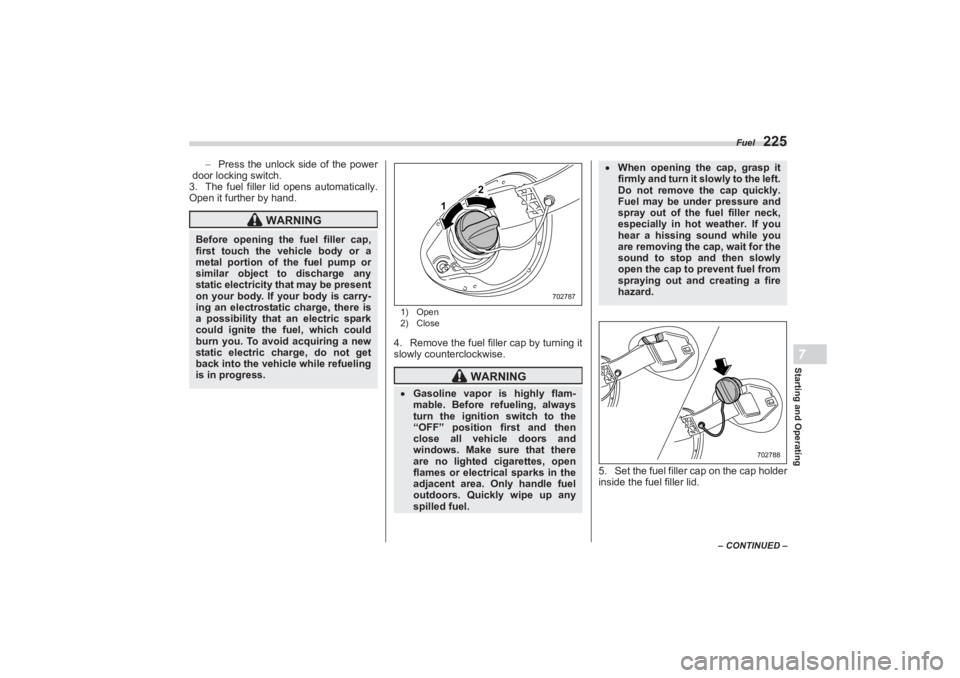
1) Open
2) Close4. Remove the fuel filler cap by turning it
slowly counterclockwise.
5. Set the fuel filler cap on the cap holder
inside the fuel filler lid.
WARNING
Before opening the fuel filler cap,
first touch the veh icle body or a
metal portion of the fuel pump or
similar object to discharge any
static electricity that may be present
on your body. If your body is carry-
ing an electrostatic charge, there is
a possibility that an electric spark
could ignite the fuel, which could
burn you. To avoid acquiring a new
static electric charge, do not get
back into the vehicle while refueling
is in progress.
WARNING
Gasoline vapor is highly flam-
mable. Before refueling, always
turn the ignition switch to the
“OFF” position first and then
close all vehicle doors and
windows. Make sure that there
are no lighted cigarettes, open
flames or electrical sparks in the
adjacent area. Only handle fuel
outdoors. Quickly wipe up any
spilled fuel.
1
2
702787
When opening the cap, grasp it
firmly and turn it slowly to the left.
Do not remove the cap quickly.
Fuel may be under pressure and
spray out of the fuel filler neck,
especially in hot weather. If you
hear a hissing sound while you
are removing the cap, wait for the
sound to stop and then slowly
open the cap to prevent fuel from
spraying out and creating a fire
hazard.
702788
BRZ_U.book 225 ページ 2022年3月29日 火曜日 午後3時59分
Page 296 of 432

New Vehicle Break-In Driving – the First 1,000 miles (1,600 km)
2908-1. New Vehicle Break-In
Driving – the First 1,000 miles (1,600 km)The performance and long life of your
vehicle are dependent on how you handle
and care for your vehicle while it is new.
Follow these instructions during the first
1,000 miles (1,600 km):
Do not race the engine. And do not
allow engine speed to exceed 4,000 rpm
except in an emergency.
Do not drive at one constant engine or
vehicle speed for a long time, either fast or
slow.
Avoid starting suddenly and rapid
acceleration, except in an emergency.
Avoid hard braking, except in an emer-
gency.
The same break-in procedures should be
applied to a newly installed or overhauled
engine or when brake pads are replaced
with new ones.
8-2. Fuel Economy HintsThe following suggestions will help to
save your fuel.
Select the proper gear position for the
speed and road conditions.
Avoid sudden acceleration or decelera-
tion. Always accelerate gently until you
reach the desired speed. Then try to main-
tain that speed for as long as possible.
Do not pump the accelerator and avoid
racing the engine.
Avoid unnecessary engine idling.
Keep the engine properly tuned.
Keep the tires inflated to the correct
pressure shown on the tire inflation pres-
sure label, which is located on the driver’s
center pillar. Low pressure will increase
tire wear and fuel consumption.
Use the air conditioner only when
necessary.
Keep the front and rear wheels in
proper alignment.
Avoid carrying unnecessary luggage or
cargo.
8-3. Engine Exhaust Gas (Carbon Monoxide)
WARNING
Never inhale engine exhaust gas.
Engine exhaust gas contains
carbon monoxide, a colorless
and odorless gas which is
dangerous, or even lethal, if
inhaled. Always properly maintain the
engine exhaust system to prevent
engine exhaust gas from entering
the vehicle. Never run the engine in a closed
space, such as a garage, except
for the brief time needed to drive
the vehicle in or out of it. Avoid remaining in a parked
vehicle for a long time while the
engine is running. If that is
unavoidable, then use the ventila-
tion fan to force fresh air into the
vehicle. Always keep the front ventilator
inlet grille free from snow, leaves
or other obstructions to ensure
that the ventilation system
always works properly.
BRZ_U.book 290 ページ 2022年3月29日 火曜日 午後3時59分