2023 HYUNDAI SONATA traction control
[x] Cancel search: traction controlPage 512 of 555
Maintenance
8-42
Wheel Replacement
When replacing the metal wheels for any
reason, make sure the new wheels are
equivalent to the original factory units in
diameter, rim width and offset.
Tire Traction
Tire traction can be reduced if you drive
on worn tires, tires that are improperly
inflated or on slippery road surfaces.
Tires should be replaced when the tread
depth is at least 1.6 mm (2/32 inch). To
reduce the possibility of losing control,
slow down whenever there is rain, snow
or ice on the road.
Tire Maintenance
In addition to proper inflation, correct
wheel alignment helps to decrease tire
wear. If you find a tire is worn unevenly,
have your dealer check the wheel
alignment.
When you have new tires installed,
make sure they are balanced. This will
increase vehicle ride comfort and tire
life. Additionally, a tire should always
be rebalanced if it is removed from the wheel.
Tire Sidewall Labeling
This information identifies and describes
the fundamental characteristics of
the tire and also provides the tire
identification number (TIN) for safety
standard certification. The TIN can be
used to identify the tire in case of a
recall.
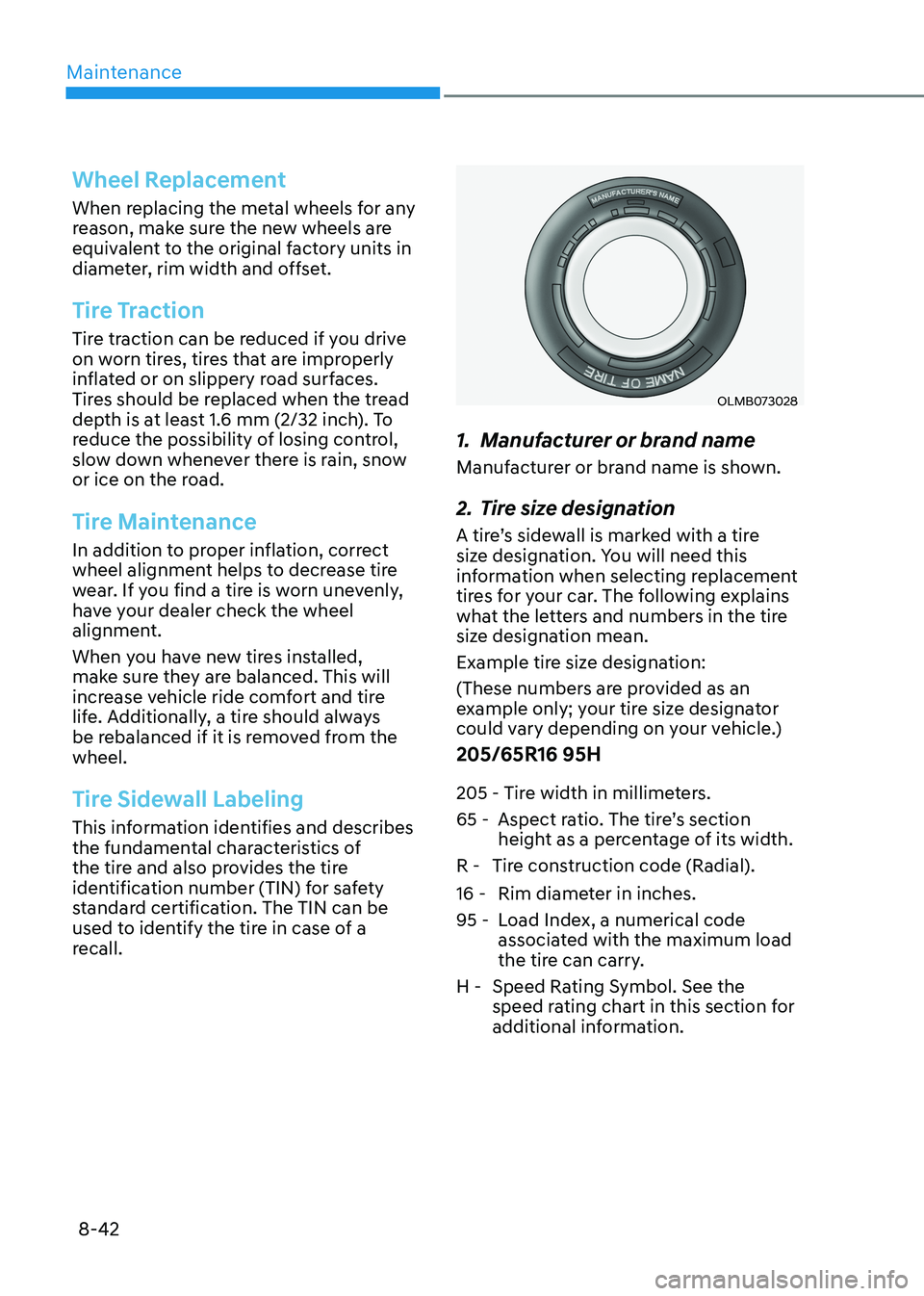
OLMB073028
1. Manufacturer or brand name
Manufacturer or brand name is shown.
2. Tire size designation
A tire’s sidewall is marked with a tire
size designation. You will need this
information when selecting replacement
tires for your car. The following explains
what the letters and numbers in the tire
size designation mean.
Example tire size designation:
(These numbers are provided as an
example only; your tire size designator
could vary depending on your vehicle.) 205/65R16 95H
205 - Tire width in millimeters.
65 - Aspect ratio. The tire’s section height as a percentage of its width.
R - Tire construction code (Radial).
16 - Rim diameter in inches.
95 - Load Index, a numerical code associated with the maximum load
the tire can carry.
H - Speed Rating Symbol. See the speed rating chart in this section for
additional information.
Page 514 of 555
Maintenance
8-44
5. Maximum permissible inflation
pressure
This number is the greatest amount
of air pressure that should be put in
the tire. Do not exceed the maximum
permissible inflation pressure. Refer to
the Tire and Loading Information label
for recommended inflation pressure.
6. Maximum load rating
This number indicates the maximum
load in kilograms and pounds that can be
carried by the tire. When replacing the
tires on the vehicle, always use a tire that
has the same load rating as the factory
installed tire.
7. Uniform tire quality grading
Quality grades can be found where
applicable on the tire sidewall between
tread shoulder and maximum section width.
For example:TREAD WEAR 200
TRACTION AA
TEMPERATURE A
Tread wear
The tread wear grade is a comparative
rating based on the wear rate of the tire
when tested under controlled conditions
on a specified government test course.
For example, a tire graded 150 would
wear one-and-a-half times (1½) as well
on the government course as a tire
graded 100.
The relative performance of tires depends upon the actual conditions
of their use, however, and may depart
significantly from the norm due to
variations in driving habits, service
practices and differences in road
characteristics and climate.
These grades are molded on the
sidewalls of passenger vehicle tires. The
tires available as standard or optional
equipment on your vehicle may vary with
respect to grade.
Traction AA, A, B & C
The traction grades, from highest to
lowest, are AA, A, B and C. Those grades
represent the tire’s ability to stop on wet
pavement as measured under controlled
conditions on specified government
test surfaces of asphalt and concrete.
A tire marked C may have poor traction
performance.
Page 515 of 555
08
8-45
WARNING
The traction grade assigned to this tire
is based on straight-ahead braking
traction tests, and does not include
acceleration, cornering, hydroplaning,
or peak traction characteristics.
Temperature A, B & C
The temperature grades are A (the
highest), B and C representing the tire’s
resistance to the generation of heat
and its ability to dissipate heat when
tested under controlled conditions on a
specified indoor laboratory test wheel.
Sustained high temperature can cause
the material of the tire to degenerate
and reduce tire life, and excessive
temperature can lead to sudden tire
failure.
WARNING
The temperature grade for this tire is
established for a tire that is properly
inflated and not overloaded. Excessive
speed, under-inflation, over-inflation,
or excessive loading, either separately
or in combination, can cause heat build-
up and possible sudden tire failure.
This may cause loss of vehicle control
resulting in an accident.
Tire Terminology and Definitions
Air Pressure
The amount of air inside the tire pressing
outward on the tire. Air pressure is
expressed in kilopascal (kPa) or pounds
per square inch (psi).
Accessory Weight
This means the combined weight of
optional accessories. Some examples
of optional accessories are automatic
transmission, power seats, and air conditioning.
Aspect Ratio
The relationship of a tire’s height to its width. Belt
A rubber coated layer of cords that is
located between the plies and the tread.
Cords may be made from steel or other
reinforcing materials. Bead
The tire bead contains steel wires
wrapped by steel cords that hold the tire
onto the rim.
Bias Ply Tire
A pneumatic tire in which the plies are
laid at alternate angles less than 90
degrees to the centerline of the tread.
Cold Tire Pressure
The amount of air pressure in a tire,
measured in kilopascals (kPa) or pounds
per square inch (psi) before a tire has
built up heat from driving.
Curb Weight
This means the weight of a motor vehicle
with standard and optional equipment
including the maximum capacity of fuel,
oil and coolant, but without passengers
and cargo.
Page 518 of 555
Maintenance
8-48
All Season Tires
HYUNDAI specifies all season tires
on some models to provide good
performance for use all year round,
including snowy and icy road conditions.
All season tires are identified by ALL
SEASON and/or M+S (Mud and Snow) on
the tire sidewall. Snow tires have better
snow traction than all season tires and
may be more appropriate in some areas.
Summer Tires
HYUNDAI specifies summer tires on
some models to provide superior
performance on dry roads. Summer tire
performance is substantially reduced in
snow and ice. Summer tires do not have
the tire traction rating M+S (Mud and
Snow) on the tire side wall. If you plan
to operate your vehicle in snowy or icy
conditions, HYUNDAI recommends the
use of snow tires or all season tires on all
four wheels.
Snow Tires
If you equip your car with snow tires,
they should be the same size and have the same load capacity as the original
tires. Snow tires should be installed on
all four wheels; otherwise, poor handling
may result. Snow tires should carry 28
kPa (4 psi) more air pressure than the
pressure recommended for the standard
tires on the tire label on the driver’s
side of the center pillar, or up to the
maximum pressure shown on the tire
sidewall, whichever is less. Do not drive
faster than 120 km/h (75 mph) when your
vehicle is equipped with snow tires.
Radial-Ply Tires
Radial-ply tires provide improved tread
life, road hazard resistance and smoother
high speed ride. The radial-ply tires used
on this vehicle are of belted construction,
and are selected to complement the
ride and handling characteristics of your
vehicle.
Radial-ply tires have the same load
carrying capacity, as bias-ply or bias
belted tires of the same size, and use the
same recommended inflation pressure.
Mixing of radial-ply tires with bias-ply or
bias belted tires is not recommended.
Any combinations of radial-ply and bias-
ply or bias belted tires when used on the
same vehicle will seriously deteriorate
vehicle handling. The best rule to follow
is: Identical pairs of radial-ply tires
should always be used as a set for the
front tires and a set for the rear tires.
Longer wearing tires can be more
susceptible to irregular tread wear. It is
very important to follow the tire rotation
interval in this chapter to achieve the
tread life potential of these tires. Cuts
and punctures in radial-ply tires are
repairable only in the tread area, because
of sidewall flexing. Consult your tire
dealer for radial-ply tire repairs.
WARNING
Do not mix bias ply and radial ply tires
under any circumstances. This may
cause unusual handling characteristics
that may cause loss of vehicle control
resulting in an accident.
Page 548 of 555
Index
I-6
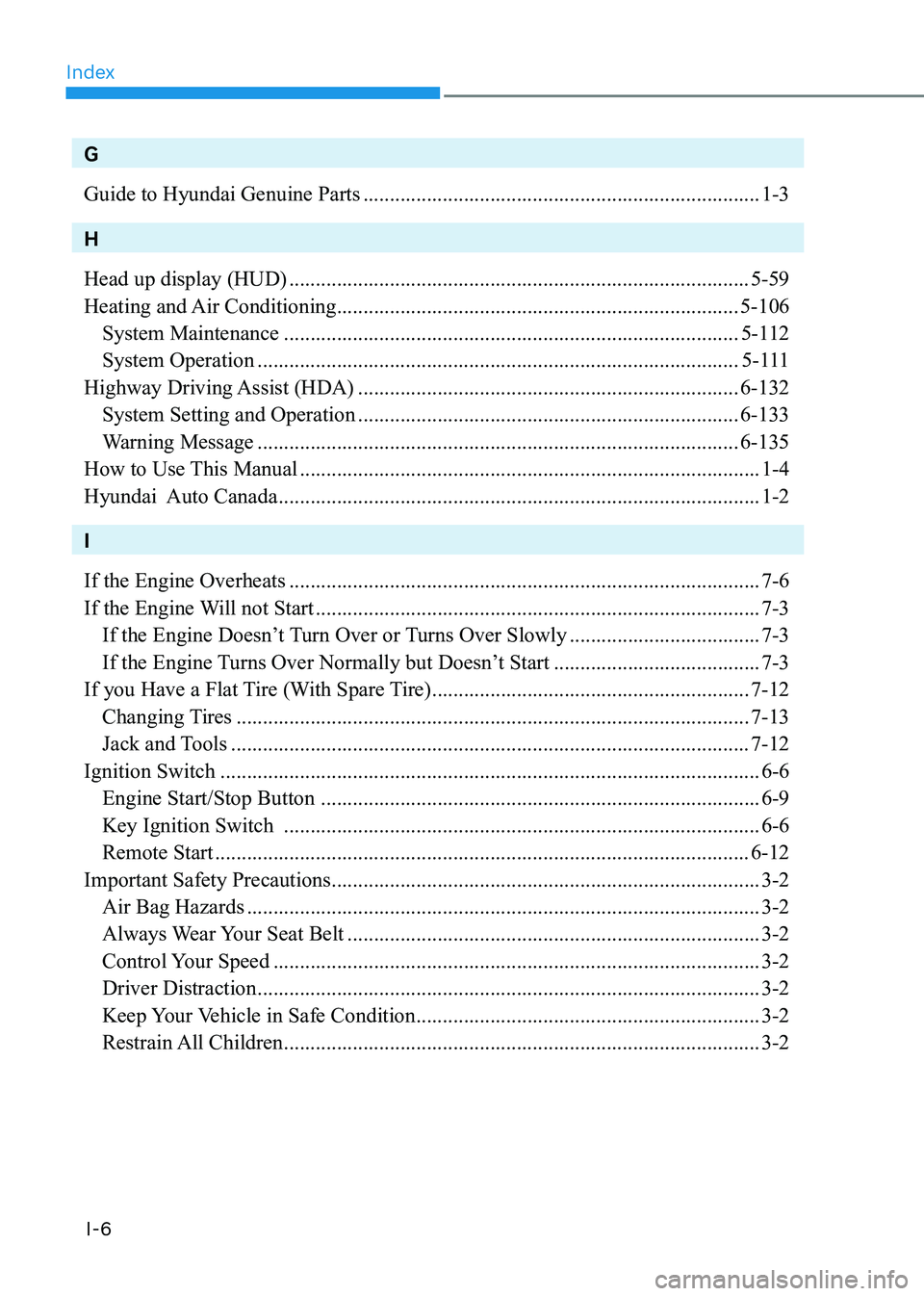
G Guide to Hyundai Genuine Parts ........................................................................... 1-3
HHead up display (HUD) ....................................................................................... 5-59
Heating and Air Conditioning ............................................................................ 5-106
System Maintenance ...................................................................................... 5-112
System Operation ........................................................................................... 5-111
Highway Driving Assist (HDA) ........................................................................ 6-132
System Setting and Operation ........................................................................ 6-133
Warning Message ........................................................................................... 6-135
How to Use This Manual ....................................................................................... 1-4
Hyundai Auto Canada ........................................................................................... 1-2
IIf the Engine Overheats ......................................................................................... 7-6
If the Engine Will not Start .................................................................................... 7-3
If the Engine Doesn’t Turn Over or Turns Over Slowly ....................................7-3
If the Engine Turns Over Normally but Doesn’t Start .......................................7-3
If you Have a Flat Tire (With Spare Tire) ............................................................7-12
Changing Tires ................................................................................................. 7-13
Jack and Tools .................................................................................................. 7-12
Ignition Switch ...................................................................................................... 6-6
Engine Start/Stop Button ................................................................................... 6-9
Key Ignition Switch .......................................................................................... 6-6
Remote Start ..................................................................................................... 6-12
Important Safety Precautions ................................................................................. 3-2
Air Bag Hazards ................................................................................................. 3-2
Always Wear Your Seat Belt .............................................................................. 3-2
Control Your Speed ............................................................................................ 3-2
Driver Distraction ............................................................................................... 3-2
Keep Your Vehicle in Safe Condition ................................................................. 3-2
Restrain All Children .......................................................................................... 3-2